If you rent a car from Caleb's Cars, you'll pay a $61 fee
and $24 per day. At Vinny's Vehicles, you'll pay a $105 fee and $20 per day. Determine the number of days you can rent a car from either place and pay the same amount. Use substitution or elimination.
Answers
Answer:
11 days
Step-by-step explanation:
y=24x+61
y=20x+105
(don't think I can solve this with elimination because there is no coefficient with a y-value.)
When looking for the interception you look for the point where both lines intercept. I graphed both equations online and looked for the point where they intercept, which is (11,325) meaning that in 11 days, both places will cost 325 dollars when you rent a car.
( I also looked for a calculator online that is especially used to find the interception between two points and it gave the same point, if wrong...I'm sorry)
Related Questions
How do you make comparisons between an equation and a table?.
Answers
Overall, equations provide a mathematical representation and understanding of relationships, while tables present data points in a structured format.
When comparing an equation and a table, you can examine their characteristics, purpose, and the information they provide. Here are some points to consider when making comparisons:
Representation:
An equation represents a mathematical relationship between variables using symbols and mathematical operations. A table presents data or values in a structured format, typically organized into rows and columns.
Communication of Information:
Equations provide a concise and general representation of a relationship, allowing for predictions, calculations, and modeling. Tables present specific data points or values, providing a visual representation of how variables are related or how they change.
Variables:
Equations involve variables, which can be manipulated to explore different scenarios and analyze the relationship between quantities. Tables display specific values or data points for variables, showing how they vary or are related based on the given information.
Visualization:
Equations can express relationships symbolically and provide a mathematical understanding, but they may not offer a visual representation of data. Tables provide a visual representation of data points, allowing for a quick overview and easy comparison of values.
Flexibility:
Equations offer flexibility in terms of adjusting variables and parameters to explore different scenarios and make predictions. Tables can be easily modified or expanded by adding or removing data points to reflect new observations or additional information.
To know more about equation,
https://brainly.com/question/30242909
#SPJ11
I will give brainiest

Answers
Answer:
I think it's 6,800 in3 I don't know perfectly whether it is correct answer or not
help me please i need help asap

Answers
Answer:
Step-by-step explanation:


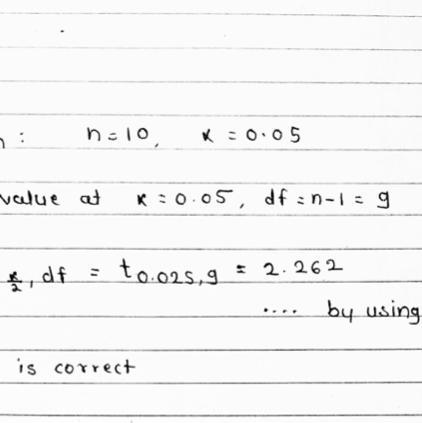
You want a 95% confidence interval for average pizza delivery time. A sample of 10 pizzas has an average delivery time of 34 minutes and a sample standard deviation of 5. 2 minutes. What t value do you use in your formula for the confidence interval?.
Answers
Dave wants to borrow $22,000 from First Finance Bank. The bank
will give him a 15-year loan at an interest rate of 4.85%. How much
Will he pay the bank in interest over the life of the loan? Round to
the nearest hundred dollars.
Answers
Interest be I
\(\\ \rm\rightarrowtail I=\dfrac{PRT}{100}\)
\(\\ \rm\rightarrowtail I=\dfrac{22000(4.85)(15)}{100}\)
\(\\ \rm\rightarrowtail I=680.41\)
Answer:
$9,000 (to the nearest hundred dollars)
Step-by-step explanation:
Loans from banks are usually amortizing loans, which is a type of loan that requires regular monthly payments.
To calculate the regular monthly payment:
\(\sf PMT=\dfrac{P\left(\dfrac{r}{n}\right)}{1-\left(1+\dfrac{r}{n}\right)^{-nt}}\)
where:
PMT = regular monthly paymentP = principalr = interest rate in decimal formn = number of payments per yeart = length of loan (in years)Given:
P = 22000r = 0.0485n = 12t = 15\(\sf PMT=\dfrac{2000\left(\dfrac{0.0485}{12}\right)}{1-\left(1+\dfrac{0.0485}{12}\right)^{-12 \cdot 15}}=172.2604115...\)
Number of months in 15 years = 15 × 12 = 180
⇒ Total payment over the term of the loan = 180 × 172.2604115...
= 31006.87406...
Total interest = total payment - principal
= 31006.87406... - 22000
= 9006.87406...
= $9,000 (to the nearest hundred dollars)
Which table represents a linear function?
Answers
Answer:
If function is given by its table representation and you have to determine what type of function it is, you can’t be 100% sure that the given function is linear. Why is that so? Because there are many functions which have the same table representation.
Example: You’re given f(0)=0 and f(1)=1. It can be representation of function f(x)=x, f(x)=x^2, f(x)=x^3 etc. If there are more given datas, maybe you can eliminate some types of functions, but you can’t be sure what type of function it is. :)
1.4K views
Related Questions (More Answers Below)
Is XOR a linear function?
717 Views
Which table represents a function?
1,949 Views
Which situations represent linear functions?
791 Views
How do you represent any function as a series of linear functions?
2,379 Views
Why are linear functions important?
276 Views
Other Answers

Dennis Wainaina, Student
Answered June 16, 2017
a linear function is used to relate to relate an independent variable and a dependent variable by introducing a rate of change(function) of which the independent variable is equated to find the dependent variable for example y=3x hence hence is the dependent variable as it depends on the change of x and 3 is the rate of change which is a constant and is determined by the division of the values of y/x hence to make a table of y over x of which y is determined by the rate of change 3*the independent variable x
3.6K views
Sponsored by HMX - Harvard Medical School
Learn key physiology concepts online.
Join a Harvard Medical School course on how the body functions and what that means for patient care.
Learn More

Clyde Maiden
Answered September 17, 2018
Line AB contains points A(4, 5) and B(9, 7). What is the slope of

?
1.4K views
Related Questions
Is XOR a linear function?
717 Views
Which table represents a function?
1,949 Views
Which situations represent linear functions?
791 Views
How do you represent any function as a series of linear functions?
2,379 Views
Why are linear functions important?
276 Views
How does one know that a linear function represents a line in the plane? How can it be proven?
1,567 Views
How do you compute the linear approximation of a function in two ways giving different answers?
266 Views
Which table represents a direct variation function?
225 Views
How do you maximize a linear function?
3,074 Views
How do you tell if a table is linear?
548 Views
What is the exact formal definition for a linear function?
576 Views
What is linear programming?
11,845 Views
How do you proof that linear activation functions always return a linear approximation as output?
600 Views
What is the difference between a linear function and a linear equation?
10,332 Views
What do you meant by a function is linear?
Answer:
b
Step-by-step explanation:
What is the domain of the step function f(x) = [2x]- 1?
O {x|x2-1}
O {x|x ≥ 1}
O x x is an integer}
O {x|x is a real number}
Answers
Domain: {x | x is a real number}
Option D, "{x | x is a real number}" accurately represents the domain of the function.
The domain of the step function f(x) = [2x] - 1, where [2x] represents the greatest integer less than or equal to 2x, can be determined by considering the restrictions on the input values.
In this case, the step function is defined for all real numbers. However, the greatest integer function imposes a restriction. Since the greatest integer function only outputs integers, the input values (2x) must be such that they produce integer outputs.
For any real number x, the greatest integer less than or equal to 2x will always be an integer. Therefore, the domain of the function f(x) = [2x] - 1 is:
Domain: {x | x is a real number}
Option D, "{x | x is a real number}" accurately represents the domain of the function.
for such more question on Domain
https://brainly.com/question/16444481
#SPJ8
If the model improves after adding an interaction, what should happen to the R2 and the standard deviation:
a. Both should increase
b. Both should decrease
c. R2 should increase, standard deviation should decrease
d. Standard deviation should increase, R2 should decrease
Answers
The correct answer is option C.
If the model improves after adding an interaction, R² should increase and the standard deviation should decrease. Option C is the right answer.
R², also known as the coefficient of determination, is a statistical measure of how well the regression line fits the data points. It indicates the proportion of variance in the dependent variable that can be explained by the independent variables.
The standard deviation is a measure of how spread out the data is in relation to the mean. If the data points are more concentrated around the mean, the standard deviation will be smaller. If the data is more dispersed, the standard deviation will be larger. Interaction terms in regression models explain how the relationship between two independent variables influences the dependent variable.
The inclusion of interaction terms can enhance the model's explanatory power by providing a more accurate depiction of the relationship between the independent and dependent variables. This can result in an increase in R² and a decrease in standard deviation.
So, we can say that if the model improves after adding an interaction, R² should increase and the standard deviation should decrease. Option C is the correct answer.
To more about explanatory power visit:
https://brainly.com/question/28357265
#SPJ11
I need help to fill in the blank for how to solve the equations with the brackets.
“When you see the brackets inside an equation, you’ll need to get rid of the brackets (to access the terms inside), which means you’ll need to ______________ the equation.”
What word is missing that goes with the math statement?
Answers
Answer:
take out or aluminate i think
Step-by-step explanation:
1) Find the value of x.
Answers
Answer:
bring the variable to the left side and bring all the remaining values to the right side
Step-by-step explanation:
Suppose demand, d, for a company’s product at cost, x, is predicted by the function ()=−.+,d of open x close equals negative , 0.25 , , x squared , plus , 1,000, and the price, p, that the company can charge for the product is given by ()=+. Find the company’s revenue function.
Enter your answer.
Answers
This company’s revenue function is given by −0.25x³ - 4x² + 1000x + 16,000.
How to determine company's revenue function?Mathematically, the amount of revenue that's being generated by a company or business organization can be calculated by using the following function (expression):
Revenue = price × demand
R(x) = p(x) × d(x)
The demand (d) for this company’s product at cost (x) is given by this demand function:
d(x) = −0.25x² + 1,000
Also, the price (p) in dollars that this company can charge for its product is given by this price function:
p(x) = x + 16
Substituting the parameters into the revenue function, we have;
Revenue function, R(x) = p(x) × d(x)
Revenue function, R(x) = (−0.25x² + 1,000) × (x + 16)
Revenue function, R(x) = −0.25x³ - 4x² + 1000x + 16,000.
Read more on revenue function here: https://brainly.com/question/21503855
#SPJ1
Complete Question:
Suppose demand, d, for a company's product at cost, x, is predicted by the function, d(x) = −0.25x² + 1,000, and the price, p, that the company can charge for the product is given by p(x) = x + 16. Find the company's revenue function.
The bottles of soda are sold to the student council in a box weighing 24 pounds. if there are 60 bottles in the box, How much does each bottle of soda weigh
Answers
Answer:
2.5 60÷24=2.5 so there is ur answer hope it helps
is -34 a rational number?
Answers
Answer:
yes
Step-by-step explanation:
-34 is an integer and an integer is a rational number
help meeeeeeeeeeeeeee pleaseeeeeee

Answers
Answer: 9.7 seconds
Step-by-step explanation:
\(16t^2 =1503\\\\t^2 =1503/16\\\\t=\sqrt{1503/16} \text{ } (t > 0)\\\\t \approx 9.7\)
Consider the following hypothesis test: H0: p ? .75 Ha: p < .75 A sample of 300 items was selected. Compute the p-value and state your conclusion for each of the following sample results. Use ? = .05. Round your answers to four decimal places.
a. p = .68 p-value? Conclusion: p-value H0?
b. p = .72 p-value? Conclusion: p-value H0 ?
c. p = .70 p-value? Conclusion: p-value H0 ?
d. p = .77 p-value? Conclusion: p-value H0?
Answers
For each given sample result, the p-value and conclusion are as follows:
a. p-value = 0.0067, Conclusion: Reject H0, b. p-value = 0.0830, Conclusion: Fail to reject H0, c. p-value = 0.0322, Conclusion: Reject H0
d. p-value = 0.6221, Conclusion: Fail to reject H0
The p-value is a measure of the evidence against the null hypothesis (H0). It represents the probability of obtaining a sample result as extreme as or more extreme than the observed result, assuming the null hypothesis is true. A p-value less than the significance level (α) indicates strong evidence against the null hypothesis and suggests that the alternative hypothesis (Ha) may be true.
a. For p = .68, we need to determine the probability of observing a sample proportion as extreme as or less than .68, assuming the null hypothesis is true. By conducting the appropriate statistical test (e.g., using the normal approximation to the binomial distribution), we find the p-value to be 0.0067. Since the p-value is less than α = .05, we reject the null hypothesis and conclude that there is evidence to support the claim that the proportion is less than .75.
b. For p = .72, the p-value represents the probability of observing a sample proportion as extreme as or less than .72. Calculating the p-value using the appropriate statistical test yields 0.0830. Since the p-value is greater than α = .05, we fail to reject the null hypothesis. Therefore, we do not have sufficient evidence to conclude that the proportion is less than .75.
c. With p = .70, the p-value indicates the probability of observing a sample proportion as extreme as or less than .70. The calculated p-value is 0.0322. As the p-value is less than α = .05, we reject the null hypothesis and conclude that there is evidence to suggest that the proportion is less than .75.
d. For p = .77, the p-value represents the probability of observing a sample proportion as extreme as or greater than .77. After performing the necessary calculations, we find the p-value to be 0.6221. Since the p-value is much greater than α = .05, we fail to reject the null hypothesis. Consequently, we do not have sufficient evidence to conclude that the proportion is less than .75.
Learn more about statistical here: https://brainly.com/question/29000275
#SPJ11
A scientist claims that 9% of viruses are airborne. If the scientist is accurate, what is the probability that the proportion of airborne viruses in a sample of 533 viruses would differ from the population proportion by less than 3%
Answers
The probability that the sample proportion of airborne viruses in differ from the population proportion by greater than 3% is 0.006.
According to the Central limit theorem, if from an unknown population large samples of sizes n > 30, are selected and the sample proportion for each sample is computed then the sampling distribution of sample proportion follows a Normal distribution.
The mean of this sampling distribution of sample proportion is:
μρ=ρ
The standard deviation of this sampling distribution of sample proportion is:
σρ=\(\sqrt \frac{p(1-p)}{n}\)
The information provided is:
n = 533
p = 0.09
As the sample size is quite large, i.e. n = 533 > 30, the central limit theorem can be used to approximate the sampling distribution of sample proportion by a Normal distribution.
The mean and standard deviation are:
μρ=ρ=0.09
σρ=\(\sqrt \frac{p(1-p)}{n}\)=\(\sqrt\frac{0.09(1-0.09)}{533}=0.01239\)
Compute the probability that the sample proportion of airborne viruses in differ from the population proportion by greater than 3% as follows:
\(p(p^-p > 0.03)=P(p^ > 0.12) \\=P(z > \frac{0.12-0.9}{0.012}) \\= P(Z > 2.5) \\= 1-P(Z > 2.5) \\ = 1- 0.993 \\ = 0.00621\)
Thus, the probability that the sample proportion of airborne viruses in differ from the population proportion by greater than 3% is 0.006.
Learn more about PROBABILITY here
https://brainly.com/question/24756209
#SPJ4
What is the sum?
X
3
2
+
X+3 x+3 x+3
O
+
colch
53
X+5
X+3
X+5
3x+27
6x
X+3

Answers
The outcome or result of adding two or more integers is known as the SUM.
What is a sum?The outcome of adding numbers or quantities mathematically is a summation, often known as a sum. A summation always has an even number of terms in it. There may be just two terms, or there may be 100, 1000, or even a million. Some summations include an infinite number of terms.
the sum of two or more numbers, magnitudes, quantities, or specifics as determined by or as though decided by the addition process in mathematics.
The outcome of adding two or more numbers, objects, or things is referred to in mathematics as the sum.
The result or solution we obtain from adding two or more integers is known as the SUM. Addends are the figures that are combined.
\(Simplify $\frac{x}{x+3}+\frac{3}{x+3}+\frac{2}{x+3}: \frac{x+5}{x+3}$Steps$$\frac{x}{x+3}+\frac{3}{x+3}+\frac{2}{x+3}$$Apply the fraction rule: $\frac{a}{c}+\frac{b}{c}=\frac{a+b}{c}$$$=\frac{x+3+2}{x+3}$$Add the numbers: $3+2=5$$$=\frac{x+5}{x+3}$$\)
Therefore, the correct answer is option b) \($=\frac{x+5}{x+3}$\)
To learn more about sum refer to:
https://brainly.com/question/25734188
#SPJ1
what is 2.1 times 3.2 find the missing partial products HELP.

Answers
Given:
The area model for \(2.1\times 3.2\).
To find:
The value of \(2.1\times 3.2\) and the missing values in the area model.
Solution:
2.1 can be written as 2 and 0.1 on the left side of the area model.
3.2 can be written as 3 and 0.2 on the top of area model.
Area of the four parts of the area model are:
\(2\times 3=6\)
\(2\times 0.2=0.4\)
\(0.1\times 3=0.3\)
\(0.1\times 0.2=0.02\)
The complete area model is shown below.
After adding all areas of the area model, we get
\(6+0.4+0.3+0.02=6.72\)
Therefore, the value of \(2.1\times 3.2\) is 6.72 and the missing values of the area model are 0.3 and 0.02 respectively.

please help i really need it thank you so much and i will give brainliest

Answers
Answer:
A reflection across the y-axis and a translation 2 units down.
Explanation:

You are playing a new video game. The table shows the proportional relationship between the number of levels completed and the time it took you to complete them. Number of Levels 2 3 Time (hours) ? 1.5 How many minutes does it take you to complete 2 levels? 30 minutes 45 minutes 60 minutes 75 minutes
Answers
The time to complete 2 levels is (c) 60 minutes
How to determine the time to complete 2 levels?The table of values is given as
Number of Levels Time (hours)
2 ?
3 1.5
Express the blank (?) with y
Number of Levels Time (hours)
2 y
3 1.5
The ordered pairs from the table are
(x, y) = (2, y) and (3, 15)
The table shows the proportional relationship
This means that the equation can be represented as
y = Y/X * x
Where
(x, y) = (2, y)
(X, Y) = (3, 1.5)
So, we have
y = 1.5/3 * 2
Evaluate the quotient
y = 0.5 * 2
This gives
y = 1 hour
Convert to minutes
y = 60 minutes
Hence, the time is 60 minutes
Read more about linear equation at
https://brainly.com/question/13738662
#SPJ1
Helpp, Find the area of the triangle

Answers
The area of the right triangle is 24 square meters.
To find the area of a right triangle, we can use the formula:
Area = (1/2)×base × height
The adjacent side of the right triangle is given as 6 m, and the hypotenuse is given as 10 m.
We can use the Pythagorean theorem to find the length of the opposite side (height) of the right triangle:
opposite side = √(hypotenuse² - adjacent side²)
= √(10² - 6²)
= √(100 - 36)
= √64
= 8 m
Now, we can calculate the area using the formula:
Area = (1/2) × base × height
= (1/2) × 6 × 8
= 3 × 8
= 24 m²
Therefore, the area of the right triangle is 24 square meters.
To learn more on Triangles click:
https://brainly.com/question/2773823
#SPJ1
6) Michelle bought four packs of
crayons for $18.12. What is the
cost of each pack of crayons, in
dollars, if all packs cost the
same?
Answers
Answer:
$4.53
Divide 18.12 by 4
select true for the part(s) of this formula that do not depend on the sample. (in other words, which parts can not change with each new sample?) true or false? the confidence interval true or false? the point estimate true or false? the critical value true or false? the standard error
Answers
If we have a two sample confidence interval, then our point estimate is given by \((\bar X_1-\bar X_2)\).
The mean of your estimate plus and minus the range of that estimate constitutes a confidence interval. Within a specific degree of confidence, this is the range of values you anticipate your estimate to fall inside if you repeat the test. In statistics, confidence is another word for probability.
a) Select true for the part(s) of this formula that do not depend on the sample (n).
The confidence interval = True
The formula for confidence interval is
\(CI = \bar x \pm critical \space value * \frac{S.D}{\sqrt{n} }\)
The Point Estimate = True
The critical value is based on significance level and degree of freedom (df)
df = n-1
The standard error = True
\(SE = \frac{\sigma}{\sqrt{n} }\)
b) We call (Critical Value) x (Standard Error) the Margin of Error
c) If we have a two sample confidence interval, then our point estimate is
\(CI = (\bar x_1-\bar x_2) \pm t_c\sqrt{s^2(\frac{1}{n1} +\frac{1}{n2} )}\)
Learn more about Confidence Interval:
https://brainly.com/question/15712887
#SPJ4
Complete question:
a. Select true for the part(s) of this formula that depend on the sample. (In other words, which parts can change with each new sample?) True or False? The confidence interval True or False? v The point estimate True or False? ~ The critical value True or False? V The standard error b. We call (Critical Value)X(Standard Error) the ? Confidence Level Margin of Error Degrees of Freedom Plus/Minus Amount c. If we have a two sample confidence interval, then our point estimate is OH1 – 112 Old Од X – X₂ Xd OX
which number is a composite
11, 5 , 9, or 2
(i need an answer asap
Answers
Answer:
2
Step-by-step explanation:
Find the length of the hypotenuse of a right angle triangle if remaining side are 3 cm and 4 cm.
Answers
Answer:
5 cm
Step-by-step explanation:
Using Pythagoras' identity in the right triangle.
let h be the hypotenuse , then
h² = 3² + 4² = 9 + 16 = 25 ( take the square root of both sides )
h = \(\sqrt{25}\) = 5
3. Evaluate.
3
8-8
11
Answers
The value of the given fraction 3/8 - 8/11 after the evaluation is -31/88.
What are fractions?A fraction is a portion of a larger whole. The number is expressed in arithmetic as a quotient, which is the numerator divided by the denominator. Both are integers in a simple fraction. A complex fraction contains a fraction in either the numerator or the denominator. There are three major types of fractions in mathematics. Proper fractions, improper fractions, and mixed fractions are the three types. Fractions are terms that have a numerator and a denominator.So, evaluation of 3/8 - 8/11:
First, we will take the LCM of 8 and 11.LCM of 8, 11 = 88Now,
3/8 - 8/11[11(3) - 8(8)]/88(33 - 64)/88-31/88Therefore, the value of fraction 3/8 - 8/11 after the solution is -31/88.
Know more about fractions here:
https://brainly.com/question/17220365
#SPJ9
a study will be conducted to investigate whether there is a difference in the mean weights between two populations of raccoons. random samples of raccoons will be selected from each population, and the mean sample weight will be calculated for each sample.
Answers
Based on the information provided, it appears that a study will be conducted to compare the mean weights of two populations of raccoons.
To do so, random samples will be selected from each population, and the mean weight of each sample will be calculated. By comparing the mean sample weights of the two populations, researchers can determine whether there is a significant difference in the mean weights between the two groups.
It is important to note that the use of random samples helps to ensure that the results are representative of the entire population and reduces the risk of bias in the study.
Visit here to learn more about mean weights brainly.com/question/16170417
#SPJ11
Which steps would be used to solve this equation? StartFraction t Over 3 EndFraction = 2. 78 Check all that apply. Multiply by 3 on both sides of the equation. Divide by 3 on both sides of the equation. 2. 78 ÷ 3 = 0. 93, so t = 0. 93. 2. 78 × 3 = 8. 34, so t = 8. 34. Substitute 8. 34 for t to check the solution. Substitute 0. 93 for t to check the solution.
Answers
The value of variable t =8.34.
We have solve the equation \(\frac{t}{3} = 2.78\)
What is the meaning of equation?A statement that the values of two mathematical expressions are equal.
We will use the steps below to solve this equation
First, multiply by 3 on both-side of the equation.
\(\frac{t}{3} \times 3= 2.78 \times 3\)
\(t=8.34\)
\(t = 8.34\)
We can further substitute 8.34 for t to check the correctness of the solution that is,
\(\frac{8.34}{3}= 2.78\)
To learn more about the equation visit:
https://brainly.com/question/2972832
Mai is riding her bicycle she rides at a speed

Answers
ANSWER
\(3.2hours\)EXPLANATION
Given;
\(\begin{gathered} speed=\frac{8km}{hr} \\ distance=25.6km \end{gathered}\)Recall;
\(\begin{gathered} time=\frac{distance}{speed} \\ =\frac{25.6}{8} \\ 3.2 \end{gathered}\)Therefore, the time taken is 3.2hours.
If f(x) = 2x3 – 2, what is the value of f(2)?
Answers
Answer:
f(2) = 14
Step-by-step explanation:
Step 1: Define
f(x) = 2x³ - 2
f(2) = x = 2
Step 2: Substitute and evaluate
f(2) = 2(2)³ - 2
f(2) = 2(8) - 2
f(2) = 16 - 2
f(2) = 14