If y varies directly with x, write an equation for the direct variation. Then find each value,
if y = 6 when x =30, find y when x = 15
Answers
Related Questions
Assume that a real estate investor that rents for $2,000 per month. Which payment plan would the nvestor prefer for the current 12-month lease? payment of $2,000 at the first of each month upfront payment of $24,000 payment of $2,000 at the end of each month payment upfront of $12,000 and $12,000 half-way through the lease
Answers
To determine which payment plan the real estate investor would prefer, we need to compare the present value of each payment option. Assuming a discount rate of 0%, meaning no time value of money is considered, we can directly compare the payment amounts.
1. Payment of $2,000 at the first of each month: This results in a total payment of $24,000 over the 12-month lease.
2. Upfront payment of $24,000: This option requires paying the full amount at the beginning of the lease.
3. Payment of $2,000 at the end of each month: Similar to option 1, this results in a total payment of $24,000 over the 12-month lease.
4. Upfront payment of $12,000 and $12,000 half-way through the lease: This option requires paying $12,000 at the beginning of the lease and another $12,000 halfway through the lease.
Since all the payment options have a total cost of $24,000, the real estate investor would likely prefer the payment plan that offers more flexibility or matches their cash flow preferences. Options 1 and 3 provide the investor with the option to pay monthly, while options 2 and 4 require a larger upfront payment. The choice would depend on the investor's financial situation and preferences.
solve for x :
-x-3=4x+27
Answers
Answer:
x= -6
Step-by-step explanation:
-x-3=4x+27
add x on both sides
-3=5x+27
subtract 27 on both sides
-30=5x
divide 5 on both sides
-6=x
Ryan, Jessica, and Mark each solved this system of equations. All of their answers are different. Find and explain the mistakes. What is the correct answer?
y = 3x + 2
6x − 2y = 10
Ryan’s answer:
I solved by adding the equations. The solution is ( 7/6, − 3/2 ).
y = 3x + 2 → 3x + y = 2
6x − 2y = 10 → 3x − y = 5
6x=7
x =7/6
6x−2y=10 → 6 (7/6) −2y = 10
7 − 2y = 10
−2y = −3
y = −3/2
Jessica’s answer:
I used matrices. The solution is (7/6, 7/2).
system determinant = [3/6, −1/−2] = 6 − (−6) = 12
x-determinant = [−2/10,−1/−2] = 4 − (−10) = 14
y-determinant = [3/6,−2/10] = 30 − (−12) = 42
x= 14/12 = 7/6
y= 42/12 = 7/2
Mark’s answer:
I graphed the equations. The lines are parallel and do not intersect, so there is no solution.
Please someone help!! I promise I'll give brainliest

Answers
Answer:
no tiene solución de problema
Is nitrogen trigonal pyramidal?
Answers
The Nitrogen is commonly considered as a Trigonal Pyramidal molecule .
In a Trigonal Pyramidal arrangement, there are three atoms attached to the central atom at the corners of a triangular plane, with the fourth atom attached above or below the plane.
This molecular geometry is commonly observed in compounds where the central atom has five valence electrons, such as nitrogen in its most common oxidation state of +3.
The Nitrogen in this oxidation state forms compounds like nitrogen triiodide (NI₃) and nitrogen trioxide (NO₃), which have a trigonal pyramidal geometry.
Therefore , Yes , Nitrogen is trigonal pyramidal .
Learn more about Trigonal Pyramidal here
https://brainly.com/question/28358543
#SPJ4
The only information you have about a certain function f[x] is:
-1 ≤ f[x] ≤ 1
for all the x's between -[infinity] and [infinity].
Is it possible for a plot of a partial expansion of f[x] to share ink with the plot of f[x] all the way from -[infinity] to + [infinity]?
Why?
Answers
Yes, it is possible for a plot of a partial expansion of f[x] to share ink with the plot of f[x] all the way from -[infinity] to + [infinity].
Explanation:
We can approximate f(x) as a Fourier series, as follows:
\($$f(x) = \sum_{n=0}^{\infty}a_n\cos\left(\frac{n\pi x}{L}\right)+\sum_{n=1}^{\infty}b_n\sin\left(\frac{n\pi x}{L}\right)$$\)
If f(x) is an odd function, the cosine terms are gone, and if f(x) is an even function, the sine terms are gone.
We can create an approximation for f(x) using only the first n terms of the Fourier series, as follows:
\($$f_n(x) = a_0 + \sum_{n=1}^{n}\left[a_n\cos\left(\frac{n\pi x}{L}\right)+b_n\sin\left(\frac{n\pi x}{L}\right)\right]$$\)
For any continuous function f(x), the Fourier series converges uniformly to f(x) on any finite interval, as given by the Weierstrass approximation theorem.
However, if f(x) is discontinuous, the Fourier series approximation does not converge uniformly.
Instead, it converges in the mean sense or the L2 sense. The L2 norm is defined as follows:
\($$\|f\|^2 = \int_{-L}^{L} |f(x)|^2 dx$$\)
Hence, it is possible for a plot of a partial expansion of f(x) to share ink with the plot of f(x) all the way from -[infinity] to + [infinity].
To know more about partial expansion visit:
https://brainly.com/question/31707489
#SPJ11
A cookie recipe requires 2 cups of chocolate chips to make 32 cookies if 100 cookies are to be baked how many cups of chocolate chips will be needed
Answers
Answer:
she would need 6.25 cups of chocolate chips
Step-by-step explanation:
32/2= 16
each cup can make 16 cookies
100/16=6.25
this should be right, have a good day
Lisa bought a new bookbag for $25.56, 3 notebooks for $.75 each and a pack of
pencils for $1.85. The tax rate is 6%. How much did Lisa spend?
Answers
Answer:
$31.44Step-by-step explanation:
bookbag = $25.56
notebook = $0.75 (3) = $2.25
pack of pencil = $1.85
---------------------------
total = $29.66
tax 6%
-------------------------------
grand total = $31.44
4. There are major chords built on what three notes (with all white notes and no accidentals)? O CFG O ABC GEB OCDE
Answers
The three major chords built on white notes without accidentals are:
1. C major chord (C, E, G)
2. F major chord (F, A, C)
3. G major chord (G, B, D)
These chords are formed by taking the root note, skipping one white note, and adding the next white note on top. For example, in the C major chord, the notes C, E, and G are played together to create a harmonious sound.
Similarly, the F major chord is formed by playing F, A, and C, and the G major chord is formed by playing G, B, and D. These three major chords are commonly used in various musical compositions and are fundamental building blocks in music theory.
To know more about musical chords, visit,
https://brainly.com/question/14936810
#SPJ4
Hi I need some help! This is algebra work btw

Answers
The solution to the system of equation y = - 2x - 7 and 9x - 10y = 12 is,
x = - 2 and y = - 3.
What are the types of solutions for a system of linear equations?If a system of equations only contains two linear equations with two variables, the system's equation can be graphed, the graph will have two straight lines, and the intersection point(s) of those lines will be the system's solution.
There are only three matching forms of solution for a given system of equations because there are only three different ways that two straight lines in the plane can graph.
Substitution in mathematics is when we replace some specific numerical values with variables according to our wants or given in the problem.
Given, Are two linear equations y = - 2x - 7 and 9x - 10y = 12.
Therefore,
9x - 10y = 12.
9x - 10(- 2x - 7) = 12.
9x + 20x + 70 = 12.
29x = - 58.
x = - 2 and hence y = - 2(-2) - 7 ⇒ y = - 3.
learn more about substitution here :
https://brainly.com/question/18330729
#SPJ1
simultaneous eqations 3x + y = 7 2x + y = 6
Answers
Answer:
Hey there!
3x+y=7
2x+y=6
3x+y=7
-2x-y=-6
Add these two equations vertically so the y terms cancel out (this is known as the elimination method)
x=1
3x+y=7
3(1)+y=7
3+y=7
y=4
(x=1, y=4)
Hope this helps :)
find the equation of line (use exact numbers)

Answers
Answer:
\(y=3x+3\)
Step-by-step explanation:
Use the slope-intercept form:
\(y=mx+b\)
m is the slope and b is the y-intercept. The y-intercept is the place where x is equal to 0, and the slope is the change in the y-axis over the change in the x-axis, otherwise known as rise over run ( \(\frac{rise}{run}\) ).
If you study the graph, you can see that the line crosses the y-axis at (0,3), so 3 is the y-intercept. Insert into the formula:
\(y=mx+3\)
Now find the slope. Use the slope formula:
\(\frac{y_{2}-y_{1}}{x_{2}-x_{1}}=\frac{rise}{run}\)
You need two points first. You can use the y-intercept (0,3) and another even point, like (1,6). Insert the values:
\((0_{x1},3_{y1})\\(1_{x2},6_{y2})\\\\\frac{6-3}{1-0}=\frac{3}{1}=3\)
The slope is 3. Insert this value:
\(y=3x+3\)
:Done
True or false. A perpendicular bisector can also be an altitude.
Answers
Answer:
True
Step-by-step explanation:
If there is an equilateral triangle or just a triangle that the vertex and midpoint on the bottom segment line up, then a perpendicular bisector and altitude can be the same thing.
Line / contains points (-4,0) and (0, -2). Find the distance between line and the point P(4, 1). Round your answer to the nearest
hundredth, if necessary.
units
Answers
The distance between the line and the point is D = 10/3 units
Given data ,
Let the two points be P ( -4 , 0 ) and Q ( 0 , -2 )
To find the slope (m)
m = (y2 - y1) / (x2 - x1)
m = (-2 - 0) / (0 - (-4))
m = -2 / 4
m = -1/2
So, the equation of the line is:
y = (-1/2)x + b
To find the y-intercept (b), we can plug in the coordinates of one of the points.
-2 = (-1/2)(0) + b
b = -2
So, the equation of the line is
y = (-1/2)x - 2
Now , Distance of a point to line D = | Ax₀ + By₀ + C | / √ ( A² + B² )
On simplifying , we get
( 1/2 )x + y + 2 = 0
A = 1/2 , B = 1 and C = 2
D = | ( 1/2 )4 + 1 + 2 | / √(9/4)
D = 5 / 3/2
D = 10/3 units
Hence , the distance is D = 10/3 units
To learn more about distance from a point to line click :
https://brainly.com/question/21096072
#SPJ1
please help im the worst at algebra 2
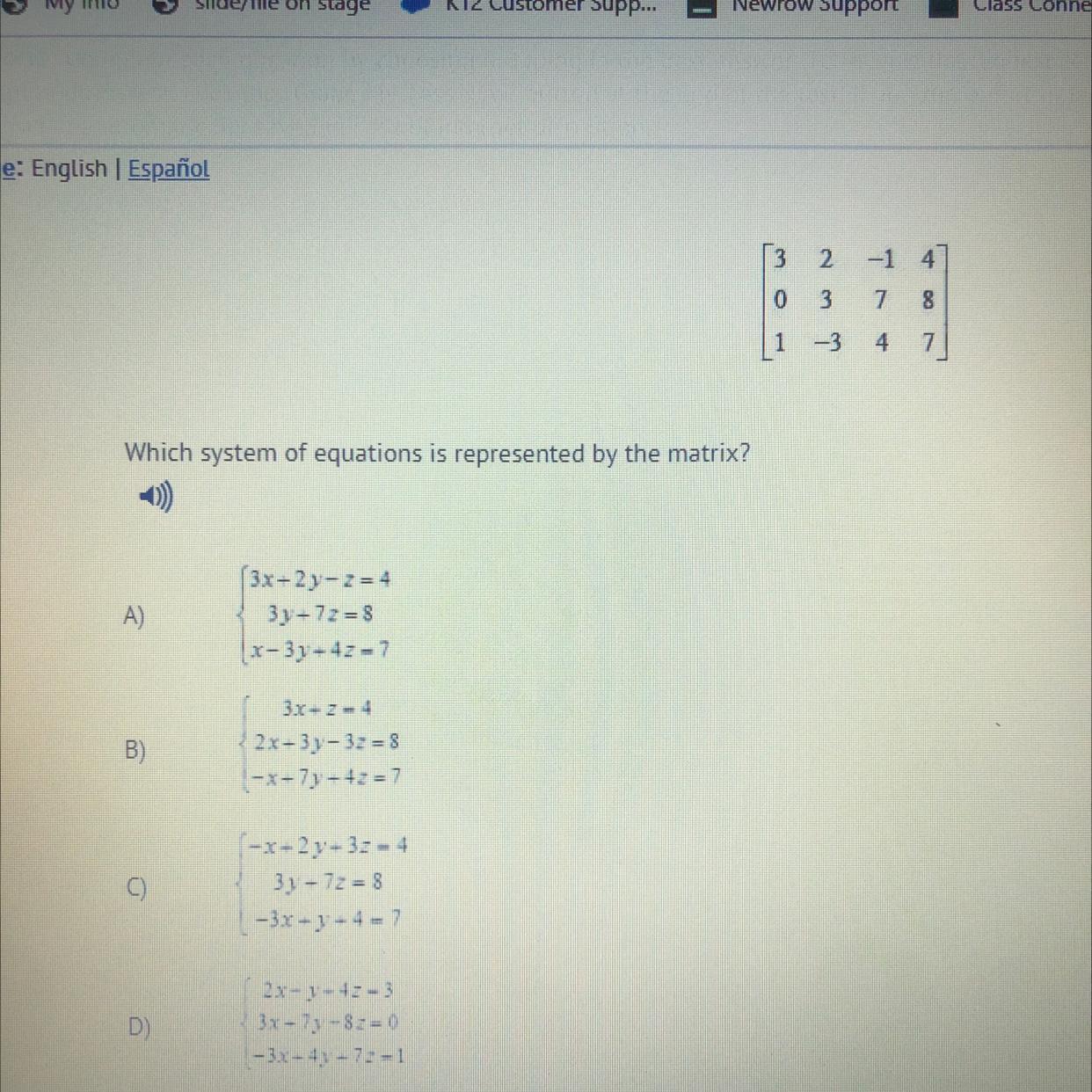
Answers
Answer:
Option AStep-by-step explanation:
According to the matrix, the system is:
3x + 2y -z = 40x + 3y + 7z = 8 ⇒ 3y + 7z = 8x - 3y + 4z = 7Correct match is A
USE THE GRAPH Of y=f(x) to graph the function y=3−4f(x+3) for each point on the graph of f(x), compute the location of the coresponding point on the graph of y=3−4f(x+3)
Answers
The corresponding points on the graph of `y = f(x)` for each point on the graph of `y = 3 - 4f(x+3)` are:
Corresponding points
x -3 -2 -1 0 1 2 3
f(x) 2 1 0 1 2 3 4
Given a function graph of `y = f(x)`.
We need to graph the function `y = 3 - 4f(x+3)` and find the corresponding points on the graph of `y = f(x)` for each point.
Here is the graph of `y = f(x)`:
Graph of y = f(x)
Graph of y = f(x)
We need to graph the function `y = 3 - 4f(x+3)` on the same graph.
To do this, we need to apply transformations on the original function `y = f(x)`.
We will first apply the transformation `(x + 3)`.
This will shift the function `3` units to the left.
The graph of `y = f(x+3)` will look like this:
Graph of y = f(x+3)
Graph of y = f(x+3)
Now we need to multiply this function by `-4`.
This will reflect the function about the x-axis and also make it `4` times steeper than the original function.
The graph of `y = -4f(x+3)` will look like this:
Graph of y = -4f(x+3)Graph of y = -4f(x+3)
Now we need to shift the graph of `y = -4f(x+3)` upwards by `3` units.
The graph of `y = 3 - 4f(x+3)` will look like this:
Graph of y = 3 - 4f(x+3)
Graph of y = 3 - 4f(x+3)
We can see that each point on the graph of `y = f(x)` corresponds to a point on the graph of `y = 3 - 4f(x+3)`.
To find the corresponding point on the graph of `y = f(x)` for each point on the graph of `y = 3 - 4f(x+3)`, we need to reverse the transformations applied to the original function.
The order of transformations will be opposite to the order in which they were applied.
To undo the shift of `3` units upwards, we will subtract `3` from the y-coordinate of each point. This will give us the graph of `y = -4f(x+3)`.
To undo the multiplication by `-4`, we will divide the y-coordinate of each point by `-4`.
This will give us the graph of `y = f(x+3)`.
To undo the shift of `3` units to the left, we will shift the graph of `y = f(x+3)` `3` units to the right.
The graph of `y = f(x)` will look like this:
Graph of y = f(x)
Graph of y = f(x)
The corresponding points on the graph of `y = f(x)` for each point on the graph of `y = 3 - 4f(x+3)` are:
Corresponding points
x -3 -2 -1 0 1 2 3
f(x) 2 1 0 1 2 3 4
To know more about transformations, visit:
https://brainly.com/question/11709244
#SPJ11
use the information given to answer the question. write your answer as a decimal rounded to the nearest tenth

Answers
Answer: The value of x is 3.5
Explanation:
Equation:
y = 2x - 7
When the equation's Line intersects the x-axis, the value of y shall be always 0
Insert y = 0, to find x intercept
⇒ 0 = 2x - 7
⇒ 2x - 7 = 0
⇒ 2x = 7
⇒ x = 3.5
So coordinates: (x, y) → (3.5, 0)
Which equation represents the line that passes through the points (–4, 3) and (2, –12)?
–9x + 2y = 42
x + 2y = 2
5x + 2y = –14
2x + 5y = 7
Answers
Answer:
5x + 2y = –14
Step-by-step explanation:
Graph the points and find the equation from there.
Answer:
the answer is 5x + 2y = –14 their right
Step-by-step explanation:
For the system of differential equations
x′(t)=1−ex+2y
y′(t)=−x−4siny
the point (x0,y0)=(0,0) is a critical point.
Expressed as an almost linear system,
x′(t)=ax+by+r(x,y)
y′(t)=cx+dy+s(x,y)
where
a= , b=
c= , d=
and the Jacobian matrix at the critical point (x0,y0) is
J(x0,y0)= ⎡⎣⎢⎢⎢ ⎤⎦⎥⎥⎥
The eigenvalues of this matrix are
λ1= <λ2=
The critical point (x0,y0) is best described as a
saddle
sink / stable node
source / unstable node
center point / ellipses
spiral source
spiral sink
none of these
Answers
To express the given system of differential equation as an almost linear system, we need to find the partial derivatives of the given functions with respect to x and y.
∂f/∂x = -ex
∂f/∂y = 2
∂g/∂x = -1
∂g/∂y = -4cosy
Now, substituting these values in the general form of an almost linear system,
x′(t) = ax + by + r(x,y)
y′(t) = cx + dy + s(x,y)
we get,
x′(t) = -ex + 2y
y′(t) = -x - 4cosy
So,
a = -e, b = 2, c = -1, d = 0
At the critical point (0,0), the Jacobian matrix is
J(0,0) = ⎡⎣⎢⎢⎢-1 2⎤⎦⎥⎥⎥
The eigenvalues of this matrix can be found by solving the characteristic equation,
det(J - λI) = 0
where I is the identity matrix of the same size as J.
det ⎡⎣⎢⎢⎢-1-λ 2⎤⎦⎥⎥⎥ = (-1-λ)(-λ) - 2(2) = λ^2 + λ - 4
Using the quadratic formula, we get the eigenvalues as
λ1 = (-1 + sqrt(17))/2 ≈ 0.56
λ2 = (-1 - sqrt(17))/2 ≈ -2.56
Since the eigenvalues have opposite signs, the critical point is a saddle.
Learn more about differential equation
https://brainly.com/question/31492438
#SPJ11
the value of 2 in 204.75 is how many times the value of 2 in 103.52
Answers
Answer:
1000.
Step-by-step explanation:
The Value of the 2 in 204.75, is 200.
The Value of the 2 in 103.52 is 0.02.
So to make the 0.02 become 200, you have to move the decimal point 3 spaces to the right.
Therefore, the 2 in 204.75 is 1000 times greater than the value of the 2 in 103.52.
I hope this helps!
Simplify
3√b^2
and no it is not 3b
Answers
The simplified form of the given expression is 9b
Simplifying an ExpressionFrom the question, we are to simplify the given expression
The given expression is 3√b^2
This expression can be properly written as
(3√b)²
To simplify the expression,
First, we will expand the expression by applying one of the rules of exponents
(3√b)²
Applying the rule of exponent
3² × (√b)²
9 × b
= 9b
Hence,
The simplified expression is 9b
Learn more on Simplifying an expression here: https://brainly.com/question/723406
#SPJ1
Below each function , write "even"" odd"or " neither " to describe its symmetry

Answers
Answer:
even yurrrr welcome because its pattern is two
Answer:
odd,even,odd,odd
Step-by-step explanation:
#platofam
#edmentumgang
use the elimination method to solve the system of equation choose the correct ordered pair 3x+6y=36 3x-6y=0
Answers
Answer:
x=6
y=3
Step-by-step explanation:
i u can't open the image i attached, pls inform me

1/3y+3−1/5y=5.
NEED AWNSER ASAP 1/3 AND 1/5 ARE FRACTIONS
Answers
Answer:
3.75 or 30/8
Step-by-step explanation:
1/3 y + 1/5 y + 3 =5
find 3 and 5s lcm. (15)
(1/3) * (5/5) = 5/15
(1/5) * (3/3) = 3/15
new equation: 5/15y + 3/15y + 3 =5
8/15 y +3 = 5
-3 = -3
(15/8) 8/15y = (15/8) 2
y = 30/8 or 3.75
I Need Help With This Question

Answers
Answer:
Step-by-step explanation:
Dont do it. Just take the detention
Sebastian drove for 2.2 hours at an average rate of 43.5 miles per hour. He calculates that he drove 95.7 miles. He knows the answer should be near 80, because 40 times 2 is 80. Which best explains Sebastian’s actual solution?
The actual product is reasonable because it is near 80 but greater than 80. Both factors were rounded down, making the estimate lower than the actual product.
The actual product is unreasonable. It should be near 80 but less than 80 because both factors were rounded down.
The actual product is reasonable because the estimate and actual answers both have two places to the left of the decimal.
The actual product is unreasonable because the estimate has zero places to the right of the decimal and the actual product has one decimal place to the right of the decimal.
Answers
Answer:
The actual product is reasonable because it is near 80 but greater than 80. Both factors were rounded down, making the estimate lower than the actual product.
Step-by-step explanation:
Answer:
A
Step-by-step explanation:
BRO SOMEONE HELP!!!!!!!!!!

Answers
Answer:
t= 52 seconds
A= 7,903 ft
Step-by-step explanation:
So start by writing each plane as an expression.
Plane A
3687+65.5*t is an expression for the ascent
Plane B
5000+40.25*t is an expression for the ascent
to find the time when they are at the same altitude set them equal to each other
3687+65.5*t = 5000+40.25*t
25.25*t = 1313
t= 52 seconds
to find the altitude solve one of the expressions with t=52
A =3687+65.5*52= 7093 ft
How to find the estimate square root of 23?
Answers
Answer:The square root is √23 = 4.795.
Step-by-step explanation:
PLZ HELP ASAP!!!! NEED HELP!!!

Answers
Answer:
I'm pretty sure the answer is C
Adding which terms to 3x2y would result in a monomial? Check all that apply
Answers
Answer:
By adding 12x²y and 4x²y result will be a monomial.
Step-by-step explanation:
Given question is incomplete; here is the complete question.
Adding which terms to 3x²y would result in a monomial? Check all that apply.
3xy
–12x2y
2x2y2
7xy2
–10x2
4x2y
3x3
1). 3x²y + 3xy → [Binomial]
2). 3x²y - 12x²y = -9x²y → [Monomial]
3). 3x²y + 2x²y² → [Binomial]
4). 3x²y + 7xy² → [Binomial]
5). 3x²y - 10x² → [Binomial]
6). 3x²y + 4x²y = 7x²y → [Monomial]
7). 3x²y + 3x³ → [Binomial]
Therefore, by adding 12x²y and 4x²y result will be a monomial.
The perimeter of a rectangle is 34 units. Its width is 6.5 units.
LAT. write an equation to determine the length
Answers
Answer:
please mark me brainlist
Step-by-step explanation:
