If the ratio of the sides of two similar prisms is 4:1. Is the ratio of the volume of the prisms the same? (4:1)
Answers
Answer:
The ratio of their volumes is not the same 4:1, but \((4:1)^3\) = 64:1.
Step-by-step explanation:
Measurements in Similar Figures
In similar figures, if the ratio of any of these corresponding lengths is expressed as a:b then the ratio of the other corresponding lengths can also be expressed as a:b.
In similar figures, if the ratio of any of these corresponding lengths is expressed as a:b then the ratio of the areas can be expressed as (a:b)^2 and the ratio of the volumes can be expressed as (a:b)^3.
We are given the ratio of the sides of two similar prisms as 4:1. The ratio of their volumes is not the same 4:1, but \(\mathbf{(4:1)^3}\) = 64:1.
Related Questions
I am very confused on this right now, pls help.

Answers
Answer:
21/97
Step-by-step explanation:
Bonsai/Senator
84/388
Simplify by dividing both numbers by 4
21/97
Tigran used 25% of paint he was given this morning for the assignment. If he has 7.2 gallons of paint left, how much was he given paint this morning for his assignment?
Answers
Let x be the initial amount of paint Tigran had. Note that Tigran used 25% of the initial amount x. To calculate the 25% of x we simply multiply 0.25 times x as follows
\(0.25\cdot x\)This is the amount Tigran used. However, after using it, he was left with 7.2 gallons of paint. So if we add the amount he used (0.25x) to what he had left (7.2) we should get the initial amount (x). This translates to the equation
\(7.2+0.25\cdot x=x\)We want to solve this equation for x, so first we start by subtracting 0.25x on both sides, so we get
\(7.2=x\text{ -0.25x = 0.75x}\)Now, we divide both sides by 0.75 so we get
\(x=\frac{7.2}{0.75}=9.6\)So at the beginning Tigran had 9.6 gallons of paint.
From a standard deck of cards, how many ways can you pick a king,a heart, and then a five
Answers
Answer: 4 ways to pick a king, 13 ways to pick a heart, and 4 ways to pick a five. Given the cards are returned to the deck, there are no special cases such as picking the King of Hearts and/or the Five of Hearts that affect the count. 208 ways.
Step-by-step explanation:
Yesterday, a movie theater sold 273 bags of popcorn. A large bag of popcorn costs $3. A small bag of popcorn costs $1. In all, the movie theater made $437
from popcorn sales. PLEASE SHOW STEPS
Answers
Answer:
I have something that helps
Step-by-step explanation:
this is a question that I was doing
Chickens and rabbits
In the yard were chickens and rabbits. Together they had 18 heads and 56 legs. How many chickens and how many rabbits were in the yard?
Correct answer:
chickens: 8
rabbits: 10
Step-by-step explanation:
a+b=18
2a+4b=56
a=8
b=10
a+b = 18
2•a+4•b=56
a+b = 18
2a+4b = 56
a = 8
b = 10
does it help, plz vote up

The side of a triangle are in the ratio 4:4:3 what kind of triangle is it (b) calculate the smallest angle of the triangle to the nearest degree
Answers
The smallest angle of the equilateral triangle is 60 degrees
If the sides of a triangle are in the ratio 4:4:3, it implies that the lengths of the sides are proportional.
To determine the type of triangle, we examine the side lengths. Since all three sides are equal in length, we have an equilateral triangle.
For an equilateral triangle, all angles are equal. To calculate the smallest angle, we divide the total sum of angles in a triangle (180 degrees) by the number of angles, which is 3:
Smallest angle \(= \frac{180}{3} = 60\)\) degrees.
Therefore, the smallest angle of the equilateral triangle is 60 degrees (to the nearest degree).
For more questions on equilateral triangle:
https://brainly.com/question/17264112
#SPJ8
Use the parabola tool to graph the quadratic function f(x)=−(x−2)2+4.
Graph the parabola by first plotting its vertex and then plotting a second point on the parabola.
Answers
The vertex is (2, 4) and (3, 3)
To graph the quadratic function
\(f(x) = -(x - 2)^2 + 4\),
we'll first identify the vertex and then plot a second point on the parabola.
The vertex form of a quadratic function is given by
\(f(x) = a(x - h)^2 + k\),
where (h, k) represents the vertex of the parabola.
Comparing the given function
\(f(x) = -(x - 2)^2 + 4\)
to the vertex form, we can identify that the vertex is located at (2, 4).
Now, let's plot the vertex (2, 4) on a coordinate plane and find another point on the parabola.
We can choose a value for x and calculate the corresponding y-coordinate using the function.
Let's choose x = 3.
Substituting this value into the function, we get:
\(f(3) = -(3 - 2)^2 + 4\)
\(= -(1)^2 + 4\)
\(= -1 + 4\)
\(= 3\)
So, when x = 3, y = 3.
Now we have two points: the vertex (2, 4) and (3, 3).
Let's plot them on a coordinate plane and draw the parabola:
|
|
|
| *
| *
|
|_______________
2 3 4
In the graph, the vertex is denoted by '*' and the second point is marked as '.'.
The parabola opens downward because the coefficient of (x - 2)^2 is negative.
For such more questions on vertex
https://brainly.com/question/25651698
#SPJ8
The graph above shows the graphs of the cost (in green) and revenue (in blue) functions for a company that manufactures and sells small radios.
a) How many radios must be produced and sold to break even?
Answer:
b) What is the dollar amount coming in and going out if the company just breaks even?
Answer:
c) Use the formulas to write the company's profit function, (), from producing and selling radios.
(Notice in this problem, you must enter the entire function, not just the right hand side)
Answer:
d) How much profit will the company earn if it produces and sells 500 radios?
Answer:
Answers
The company must sell 400 radios to break even, i.e, when the revenue function and cost function is same.
The sum of the units sold times the price per unit is the revenue. Multiply the output level by the pricing function to get the revenue function.
The cost function is the total cost of production of the item which includes the cost of raw materials, labor, transport and establishment costs.
The cost function and the revenue function is given as:
Cost function is C(x) =5000 + 7.5x
And the revenue function is R(x) = 20x
a)In the break even point cost will be equal to revenue
so, C(x)=R(x)
or,5000+7.5x=20x
or,12.5x=5000
or, x=5000÷12.5
or, x=400
The number of radios produced to break even is 400.
(b)When the company breaks even then x=400
∴R(200)=200×20=8000
So the amount of money is dollars that is coming in or going out is given by 8000.
(c)We know that the profit=Revenue - cost
So the required profit function is given by:
p(x)=R(x)-C(x)
or, p(x)=20x-5000-7.5x
or,p(x)=12.5x-5000
(d)The company sells 500 radios
Therefore profit will be given by
p(500)=12.5×500-5000
or,p(500)=6250-5000
or, p(500)=1250
So on selling 500 radios the company will earn $1875.
Disclaimer: The revenue and cost function of the equation are
C(x) =5000 + 7.5x and R(x) = 20x .
To learn more about cost and revenue function visit:
https://brainly.com/question/12909885
https://brainly.com/question/13260537
#SPJ9
What is the difference of the whole number and the mixed number below? 9-3 3/4 A. 5 1/4 B. 6 1/4 C. 6 3/4 D. 5 3/4
Answers
Answer:
A
Step-by-step explanation:

Simone is four years older than her sister Olivia. Their combined ages is 28. What are their ages. Show all of your work
Answers
Answer:
Simone is 16 and Olivia 12 years old.
Step-by-step explanation:
"Simone is four years older than her sister Olivia."
(1) Simone age = Olivia age + 4
"Their combined ages is 28."
(2) Simone age + Olivia age = 28
→ We can substitute from the first equation (1) Simone age with Olivia age + 4 into the second equation (2)
Simone age + Olivia age = 28
Olivia age + 4 + Olivia age = 28, subtract 4 from both sides
Olivia age -4 +4 + Olivia age = 28 - 4
2· Olivia age = 24 , divide both sides by 2
Olivia age = 24/2
Olivia age = 12 years old
→ From the first equation (1) we have:
Simone Age = Olivia age + 4 = 12 + 4 = 16 years old
Check our answer:
"Their combined ages is 28 "
12 + 16 = 28 ✅
Kamal invested $1200 in a savings acc paying 1.8% per yr compound interest.
he left the money in the acc for 5 yrs.
what is the amount of money in the acc at the end of 5 yrs???
give the ans with working and to the nearest cent
Answers
Answer:
A = $1311 and 96cents
Step-by-step explanation:
\(A = P(1 + \frac{r}{n})^{nt}\)
P = $1200
r = 1.8% = 0.018
n = 1 (compounded yearly)
t = 5
\(A = 1200(1 + 0.018)^5 = 1200 \times(1.018)^5 = 1311. 96\)
Special Lines: Tutorial
12 of 25
E Save & Exit
Which equation represents a line that's parallel to line JK and passes through point P(6,-2)?
Select the correct answer.
- -2
Oy = {x - 14
Oy = x - 5
Oy = 2x – 14
Oy = 2x - 5
Answers
Answer:
y= 1/2x-5
Step-by-step explanation:
true-false questions: justify your answers. 1.13 the solution set to a system of three equations in three unknowns cannot be a plane. 1.14 a system of linear equations cannot have only two solutions. 1.15 the solution set to a consistent rank 2 linear system in four unknowns would be a line in four-dimensional space. 1.16 a system of four equations in four unknowns always has a solution. 1.17 a system of four equations in four unknowns can have at most one solution. 1.18 the rank of a system is always less than or equal to the number of equations in the system. 1.19 use geometric reasoning to answer the following questions concerning systems (i) and (ii) below: (a) if (i) has exactly one solution, then the same is true for (ii). (b) if the solution set of (i) is a line, then the same is true for (ii). (c) if (i) has no solutions, then the same is true for (ii). (i) a1x b1y c1z
Answers
The True- False of given statements of Solutions of Equations are justified.
1.13 False. The solution set to a system of three equations in three unknowns can be a point, a line, or a plane. It depends on the system of equations and how they intersect in three-dimensional space.
1.14 False. A system of linear equations can have infinitely many solutions, one solution, or no solutions. It depends on the coefficients of the equations and the rank of the coefficient matrix.
1.15 False. The solution set to a consistent rank 2 linear system in four unknowns would be a plane in four-dimensional space, not a line.
1.16 False. A system of four equations in four unknowns may not have a solution, or it may have infinitely many solutions or one solution. It depends on the coefficients of the equations and the rank of the coefficient matrix.
1.17 False. A system of four equations in four unknowns can have infinitely many solutions or one solution, but it cannot have at most one solution.
1.18 True. The rank of a system is always less than or equal to the number of equations in the system.
1.19 (a) False. If (i) has exactly one solution, it does not necessarily mean that (ii) will have exactly one solution. It depends on the coefficients of the equations in (ii).
(b) False. If the solution set of (i) is a line, it does not necessarily mean that the same is true for (ii). It depends on the coefficients of the equations in (ii).
(c) True. If (i) has no solutions, then the same is true for (ii), since (ii) is equivalent to (i).
To know more about Solutions of Equations:
https://brainly.com/question/29757556
#SPJ4
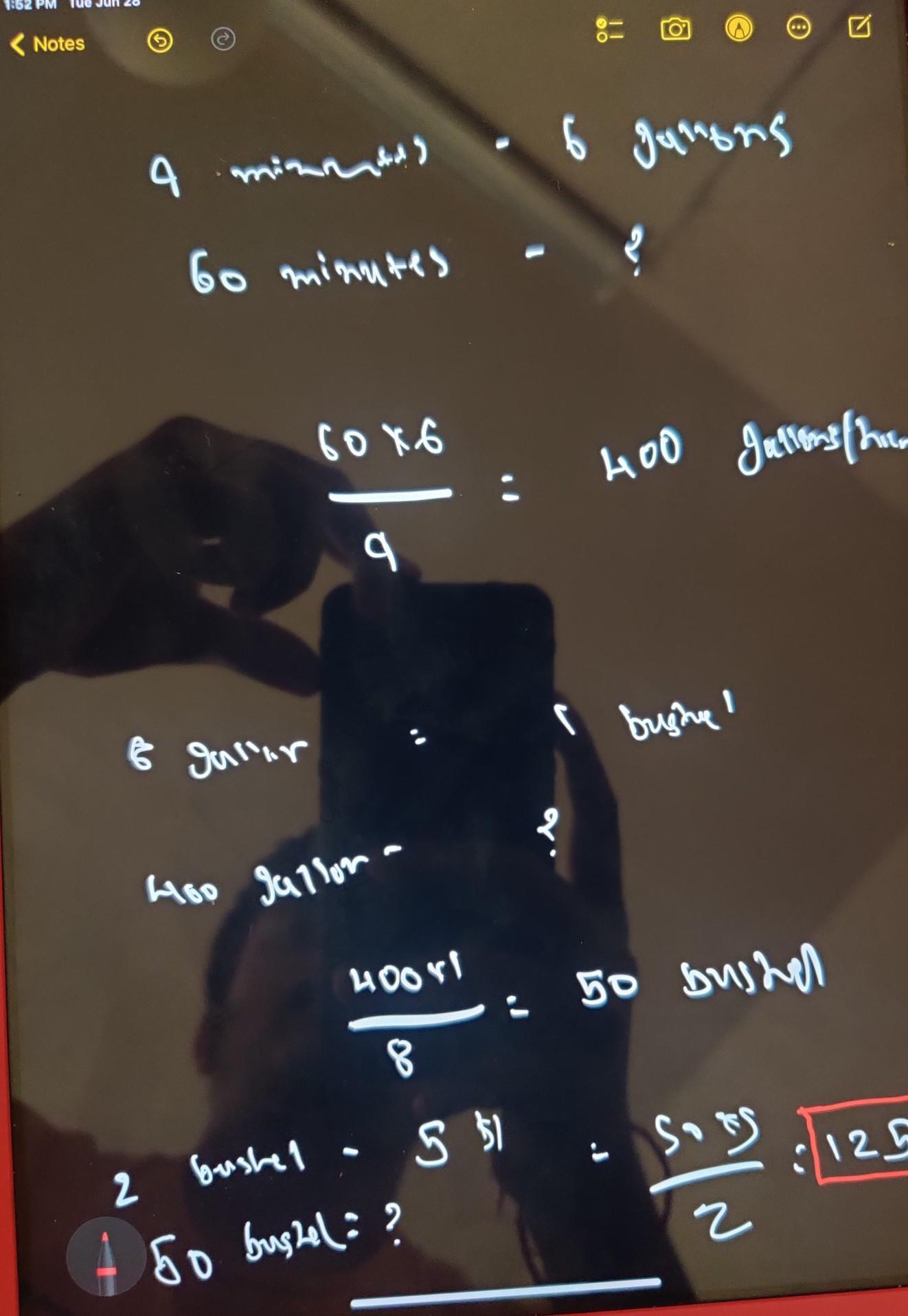
As a summer job, Bart is picking strawberries at his uncle's farm. He can pick 6
gallons of strawberries in 9 minutes, and his uncles pays him $5 for 2 bushels. How
much does Bart make per hour picking strawberries?
Given: 8 gallons = 1 bushel & 60 minutes = 1 hour

Answers
Answer:
125
Step-by-step explanation:
All the work is in picture attat
i need help with these answers!

Answers
Answer:
1. true
2. false
3. supplementary
4. vertical
5. it would be 5
Solve the system using elimination. 5x + 3y = -6
3x-2y = 4
Answers
Answer:
x=0;y= -2Step-by-step explanation:
(please look the attachment) Hope it helps... please mark this answer as brainliest
simplify (-13x^2-7x-9)-(-7x^2+11x-10)
Answers
Answer:
-6x^2-18x+1
Step-by-step explanation:
not fully sure but hope this helps!!
Please help, This is urgent 7th-grade math.
There was 2/3 of a pan of lasagna in the refrigerator. Bill and his friends ate half of what was left. Write a number sentence and draw a model to represent the problem. How much of the pan did they eat?
Explanations/Answers, please!
Answers
Find the slope of the line given the following two points(-2,3) and (3, 13)
Answers
Slope is 2
Using the slope formula
\(undefined\)Answer this please please

Answers
Answer:
X = 1/5
Step-by-step explanation:
16 - 10X = 14
10X = 2
X = 0.2
Answer
x=0.2
-16+10x=-14
10x=-14+16
10x=2
10x÷10=2÷10
x=0.2
Suppose that g(x) = f(x) + 5. Which statement best compares the graph ofg(x) with the graph of f(x)?
Answers
We are told that
\(g(x)=f(x)+5\)If we were given the graph of f(x), note that in this equation we add 5 to the value of f(x) to find the value of g(x). So, in terms of the graph, as we are taking the final value of f and adding 5, this means that we are moving the graph of f 5 units up. That is the graph of g(x) is the graph of f(x) shifted 5 units up
I need help for these 5 questions

Answers
Answer:
1. 6²=36
2. 289\(\frac{1}{2}\) = 17
3. \(14^{-2}\) = \(\frac{1}{196}\)
4. 10³=1000
5. \(5^{4}\)=625
Step-by-step explanation:
Answer:
1. 6² = 36
2. 289^1/2 = 17
3. 14^-2 = 1/196
4. 10³ = 1000
5. 5⁴ = 625
Step-by-step explanation:
I just used the rule that logₓy = n means that xⁿ = y and a logarithm without a base, has a base of 10 (called a "common logarithm").
Which value of x makes this inequality true? x+9<4x
A.4
B.1
C.3
D.2
Answers
Answer:
A. 4
Step-by-step explanation:
Given inequality:
\(x+9 < 4x\)
Rearrange the inequality to isolate x.
Subtract x from both sides of the inequality:
\(\begin{aligned}x+9-x & < 4x-x\\9& < 3x\end{aligned}\)
Divide both sides of the inequality by 3:
\(\begin{aligned}\dfrac{9}{3}& < \dfrac{3x}{3}\\\\3& < x\\\\x& > 3\end{aligned}\)
So the values of x that make the inequality true are:
Any value of x that is greater than 3.Therefore, from the given answer options, the value of x that makes the inequality true is x = 4.
To check this, substitute x = 4 into the inequality:
\(\begin{aligned}x+9& < 4x\\x=4\implies 4+9& < 4(4)\\13& < 16\end{aligned}\)
As 13 is less than 16, the inequality is true when x = 4.
what is the mean (average) of 2,4,5,6,8
Answers
Answer:
5
Step-by-step explanation:
In order to figure out average, we need to add up all the numbers. So adding 2, 4, 5, 6, and 8 gives us 25. We now divide that total by the total number of terms we used to reach 25. So since we had 5 numbers, we divide 25 by 5 to get an average of 5.
Answer:
5.
Step-by-step explanation:
To find mean. you just add all the numbers up and divide by the number of numbers (5).
2+4+5+6+8=25
25/5=5
0.4(2-) 0.2(9 + 7) A)-3 B - 1 C) 3 D) all real numbers
Answers
Let us solve the equation to arrange the steps
\(-3(4+3x)+5x=-16\)In the first step, we must multiply the bracket by -3 (distributive property)
\((-3)(4)_{}+(-3)(3x)=-12-9x\)Then the equation is
\(-12-9x+5x=-16\)Now add the like terms on the left side
\(\begin{gathered} -12+(-9x+5x)=-16 \\ -12x+(-4x)=-16 \\ -12-4x=-16 \end{gathered}\)Next step, add 12 to both sides
\(undefined\)Find the length of the hypotenuse rounded to the nearest tenth. 40° 8 cm
Answers
cos 40 = x/8
x = 8 cos 40
x = 6.128 cm= 6.1 cm ( nearest tenth)
A political candidate has asked you to conduct a poll to determine what percentage of people support her. If the candidate only wants a 10% margin of error at a 95% confidence level, what size of sample is needed? Give your answer in whole people.
Answers
Given:
margin of error = 10% or 0.10 in decimal form
confidence level = 95%
Find: sample size
Solution:
To determine the sample size, we can use Cochran's formula.
\(n=\frac{Z^2pq}{e^2}\)where:
Z is the critical value of the given confidence level
p = estimated proportion of the population having the attribute in question (ex. supports the candidate)
q = 1 - p
e = margin of error
Based on the given information, our confidence level is 95%. The z-value at this confidence level is 1.96. Hence, z = 1.96.
For p and q, since none is stated in the question, we will assume p = 0.5 and q = 0.5 or 50% each.
Let's plug into the formula above the values of Z, p, q, and e.
\(n=\frac{1.96^2(0.5)(0.5)}{0.10^2}\)\(n=\frac{3.8416\times0.25}{0.01}\)\(n=\frac{0.9604}{0.01}\Rightarrow n=96.04\approx97\)Any excess decimal will be considered as 1 person. So, 96 + 1 = 97.
Therefore, we need 97 people as our sample size.
change 5 out of 19 to a percentage
Answers
Answer:
26.3%
Step-by-step explanation:
5 is divided by 19
That answer is then multiplied by 100.
You may round your answer to the nearest whole number.
A store is offering 20% discounts on new laptops and 10% discounts on new printers when the two are purchased together. The original prices of the two together is at least $1,050. The discounted price exceeds $860. Which system of inequalities can be used to find the possible original prices of a laptop, x, and of a printer, y?
Answers
The system of inequalities that can be used to find the possible original prices of a laptop, x, and of a printer, y is: x + y ≥ 1050 and 0.8x + 0.9y > 860
How to determine the system of inequalitiesLet x be the original price of the laptop and y be the original price of the printer.
So, the discounted price of the laptop is 0.8x and the discounted price of the printer is 0.9y
If the two are purchased together, the total discounted price is:
0.8x + 0.9y
This exceeds $860
0.8x + 0.9y > 860
The original prices of the two together is at least $1,050.
This can be written as:
x + y ≥ 1050
So, we have
x + y ≥ 1050 and 0.8x + 0.9y > 860
Read more about inequalities at
https://brainly.com/question/30673825
#SPJ1
Sociologists say that 85% of married women claim that their husband's mother is the biggest bone of contention in their marriages (sex and money are lower-rated areas of contention). Suppose that six married women are having coffee together one morning. Find the following probabilities. (Round your answers to three decimal places.)
(a) All of them dislike their mother-in-law.
Incorrect: Your answer is incorrect.
(b) None of them dislike their mother-in-law.
(c) At least four of them dislike their mother-in-law.
(d) No more than three of them dislike their mother-in-law.
Answers
The probability is equal to 0.9788.
We have given that,
Sociologists say that 85% of married women claim that their husband's mother is the biggest bone of contention in their marriages (sex and money are lower-rated areas of contention). Suppose that six married women are having coffee together one morning.
We have to find the probability
Probability all dislike is
\(0.85^8= 0.27\)
What is the probability?Probability is the branch of mathematics concerning numerical descriptions of how likely an event is to occur, or how likely it is that a proposition is true. The probability of an event is a number between 0 and 1, where, roughly speaking, 0 indicates the impossibility of the event and 1 indicates certainty.
The probability that none dislike is,
\(0.15^8= 2.6 \times 10^{(-7)}\)
At least 5 dislike
5 dislike 8C5
\((0.85)^5(0.15)^3= 0.0839\)
6 dislike 8C6
\((0.85^6 0.15)^2= 0.2376\)
7 dislike
\(8*(0.85^7) (0.15)=0.3848\)
8 dislike
\(0.85^8= 0.2725\)
Therefore the probability is equal to 0.9788.
To learn more about the probability visit:
https://brainly.com/question/25870256
#SPJ1
So I tried solving this problem with the population growth formula,
· Population Growth: =^; a=initial amount, r=growth rate as a decimal; t=time in years; y=resulting population
My equation looked like this but I got this question wrong so any help will be appreciated
9667=11211e^(.418)(t)

Answers
The number of years it would take is approximately equal to 53 years.
How to determine the population after a number of year?In Mathematics, a population that increases at a specific period of time represent an exponential growth. This ultimately implies that, a mathematical model for any population that increases by r percent per unit of time is an exponential function of this form:
P(t) = I(1 + r)^t
Where:
P(t ) represent the population.t represent the time or number of years.I represent the initial number of persons.r represent the exponential growth rate.By substituting given parameters, we have the following:
96627 = 11211(1 + 0.0418)^t
8.61894567835 = (1.0418)^t
By taking the ln of both sides, we have:
Time, t = ln(8.61894567835)/ln(1.0418)
Time, t = 52.60 ≈ 53 years.
Read more on exponential functions here: brainly.com/question/28246301
#SPJ1