If $a:b = 1:3$ and $b$ is a positive, one-digit integer, what is the greatest possible value of $a$?
Answers
=========================================
Work Shown:
a:b = 1:3
a/b = 1/3
a*3 = b*1 ... cross multiply
3a = b
b = 3a
Since b is a one digit number, this means that the largest it can get is 9
\(b \le 9\\\\3a \le 9\\\\a \le \frac{9}{3}\\\\a \le 3\)
The largest possible value of 'a' is 3
Related Questions
Which of the following are the most likely factors of the function graphed above?
Answers
The factors of the function graphed in the given graph is option (C) (x-1)(x+5)
The function is the mathematical statement that shows the relationship between the dependent variable and independent variable
From the given graph
The given graph is a parabola and the equation of the graph will be a quadratic function
x intercepts of the lines are
x = -5 and x = 1
Then to find the factors of the function graphed
x = -5
x + 5 = 0
Similarly the second equation will become
x = 1
x-1 = 0
Then the factors function will be
(x+5)(x-1)
Therefore, the factors are option (C) (x-1)(x+5)
I have solved the question in general, as the given question is incomplete
The complete question is
Which of the following are the most likely factors of the function graphed above?
A. (x+1)(x-5)
B. (x)(x-5)
C. (x-1)(x+5)
D. (x)(x+5)
Learn more about factors here
brainly.com/question/16813491
#SPJ4
Please help thank youu

Answers
Answer:
2√73 or 17.09 inches
Step-by-step explanation:
The small red square at the corner of the triangle symbolizes that the triangle is a right triangle. Therefore, to find the hypotenuse of the triangle, we can use the Pythagorean Theorem: a² + b² = c²
a = 6
b = 16
c = ?
Plug these values into the equation.
(6)² + (16)² = c²
Evaluate the exponents.
36 + 256 = c²
292 = c²
Take the square root of both sides to find c.
√292 = √c²
17.09 ≈ c
This is your answer.
You can also simplify the radical without using decimals.
4 • 73 = 292
Therefore,
√4 • √73 = √292
Which also means,
2•√73 = √292
So your answer is: 2√73
Hope this helps!
Answer:
We use the pythagorean theorem a²+b²=c² and in this question
a = 6
and
b = 16
so
36 + 256 = c²
so
c² = 292 so now we take the square root of it to get \(\sqrt{292}\)
Hope this helps!
help please i don't understand

Answers
Answer:
x = -4, -1, 9
Step-by-step explanation:
The zeros of f(x) will be found from the factors of f(x). Like factoring numbers, you reduce the problem in stages by factoring out the given factor. You can do this using polynomial long division, or its simpler cousin, synthetic division.
The attachment shows the synthetic division required to determine that the remaining quadratic factor is (x^2 -8x -9). That is ...
f(x) = (x +4)(x^2 -8x -9)
The quadratic can be factored by looking for two numbers that have a product of -9, but have a sum of -8. Those numbers are +1 and -9. These are the values of the constants in the remaining factors you need.
f(x) = (x +4)(x +1)(x -9)
The zeros of f(x) are the values of x that make these factors zero. (When a factor is 0, f(x) is 0.) The values of interest are the opposites of the constant in each factor, -4, -1, 9.
The zeros of f(x) are x = -4, -1, 9.
_____
Additional comment
In regular division, the divisor is multiplied by the (partial) quotient, and the product is subtracted from the dividend to get a new dividend. In synthetic division, the divisor is presumed to be a binomial of the form (x -r), where r is the zero of this binomial term. (x=r gives r-r = 0) It is this r value that appears in the upper left corner of the synthetic division table.


The sum of triple a number and 12.
Answers
Answer:
3x+12
Step-by-step explanation:
Triple is 3 times a number which we will call “x” and sonce it is the sum, it is addition :)
What is the effective annual rate of an account that pays interest at the nominal rate of
7% per year, compounded daily? Compounded hourly?
Answers
Answer:
To find the effective annual rate (EAR) of an account that pays interest at the nominal rate of 7% per year, compounded daily, we can use the following formula:
EAR = (1 + r/n)^n - 1
where r is the nominal annual interest rate (expressed as a decimal), and n is the number of times the interest is compounded in a year.
For daily compounding, n = 365 (since there are 365 days in a year), so we have:
EAR = (1 + 0.07/365)^365 - 1 = 0.0725 or 7.25%
To find the effective annual rate for hourly compounding, we need to adjust the value of n to account for the fact that interest is compounded more frequently. There are 365 days * 24 hours = 8,760 hours in a year, so we can use n = 8,760:
EAR = (1 + 0.07/8760)^8760 - 1 ≈ 0.0727 or 7.27%
Therefore, the effective annual rate for hourly compounding is approximately 7.27%.
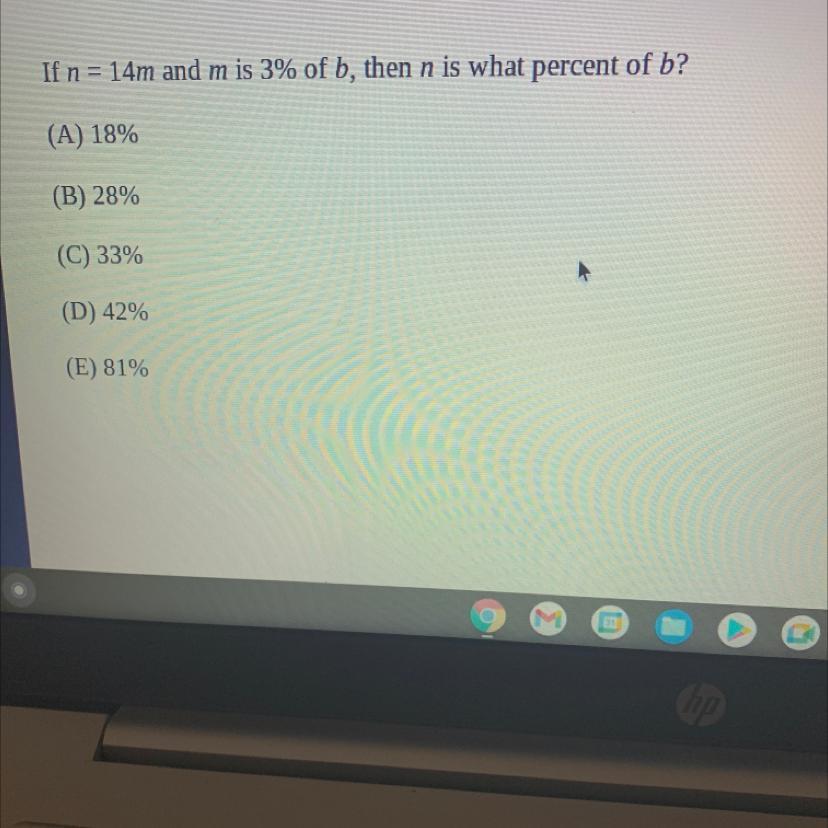
If n = 14m and m is 3% of b, then n is what percent of b?
Answers
The value of n in terms of b is given as 42%.
What is percentage?A percentage is a value that indicates 100th part of any quantity.
A percentage can be converted into a fraction or a decimal by dividing it by 100.
And to convert a fraction or a decimal into percentage, they are multiplied by 100.
Given that,
n = 14m.
And, m = 3% of b.
From the given expressions, n can be written in terms of b as follows,
n = 14m
=> n = 14 × 3% of b
=> n = 14 × 3/100 × b
=> n = 42/100 × b
The conversion of 42/100 into percentage is 42%.
Hence, the value of n is 42 percentage of b.
To know more about percentage click on,
brainly.com/question/29306119
#SPJ1
What is the measure of x? 37° 67° 97° 107°

Answers
Answer:
97°
Step-by-step explanation:
The angles of any quadrilateral will add up to 360°. Since we already know 3 out of the 4 angles (the bottom two are both 90°), we can easily find the measure of x.
\(90 + 90 + 83 +x = 360\)
\(263 + x = 360\\\\x = 97\)
Hope this helped!
Answer:
Value of x = 97 degrees
Step-by-step explanation:
In the given quadrilateral
One angle = 83
2 other angles = 90 degrees each
Sum of all the four angles in a quadrilateral = 360 (Angle Sum Property of quadrilaterals)
=>90+90+x+83= 360
=>180+83+x = 360
=> 263+x= 360
=>x= 360-263
=>x=97
there are 15 squares and nine circles what is the simplest ratio of circles to total shapes?
Answers
Answer:
3 to 8
Step-by-step explanation:
There are 24 total shapes, 9 of which are circles. So we have the ratio 9 to 24, or 3 to 8.
use pie=3.14 to estimate the unknown measures for each circle.c=132 ind=r=A=I'll upload a picture

Answers
Problem N 25
we know that
C=132 in
Remember that
The formula to calculate the circumference is given by
\(C=pi*D\)using pi=3.14
C=132 in
substitute given values in the formula
\(\begin{gathered} 132=3.14*D \\ solve\text{ for D} \\ D=\frac{132}{3.14} \\ D=42.04\text{ in} \end{gathered}\)The diameter D=42.04 in ( with pi=22/7 the diameter is 42 in exact)
Find out the radius r
r=D/2=42.04/2=21.02 in -----> the radius is half the diameter
Find out the area of the circle
The area is given by the formula
\(A=pi*r^2\)we have
r=21.02 in
pi=3.14
substitute
\(\begin{gathered} A=3.14*21.02^2 \\ A=1,387.38\text{ in}^2 \end{gathered}\)therefore
the answer isd=42.04 inr=21.02 inA=1,387.38 in2In a recent study of a random sample of 113 people, 92 reported dreaming in color. In the 1940’s, the proportion of people who reported dreaming in color was 29%. Is there evidence to show that the proportion of people who dream in color is different than the proportion in the 1940’s? What is the critical value for this hypothesis test?
Answers
what is 1'000+686+754
Answers
Answer:
2440
Step-by-step explanation:
1,000+686 =
1,686
1686+ 754
= 2440
What should you substitute for x in the second equation (bottom equation) in order to solve the system by the substitution method?

Answers
We substitute -1+1/6y for x in the second equation (bottom equation) in order to solve the system by the substitution method.
The given system of equations are 2x-1/3y = -2...(1)
3x+y=1...(2)
We solve this system of equations by using substitution method.
Let us solve for x in equation to substitute it in equation (2).
2x=-2+1/3y
Divide both sides of equation by 2.
x=-1+1/6y
Now plug in the value of x in equation 2.
Hence, we substitute -1+1/6y for x in the second equation (bottom equation) in order to solve the system by the substitution method.
To learn more on Equation:
https://brainly.com/question/10413253
#SPJ1
1/3(x-10)=40
What is the value of x
Answers
Answer:
1/3(x-10) = 40
(x-10) = 120
x= 130
Four inches of heavy, wet snow are equivalent to an inch of rain. Estimate the water content in 17 inches of heavy, wet snow
Answers
Question:
Four inches of heavy, wet snow are equivalent to an inch of rain. Estimate the water content in 17 inches of heavy, wet snow.
Solution:
Consider the following diagram (also named "rule of tree"):
by cross-multiplication and solving for x, we get:
\(x=\frac{17\text{ x 1}}{4}=\frac{17}{4}=4.25^{}\)so that, the correct answer is:
\(4.25^{}\)
Log5(9) + log5 -x ; x =3
Show steps
Answers
Exact Form:
10 log(5)-3
Decimal Form:
3.98970004
Divide 30 into five parts such that first nad last part are in the ratio 2:3
Answers
To divide 30 into five parts such that the first and last parts are in the ratio of 2:3, we can follow these steps:
1. Determine the ratio between the first and last parts. In this case, it is 2:3.
2. Add the ratio values together to find the total number of parts: 2 + 3 = 5.
3. Divide the total value (30) by the total number of parts (5) to find the value of each part: 30 / 5 = 6.
4. Multiply the value of each part by the respective ratio values to obtain the individual parts:
- First part: 2 * 6 = 12
- Second part: 6
- Third part: 6
- Fourth part: 6
- Last part: 3 * 6 = 18
Therefore, the five parts of 30, with the first and last parts in the ratio of 2:3, are 12, 6, 6, 6, and 18.
Question 10 of 25 What is the recursive formula for this geometric sequence? -2,-16, -128, -1024,... A. ○ B. C. (a, D. 3₁ = :-2 an = 2n-1 = = -2 an = an-1.8 • a₁ = 8 an = an-1• (-2) (a₁ = -8 30 = 20-1.2 SUBMIT
Answers
Answer:
\(a_{n}\) = 8\(a_{n-1}\) ; a₁ = - 2
Step-by-step explanation:
a recursive formula in a geometric sequence allows a term to be found by multiplying the preceding term by the common ratio r
here r = \(\frac{a_{2} }{a_{1} }\) = \(\frac{-16}{-2}\) = 8 , then
\(a_{n}\) = 8\(a_{n-1}\) ; a₁ = - 2
i really need help i have till 11:00

Answers
The expression that represents the combined inventory of these two stores is given as follows:
A. 7g²/2 - 4g/5 + 15/4.
How to obtain the combined inventory?The combined inventory is obtained adding the inventories for each store, combining the like terms.
The addition of the like terms for g² is given as follows:
1/2 + 3 = 0.5 + 3 = 3.5 = 7/2g².
The term with g is given as follows:
-4g/5.
The constant like terms are combined as follows:
7/2 + 1/4 = 14/4 + 1/4 = 15/4.
Hence the simplified expression is given as follows:
7g²/2 - 4g/5 + 15/4.
Meaning that the correct option is given by option A.
More can be learned about simplification of expressions at https://brainly.com/question/723406
#SPJ1
AABC is reflected over the x-axis. What will be the coordinates of C' ?
A.(1,3)
B.(-1,-3)
C.(-3,-1)
D.(3,1)

Answers
Explain how to find the 41st term of the arithmetic sequence where a1=5 and a7=34.
Answers
Answer:
198 1/3
Step-by-step explanation:
arithmetic sequence formula for the nth term:
aₙ = a₁ + (n-1)d
d = the common difference between each term
a₇ = a₁ + (7-1)d
34 = 5 + 6d
subtract 5 from both sides to isolate d and its coefficient
29 = 6d
divide both sides by 6 to isolate d
d = 29/6
a₄₁ = a₁ + (n-1)d
= 5 + (41-1)d
= 5 + 40d
= 5 + 40(29/6)
= 198 1/3
Write a formula for the function g(x) obtained when the graph of f(x)=√x is shifted up 1 unit and to the left 6 units.
g(x).
Answers
Answer:
The formula for the function g(x) obtained when the graph of f(x) = √x is shifted up 1 unit and to the left 6 units is g(x) = √(x + 6) + 1.
Step-by-step explanation:
To obtain the formula for the function g(x) when the graph of f(x) = √x is shifted up 1 unit and to the left 6 units, we can use the following transformations:
A vertical shift up by 1 unit is represented by adding 1 to the function: f(x) + 1
A horizontal shift to the left by 6 units is represented by replacing x with (x + 6): f(x + 6)
Therefore, the formula for the function g(x) is:
g(x) = f(x + 6) + 1
Substituting the expression for f(x), we get:
g(x) = √(x + 6) + 1
So, the formula for the function g(x) obtained when the graph of f(x) = √x is shifted up 1 unit and to the left 6 units is g(x) = √(x + 6) + 1.
Is the advert
A multiple-choice examination has 20 questions, each with five possible answers, only one of which is correct. Suppose that one of the students who takes the examination answers each of the questions with an independent random guess. What is the probability that he answers at least seventeen questions correctly? (Round your answer to three decimal places.)
Answers
Answer:
The probability that the student answers at least seventeen questions correctly is \(8.03\times 10^{-10}\).
Step-by-step explanation:
Let the random variable X represent the number of correctly answered questions.
It is provided all the questions have five options with only one correct option.
Then the probability of selecting the correct option is,
\(P(X)=p=\frac{1}{5}=0.20\)
There are n = 20 question in the exam.
It is also provided that a student taking the examination answers each of the questions with an independent random guess.
Then the random variable can be modeled by the Binomial distribution with parameters n = 20 and p = 0.20.
The probability mass function of X is:
\(P(X=x)={20\choose x}\ 0.20^{x}\ (1-0.20)^{20-x};\ x =0,1,2,3...\)
Compute the probability that the student answers at least seventeen questions correctly as follows:
\(P(X\geq 17)=P (X=17)+P (X=18)+P (X=19)+P (X=20)\)
\(=\sum\limits^{20}_{x=17}{{20\choose x}\ 0.20^{x}\ (1-0.20)^{20-x}}\\\\=0.00000000077+0.000000000032+0.00000000000084+0.000000000000042\\\\=0.000000000802882\\\\=8.03\times10^{-10}\)
Thus, the probability that the student answers at least seventeen questions correctly is \(8.03\times 10^{-10}\).
log2(1/128)=x, then x =
Answers
The value of x will be -7. The expression is solved using the identity.
What is the definition of a logarithm?Exponents can also be written as logarithms. The other number is equal to a logarithm with a number base. It's the exact inverse of the exponent function.
Given expression;
\(\rm log_2(\frac{1}{128}) = x\)
The expression is solved using the identity as;
\(\rm log_e1 = x\\\ e^x=1\)
Apply the identity;
\(\rm log_2(\frac{1}{128}) = x \\\\ 2^x = \frac{1}{128}\\\\ 2^x = \frac{1}{2^7} \\\\ 2^x = 2^{-7} \\\\ x = -7\)
Hence the value of x will bed -7.
To learn more about the logarithm refer;
https://brainly.com/question/7302008
#SPJ1
what is 0.16 (6 repeating) as a simplified fraction? pls hurry, ty
Answers
Answer:
1/6.
Step-by-step explanation:
Answer:
Step-by-step explanation:
0.1666666 (6 repeating) is 1/6
Pls help with this it’s due soon i need answers pls and thank you

Answers
Based on the given triangle, we can find that:
The length of PN is 11The length of GN 37The size of angle ∠GLN is 32First, we will focus on the triangle NLP. NLP is a right triangle, then we can use the formula of sinus to find the length of NP, where:
Sin ∠NLP = NP / LP
Sin 35° = NP / 20
0.57 = NP / 20
NP = 11.47
NP ≈ 11
Next, we will focus on triangle GLP. GLP is a right triangle with hypotenuse of 52 and the base of 20. Using the Phytagoras theorem we can try to find the triangle's height.
GL² = GP² + LP²
52² = GP² + 20²
2704 = GP² + 400
GP² = 2304
GP = 48
GP = GN + NP
48 = GN + 11
GN = 37
To find the size of angle ∠GLN, we have to find the size of angle ∠PGN first. We will use the Sines Law:
LP / sin ∠PGN = GL / sin ∠GPN
20 / sin ∠PGN = 52 / 1
sin ∠PGN = 20/52
∠PGN = 22.5°
∠PGN ≈ 23°
∠GLP + ∠GPL + ∠PGN = 180°
∠GLP + 90° + 23° = 180°
∠GLP = 67°
∠GLP = ∠GLN + ∠NLP
67° = ∠GLN + 35°
∠GLN = 32°
Learn more about Triangle here: brainly.com/question/2773823
#SPJ1
Determine the amplitude of function

Answers
The amplitudes of functions are a) 8 and b) 6.
Given are the functions we need to determine the amplitude of function,
a) y = 8 Sin (x/2) + 3
b) y = 6 Cos x + 2
So,
To determine the amplitude of a trigonometric function, you can follow these steps:
For a sine function of the form y = A×sin(Bx + C) + D:
The amplitude is equal to the absolute value of the coefficient A.
For a cosine function of the form y = A×cos(Bx + C) + D:
The amplitude is equal to the absolute value of the coefficient A.
Let's apply these steps to the given functions:
a) y = 8×sin(x/2) + 3
The coefficient of sin in this function is 8, so the amplitude is |8| = 8.
Therefore, the amplitude of function a) is 8.
b) y = 6×cos(x) + 2
The coefficient of cos in this function is 6, so the amplitude is |6| = 6.
Therefore, the amplitude of function b) is 6.
Hence the amplitudes of functions are a) 8 and b) 6.
Learn more about amplitude click;
https://brainly.com/question/9525052
#SPJ1
2. A new car depreciates as soon as you drive it out of the parking lot. A certain car depreciates to half its original value in 4 years. If you bought a car 8 years ago and it is now worth $5,000, how much did you pay for the car originally? *
Answers
Answer:
Step-by-step explanation:
Help me with this and give the correct answer and get 25 points

Answers
Answer:
x =6.0
The base is 6x = 35.8
The side is 3x = 17.9
Step-by-step explanation:
We can use the pythagorean theorem
a^2 + b^2 = c^2
(6x)^2 +(3x)^2 = 40^2
36x^2 + 9x^2 = 1600
Combine like terms
45x^2 = 1600
Divide each side by 45
45x^2 /45 =1600/45
x^2 =35.555555555
Take the square root of each side
sqrt(x^2) = sqrt(35.555555555)
x =5.96284794 = 6.0
The base is 6x = 6*5.9628479 =35.77708 = 35.8
The side is 3x = 3*5.9628479 =17.88854382= 17.9
Answer:
x = 6.0
3x = 17.9
6x = 35.8
Step-by-step explanation:
Using pythagoras theorem
40² = (3x)² + (6x)²
1600 = 9x² + 36x²
1600 = 45x²
x² = 320/9
x = 5.96284794
3x = 17.88854382
6x = 35.77708764
The width of a rectangular slab of concrete is 14 m less than the length. The area is 32 m². What are dimensions of rectangle? The length of the slab?
Answers
The dimensions of the rectangular slab are 16 meters in length and 2 meters in width.
Let's assume the length of the rectangular slab of concrete is L meters. According to the given information, the width is 14 meters less than the length, so the width would be L - 14 meters.
The formula for the area of a rectangle is A = length × width. In this case, the area is given as 32 m², so we can set up the equation:
32 = L × (L - 14)
Expanding the equation, we get:
32 = L² - 14L
Rearranging the equation, we have:
L² - 14L - 32 = 0
To solve this quadratic equation, we can either factorize it or use the quadratic formula. In this case, it's easier to use the quadratic formula:
L = (-b ± √(b² - 4ac)) / (2a)
Here, a = 1, b = -14, and c = -32. Substituting these values into the formula, we get:
L = (14 ± √((-14)² - 4 × 1 × (-32))) / (2 × 1)
Simplifying further:
L = (14 ± √(196 + 128)) / 2
L = (14 ± √324) / 2
L = (14 ± 18) / 2
Therefore, we have two possible values for L:
L₁ = (14 + 18) / 2 = 16
L₂ = (14 - 18) / 2 = -2
Since the length of the slab cannot be negative, we discard the negative value.
Thus, the length of the rectangular slab is 16 meters. To find the width, we subtract 14 meters from the length:
Width = 16 - 14 = 2 meters
Therefore, the dimensions of the rectangle are 16 meters by 2 meters.
To learn more about dimensions
https://brainly.com/question/31460047
#SPJ8
A researcher wishes to study how the average weight Y (in kilograms) of children changes during the first year of life. He plots these averages versus the age X (in months) and decides to fit a least-squares regression line to the data with X as the explanatory variable and Y as the response variable. He computes the following quantities. r = correlation between X and Y = 0.9 J = mean of the values of X = 6.5 M = mean of the values of Y = 6.6 sJ = standard deviation of the values of X = 3.6 sM = standard deviation of the values of Y = 1.2 Find the slope of the least-squares line.
Explain it step by step
Answers
The slope of the least-squares line is 0.3
How to find the slope of the least-squares line?
Given:
r = correlation between X and Y = 0.9
J = mean of the values of X = 6.5
M = mean of the values of Y = 6.6
sJ = standard deviation of the values of X = 3.6
sM = standard deviation of the values of Y = 1.2
To find the slope of the least-squares line in this case, you can use the following formula:
Slope = r × (sM / sJ)
Substituting the given values for r, sJ, and sM:
Slope = 0.9 × (1.2 / 3.6) = 0.3
Thus, the slope of the least-squares line is 0.3. This tells you the rate at which the average weight of children changes as their age increases by one month
Learn more about slope of the least-squares line on:
brainly.com/question/23731608
#SPJ1