if a is not equal to b and 1/x+ 1/a= 1/b then x=
Answers
Answer:
ab / (a-b) =x
Step-by-step explanation:
1/x+ 1/a= 1/b
Multiply by axb to get rid of fractions
axb(1/x+ 1/a)= 1/b* axb
ab + bx = ax
Subtract bx from each side
ab+bx -bx = ax-bx
ab = ax-bx
Factor out x
ab = x(a-b)
Divide each side by (a-b)
ab / (a-b) = x (a-b)/(a-b)
ab / (a-b) =x
Related Questions
A window in Linda's front door is shaped like a semicircle. The bottom edge of the window is 48 inches long. What is the area of the window?
Answers
As semicircle is half a circle, The area of semicircular window is 905.96 inches².
What exactly is a circle?
A circle is a two-dimensional geometric shape that is defined as the set of all points in a plane that are at a constant distance (called the radius) from a fixed point (called the center). The distance around the circle is known as the circumference, while the distance from the center to any point on the circle is known as the radius. The diameter of a circle is the distance across the circle passing through the center, and is equal to twice the radius.
Now,
Since the window is a semicircle, its area is half the area of the circle with the same radius as the semicircle.
Let's first find the radius of the semicircle. The diameter of the semicircle is the same as the length of the bottom edge of the window, which is 48 inches. So, the radius is 1/2 of the diameter
r = 48/2 = 24 inches
Now, the area of the full circle with radius 24 inches is:
A = πr^2 = π(24)^2 = 576π square inches
And the area of the semicircle is half of this:
A(semicircle) = (1/2)A = (1/2)(576π) = 288π square inches
So, the area of the window is approximately:
A(window) ≈ 905.96 inches².
To know more about circle visit the link
brainly.com/question/11833983
#SPJ1
Write the slope-intercept form of the equation of the line through the given point with the givenslope.8) through: (4,4), slope = 27) through: (3,-1), slope = -2/3
Answers
Let's begin by listing out the information given to us:
slope-intercept form of the equation of the line is given by:
A plastic pool gets filled up with 10L of water per hour.
a) After 2 hours how much water is in the pool? Write an equation.
b) After how many hours will the pool be 80L?
c) Is part b) linear or nonlinear?
Answers
a) The amount of water in the pool after 2 hours can be calculated using the equation.
Water in pool = 10L/hour × 2 hours = 20L.
b) The pool will be 80L when the equation is satisfied: 80L = 10L/hour × Time.
Solving for Time, we find Time = 8 hours.
c) Part b) is linear.
a) To calculate the amount of water in the pool after 2 hours, we can use the equation:
Water in pool = Water filling rate × Time
Since the pool gets filled up with 10L of water per hour, we can substitute the values:
Water in pool = 10 L/hour × 2 hours = 20L
Therefore, after 2 hours, there will be 20 liters of water in the pool.
b) To determine the number of hours it takes for the pool to reach 80 liters, we can set up the equation:
Water in pool = Water filling rate × Time
We want the water in the pool to be 80 liters, so the equation becomes:
80L = 10 L/hour × Time
Dividing both sides by 10 L/hour, we get:
Time = 80L / 10 L/hour = 8 hours
Therefore, it will take 8 hours for the pool to contain 80 liters of water.
c) Part b) is linear.
The equation Water in pool = Water filling rate × Time represents a linear relationship because the amount of water in the pool increases linearly with respect to time.
Each hour, the pool fills up with a constant rate of 10 liters, leading to a proportional increase in the total volume of water in the pool.
For similar question on amount.
https://brainly.com/question/25720319
#SPJ8
I think of a number, double it, then subtract 7. The result is 10.
Find the number.
Answers
Answer:
17/2
Step-by-step explanation:
Work backwards. you have 10, then opposite of subtract 7 is add 7 which gives you 17. then opposite of double is half getting you 8.5 or 17/2
Answer:
Your number is 8.5 or 17/2
Step-by-step explanation:
Let's say your number is equal to the variable n.
Then we can set up an equation for this scenario: 2n - 7 = 10
Now, we need to use algebra to solve:
2n - 7 = 10 → add 7 to both sides
2n = 17 → divide both sides by 2
n = 17/2 = 8.5
Thus, the number you were thinking of was 8.5, or 17/2
Suppose that the average people living in a brgy is 34 years old with a standard deviation of 14
Answers
The statement provides information about the age distribution of people in a barangay. Specifically, it states that the average age of people living in the barangay is 34 years old, with a standard deviation of 14.
This information is useful for understanding the age demographics of the barangay and can be used in various ways. For example, it can help inform decisions related to public health initiatives, social services, and infrastructure planning. It can also be used in statistical analyses, such as calculating the probability of certain age ranges occurring within the barangay population or comparing the age distribution of the barangay to other populations.
To know more about standard deviation , here
brainly.com/question/23907081
#SPJ4
--The complete question is, Suppose that the average people living in a brgy is 34 years old with a standard deviation of 14. What according to the information given can be concluded from the situation?--
Solve:
1/3(2x-6/5)=4/9(x+1/3)
Answers
\( \frac{1}{3} .( \frac{2x - 6}{5} ) = \frac{4}{9} .( \frac{x + 1}{3} )\)
\( \frac{2x - 6}{15} = \frac{4x + 4}{27} \)
\(54x - 162 = 60x + 60\)
\( - 222 = 6x\)
\(x = - 37\)
I guess it's right.We learnt this way in Turkey.
Pls answer the questions in the yellow and green box

Answers
Answer:
a= 115° ( by alternate)
b=108°(by corresponding)
c=135°( by alternate)
For 3 which is a vertical to <2

Answers
Answer:
∠4
Step-by-step explanation:
Since the opposite of ∠2 is ∠4, then the vertical angle of ∠2 would be ∠4. (That is the literal definition of vertical angles)
WILL MARK BEST ANSWER BRAINLIEST
Miranda compared the function f (x) = 1/4x + 5 to the linear function, g(x), shown in the table.
table:
X G(X)
-9 -10
-6 -8
-3 -6
0 -4
What is the slope of the function with the larger slope?
A: 5/1
B: 1/4
C: 3/2
D: 2/3
Answers
The answer above is correct, i got it right on the test!
a.)find the open interval on which the function H(t)=t^12-6/7t^14 is increasing and decreasing.
b.)identify the functions local and absolute extreme values, if any, saying where they occur.
Answers
Therefore, H(t) is increasing on the intervals (-∞, -1/\(\sqrt7\)) and (\(1/\sqrt7\), ∞) and decreasing on the interval (\(-1/\sqrt7\), \(1/\sqrt7\)).and There are no local or absolute maximum values for H(t).
To find the intervals on which the function H(t) is increasing or decreasing, we need to take the first derivative of H(t) and find its critical points.
a.) First derivative of H(t):
\(H'(t) = 12t^11 - 84/7t^13\)
\(= 12t^11(1 - 7t^2)/7t^2\)
The critical points are where H'(t) = 0 or H'(t) is undefined.
So, setting H'(t) = 0, we get:
\(12t^11(1 - 7t^2)/7t^2 = 0\)
\(t = 0\) or t = ±(\(1/\sqrt7\))
H'(t) is undefined at t = 0.
Now, we can use the first derivative test to determine the intervals on which H(t) is increasing or decreasing. We can do this by choosing test points between the critical points and checking whether the derivative is positive or negative at those points.
Test point: -1
\(H'(-1) = 12(-1)^11(1 - 7(-1)^2)/7(-1)^2 = -12/7 < 0\)
Test point: (-1/√7)
\(H'(-1/\sqrt7) = 12(-1/\sqrt7)^11(1 - 7(-1/\sqrt7)^2)/7(-1/\sqrt7)^2 = 12/7\sqrt7 > 0\)
Test point: (1/√7)
\(H'(1/\sqrt7) = 12(1/\sqrt7)^11(1 - 7(1/\sqrt7)^2)/7(1/\sqrt7)^2 = -12/7\sqrt7 < 0\)
Test point: 1
\(H'(1) = 12(1)^11(1 - 7(1)^2)/7(1)^2 = 5/7 > 0\)
Therefore, H(t) is increasing on the intervals (-∞, -1/√7) and (1/√7, ∞) and decreasing on the interval (-1/√7, 1/√7).
b.) To find the local and absolute extreme values of H(t), we need to check the critical points and the endpoints of the intervals.
Critical points:
\(H(-1/\sqrt7) \approx -0.3497\)
\(H(0) = 0\)
\(H(1/\sqrt7) \approx-0.3497\)
Endpoints:
H (-∞) = -∞
H (∞) = ∞
Since H (-∞) is negative and H (∞) is positive, there must be a global minimum at some point between -1/√7 and 1/√7. The function is symmetric about the y-axis, so the global minimum occurs at t = 0, which is also a local minimum. Therefore, the absolute minimum of H(t) is 0, which occurs at t = 0.
There are no local or absolute maximum values for H(t).
To know more about derivative visit:
https://brainly.com/question/23847661
#SPJ1
i don't get this can some body help me

Answers
Step-by-step explanation:
\(1) \: \: \sqrt{x - 4} + x = 6 \: \: \: .....square \: all \\ (x - 4) + {x}^{2} = 36 \: \: \: simplfy \: \: and \: rearrange\\ {x}^{2} + x - 40 = 0 \: \: quadatric \: eq\\ 2)follow \: same \: steps\)
Answer:
the answer is x=5
number two answer is x=7
Step-by-step explanation:
x-4=36+12-x²=0
13x-40-x²=0
-x²-5x-8x+40=0
(x-5)×(x-8)
x=5
this is the number 1 sorry i can explain everything becuse is a lot
x-2=x²-8x+16
-x²+9x-14=0
x²-9x+14=0
x²-2x-7x+14=0
(x-2) (x-7)
x=7
P3.168 Multnomah Falls in the Columbia River Gorge has a sheer drop of 543ft. Using the steady flow energy equation, estimate the water temperature change in
∘
F caused by this drop.
Answers
Temperature change for water due to sheer drop is approximately 0.7 °C when Multnomah Falls in the Columbia River has a sheer drop of 543 ft.
Given that,
Multnomah Falls in the Columbia River Gorge has a sheer drop of 543 feet.
We have to find estimate the water temperature change in °F caused by this drop using the steady flow energy equation.
We know that,
Sheer drop is z₁ - z₂ = 543 feet
We required to calculate temperature change that is ∆T caused by this drop using steady flow energy equation says SFEE.
Assuming
Adiabatic flow i.e. Q =0
No work done, i.e. W=0
Neglecting kinetic energies.
Steady flow energy equation is a mathematical expression that states that for a steady flow the net energy at the inlet of control volume is equal to the net energy at the exit of of the control volume.
SFEE is given as,
h₁ + \(\frac{(v_1)^2}{2}\) + gz₁ + Q = h₂ + \(\frac{(v_2)^2}{2}\) + gz₂ + Q -------> equation(1)
Where, h₁ and h₂ enthalpies at inlet and exit of control volume,
v₁ and v₂ are velocities at inlet and exit of control volume (kinetic energies),
z₁ and z₂ are elevation at inlet and exit of control volume (potential energies),
Q is energy flow into the control volume and
W is work done by control volume.
Neglecting change in kinetic energies ; Q=0; W=0
Then equation (1) will be,
h₁ - h₂ = g(z₂ - z₁)
Cp(ΔT) = g(z₂ - z₁)
ΔT = \(\frac{g(z_2-z_1)}{Cp}\)
Here,
Value of g is 32.2 feet per second square and value of Cp for water is 25100 feet
Substituting all values we get,
ΔT = \(\frac{32.2(543)}{25000}\)
ΔT = 0.69°C
ΔT = 0.7°C (approximately)
Therefore, Temperature change for water due to sheer drop is approximately 0.7 °C.
To know more about temperature visit:
https://brainly.com/question/32983996
#SPJ4
What should be done for an experiment to be considered verifiable?
Answers
We know that an experiment can be considered verifiable, meaning that its results can be trusted and used to inform future research and decision-making.
For an experiment to be considered verifiable, several things should be done. Firstly, the experiment should be designed in a way that allows others to replicate it and obtain the same results. This means that all procedures, materials, and variables used should be clearly documented and made available to others.
Secondly, the experiment should be conducted in a controlled environment, where all external factors that could influence the results are minimized or eliminated.
Thirdly, the data obtained from the experiment should be analyzed and interpreted objectively, without any bias or preconceived notions. Finally, the results should be subjected to peer review and scrutiny by experts in the relevant field to ensure that they are valid and reliable.
By following these steps, an experiment can be considered verifiable, meaning that its results can be trusted and used to inform future research and decision-making.
To know more about decision-making refer here
https://brainly.com/question/31422716#
#SPJ11
Forest rangers at a state park have observed a decline in the rate of trees per
acre over a 5-year period. At the beginning of their observations, there was an average of 48 trees per acre. At the end of the 5-year period, there was an
average of 42 trees per acre. If this trend continues, how many trees per acre
will there be 412 years from the end of the 5-year observation period?
Answers
After 412 years there will be no trees at the state park.
What are lines and their slopes?We know lines have various types of equations, the general type is
Ax + By + c = 0, and the equation of a line in slope-intercept form is
y = mx + b.
Where slope = m and b = y-intercept.
the slope is the rate of change of the y-axis with respect to the x-axis and the y-intercept is the (0,b) where the line intersects the y-axis at x = 0.
From the given information,
Slope(m) = (42 - 48)/(5 - 0).
Slope(m) = - 6/5.
b = 48, As y-intercept(0, 48).
Therefore, y = - (6/5)x + 48.
Now, y = - (6/5)×412 + 48.
y = - 446.4 trees per acre, But there will be no trees as it came out to be a negative value.
learn more about lines and slopes here :
https://brainly.com/question/3605446
which quadrilateral has diagonals that always bisect its angles and also bisect? 1) rhombus 2) rectangle 3) parallelogram
Answers
The quadrilateral that has diagonals that always bisect its angles and also bisect each other is a (1) rhombus.
In a Rhombus, the diagonals are perpendicular bisectors of each other, and they bisect each other at their point of intersection, dividing the rhombus into four congruent triangles.
Each angle of a rhombus is = 180° divided by number of sides, so each angle of a rhombus is 90°.
In a rectangle, the diagonals bisect each other, but they do not necessarily bisect the angles of rectangle.
In a parallelogram, the diagonals bisect each other, but they do not necessarily bisect the angles of parallelogram.
In an isosceles trapezoid, the diagonals do not bisect each other.
Therefore, the correct answer is option (1) rhombus.
Learn more about Rhombus here
https://brainly.com/question/4165249
#SPJ4
The given question is incomplete, the complete question is
Which quadrilateral has diagonals that always bisect its angles and also bisect each other?
1) rhombus
2) rectangle
3) parallelogram
4) isosceles trapezoid.
4.
Clare made an error when solving – 4x + 3 < 23.
Describe the error that she made.
- 4x + 3 =23
- 4x < 20
Answers
Step-by-step explanation:
-4x + 3 < 23
-4x < 20
x > -5
hmm,I don't think we need to put equal sign instead of (<) , for when we started calculating.
we can just keep the question as it is and calculate.
The error Clare made in solving the inequality -4x + 3 < 23 is in the last step. The correct solution should be x > -5, not x < -5.
When dividing or multiplying both sides of an inequality by a negative number, the direction of the inequality symbol should be flipped. In this case, since we are dividing by -4, which is negative, the inequality should be reversed.
The correct steps to solve the inequality are as follows:
-4x + 3 < 23
Subtract 3 from both sides:
-4x < 20
Divide both sides by -4 (remembering to flip the inequality symbol):
x > -5
Therefore, the correct solution is x > -5, indicating that x is greater than -5, not less than -5 as Clare mistakenly wrote.
To learn more on Inequality click:
https://brainly.com/question/28823603
#SPJ6
Clare made an error when solving -4x + 3 < 23
-4x + 3 < 23
-4x < 20
x < - 5
Describe the error she made
PLEASE HELP ME WITH THIS QUESTION
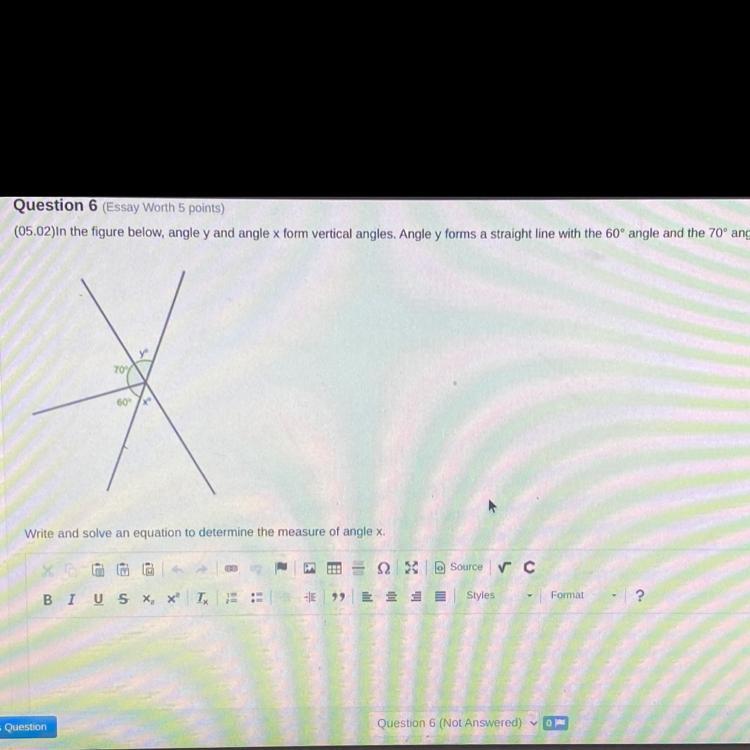
Answers
Y =50, vertical angles are congruent
X=50 degrees
In a standard deck of cards, what is the probability of drawing a red card or a face card?
Answers
Answer:
3/26
Step-by-step explanation:
6 of the 52 cards are red
What the answer ......

Answers
how many solutions are there to square root x =9
Answers
Answer:
There are 2 solutions to square root x = 9
They are 3, and -3
Step-by-step explanation:
The square root of x=9 has 2 solutions,
The square root means, for a given number, (in our case 9) what number times itself equals the given number,
Or, squaring (i.e multiplying with itself) what number would give the given number,
so, we have to find the solutions to \(\sqrt{9}\)
since we know that,
\((3)(3) = 9\\and,\\(-3)(-3) = 9\)
hence if we square either 3 or -3, we get 9
Hence the solutions are 3, and -3
Which, if any, of the following generalized formulas does not exist for interhalogen compounds? (X and Y represent different halogens.)
XY
XY2
XY3
XY5
All the above can represent stable interhalogen compounds.
Answers
All the above can represent stable interhalogen compounds. Interhalogen compounds are formed when different halogens combine with each other.
The general formula for interhalogen compounds is given by XYn, where X and Y represent different halogens, and n represents the number of Y atoms bonded to the X atom. The interhalogen compounds can have different stoichiometries, resulting in different values of n. Therefore, all the given formulas, XY, XY2, XY3, and XY5, can represent stable interhalogen compounds, depending on the specific combination of halogens and their bonding arrangements.
Hence, none of the given formulas does not exist for interhalogen compounds, as all of them can be valid representations of stable interhalogen compounds.
To learn more about compounds click here: brainly.com/question/31217310
#SPJ11
simplify the expression
e^-3•e^8
Answers
Answer:
\(e^{5}\)
Step-by-step explanation:
using the rule of exponents
\(a^{m}\) × \(a^{n}\) = \(a^{(m+n)}\) , then
\(e^{-3}\) × \(e^{8}\) = \(e^{(-3+8)}\) = \(e^{5}\)
what is the square root of 1476
Answers
Answer : 6√41
Preston uses the bar diagram
below to represent 4x - 3 = 13. How would you
use the bar diagram to solve for x?
please hurry
Answers
Answer: x = 4
Step-by-step explanation:
4x = 13 + 3
4x = 16
x = 16/4
x = 4
−1.64 as a mixed number in simplest form.
Answers
-41\25
Lucius and Angelina's teacher gave them a system of linear equations to solve. They each took a few steps that led to the systems shown in the table below.

Answers
Answer:
both
Step-by-step explanation:
Luc and Ang both just didn't simply one of there equations, otherwise it is equal
Find the total surface area of this triangular prism.
10cm
6 cm
4cm
8 cm

Answers
Method:
Front: 6x8 = 48/2 = 24
Back: Also 24
Base: 8x4 = 32
Left: 6x4=24
Add your answers:
24 + 24 + 24 + 32 + 40
Answer:
TSA is 144 cm²
How many per ounces and which circle do I need to choose

Answers
We are asked to determine the unit price of two different packages. The unit price is determined by dividing the price of an item over the quantity used to measure that item at the given price. In this case, the unit of measure is "ounce", therefore, we need to determine the price per ounce. The first unit price is determined by dividing the price of $3.19 for 11.5 ounces, like this:
\(P_1=\frac{3.19\text{ dollars}}{11.5\text{ ounces}}=0.28\text{ dollar/ounce}\)Since we are told to round to the nearest cent we take the first two digits after the decimal point and we add 1 to the second digit if the third digit is equal to or greater than 5.
Now we use the same procedure to determine the second unit price:
\(P_2=\frac{7.98\text{ dollars}}{30.6\text{ ounces}}=0.26\text{ dollar/ounce}\)Since the unit price for the 30.6 ounces package is less than the price for the 11.5 ounces package this means that the second package is a better buy.
A radar station is 2000 ft from the launch site of a rocket. If the rocket is launched vertically at the
rate of 500 ft/sec, how fast is the distance between the radar station and the rocket changing 10 seconds
later?
Answers
Answer: f 500 Ft./sec
Step-by-step explanation:
By evaluating the derivate of the distance in t = 10s, we will see that at t = 10s the distance is changing at a rate of 464.2 ft/s
We can think of the situation as in a right triangle, one cathetus is equal to 2000ft, and the other cathetus increases at a rate of 500ft/sec.
The hypotenuse would be the distance between the radar and the rocket.
Then the distance function is:
\(D(t) = \sqrt{(2000ft)^2 + (500ft/s*t)^2}\)
Now we need to get the rate of change, this is given by:
\(\frac{dD(t)}{dt} = (1/2)*\frac{2*(500ft)^2*t}{\sqrt{(2000ft)^2 + (500ft/s*t)^2} }\)
Now we evaluate this in t = 10s to get:
\(\frac{dD(10s)}{dt} = (1/2)*\frac{2*(500ft/s)^2*10s}{\sqrt{(2000ft)^2 + (500ft/s*10s)^2} } = 464.2 ft/s\)
If you want to learn more, you can read:
https://brainly.com/question/18904995
What are the coordinates of the vertex

Answers
Answer:
(-1,1)
Step-by-step explanation:
The vertex is the tip of the parabola.
-hope it helps