if a binomial experiment has seven trials in which the probability of success is p and the probability of failure is q, write an expression that could be used to compute each of the following probabilities: a) p(exactly five successes) b) p(at least five successes) c) p(at most five successes)?
Answers
To calculate the probability of getting at most five successes, we can add up the probabilities of getting 0, 1, 2, 3, 4, or 5 successes
Sure, here are the expressions that can be used to compute each of the probabilities:
a) p(exactly five successes) = (7 choose 5) * p^5 * q^2
This expression uses the binomial coefficient (7 choose 5), which represents the number of ways to choose 5 successes out of 7 trials. We then multiply this by the probability of getting 5 successes (p^5) and the probability of getting 2 failures (q^2).
b) p(at least five successes) = p(five successes) + p(six successes) + p(seven successes)
To calculate the probability of getting at least five successes, we can add up the probabilities of getting exactly 5, 6, or 7 successes. We can use the expression from part a to calculate each of these probabilities.
c) p(at most five successes) = p(zero successes) + p(one success) + p(two successes) + p(three successes) + p(four successes) + p(five successes)
. We can again use the expression from part a to calculate each of these probabilities.
Know more about probability here:
https://brainly.com/question/30034780
#SPJ11
Related Questions
Let V be the volume of a cube with side length x feet. If the cube expands as time passes at a rate of 2 ft/min, how fast is the side length x changing when x = 3? (Hint: x and V are both changing as functions of time.
Answers
When the side length of the cube is 3 feet, it is expanding at a rate of 2/27 ft/min.
To solve this problem, we need to relate the rate of change of the volume, dV/dt (the derivative of V with respect to time), to the rate of change of the side length, dx/dt (the derivative of x with respect to time). We can do this by using the relationship between the volume and the side length of a cube.
The volume V of a cube is given by V = x³, where x represents the side length of the cube. Since both V and x are changing with time, we can differentiate this equation with respect to time t to obtain:
dV/dt = d/dt (x³)
Now, let's find the derivative of x³ with respect to t. By applying the chain rule, we have:
dV/dt = 3x² * dx/dt
This equation relates the rate of change of the volume to the rate of change of the side length. We know that the rate of change of the volume, dV/dt, is 2 ft/min, as given in the problem. Therefore, we can substitute this value into the equation:
2 = 3x² * dx/dt
Now, we can solve for dx/dt, which represents the rate at which the side length is changing. Let's plug in x = 3 into the equation:
2 = 3(3²) * dx/dt
2 = 3(9) * dx/dt
2 = 27 * dx/dt
To isolate dx/dt, we divide both sides by 27:
2/27 = dx/dt
So, when x = 3, the rate at which the side length is changing, dx/dt, is equal to 2/27 ft/min.
To know more about volume here
https://brainly.com/question/11168779
#SPJ4
in a recent survey 60% of those surveyed indicated that they preffered walking to running. a.if 540 people preffered walking how many people were surveyed?? b.how many people preferred running??
Answers
Answer:
216 person
Step-by-step explanation:
100-60=40%
540×40/100=216 person
What percentage of a dollar is the value of 1 nickel and 3 pennies?
Answers
Answer:
50%
Step-by-step explanation:
say u have 3 friends coming to a party each get 8 cookies and each box has 4 cookies how man boxes would u have to buy
Answers
Answer:
3 * (8/4) = 6
each person needs 8 cookies at 4 per box
you need 8/4 boxes per friend
you have three friends so 3 * (8/4)
Step-by-step explanation:
Smoky Hill DECA and Grandview DECA are both heading down to the state finals in Colorado Springs. Smoky Hill took 8 vans and 8 mini-busses with 240 students while Grandview took 4 vans and 1 mini-bus for a total of 54 students. How many students does a van Hold? How many students does a mini-bus hold?
Answers
Answer:
number of students in a van = 8
number of students in a minibus = 22
Step-by-step explanation:
Let
x = number of students in a van
y = number of students in a minibus
8x + 8y = 240 (1)
4x + y = 54 (2)
Multiply (2) by 8 to eliminate y
4x + y = 54 ×8
32x + 8y = 432 (3)
8x + 8y = 240 (1)
32x + 8y = 432 (3)
Subtract (1) from (3)
32x - 8x = 432 - 240
24x = 192
Divide both sides by 24
x = 192 / 24
= 8
x = 8 students
Substitute x = 8 into (2)
4x + y = 54
4(8) + y = 54
32 + y = 54
y = 54 - 32
= 22
y = 22 students
number of students in a van = 8
number of students in a minibus = 22
answer and or help would be much appreciated work is due and needs to be submitted
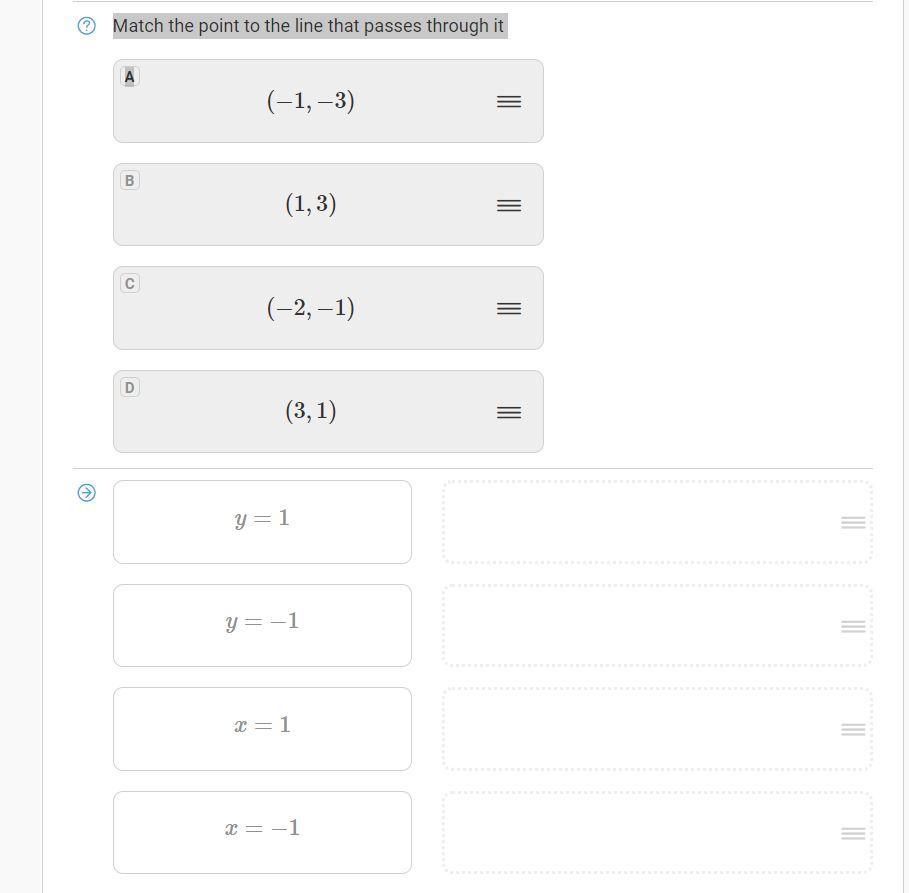
Answers
Answer:
1. D
2. C
3. B
4. A
Step-by-step explanation:
just match up the number y is on the right side and x on the left side like this (x,y)
in 1998, the university of wisconsin collected data on means of transportation to work. in 2008, betsy (a university of minnesota student) used the data for her own project. betsy is using which data collection method? secondary analysis evaluation research survey experiment field research.
Answers
in 1998, the university of Wisconsin collected data on means of transportation to work. in 2008, Betsy (a university of Minnesota student) used the data for her own project. betsy is using Secondary analysis collection method.
Secondary data is information gathered by someone other than the original user. It signifies that the data is already accessible and has been analyzed. Magazines, newspapers, books, and journals are examples of secondary data. It might be published or unpublished data.
Secondary analysis is the use of existing data acquired for the purposes of a previous study to pursue a research interest that is unique from the original work; this might be a new research topic or an alternate viewpoint on the original subject.
Secondary research methods commonly used include data acquisition via the internet, libraries, archives, schools, and organizational reports.
For more questions on Secondary analysis collection method.
https://brainly.com/question/26711803
#SPJ4
a=1/2(b_1 + b_2)h solve for h
Answers
Answer: H = 1
Step-by-step explanation:
a new printing press can print newspapers twice as fast as the old one can. the old one can print the afternoon edition in 4 hours. find how long it takes to print the afternoon edition if both printers are operating.
Answers
The speed of both printers operating together is 1.333 hours which was found using the given data.
What is distance, time and speed?The formula used to explain the connection between speed, distance, and time is speed = distance/time.
Given: Newspapers can be printed twice as quickly on a modern printing press as they can on an old one. The old one takes four hours to publish the afternoon edition.
Let,
a = Speed of New printing press
b = Speed of Old printing press
x = Speed of both printers operating together
We know that,
(1/a)+(1/b)=(1/x)
(1/2)+(1/4)=(1/x)
(4/8)+(2/8)=(1/x)
6/8=1/x
x=8/6
x=1.333
Therefore, the speed of both printers operating together is 1.333 hours which was found using the given data.
Learn more about speed, distance and time here:
https://brainly.com/question/19915685
#SPJ4
I INCLUDED THE GRAPH! PLEASE HELP ITS URGENT PLEASE I AM DOING MY BEST TO RAISE MY GRADE!!!
Graph g(x)=−|x+3|−2.
Use the ray tool and select two points to graph each ray.

Answers
The graph of the function g(x) = −|x + 3| − 2 is added as an attachment
How to determine the graph of the functionFrom the question, we have the following parameters that can be used in our computation:
g(x) = −|x + 3| − 2
The above expression is an absolute value function that hs the following properties
Reflected over the x-axisTranslated left by 3 unitsTranslated down by 2 unitsVertex = (-3, -2)Next, we plot the graph
See attachment for the graph of the function
Read more about graph at
https://brainly.com/question/30390162
#SPJ1

Let v =LeftAngleBracket 8, negative 1 RightAngleBracket. What is the approximate direction angle of v?
7°
83°
173°
353°
Answers
Answer:
D. 353
Step-by-step explanation:
just took test
The approximate direction angle of v =<8, -1> is 353°
What is direction angle?For any vector its direction angle is the angle that vector makes with a horizontal line.
Formula to find the direction angle of vector:The direction angle of vector <x , y> is ,
\(\theta=tan^{-1}(\frac{y}{x} )\)
For given example,
We have been given a vector v = <8, -1>
Let \(\theta\) be the direction angle
x = 8, y = -1
Using the formula of direction angle of vector,
\(\Rightarrow \theta=tan^{-1}(\frac{y}{x} )\\\\\Rightarrow \theta=tan^{-1}(\frac{-1}{8} )\\\\\Rightarrow \theta=tan^{-1}(-0.125)\\\\\Rightarrow \theta=-7.12501635\\\\\Rightarrow \theta \approx -7^{\circ}\)
If we measure this angle in anticlockwise direction then the direction angle would be,
\(\Rightarrow \theta=360^{\circ}-7^{\circ}\\\\\Rightarrow \theta=353^{\circ}\)
Therefore, the approximate direction angle of v is 353°
Learn more about the direction angle of vector here:
https://brainly.com/question/17330233
#SPJ2
Find the lowest common denominator (multiple). Type the equivalent fractions. Then, add or subtract. Simplify your answer. 1
2
1
3
Answers
Answer:what
Step-by-step explanation:what does this mean
Determine whether the statement is true or false. If the statement is false, explain why. The midpoint of the segment joining (0,0) and (38,38) is 19.
Answers
The midpoint has coordinates (19,19) as per the midpoint formula.
The statement is false.
The statement is false. The midpoint of the segment joining two points is determined by taking the average of their x-coordinates and the average of their y-coordinates. In this case, the two given points are (0,0) and (38,38).
To find the x-coordinate of the midpoint, we take the average of the x-coordinates of the two points:
(x1 + x2) / 2
= (0 + 38) / 2
= 38 / 2
= 19
Therefore, the x-coordinate of the midpoint is 19, which matches the statement. However, to determine if the statement is true or false, we also need to check the y-coordinate.
To find the y-coordinate of the midpoint, we take the average of the y-coordinates of the two points:
(y1 + y2) / 2
= (0 + 38) / 2
= 38 / 2
= 19
The y-coordinate of the midpoint is also 19. Therefore, the coordinates of the midpoint are (19,19), not 19 as stated in the statement. Since the midpoint has coordinates (19,19), the statement is false.
To learn more about the midpoint;
https://brainly.com/question/28224145
#SPJ4
The coordinates of Point P are
.
The coordinates of Point T are
.
Point
is located at (1
2
, −21
2
).
Answers
The minimum distance between Point P and Point T is √(97)
The coordinates of point P are (-2, 6).
The coordinates of point T are (6, -2).
Point S is located at (1/2, -21/2).
To find the coordinates of Point P and Point T, use the distance formula.
The distance formula for two points, A(x1, y1) and B(x2, y2) is given as:
Distance, AB = √[ (x2 - x1)² + (y2 - y1)² ]
Now, substituting the coordinates of Point P and Point T into the distance formula gives
:Distance, PT = √[ (xT - xP)² + (yT - yP)² ]... Equation (1)
Let d be the distance PT. Using the coordinates of Point S, we can express the distance PT as the sum of two smaller distances, PS and ST.
Distance, PT = PS + ST... Equation (2)
Substituting the coordinates of Point P and Point S into Equation (2),
we get: Distance, PS = √[ (1/2 - (-2))² + (-21/2 - 6)² ] = √(97)Distance,
ST = √[ (6 - 1/2)² + (-2 - (-21/2))² ] = √(97)
Therefore, d = PS + ST = 2 √(97).
By Pythagoras theorem, if x is the distance from Point P to Point S along the x-axis, then:
Distance, PS = |x - 1/2|And, if y is the distance from Point P to Point S along the y-axis, then:
Distance, PS = |y - (-21/2)|
Thus, the distance PT can be expressed in terms of x and y as follows: d = |x - 1/2| + |y + 21/2|... Equation (3)
Now, we need to find the minimum value of d. We can do this by first minimizing the first term |x - 1/2| and then minimizing the second term |y + 21/2|.
To minimize the first term |x - 1/2|, x should be as close as possible to 1/2.
Therefore, let x = 1/2.
Then, substituting x = 1/2 into Equation (1)
gives:|y - (-21/2)| = 2 √(97)Solving for y,
we get: y = -21/2 ± 2 √(97)
Substituting y = -21/2 + 2 √(97) into Equation (3),
we get: d = √(97)
To know more about distance visit:
https://brainly.com/question/13034462
#SPJ11
For every 7 push-ups Dulce can do, Sara can do 6. If Ducle did 28 push-ups during gym class, how many push-ups did sara do?
Answers
The number of push-ups did sara did during gym class if for every 7 push-ups Dulce can do, Sara can do 6 is 24 push ups.
How to solve ratio?Number of push ups Dulce can do : number of push ups Sara can do
Let
number of push ups Sara does = x
7 : 6 = 28 : x
7/6 = 28/x
cross product
7 × x = 28 × 6
7x = 168
divide both sides by 7
x = 168/7
x = 24
Therefore, Sara does 24 push ups during the gym class.
Read more on ratio:
https://brainly.com/question/2328454
#SPJ1
X
3
⋅y
4
x, cubed, dot, y, start superscript, 4, end superscript when x=3x=3x, equals, 3 and y=0y=0y, equals, 0?
Answers
The value of \(x^{3} . y^{4x}\) when x = 3 and y = 0 is 0.
Zero: Zero is a number that denotes nothingness. By multiplying the digits to the left of 0 by the radix, typically by 10, 0 also serves as a placeholder numerical digit in place-value notation, such as the Hindu–Arabic numeral system. As a number, 0 satisfies a focal job in science as the added substance personality of the numbers, genuine numbers, and other logarithmic designs.
Given that,
x = 3 and,
y = 0
Substituting the values in the equation \(x^{3} . y^{4x}\) .
= 3³ × 0⁴⁽³⁾
= 27 × 0¹²
Additionally, we are aware that anything raised to the power of zero also returns zero.
thus, 27 × 0 = 0
Learn more about zero here: https://brainly.com/question/15238532
#SPJ4
(complete question)
What is the value of \(x^{3} . y^{4x}\) when x = 3 and y = 0?
A rectangular cotton field is 525 feet wide. The field of cotton has a perimeter of 2025 feet. Which equation represents the cotton field
Answers
Answer:
hi
Step-by-step explanation:
which expression is equivalent to 2^2 x 2/24
a. 2^-2
b.2^-1
c.2^6
d.2^7
Answers
Answer:
noneStep-by-step explanation:
which expression is equivalent to 2^2 x 2/24
a. 2^-2
b.2^-1
c.2^6
d.2^7
2^2 * 2/24 =
4 * 2/24 =
4 * 1/12 =
1/3
then
1/3 = 0.33
find equivalent
a) 2^-2 = 0.25
b) 2^-1 = 0.5
c) 2^6 = 64
d) 2^7 = 128
I'm stuck and I need help quick

Answers
Answer:4
Step-by-step explanation:
The square root of 9 is 3, 3 multiplied by 2 is 6, and 10 - 6 =4.
Deloria says she can find the relative frequency of nuts based on another relative frequency. What might she be doing?
Answers
Answer:
frequency of nuts based on another relative frequency. What might
she be doing
nuts:3/30=15%
In investigating whether stress is a factor in aging, telomere length was measured in women with chronically ill children, and compared to the number of years since the child's diagnosis. Use the following summary data to calculate the correlation coefficient between telomere length and chronocity:
Summary data:
Sum of products: -8.822
Sum of squares for chronicity: 318.817
Sum of squares for telomere length: 2.868
Total sample size: 38
Answers
The calculated correlation coefficient (r) is approximately -0.291.
To calculate the correlation coefficient between telomere length and chronicity, we can utilize the given summary data. The correlation coefficient, often denoted as r, measures the strength and direction of the linear relationship between two variables.
Let's denote the sum of products as Σxy, the sum of squares for chronicity as Σx², the sum of squares for telomere length as Σy², and the total sample size as n.
From the given data, we have the following values:
Σxy = -8.822
Σx² = 318.817
Σy² = 2.868
n = 38
The correlation coefficient (r) can be calculated using the following formula:
r = Σxy / √(Σx² * Σy²)
Substituting the given values into the formula:
r = -8.822 / √(318.817 * 2.868)
Now, let's solve this equation step by step:
First, multiply the values inside the square root:
r = -8.822 / √(913.350956)
Next, calculate the square root:
r = -8.822 / 30.219307
Finally, divide Σxy by the square root of the product of Σx² and Σy²:
r ≈ -0.291
To know more about correlation coefficient here
https://brainly.com/question/29978658
#SPJ4
Consider the function (x, y) = yi + x2j that function (x, y) is defined over the triangle with vertices (−1,0), (0,1), (1, −1)
a) The first part of the exercise is solved by a line integral (such a line integral is regarded as part of the Green's theorem).
b) You must make a drawing of the region.
c) The approach of the parameterization or parameterizations together with their corresponding intervals, the statement of the line integral with a positive orientation, the intervals to be used must be "consecutive", for example: [0,1],[1,2] are consecutive, the following intervals are not consecutive [−1,0],[1,2] The intervals used in the settings can only be used by a once.
d) Resolution of the integral.
Answers
a) Line Integral part of Green's Theorem: Green's theorem is given as follows: ∮ P dx + Q dy = ∬ (Qx - Py) dA
Here, P = yi, Q = x^2, x runs from -1 to 1, and y runs from 0 to 1 - x.
We can now use Green's theorem to write
∮ Pdx + Qdy = ∬ (Qx - Py) dA = ∫ -1^1 ∫ 0^(1 - x) ((x^2 - 0i) - (yj) dy dx)
= ∫ -1^1 ∫ 0^(1 - x) x^2 dy dx
= ∫ -1^1 [x^2y]0^(1-x)dx= ∫ -1^1 x^2 (1-x) dx
= ∫ -1^1 (x^2 - x^3) dx= 2/3
b) Region's Drawing: [asy] unitsize(2cm); pair A=(-1,0),B=(0,1),C=(1,-1); draw(A--B--C--cycle); dot(A); dot(B); dot(C); label("$(-1,0)$",A,S); label("$(0,1)$",B,N); label("$(1,-1)$",C,S); label("$y=1-x$",B--C,W); label("$y=0$",A--C,S); label("$y=0$",A--B,N); [/asy]
c) Parameterization's Approach: To parameterize the triangle ABC, we can use the following equations: x = s t1 + t t2 + u t3y = r t1 + s t2 + t t3.
Here, we can use: A = (-1, 0), B = (0, 1), C = (1, -1)to obtain: s(1,0) + t(0,1) + u(-1,-1) = (-1,0)r(1,0) + s(0,1) + t(1,-1) = (0,1)t(1,0) + r(0,1) + s(-1,-1) = (1,-1).
We get: s - u = -1r + s - t = 1t - s = 1.From the above equations, we get the following values:s = t = (1 - u)/2r = (1 + t)/2From this, we get our parameterization as follows: x(u) = u/2 - 1/2y(u) = (u + 1)/4
d) Integral's Resolution: Since we have already obtained our parameterization as: x(u) = u/2 - 1/2y(u) = (u + 1)/4.we can now use the formula for a line integral as follows:∫ P(x,y)dx + Q(x,y)dy = ∫ F(x(u),y(u)) . dr/dt dt [a,b]
Here, we can use P(x, y) = yi, Q(x, y) = x^2, a = 0, b = 1.Substituting everything, we get:
∫ P(x,y)dx + Q(x,y)dy = ∫ F(x(u),y(u)) .
dr/dt dt [0,1]= ∫ -1^1 (u/4 + 1/16) . (1/2)i + (1/2 - u^2/4) . (1/4)j du
= ∫ -1^1 (u/8 + 1/32)i + (1/8 - u^2/16)j du
= [u^2/16 + u/32](-1)^1 + [1/8u - u^3/48](-1)^1= 1/2
Let's learn more about Green's theorem:
https://brainly.com/question/23265902
#SPJ11
Students were asked to choose their favorite subject. If 3/10 of the students chose history and 5/10 chose biology, what fraction chose either history or biology?
Answers
Answer: 8/10
Step-by-step explanation:
if you do 5/10 plus 3/10 it equals 8/10 and that is what the question is telling you to do.
Convert 73.5% to a fraction in lowest terms.
Answers
Answer:
147/200
Step-by-step explanation:
Please Answer.Dont show the work. Just please explain the work and how to get the answer.Water comes out of Leigh's garden hose at a rate of 1 gallon per of a minute. What is the unit rate at which water flows out of Leigh's garden hose?
A. of a gallon per 4 minutes
B. of a gallon per minute
C. 4 gallons per minute
D. 9 gallons per 4 minutes

Answers
Answer:
A
Step-by-step explanation:
I have the same question and got it write
A classroom has a length of 20ft. And a width of 30ft. The flooring is to be replaced by tiles. If each tile has a length of 24 in and a width of 36 in, how many tiles are needed to cover the classroom?
Answers
Answer:
100
Step-by-step explanation:
first we need to turn the feet into inches
20x12=240
30x12=360
now to get the area of the floor we need to do 360x240=
86,400
now the area of each tile is 24x36=864
now to find out how many tiles fit on the floor we need to do 86,400 divided by 864 which = 100
please do only part B in 45 minutes please urgently... I'll give you up thumb definitely2. Consider the following two-period model of the current account: U = (1-8)In(C1) + Bln(C2)
C1 = Y1
-
CA1, C2 = Y2+ (1+r)CA1
CA1+CA20
where C is consumption, CA is the current account balance, and r is the given world interest rate. Y1, Y2 > 0 are given endowments in periods 1 and 2 and 0 < < 1 is a known parameter.
(a) Derive the lifetime budget constraint C1+2 = Y1+12, and find analytical solutions for C1, C2, CA1, CA2. Show that the home country runs a current account deficit in period 1 if and only if where A is the autarky interest rate.
pA >r,
(b) We now set Y1 1, Y2 = 2, r = 0.1, B
=
0.5. Find numerical
[10%]
U = (1-3) + B
Cl-o 1-6
1-0
solutions for C1, C2, CA1, CA2. How do the solutions differ if where σ = 2? Comment on the results. [10%]
Answers
In this two-period model of the current account, the utility function U is given by U = (1-θ)ln(C1) + Bln(C2), where C1 and C2 represent consumption levels, CA1 and CA2 are the current account balances, r is the world interest rate, Y1 and Y2 are endowments in periods 1 and 2, and θ is a known parameter between 0 and 1.
(a) To derive the lifetime budget constraint, we add the present value of future income to the current period income: C1 + (1+r)C2 = Y1 + (1+r)Y2. This equation represents the constraint on total consumption over the two periods. By substituting the given expressions for C1 and C2 into the constraint, we can solve for C1, C2, CA1, and CA2 analytically:
C1 = Y1 - CA1
C2 = Y2 + (1+r)CA1 - CA2
CA1 = (1-θ)Y1 - C1
CA2 = (1-θ)(1+r)Y1 + θY2 - C2
To show that the home country runs a current account deficit in period 1 if and only if pA > r, where pA is the autarky interest rate, we need to compare the autarky interest rate with the world interest rate. If the autarky interest rate is greater than the world interest rate, the home country will experience a current account deficit in period 1.
It's important to note that the numerical solutions and interpretations depend on the specific values and equations given in the question. Any errors or omissions in the question may affect the accuracy of the response.
To learn more about two-period model: -brainly.com/question/23679509
#SPJ11
Solve:
3x + x -5 = 2(x -2)
Answers
Answer:
it's says that it is ×=1
Step-by-step explanation:
3×-5=2(x-2)
3x-5=2x-4
3x-5+5=2x-4+5
3x=2x+1
3x=2x + 1
3x-2x=2x+1-2x
Answer x=1
Dice A and dice B have ten sides. What is the probability of rolling and odd number with both dice A and B?
Answers
The probability of rolling and odd number with both dice A and B is 1/4.
What is probability?Probability simply means the likelihood that an event will occur on a scenario.
Since Dice A and dice B have ten sides,the numbers will be from 1 to 10. Therefore, there are 5 even numbers and 5 odd numbers.
Probability of odd number = 5/10 = 1/2
Probability of even number = 5/10 = 1/2
Probability of rolling both odd numbers will be:
= P(odd) × P(odd)
= 1/2 × 1/2
= 1/4
The probability is 1/4.
Learn more about probability on:
brainly.com/question/24756209
#SPJ1
(x+3)*(x+4)*(x+5)*(x+6)+1
Answers
ANSWER:
