idk if im in the right subject but please help
Which outcome would most likely suggest that data collected is unreliable?
A.)Other scientists conduct the same study but find different data.
B.) The data is put on a scatterplot but does not show any trend.
C.)Each data point is considered by many scientists to be accurate.
D.)Many tools were used in the same laboratory to measure the data.
Answers
A.
Let's break it down:
-If the study has been conducted by multiple others and they get different results, it might be a sign that something went wrong in the experiment, and the data is unreliable. For example, if everybody else timed an event and got the same exact time except for the fact that you got a different time, you may start to suspect that you had done something wrong and the data was unusable.
Hope this helped! :)
Related Questions
Which is a question which science cannot answer?
How does the moon affect tides on earth?
When will the next earthquake happen?
Why do volcanoes erupt?
How long does it take for the earth to rotate on its axis?
Answers
Answer:
When the next earthquake will happen
Explanation:
science cannot predict exactly when something like that will happen.
Which of the following was derived from an ancestral free-living bacteria?
Lysosome
Vacuole
Mitochondrion
Golgi Appartus
Answers
Answer:
Option C Mitochondrion
Explanation:
The mitochondrion was derived from an ancestral free-living bacteria
HELP ASAP!!
Research how coral reefs are formed. What types of animals live there? What important roles do cnidarians play in coral reefs? How do the tiny animals get their food? How do algae help the corals? Write three paragraphs describing coral reefs. Include the information listed above plus any other information you find.
Answers
Fish, corals, lobsters, clams, seahorses, sponges, and sea turtles are only a few of the thousands of creatures that rely on reefs for their survival.
Cnidaria have important ecological roles as reef structure builders, and as predators and prey in planktonic and benthic ecosystems.
At night, coral polyps come out of their skeletons to feed, stretching their long, stinging tentacles to capture critters that are floating by. Prey are pulled into the polyps' mouths and digested in their stomachs.
Algae belonging to the group known as dinoflagellates live inside the corals' tissues. The algae use photosynthesis to produce nutrients, many of which they pass to the corals' cells. The corals in turn emit waste products in the form of ammonium, which the algae consume as a nutrient.
Coral reefs begin to form when free-swimming coral larvae attach to submerged rocks or other hard surfaces along the edges of islands or continents. As the corals grow and expand, reefs take on one of three major characteristic structures — fringing, barrier or atoll.
Fish, corals, lobsters, clams, seahorses, sponges, and sea turtles are only a few of the thousands of creatures that rely on reefs for their survival.
Cnidaria have important ecological roles as reef structure builders, and as predators and prey in planktonic and benthic ecosystems.
At night, coral polyps come out of their skeletons to feed, stretching their long, stinging tentacles to capture critters that are floating by. Prey are pulled into the polyps' mouths and digested in their stomachs.
Algae belonging to the group known as dinoflagellates live inside the corals' tissues. The algae use photosynthesis to produce nutrients, many of which they pass to the corals' cells. The corals in turn emit waste products in the form of ammonium, which the algae consume as a nutrient.
A coral reef is an underwater ecosystem characterized by reef-building corals. Reefs are formed of colonies of coral polyps held together by calcium carbonate.[1] Most coral reefs are built from stony corals, whose polyps cluster in groups.
Coral belongs to the class Anthozoa in the animal phylum Cnidaria, which includes sea anemones and jellyfish. Unlike sea anemones, corals secrete hard carbonate exoskeletons that support and protect the coral. Most reefs grow best in warm, shallow, clear, sunny and agitated water. Coral reefs first appeared 485 million years ago, at the dawn of the Early Ordovician, displacing the microbial and sponge reefs of the Cambrian.[2]
Sometimes called rainforests of the sea,[3] shallow coral reefs form some of Earth's most diverse ecosystems. They occupy less than 0.1% of the world's ocean area, about half the area of France, yet they provide a home for at least 25% of all marine species,[4][5][6][7] including fish, mollusks, worms, crustaceans, echinoderms, sponges, tunicates and other cnidarians.[8] Coral reefs flourish in ocean waters that provide few nutrients. They are most commonly found at shallow depths in tropical waters, but deep water and cold water coral reefs exist on smaller scales in other areas.
Coral reefs have declined by 50% since 1950, partly because they are sensitive to water conditions.[9] They are under threat from excess nutrients (nitrogen and phosphorus), rising ocean heat content and acidification, overfishing (e.g., from blast fishing, cyanide fishing, spearfishing on scuba), sunscreen use,[10] and harmful land-use practices, including runoff and seeps (e.g., from injection wells and cesspools).[11][12][13]
Coral reefs deliver ecosystem services for tourism, fisheries and shoreline protection. The annual global economic value of coral reefs has been estimated at anywhere from US$30–375 billion (1997 and 2003 estimates)[14][15] to US$2.7 trillion (a 2020 estimate)[16] to US$9.9 trillion (a 2014 estimate).[17]
Sorry I gave you more than 3 paragraphs.
This weather map showed the temperature (in °F) in the United States on a winter day. It also includes two pressure systems, labeled "H" and "L." Explain where weather fronts are most likely located, and predict the weather at each pressure system.
Read the assignment carefully and make sure you answer each part of the question or questions.
After you've written your response, go back and read it again to make sure your thoughts are clear.
Please someone answer I need help.
Answers
Answer: The Low Pressure systems will usually be found more North where it gets verycold but can really happen anywhere, and High pressure systems are usually found in the Southwest during winter.
Explanation:
High Pressure:A high pressure system has higher pressure at its center than the areas around it. Winds blow away from high pressure. Swirling in the opposite direction from a low pressure system, the winds of a high pressure system rotate clockwise north of the equator and counterclockwise south of the equator. This is called anticyclonic flow. Air from higher in the atmosphere sinks down to fill the space left as air is blown outward. On a weather map, you may notice a blue H, denoting the location of a high pressure system.
Low Pressure:
A low pressure system has lower pressure at its center than the areas around it. Winds blow towards the low pressure, and the air rises in the atmosphere where they meet. As the air rises, the water vapor within it condenses, forming clouds and often precipitation. Because of Earth’s spin and the Coriolis effect, winds of a low pressure system swirl counterclockwise north of the equator and clockwise south of the equator. This is called cyclonic flow. On weather maps, a low pressure system is labeled with red L.

List 3 negative impacts does plastic pollution have on the ocean?
Answers
Ingestion
And suffocation
Answer:
Negative physical impact on marine life, chemical impact on the water, and transport of native species.
Explanation:
Negative physical impact on marine life:
Plastic can be dangerous to creatures living in the ocean. Marine animals can fatally swallow plastic, become entangled in it, and even become physically impaired for the rest of their life.
Chemical impact on the water:
Plastics carry chemicals such as PCBs and DDT that can invade the water and cause harm to marine ecosystems.
Transport of native species:
Plastic can carry organisms from one part of the ocean to a relatively remote area. By introducing new organisms to an ecosystem, the flow can be disrupted and result in major consequences.
Use the picture below to answer the question.
The picture shows a representation of fossil skulls.
An illustration shows the evolution of the human skull from Australopithecus, homo erectus, homo sapiens neanerthalensis, to homo sapiens.
What do these skulls in the fossil record tell us about hominin evolution?
(1 point)
Responses
The jaw grew relatively larger as hominins evolved.
The jaw grew relatively larger as hominins evolved.
Hominins grew taller as they evolved.
Hominins grew taller as they evolved.
The nose became more prominent as hominins evolved.
The nose became more prominent as hominins evolved.
Human skulls became more pointed as hominins evolved.

Answers
These skulls in the fossil record reveals that the nose became more prominent in the hominin evolution, option C.
What is the evolution of hominins?The evolution of hominins is a known process where by hominins (a group of primates including modern humans and similar evolutionary ancestry) had morphed over time. The changes in shape and structure of the skulls are evident in the fossil record exhibits of the hominin skull over time, indicating a process of evolution.
These changes include a reduction in the size of brow ridge and the jaw, an increased capacity in the cranium, a more prominent nose, and a vertically oriented skull that is equally round. These modifications reflect hominins' alterations to dynamic environments, nutrition, and social constructs as they evolved over time.
Learn more on the hominins here: https://brainly.com/question/13959334
#SPJ1
Explain how energy is conserved even though the amount of energy available decreases as you move up the pyramid.
Answers
Answer:
in the explanation part
Explanation:
The amount of energy at each trophic level decreases as it moves through an ecosystem. As little as 10 percent of the energy at any trophic level is transferred to the next level; the rest is lost largely through metabolic processes as heat.
Help please (Science)

Answers
Answer:
oh, gladly!
Explanation: 10. vacuoles
the rest i have no answer to, or its not on there.
i apologize.
please help will mark brainliest for answer with explanation, but will report if rubbish answers are given
thank you

Answers
Answer:
A is the cell surface membrane
B is the nucleus
C is the cytoplasm
please help i do not understand it. does anyone?
Answers
Answer:
1 summer
2winter
3 spring
4 i was able to solve that by knowing the sequence of changes followed by winter
A chemical equation is __________________ that scientists use to describe a chemical reaction.
Answers
Answer:
reactants or a product
Explanation:
A chemical reaction is a process in which one or more substances, also called reactants, are converted to one or more different substances, known as products. ... A chemical reaction rearranges the constituent atoms of the reactants to create different substances as products.
Answer: symbolic representation
Explanation: noun. a representation of a chemical reaction using symbols of the elements to indicate the amount of substance, usually in moles, of each reactant and product
What are some of the other common organisms that live in the desert (biotic factors)?
Answers
Answer:
Some of the other common organisms that live in the desert (biotic factors) include reptiles, amphibians, insects, small mammals, and birds. This can be determined by using the information from desertusa.com, which states that some of the other common organisms that live in the desert (biotic factors) include reptiles, amphibians, insects, small mammals, and birds.
Explanation:
Answer:
In deserts, you'll usually see a lot of open land and not much of any plants. Animals that live in deserts include lizards, geckos, jackrabbits, camels, snakes, spiders and meerkats.
Type the correct answer in each box. Use numerals instead of words.
A force of 25 newtons moves a box a distance of 4 meters in 5 seconds.
The work done on the box is
Nm, and the power is
Nm/s.
Answers
overheating of an enzyme means the enzyme has lost its ___ (15pts)
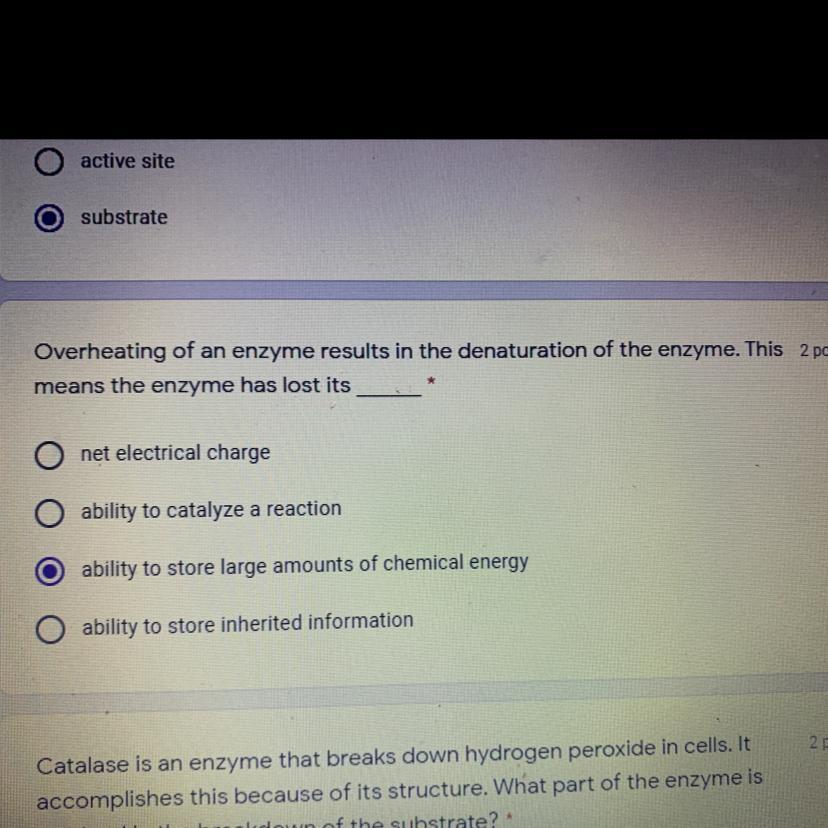
Answers
hey i did some of them will someone help by telling me the rest of the answers. thnx <3

Answers
Answer:
Explanation:
I dunno sorry
First person to answer it with all the question right gets brainly Est Question 1 (3 points)
To function on their own, what must unicellular organisms do?
Question 1 options:
work with other cells
perform a specialized task
make tissues
do all jobs for survival
Question 2 (3 points)
All living things are made of ______.
Question 2 options:
multicellular
tissues
cells
organisms
Question 3 (3 points)
A fish laying hundreds of eggs is an example of _________.
Question 3 options:
producing offspring
obtaining energy
all of the answers are correct
maintaining structure
Question 4 (3 points)
What do we call the branch of science for classification of organisms?
Question 4 options:
Taxonomy
Physics
Chemistry
Biology
Question 5 (3 points)
Which example is NOT a basic need of all organisms?
Question 5 options:
water
soil
food
appropriate enviornment
Question 6 (3 points)
All successful organisms must be able to do what three things?
Question 6 options:
obtain energy, produce offspring, eat
obtain energy, eat, play video games
maintain their structure, eat, build a home
obtain energy, produce offspring, maintain their structure
Question 7 (3 points)
Which example is NOT an organism?
Question 7 options:
bacteria
mold
human
lung
Question 8 (3 points)
What is an example of "maintaining structure"?
Question 8 options:
eating an apple
a cell dividing
healing a broken arm
catching a fish
Question 9 (3 points)
Which type of organism is ale to cause an infection or contagious disease?
Question 9 options:
rose
plant
animal
bacteria
Question 10 (3 points)
Saved
What do all living things need?
Question 10 options:
energy, water, sunshine, and protection
oxygen, an outer covering, parents, vitamins
food, water, air, and a place to live
water, parents, a place to live, and air
Answers
3. producing offspring
4. biology
5. soil
6. i think obtain energy produce offspring and eat
7. lung
8. healing a broken arm
9. bacteria
10. energy water sunshine and protection
Answer:
Unicellular organisms include bacteria and some protists and fungi. Many unicellular organisms live in bodies of water and must move around to find food. Most often, they must obtain nutrients by eating other organisms. Plant-like protists, and some types of bacteria, can make their own food through photosynthesis.
Cells
All of the answer are correct r it is Producing offspring
Biology
Soil
obtain Energy,Produce offspring and maintain their structure
Lung
A cell Dividing
Bacteria
energy water sunshine and protection
Explanation:
I think i got some wrong like one or two.
how are osmosis and facilitated diffusion alike?
Answers
They both use passive transport. they don't need energy to move molecules through the plasma membrane.
Who is Vandana Shiva
Answers
Vandana Shiva is an Indian scholar, environmental activist, and author known for her work in the field of environmental sustainability, biodiversity conservation, and social justice. She was born on November 5, 1952, in Dehradun, India. Shiva has a background in physics and earned her Ph.D. in philosophy from the University of Western Ontario, Canada.
Shiva is a prominent advocate for sustainable agriculture, seed sovereignty, and the rights of small-scale farmers. She is known for her opposition to genetically modified organisms (GMOs) and the negative impacts of industrial agriculture on the environment and local communities. Shiva has been involved in grassroots movements and organizations, including Navdanya, which promotes seed conservation and organic farming practices.
Vandana Shiva has authored numerous books, including "Staying Alive: Women, Ecology, and Development," "Earth Democracy: Justice, Sustainability, and Peace," and "Making Peace with the Earth." She has received several awards for her work, including the Right Livelihood Award (Alternative Nobel Prize) in 1993. Shiva continues to be actively involved in raising awareness about sustainable agriculture, biodiversity, and social justice issues on a global scale.
\(\huge{\mathfrak{\colorbox{black}{\textcolor{lime}{I\:hope\:this\:helps\:!\:\:}}}}\)
♥️ \(\large{\textcolor{red}{\underline{\mathcal{SUMIT\:\:ROY\:\:(:\:\:}}}}\)
Point mutations:
A. always changes the amino acid
B. never changes the amino acid
C. has no affect on amino acid production
D. this may or may not change the resulting amino acid
Answers
Answer:
D. this may or may not change the resulting amino acid
Explanation:
The answer would be a since point mutations change a single nucleotide of DNA leading to it changing the amino acid of the DNA
If this answer helped you in the slightest I would really appreciate it if you could check out my y o u t u b e channel called Nitro Studios. It would mean the a whole lot to me. Thanks.
A scientist genetically engineered a grain cereal. The genetically engineered variety can produce its own vitamins and is drought resistant. What is the likely impact of growing such a cereal crop on the society?
May trigger an adverse climate change
May worsen the water crisis around the world
Would be beneficial for the malnourished population
Would increase the shortage of food around the world
Answers
Piet is designing a computer model to show what happens when a warm, wet air
mass meets a cool, dry air mass. What is he modeling?
A. a flood
B. a hurricane
C. a snow shower
D. a thunderstorm
Answers
Why is it important that the location of fossils found in the ground is recorded?
The location in which they are found provides the age of the fossil.
The locations in which they are found provide clues to what type of animals lived in that area.
The location in which they are found can provide clues on how to reconstruct the fossil.
The location in which they are found provides clues on what time they were fossilized.
Answers
Answer:
The fossil record helps paleontologists, archaeologists, and geologists place important events and species in the appropriate geologic era.
Explanation:
It is based on the Law of Superposition which states that in undisturbed rock sequences the bottom layers are older than the top layers.
Explainition:
Count the number of breaths you take in a minute and compare it with the number of times a fish opens and closes its mouth. Which of the two is faster? What could be the reason?
Answers
Answer:
breath we take in minutes
The theory of evolution has changed over time. Initially, Lamarck believed that organisms developed traits in response to a changing environment to improve their chances of survival. Later Darwin proposed that organisms that already possessed traits suitable to a changing environment were more likely to survive and reproduce.
Which of the following does not explain why the theory of evolution has changed?
A. Lamarck’s theory was discarded when new scientific information became available.
B. Darwin collected empirical evidence to support that organisms with favorable traits survived and reproduced.
C. The theory of evolution became a scientific law after much debate and confirmation in the scientific community.
D. Other scientists such as Peter and Rosemary Grant have collected additional empirical evidence that supports Darwin’s findings.
Answers
I thing is true
Which two processes happen during mitosis? A. The nucleus divides only once B the chromosomes move in a pattern C the gametes fuse to form a zygote D the nucleus goes through two rounds of division (Choose two pls)
Answers
Answer:
A and B, I think.
Explanation: Mitosis is when a cell undergoes 1 stage of division, Gametes go under the category of sex cells that undergo 2 stages in Meiosis. Eliminating C and D. Leaving A and B
How does a mountain range in the path of prevailing winds affect precipitation on either side of the mountain?
Answers
Answer: As winds rise up the windward side of a mountain range, the air cools and precipitation falls. On the other side of the range, the leeward side, the air is dry, and it sinks. So there is very little precipitation on the leeward side of a mountain rang
Explanation:
What does a 20x magnification mean?
I can zoom in 20 times on an object
An object is magnified 20 times larger than normal
A magnifying lens is used 20 times on an object
Answers
Answer: B. An object is magnified 20 times larger than normal
Explanation:
C. is wrong because you are not just magnifying something 20 different times,
A. is wrong because it does not give a starting point for the magnification
b. is correct because it gives a starting and endpoint for the magnification.
Convert 0.37 kilograms to grams
Answers
Answer:
370g
Explanation:
K H D U(NITS) D C M
KILO -> UNITS
3 SPACES TO THE RIGHT
MOVE DECIMAL 3 SPACES
0.37
370g
To memorize the khdudcm use:
king
henry
died
unusually
drinking
chocolate
milk
BRAINLIEST
While savannas and temperate grasslands are both types of
grasslands and share many characteristics, they also have
some differences. Compare them below by writing each
characteristic in the correct location. You will use each only
once.
• home to many types of grazers
• experience all seasons of weather
• home to bison
• home to the African elephant
• example: tallgrass prairies of North America
• example: Serengeti in Tanzania
• also known as tropical grasslands
• few trees due to little rainfall
1)
(Savannas)
(Both Types of
Grasslands)
(Temperate
Grasslands)

Answers
Answer:
S - Savannas are typically found in tropical or subtropical regions.
S - Savannas tend to have more trees and shrubs.
S - Savanna's climate is drier than that of a grassland.
G - Grasslands are found in temperature regions.
G - Temperature Grasslands are mainly devoid of trees, receive less rainfall than Savannas & endure broader temperature extremes.
G - Grasslands make up 25 percent of the Earth's land surface and dominate in regions with limited rainfall, which prevents forest growth. This results from nearby mountain ranges that cause rain shadows over adjacent open-range lands.
B - Both represent the world's richest and most diverse ecosystems. They both provide a home for a quarter of the world's population and a habitat for thousands of plants and animals.
B - Many species gather in vast numbers, graze on the varied grasses, and can be found nowhere else on Earth. The coexistence between wildlife and grasses is key to healthy ecosystems. Animal migrations regenerate the landscapes, by controlling pests, dispersing seeds, and trampling invasive species. Through this partnership, grasslands and savannahs generate vital benefits for both people and nature.
B - Ecosystems such as these two in specific are essential for climate mitigation – they store carbon, locking it deep in the soil and extensive root systems. They are the source of or support many of the world’s biggest rivers and wetlands, ensure food security, support livelihoods, and are embedded in the cultural identity of millions of people.
(Also, A savanna or savannah is a mixed woodland-grassland<---similarity)
Explanation: Just research. I decided to state 3 characteristics for both The Savanna and The Grasslands, and then 3 for "B" (both).
(Both Types of Grasslands) experience all seasons of weather, few trees due to little rainfall
(Temperate Grasslands) home to bison, example: tallgrass prairies of North America
1. What kinds of pollution do you know? Which is the worst? Discuss in group.
2. What are fossil fuels? Give examples. Where are they used? Can they be replaced?
3. Some factories dump waste water in rivers and ocean. How can we prevent this?
4. People throw away tons of garbage everyday. How can we reduce the amount of garbage?
5. Do you drink bottled water? Why or why not? What is its effect on the environment?
pls 3-5 sentence and then explain briefly the answer. ty
Answers
Answer:
1. There's air pollution, water pollution, noise pollution, and light pollution. The worst pollution is air pollution because it can cause severe health problems like respiratory diseases or even cancer.
2. Fossil fuels are resources that are formed from the remains of dead plants and animals. An example would be coal, oil, and natural gas. These fuels are used to generate electricity, power vehicles, heat homes and buildings. Yes, there many other energy sources that can replace fossil fuels.
3. One way to prevent factories from dumping waste water in rivers and oceans is to implement stricter regulations and penalties for those who violate them.
4. One of the best ways to reduce the amount of garbage is to reduce, reuse, and recycle.
5. Yes, I drink bottled water because it's more water to drink from a bottle and its effect on the environment is recycling and being reused.
1. Pollution can be of many types such as air pollution, water pollution, noise pollution, and land pollution. In my opinion, air pollution is the worst because it affects people's health and can cause breathing problems, heart diseases, and even cancer. Discussing this issue in a group can help us understand different perspectives and find solutions to reduce pollution.
2. Fossil fuels are non-renewable sources of energy that are formed from the remains of dead plants and animals. Examples of fossil fuels include coal, oil, and natural gas. They are used to generate electricity, fuel vehicles, and heat homes. However, they are a major contributor to air pollution and climate change. Fossil fuels can be replaced by renewable sources of energy such as solar, wind, and hydro power.
3. Factories dumping waste water in rivers and oceans can have a negative impact on aquatic life and the environment. To prevent this, factories can treat their waste water before discharging it into the environment. Governments can also enforce strict regulations and penalties for factories that violate environmental laws.
4. To reduce the amount of garbage, we can follow the three R's - reduce, reuse, and recycle. We can reduce the amount of waste we generate by using reusable bags, bottles, and containers. We can also compost organic waste such as food scraps and yard waste. Recycling can also help reduce the amount of garbage by turning waste into new products.
5. I try to avoid drinking bottled water because it generates a lot of plastic waste that can take hundreds of years to decompose. Plastic waste can also harm wildlife and pollute the oceans. Instead, I use a refillable water bottle and fill it with tap water. Tap water is safe to drink in most developed countries and can be a more sustainable choice.