Identify the vertex, the axis of symmetry, the maximum or minimum value, and the domain and range of each function.
y= (1/2)(x-3)²-2
Answers
1. Vertex: (3, -2). 2. Axis of Symmetry: x = 3. 3. Maximum or Minimum Value: Minimum value of y = -2. 4. Domain: (-∞, +∞). 5. Range: [-2, +∞).
To identify the vertex, axis of symmetry, maximum or minimum value, and the domain and range of the function y = (1/2)(x - 3)² - 2, we can examine the equation in vertex form:
y = a(x - h)² + k
where (h, k) represents the vertex of the parabola.
Comparing this with the given function, we can see that:
a = 1/2
h = 3
k = -2
1. Vertex: The vertex of the parabola is given by (h, k), so the vertex in this case is (3, -2).
2. Axis of Symmetry: The axis of symmetry is a vertical line that passes through the vertex. For a parabola in the form y = a(x - h)² + k, the equation of the axis of symmetry is x = h. Therefore, the axis of symmetry for this parabola is x = 3.
3. Maximum or Minimum Value: The coefficient 'a' in the equation determines whether the parabola opens upward (minimum value) or downward (maximum value). Since a = 1/2, which is positive, the parabola opens upward and the vertex represents the minimum value. Thus, the minimum value is y = -2.
4. Domain: The domain of the function is the set of all real numbers since there are no restrictions on the input variable x. Therefore, the domain is (-∞, +∞).
5. Range: Since the parabola opens upward and the vertex represents the minimum value, the range of the function is y ≥ -2. In interval notation, the range can be expressed as [-2, +∞).
Learn more about parabola here:
https://brainly.com/question/11911877
#SPJ11
Related Questions
What are the solutions to the following system of equations? x + y = 3 y = x2 − 9 (3, 0) and (1, 2) (−3, 0) and (1, 2) (3, 0) and (−4, 7) (−3, 0) and (−4, 7)
Answers
The solutions for the given system of equations are:
(3, 0), (-4, 7).
How to solve the given system of equations:
Here we have the system:
x + y = 3
y = x² - 9
To solve this, we can replace the second equation into the first one, so we get:
x + (x² - 9) = 3
Now we can solve this quadratic equation for x, we need to solve:
x² + x - 12 = 0.
The solutions are given by Bhaskara's formula:
\(x = \frac{-1 \pm \sqrt{1^2 - 4*1*(-12)} }{2*1} \\\\x = \frac{-1 \pm 7 }{2}\)
Then the two solutions are:
x = (-1 + 7)/2 = 3
x = (-1 - 7)/2 = -4
To get the y-values correspondent, we can evaluate the linear equation in these two values:
y = 3 - x.
For x = 3:
y = 3 - 3 = 0
For x = -4:
y = 3 + 4 = 7
Then the two solutions are: (3, 0), (-4, 7).
If you want to learn more about systems of equations:
https://brainly.com/question/13729904
#SPJ1
Josh has been working andsaving money in order to buy a car andtravel the country. According to hiscalculations, it will cost him $1450 amonth for all his expenses. If Josh hassaved up $40,000, and will be purchasinga car for $16,500, at most, how manymonths will he have enough money totravel?
Answers
Answer:
16 months
Step-by-step explanation:
40k-16.5k=23.5k. 23.5k/1450= A little bit more than 16 months.
Unfortunately you injected lidocaine intra-arterially. The first sign of lidocaine toxicity would be, except....
a. circumoral numbness
b. tongue paresthesia
c. dizziness
d. cold
Answers
If lidocaine is injected intra-arterially, it can quickly lead to systemic toxicity. The first signs of toxicity may include circumoral numbness and tongue paresthesia, but these symptoms may be followed by more severe manifestations such as dizziness, seizures, and cardiac arrest.
The systemic effects of lidocaine are dose-dependent, meaning that the higher the dose, the more severe the symptoms.
Lidocaine is a local anesthetic that is commonly used for minor surgical procedures or dental work. It works by blocking the nerve signals that transmit pain to the brain. However, if it is injected into an artery, it can rapidly spread throughout the body and affect other organs, leading to potentially life-threatening complications.
If you suspect that a patient has been injected with lidocaine intra-arterially, it is important to act quickly. The first step is to stop the injection and monitor the patient closely for signs of toxicity. If the patient is experiencing severe symptoms, such as seizures or cardiac arrest, emergency treatment should be initiated immediately. Treatment may include administering medications to counteract the effects of the lidocaine or performing cardio-pulmonary resuscitation (CPR) if necessary.
In conclusion, the first signs of lidocaine toxicity may include circumoral numbness and tongue paresthesia, but more severe symptoms may follow, such as dizziness, seizures, and cardiac arrest. If you suspect that a patient has been injected with lidocaine intra-arterially, it is important to act quickly to prevent potentially life-threatening complications.
learn more about systemic toxicity here: brainly.com/question/28222646
#SPJ11
Classify each polygon by its number of sides.
Drag the choices into the boxes to correctly classify each polygon.

Answers
Answer choices for shape number 1:
A Pentagon
Answer choices for shape number 2:A Dodecagon
Answer choices for shape number 3:A Decagon
Sure hope this helps you
sami gets £50 for her birthday.She buys a magazine costing £1.95, a bag for £7.50 and a pair of shoes for £24.99.How much does she have left?
Answers
Answer:
15.56
Step-by-step explanation:
mark brainliest k ty
Step-by-step explanation:
50 - ( 1.95+ 7.50+ 24.99) =
50 - 34.44 = 15.56
1. Suppose that the water level of a river is 34 feet and that it is increasing at a rate of
0.5 foot per day.
a. Write an equation for the water level, L, after d days.
b. In how many days will the water level be 26 feet?
Answers
Answer:
a. L = 0.5d + 34, and
b. "Never," or "can't be determined with the information provided."
Step-by-step explanation:
a. Write an equation for the water level, L, after d days.
L is water level, in feet. It is rising at a rate of 0.5 ft/day. The slope of an equation of a straight line (we know it is straight, since the rate of increase is a constant, 0.5 ft/day) would be:
y = mx + b
y = 0.5x + b
x is the number of days, which are set to "d," as per the instructions., and b is the water height at day 0, the start. In this case, the initial height is 34 feet. So the equation for predicting future water levels, L, is:
L = 0.5d + 34 [L = 0.5(ft/day)d + 34(ft)]
b. In how many days will the water level be 26 feet?
The question is asking how many days it will take for the water level to reach 26 feet. This is odd, since we are only told that the river is rising. No information was given about timing when the river may begin falling, not the rate at which that will occur. Based only on the way the question is written, the answer is "Never," or "can't be determined with the information provided."
If the question was phrased "In how many days will the water level reach 42 feet, we can use the equation to find d:
L = 0.5d + 34
42 = 0.5d + 34
0.5d = 8
d = 16 days
The height of men is a normally distrubuted variable with a mean of 68 inches and a standard deviation of 3 inches.**Round answers to ONE decimal place**a.) What is the minimum height you could be to be considered in the top 10% of tallest men? b.) What is the tallest you could be to be considered in the shortest 15% of men?
Answers
For this problem, we are given the mean and standard deviation for the height of men. We need to calculate the minimum height to be considered in the top 10% of tallest men, and the maximum height to be considered in the shortest 15% of men.
The first step we need to solve this problem is to calculate the z-score. The z-score can be found by using the following expression:
\(z=\frac{x-\mu}{\sigma}\)For the first situation, we want a z-score for the top 10% of tallest men. This means that we need to go on the z-table and find the z-score that represents 90% of probability to the left because this will give us the minimum height to be at the 10% tallest. From the z-table we have:
\(z=1.29\)Now we can use the z-score expression to find the value of x. We have:
\(\begin{gathered} 1.29=\frac{x-68}{3} \\ x-68=3.87 \\ x=3.87+68 \\ x=71.87 \end{gathered}\)The man should be at least 71.85 inches tall to be considered among the 10% of tallest men.
For the second situation, we have something similar. We need to find the maximum height for a man to be considered between the 15% of men. We need to go into the z-table and find the z-score that produces a result close to 0.15. We have:
\(z=-1.04\)Now we need to use the z-score expression to determine the height:
\(\begin{gathered} -1.04=\frac{x-68}{3} \\ x-68=-3.12 \\ x=68-3.12 \\ x=64.88 \end{gathered}\)In order to be considered among the smallest men, someone needs to be 64.88 inches tall.
the charge on the capacitor is zero when the switch cloes at t=0s
Answers
The capacitance does not depend on the potential difference, the capacitance of the capacitor is the same at t = 0s and all other times. The charge on the capacitor is zero at t = 0s.
When the switch is closed at t = 0s, the capacitor is initially uncharged. The current through the capacitor is zero since there is no voltage difference across it. Consequently, the charge on the capacitor is also zero. This is because, when a capacitor is connected to a circuit, the presence of an electric field causes electrons to move from one plate to the other, resulting in a build of charge on the capacitor. Since the current is zero at t = 0s, electrons do not move, preventing the buildup of charge on the capacitor. Mathematically, this can be explained by considering the electric field inside a capacitor: E = V/d where V is the potential difference between the plates and d is the distance between the plates. Since V = 0 at t = 0s, the electric field is also zero, meaning that no electrons move and the charge on the capacitor is zero.
Furthermore, the capacitance of a capacitor is determined by the equation C = εA/d where ε is the permittivity of the material between the plates, A is the area of the plates, and d is the distance between the plates. Since the capacitance does not depend on the potential difference, the capacitance of the capacitor is the same at t = 0s and all other times. Therefore, the charge on the capacitor is zero at t = 0s.
Learn more about difference here:
https://brainly.com/question/30461754
#SPJ4
Does anyone know??
i need help like really bad

Answers
Answer:
Down below :#
Step-by-step explanation:
The first one is False: reason \(\mathrm{Apply\:exponent\:rule}:\quad \:a^b\cdot \:a^c=a^{b+c}\)
\(b^9b^2=b^{9+2}\)
\(=b^{9+2}\)
And then its b^11
Second one is false
Third one is True
Fourth false
Reason: \(\mathrm{Apply\:exponent\:rule:\:}\left(a^b\right)^c=a^{bc},\:\quad \mathrm{\:assuming\:}a\ge 0\)
\(=b^{6\cdot \:5}\)
fifth one is False
\(\mathrm{Apply\:exponent\:rule:\:}a^0=1,\:\quad \mathrm{\:assuming\:}a\ne \:0\)
That equals 1
:) hope this helps
the value of “y” varies directly with “x”. if y= 56, then x= 4
Answers
Points that are on the same line are collinear. Use the definition of slope to determine whether the given points are collinear.
(-2,6),(0,2),(1,0)
Answers
Using the definition of slope, the points (-2 , 6), (0 , 2), and (1 , 0) are collinear.
Three or more points are said to be collinear if they lie on a single straight line.
To determine whether the given points are collinear, use the definition of slope. The slope, m, determines the steepness of a line. It can be measured by the vertical distance from one point to another divided by the horizontal distance of the same points.
m = (y2 - y1)/(x2 - x1)
Getting the slope of each pair of points:
(-2 , 6) and (0 , 2)
m = (y2 - y1)/(x2 - x1)
m = (2 - 6)/(0 - -2)
m = -4/2
m = -2
(0 , 2), and (1 , 0)
m = (y2 - y1)/(x2 - x1)
m = (0 - 2)/(1 - 0)
m = -2/1
m = -2
(-2 , 6) and (1 , 0)
m = (y2 - y1)/(x2 - x1)
m = (0 - 6)/(1 - -2)
m = -6/3
m = -2
Since collinear points lies on the same line, the slope of any pair of points should be the same. Since the slopes of each pair of points is equal with each other, then they are collinear.
Learn more about collinear points here: https://brainly.com/question/17314715
#SPJ4

If I 50% increase is followed by a 33 1\3 % decrease is it greater, less than, or the same as the original
Answers
Answer:
Greater than.
Step-by-step explanation:
Let the original value be x.
A 50% increase in x is given by
x + 50%x
=> x + 0.5x
=> 1.5x
Followed by a 33 \(\frac{1}{3}\) % decrease in the value gives:
1.5x - 33 \(\frac{1}{3}\) %(1.5x)
=> 1.5x - 0.33(1.5x)
=> 1.5x - 0.495x
=> 1.005x
Since 1.005x is greater than the original value, x, then:
A 50% increase followed by a 33 \(\frac{1}{3}\) % decrease gives a value that is greater than the original.
Could you help asap! Brainliest and 50 points!


Answers
(5x^2-21x-20)/(5x^2-16x-16)
((x-5)(5x+4))/((x-4)(5x+4))
(x-5)/(x-4)
x² - 3 x - 54 = x² + 6 x - 9 x - 54 = x ( x + 6 ) - 9 ( x + 6 ) = ( x + 6 ) ( x - 9 )
x² - 18 x + 81 = ( x - 9 )²
x² + 12 x + 36 = ( x + 6 )²
... = ( x + 6 ) · ( x - 9 ) / ( x - 9 )² * ( x + 6 )² / ( x + 6 ) = ( after cancellation )
= ( x + 6 )² / ( x - 9 )
After solving the given problem, I’ve been able to get 3(x-2) / 2(x-3) as the simplified form of the given equation. I am hoping that this answer has satisfied your query and it will be able to help you, and if you would like, feel free to ask another question.
If I understand clearly, the expression is
(18st^4/52s^3t)(16s^3/9s^2t)
To simply the expression, we simply have to multiply the constants and reduce the product to the lowest terms and apply the laws on exponents to simplify the variables. So, the answer would be:
8t^2/13s
(40v^2)/(35v^4) / (20v^3)/(5v)
(8)/(7v^2) / (4v^2/1)
(8)/(7v^2) * (1 / 4v^2)
2/(7v^4)
Answer:
1) m= 2
2)a=3
3) t =7
this are the first 3
Which is equivalent to 4 radical 9^1/2x
Answers
Answer: 9 1/8x
Step-by-step explanation:
The word in the image is feet, please answer !!

Answers
Answer:
she
Step-by-step explanation:
Answer:
A - she
pronounced shee
hope this helps
a suspension bridge with weight uniformly distributed along its length has twin towers that extend meters above the road surface and are meters apart. the cables are parabolic in shape and are suspended from the tops of the towers. the cables touch the road surface at the center of the bridge. find the height of the cables at a point meters from the center.
Answers
The height of the cable is 0.15 meters and 1.35 meters at a point 200 meters and -200.
The given details are: Height of twin towers above road surface = h = 160 meters. Distance between twin towers = d = 800 meters. At the center of the bridge, the cables touch the road surface so the maximum height of the cable will be h. Using the formula for the parabolic cable we get: h(x) = a(x - d/2)(x + d/2). Let's find the value of "a" using the maximum height of the cable at the center of the bridge .i.e., h = a(0 - d/2)(0 + d/2) => h = a(d/2)^2 => a = (4h/d^2)Therefore, h(x) = (4h/d^2)(x - d/2)(x + d/2)We need to find the height of the cables at a point x meters from the center. Therefore, we need to find the value of h(x) when x = ±200 meters from the center of the bridge. h(x) = (4h/d^2)(x - d/2)(x + d/2) => h(x) = (4 × 160)/(800 × 800) (x - 800/2)(x + 800/2)When x = -200,h(-200) = (4 × 160)/(800 × 800) (-200 - 800/2)(-200 + 800/2)= (4 × 160)/(800 × 800) (-1200)(200)h(-200) = 0.15 meters. When x = 200,h(200) = (4 × 160)/(800 × 800) (200 - 800/2)(200 + 800/2)= (4 × 160)/(800 × 800) (-400)(1200)h(200) = 1.35 meters. Hence, the height of the cable is 0.15 meters and 1.35 meters at a point 200 meters and -200 meters from the center of the bridge respectively.
Learn more about Height
brainly.com/question/10726356
#SPJ11
An elementary school is offering 3 language classes one in spanish one in french, if 2 students are chosen randomly, what is the probability that at least 1 is taking a language class?
Answers
The probability that atleast one students is taking a language class is 0.7
What is the probability?Probability refers to a possibility that deals with the occurrence of random events.
The probability of all the events occurring need to be 1.
Let :
Spanish = S ; French = F ; German = G
SnFnG = 3
(SnF) only = 9 - 3 = 6
(SnG) only = 5 - 3 = 2
(FnG) only = 5 - 3 = 2
S only = 28 - (6+3+2) = 17
F only = 21 - (2+3+2) = 14
G only = 12 - (6+3+2) = 1
Student not taking any of the classes are;
(100 - (17+14+1+2+2+6+3))
100 - 45 = 55
Atleast 1 is taking a language class out of 2 selected
The probability that atleast one students is taking a language class :
(45/100 * 55/99) + (55/100 * 45/99) + (45/100 * 44/99)
= 0.7
Learn more about probability here;
https://brainly.com/question/11234923
#SPJ4
The area of a square garden is
1/144 km ^2 . How long is each side?
Answers
Answer:
\(\frac{1}{12}\) Km
Step-by-step explanation:
the area (A) of a square is calculated as
A = s² ( s is the side length )
here A = \(\frac{1}{144}\) , then
s² = \(\frac{1}{144}\) ( take square root of both sides )
s = \(\sqrt{\frac{1}{144} }\) = \(\frac{1}{\sqrt{144} }\) = \(\frac{1}{12}\)
Answer:
side= 1/12 km = 0.083km
Step-by-step explanation:
The formula of area of a square is: A=side²
To get the length of each side, square root each side of the formula as shown below:
√A=√(side)²
√(1/144)=side
side= √(1/144) = 1/12 = 0.083km
What is the straight distance between points h and j on the grid

Answers
Answer:
13
Step-by-step explanation:
count across and then down
Your school raised 125% of its fundraising goal.The School raised $4500.What was the goal?
Answers
Answer:
3600
Step-by-step explanation:
125%=4500
5*25%=4500
25%=900
125%-25%=100%
4500-900=3600
Can someone help me? I got some help from a friend but I still don’t get it

Answers
STEP - BY - STEP EXPLANATION
What to find?
• Surface area of the cylinder.
,• Volume of the cylinder.
Given:
Radius = 3.5
Height =14
π is a constant = 3.14
The surface area can be determined using the formula below:
\(Surface\text{ area}=2\pi rh+2\pi r^2\)Substitute the values into the formula and simplify.
\(Surface\text{ area}=2(3.14)(3.5)(14)+2(3.14)(3.5)^2\)\(=307.72+76.93\)\(\approx384.7\)Hence, the surface area is 384.7 ft²
The volume of the cylinder can be obtained using the formula below:
\(Volume=\pi r^2h\)Substitute the values into the formula and simplify.
\(Volume=3.14\times(3.5)^2\times14\)Simplify the above.
\(Volume\approx538.5ft^3\)ANSWER
• Surface area = 384.7 ft²
• Volume = 538.5 ft,³
What is the slope of y=-1/2x+3
Answers
Answer:
slope = - \(\frac{1}{2}\)
Step-by-step explanation:
The equation of a line in slope- intercept form is
y = mx + c ( m is the slope and c the y- intercept )
y = - \(\frac{1}{2}\) x + 3 ← is in slope- intercept form
with slope m = - \(\frac{1}{2}\)
Given : A linear equation in two variables is given to us , which is y = -½ + 3 .
To Find : The slope of the line .
Solution : The given equation to us is y = -½ + 3 . This equation is also similar to form of a equation in slope - intercept form , which is ,
\(\large\boxed{\red{\bf y = mx + c }}\)
Where , m is the slope of the line and c is the y - intercept of the line .
Now , on comparing the equation with the standard form , we have :
m ( slope ) = -½ .c ( y - intercept ) = 3 .Hence the slope of the line is -½.
The group you wish to generalize your results to is called the ______. a. sample b. population c. sampling error d. general group
Answers
The group you wish to generalize your results to is called the population (option b).
In statistical terms, the population refers to the entire set of individuals, items, or elements that possess certain characteristics of interest and from which a sample is drawn.
When conducting research or experiments, it is often not feasible or practical to collect data from the entire population due to factors such as time, cost, and accessibility.
Instead, a smaller subset known as a sample is selected to represent the larger population.
The purpose of sampling is to obtain information about the population by studying a more manageable and representative subset.
The goal is to make inferences and draw conclusions about the population based on the characteristics observed in the sample.
Generalizing the results from a sample to the population involves assuming that the sample is representative and accurately reflects the larger population.
Statistical techniques and methods are used to estimate population parameters, such as means, proportions, or relationships between variables, based on the data collected from the sample.
It is important to recognize that the accuracy of generalizations depends on the quality of the sample and the sampling methods employed. Additionally, sampling error (option c) refers to the variability or discrepancy between sample statistics and population parameters, which is inherent in the process of sampling.
For similar question on population.
https://brainly.com/question/29885712
#SPJ11
choose the correct solution and graph for the inequality x+7 _< 5
Answers
Inequality shows a relationship between two numbers or two expressions.
The solution for the inequality is x ≤ -2.
The graph is given below.
What is inequality?It shows a relationship between two numbers or two expressions.
There are commonly used four inequalities:
Less than = <
Greater than = >
Less than and equal =
Greater than and equal=
Example:
2x > 4
We have,
x + 7 ≤ 5
Subtract 7 on both sides we get,
x + 7 - 7 ≤ 5 - 7
x ≤ -2
This inequality can be graphed as given below:
x is equal and less than -2.
Thus,
The solution for the inequality is x ≤ -2.
The graph is given below.
Learn more about inequalities here:
https://brainly.com/question/20383699
#SPJ1

Which algebraic expression is equivalent to 9(4x + 8) - 4
Answers
Answer: 36x + 68
Step-by-step explanation:
Expanding it, you get:
36x + 72 - 4
= 36x + 68
Why would the median be a better measure of the center than the mean for the following set of data? 3, 4, 4, 4, 5, 6, 7, 23
Answers
Answer:
Step-by-step explanation:
If I found the mean, the answer would be:
3+ 4+4+4+5+6+7+23= 56
56/ 8 = 7
If I found the average value using the median, the answer would be 4.5.
In this set of data, the anomaly is 23 as it is much higher than the other numbers.
The median is more accurate because it find the more ‘central’ number and is not affected as greatly with anomalies whereas the mean is affected greatly with anomalies as it raises the value significantly.
Therefore, the median is better to work out the average in this set of data.
:)
A natural sponge company's profit, P(x), is modeled by the function P(x) = −0.1x2 + 15x + 120, where x is the number of $0.15 increases in the price of each sponge. Use the graph to answer the question. Graph of function p of x equals negative 0.1 x squared plus 15 x plus 120. The graph has the x-axis labeled as number of price increases, and the y-axis labeled as profit. The curve begins at (0, 120), increases to (75, 682.5), and then decreases through (157.614, 0). Choose the answer choice that correctly shows the coordinates for the company's profit if there are no price increases.
Answers
The company's profit if there are no price increases is $120.
We have,
The problem provides a function P(x) that models the profit of a natural sponge company.
The function takes as input the number of $0.15 increases in the price of each sponge, denoted by x.
When the value of x is 0, it means that there are no price increases, and therefore the initial price of each sponge is unchanged.
Now,
If there are no price increases, then the value of x in the function P(x) is 0, since x represents the number of price increases.
Substituting x = 0 into the function, we get.
P(0) = -0.1(0)^2 + 15(0) + 120 = 120
Therefore,
The company's profit if there are no price increases is $120.
We can also see this from the graph of the function, which starts at (0, 120) and represents the profit when there are no price increases.
Learn more about functions here:
https://brainly.com/question/28533782
#SPJ1
11. The sum of proper subsets and subsets of a set is
127. How many elements are there in this set?
Answers
Elements in set A is 7.
How do you calculate the number of items in a correct subset?Consider the following example: If set A includes the elements, A = a, b, then the correct subset of the provided subset is, a, and b. The set has two components in this case. The formula for calculating the number of appropriate subsets is 2n – 1.
RECALL: The number of proper subsets of a set with nn elements is 2^n-12
N
−1.
Let n = number of elements of the set.$
Then,Then, 2^n-1 = 127
2^n = 127+1
2^n=128
2^n = 2^7
N=7
$The set has 7 elements.
To learn more about elements of the set to refer:
https://brainly.com/question/13094423
#SPJ1
According to the given information in the question the element in set A is 7.
How do you calculate the number of items in a correct subset?Consider the following example: If set A includes the elements, A = a, b, then the correct subset of the provided subset is, a, and b. The set has two components in this case. The formula for calculating the number of appropriate subsets is 2n – 1.
RECALL: The number of proper subsets of a set with nn elements is 2^n-12
N
−1.
Let n = number of elements of the set.$
Then, Then, 2^n-1 = 127
2^n = 127+1
2^n=128
2^n = 2^7
N=7
$The set has 7 elements.
To learn more about elements of the set to refer:
brainly.com/question/13094423
#SPJ1
help fast it's timed

Answers
15x+75=180
Subtract 75 on both sides to get
15x=105
x=7
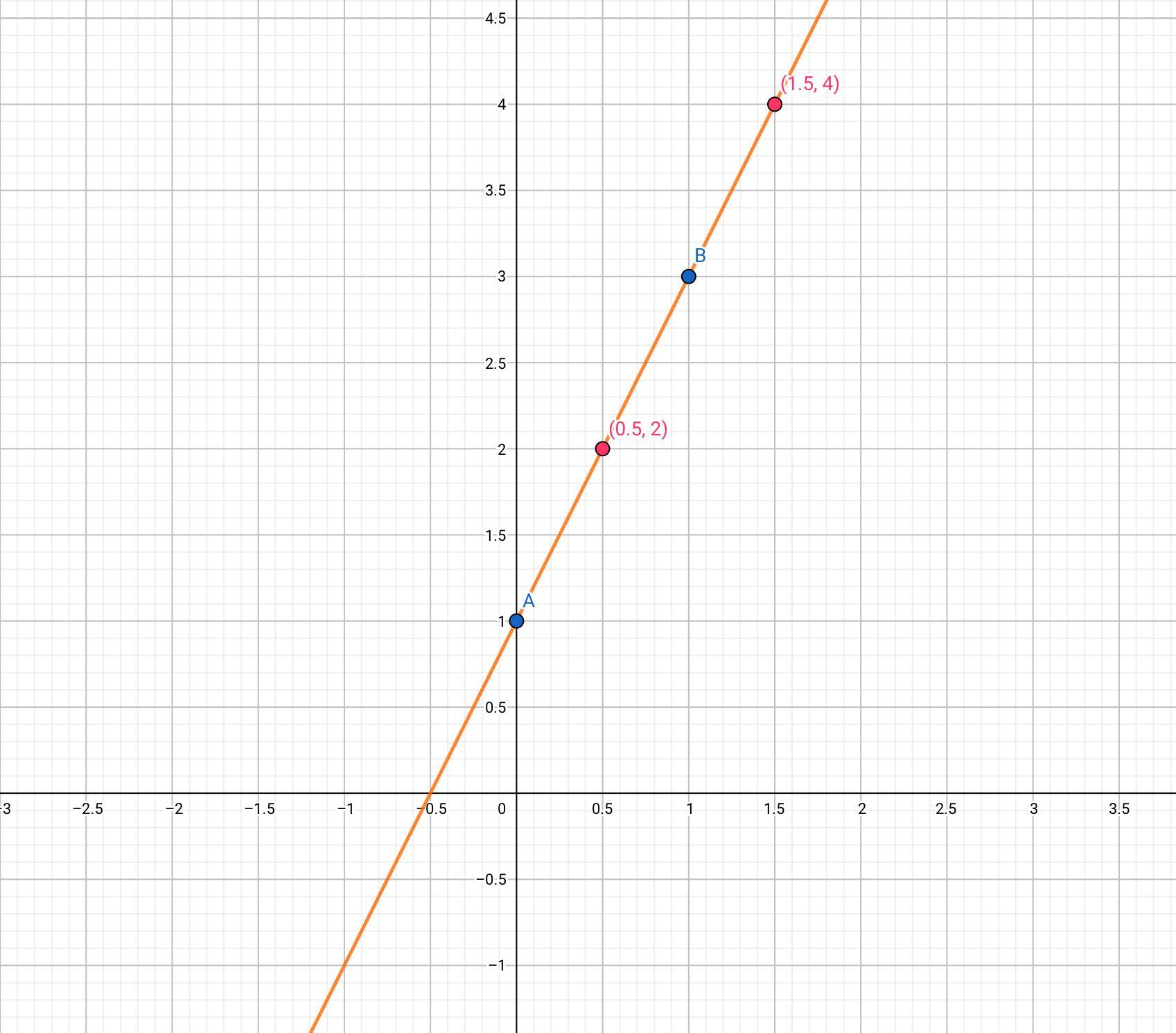
Draw the graph of the linear equation 2x – y + 1 = 0. From the graph find the values of h and k if the graph passes through the point (h,4) and (1/2 , k)
Answers
Answer + Step-by-step explanation:
2x – y + 1 = 0
We know that the graph of a linear equation is a line.
So ,in order to draw it we need to find two points A and B of the line
Afterward, we join A and B to get the graph.
2x – y + 1 = 0
If x = 0 → y = 1 ⇒ A(0 , 1) lie on the line AB (the graph)
If x = 1 → y = 3 ⇒ B(1 , 3) lie on the line AB
Now ,all we have to do is plotting A and B
on the coordinates plane ,then connecting then with a line.
According to the graph (check the attached image) :
If (h,4) ∈ line AB ⇒ h = 3/2
If (1/2 , k) ∈ line AB ⇒ k = 2