Answers
Solution:
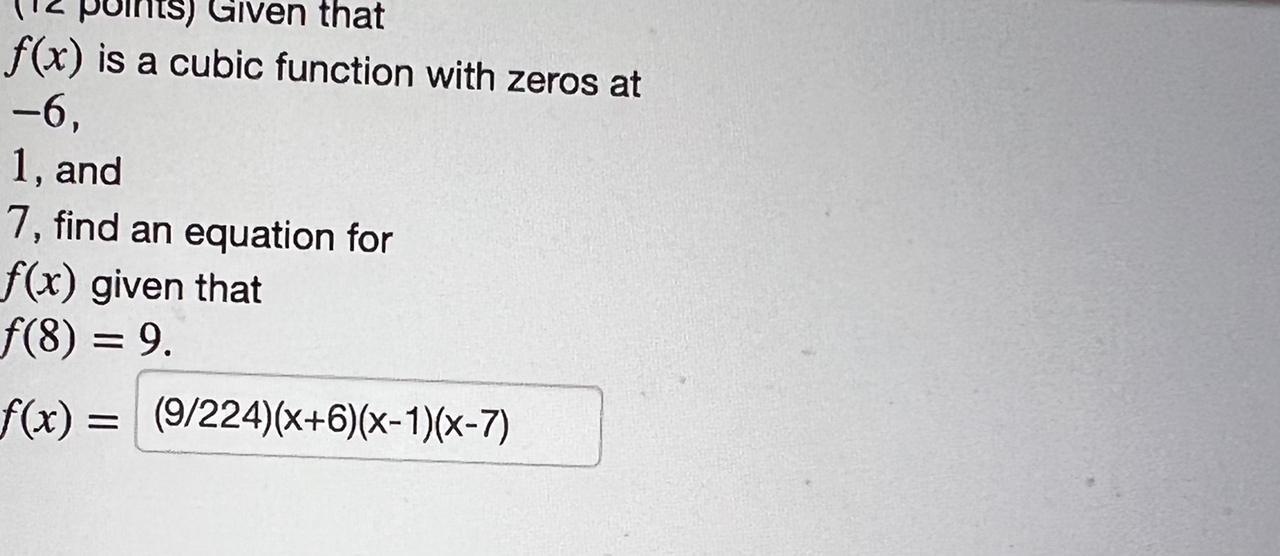
When a and b are the zeros of a function, this implies that
\(\begin{gathered} x=a \\ \Rightarrow(x-a) \\ x=b \\ \Rightarrow(x-b) \end{gathered}\)\(A(x-a)(x-b)=0\)This implies the values of x when the function equals zero.
Given that the zeros of the cubic function f(x) are -6, 1 and 7, this implies that
\(f(x)=A(x+6)(x-1)(x-7)\text{ ---- equation 1}\)Given that
\(f(8)=9\)we substitute 9 for f(x) and 8 for x.
Thus,
\(\begin{gathered} 9=A(8+6)(8-1)(8-7) \\ 9=A\times14\times7\times1 \\ 9=98A \\ \Rightarrow A=\frac{9}{98} \end{gathered}\)Substitute the value of A into equation 1.
\(f(x)=\frac{9}{98}(x+6)(x-1)(x-7)\)Expand the resulting equation.
\(\begin{gathered} f(x)=\frac{9}{98}\mleft(x^2+5x-6\mright)\mleft(x-7\mright) \\ \frac{9}{98}(x-7)=\mleft(\frac{9x}{98}-\frac{9}{14}\mright) \\ t\text{hus, we have} \\ f(x)=(\frac{9x}{98}-\frac{9}{14})(x^2+5x-6) \\ =(\frac{9x}{98}\times x^2)+(\frac{9x}{98}\times\: 5x)+\frac{9x}{98}\mleft(-6\mright)-\frac{9}{14}x^2-(\frac{9}{14}\times\: 5x)-\frac{9}{14}\mleft(-6\mright) \\ \therefore f(x)=\frac{9x^3}{98}-\frac{9x^2}{49}-\frac{369x}{98}+\frac{27}{7} \end{gathered}\)Hence, the equation for f(x) is
\(f(x)=\frac{9x^3}{98}-\frac{9x^2}{49}-\frac{369x}{98}+\frac{27}{7}\)Related Questions
I need help can somebody help me

Answers
Answer:
2(9x-3)
6(3x-1)
16.4x-6-1.6x
A dozen eggs are sold for $2.52. What is the cost of 14 eggs?
Answers
Answer:
$2.94
Step-by-step explanation:
2.52 for 12 eggs
0.21 for 1 egg
0.21 * 14 = 2.94
Answer:
$2.94
Step-by-step explanation:
Find the cost per egg
2.52/12 = 0.21
$0.21 per egg
0.21 x 14 = 2.94
$2.94 for 14 eggs
In a sequence of numbers,
a₁ = -6, a3 = 4, a5 = 14, a6 = 19,
and a 24. Based on this
information, which equation
can be used to find the nth
term in the sequence, an?
Answers
Answer:
Step-by-step explanation:
To find the equation for the nth term in the sequence, we need to determine the pattern or rule that generates the sequence.
From the given information, we can see that the sequence is not arithmetic because the differences between consecutive terms are not constant. Instead, the sequence appears to be quadratic because the second difference between consecutive terms is constant.
Using the given values of a₁, a₃, and a₅, we can find the first few differences:
a₃ - a₁ = 4 - (-6) = 10
a₅ - a₃ = 14 - 4 = 10
So, the first difference is 10, which indicates a linear term in the equation for an. We can now use the given value of a₁ and the first difference to find the constant term in the quadratic equation. Let d be the common difference, then we have:
a₂ = a₁ + d = -6 + 10 = 4
a₄ = a₃ + d = 4 + 10 = 14
a₆ = a₅ + d = 14 + 10 = 24 - 1
a₇ = a₆ + d = 24 - 1 + 10 = 33
Now, we can find the second difference between consecutive terms:
a₄ - 2a₃ + a₂ = 14 - 2(4) + (-6) = 0
a₆ - 2a₅ + a₄ = 19 - 2(14) + 4 = -5
a₇ - 2a₆ + a₅ = 33 - 2(19) + 14 = 9
Since the second difference is constant (-5), this confirms that the sequence has a quadratic term in its equation. Let's assume the equation for the nth term is:
an = an² + bn + c
Substituting the values we know, we get three equations:
a₁ = a₁² + b₁ + c --> -6 = c
a₃ = a₃² + b₃ + c --> 4 = 9a + b + c
a₅ = a₅² + b₅ + c --> 14 = 25a + 5b + c
Solving this system of equations, we get:
a = 1/2, b = 19/2, and c = -6
Therefore, the equation for the nth term in the sequence is:
an = (1/2)n² + (19/2)n - 6.
T(n)=5n-11
Identify the expressions that correctly model the distance between a point located at (-2,3) and the point (x,y). Select all the apply

Answers
The distance between the two points is
d = √( -2-x)² + (3 -y)² OR d = √ (x+2)² + (y-3)².
What is distance between two points?Distance between two points is the length of the line segment that connects the two points in a plane.
The distance between two points is expressed as;
d = √ (X-x )² + (Y-y)²
X = -2
x = x
Y = 3
y = y
Therefore the distance between the two points is
d = √( -2-x)² + (3 -y)²
or it can also be written in this form
d = √ x-(-2)² + (y-3)²
d = √ x+2)² + (y-3)²
therefore the model of the distance between the two points can be
d = √( -2-x)² + (3 -y)² OR d = √ (x+2)² + (y-3)².
learn more about distance between two points from
https://brainly.com/question/7243416
#SPJ1
The area of a rectangle is 40 square inches. The rectangle is 8 inches long. How wide is the rectangle?
A. 3 inches
B. 32 inches
C. 5 inches
D. 13 inches
Answers
Answer:
C. 5 inches
Step-by-step explanation:
I’m area you have to multiply L • W
But since we don’t know the width we can divide the length by the area.
40/8 = 5
So the answer would be 5.
Another way to solve this problem is with using guess and check.
I hope it helps! Have a great day!
Anygays~
Answer:
C. 5 inches
Step-by-step explanation:
Use the numbers we have in the word problem, so you´d divide 40 by 8 since you´re trying to find the width. 40 is the area and 8 is the length so divide it tofind the width.
40/8 = 5
ANSWER: 5 inches
I hope it helps! Have a great day!
Find the value of x.
Round to the nearest tenth.

Answers
The value of x in the triangle is 109.5
How to solve for x?The value of x can be calculated using the following law of cosine
a^2 = b^2 + c^2 - 2bc cos(A)
Where:
a = x
b = 63
c = 61
A = 124
So, we have:
x^2 = 63^2 + 61^2 - 2 * 63 * 61 cos(124)
Evaluate
x^2 = 11987.96
Take the square root of both sides
x = 109.5
Hence, the value of x is 109.5
Read more about law of cosine at:
https://brainly.com/question/4372174
#SPJ1
How do you identify a table as linear, exponential, or quadratic?
Answers
The way to identify these tables is through the way that the value of y increases.
How to identify a linear tableA linear table is a table that increases or decreases by a common difference. Check the attachment to see how it increases.
How to identify an exponential tableThis is the table that the value increases with a common ratio. The y value doubles in this case.
How to identify a quadratic tableThis is a table that has a constant second difference.
Read more on Quadratic and linear functions here:
https://brainly.com/question/25841119

I need help please!! Someone

Answers
The domain is the set of x-values.
The range is the set of y-values.
For it to be a function, it must pass the vertical line test (which states that any vertical line must intersect the graph at no more than one point).
Question 3
Domain: All real numbers
Range: [1,3]
Function: Yes
Question 4
Domain: All real numbers greater than or equal to 2
Range: All real numbers
Function: No
I need help solving this step by step

Answers
Answer:
x = -10
Step-by-step explanation:
1) A line creates a 180° angle on each side of it. Even if another line intersects it, we know that the total measure of angles on that side will equal 180°.
2) We set the equations equal to 180.
(-4x) + (-14x) = 180
Combine like-terms
-18x = 180
Isolate x by dividing both sides by -18.
x = -10
3) To solve for each angle, you can plug in -10 for x and solve.
-4(-10) = 40°
-14(-10) = 140°
1. A target is divided into 100 squares colored in dark blue, white, and light blue. Amber throws a beanbag that lands on the target.
co
9 25
dark blue
What is the probability that it will land on a dark blue square?
26
white
light blue

Answers
The probability of landing on the dark blue target is 2/5.
Finding probabilityProbability is the ratio of required to the total possible outcomes of an event.
The required outcome = dark blue= 25Total possible outcomes= entire sample Space = 100P(dark blue ) = 40/100
divide through by 20
P(dark blue ) = 2/5
Therefore, the probability of landing on target is 2/5
Learn more on probability:https://brainly.com/question/24756209
#SPJ1
altitude is drawn from the vertex of an isosceles triangle, forming a right angle
and two congruent triangles. As a result, the altitude cuts the base into two
equal
segments. The length of the altitude is 36 inches, and the length of the base is 12
inches. Find the triangle's perimeter. Round to the nearest tenth of an
Answers
Answer:18
Step-by-step explanation:15 + 6 u add the 15 and the 6 for it to be 18
6 cm
M
x cm
O
4 cm
x cm
B
G
The area of rectangle ABCD is 28 cm²
a) What is the length of side AB in terms of x?
length of AB =
b) If the area of rectangle ABCD is 28 cm²,
we can show that x² + ax=b where
a and b are integer values.
Work out the values of a and b.
a=
46%
(1) b=
Total marks: 3
Answers
Answer:
Step-by-step explanation:
The length of AB is (x + 4) cm and the values of a and be are a = 10, b = 4
A rectangle is a quadrilateral in which opposite sides are equal and parallel to each other. The area of a rectangle is:
Area = length * width
From the image:
Length of AB = x + 4
Length of BC = x + 6
The area of rectangle ABCD = Length of AB * Length of BC
28 = (x + 4)(x + 6)
x² + 10x + 24 = 28
x² + 10x = 4
Comparing with x² + ax = b gives:
a = 10, b = 4
Therefore the length of AB is (x + 4) cm and the values of a and be are a = 10, b = 4
Which linear function has the same y-intercept as the one that is represented by the graph?
On a coordinate plane, a line goes through points (3, 4) and (5, 0).
A 2-column table with 4 rows. Column 1 is labeled x with entries negative 3, negative 1, 1, 3. Column 2 is labeled y with entries negative 4, 2, 8, 14.
A 2-column table with 4 rows. Column 1 is labeled x with entries negative 4, negative 2, 2, 4. Column 2 is labeled y with entries negative 26, negative 18, negative 2, 6.
A 2-column table with 4 rows. Column 1 is labeled x with entries negative 5, negative 3, 3, 5. Column 2 is labeled y with entries negative 15, negative 11, 1, 5.
A 2-column table with 4 rows. Column 1 is labeled x with entries negative 6, negative 4, 4, 6. Column 2 is lab
eled y with entries negative 26, negative 14, 34, 46.
Answers
The linear function that has the same y-intercept as the given graph is the equation y = -2x + 10, corresponding to option 3.
To determine the linear function with the same y-intercept as the graph, we need to find the equation of the line passing through the points (3, 4) and (5, 0).
First, let's find the slope of the line using the formula:
slope (m) = (change in y) / (change in x)
m = (0 - 4) / (5 - 3)
m = -4 / 2
m = -2
Now that we have the slope, we can use the point-slope form of a linear equation to find the equation of the line:
y - y1 = m(x - x1)
Using the point (3, 4) as our reference point, we have:
y - 4 = -2(x - 3)
Expanding the equation:
y - 4 = -2x + 6
Simplifying:
y = -2x + 10
Now, let's check the given options to find the linear function with the same y-intercept:
Option 1: The table with x-values (-3, -1, 1, 3) and y-values (-4, 2, 8, 14)
The y-intercept is not the same as the given line. So, this option is not correct.
Option 2: The table with x-values (-4, -2, 2, 4) and y-values (-26, -18, -2, 6)
The y-intercept is not the same as the given line. So, this option is not correct.
Option 3: The table with x-values (-5, -3, 3, 5) and y-values (-15, -11, 1, 5)
The y-intercept is the same as the given line (10). So, this option is correct.
Option 4: The table with x-values (-6, -4, 4, 6) and y-values (-26, -14, 34, 46)
The y-intercept is not the same as the given line. So, this option is not correct.
Therefore, the linear function that has the same y-intercept as the given graph is the equation y = -2x + 10, corresponding to option 3.
for such more question on linear function
https://brainly.com/question/9753782
#SPJ8
Which are correct representations of the inequality –3(2x – 5) < 5(2 – x)? Select two options. x < 5 –6x – 5 < 10 – x –6x + 15 < 10 – 5x A number line from negative 3 to 3 in increments of 1. An open circle is at 5 and a bold line starts at 5 and is pointing to the right. A number line from negative 3 to 3 in increments of 1. An open circle is at negative 5 and a bold line starts at negative 5 and is pointing to the left.
Answers
An open circle at 5 and a bold line starting at 5 and pointing to the right (>) is the correct representations of the inequality
How to identify the correct representations of the inequality?An inequality compares two values, showing if one is less than, greater than, or simply not equal to another value e.g 5 < 6, x ≥ 2, etc.
Given: the inequality –3(2x – 5) < 5(2 – x)
First, we have to solve for x in the inequality
–3(2x – 5) < 5(2 – x)
Clear the parenthesis:
-6x + 15 < 10 - 5x
Collect like terms:
-6x + 5x < 10 - 15
-x < -5
Divide both sides by -1:
x > 5 ( Note: Dividing both sides by -1 will change the < to > )
This is what will determine our answer
Since our answer is x > 5. An open circle will be at 5 and a bold line starts at 5 and is pointing to the right (>)
Therefore, the correct representations of the inequality is an open circle is at 5 and a bold line starts at 5 and is pointing to the right
Learn more about inequality on:
brainly.com/question/25275758
#SPJ1
algebra question please help tell

Answers
See attached. No idea why I can't submit this answer...

Write 72 as a product of primes.
Use index notation when giving your answer.
Answers
Multiplication is the process of multiplying. The number 72 in terms of the product of primes is described as 2³ × 3².
What is multiplication?Multiplication is the process of multiplying, therefore, adding a number to itself for the number of times stated. For example, 3 × 4 means 3 is added to itself 4 times, and vice versa for the other number.
The number 72 in terms of the product of primes can be written as,
72 = 2×2×2×3×3×1 = 2³ × 3²
Hence, the number 72 in terms of the product of primes is described as 2³ × 3².
Learn more about Multiplication:
https://brainly.com/question/14059007
#SPJ1
estimate the following by rounding each number all the way; then add to find the exact answer. 417,459 384,404
Answers
The average exact answer is 801,863. Rounding each number all the way means that 417,459 is rounded to 400,000 and 384,404 is rounded to 400,000. 400,000 + 400,000 = 800,000, which is rounded to 801,863.
417,459 rounded to 400,000
384,404 rounded to 400,000
400,000 + 400,000 = 800,000
800,000 rounded to 801,863
Exact answer is 801,863
When rounding each number all the way, 417,459 is rounded down to 400,000 and 384,404 is rounded up to 400,000. When adding these two numbers, the exact answer is 801,863. This can be shown by step by step calculations. First, 417,459 is rounded to 400,000 and 384,404 is rounded to 400,000. Next, 400,000 + 400,000 equals 800,000. Finally, 800,000 is rounded up to 801,863, which is the exact answer. This demonstrates how rounding each number all the way and then adding them together can be used to estimate the exact answer without having to do any more complex calculations.
Learn more about average here
https://brainly.com/question/24057012
#SPJ4
4^3/2 Rewrite in radical form and then simplify
Answers
Answer:
8
Step-by-step explanation:
radical form conversion uses the equation: \(\alpha ^\frac{z}{n} = `^n\sqrt{a^x}\)
Use the rule to convert 4^3/2 to a radical, where a = 4, x = 3, and n = 2
\(\sqrt{4^3}\)
simplified, your answer is 8
hope this helps:)
Answer:
8
Step-by-step explanation:
\(27^\frac{1}{3}\) is the same as \(\sqrt[3]{27^1}\). To write an exponent in radical form , the denominator, or index goes in front of the radical, and the numerator goes inside of the radical. We raise the base to the power of the numerator.
\(4^{ \frac{3}{2}}\) is the same as \(\sqrt4^3}\)
\(\sqrt{64}\)
\(\sqrt(8*8)\)
\(\cancel\sqrt(8^\cancel2) (cancel)\)
= 8
Leroy owns a business earning $49,300 in profits, these profits are appreciating at about 2.9% each year. What are leroys profits after nine years ?
Answers
Answer:
$62,167.3
Step-by-step explanation:
Profit after nine years is the amount.
Amount = Principal + Interest
Given
Earning profit = Principal = $49,300
Rate = 2.9%
Time = 9 years
Interest = Principal * Rate * Time/100
Interest = $49,300*2.9*9/100
Interest = 1,286,730/100
Interest = $12,867.30
Amount = $49,300+$12,867.30
Amount = $62,167.3
Hence leroys profits after nine years is $62,167.3
Natasha walked 3/5 of a mile from her house to the beach she feels a breeze every 1/10 of a mile how many times does she feel a breeze
Answers
Answer:
she feels it 6 times
Step-by-step explanation:
3/5=6/10
so she feels it 6 times
Because perpendicular parking spaces require turning at a __ degree angle, allow yourself plenty of room by delaying turning until you can see all the way down the stall line.
a. 360
b. 90
c. 180
d. 30
Answers
Answer:
90
Step-by-step explanation:
The word perpendicular means there is a right angle that is 90°
What number should be added to both sides of the equation to complete the square? x2 – 10x = 7
Answers
Answer:
25
Step-by-step explanation:
x^2 – 10x = 7
Take the coefficient of x
-10
Divide by 2
-10/2 = 5
Square it
5^2 = 25
Add this to both sides
x^2 – 10x+25 = 7+25
identify the "b" value: 16x²-8x-24
Answers
The 'b' value of the given expression is -8. The solution has been obtained by using quadratic equation.
What is a quadratic equation?
Any algebraic equation that can be expressed in standard form as where x represents an unknown value and where a, b, and c represent known values, where a 0 is a quadratic equation.
We are given an expression as 16\(x^{2}\) - 8x - 24.
Since, it is a quadratic equation, so it will form a parabola.
We know that the general form of a quadratic equation is
y = a\(x^{2}\) + bx + c.
Now, on comparing the given expression with the general form, we get
a = 16
b = -8
c = -24
Hence, the 'b' value of the given expression is -8.
Learn more about quadratic equation from the given link
https://brainly.com/question/1214333
#SPJ1
First use appropriate properties of logarithms to rewrite f(x) and then find f’(x)

Answers
Answer:
f(x) = 6ln(8) -6ln(x)f'(x) = -6/xStep-by-step explanation:
You want to rewrite f(x) and differentiate it for f(x) = 6·ln(8/x).
Rules of logarithmsThe log of a ratio is the difference of logs:
ln(a/b) = ln(a) -ln(b)
ApplicationUsing this to rewrite f(x), we have ...
f(x) = 6ln(8/x) = 6(ln(8) -ln(x))
f(x) = 6·ln(8) -6·ln(x)
DerivativeThe derivative of the constant is zero, so ...
f'(x) = -6/x
x+y=12 and2x+5y=36 what are the values of x and y
Answers
The values of x and y that satisfy the system of equations are x = 8 and y = 4.
What are the values of x and yTo solve for the values of x and y in the system of equations:
x + y = 12
2x + 5y = 36
We can use the method of substitution. Solving the first equation for x, we get:
x = 12 - y
We can substitute this expression for x into the second equation and solve for y:
2(12 - y) + 5y = 36
24 - 2y + 5y = 36
3y = 12
y = 4
Now that we know y is 4, we can substitute this value back into the first equation and solve for x:
x + 4 = 12
x = 8
Therefore, the values of x and y that satisfy the system of equations are x = 8 and y = 4.
Read more about equations at
https://brainly.com/question/148035
#SPJ1
need help with that answer

Answers
For you to make 5 pecan pies, it would be necessary to buy 1.9 pounds of pecans.
How many grams are there in a cup of pecans?Based on the information displayed on the label 1 cup of pecans is equal to 99 grams.
How many pounds do you need for 5 pecan pies?We know 1 pecan pie requires 1 3/4 cups or 1.75 cups (3/4 = 0.75)
1.75 x 5 = 8.75 cups in total
Now, let's calculate this in grams:
8.75 x 99 = 866.22 grams
Finally, let's calculate the pounds
1 pound = 453
x = 866.22
x = 866.22 / 453 = 1.9
Learn more about ratios in https://brainly.com/question/13419413
#SPJ1
Ronald made some chili with 1/2 of a can of black beans and 7/10 of a can of pinto beans.
How many cans of beans did Ronald use in all?
Write your answer as a fraction or as a whole or mixed nunver.
Submit
cans
Answers
Total of 3/5 can of black beans and pinto beans used in preparing the chili by Ronald.
Explain about the fraction of the number?An element of a whole is a fraction. The number is represented mathematically as a quotient, where the numerator and denominator are split. Both are integers in a simple fraction. A fraction appears in the numerator either denominator of a complex fraction.
Fraction of beans used by Ronald to make chili.
black beans = 1/2 can
pinto beans = 7/10 can
Thus,
total beans = 1/2 can + 7/10 can
total beans = (1/2 + 7/10) can
Simplifying:
total beans = (5*1 + 7)/ 2*10 can
total beans = 12/20 can
total beans = 3/5 can
Thus, total of 3/5 can of black beans and pinto beans used in preparing the chili by Ronald.
Know more about the fraction of the number
https://brainly.com/question/78672
#SPJ1
PLEASE FAST
What is the equation of the line containing the paints A and B?
a) y = - 3x + 4
b) y = 1/3x + 4
c) y = 3x + 4
d) y = - 1/3x + 4

Answers
The equation of the line containing the paints A and B is y = -1/3x + 4
How to determine the linear equation that represents the graphfrom the question, we have the following parameters that can be used in our computation:
The graph
Where, we have
(6, 2) and (0, 4)
A linear equation is represented as
y = mx + c
Where
c = y when x = 0
So, we have
y = mx + 4
Using the other points, we have
6m + 4 = 2
So, we have
6m = -2
Evaluate
m = -1/3
So, we have
y = -1/3x + 4
As an equation, we have
y = -1/3x + 4
Read more about linear relation at
https://brainly.com/question/30318449
#SPJ1
Find the slope of the line that passes through (10, 6) and (7, 10).
Simplify your answer and write it as a proper fraction, improper fraction, or integer.
Answers
Answer:
-1 1/3 - Proper Fraction
-4/3 - Improper Fraction
Step-by-step explanation:
(10,6) (7,10)
m = \(\frac{rise}{run}\)
your "equation" should look like this: \(\frac{10-6}{7-10} =\frac{4}{-3} = -1\frac{1}{3}\)
I hope this helped!!!!
54:46
Which algebraic expression means "four less than three times a number"?
ОООО
4-12
3n-4
4-3n
2-4
Save and Exit
Next
Submit