Answers
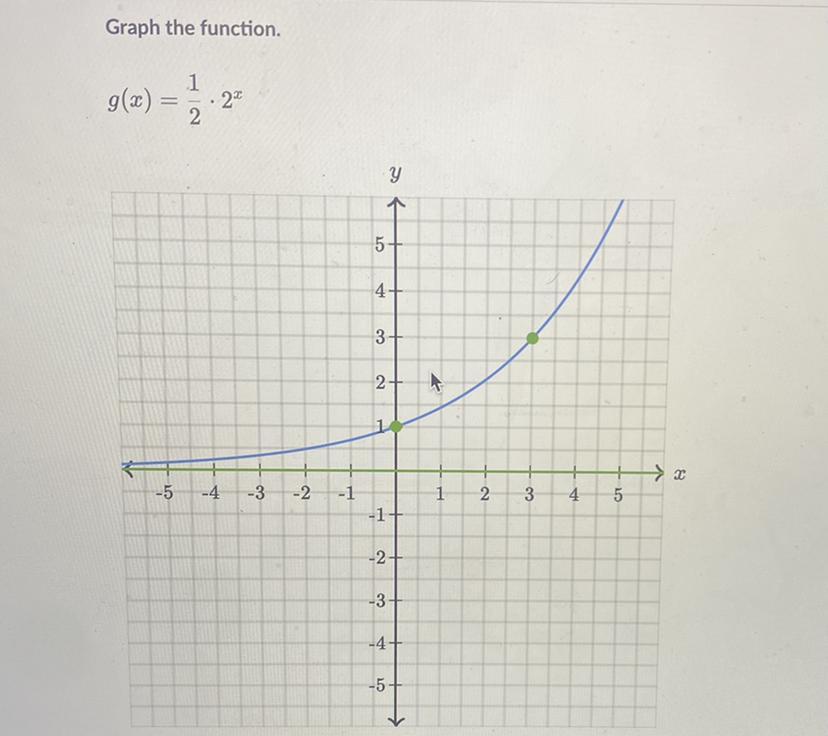
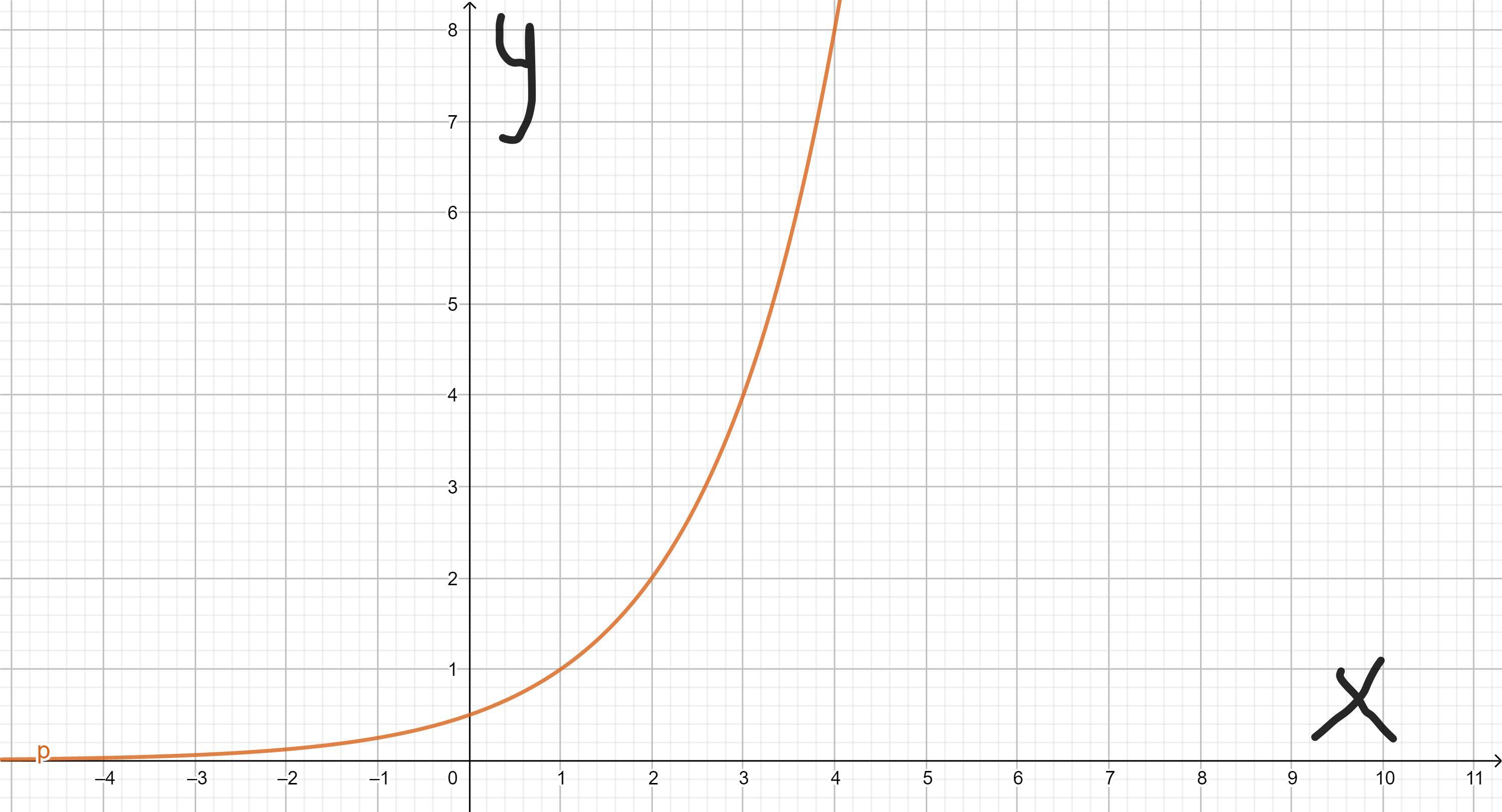
The graph of the exponential function can be seen at the end of the answer.
How to graph the given function?
Here we have the exponential function:
\(g(x) = \frac{1}{2} *2^x\)
We can simplify this to get:
\(g(x) = \frac{1}{2} *2^x = 2^{x - 1}\)
notice that when x = 0, we have:
\(g(0) = 2^{0 - 1} = 1/2 = 0.5\)
\(g(1) = 2^{1 - 1} = 1\)
\(g(2) = 2^{2 -1} = 2\)
Now that we have 3 points (0, 0.5), (1, 1) and (2, 2), we can graph them and then complete the exponential curve such that passes through these.
The graph is the one you can see below.
If you want to learn more about exponential functions:
https://brainly.com/question/11464095
#SPJ1
Related Questions
Selina has $50. She wants to buy some donuts which cost $2.80 each. How many donuts can she buy?
Answers
Answer:
50/2.80= 17
17 dounuts
Julie sold 4500 mL of lemonade. How many liters did she sell?
Answers
Answer:
4.5
Step-by-step explanation:
To find the answer you should divide 4,500 by 1000, hence there are 1000 liters in 1 mL
Please help TIA!!!!!!!!
Answers
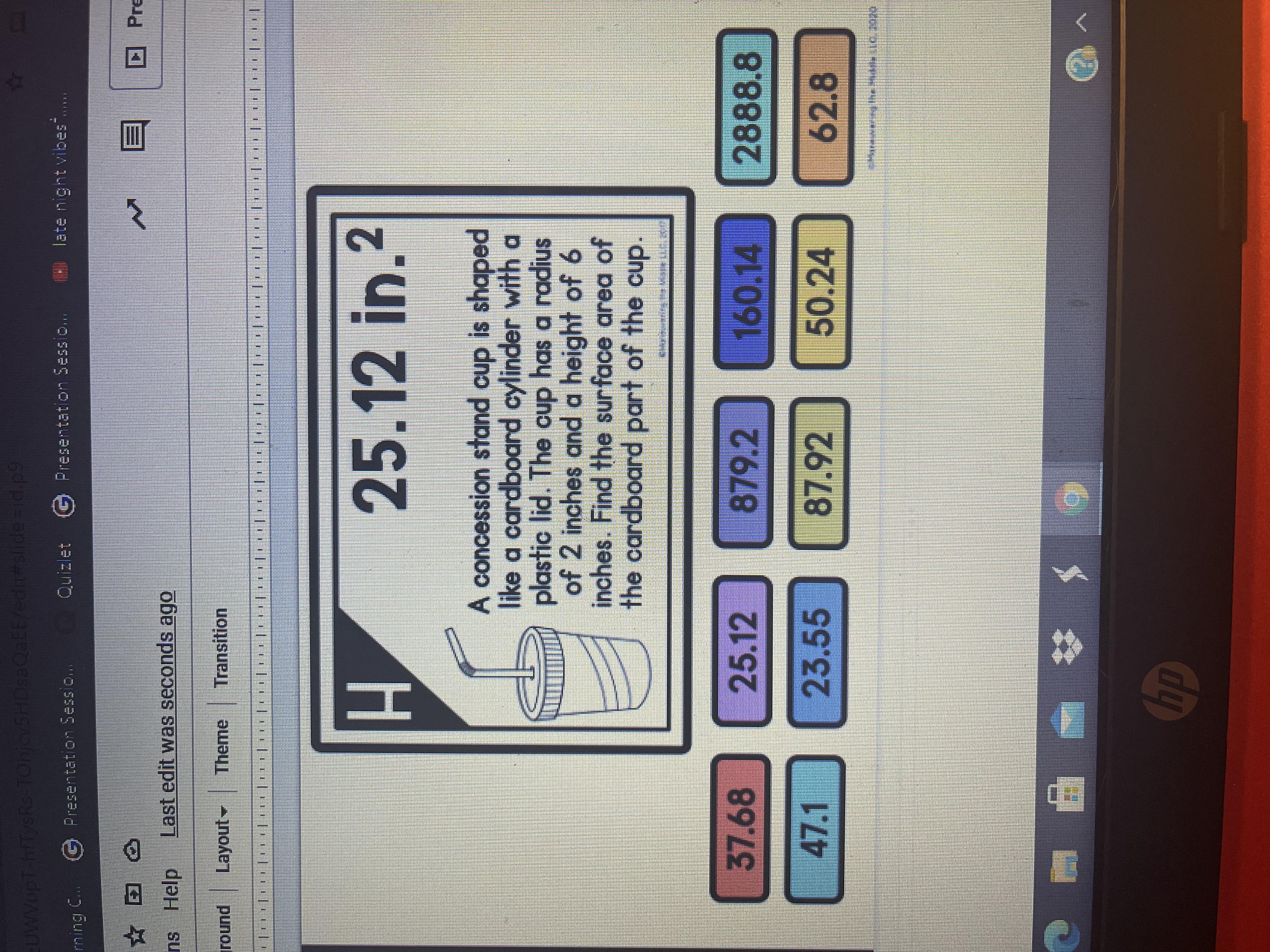
What would the area be for a circle with the diameter of 7
Answers
Answer:
The answer is 38.48
Step-by-step explanation:
Picture with explanation provided below.

this is the second question I don't undrstand

Answers
Answer:
\(d=\sqrt{58}\)
Step-by-step explanation:
Distance Formula: \(d=\sqrt{(x_2-x_1)^2+(y_2-y_1)^2}\)
Simply plug in your coordinates into the distance formula to find the length of AB:
\(d=\sqrt{(9-2)^2+(4-1)^2}\)
\(d=\sqrt{(7)^2+(3)^2}\)
\(d=\sqrt{49+9}\)
\(d=\sqrt{58}\)
/58
I’m not sure I’m just a high schooler sooo I hope it helps
When a sample has an odd number of observations, the median is the A.observation in the center of the data array. B.average of the two observations in the center of the data array. C.value of the most frequent observation. D. average of Q1 and Q3.
Answers
When a sample has an odd number of observations, the median is (A). observation in the center of the data array.
The median is a measure of central tendency that is used to determine the middle value in a data set. When a sample has an odd number of observations, the median is the observation in the center of the data array. This means that half of the observations will be less than the median, and half of the observations will be greater than the median.
To find the median in a data set with an odd number of observations, you can simply sort the data in ascending or descending order and then identify the observation in the center of the data array. For example, if you have the data set {1, 2, 3, 4, 5}, the median would be 3, since it is the observation in the center of the data array.
In contrast, when a sample has an even number of observations, the median is the average of the two observations in the center of the data array. For example, if you have the data set {1, 2, 3, 4}, the median would be (2+3)/2 = 2.5, since it is the average of the two observations in the center of the data array.
Therefore, the correct answer to this question is A. observation in the center of the data array.
know more about data array here
https://brainly.com/question/8818134#
#SPJ11
10,9,8,7......
what is the 30th term of the sequence ?????????? PLZZZZZZZ HELPPPPPPPPPPP MEEEEEEEEEEEEEEEEEE
Answers
Answer: -19
Step-by-step explanation:
Seriously... anyway u already know 4 out of the 30 terms of the sequence. U just count back 26 more numbers. I’ll elaborate further 4 u. Keep in mind u already counted 10,9,8 and 7
6,5,4,3,2,1,0,-1,-2,-3,-4,-5,-6,-7,-8,-9,-10,-11,-12,-13,-14,-15,-16,-17,-18,-19
Since u already counted 10,9,8 and 7 you realize that the 30th number is -19.
No need to thank me. Anything 4 my friends ;)
find the perimeter of the figure below 13ft and 12ft
Answers
Answer:
Yes
Step-by-step explanation:
Yes
Answer:
50
Step-by-step explanation:
solve 3x^3 +2x^2 +15 divided by (x+2) show step by step
Answers
Answer:
3x^2-4x+8 (R -1)
Step-by-step explanation:
We can use synthetic division:
-2 | 3 2 0 15
____-6 8 -16
3 -4 8 | -1
So basically, you solve x+2=0 (which is x=-2) and then you put it on the left side. Then make a line and put the coefficients of the polynomial you want to divide. Then with the first coefficient it gets dropped. You would then multiply this by -2 (so 3*-2=-6) and then combine it with 2 in the second column (2+-6=-4). Then we do the same thing with the third column (-4*-2=8) and combine (0+8=8). Same with the fourth column (8*-2=-16) but when we combine this time the answer will be our remainder (15+-16=-1).
So how you would read your final answer is 3x^2-4x+8 (R -1) which the numbers you get are the coefficients.
help meeeeeeeeee pleasee

Answers
Answer: 2.5, 5.3
Step-by-step explanation:
\(-16t^2 +126t=217\\ \\ 16t^2 -126t+217=0\\\\t=\frac{-(-126) \pm \sqrt{(-126)^2 -4(16)(217)}}{2(16)}\\\\t \approx 2.5, 5.3\)
Which biconditional statement below is true?
Angles are congruent if and only if they are vertical angles.
Angles are congruent if and only if they are vertical angles.
Angles are supplementary if and only if their sum is 180°.
Angles are supplementary if and , only if their sum is 180°.
A number is a whole number if and only if it is a natural number.
A number is a whole number if and only if it is a natural number.
Points are collinear if and only if they are coplanar.
Points are collinear if and only if they are coplanar.
Answers
Answer: Angles are supplementary if and only if their sum is 180° is true.
Step-by-step explanation:
Test by making both parts negative: Angles are not supplementary if and only if their sum is not 180° This is also true.
Direction: Choose the letter of the best answer and we
on your ans
1) Given f(x) = 2x - 5 & g(x) = 3x +4, solve for (gof)(x).
C. 6x - 11
11 - 6
Answers
Answer:
C
Step-by-step explanation:
To find (g ○ f)(x), substitute x = f(x) into g(x) , that is
g(2x - 5)
= 3(2x - 5) + 4
= 6x - 15 + 4
= 6x - 11 → C
Thank you to who ever helps

Answers
Applying the transitive property of congruency and other postulates, lines l and m are proven to be parallel as explained below.
What is the Transitive Property of Congruency?The transitive property of congruency states that when two angles are sides are congruent to another third angle or side, then the three sides or angles are all congruent to each other.
For example, if <A = <C, and <B = <C, then <A = <B.
The proof that shows that lines l and m are congruent is explained below:
Statement Reason
1. r║s, <5 is congruent to <6 1. Given
2. <5 is supplementary to <4 2. Same-side interior angles theorem
3. <4 is supplementary to <6 3. Transitive property of congruency
4. l║m 4. Converse of same-side interior <s theorem
Learn more about transitive property of congruency on:
https://brainly.com/question/2437149
#SPJ1
0.32 as a mixed number
Answers
Answer:
Hi! The answer to your question is 0 8/25
Step-by-step explanation:
☆*: .。..。.:*☆☆*: .。..。.:*☆☆*: .。..。.:*☆☆*: .。..。.:*☆
☁Brainliest is greatly appreciated!☁
Hope this helps!!
- Brooklynn Deka
state flags if we randomly select two state flags, with replacement, what is the probability that exactly one will have other characteristics?
Answers
The probability that exactly one will have other characteristics is 2 × (11/28 × 17/28). The correct answer is option e.
To calculate the probability that exactly one state flag will have other characteristics, we can break it down into two cases:
The first flag has other characteristics and the second flag does not.
The first flag does not have other characteristics and the second flag does.
The probability of the first case is (11/28) × (17/28), since the probability of selecting a flag with other characteristics on the first draw is 11/28, and the probability of selecting a flag without other characteristics on the second draw is 17/28 (since we are drawing with replacement, the probabilities remain the same for both draws).
Similarly, the probability of the second case is (17/28) × (11/28).
So the total probability is the sum of these two probabilities, which is:
(11/28) × (17/28) + (17/28) × (11/28) = 2 × (11/28) × (17/28) = 0.335 (rounded to three decimal places)
Learn more about the probability at
https://brainly.com/question/30034780
#SPJ4
The question is -
If we randomly select two state flags, with replacements, what is the probability that exactly one will have other characteristics?
a. 1/11 × 1/11
b. 2 × (11/28 × 17/27)
c. 12/28 + 17/28
d. 2 × 11/28
e. 2 × (11/28 × 17/28)
f. 11/28 × 17/28
On a coordinate grid, the x axis represents the age of a plant in weeks, and the y axis represents the height of the plant in inches. After 3 weeks, the plant was 4.5 inches tall. Write the coordinates.

Answers
Answer:
(3,4.5)
Step-by-step explanation:
Three, Four point five
The required coordinates are (3,4.5) which represents the plant was 4.5 inches tall after 3 weeks in the given graph.
What is a graph?A graph can be described as a visual representation or a diagram that represents data or values.
The graph is shown which is given in the question
Here the x-axis represents the age of a plant in weeks, and the y-axis represents the height of the plant in inches on a coordinate grid.
After 3 weeks, the plant was 4.5 inches tall.
As per the given condition,
The x-coordinate is 3 weeks which means 3 units
The y-coordinate is 4.5 inches height of the plant which means 4.5 units
Therefore, the required coordinates are (3,4.5) which represents the plant was 4.5 inches tall after 3 weeks in the given graph.
Learn more about the graphs here:
brainly.com/question/16608196
#SPJ2
what is the decimal equivalent of 20/9
Answers
Answer:
2.222222
Step-by-step explanation:
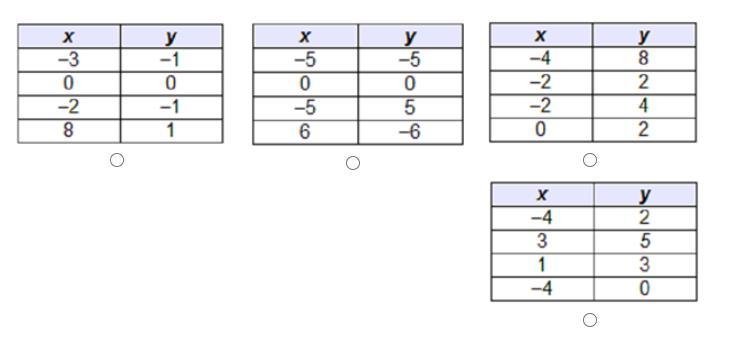
Which table represents a function?
Answers
Answer:
The table that starts with (-3, -1)
Step-by-step explanation:
For a table to represent a function the x value has to be different number. Such as, the other tables one has two -5, two -2, two -4 and etc. Do you get it
Answer: the first box
-3 -1
0 0
-2 -1
8 1
Step-by-step explanation: the x value can not repet it self but the y value can
9.8. installation of a certain hardware takes random time with a standard deviation of 5 minutes. (a) a computer technician installs this hardware on 64 different computers, with the average installation time of 42 minutes. compute a 95% confidence interval for the population mean installation time. (b) suppose that the population mean installation time is 40 minutes. a technician installs the hardware on your pc. what is the probability that the installation time will be within the interval computed in (a)?
Answers
There is an 80.8% chance that the installation time for a single computer falls within the confidence interval computed in part (a).
a) To compute the 95% confidence interval for the population mean installation time, we can use the formula:
CI = x ± z* (σ/√n)
where x is the sample mean installation time, σ is the population standard deviation, n is the sample size, and z* is the z-score associated with the desired confidence level (in this case, 95%).
Substituting the given values, we have:
CI = 42 ± 1.96 * (5/√64)
CI = 42 ± 1.225
CI = (40.775, 43.225)
Therefore, we can say with 95% confidence that the population mean installation time is between 40.775 minutes and 43.225 minutes.
(b) If the population mean installation time is 40 minutes, the probability that a randomly selected installation time falls within the confidence interval computed in part (a) can be calculated using the standard normal distribution. We first convert the interval to z-scores:
Lower bound z-score: (40.775 - 40) / (5/√64) = 1.39
Upper bound z-score: (43.225 - 40) / (5/√64) = 4.29
Using a standard normal table or a calculator, we can find the probability that a z-score falls between 1.39 and 4.29. This probability is approximately 0.808.
Learn more about confidence interval at: brainly.com/question/13067956
#SPJ11
I NEED REAL HELP QUICKLY please

Answers
Answer:
hold on its its.............oh yeah 21
Answer:
b
Step-by-step explanation:
All parallelograms have 4 sides.
Answers
Answer:
yes
Step-by-step explanation:
a parallelogram is a 4 sided figure
Which postulate proves these two triangles are congruent?
A. HL
B. SSA
C. SAS
D. None, not congruent

Answers
The postulate that proves that the two triangles are congruent is A. HL (Hypotenuse-Leg).
What is the Hypotenuse-Leg (HL) theory of triangles congruent?The Hypotenuse-Leg Triangle Congruence Theorem can be described as the triangle theorem which is one of the case of congruency that is been seen as two right triangles are congruent.
From the triangle, we can see that the hypotenuse as well as the leg of the right triangle is been seen as being congruent , and it should be noted that congruency implies that both the sides as well as the angles seems equal in their orientation.
Read more about triangles at:
https://brainly.com/question/17335144
#SPJ1
A cylinder has a base diameter of 8ft and a height of 20ft what is its volume in cubic ft to the nearest tenths place
Answers
Please help giving up 20 points for answers


Answers
Answer:
Question 2: 6x-21
Question 1: -9x+3
Step-by-step explanation:
15x + 3 + 2x + 9r - (8 - r)
Answers
Answer:
17x + 10r -5
Step-by-step explanation:
15x +3 + 2x + 9r- (8-r)
17x +3 +9r -8 +r
17x+ 10r+ -5
Beth’s father asked her to buy party favors for her little brother’s birthday party. Party hats cost $1.60 each, balloons cost $.75 each, and noisemakers cost $.89 each. If each of the nine children receives one of each of the favors, find a reasonable estimate of the total cost of the party favors by rounding each amount to the nearest dollar.
Beth’s father asked her to buy party favors for her little brother’s birthday party. Party hats cost $1.60 each, balloons cost $.75 each, and noisemakers cost $.89 each. If each of the nine children receives one of each of the favors, find a reasonable estimate of the total cost of the party favors by rounding each amount to the nearest dollar.
Answers
Answer:
29$
Step-by-step explanation:
1.60+0.75+0.89=3.24 - dollars per one kid
3.24 * 9 = 29.16 - dollars total
round 29.16 to the nearest dollar - 29$
True or False: When conducting a cluster sample, it is better to have fewer clusters with more individuals when the clusters are heterogeneous
Answers
Answer: True
Step-by-step explanation: This statement is true because when clusters are heterogeneous they are a "scaled-down version" of the population sampled. I hope this helped!
Answer:true
Step-by-step explanation:
the scale of a map is 1cm : 2km. if the length of Alfreda creek on this map is about 2.85 cm, calculate the actual length of the creek
Answers
1 cm..............2 km = scale of the map
2,85 cm....... n km = to be calculated
n x 1 = 2 x 2,85
n = 5,7 km
Step-by-step explanation:
1cm rep 2km
2.85x2
=5.7
=5.7km
how many degrees does the minute hand of a clock turn in 45 minutes
Answers
The clock minutes rotate 270 degrees in 45 minutes.
How to calculate the angular size of a clock's handsWhile rotating, the clock's hands are seen to move at a speed of six degrees per minute.
The number of degrees for a clock minute is solved by
60 minutes = 360 degrees
1 minute = ?
cross multiplying
60 * ? = 360
? = 360 / 60
? = 6
hence 1 minute is 6 degrees
The formula to use to get the calculation is multiplying the number of minutes by 6
Number of degrees in 45 minutes = 45 * 6
Number of degrees in 45 minutes = 270 degrees
Learn more about clock rotation:
brainly.com/question/28741125
#SPJ1
If events A and B are independent, what must be done to find the probability of event A AND B?
A. Multiply the probability of A and the probability of B.
B. Divide the probability of A and the probability of B.
C. Subtract the probability of A and the probability of B.
D. Add the probabilities of A and the probability of B.
Answers
The correct answer is A. When events A and B are independent, it means that the occurrence of one event does not affect the probability of the other event occurring.
In other words, the probability of A occurring does not depend on whether B occurs or not, and vice versa.
To find the probability of both A and B occurring, we need to use the multiplication rule of probability. The multiplication rule states that the probability of two independent events occurring together is equal to the product of their individual probabilities. That is, P(A and B) = P(A) × P(B).
For example, if the probability of event A occurring is 0.3 and the probability of event B occurring is 0.4, then the probability of both events occurring together is:
P(A and B) = P(A) × P(B) = 0.3 × 0.4 = 0.12
Therefore, to find the probability of event A AND B when events A and B are independent, we simply multiply the probability of A by the probability of B.
Learn more about probability at: brainly.com/question/32004014
#SPJ11
The value of c in the perfect square trinomial x^2 + 10x + c can be determined by examining the entries in the 6-column table.
In the given table, the first column represents \(x^2\) and has entries x, x, x, x, x. The second column represents x and has missing entries, which we need to determine. The third, fourth, fifth, and sixth columns also have missing entries.
To find the value of c in the perfect square trinomial \(x^2\) + 10x + c, we need to complete the table and observe the entries in the second column. Since the first column represents \(x^2\), we can see that each entry is \(x^2\). Thus, the missing entries in the second column are x, x, x, x, x, respectively.
The perfect square trinomial \(x^2\) + 10x + c can be factored as \((x + 5)^2\), which expands to \(x^2\) + 10x + 25. Comparing this with the given expression, we can conclude that c = 25.
Learn more about square here:
https://brainly.com/question/14198272
#SPJ11