How much money invested at 7% compounded continuously for 6 years will yield $500?
remember: a = pe^rt
Answers
Answer:
$328.52
Step-by-step explanation:
let p = x, t = 6 years and r = 0.07. now the formula is x*e^0.42 = 500. e^0.42 is approx. 1.522. divide 500 by that to get about $328.52
Related Questions
show that log ab×log ba =1
Answers
Answer:
See below for proof.
Step-by-step explanation:
Given:
\(\log_ab \times \log_ba=1\)
To prove the given equation, begin by changing the base of the two logs so that they have the same base.
\(\boxed{\textsf{Change of base}: \quad \log_pr=\dfrac{\log_xr}{\log_xp}}\)
Change the base of both logs to x by using the change of base formula:
\(\implies \log_ab=\dfrac{\log_xb}{\log_xa}\)
\(\implies \log_ba=\dfrac{\log_xa}{\log_xb}\)
Substitute into the equation:
\(\implies \log_ab \times \log_ba=\dfrac{\log_xb}{\log_xa} \times \dfrac{\log_xa}{\log_xb}\)
\(\textsf{Apply the fraction rule} \quad \dfrac{a}{c}\times \dfrac{b}{d}=\dfrac{a \times b}{c \times d}:\)
\(\implies \dfrac{\log_xb \times \log_xa}{\log_xa \times \log_xb}\)
Apply the commutative property of multiplication to the numerator:
\(\implies \dfrac{\log_xa \times \log_xb}{\log_xa \times \log_xb}\)
Cancel the common factor logₓb:
\(\implies \dfrac{\log_xa}{\log_xa}\)
\(\textsf{Apply the fraction rule} \quad \dfrac{n}{n}=1:\)
\(\implies \dfrac{\log_xa}{\log_xa}=1\)
Hence proving that:
\(\log_ab \times \log_ba=1\)In one calculation:
\(\begin{aligned}\implies \log_ab \times \log_ba & =\dfrac{\log_xb}{\log_xa} \times \dfrac{\log_xa}{\log_xb}\\\\&=\dfrac{\log_xb \times \log_xa}{\log_xa \times \log_xb}\\\\&=\dfrac{\log_xa \times \log_xb}{\log_xa \times \log_xb}\\\\&=\dfrac{\log_xa}{\log_xa}\\\\&=1\end{aligned}\)
What is the solution for the following system of equations?
5x + 7y = 3
2x + 3y = 1
O (-1,2)
O (1,-2)
O (-2,1)
O (2,-1)
Answers
Step-by-step explanation:
I recommend you to use matrices for systems of equations; it's a lot faster and more expedient.

Answer:
\((2, -1)\)
Step-by-step explanation:
Given the system of equations:
\(\begin{cases}5x+7y=3,\\2x+3y=1\end{cases}\)
Multiply the first equation by -2 and the second equation by 5, then add both equations to solve for \(y\):
\(\begin{cases}-2(5x+7y)=(-2)3,\\5(2x+3y)=(5)1\end{cases},\\\begin{cases}-10x-14y=-6,\\10x+15y=5\end{cases},\\-10x+10x-14y+15y=-6+5,\\y=-1\)
Substitute \(y=-1\) into any equation to solve for \(x\):
\(2x+3y=1,\\2x+3(-1)=1,\\2x-3=1,\\2x=4,\\x=\boxed{2}\)
Therefore, the solution to this system of equations is \(\boxed{(2, -1)}\)
hurry please thank u if u answer

Answers
Answer:
92
Step-by-step explanation:
<C = 180 - 140 = 40 deg
180 = 40 + 2x + (x+2)....... x= 46
<B = 2x = 2*46 = 92 deg ans
27y over 15y in lowest terms
Answers
Given: 27y over 15y
The expression will be as following:
\(\frac{27y}{15y}=\text{?}\)The result of the given expression will be:
\(\frac{27y}{15y}=\frac{27}{15}=\frac{3\cdot9}{3\cdot5}=\frac{9}{5}\)The answer is 9/5
It can be written as a mixed number = 1 4/5
Here is an expression: 3 • 2t
1. Evaluate the expression when t is 1
2. Evaluate the expression when t is 4
Answers
Answer:
1. 6
2. 24
Step-by-step explanation:
Substitute in the values for t and solve the expression.
Answer:
1. 6
2. 24
Step-by-step explanation:
Substitute in the values for t and solve the expression.
Kitsap Corporation has provided the following contribution format income statement. Assume that the following information is within the relevant range. Sales (3,000 units) $ 180,000 Variable expenses 108,000 Contribution margin 72,000 Fixed expenses 62,400 Net operating income $ 9,600 The contribution margin ratio is closest to:
Answers
The contribution margin ratio can be calculated by dividing the contribution margin by the sales. In this case, the contribution margin ratio for Kitsap Corporation is closest to a certain value.
The contribution margin ratio is calculated by dividing the contribution margin by the sales. In the given information, the contribution margin is stated as $72,000 and the sales as $180,000.
Contribution Margin Ratio = (Contribution Margin / Sales) * 100
Contribution Margin Ratio = ($72,000 / $180,000) * 100
Contribution Margin Ratio = 40%
Therefore, the contribution margin ratio for Kitsap Corporation is 40%. The contribution margin ratio represents the proportion of each dollar of sales that is available to cover fixed expenses and contribute to net operating income. In this case, for every dollar of sales, 40 cents contribute towards covering fixed expenses and generating net operating income. The higher the contribution margin ratio, the greater the portion of sales revenue available to cover fixed costs and generate profit.
Learn more about value here:
https://brainly.com/question/30145972
#SPJ11
an entry level machinist’s annual pay is $40,872 based on 52 weeks per year. Due to the economy, his company is having to cut back on the number of weeks that it employs it’s machinists. if the firm cuts the work year to 50 weeks but keeps the same rate of pay, how much should the machinist expect his annual pay to decrease? Round your answer to the nearest dollar.
Answers
We know that
• The annual pay is $40,872 based on 52 weeks per year.
First, we have to find the rate per week, let's divide.
\(\frac{40,872}{52}=786\)This means that each machinist receives $786 per week.
If the firm cuts the work year to 50 weeks, then we just have to multiply it by the weekly payment to get the new amount per year.
\(50\cdot786=39,300\)Them, subtract the 52 weeks year payment from the 50 weeks year payment.
\(40,872-39,300=1,572\)Therefore, the annual payment will decrease by $1,572.Tiffany makes 35% commission on the websites he sells to businesses. If he sells $3500 worth of websites, what is his commission?
Answers
Answer:
1225
Step-by-step explanation:
.35 x 3500 = 1225 im late though
\(Solve : 3x = \frac{x}{2} - 5 \\ \)
Correct answer will be mark as brainliest.
Answers
Answer:
-2
Step-by-step explanation:
As per the provided information in the given question, we have a linear equation. We have to find the value of x.
Here, we'll use transposition method to solve this linear equation.Basically, transposition method is used to solve a linear equation in one variable containing constants and variables. We just transpose the values from RHS to LHS by changing its arithmetic operators. In this way, we solve for the unknown value. During transposing the values, ( + ) changes to ( – ) and vice-versa ; ( × ) changes to ( ÷ ) and vice-versa.
Now, coming back to the question. We have,
\(\longmapsto \rm { 3x = \dfrac{x}{2}- 5} \\ \)
Taking the LCM in RHS and performing subtraction.
\(\longmapsto \rm { 3x = \dfrac{x - 10}{2}} \\ \)
Transposing 2 from RHS to LHS. Its arithmetic operator will get changed.
\(\longmapsto \rm { 3x \times 2 = x - 10} \\ \)
Performing multiplication in LHS.
\(\longmapsto \rm { 6x = x - 10} \\ \)
Transposing x from RHS to LHS. Its arithmetic operator will get changed.
\(\longmapsto \rm { 6x - x = - 10} \\ \)
Performing subtraction of the terms in LHS.
\(\longmapsto \rm { 5x = - 10} \\ \)
Transposing 5 from LHS to RHS. Its arithmetic operator will get changed.
\(\longmapsto \rm { x = \cancel{\dfrac{- 10}{5}}} \\ \)
Dividing –10 by 5.
\(\longmapsto \underline{\boxed{\bf { x = - 2}}} \; \bigstar \\ \)
Therefore, the value of x is –2.
Find the centroid of each of the given plane region bounded by the following curves:y = x^2 - 4
y = 2x - x^2
Answers
The y-coordinate of the centroid is -1/7. We can use the formulas for the x-coordinate and y-coordinate of the centroid to find centroid.
To find the centroid of the region bounded by the curves y = x² - 4 and y = 2x - x², we need to use the formulas for the x-coordinate and y-coordinate of the centroid:
x = (1/A) ∫[a,b] x*f(x) dx
y = (1/A) ∫[a,b] f(x) dx
where A is the area of the region and f(x) is the function that represents the top curve minus the bottom curve.
First, we need to find the intersection points of the two curves by setting them equal to each other:
x² - 4 = 2x - x²
2x² - 2x - 4 = 0
x² - x - 2 = 0
(x - 2)(x + 1) = 0
So the curves intersect at x = -1 and x = 2.
To find the area A, we need to find the definite integral of the function f(x) over the interval [a,b]:
A = ∫[a,b] f(x) dx = ∫[-1,2] [(2x - x²) - (x² - 4)] dx
= ∫[-1,2] (6x - 2x²) dx
= [3x² - (2/3)x³]∣∣[-1,2]
= 14
So the area of the region is 14 square units.
Now we can find the x-coordinate and y-coordinate of the centroid using the formulas above:
x = (1/A) ∫[a,b] x*f(x) dx
= (1/14) ∫[-1,2] x[(2x - x²) - (x² - 4)] dx
= (1/14) ∫[-1,2] (6x² - x³) dx
= (1/14) [(2x³/3) - (x^4/4)]∣∣[-1,2]
= 4/7
So the x-coordinate of the centroid is 4/7.
y = (1/A) ∫[a,b] f(x) dx
= (1/14) ∫[-1,2] [(2x - x²) + (x² - 4)] dx
= (1/14) ∫[-1,2] (2x - 4) dx
= (1/14) [(x^2 - 4x)]∣∣[-1,2]
= -1/7
Learn more about the centroid: https://brainly.com/question/10708357
#SPJ11
Find the radius and write an equation of a circle that passes through (8,4) and (0,-2)

Answers
Given
A circles passes through A(8,4) and B(0,-2).
To find the radius and the equation of the circle.
Explanation:
It is given that,
A circles passes through (8,4) and (0,-2).
Then, the diameter of the circle is,
\(\begin{gathered} d=\sqrt{(x_2-x_1)^2+(y_2-y_1)^2} \\ d=\sqrt{(8-0)^2+(4-(-2))^2} \\ =\sqrt{8^2+(4+2)^2} \\ =\sqrt{8^2+6^2} \\ =\sqrt{64+36} \\ =\sqrt{100} \\ =10\text{ }units \end{gathered}\)Therefore, the radius of the circle is,
\(\begin{gathered} r=\frac{d}{2} \\ =\frac{10}{2} \\ =5\text{ }units \end{gathered}\)Also, the center of the circle is,
\(\begin{gathered} Midpoint\text{ }of\text{ }AB=(\frac{x_1+x_2}{2},\frac{y_1+y_2}{2}) \\ =(\frac{8+0}{2},\frac{4+(-2)}{2}) \\ =(\frac{8}{2},\frac{2}{2}) \\ =(4,1) \end{gathered}\)Therefore, the center is (4,1).
Now, consider the equation of the circle as,
\((x-4)^2+(y-1)^2=5^2\)That implies,
\(undefined\)3/15 in simplist form
Answers
Answer: 1/5
Step-by-step explanation: 3/15 divided by 3= 1/5
The answer is 1/5.
First, You have to figure out if there are any numbers that go into both the numerator and denominator evenly.
This number, in this problem, would be three.
This is because 3/3=1 and 15/3=5.
Given that it asks for a fraction in the simplest form, we of course have order those numbers as numerator and denominator.
The three is the numerator, or, above the fifteen, or the denominator.
This must mean that the one is the numerator.
Because the 1 is the numerator, that must mean the 5 is the denominator, which brings us to the answer.... 1/5
An altitude is drawn to the base of equilateral triangle abc. if ac=13, find the length of the altitude.
Answers
The length of the altitude of the equilateral triangle ABC is \(\frac{13\sqrt{3} }{2}\).
Equilateral Triangle is defined as the triangle with all the sides equal and all the angles = 60 deg.
Altitude of a Triangle can be defined as the perpendicular drawn from the vertex of a triangle to the opposite side.
According to the question
In the figure given below
In ΔADC
Since ΔADC is a right angle triangle we can apply Pythagoras Theorem.
Let the sides of the equilateral triangle be "a". and "h" be the altitude.
Since the altitude is of equilateral triangle it divides the base i.e. DC=a/2
\((AC)^{2} =(AD)^{2}+(DC)^{2}\)
\(a^{2} =h^{2}+(\frac{a}{2})^{2}\\ \\ h^{2}=\frac{4a^{2}-a^{2}}{4} \\ \\ h=\sqrt{3} *\frac{1}{2} *a\)
Substituting the value of a=13 we get
Altitude \(h=\frac{13\sqrt{3} }{2}\)
Therefore , The length of the altitude of the equilateral ΔABC is \(\frac{13\sqrt{3} }{2}\).
Learn more about Altitude of a triangle here https://brainly.com/question/24093322
#SPJ4

Does anyone knows the answers to these

Answers
Range is 17.4
IQR is 6
2 (3)^3 + 5
And explain how you got it
Answers
Answer:
59
Step-by-step explanation:
3^3=27
2x27=54
27+54+5=59
Answer:
2 times 3 i 6 o 3 plus 5 equal 8
Step-by-step explanation:
beca you supoed to multiply ad divide
What is the quotient of 3.12 x 10⁸ and 2.6 x 10⁵ expressed in scientific notation?
Answers
Answer:
1.2 * 10^3
Step-by-step explanation:
3.12 * 10^8
=========
2.6 * 10^5
Start by doing 3.12 / 1.6 = 1.2 and that is the correct number of sig digs.
Now get the power on the 10. When dividing, the powers subtract.
10^(8 - 5)
10^ 3
The answer is 1.2 * 10^3
Solve for the value of q.

Answers
Answer:
q = 20
Step-by-step explanation:
The two angles shown in the image are supplementary angles which means their sum is equal to 180°
We can find the value of q using the following equation:
78 + 5q + 2 = 180 add like terms
80 + 5q =180 subtract 80 from both sides
5q = 100 divide both sides by 5
q = 20
\(\huge\text{Hey there!}\)
\(\huge\textsf{Guide to follow:}\)
\(\bullet\large\textsf{ A supplementary angles (}\angle\large\textsf{) is equal to 180}^\circ\\\bullet\large\textsf{ A complementary angles (}\angle\large\textsf{) is equal to 90}^\circ\)
\(\star \large\textsf{ The current angel that you are working with is a \boxed{\mathsf{supplementary \ angle \ (\angle)}}}}\\\large\textsf{so that means means \large\textsf{that your angle is equal to \boxed{\mathsf{180 ^\circ}}}}\)
\(\huge\textsf{What does your equation look like?}\)
\(\mathsf{(78) + (5q + 2) = 180}\)
\(\huge\textsf{How we solve for your equation?}\)
\(\mathsf{(78) + (5q + 2) = 180}\)
\(\mathsf{78 + 5q + 2 = 180}\)
\(\large\textsf{COMBINE the LIKE TERMS}\)
\(\mathsf{(78 + 2) + (5q) = 180}\)
\(\mathsf{78 + 2 + 5q = 180}\)
\(\mathsf{80 + 5q = 180}\)
\(\large\textsf{Simplifying}\)
\(\mathsf{5q + 80 = 180}\)
\(\large\textsf{SUBTRACT 80 to BOTH SIDES}\)
\(\mathsf{5q + 80 - 80 = 180 - 80}\)
\(\large\textsf{Simplify it:}\)
\(\mathsf{5q = 180 - 80}\)
\(\mathsf{5q = 100}\)
\(\large\textsf{DIVIDE 5 to BOTH SIDES}\)
\(\mathsf{\dfrac{5q}{5} = \dfrac{100}{5}}\)
\(\large\textsf{Simplify it:}\)
\(\mathsf{q = \dfrac{100}{5}}\)
\(\mathsf{q = 20}\)
\(\huge\textsf{So, what does mean your answer should be?}\)
\(\huge\text{Therefore, your answer should be: \boxed{\mathsf{q = 20}}}\huge\checkmark\)
\(\huge\text{Good luck on your assignment \& enjoy your day!}\)
What is the simplified value of the expression below?
Negative 2.6 + 5.8
–8.4
–3.2
3.2
8.4
Answers
Answer:
i did that quiz the answer is 3.2
Step-by-step explanation:
your welcome
Answer:
3.2
Step-by-step explanation:
B.
-2x + 8 = y
3x - y = 22
How do I solve it
Answers
answer
x=6, y=-2
explanation
-2x + 8 = y -------equ 1
3x - y = 22 -------equ 2
u can use any of the simultaneous equation method
using elimination method
rearrange first from -------equ 1
-2x+8=y
-y-2x=-8
multiple through by -1
y+2x=8 -------equ 3
rearrange first from -------equ 2
3x-y=22
-y+3=22 ------equ 4
equate 3 and 4, adding them together
y+2x=8 -------equ 3
-y+3=22 ------equ 4
0+5x=30
5x=30
x=6------equ 5
replace 6 for x in any equation
using -------equ 3
y+2x=8
y+2(5)=8
y+10=8
y=8-10
y=-2
Answer:
(x, y)=(6, -4)
Step-by-step explanation:
-2x+8=y
3x-y=22
Substitute the given value of y into the equation 3x-y=22
3x-(-2x=8)=22
Solve the equation for x
x=6
Substitute the given value of x into the equation 3x-y=22
3x6-y=22
Solve the equation for y
y=-4
The possible solution of the system is the ordered pair (x, y)
(x, y)=(6, -4)
Check if the given ordered pair is the solution of the system of equations
-2x6+8=-4
3x6-(-4)=22
Simplify the equalities
-4=-4
22=22
Since all of the equalities are true, the ordered pair is the solution of the system
(x, y)=(6, -4)
How to multi step equations

Answers
3 (p – 3 ) – 8 = 4p – 18
3p – 9 – 8 = 4p – 18
4p – 3p = – 9 – 8 + 18
p = 1
I hope I helped you^_^
What is the solution of
2x = 3 + 4 = 7?

Answers
Answer:
x = 6
Step-by-step explanation:
Given
\(\sqrt{2x-3}\) + 4 = 7 ( subtract 4 from both sides )
\(\sqrt{2x-3}\) = 3 ( square both sides )
2x - 3 = 3² = 9 ( add 3 to both sides )
2x = 12 ( divide both sides by 2 )
x = 6
Erik and Nita are playing a game with numbers. In the game, they each think of a random number from 0 to 20. If the difference between their two numbers is less than 10, then Erik wins. If the difference between their two numbers is greater than 10, then Nita wins. Use the information in the interactive and what you know about absolute value inequalities to better understand the game.
Answers
Question:
Write an algebraic statement that represents all the ways your player will win. Be sure to define your variable
Answer:
Erica:
\(0 \leq |x - y| < 10\)
Nita:
\(10 < |x - y| \leq 20\)
Step-by-step explanation:
Given
Players: Erica & Nita
Range: 0 to 20
Represent Erica with x and Nita with y
For Erica to win;
The difference between x and y must be less than 10 but greater than or equal to 0
i.e.
\(0 \leq x - y \leq 10\) or \(0 \leq y - x \leq 10\)
These two expressions can be merged together to be:
\(0 \leq |x - y| < 10\)
For Nita to win;
The difference between x and y must be greater than 10 but less than or equal to 20
i.e.
\(10 < x - y \leq 20\) or \(10 < y - x \leq 20\)
These two expressions can be merged together to be:
\(10 < |x - y| \leq 20\)
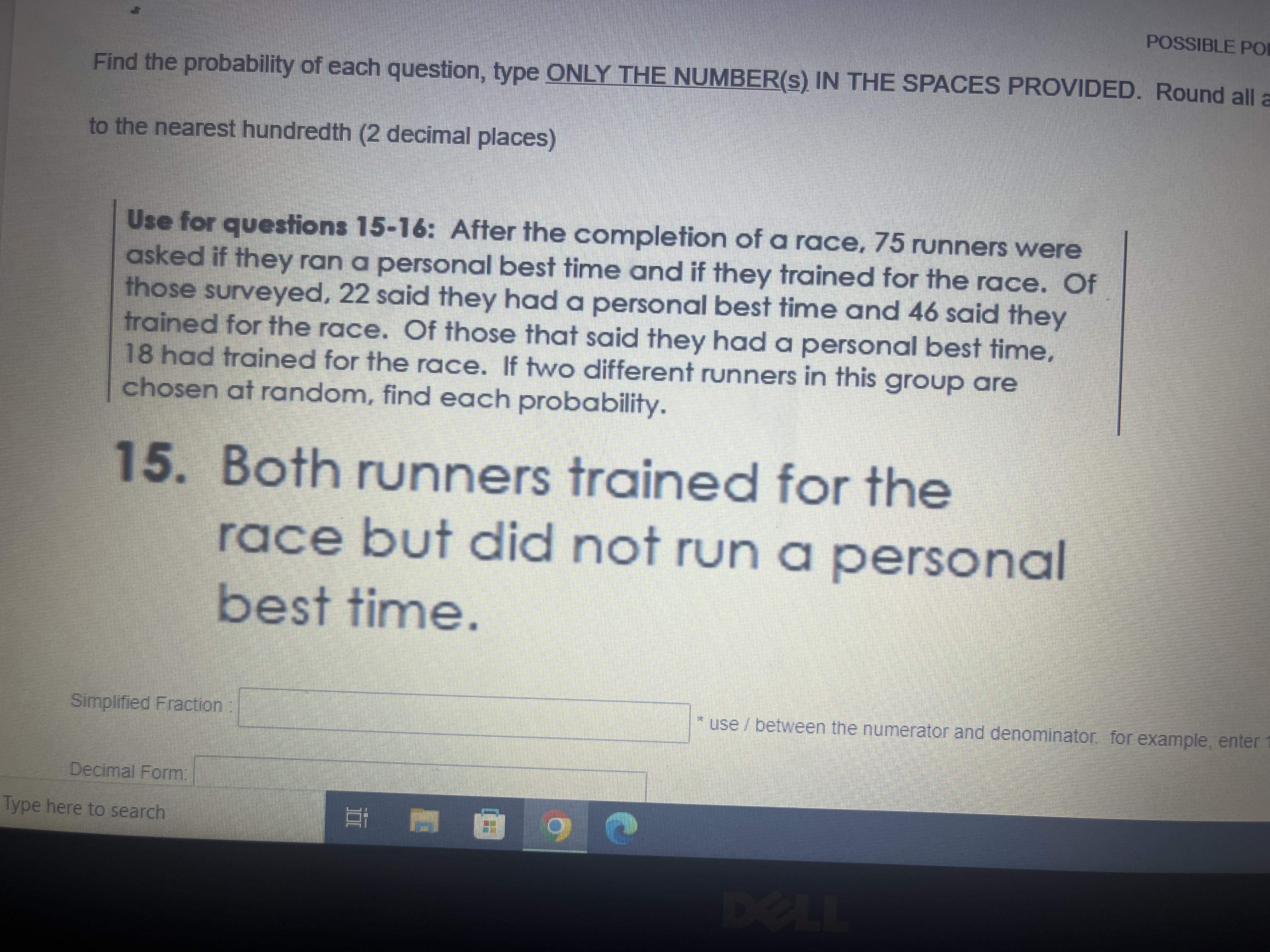
If two runners in this group are chosen at random, find each probability.
Answers
The probability that both runners trained for the race but did not run a personal best time is given as follows:
Fraction: 126/925.Decimal: 0.136.How to calculate a probability?A probability is calculated as the division of the desired number of outcomes by the total number of outcomes in the context of a problem/experiment.
The total number of runners for this problem is given as follows:
75.
Of the 46 runners that trained, 18 had a personal best time, hence the number of runners who trained and did not have a personal best time is given as follows:
46 - 18 = 28.
Hence for both runners the probability is given as follows:
p = 28/75 x 27/74
p = 14/25 x 9/37
p = 126/925.
p = 0.136.
More can be learned about probability at https://brainly.com/question/24756209
#SPJ1
The wages
w
(in £) Caroline earns is the number of hours she works
n
multiplied by her hourly rate
r
(in £ per hour). Enter a formula for Caroline's wages and enter the wage she would earn if she worked 20 hours at a rate of £7.20 per hour
Answers
Answer:
£ 144
Step-by-step explanation:
the formula would be :
w = n * r
finding the wages for 20 hours at a rate of 7.20 hours can be solved like this:
w = n *r
w = 7.20 * 20
w =£ 144
In the original Milgram experiment, only men participated. In another version of the experiment, there were only women participants. How did women's obedience in the experiment compare to men's
Answers
In the original Milgram experiment, only men participated, and the study aimed to investigate their obedience to authority figures. Later, a version of the experiment was conducted with only women participants to compare their obedience levels to men's.
In the replication of the Milgram experiment with only women participants, the level of obedience was found to be similar to that of the original experiment with only men. In fact, the results showed that women were just as likely as men to obey authority figures and administer the maximum level of electric shocks to the supposed "learner" in the experiment. This suggests that obedience to authority is not gender-specific and that both men and women can be equally susceptible to obeying orders, even when they conflict with their own moral beliefs.
To answer your question, women's obedience in the Milgram experiment was found to be similar to men's obedience. Both genders displayed high levels of obedience to the authority figure, even when instructed to administer painful electric shocks to the "learner." This result suggests that obedience to authority is not solely dependent on gender but is rather a widespread human tendency.
Learn more about Milgram experiment at: brainly.com/question/30950092
#SPJ11
Identify the key features of the graph of
the function y = x^2 - 2x + 6
Answers
Answer:
The vertex of the parabola is at (1,5), opens upwards, the y-intercept is at (0,6), and the axis is at y=1
Step-by-step explanation:
Rachel currently has $836 in a savings account that has earned 4. 5% annual compound interest for the past year. What was Rachel’s beginning balance one year ago if she has made no other deposits during the year?
Answers
Rachel's beginning balance one year ago was $800.
What is compound interest?Compound interest is applicable when there will be a change in the principle amount after the given time period.
For example, if you give anyone $500 at the rate of 10% annually then $500 is your principle amount. After 1 year the interest will be $50 and hence principle amount will become $550 now for the next year the interest will be $550, not $500.
Given that,
The current balance is $836 which is the result of compound interest of 4.5 % annually.
The original amount was a priciple amount P on which interest was applied and the final amount $836 made.
Compound interest formula;
A = P[ 1 + RT/100]^T
Where A is the final amount and T is the time period.
Here,
A = 836 , R = 4.5% and T = 1 year.
So,
836 = P[1 + 4.5/100]^1
P = 836/1.045 = $800
Hence "Rachel's beginning balance one year ago was $800".
For more information about compound interest,
brainly.com/question/26457073
#SPJ2
How do I solve this?

Answers
Answer: -2
Step-by-step explanation:
you do
2=x+4
then you minus four from both sides
2-4=x+4-4
2-4=-2
and you are left with -2=x
A right triangle has sides of length 2.4 cm and 6.5 cm. What is the length
of the hypotenuse? (round to the nearest tenth) *
help!!!!
Answers
Answer:
6.9
Step-by-step explanation:
Answer:
6.9
Step-by-step explanation:
write 2 equations that relate distance and time
Answers
2. Time = Distance / Speed