How many grams of calcium carbonate must be decomposed to produce 5.00 L of carbon dioxide at 901 mmHg and 0'C?
Answers
26.3 grams of calcium carbonate must be decomposed to produce 5.00 L of carbon dioxide at 901 mmHg and \(0^0C\)
Explanation:
According to ideal gas equation:
\(PV=nRT\)
P = pressure of gas = 901 mm Hg = 1.18 atm (760 mm Hg = 1 atm)
V = Volume of gas = 5.00 L
n = number of moles = ?
R = gas constant =\(0.0821Latm/Kmol\)
T =temperature =\(0^0C=(0+273)K=273K\)
\(n=\frac{PV}{RT}\)
\(n=\frac{1.18atm\times 5.00L}{0.0821L atm/K mol\times 273K}=0.263moles\)
The chemical reaction for the decomposition of calcium carbonate follows the equation:
\(CaCO_3(s)\rightleftharpoons CaO(s)+CO_2(g)\)
According to stoichiometry:
1 mole of carbon dioxide is produced by = 1 mole of calcium carbonate
Thus 0.263 moles of carbon dioxide is produced by = \(\frac{1}{1}\times 0.263=0.263\) moles of calcium carbonate
Mass of calcium carbonate=\(moles\times {\text {Molar mass}}=0.263mol\times 100g/mol=26.3g\)
26.3 grams of calcium carbonate must be decomposed to produce 5.00 L of carbon dioxide at 901 mmHg and \(0^0C\)
Related Questions
Occurs when the particles in one part of an object _____________ more and ____________ with ______________ particles, making them ______________ ______________.
Different _______________ conduct ___________ at different ___________. ____________ are generally good conductors of heat compared to ______________ (paper, wood, plastics).
____________ are better conductors then liquids because _________________ in solids are ______________ _______________.
Answers
Occurs when the particles in one part of an object vibrate more and collide with neighboring particles, making them transfer energy.
Different materials conduct heat at different rates. Metals are generally good conductors of heat compared to non-metals (paper, wood, and plastics).
Solids are better conductors than liquids because the particles in solids are tightly packed together.
What is thermal energy?Thermal energy is the energy associated with the random motion of particles in a substance. It is a form of kinetic energy created from the vibrational and rotational motion of atoms and molecules in a substance.
All objects contain thermal energy and when two objects of different temperatures are in contact, heat flows from the hotter object to the colder object until they reach a state of thermal equilibrium. Thermal energy is used in many applications such as heating, cooling, and even cooking food.
learn about conduction here https://brainly.com/question/20493362
#SPJ1
Is this statement true or false?
The size and color of an object effects how it moves.
TRUE
FALSE
Answers
Answer:
True
Explanation:
The size of an objects effects how it moves
If the size is large the object moves slowly
And if the size is small the object move fastly
Marco put a pot of water on to boil eggs. Half an hour later, he returned to find the pot dry. This is an example of _____.
condensation
deposition
sublimation
vaporization
Answers
Answer:
Marco put a pot of water on to boil eggs. Half an hour later, he returned to find the pot dry. This is an example of vaporization.
Explanation:
Hope it helps you!!Marco put a pot of water on to boil eggs. Half an hour later, he returned to find the pot dry. This is an example of vaporization. Hence option 4 is correct.
What is vaporization?Vaporization is defined as the process by which a liquid or solid is transformed into a gas at any temperature. Only the liquid's top experiences evaporation, whereas the liquid's bulk experiences boiling. When anything turns from a liquid to a gas, evaporation occurs. Water evaporates when it is heated. The molecules vibrate and travel so swiftly that they release water vapor molecules into the atmosphere.
When you boil a pot of water, you can observe evaporation. Evaporation and boiling are the two processes that cause vaporization. When water is exposed to sunshine, it evaporates, turning into vapor that rises into the atmosphere.
Thus, Marco put a pot of water on to boil eggs. Half an hour later, he returned to find the pot dry. This is an example of vaporization. Hence option 4 is correct.
To learn more about vaporization, refer to the link below:
https://brainly.com/question/14578189
#SPJ2
QUESTION 1.... Please help!!
Competition between two organisms for resources is a limiting factor because...
A. There is only a limited amount of food and living
space available in any ecosystem.
B.Predator-prey populations often increase and decrease in cycles.
C.Abiotic factors such as light, water, and temperature are present.
D.Cities, highways, campgrounds, and orchards provide alternate environments for
animals and plants.
Answers
I just need help all I need is the answer please some one

Answers
Answer: The correct fill-in-the-blank answers are:
1. through binary fission (already filled in)
2. be resistant to penicillin
3. through asexual reproduction.
4. cell replicates before
5. a simpler process
Explanation:
The correct fill-in-the-blank answers are:
1. Bacteria reproduce through binary fission (already filled in)
2. A parent bacterial cell is able to survive in the presence of antibiotic penicillin. Subsequent generations from this parent will be resistant to penicillin
3. Something that potatoes and bacteria have in common is that they both reproduce through asexual reproduction.
4. In asexual reproduction DNA from the parent cell replicates before it produces daughter cells.
5. Asexual reproduction is a simpler process than sexual reproduction.
Know more about Bacteria: https://brainly.com/question/6941760
Oil is a powerful source of energy used for cars, machines, and many other purposes. While studying sources of energy that could replace the use of oil, a student thinks about solar power, wind power, nuclear power, and electric batteries. The students asks,"Which type of source will waste the least energy and provide the most energy in all situations?"
Which best describes why a scientist would ask a different question than this one?
O The question asks about subjective personal preferences regarding energy.
O The question focuses on the objective measurements of amounts of energy.
O The question has too wide of a focus, as though all situations can be studied at once.
O The question is focused on the future and finding new answers about changing needs.
Answers
Answer:
C
Explanation:
scientists usually focus on one specific problem, rather than a whole range. so the answer would be that it's too wide a focus.
btw this is where the crown is on the bottom of the question

Answer:
c
Explanation:
What happened when the two substances were combined together in the cup? (highlight one)
The substances changed into different substances.
The substances did not change into different substances.
I am not sure if the substances changed into different substances.
Explain your answer using evidence from the Sim.
Answers
Based on evidence from Sim, when two substances were combined they did not change into different substances.
Here the word Sim is used to describe the process simulation. Simulation is defined as when two substances combined they do not change into different substances.
They just combine together and form a new substance.
Let us understand it as the first substance is liquid and the second substance is solid then when we combine both of them they form a new mixture but do not change their property.
The mixture is still liquid but it also has some properties of solid substance.
For more details about Sim,
https://brainly.com/question/31764333
The substances did not change into different substances.
Based on the information provided in the question, there is no evidence or indication of any chemical reaction or change in the substances when they were combined in the cup. The question does not mention any observations or effects that would suggest a chemical transformation.
If there were a chemical reaction or change, it would typically be accompanied by observable signs such as color change, gas production, temperature change, or formation of a precipitate. However, since the question does not provide any evidence or observations of such changes, we can conclude that the substances did not undergo any chemical transformation when combined.
It is important to note that without additional information or details about the substances and their behavior, it is not possible to make definitive conclusions. However, based on the given information, the most reasonable conclusion is that the substances remained unchanged when combined in the cup.
To learn more about substances, here
https://brainly.com/question/13320535
#SPJ2
What kind of rocks would you expect to see on Mars? What evidence supports your response?
Answers
What is an ellipse please help)
Answers
In mathematics, an ellipse is a plane curve surrounding two focal points, such that for all points on the curve, the sum of the two distances to the focal points is a constant. As such, it generalizes a circle, which is the special type of ellipse in which the two focal points are the same.
Maybe they might use that math thing for Science.
help me with my science homework

Answers
Take a closer look at Arica, Chileclimograph and the Ocean current map. What can you tell about the seasons and the corresponding months? How is this related to the hemisphere in which Arica is located?
Answers
Answer:
Hello world, today we were given a bunch of worksheets and had to answer questions. We also had to make charts and put them on the website. Let's see how that goes. I'll see you later. Peace!
Picture
Picture
Picture
Picture
7. What can you infer about the climate of each region by reviewing these climographs?
> Tokyo is a place in between warm and cold with a good amount of precipitation. Trondheim is a warm place. Arica is a desert, so it is very humid there.
Research Question: Do Ocean Currents Influence Climate?
Hypothesis: Have each student discuss the research question with one or two other students and then write their hypothesis(es) on paper.
1st Procedure: Predicting the Effect of Ocean Surface Currents on Coastal Climates
Read the Introduction aloud. Then look at the map of major ocean currents and write a prediction describing the climate you would expect of each place listed below. (The symbols are to help locate the cities on the world map.)
Arica, Chile (along the Peru Current, symbol: star)
Trondheim, Norway (along the Norwegian Current, symbol: smiley face)
Tokyo, Japan (along the Kuroshio Current, symbol: heart)
2nd Procedure: Recording Data-Making a Climograph (teacher should make 3 copies of blank climographs per student or group.)
Using the climate data from Fact Sheet A, create a climograph for each city listed. Use a line graph for temperature and a bar graph for precipitation on the same graph.
Conclusion and Analysis:
1. Examine your climographs. What is the difference between the highest and lowest temperatures in the climograph for each city?
> Tokyo, Japan: 39 degree difference
Trondheim, Norway: 32 degree difference
Arica, Chile: 12 degree difference
2. Which city is a desert? How can you tell?
> Arica, Chile is the city in the desert. I know this because there is no precipitation.
3. Take a closer look at the Arica, Chile climograph. What can you tell about the seasons and the months? How is this related to the hemisphere where Arica is located?
> In Arica, it would be warmer during January, February, November, and December, but here during in the Northern Hemisphere it would be colder. The reason is because the seasons are reversed in the Southern and Northern Hemisphere.
4. Is there a relationship between the temperature of the ocean current and the coastal climate?
> Yes, the temperature of the ocean current and the costal climate do have a relationship. With warm currents, the air is warm and moist. With cold currents, the air is dry.
5. Is there a relationship between the direction of the ocean current and the coastal climate?
> Yes, the direction of the ocean current and the costal climate do have a relationship. The ocean currents from the coast affects how the air will be on
land.
6. In general, on which side of the ocean basins are the cold currents? Warm currents?
> The east side of the ocean basins is where the cold currents are. The west side of the ocean basins are where the warm currents are.
what is a cytoplasm and what building would represent it
Answers
Answer:
A cytoplasm is a fluid inside a eukaryotic cell that contains fluids and other molecules. Most of a cell's water is in the cytoplasm. It has a colorless look.

WARNING (It's actually 8th grade science but it's not on here...)
The periodic table is organized into groups and periods of elements. The characteristics of a certain group of elements are listed below. Which of these elements is in this group?
Characteristics of a group of elements
•It's shiny
•It's a solid at room temperature
• It has atoms with 2 valence electrons
Answer Choices
A. Lithium
B. Strontium
C. Aluminum
D. Silicon
Answers
You may think of changes in climate occurring as you go north or south. This climber stayed at the same latitude and went up. What explains the difference in temperature and climate between the top and bottom of Mt. Kilimanjaro? Please explain in 3-5 sentences thank you for 81 points
Answers
Answer: I'm not really sure but I think its dew to the different heights and tempura going up and down and the flow of wind.
Explanation:
Answer:
Mountains make it possible for snow to be found at the equator. Why does the temperature become colder the higher up a Mountain? Generally the climate on mountains get progressively colder with increased altitude (the higher up you go).
Explanation:
What is the charge on the Cr in Cr2O72-
Answers
Answer:
+6.
Explanation:
So, a chromium atom here has an oxidation number of +6.
Which of the following is a renewable resource?
Oil
Sunlight
Gold
Natural gas
Answers
all light is the same whether it comes from the sun a light bulb or anywhere
do you agree with this statement explain
Answers
NOT ALL LIBHT SOURCES ARE THE SAME
No, the light from a lightbulb or many other electronic stuff, it’s light brightness depends on 1. The object 2. The amount of electric. The sun on the other hand can burn your eyes and skin just by it’s heat waves and bright glare. The sun is the brightest thing.
All light being the same whether it comes from the sun a light bulb or
anywhere is False.
What is Light energy?This is a type of kinetic energy which makes light to be visible to the eyes.
There are different sources of light which include:
SunElectric bulbCandle etc.Light from bulbs and Sun involve photons being emitted at different
intensities which is why the light from both sources are different. The
Sun has more intensity and a different source than the Light bulb.
Read more about Light energy here https://brainly.com/question/8181719
HELP ASAP ITS 8th GRADE SCIENCE BUT IT DOESN'T HAVE THAT OPTION
The graph shows the kinetic energy (KE) and potential energy (PE) of a bouncing ball over a period of 9 seconds. Use the graph to answer question 2-3.
2. When does the ball have the most kinetic energy?
3. What statement best describes what happens to the total mechanical energy of the ball as it bounces?
please and thank you <333

Answers
Answer: By best guest is 2-A & 3-A
Explanation:
I would have an expert answer this just in cast i'm wrong
PLS HELP DONT GOGGLE!!

Answers
The area where the land meets the sea is called the coastline. This area can have different physical features depending on its location. Some common features of coastlines are beaches, cliffs, bays, harbors, estuaries, and dunes. Beaches are made up of loose particles like sand and gravel that are deposited by the sea.
In some areas, the shoreline may consist of a wide, sandy beach, while in others it may be rocky and steep.
In general, the shoreline is where the land transitions to the sea, and it is often marked by the presence of waves, tides, and other oceanic phenomena.
Do you think rayon when burnt will stick to the body like other synthetic fibers?
Answers
What are thermal plasmas?
plasmas that have particles that collide infrequently
plasmas that reach a temperature equal to their surroundings
plasmas that do not reach thermal equilibrium
plasmas that have only a few particles ionized at any given mom
Answers
Explanation:
Thermal plasmas are plasmas that reach a temperature equal to their surroundings.
Answer:
B
Explanation:
KNO₃ number of atoms
Answers
Answer:
5
Explanation:
Heavy atom count:5
Formal Charge:0
Complexity: 18.8
Isotope Atom count: 0
hope this helps:))
Answer:
There are 5 atoms in KNO3What results when two waves that are completely out of phase meet?
A: constructive interference that results in a greater amplitude
B: destructive interference that results in a greater frequency
C :destructive interference that results in a lower amplitude
Answers
Answer:
The result is a superposition which is twice the amplitude of each input wave. Φ = π means the two waves are completely OUT OF PHASE, and so add completely destructively. The result is a superposition which has no amplitude at all.
Explanation:
The result is a superposition which is twice the amplitude of each input wave. Φ = π means the two waves are completely OUT OF PHASE, and so add completely destructively. The result is a superposition which has no amplitude at all.
Destructive interference occurs when the maxima of two waves are 180 degrees out of phase: a positive displacement of one wave is cancelled exactly by a negative displacement of the other wave. The amplitude of the resulting wave is zero.
Tell me step by step how to do 3/5 divided by 5.
Answers
Answer:
3/25
Explanation:
3/5 divided by 5.
Flip the reciprocal of 5.
3/5*1/5.
3/25.
Hope this helps plz mark brainliest :D
Answer:3/25
Explanation:divide
baking soda and vinegar come together to form new substances. what are these new substances called? *
A reactants
B compounds
C products
D chemical bonds
Answers
Answer:
Answer:C. Products
Explanation:
baking soda and vinegar are the reactants and when reactants are mixed to form new substances then they are called Products.
e.g: baking soda and vinegar are mixed together to form carbonic acid. In this chemical reaction reactants are baking soda and vinegar, Product is carbonic acid which is also known as Carbon dioxide gas.
please help me 7th grade science
When a chemical reaction occurs, what happens to the atoms of the two substances? Provide an example from the Sim (on Amplify) as evidence to support your answer.
When a chemical reaction does not occur, what happens to the atoms of the two substances? Provide an example from Sim as evidence to support your answer.
Answers
An example of this can be seen in the Sim on Amplify, where students can experiment with different chemical reactions. For instance, in the "Chemical Reactions" Sim, students can explore the reaction between iron and sulfur to form iron sulfide. In this reaction, the iron atoms and sulfur atoms combine to form a new compound, iron sulfide, with different properties than the original iron and sulfur. The atoms of the iron and sulfur are rearranged to form new bonds, resulting in the formation of a new substance. This is an example of a chemical reaction, where the atoms of the two substances are rearranged to form a new compound with different properties.
Answer:
Explanation:A chemical response is a chemical transformation in which two chemicals combine to create a third component.
(i) Adding diluted acid to an active metal causes the test tube to heat up and hydrogen gas to escape, which results in the production of heat.
(ii) When diluted hydrochloric acid is added to silver nitrate, AgCl, a white precipitate, results.
(iii) When water is added to quicklime, the mixture boils and produces heat along with a hissing sound.
(iv) Thermal breakdown of mercury oxide - Mercury turns from red to a metallic silver tint as a result of this process.
Which word names melted rock and minerals found beneath Earth's crust?
A. lava
B. magma
C. rhyolite
D. gabbro
Answers
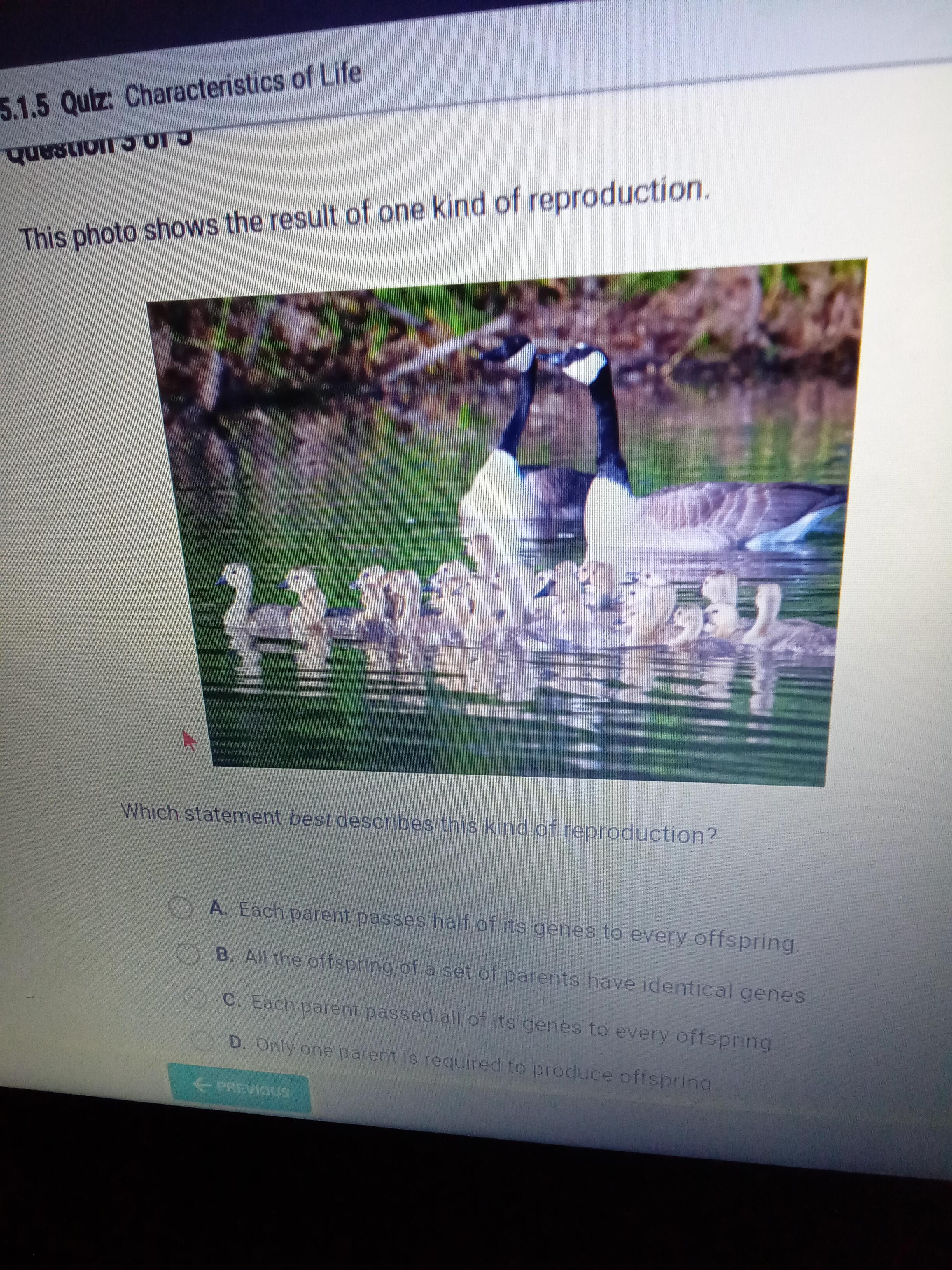
This photo shows the results of one kind of reproduction
Which statement Best describes this kind of reproduction?
A. Each parent passes half of it's genes to every offspring
B. all the offspring of a set of parents have identical genes
C. Each parent passed all of it's genes to every offspring
D. Only one parent is required to produce offspring
Answers
Answer:
b
Explanation:
their genetics come from the same two parents so if their genetics looked different it would mean that a offspring wasnt one of the parents.
To solve this, we must know each and every concept behind reproduction. Therefore, all the offspring of a set of parents have identical genes best describes this kind of reproduction. the correct option is option B.
What is reproduction?The process through which organisms duplicate themselves is known as reproduction. In general, reproduction is among the most essential notions in biology: it involves creating a replica, a likeness, and so ensuring the survival of species.
Their genetics are derived from the exact two parents, thus if their genetics differed, it meant that an offspring was not one of the mom and dad. "All the offspring of a set of parents have identical genes" best describes this kind of reproduction.
Therefore, all the offspring of a set of parents have identical genes best describes this kind of reproduction. the correct option is option B.
To know more about reproduction, here:
https://brainly.com/question/14329745
#SPJ1
What are the four main categories of stars?
How does each of these types of stars differ in size, brightness, and temperature? *Answer both, please!* :)
Answers
Answer:
Read below:
Explanation:
1. The four main categories of stars are:
O-type stars: These are the hottest and most massive stars. They are extremely bright and have surface temperatures of more than 30,000 K.B-type stars: These stars are slightly cooler and less massive than O-type stars. They have surface temperatures of around 10,000 K and are also very bright.A-type stars: These stars are cooler and less massive than B-type stars. They have surface temperatures of around 7,500 K and are relatively bright.M-type stars: These stars are the coolest and least massive of the four categories. They have surface temperatures of less than 3,500 K and are not very bright.2. In general, O-type stars are the largest and most luminous, while M-type stars are the smallest and least luminous. B-type and A-type stars fall in between these two extremes in terms of size, brightness, and temperature. However, there is a lot of variation within each of these categories, and there is not a hard and fast rule for how these characteristics relate to one another. The size, brightness, and temperature of a star depend on a variety of factors, including its mass, age, and composition.
Which of the following properties can be used as evidence a chemical reaction has occurred? (Select all that apply)
a. Density change
b. Melting point change
c. odor change
d. Color change