Answers
Answer:
2.1 × 10²⁴ atoms Pb
Explanation:
Avogadro's number: 6.022 × 10²³
Step 1: Find conversions
1 mol Pb = 6.022 × 10²³ atoms Pb
Step 2: Use Dimensional Analysis
\(3.5 \hspace{3} mol \hspace{3} Pb(\frac{6.022(10)^{23} \hspace{3} atoms \hspace{3} Pb}{1 \hspace{3} mol \hspace{3} Pb} )\) = 2.107 × 10²⁴ atoms Pb
Step 3: Simplify
We have 2 sig figs.
2.107 × 10²⁴ atoms Pb ≈ 2.1 × 10²⁴ atoms Pb
Related Questions
A reaction is found to have an activation energy of 38.0 kJ/mol. If the rate constant for this reaction is 1.60 × 10² M-1s-1 at 249 K, what is the rate constant at 436 K?
Answers
The new rate constant is 1.5 * 10^6 M-1s-1 .
What is the rate constant?In this case we know that we have to use the Arrhenius equation to find the rate constant at two different temperatures by the use of the formula;
ln(k2/k1) = -Ea/R(1/T2 - 1/T1)
k2 = Rate constant at 436 K
k1 = Rate constant at 249 K
T1 = initial temperature
T2 = final temperature
R = Gas constant
Ea = activation energy
Hence;
ln(k2/1.60 × 10^2) = -38 * 10^3/8.314(1/436 - 1/249)
ln(k2/1.60 × 10^2) = -38 * 10^3/8.314(0.002 - 0.004)
ln(k2/1.60 × 10^2) = 9.14
k2/1.60 × 10^2 = e^ 9.14
k2 = e^ 9.14 * 1.60 × 10^2
k2 = 1.5 * 10^6 M-1s-1
Learn more about activation energy:https://brainly.com/question/11334504
#SPJ1
What type of reaction is this?

Answers
Cu + O2 ---> CuO2 -The first reaction is a combustion reaction
2 HCl + Mg → H2 + MgCl2- The second reaction is a Single replacement reaction
What is a combustion reaction?A combustion reaction is a type of chemical reaction that occurs between a fuel and an oxidizer in the presence of heat or light, resulting in the release of energy in the form of heat and light.
In other words, it is a reaction in which a substance reacts with oxygen to produce heat and light.
Combustion reactions are important in many aspects of daily life, including the burning of fossil fuels for energy production, the combustion of wood or other materials for heating or cooking, and the combustion of fuels in internal combustion engines.
Learn more about combustion reaction:https://brainly.com/question/30562669
#SPJ1
1. Write the balanced chemical equation for the synthesis of magnesium phosphide from its elements, including the word “energy” as a product.
- Write the Keq expression for the reaction.
Answers
Answer:
3Mg(s) +2P(s) -------> Mg3P2(s) + energy
Keq= [Mg3P2]/[Mg]^3 [P]^2
Explanation:
The equation for the formation of magnesium phosphide from its elements is;
3Mg(s) +2P(s) -------> Mg3P2(s) + energy
Hence we can see that three moles of magnesium atoms combines with two moles of phosphorus atoms to yield one mole of magnesium phosphide. The equation written above is the balanced chemical reaction equation for the formation of the magnesium phosphide.
The equilibrium expression for the reaction K(eq) will be given by;
Keq= [Mg3P2]/[Mg]^3 [P]^2
5.86 ■ Liquid oxygen for use as a rocket fuel can be produced by cooling dry air to −183°C, where the O2 condenses. How many liters of dry air at 25°C and 750 torr would need to be processed to produce 150 L of liquid O2 at −183°C? (The mole fraction of oxygen in dry air is 0.21, and the density of liquid oxygen is 1.14 g/mL.)
Answers
Approximately 631.5 liters of dry air at 25°C and 750 torr would need to be processed to produce 150 liters of liquid \(O_2\) -183°C.
To solve this problem, we need to consider the ideal gas law and the molar volume of gases.
First, we can calculate the number of moles of oxygen in 150 L of liquid \(O_2\) at -183°C. To do this, we divide the mass of liquid oxygen by its molar mass:
Mass of liquid oxygen = volume of liquid oxygen * density of liquid oxygen = 150 L * 1.14 g/mL = 171 g
Molar mass of oxygen (O2) = 32 g/mol
Number of moles of oxygen = mass of oxygen / molar mass of oxygen = 171 g / 32 g/mol ≈ 5.34 mol
Since the mole fraction of oxygen in dry air is given as 0.21, we can calculate the total moles of dry air needed to produce 5.34 mol of oxygen:
Moles of dry air = moles of oxygen / mole fraction of oxygen = 5.34 mol / 0.21 ≈ 25.43 mol
Now, we can use the ideal gas law to calculate the volume of dry air at 25°C and 750 torr (convert to atm) that corresponds to 25.43 mol:
PV = nRT
P = 750 torr * (1 atm / 760 torr) ≈ 0.987 atm
V = volume of dry air (unknown)
n = 25.43 mol
R = 0.0821 L·atm/(mol·K)
T = 25°C + 273.15 = 298.15 K
Solving for V:
V = nRT / P = (25.43 mol)(0.0821 L·atm/(mol·K))(298.15 K) / 0.987 atm ≈ 631.5 L
For more such questions on dry air visit:
https://brainly.com/question/14247097
#SPJ8
How many significant figures are in 6.07×10^14
Answers
Answer:3
Explanation: counting from left to right there is 3 sig figs.
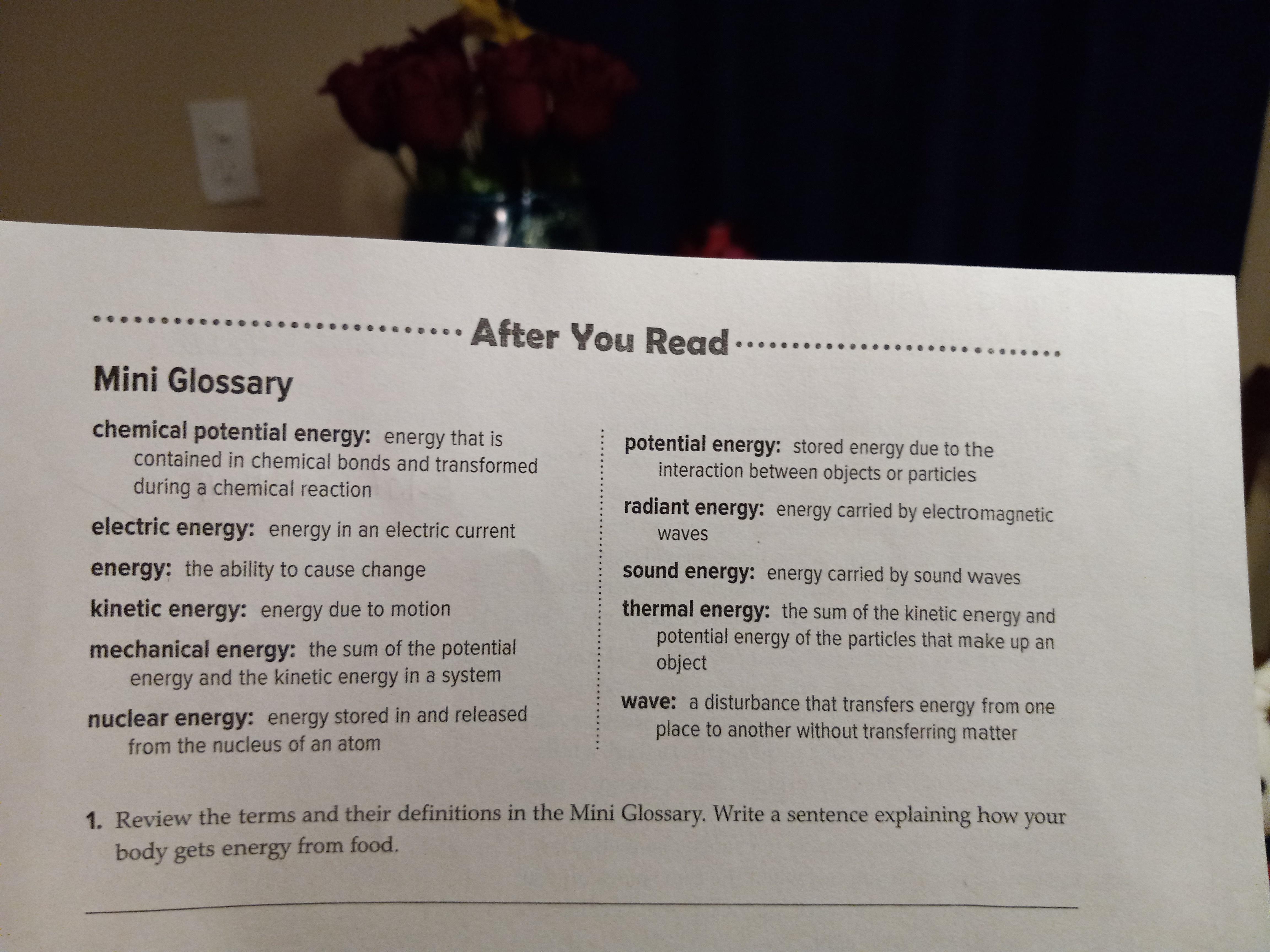
Review the terms and their definitions in the Mini Glossary. Write a sentence explaining how your body gets energy from food
Answers
Food energy is transformed into energy that the body's cells can utilise during cellular respiration. Energy is converted to ATP during cellular respiration, which transforms glucose and oxygen into carbon dioxide and water.
What kind of energy is used by your body to develop and maintain itself?
Your body can move its muscles when you ingest food, which enables you to breathe, walk, run, leap, lift objects, and perform all the other survival-related tasks. The mechanical energy of moving muscles is created from the chemical energy of food.
What kind of energy is used by your body to develop and maintain itself?Your body can move its muscles when you ingest food, which enables you to breathe, walk, run, leap, lift objects, and perform all the other survival-related tasks. The mechanical energy of moving muscles is created from the chemical energy of food.
To know more about cellular respiration visit:
https://brainly.com/question/13721588
#SPJ9
Calculate the kinetic energy of a mole of oxygen gas molecules that have a speed
of 10.0 m/s.
Answers
Answer:
1600J
Explanation:
1 mole of oxygen gas (O2) has a mass of 32g i.e. the molar mass = 32g/mol
Kinetic energy (K.E) = ½ × m × v²
Where;
m = mass (g)
v = speed or velocity (m/s)
From the information given in this question;
m = 32g
V = 10m/s²
K.E = ½ × 32 × 10²
K.E = 16 × 100
K.E = 1600J
How many grams are 1.2 x 10^-2 moles of K3PO4
Answers
Answer:
2.5471951319999997
Explanation:
Why does the solubility of many substances increase with temperature? (Remember what an increase in temperature means on a microscopic scale.)
Answers
The solubility of many substances increases with temperature, there are exceptions. Some substances exhibit a decrease in solubility with temperature due to specific interactions or changes in solute-solvent interactions at higher temperatures.
The increase in solubility of many substances with temperature can be attributed to the effect of temperature on the kinetic energy and intermolecular interactions of molecules.
On a microscopic scale, an increase in temperature corresponds to an increase in the kinetic energy of molecules. As the kinetic energy increases, the molecules move more rapidly and collide with each other and with the solvent molecules more frequently and with greater force.
These increased collisions and kinetic energy result in enhanced molecular interactions and overcome the forces holding the solute particles together. This increased energy disrupts the intermolecular forces within the solute, allowing the solvent molecules to surround and interact more effectively with the solute particles, leading to greater solubility.
Additionally, an increase in temperature can cause solvent molecules to move more freely, reducing their cohesion and allowing them to interact more readily with solute particles.
for more questions on solubility
https://brainly.com/question/24057916
#SPJ8
HELPPP PLEASEE w/ all

Answers
The covalent bond is present in the compound C₃H₈. The reactant C is 3, product C is 6, reactant H is 8, product H is 10, Reactant O is 2, product O is 9.
What is covalent bond ?
Atoms share electron pair between them in covalent bonds. H-H or C-H are examples of nonpolar covalent bonds between atoms with similar or identical electronegativity, whereas polar covalent bonds are formed when unequal electronegativity is shared between atoms (e.g., H–O).
What is reactant ?
Raw materials known as reactants combine to create products. When the right factors, such as temperature, time, or pressure, come into play, the chemical bonds between the reactants are broken, allowing the atoms to form new bonds that lead to various combinations.
Therefore, covalent bond is present in the compound C₃H₈. The reactant C is 3, product C is 6, reactant H is 8, product H is 10, Reactant O is 2, product O is 9.
Learn more about covalent bond from the given link.
https://brainly.com/question/3447218
#SPJ1
A student drew a diagram of the quantum model of an atom, as shown.
A small circle is shown. Six light gray spheres and six dark gray spheres are shown inside the circle. On the outer side of the circle is another circle of larger radius. This circle has two small circle on its boundary. Another circle of even greater radius is on the outside of the second circle. This outermost circle has four small circles on its boundary.
Which of the following explains if the student's diagram is correct or incorrect?
A - The diagram is incorrect because electrons follow an elliptical path instead of a circular path.
B - The diagram is incorrect because the exact location of the electrons cannot be determined.
C - The diagram is correct because protons and neutrons are concentrated at the center of the atom.
D - The diagram is correct because electrons are present in distinct energy levels around the nucleus.

Answers
The diagram is correct because electrons are present in distinct energy levels around the nucleus. Option D
What is the quantum model?Let nus just take a minute to be able to remind ourselves that when we look at the atom that there are several subatomic particles that can be shown to be able to make up the atom. We know that the electron is the particle that can be shown to be arranged in shells.
What we saw in the inner or the core of the atom is the nucleus and the six grey spheres that we can see there would have to do with the nucleus of the atom that is in the question.
As we now look up at the shells, we can see the electrons as they have been arranged into the respective shells were they can be found in the atom on the basis of the energy that they possess.
Learn more about atoms:https://brainly.com/question/13654549?
#SPJ1
A geologist is making observations from atop a small mountain. She sees two parallel faults: one directly to the east and one directly to the west. She concludes that these faults are caused by tension stretching the crust.
From what type of land feature is the geologist making her observations?
plateau
anticline
syncline
fault-block mountain
This is really a science question but i could not find it
Answers
Answer:
Fault-Block Mountain
Explanation:
just did test and got it correct UwU
The geologist is making observation from the fault block mountain so that she sees two parallel faults one from east and another from west.
What is fault block mountain?Mountains with fault blocks are identifiable by their great sheer rock faces. These are created when a large rock mass separates from another due to intense subterranean pressure. The fault is the location on the line where this break occurs.
The rocks rise on one side of this breach and sink on the other. Fault blocks are very large blocks of rock, sometimes hundreds of kilometers in extent, created by tectonic and localized stresses in earth's crust. Large areas of bedrock are broken up into blocks by faults. Blocks are characterized by relatively uniform lithology.
The largest of these fault blocks are called crustal blocks. Large crustal blocks broken off from tectonic plates are called terranes. Those terranes which are the full thickness of the lithosphere are called microplates.
To find more on block mountains, refer here:
https://brainly.com/question/22964031
#SPJ6
A student dissolved a 40-gram block of a salt in 100 grams of warm water at 45°C. The solution was allowed to cool down to 24°C. The student noticed that some of the salt came out of the solution and settled to the bottom of the beaker. It is later determined that 12 grams of the salt came out of the solution. How many grams of the salt were dissolved in the solution at 24°c 100 grams of warm water , PLEASE HELP ME FAST I ONLY HAVE A COUPLE MIN LEFT TO
FINISH I WILL GIVE YU BRAINLIEST!
Answers
Answer:
28
Explanation:
The grams of salt dissolved in the solution was 28, because 40 minus 12 would be 28. I know I'm suppose to subtract 40 by 12 considering the fact, it is 12 grams of salt that came out. The rest of the numbers are irrelevant. (apologies this is a week late.)
The amount of salt that was dissolved in the water is 28 grams of the salt.
What is solubility?The term solubility refers to the amount of a substance that dissolves in solution. In this case we are told that about 40-grams of salt was added to water but about 12 grams of the salt came out of the solution.
In this case, the amount of salt that was dissolved in the water is 40 g - 12 g = 28 grams of the salt.
Learn more about solubility: https://brainly.com/question/14356798
Which one of the following salts is least soluble in water?
1. Na2SO4
2.CaBr2
3. LiCl
4. RbI
5. PbSO4
Answers
Suppose a solution has a density of 1.87 g/mL. If a sample has a mass of 17.5 g the volume of the sample in mL is what?
Answers
We can use the formula:
Density = Mass/Volume
Rearranging the formula gives:
Volume = Mass/Density
Substituting the given values gives:
Volume = 17.5 g / 1.87 g/mL = 9.36 mL.
what is the net force if you start to pull instead of pushing?
Answers
Answer:
45N, and B
Explanation:
Answer:
an object will continue in its state of motion unless an unbalanced force is acting on it. If forces are balanced, then the net force equals 0. This means that there is no acceleration.
Explanation:
If you have 12 grams of H2 gas, .
how many moles do you have?
Answers
Answer:
zwasetdrcyfvgybhuknjimk
Explanation:
Which option correctly explains a metallic bond

Answers
Answer:
The chemical bond between atoms in metallic elements
Explanation:
Metallic bond is a bond that exist between metallic elements. It does not occur between metals and non metals.
A worker gets paid 11.33 $/hour. The worker works on average 39.7 hours/week for 48 weeks per year. How much does the worker make in 1.7 years?
Answers
Answer:
36704 $
Explanation:
First we calculate how much the worker gets paid in one week:
11.33 $/hour * 39.7 hour/week = 449.80 $/weekThen we calculate how many weeks does the worker work in 1.7 years:
48 week/year * 1.7 years = 81.6 weeksFinally we calculate how much does the worker make in 1.7 years:
449.80 $/week * 81.6 weeks = 36704 $For each ionic compound below determine the formula and the cation anion ( metal:nonmetal) ratio.Ionic compound 1.

Answers
The first shown ionic compound has only two elements, Li and F.
On a periodica table, we can see that Li is on the first group, so it is the metal one.
F is on the 17th group, so it is the nonmetal.
We have only one of each of them, so the formula will only have one of each.
The formula is:
\(LiF\)And we have 1 of each, so their ratio is 1:1.
H₂PO4 + 3 KOH --- ----> K₂PO4 + 3 H₂O
2. If 49.0 g of H3PO4 is reacted with excess KOH, determine the percent yield of K,PO, if
you isolate 49.0 g of K3PO4.
Answers
The percentage of yield of K₂PO₄ obtained from the reaction of 49.0 g of H₃PO₄ is 46.2%
How do i determine the percentage yield of K₂PO₄?We'll begin by obtaining the theoretical yield of K₂PO₄. Details below:
H₃PO₄ + 3KOH -> K₃PO₄ + 3H₂O
Molar mass of H₃PO₄ = 98 g/molMass of H₃PO₄ from the balanced equation = 1 × 98 = 98 gMolar mass of K₃PO₄ = 212 g/mol Mass of K₃PO₄ from the balanced equation = 1 × 212 = 212 gFrom the balanced equation above,
98 g of H₃PO₄ reacted to produce 212 g of K₃PO₄
Therefore,
49 g of H₃PO₄ will react to produce = (49 × 212) / 98 = 106 g of K₃PO₄
Thus, the theoretical yield of K₃PO₄ obtained is 106 g
Now, we shall determine the percentage yield of K₃PO₄. Details below:
Actual yield of K₃PO₄ = 49 gTheoretical yield of K₃PO₄ = 106 gPercentage yield of K₃PO₄ =?Percentage yield = (Actual /Theoretical) × 100
Percentage yield of K₃PO₄ = (49 / 106) × 100
Percentage yield of K₃PO₄ = 46.2%
Learn more about percentage yield:
https://brainly.com/question/29615581
#SPJ1
help me, please - i will make you brainliest

Answers
Answer:the correct answer is a.
Phosphine contains 91.1 % P an 8.9% H. Water contain 88.8% of O and 11.2% of H.Phosphorus tetraoxide contains 56.4% of and 43.6% of O.Show that these data illustrate law of reciprocal proportions.
Answers
According to the law of reciprocal proportions, they should combine in the ratio of 10.24:7.92:1.29 by mass.
What is the law of reciprocal proportions ?According to the law of reciprocal proportions when two elements join to form more than one compound, the weights of one element that combine with a fixed weight of the another are in a ratio of small whole numbers.
In phosphine, phosphorus = 91.1 parts and hydrogen = 8.9 parts
So, 8.9 pads of hydrogen combine with phosphorus = 91.1 parts .
1 part of hydrogen combine = 91.1 / 8.9
= 10.24 parts
Similarly,
for water 88.8 / 11.2
= 7.92 parts of hydrogen
For Phosphorus tetra oxide
= 56.4 / 43.6
= 1.29 parts
Thus, According to the law of reciprocal proportions, they should combine in the ratio of 10.24:7.92:1.29 by mass.
To learn more about the law of reciprocal proportions, follow the link;
https://brainly.com/question/17062521
#SPJ1
i have a picture of question

Answers
The mass of the cereal that you would need to consume can be obtained as 84.8 g
What is the number of moles?The number of moles, denoted by the symbol "n," is a fundamental unit of measurement in chemistry that represents the amount of a substance. It is used to quantify the quantity of atoms, molecules, or ions in a sample.
Number of moles of sucrose in the cereal = 11g/342 g/mol
= 0.03 moles
Now;
0.03 moles of sucrose is contained in 60 g of cereal
0.0424 moles of sucrose would contain 0.0424 moles * 60 g/0.03 moles
= 84.8 g
Learn more about moles:https://brainly.com/question/15209553
#SPJ1
List three ways in which the octet rule can sometimes fail to be obeyed
Answers
Answer:
1. Electron-deficient molecules
2. Odd electron molecules
3. Expanded valence shell molecules
Explanation:
How are light-years used to measure distances and sizes in the universe?
O
A They provide information about time as well as distance and size.
B. They provide more accuracy than using other units of distance and size.
O
C. They provide smaller numbers to work with when measuring distances and sizes in the universe
D. They provide easy conversion into scientific notation, unlike other units of distance and size.
Answers
Answer:
.
Explanation:
A light-year is how astronomers measure distance in space. It's defined by how far a beam of light travels in one year – a distance of six trillion miles. Think of it as the bigger, badder cousin of the inch, the mile, the kilometer, and the furlong.
How does Gas Trapping bottles Monitor Volcanos?
( put in your own words don’t look up on internet )
I will give brainlst If you answer correctly.
Answers
Answer: the pressure releases gas. The two most abundant gases are sulfur dioxide and carbon dioxide, and if levels of these gases increase,
Explanation:
A product in the chemical reaction NaCl(aq)+AgNO 3 (aq) AgCl(s)+NaNO 3 (aq)is:
Answers
Answer:
\(\text{AgCl}\)Explanation:
Here, we want to get the product of the chemical reaction
In a chemical reaction equation, the reactants are written on the left-hand side before the arrow, while the products are written on the right-hand side after the arrow
What that means is that the two products we have here are:
\(\text{NaNO}_3\text{ and AgCl}\)WILL GIVE BRAINLIEST- What is the % of each element in Al2(CrO4)3

Answers
Answer:
Al = 13.4% Cr = 38.8% O = 47.7
Aluminium Chromium Oxygen
Explanation:
im so sorry if i am wrong
if there are more products than reactants, does that mean there is an increase in the forward or backward reaction? And if there are more reactants that products, is there an increase in the forward or backward reaction?
Answers
Answer:
If there are more products than reactants, that means the reaction has shifted towards the left, which is the backward direction. If there are more reactants than products, that means the reaction has shifted towards the right, which is the forward direction.