How does s(t) =(5/2)^t change over the interval from t=1 to t=2?Does it?s(t) increases by 5/2 unitss(t) increases by 2.5%s(t) decreases by a factor of 5/2/s(t) increases by a factor of 5/2
Answers
ANSWER
Increases by factor of 5/2
EXPLANATION
Given;
\(s\left(t\right)=\left(\frac{5}{2}\right)^t\)At interval (1,2);
For x=1;
\(\begin{gathered} s(1)=(\frac{5}{2})^1 \\ =\frac{5}{2} \end{gathered}\)For x=2;
\(\begin{gathered} s(2)=(\frac{5}{2})^t \\ =(\frac{5}{2})^2 \\ =\frac{25}{4} \end{gathered}\)Average rate of Change;
\(\begin{gathered} \frac{\frac{25}{4}-\frac{5}{2}}{2-1} \\ \\ =\frac{15}{4} \\ \end{gathered}\)Related Questions
The triangle below is isosceles. Find the length of side x to the nearest tenth.

Answers
Answer: x=15.6
Step-by-step explanation:
An isosceles triangle has two congruent sides. (1 pair). So, the other side (not x) must equal 11.
Using the Pythagorean Theorem; a^2+b^2=c^2, you can substitute the values in as follows
11^1+11^2=x^2
121+121=x^2
242=x^2
15.55634918610405=x
round to the nearest tenth as said in the question...
x=15.6
Find the area of the figure. (Sides meet at right angles.)
2 ft
2 ft
\ ft
bft
8 ft
8 ft
4 ft
8 ft

Answers
Answer:
44 ft²Step-by-step explanation:
A1 = 2(5 x 2) = 20
A2 = 8 x 3 = 24
total = 20 + 24
= 44 ft²

3.5 as a mixed number.
Answers
Answer:
3 and 1/2
Step-by-step explanation:
Mixed numbers are numbers with one whole number and a fraction.
Answer:
3 1/2
Step-by-step explanation:
well 3.5 in fraction form is 3 1/2.
the 5 is the 1/2 because 5/10 is half of 10 an 5/10 is equivalent to 1/2 sooo
3 1/2
Write the equation of a parabola with the focus at (3, 0) and the directrix at x = –3.
x^2 = –3y
y^2 = –3x
x^2 = 12y
y^2 = 12x
Answers
The equation of the parabola whose focus is at (3, 0) and directrix at x = - 3 is y² = 12 · x. (Correct choice: D)
How to derive the equation of the parabola
In this problem we need to determine the equation of a parabola based on the information of the focus and the directrix. The vertex form of the parabola is described below:
4 · p · (x - h) = (y - k)²
Where p is the distance from the vertex to the focus. The coordinates of the vertex is the midpoint of the line segment of the least distance between the directrix and the focus.
First, determine the coordinates of the vertex:
(h, k) = 0.5 · (- 3, 0) + 0.5 · (3, 0)
(h, k) = (0, 0)
Second, calculate the distance from the vertex to the focus:
p = 3 - 0
p = 3
Third, write the vertex form of the parabola:
y² = 12 · x
To learn more on parabolas: https://brainly.com/question/21685473
#SPJ1

This is in the I -r ead y D ia df

Answers
Answer:
its the 3rd option, you got it worng, its -11/12
Step-by-step explanation:
So solve each side first then divide since it sa fraction
ultimately it would be
11/8*-6/9 (keep change flip)
you’d get -11/12
Please solve this, thank you

Answers
Answer:
2.62 x 10^16
Step-by-step explanation:
Let look at the numerator:
(3.1 x 10^6)(6.97 x 10^4)
= (3.1 x 6.97) x 10^(6+4)
= 21.607 x 10^10
So 21.607 x 10^10
_______________
8.245 x 10^-6
= (21.607/8.245) x 10^(10 - -6)
= 2.62 x 10^(10 + 6)
= 2.62 x 10^16
I hope this helps
Im need help on this question

Answers
Which statement applies to the transformed function f(x)−4
?

Answers
The function is odd, and the graph would be shifted downward. option(2)
The statement "f(x) - 4" represents a transformation applied to the original function f(x). This transformation involves subtracting 4 from the values of the function f(x) for all x. In other words, it shifts the entire graph of f(x) downward by 4 units along the y-axis.
Specifically, each y-value of the original function f(x) is reduced by 4. For example, if the original function had a point (x, y), the transformed function f(x) - 4 would have the corresponding point (x, y - 4). This means that every point on the graph is shifted downward by 4 units.
This transformation affects the overall shape, position, and properties of the function. The new graph will have the same general shape as the original, but it will be translated downward. If there were any intercepts or turning points in the original function, they will also be shifted downward by 4 units.
The statement "f(x) - 4" represents a transformation applied to the original function f(x). This transformation involves subtracting 4 from the values of the function f(x) for all x. In other words, it shifts the entire graph of f(x) downward by 4 units along the y-axis.
Specifically, each y-value of the original function f(x) is reduced by 4. For example, if the original function had a point (x, y), the transformed function f(x) - 4 would have the corresponding point (x, y - 4). This means that every point on the graph is shifted downward by 4 units.
This transformation affects the overall shape, position, and properties of the function. The new graph will have the same general shape as the original, but it will be translated downward. If there were any intercepts or turning points in the original function, they will also be shifted downward by 4 units. Option(2)
For more such questions on graph
https://brainly.com/question/19040584
#SPJ8
Find the missing side.
+
18
12
x = [?]
Round to the nearest tenth.
![Find the missing side.+1812x = [?]Round to the nearest tenth.](https://i5t5.c14.e2-1.dev/h-images-qa/contents/attachments/oDRoUdD19AKIQpKgwyHuK5fdcNjUavHW.png)
Answers
\(\begin{array}{llll} \textit{using the pythagorean theorem} \\\\ a^2+o^2=c^2\implies a=\sqrt{c^2 - o^2} \end{array} \qquad \begin{cases} c=\stackrel{hypotenuse}{18}\\ a=\stackrel{adjacent}{x}\\ o=\stackrel{opposite}{12} \end{cases} \\\\\\ x=\sqrt{ 18^2 - 12^2}\implies x=\sqrt{ 324 - 144 } \implies x=\sqrt{ 180 }\implies x\approx 13.4\)
The missing side of a right-angled triangle, assuming it to be the hypotenuse with other sides as 12 and 18, can be calculated using the Pythagorean theorem. The square root of the sum of 12^2 and 18^2 gives the length of the hypotenuse, which is approximately 21.6 when rounded to the nearest tenth.
Explanation:This question relates to the Pythagorean theorem which states that in a right-angled triangle, the square of the length of the hypotenuse (the side opposite the right angle) is equal to the sum of the squares of the lengths of the other two sides. This can be written as: a² + b² = c².
Assuming that the missing side in your question (x) is the hypotenuse and the other two sides are 12 and 18, you can calculate it using the aforementioned theorem. Therefore, you find x by calculating the square root of (12² + 18²), or √(144 + 324) which equals to √468. This value, rounded to the nearest tenth, is 21.6.
Learn more about Pythagorean theorem here:https://brainly.com/question/19649203
#SPJ2
after being discounted 40%, weather radio sells for $35.97. find the original price (round your answer to the nearest cent)
Answers
Answer:
$89.93
Step-by-step explanation:
Set up an equation:
Variable x = original price
40/100 = 35.97/x
Cross multiply
40 × x = 100 × 35.97
40x = 3597
Divide both sides by 40
x = 89.925
Round to the nearest cent:
5 rounds up so:
89.93
Check your work (use the original number instead of the rounded number to be more exact):
89.925 × 40%
Convert the percentage into a decimal to multiply:
89.925 × 0.40
35.97
Correct!
3x + y = -3
y = x + 5
Substitution pls show solving
Answers
Substitute y = x + 5 in the ‘y’ spot in the 3x + 7 = -3 equation
3x + y = -3
3x + x + 5 = -3
combine liked terms
4x + 5 = -3
-5 on both sides
4x = -8
/4 on both sides
x = -2
Answer:
x = -2
Answer:
( -2, 3 )
Step-by-step explanation:
3x + y = -3
y = x + 5
Since "y" has been given to us, all we need to do is substitute.
3x + x + 5 = -3
Combine like terms
4x + 5 = -3
Subtract 5 onto both sides
4x + 5 - 5 = -3 - 5
4x = -8
Divide by 4 into both sides to isolate the variable
4x/4 = -8/4
x = -2
Now that we have x ( -2 ), we can substitute that to get what y is.
y = x + 5
y = -2 + 5
y = 3
( x, y ) ---> ( -2, 3 )
Hope this helped!
Have a supercalifragilisticexpialidocious day!
AB and AD are tangent to circle C. Find the length of AB, if AB = 8x and AD = x + 9. Round your answer to 2 decimal places.
Answers
When a line is tangent to a circle, it forms a right angle with the radius drawn to the point of tangency. This means that triangle ABD is a right triangle with AB as the hypotenuse.
We can use the Pythagorean theorem to find the length of AB:
AB^2 = AD^2 + BD^2
Since AD = x + 9 and BD = 8x - (x + 9) = 8x - x - 9 = 7x - 9, we can substitute these values into the equation:
(8x)^2 = (x + 9)^2 + (7x - 9)^2
64x^2 = x^2 + 18x + 81 + 49x^2 - 126x + 81
64x^2 = 50x^2 - 108x + 162
14x^2 + 108x - 162 = 0
Dividing the equation by 2, we get:
7x^2 + 54x - 81 = 0
Using the quadratic formula:
x = (-b ± √(b^2 - 4ac)) / (2a)
a = 7, b = 54, c = -81
x = (-54 ± √(54^2 - 4 * 7 * -81)) / (2 * 7)
x = (-54 ± √(2916 + 2268)) / 14
x = (-54 ± √5184) / 14
x = (-54 ± 72) / 14
Now we solve for x:
Case 1: x = (-54 + 72) / 14 = 18 / 14 = 9 / 7
Case 2: x = (-54 - 72) / 14 = -126 / 14 = -9
Since the length of a segment cannot be negative, we discard the second case and focus on the positive solution.
Therefore, x = 9/7.
Substituting this value back into AB = 8x:
AB = 8 * (9/7) = 72/7 ≈ 10.29
Rounding to 2 decimal places, the length of AB is approximately 10.29 units.
Answer:
To find the length of AB, we can use the property that two tangents to a circle from the same external point are equal. This means that AB = AD. Substituting the given values, we get:
8x = x + 9
Solving for x, we get:
x = 1.5
Therefore, AB = 8x = 8(1.5) = 12.
To check our answer, we can use the Pythagorean theorem on triangle ABD, since AB is perpendicular to BD at the point of tangency. We have:
AB^2 + BD^2 = AD^2
Substituting the values, we get:
12^2 + BD^2 = (1.5 + 9)^2
Simplifying, we get:
BD^2 = 56.25
Taking the square root of both sides, we get:
BD = 7.5
Hence, the length of AB is 12 and the length of BD is 7.5.
MARK AS BRAINLIEST!!!
35 Points! Multiple choice. State the domain and range of the function graphed. Photo attached. Thank you!

Answers
Domain and range of function is (D)=D={x|x≥2}, R={y|y≥0}.
Define domain and range of functionIn mathematics, the domain of a function is the set of all possible input values for which the function is defined. The range of a function is the set of all possible output values that the function can produce, based on its input values. In other words, the domain is the set of all x-values that the function can take, while the range is the set of all corresponding y-values that the function can take.
The given graph is oriented toward x direction
Domain of function =x≥2
For every value of x the y is always positive
So, range =y≥0
Hence, domain and range of function is (D)=D={x|x≥2}, R={y|y≥0}
To know more about function, visit:
https://brainly.com/question/12431044
#SPJ1
What is the probability of spinning a C

Answers
What's the result of translating the point (9, –5) using the rule (x, y) → (x + 7, y – 2)?
Question 10 options:
A)
(16, –5)
B)
(16, –7)
C)
(2, –3)
D)
(9, –7)
Answers
Answer:
B
Step-by-step explanation:
X = 9 + 7 = 16
Y = (-5) - 2 = -7
Why is the interest rate of a loan one of the most important things to consider when shopping around for loans?
a.
The interest rate should be ignored, because there’s nothing a consumer can do to change it.
b.
The interest rate is essentially how long you have to pay off your loan, and the shorter the better.
c.
The interest rate can drastically change the total amount paid to the lender, in the case of mortgages, up to thousands of dollars.
d.
The interest rate does not change, even between banks, so choosing the right time to borrow is essential.
Answers
Answer:
C
Step-by-step explanation:
trust me c is the correct answer
A rectangle on a coordinate plane has vertices L(0.6), M3, 6), N80), and O(0, 0) What are the dimensions of the
rectangle?
O
• The base is 6 and the height is 8
• The base is 8 and the height is 6
• The base is 6 and the height is 6
• The base is 8 and the height is 8
Answers
Answer:
• The base is 8 and the height is 6
Step-by-step explanation:
A rectangle has two dimensions:
The base, which is the distance between the points who have the same value of y.
The height, which is the distance between the points who have the same value of x.
Distance between 2 points:
Points (a,b) and (c,d).
\(D = \sqrt{(c-a)^{2} + (d-b)^{2}}\)
I suppose there was a small typing mistake, as these points do not make a rectangle.
I will say that we have these following points:
L(0,6), M(8,6), N(8,0), O(0,0).
Base:
Same value of y.
L(0,6), M(8,6), or N(8,0) and O(0,0).
They will have the same result, will use the second.
\(D = \sqrt{(8-0)^{2} + (0-0)^{2}} = \sqrt{64} = 8\)
The base is 8.
Height:
Same value of x.
L(0,6), O(0,0) or M(8,6) and N(8,0).
\(D = \sqrt{(8-8)^{2} + (6-0)^{2}} = \sqrt{36} = 6\)
The height is 6.
So the correct answer is:
• The base is 8 and the height is 6
can you please give me a short brief answer

Answers
Answer:
120 yards 1.
Step-by-step explanation:
In the shape, it is a rectangle with a triangle cut out from it. What is the area of the shape:
Area of rectangle = length × width
12 × 15 = 180 yards²
Area of triangle = ½ × base × height
½ × 10 × 12 = 60 yards²
Now subtract the area of triangle from the area of rectangle:
180 - 60 = 120 yards ²
what is 235% of 82
please hurry!!
Answers
Answer:
192.7
Step-by-step explanation:
8. How many terms does -xy + y-z +10 have? a.3 b.4 c.5 d.6
Answers
Answer:
I Believe the answer is A. 3 terms
Step-by-step explanation:
-xy is a term
y-z is another term
and 10 is the last..
I hope this helps..
Good luck :)
Step-by-step explanation:
krodd power is god blackndick
Write an equation in slope-intercept form for the line described.
Slope 4, y-intercept (0,-7)
Answers
Answer:
y=4x-7
Step-by-step explanation:
The y intercept is -7, the slope is 4
y=mx+b
m=slope b=y intercept
Answer:
y = 4x - 7
Step-by-step explanation:
y = mx + b
m is slope, which is 4
b is y-intercept, which is -7
can i get brainliest please?
The cross-section of this prism is a square with side length 4 m. What is the surface area of the prism?
(photo attached below.)

Answers
The final answer for the surface area of the prism is 32 m^2 + 16h m^2.
To find the surface area of the prism, we need to calculate the area of each face and sum them up.
The prism has two identical square faces and four rectangular faces. The square face has a side length of 4 m. The area of one square face is given by:
Area of square face = side length^2 = 4^2 = 16 m^2
Since there are two square faces, the total area of the square faces is:
Total area of square faces = \(2 * 16 = 32 m^2\)
The rectangular faces have a length equal to the side length of the square face (4 m) and a width equal to the height of the prism. Let's assume the height of the prism is h. The area of one rectangular face is given by:
Area of rectangular face = length * width = \(4 * h = 4h m^2\)
Since there are four rectangular faces, the total area of the rectangular faces is:
Total area of rectangular faces = \(4 * 4h = 16h m^2\)
Therefore, the surface area of the prism is the sum of the areas of the square and rectangular faces:
Surface area of prism = Total area of square faces + Total area of rectangular faces
= \(32 m^2 + 16h m^2\)
= \(32 m^2 + 16h m^2\)
The answer for the surface area of the prism is 32 m^2 + 16h m^2.
For more questions on prism
https://brainly.com/question/23963432
#SPJ8
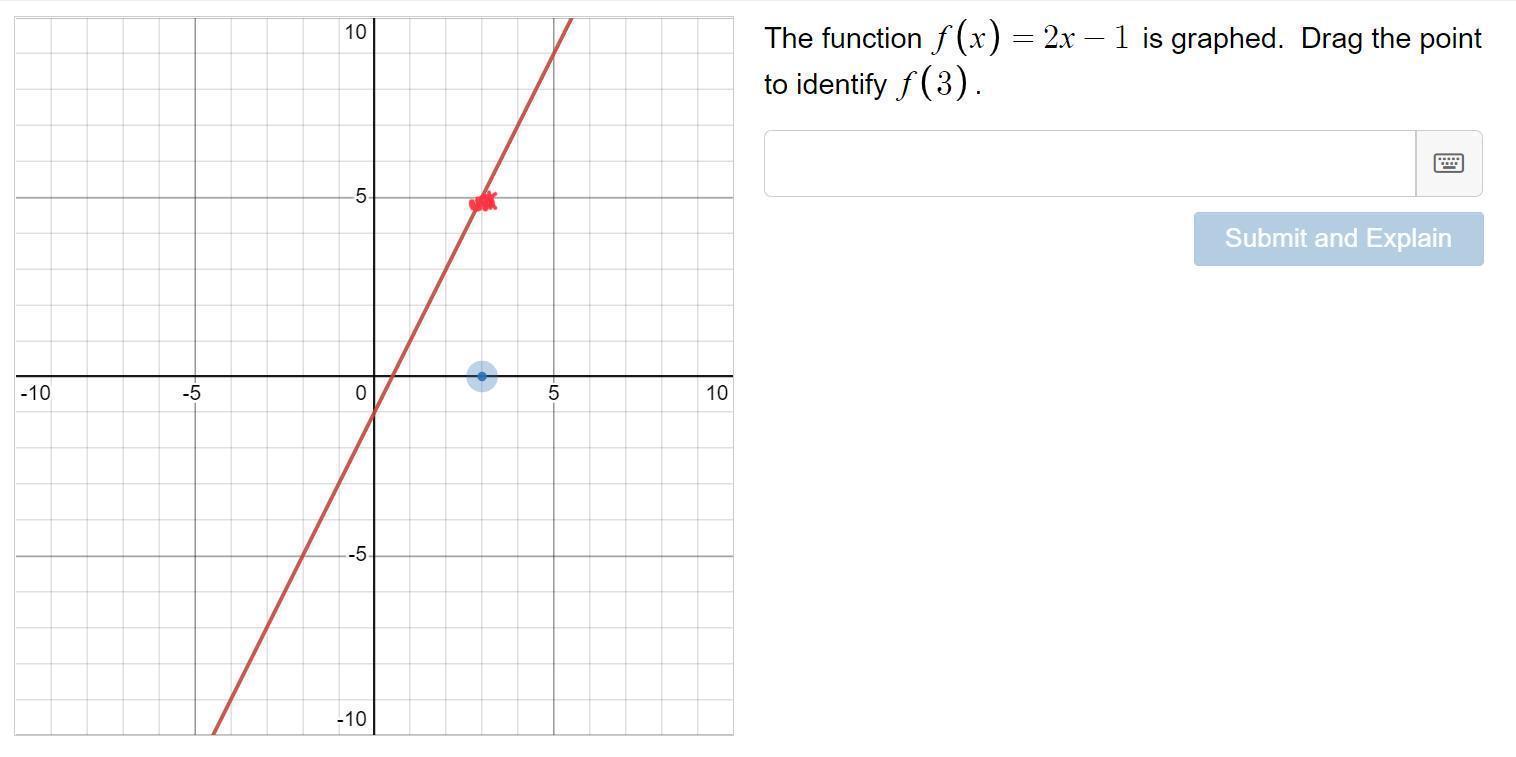
helppppppppppppppppppppppppppppp

Answers
Answer:
f(3)=5
Or
(3,5)
Step-by-step explanation:
all you have to do is look at what y axis is on the line when x=3
And y=5
f(3)=5
Hopes this helps please mark brainliest
HELP PLSSS HURRY PLS

Answers
Answer:
48
Step-by-step explanation:
because it gives us the perimeter, we add all the sides
4z-1+4z-1+5z+3+5z+3=166
8z-2+10z+6=166
18z+4=166
18z=162
z=9
side PS is 5z+3
plug in z to get 45+3=48
Can someone help me solve this problem

Answers
Answer:
Step-by-step explanation:
Base = 13 cm and its corresponding height = 6 cm
Area of the parallelogram = base * height
= 13 * 6
= 78 cm²
The tables represent the points earned in each game for a season by two football teams.
Panthers
14 10 10
10 17 3
28 13 17
32 16 10
14 7 21
Cowboys
10 3 8
6 24 12
21 3 10
28 28 7
7 13 3
Which team had the best overall record for the season? Determine the best measure of center to compare and explain your answer.
Panthers; they have a larger median value of 14 points
Cowboys; they have a larger median value of 10 points
Panthers; they have a larger mean value of about 14.8 points
Cowboys; they have a larger mean value of about 12.2 points
Answers
Answer:
Therefore, the Panthers had a better overall record for the season, with a total of 212 points earned compared to the Cowboys' total of 173 points.
Step-by-step explanation:
To compare the measures of center, we can calculate the mean and median points earned by each team:
Panthers: Mean = 212/15 = 14.13 points, Median = 14 points
Cowboys: Mean = 173/15 = 11.53 points, Median = 10 points
Based on these calculations, we can see that the Panthers have a larger mean value of about 14.13 points compared to the Cowboys' mean value of about 11.53 points. However, the median value for both teams is less useful for comparison since they are only one point apart. Therefore, we can conclude that the Panthers had the better overall record for the season based on both the total points earned and their larger mean value.
So, the answer is Panthers; they have a larger mean value of about 14.8 points (Option C is incorrect as the mean value of Panthers is approximately 14.13 and not 14.8).
An earthquake with a rating of 7.9 is
known to be a great earthquake that can
cause damage that extends several
hundred kilometers.
R = log x
R = rating of the earthquake's size on the
Richter scale
x = ratio of earthquake intensity to a
minimum level of intensity
1) Substitute known values into the
equation.
2) Raise each side of the equation as the
power of the base of the log.
3) Simplify using the property.
What is the value of x when the Richter
scale rating is 7.9? Round your answer
to the nearest hundredth.
Enter the correct answer.
DONE

Answers
The value of x when the Richter scale rating is 7.9 is approximately 79432.82
How to find the valueTo find the value of x when the Richter scale rating is 7.9, we can follow the steps provided:
Substitute known values into the equation.
R = log(x)
R = 7.9
Raise each side of the equation as the power of the base of the log.
\(10^R = 10^(^l^o^g^(^x^)^)\)
Simplify using the property.
\(10^R = x\)
Now we can substitute the value of R (7.9) into the equation:
\(10^(^7^.^9^) = 79432.82\)
Therefore, the value of x when the Richter scale rating is 7.9 is approximately 79432.82 (rounded to the nearest hundredth
Read more on richter scale here:https://brainly.com/question/24037139
#SPJ1
Find the width, thank you!

Answers
length=3width-5
(2(x))+(2(3x-5)=46
2x+6x+10=46
8x=56
x=7
width=7 length=16
Answer:
w = 7
l = 3w-5
2l + 2w = 46
lets substitute the value of length
2(3w-5)+2w
6w-10+2w
6w+2w = 8w
8w-10 = 46
add 10 to both sides to cancel out the -10 on the left side.
8w = 56
56/8 = 7
w = 7
hope this helps and hope it is correct
Step-by-step explanation:
Let f(x) = 5x - 1 and g(x) = x2 + 2
Find (fog)(-2).
Answers
Answer:
→please refer to the above attachment←
f(x) = 5x - 1 and g(x) = x² + 2
(fog)(x)=5x²+9
(fog)(-2)= 29
★ 29 is the right answer.

Solve each of the following equations and show how you checked your answers 2y+4y=6-3y
Answers
Answer:
y=2/3
Step-by-step explanation:
2y+4y=6-3y
⇔ 2y+4y+3y=6
⇔ 9y=6
⇔ y=6/9=2/3
The answer is:
y = 2/3
Work/explanation:
For now, I focus on the left side and combine the like terms:
\(\bf{2y+4y=6-3y}\)
\(\bf{6y=6-3y}\)
Add 3y to each side
\(\bf{6y+3y=6}\)
Combine like terms
\(\bf{9y=6}\)
Divide each side by 9
\(\bf{y=\dfrac{6}{9}}\)
\(\bf{y=\dfrac{2}{3}}\)
Hence, the answer is 2/3.