
Answers
Related Questions
If you lived in Flagstaff, Arizona, how much salt (NaCl) would you have to add to your spaghetti water to get it to boil at 100 oC. Assume you are using 2 quarts of water in your spaghetti pot. Report the amount of salt in units you might actually be able to measure in your kitchen. If you have a scale that shows grams that will be okay. (Hint: To get started find out the actual boiling point of water in Flagstaff.) It is at an elevation above 7000 ft.)
Answers
Answer:
Explanation:
This question is both theoretical and practical. While the theoretical aspect will be detailed fully here, the practical aspect will be provided as a form of guidance.
Water generally boils at 100°C when altitude (in feet) is 0. One of the colligative properties that occurs when salt is added to water is that there is a boiling point elevation(meaning an increase in boiling point). For instance, if 20g of salt is added to about 5.3 quarts of water, the boiling point of water will increase from 100°C to 100.04°C.
However, when the altitude/elevation of a place is about 7000 ft (like in Flagstaff, Arizona), water will boil at 95.3°C. In order to get 2 quarts of water to boil at 100°C in Flagstaff;
20g causes an increase in boiling point by 0.04°C (100°C to 100.04°C) in 5.3 quarts of water
What gram will increase the boiling point by same 0.04°C in 2 quarts
20g ⇒ 5.3
X ⇒ 2
5.3 X ⇒ 40g
X = 40 ÷ 5.3
X = 7.55g
Hence, 7.55g will cause an increase in boiling point by 0.04°C (from 100°C to 100.04°C) in 2 quarts of water
What mass of salt will increase the boiling point by 4.7°C (95.3°C to 100°C)
7.55g ⇒ 0.04
X ⇒ 4.7
X × 0.04 ⇒ 7.55 × 4.7
0.04X ⇒ 35.5
X = 887.5g
Hence, in order for the spaghetti water to boil at 100°C, 887.5g of salt needs to be added.
For the practical part of the question, some Kitchen scales have an accuracy of .25kg (250g) and some have an accuracy of .2 kg (200g) and some have an accuracy of .5kg (500g). The one your kitchen has will determine the amount of salt that you can measure. For example, if your kitchen scale/balance has an accuracy of 250g/0.25kg, then you can only measure 750g of the 887.5g (as the rest is 137.5g, which is not up to 250g of the scale's accuracy) of the required salt measurement. However, if you have a digital balance that can measure up to 2kg/2000g in one decimal place, that's the perfect balance to measure this salt.
One liter= 1.056 quarts and 4 quarts =1 gallon. How many gallons of water are represented by 500 liters of water?
Answers
Answer:
132 gallons.
Explanation:
\( \frac{1.056 \times 500}{4} = 132 \: gallons\)
The volume of water contained in 500 litres is approximately similar to 132 gallons of water.
We will make use of the following conversion factors in order to convert five hundred litres of water to gallons: 1 litre = 1.056 quarts and 4 quarts = 1 gallon.
First, let's convert litres to quarts:
500 litres * 1.056 quarts/liter = 528 quarts.
Next, let's convert quarts to gallons:
528 quarts * (1 gallon / 4 quarts) = 132 gallons.
Therefore, the volume of water contained in 500 litres is approximately similar to 132 gallons of water.
Learn more about conversion factors, here;
https://brainly.com/question/30567263
#SPJ6
How do chemicals affect our lives? O A. Chemicals have made our lives much harder. B. Chemicals make our daily lives more dangerous. O C. Chemicals have made it possible for us to own less. O D. Chemicals have made many things easier.
Answers
Answer:
the answer is d
Answer:
D
Explanation:
Because they are many different types of chemicals some are dangerous but some are applicable to use . chemicals help to wash germs away so we can live in a healthy environment.
Because pure H2 is a hazardous substance, safer and more cost effective techniques to store it as a solid for shipping purposes have been developed. One such method is the reaction represented above, which occurs at 200 degrees Celsius. Which of the following happens to H atoms in the forward reaction?
Answers
In the given reaction, hydrogen undergoes both oxidation and reduction. Hydrogen first oxidises from 0 to +1 oxidation state and then reduced to -1 in LiH.
What is oxidation?Oxidation is the process by which element combines with oxygen or loses electron forming its higher oxidation state. Whereas reduction is the process of combining with hydrogen or gaining electron to form the lower oxidation state of the element.
If an element undergoes both oxidation and reduction in the same reaction, it is called as disproportionation reaction. In the given reaction hydrogen undergoes disproportionation reaction.
In the molecular state H₂ is in 0 oxidation state and when it turns to LiNH₂, it oxidises to + 1 oxidation state and then reduces to -1 in LiH. Hence, option C is correct.
To find more on oxidation, refer here:
https://brainly.com/question/9496279
#SPJ1
Your question is incomplete. But your complete question probably was:
Because pure H2 is a hazardous substance, safer and more cost effective techniques to store it as a solid for shipping purposes have been developed. One such method is the reaction represented above, which occurs at 200 degrees Celsius. Which of the following happens to H atoms in the forward reaction?
Li₃N(s) + 2 H₂(g) ←→ LiNH₂(s) + 2 LiH(s)
(A) H atoms are oxidized only.
(B) H atoms are reduced only.
(C) H atoms are both oxidized and reduced.
(D) H atoms are neither oxidized nor reduced.
Net ionic equation for potassium sulfide and magnesium iodide
Answers
The net ionic equation for the reaction between potassium sulfide and magnesium iodide is S2- + Mg2+ -> MgS, as the potassium and iodide ions are spectator ions and do not participate in the reaction.
To determine the net ionic equation for the reaction between potassium sulfide (K2S) and magnesium iodide (MgI2), we first need to identify the ions present in each compound and then determine the products formed when they react.
Potassium sulfide (K2S) dissociates into two potassium ions (K+) and one sulfide ion (S2-):
K2S -> 2K+ + S2-
Magnesium iodide (MgI2) dissociates into one magnesium ion (Mg2+) and two iodide ions (I-):
MgI2 -> Mg2+ + 2I-
Now, we need to determine the possible products when these ions combine. Since potassium (K+) has a +1 charge and iodide (I-) has a -1 charge, they can combine to form potassium iodide (KI):
K+ + I- -> KI
Similarly, magnesium (Mg2+) and sulfide (S2-) can combine to form magnesium sulfide (MgS):
Mg2+ + S2- -> MgS
Now, we can write the complete ionic equation by representing all the ions present before and after the reaction:
2K+ + S2- + Mg2+ + 2I- -> 2KI + MgS
To obtain the net ionic equation, we remove the spectator ions, which are the ions that appear on both sides of the equation and do not participate in the actual reaction. In this case, the spectator ions are the potassium ions (K+) and the iodide ions (I-).
Thus, the net ionic equation for the reaction between potassium sulfide and magnesium iodide is:
S2- + Mg2+ -> MgS
For more such questions on ionic equation visit:
https://brainly.com/question/25604204
#SPJ8
2. 4.6gof X is burnt completelyto produce 6.2g of X oxide (X,O). M (0) = 16 gmol ¹. Calculate the amount of oxygen that reacted in this experiment. [2 MARKS]
[ii] calculate the mass of 1 mole of x.[2mark]
[iii] predict and give a reason explaining the reaction of x2o in water.[1mark]
Answers
As per the given data, 1.6 grams of oxygen reacted in this experiment.
To calculate the amount of oxygen that reacted in the experiment, we need to determine the difference in the mass of X oxide (X,O) formed and the mass of X initially used.
Given:
Mass of X = 4.6 g
Mass of X oxide (X,O) = 6.2 g
To find the amount of oxygen that reacted:
Mass of oxygen = Mass of X oxide - Mass of X
= 6.2 g - 4.6 g
= 1.6 g
Therefore, 1.6 grams of oxygen reacted in this experiment.
Calculate the mass of 1 mole of X:
Given that the mass of X is 4.6 g, we can calculate the molar mass of X by dividing the mass by the number of moles:
Molar mass of X = Mass of X / Number of moles of X
Molar mass of X = 4.6 g / 0.1 mol
Molar mass of X = 46 g/mol
Therefore, the mass of 1 mole of X is 46 grams.
Thus, the answer is 46 grams.
For more details regarding moles, visit:
https://brainly.com/question/30885025
#SPJ1
0.93 mol/L*1.85L
0.93 mol/L *0.225L
612.2g/0.36 mL
Answers
Answer:
(0.93 (mol / L)) * 1.85 L = 1.7205 moles
(0.93 (mol / L)) * 0.225 L = 0.20925 moles
(612.2 grams) / (0.36 mL) = 1700 555.56 kg / m^3
Explanation:
brainliest plzzzzzzzzz
The density of an object is 5g/cm^3 and the volume of the object is 10 cm^3. What is the mass of the object
Answers
The mass of the object of density 5g/cm³ and volume 10 cm³ is 50kg.
What does physics mean when it refers to density?Defining density How tightly a material is packed together is determined by its density. Its definition is "mass per unit volume". D or, the symbol for density
Density Formula: = m/V,
where is the density, m is the object's mass, and V is its volume.
The units used change depending on the calculation's use of mass and volume units. Density would be expressed in kg/cm³ if the mass is expressed in kg and the volume in cm³.
Density = mass / volume
Mass = density × volume
Mass = 5×10
Mass = 50 kg.
To know more about density, visit:
https://brainly.com/question/6107689
#SPJ1
How many electrons are in the ion, P3-?
A
18
B
28
C
12
D
34
Answers
Answer: 18
Explanation:
The atomic number of P is 15, and the charge of -3 indicates that it has 3 more electrons than protons.
There are 15 protons (since atomic number = number of protons), so there are 15 + 3 = 18 electrons.
An atom of oxygen has six electrons in its outermost ring and requires two more to become stable. What is the valence number of oxygen? Question 5 options: +6 +2 –2 –6
+6
+2
–2
–6
Answers
Answer: -2
EXPLANATION
Valence refers to the number of electrons that an atom must borrow or lend to complete its outermost shell. An atom of oxygen wants to add two more electrons to complete its outer shell of eight electrons. Since doing so would result in the oxygen atom becoming negatively charged by accepting two more electrons, oxygen is said to have a valence -2
-2
this is the answer
What happens when an acid reacts with a metal such as sodium?
The temperature decreases.
The acid is converted to a base.
A chemical reaction occurs.
The metal becomes polished and shiny.
Answers
Answer:
a chemical reaction occurs
Which of these pairings with create an octet for each atom?
A. One aluminum atom and one oxygen atom
B. One magnesium and one chlorine
C. One magnesium and one oxygen
D. One potassium and one sulfur atom
Answers
Answer:
C) one magnesium and one oxygen
What happens to the rate of reaction as the reactants get used up in a reaction?
Answers
Answer:So, when a reactant gets used up, its concentration decreases, and so the total reaction rate decreases. As you can see here, more products equal less reagents (reactants), and so the reaction rate decreases.
Explanation: i hope this helps!! :)))
Which circle contains the mixture? Is it D?

Answers
Which of the following does NOT occur in an ionic bond?
Two atoms share an electron.
A bond is formed between a positive and negative ion.
An electron is transferred from one atom to another.
Forms between a metal and a nonmetal element.
Answers
Answer: its the first answer
Explanation:
Calculate the volume in ml of 0.200 M na2co3 needed to produce 2.00 g of caco3 there is an excess of cacl2
Molar mass of calcium carbonate = 100.09 g/mol
Answers
Answer:
\(V=100mL\)
Explanation:
Hello.
In this case, since the chemical reaction is:
\(Na_2CO_3+CaCl_2\rightarrow CaCO_3+2NaCl\)
We next compute the moles of sodium carbonate from the 2.00 grams of calcium carbonate via their 1:1 mole ratio in the chemical reaction:
\(n_{Na_2CO_3}=2.00gCaCO_3*\frac{1molCaCO_3}{100.09gCaCO_3}*\frac{1molNa_2CO_3}{1molCaCO_3} \\\\n_{Na_2CO_3}=0.0200molNa_2CO_3\)
Thus, by knowing the molarity, we compute the volume:
\(M=\frac{n}{V}\\ \\V=\frac{n}{M}=\frac{0.0200mol}{0.200mol/L}\\ \\V=0.100L*\frac{1000mL}{1L}\\ \\V=100mL\)
Best regards.
The volume in mL of 0.200 M Na₂CO₃ needed to produce 2.00 g of CaCO₃ there is an excess of CaCl₂ is 100mL.
What is molarity?Molarity is define as no. of moles of solute present in per liter of solvent or solution.
Given chemical reaction is:
Na₂CO₃ + CaCl₂ → CaCO₃ + 2NaCl
From the stoichiometry of the reaction it is clear that:
1 mole of CaCO₃ = produced by 1 mole of Na₂CO₃
Moles of CaCO₃ will be calculated as:
n = W/M, where
W = given mass = 2g
M = molar mass = 100.09g/mole
n = 2/100.09 = 0.0200 moles
0.0200 mole of CaCO₃ = produced by 0.0200 moles of Na₂CO₃
Now we calculate the volume by using molarity as:
V = n/M
V = 0.0200/0.2 = 0.1L = 100mL
Hence, the required volume is 100mL.
To know more about molarity, visit the below link:
https://brainly.com/question/16343005
if there are more products than reactants, does that mean there is an increase in the forward or backward reaction? And if there are more reactants that products, is there an increase in the forward or backward reaction?
Answers
Answer:
If there are more products than reactants, that means the reaction has shifted towards the left, which is the backward direction. If there are more reactants than products, that means the reaction has shifted towards the right, which is the forward direction.
which of the following phrases best describes a synthesis reaction?
A. Putting together into one
B. Breaking apart into many
C. Putting together into at least two
D. Breaking apart into not more than two
Answers
The phrase which best describes a synthesis reaction is: A. Putting together into one
A chemical reaction can be defined as a chemical process involving the continuous transformation and rearrangement of either the ionic, atomic or molecular structure of a chemical element, especially through the breakdown and formation of chemical bonds that produces a new chemical compound.
In Chemistry, there are five (5) main types of chemical reaction and these include;
Combustion reaction.Double-replacement reaction.Decomposition reaction.Single-replacement reaction.Combination or synthesis reaction.A synthesis reaction is also referred to as a combination reaction.
Hence, a synthesis reaction involves putting together two (2) different atoms into one (1), so as to form a chemical compound.
\(Na + Cl --> NaCl\)
Read more: https://brainly.com/question/13750908
Prepare one solution that has 0.12 M of FeCl3 and 0.40 M of HCl with the reagents 3 M HCl and Solid FeCL3 * 6H20. Provide the calculations and protocol to make the solution in a lab.
Answers
To prepare a 0.12 M solution of FeCl₃, the amount of solid FeCl₃ to be dissolved in a given volume of solvent will be 9.72 grams.
Given,
Molarity of FeCl₃ (M)= 0.12 M
The molecular weight (m) of FeCl₃ is = 162 gm
The volume of the solution (V) to be prepared is =500 ml
The amount of FeCl₃ to be dissolved to make a 0.12 M solution is= x
So,
MV= x ÷ m × 1000
0.12× 500 = x ÷ 162 × 1000
x = 60 × 162 ÷ 1000
x= 9.72 gm
So 9.72 grams of FeCl₃ is dissolved to make 500 ml of 0.12 M solution.
For preparing 0.4 M HCl from 4M HCL:
If we need to make 500 ml of solution with 0.4M of HCL, then we use the formula:
M₁V₁= M₂V₂
0.4 × 500= 4 × x
x= 50 ml
So 50 ml of 4M HCL is taken to make 0.4 M HCL.
To learn more about FeCl₃, refer to the link:
https://brainly.com/question/32098087
#SPJ1
When 3.98 g of bismuth oxide (molar mass = 465.96 g/ml) reacts with excess carbon to form 2.97 g of bismuth metal (molar mass = 208.98 g/mol) according to the equation:
Answers
The bismuth metal has a percentage yield of 93.4%
What is the mass of the bismuth formed?We know that the reaction as shown in the question has to do with the reaction of the bismuth oxide with the excess carbon. this implies that the excess carbon is the reactant in excess while the bismuth oxide is the limiting reactant.
Number of moles of the bismuth oxide = 3.52 g /465.96 = 0.0076 moles
1 mole of bismuth oxide yields 2 moles of Bi
0.0076 moles of bismuth oxide yields 0.0076 moles * 2/ 1 mole
= 0.00152 moles
Theoretical yield of bismuth = 0.00152 moles * 208.98
= 3.18 g
The percent yield is now obtained from; 2.97 g / 3.18 g * 100/1
=93.4%
Learn more about limiting reactant:https://brainly.com/question/14225536
#SPJ1
Missing parts;
When 3.98 g of bismuth oxide (molar mass - 465.96 g/ml) reacts with excess carbon to form 2.97 g of bismuth metal (molar mass-208.98) according to the equation:
Bi2O3(s) + 3C(s) = 2 Bi(s) + 3 CO(g)
What is the percent yield of the reaction?
The owner of Grizzly Tea Shack is thinking about adding iced tea to the menu. He
thinks he can do this with minimal effort by adding ice cubes to cups of hot tea.
He decides to measure how changing the number of ice cubes in a glass of
freshly brewed tea affects its cooling rate.
To begin, the owner varies the number of ice cubes, x, he puts in glasses of
freshly brewed tea. He then checks the temperature (in Celsius), y, of each glass
after 10 minutes.
Ice cubes Temperature after 10 minutes (in degrees Celsius)
2
17
3
5
6
6
20
10
11
15
Round your answers to the nearest thousandth.

Answers
Answer: 5,266
Explanation:
5,266
Silver is heated with oxygen to form silver oxide.o Write the formulaso Label the phaseso Balance the equation
Answers
Answer
Formulas: Ag₂O (silver oxide), oxygen (O₂ ), and elemental silver (Ag)
Equation with labeled phases
\(4Ag(s)+O_2(g)→\text{ }2Ag_2O\text{\lparen}s)\)Procedure
Silver oxide can be produced by allowing silver to react with oxygen at temperatures lower than its decomposition point (195 °C).
The chemical formula for silver oxide (product) is
Ag₂O
Where the reactants are molecular oxygen (O₂ )and elemental silver (Ag).
The chemical equation with labels will be
\(Ag(s)+O_2(g)→Ag_2O\text{\lparen}s)\)The final balanced equation is
\(4Ag(s)+O_2(g)→\text{ }2Ag_2O\text{\lparen}s)\)where you will find 4 silver atoms and 2 oxygen atoms in both reagents and products sides of the chemical equation.
As 1 g of the radioactive element radium decays over 1 year, it produces 1.16 cross times 10 to the power of 18 alpha particles (helium nuclei). Each alpha particle becomes an atom of helium gas. What is the pressure, in pascal, of the helium gas produced if it occupies a volume of 125 mL at a temperature of 25° C?
Answers
The pressure of the Helium gas can be obtained as 0.28 Pa.
What is the pressure?We have to call to mind the Avogadro's law in this case and we would have to make use of the law. Let us note that we have the number of the particles that are present as 1.16 * 10^18 particles
From Avogadro's law;
1 mole of the helium gas contains 6.02 * 10^23 alpha particles
x moles of the helium gas would contain 1.16 * 10^18 particles
x = 1.16 * 10^18 particles * 1 mole/ 6.02 * 10^23 particles
x = 1.9 * 10^-6 moles
We have that;
PV = nRT
P =pressure
V = volume
n = Number of moles
R = gas constant
T = temperature
P = 1.9 * 10^-6 * 0.082 * 298/0.125
P = 3.7 * 10^-4 atm or 0.28 Pa
Learn more about pressure of the gas:https://brainly.com/question/18124975
#SPJ1
Indicate whether the following balanced equations involve oxidation-reduction. If they do, identify the elements that undergo changes in oxidation number.
(a)PBr3(l) +3H2O(l)=H3PO3(aq) + 3HBr(aq)
(b)NaI(aq) + 3HOCl(aq)=NaIO3(aq) + HCl(aq)
(c)3SO2(g) + 2HNO3(aq) + 2H2O(l)=3H2SO4(aq) + 2NO(g)
(d) 2H2SO4(aq) + 2NaBr(s)=Br2(l) + SO2(g) + Na2SO4(aq) + 2H2O(l)
Answers
The oxidation-reduction process is present in each of the responses to this question. Redox reaction is another name for it. See down for more details
What is an oxidative reaction?It is known as the process in which oxidation and reduction happen at the same time. Both the oxidation and reduction processes proceed simultaneously. While electrons are obtained during a reduction reaction, they are lost during an oxidation reaction. (a) This process is an oxidation-reduction reaction because bromine's oxidation state moves from (-1) to (0), demonstrating oxidation, and sulfur's, from (+6) to (+4), demonstrating reduction. (b) Because nitrogen moves from (+5) to (+2), indicating reduction, and sulfur changes form (+4) to (+6), indicating oxidation, this reaction involves both oxidation and reduction.(c) (c) The change in the oxidation states of iodine from (-1) to (+5), which indicates oxidation, and chlorine from (+5) to (-1), which indicates reduction, indicates that this process involves oxidation-reduction. (d) Because the element is present on both the reactant and product sides, this reaction does not involve an oxidation-reduction reaction.
To know more about Redox reaction visit:
https://brainly.com/question/13293425
#SPJ4
A student is researching how chemical reactions occur and how temperature impacts the rate of the reaction. She
measures how long it takes for 5 grams of calcite to dissolve in a strong solution of hydrochloric acid at different
temperatures. Her data is shown in the graph

Answers
Based on the data shown in the graph, the rate of reaction is directly proportional to the temperature of a reaction.
What is the rate of a reaction?The speed at which a chemical reaction occurs is called the reaction rate or rate of reaction. The rate of a reaction is proportional to the increase in product concentration per unit time and the decrease in reactant concentration per unit time.
The rate of a reaction is affected by the following:
the temperature of the reaction - the rate of reaction is directly proportional to the temperature of a reaction. Hence, the rate of a reaction increases with an increase in temperature.
presence of a catalyst - the rate of a reaction increases with the addition of a catalyst. A catalyst speeds up the rate of a reaction.
the surface area of the reactants - the rate of a reaction increases with an increase in the surface area of the reactants,
Learn more about the rate of reaction at: https://brainly.com/question/25724512
#SPJ1
Answer:
At higher temperatures, chemical reactions occur more quickly.
Explanation:
edmentum
Which of the following processes absorbs heat energy from the environment?
A.
Freezing
B.
Deposition
C.
Condensation
D.
Melting
Answers
Answer:
Freezing
Explanation:
To break this bond, heat energy is absorbed from the surroundings to separate the molecules apart from each other. Freezing is the process in which liquid changes to a solid state. During the freezing process also, heat energy is released.
Describe the chemical reaction based on the chemical equation below. Also, explain whether the equation is balanced.

Answers
Answer:
edg 2020
Explanation:
Ammonia gas reacts with oxygen gas.
Nitric oxide gas and liquid water are produced.
Platinum is used as a catalyst.
The equation is unbalanced because the number of hydrogen atoms is not the same on both sides of the equation.
Answer:
Ammonia gas reacts with oxygen gas.
Nitric oxide gas and liquid water are produced.
Platinum is used as a catalyst.
The equation is unbalanced because the number of hydrogen atoms is not the same on both sides of the equation.
Explanation:
For edge:)
HELP ASAP PLS I'LL GIVE YOU BRAINLIEST
Select the correct answer.
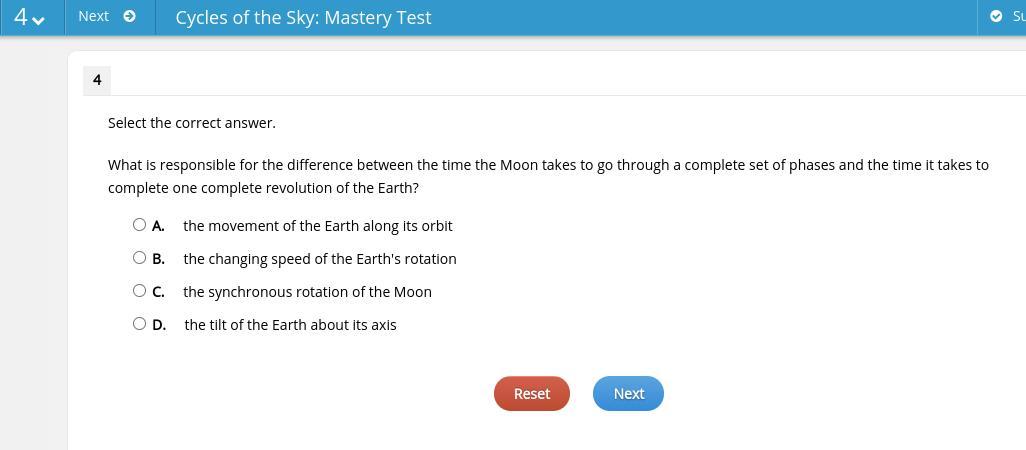
What is responsible for the difference between the time the Moon takes to go through a complete set of phases and the time it takes to complete one complete revolution of the Earth?
A.
the movement of the Earth along its orbit
B.
the changing speed of the Earth's rotation
C.
the synchronous rotation of the Moon
D.
the tilt of the Earth about its axis
Answers
Answer:
A
Explanation:
the correct answer is A
This is the sidereal month. It is measured against the background stars. However, the Earth is also orbiting the Sun, and the moon needs extra time to catch up to its previous position relative to the Sun.
Why is the percentage of food eaten a good number to use? Explain.
Answers
idea about the food availability for the
species of organisms.
A small amount of chemical splashes in Frank’s eye. What should Frank do immediately?
Answers
Answer:
A small amount of chemical splashes in Frank's eye. What should happen next? Frank should go to the eyewash station while his lab partner tells the teacher what happened.
Explanation:
Brainlist