
Answers
Answer:
1. This question seems to already have the answer. The radius of the circle is the distance from the center of the circle to any point on the circle.
2. $65.91
3. 36.04cm
Step-by-step explanation:
2. First, you neeed to solve for the circumference of the circle to determine how much fencing you will need. To do this, use the formula C=2πr and insert the given radius of 3.8 into the equation.
C = 2 * pi * 3.8
C = 23.88
Then, to find the total cost, multiply the circumference by the price per meter of fencing.
23.88 * 2.76 = 65.91
3. First, you have to find the total area of the circle so you can work backwards to find the diameter. To do this, since there are 12 slices, multiply the area of each slice by 12.
85 * 12 = 1020
So 1020 is the area of the circle. The formula to find the area of a circle is A = πr^2. So we need to use that equation to find the radius, so we can double it to get the diameter.
We know the area is 1020 so we set that to A.
1020 = pi(r^2)
Divide both sides by pi.
1020/pi = r^2
Then square root both sides.
sqrt(1020/pi) = r
r = 18.02
Then, since diameter is r*2, you can just multiply 18.02 * 2 to get the diameter.
d = 18.02 * 2
d = 36.04
Hope this helps.
Related Questions
Wesley spent $34.60 at the grocery store. 15%of that was spent on fruit. How much didWesley spent on fruit?
Answers
We determine what he spent as follows:
\(34.60(0.15)=5.19\)So, he spent %5.19.
Please help. I’ll mark you as brainliest if correct . I don’t understand this math problem. Thank you .

Answers
Answer:
That can be factored as
(x -1 (1/3) ) * ( x +3) * (x -4/5)
and the zeroes are located at:
x = 1.33333333... x = -3 and x = .8
Step-by-step explanation:
Answer:
\(\boxed{\sf \ \ \ f(x)=(x+3)(5x-4)(3x-4) \ \ \ }\)
Step-by-step explanation:
We need to factorise the following function
\(f(x)=15 x^3+13 x^2-80 x+48\)
-3 is a trivial solution, we can notice that f(-3)=0
so we can factorise by (x+3)
let s note a, b and c real and let s write
\(f(x)=15 x^3+13 x^2-80 x+48=(x+3)(ax^2+bx+c)\)
\((x+3)(ax^2+bx+c) = ax^3+bx^2+cx+3ax^2+3bx+3c=ax^3+(b+3a)x^2+(3b+c)x+3c\)
let s identify...
the terms in \(x^3\)
15 = a
the terms in \(x^2\)
13 = b + 3a
the terms in x
-80 = 3b+c
the constant terms
48 = 3c
so it comes, c=48/3=16, a = 15, b = 13-3*15=13-45=-32
so \(f(x)=(x+3)(15x^2-32x+16)\)
\(\Delta=32^2-4*15*16=64\)
so the roots of \((15x^2-32x+16)\) are
\(\dfrac{32-8}{15*2}=\dfrac{24}{30}=\dfrac{12}{15}=\dfrac{4}{5}\)
and
\(\dfrac{32+8}{15*2}=\dfrac{40}{30}=\dfrac{20}{15}=\dfrac{4}{3}\)
so \(f(x)=(x+3)(5x-4)(3x-4)\)
the zeros are -3, 4/5, 4/3
Is line e perpendicular to line g?
Answers
Answer:
Yes.
Step-by-step explanation:
Always.
(b) a dy integral that represents the surface area of the solid formed when c is rotated about the (x or y)-axis
Answers
The surface area of the surface generated by rotating the curve y = x² about the y-axis, and we found that the surface area is approximately 54.33 square units.
In this case, the curve we want to rotate is y = x², and we want to rotate it about the y-axis. To use the formula above, we need to express the equation of the curve in terms of x. Therefore, we need to rewrite y = x² as x = √y.
Next, we need to find the derivative of x = √y with respect to y, which is:
dx/dy = 1/2√y
Substituting this into the formula for the surface area, we get:
Surface Area = 2π ∫[0,4] √y √(1+(1/2√y)²) dy
Simplifying the expression inside the square root, we get:
Surface Area = 2π ∫[0,4] √(y+(1/4)) dy
We can evaluate this integral using the power rule of integration, which gives:
Surface Area = 2π [2/3(y+(1/4))^(3/2)]₀⁴
Simplifying further, we get:
Surface Area = 2π [2/3(17/4)^(3/2)]
Surface Area ≈ 54.33 square units
Therefore, the surface area of the surface generated by rotating the curve y = x² about the y-axis is approximately 54.33 square units.
To know more about surface area here
https://brainly.com/question/27784309
#SPJ4
Complete Question:
How do you find the area of the surface generated by rotating the curve about the y-axis y = x^2 , 0 ≤ x ≤ 2 ?
PLEASE HELP WILL MARK BRAINLYIST HELP
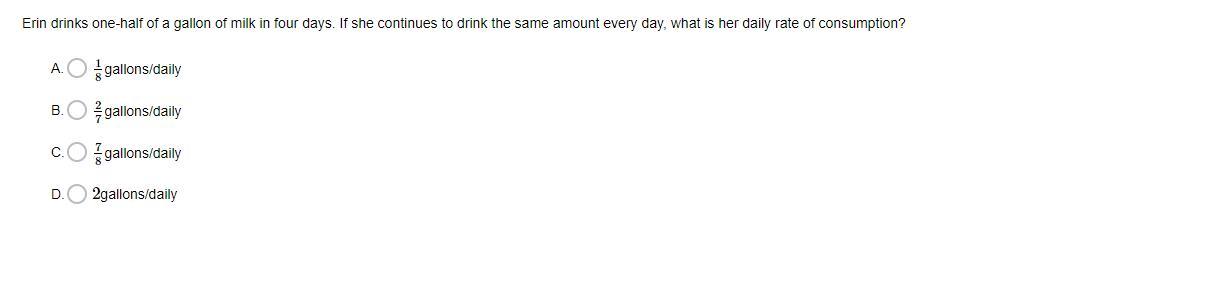
Answers
Explanation
1/2 divided by 4 = 1/8
Just trust me, and mark me brainliest ty
Have a nice day!
i need help on these 2 !!!

Answers
The length of RS is 13 units and the length of the hypotenuse XY is approximately 16.4 units.
15) In ΔTSR
TR² = TS² + RS²
Substituting the given values, we get:
(5√10)² = 9² + RS²
250 = 81 + RS²
RS² = 169
Taking the square root of both sides, we get:
RS = 13 units
16)In ΔYZX
XY² = YZ² + XZ²
Substituting the given values, we get:
XY² = 10² + 13²
XY² = 169 + 100
XY² = 269
Taking the square root of both sides, we get:
XY = √269
XY=16.4 units
What is Pythagorean theorem?
In a right triangle, the Pythagorean theorem states that the square of the length of the hypotenuse is equal to the sum of the squares of the lengths of the other two sides.
To know more about the Pythagorean Theorem visit:
https://brainly.com/question/18163189
#SPJ1
M
Check all that apply.

Answers
The angles that we have in the image here are:
supplementary angleright angleWhat is a supplementary angle?When two angles are measured, they sum up to 180. They are said to be supplementary angles.
On the question, we have two angles that are 90 degrees on a straight line. Hence they are supplementary.
What is a right angle
This is an angle that is at 90 degrees. We have to two right angles on the diagram that we have here.
Read more on supplementary and right angles here:https://brainly.com/question/12919120
#SPJ1
Find a 3-by-3 magic square using the numbers 4, 5, 6, 14, 15, 16, 24, 25, and 26.
Fill in the magic square.
Please so work.

Answers
A 3-by-3 magic square :
5 24 16
26 15 4
14 6 25
A square array of numbers, often positive integers, is referred to as a magic square in recreational mathematics if the sums of the numbers in each row, each column, and both main diagonals are the same.
The following values are listed in the question:
The numbers are 4, 5, 6, 14, 15, 16, 24, 25, and 26.
A 3-by-3 magic square is required.
Since the numbers are 4, 5, 6, 14, 15, 16, 24, 25, and 26.
Now the sum of all numbers is :
4 + 5 + 6 + 14 + 15 + 16 + 24 + 25 + 26 = 135
There are now 3 rows and 3 columns, thus the total number is divided by 3.
5 24 16
26 15 4
14 6 25
5 + 24 + 16 = 45
5 + 26 + 14 = 45
26 + 15 + 4 = 45
24 + 15 + 16 = 45
14 + 6 + 25 = 45
5 + 15 + 25 = 45
So, the total of each row and each column is therefore 45.
Therefore, this is a 3-by-3 magic square that satisfies the conditions :
5 24 16
26 15 4
14 6 25
To know more about the magic square, refer to this link :
https://brainly.com/question/17355019?referrer=searchResults
#SPJ1
What is the equation of a line that is perpendicular yo the line whose equation is 2y+3x=1?
Answers
Answer:
y = 2/3x + 1/2
Step-by-step explanation:
First, make the equation into a slope-intercept form:
2y + 3x = 1
2y = -3x + 1
y = -1.5x + 0.5
You can make it into a fraction:
y = -3/2x + 1/2
Now here's the equation:
y = 2/3x + 1/2
Hope this helps!
Let me know if I'm wrong :)
The domain of a function is all whole numbers between 2.5 and 7.5. Can you represent the domain using set-builder notation in more that one way? Explain
Answers
The set builder notation of "The domain of a function is all whole numbers between 2.5 and 7.5" is Domain = {x: x∈W , 2.5<x<7.5 }.
In the Set Builder form , a statement or expression is used to represent all the elements of the set .
In the question ;
it is given that
the domain of the function is all whole numbers between 2.5 and 7.5 .
the set of whole numbers is represented by W.
Since the numbers between 2.5 and 7.5 are included , so "<" will be used .
The Set Builder notation is Domain = {x: x∈W , 2.5<x<7.5 } .
Therefore , the set builder notation of "The domain of a function is all whole numbers between 2.5 and 7.5" is Domain = {x: x∈W , 2.5<x<7.5 }.
Learn more about Set Builder Notation here
https://brainly.com/question/10294211
#SPJ1
If 400 is invested at the day of 6% for one year what will be the total of the investment
Answers
424 is your answers to this problem
Answer:
424
Step-by-step explanation:
The formula for the value of an amount P invested at simple interest rate r for t years is ...
A = P(1 +rt)
Using the given values, we get ...
A = 400(1 +0.06·1) = 424
The total of the investment will be 424.
Fred bakes 10 dozen cookies for the bake sale ( 1 dozen = 12 cookies) he makes the following type of cookies
1/2 of Fred’s cookies are chocolate chip
1/4 of Fred’s cookies are peanut butter
1/8 of Fred’s cookies are snickerdoodle
1/8 of Fred’s cookies are oatmeal raisin
How many chocolate chip cookies did Fred make?
How many peanut butter cookies did Fred make?
How many snickerdoodle cookies did Fred make?
How many oatmeal raisin cookies did Fred make?
Answers
Answer:
60 cookies are chocolate
30 cookies are peanut butter
15 cookies are snickerdoodle
15 cookies are oatmeal raisin
Step-by-step explanation:
|x| − 8 = −5
can someone help me asap
Answers
Answer:
3
Step-by-step explanation:
3-8 is equal to -5!!! I hope that helps you out
Answer:
its 3
Step-by-step explanation:
many people said its 3 so it prob is
Please help!!!!!!!!!!!

Answers
Answer:
Circle on the left: 30 ft Circle in the middle: 4m Circle on the right: 10 mm
Step-by-step explanation:
I got these answers by multiplying the radius by 2. In the problem, they gave you the radius. The diameter is r*2, so that is how I got my answers.
Answer:
1. I think 30ft 2. I think 4m 3.I think 10mm
The sum of two angles is 85 degrees. If the angles are in the ratio 5:12, what is the measure of each angle?
Answers
Answer:
5x + 12x + 19x = 180 36x = 180 x = 5 19(5) = 95º
Step-by-step explanation:
Jack was 13 years older than Priscilla. together their ages totaled 163 years . What were their ages?
Answers
Answer:
Jack is 88, Priscilla is 75.
Step-by-step explanation:
Let J represent Jack's age and let P represent Priscilla's age.
Their age totaled 163, so:
\(J+P=163\)
And we know that Jack was 13 years older than Priscilla. In other words:
\(J=13+P\)
Solve for J and P. To do so, substitute the second equation into the first:
\(13+P+P=163\)
Combine like terms:
\(2P+13=163\)
Subtract 13 from both sides:
\(2P=150\)
Divide 2 from both sides:
\(P=75\)
So, Priscilla is 75 years old right now.
Jack is 13 years older meaning that Jack is 88 years right now.
And we're done!
X +7 over -3 is less than or greater than five

Answers
Step-by-step explanation:
multiply by -3 on both sides then flip sign due to rule
\(x + 7 \geqslant - 15 \\ - 7 \\ x \geqslant - 22\)
Evaluate function expressions

Answers
Answer:
Your answer is -24.
Step-by-step explanation:
Given information.
The graph of f(x) and g(x)
Solving for
-6 * f(3) - 6 * g(-1) = ?
think of f(x) = y as x is the input and y is the output.
Input a value of x into f(x) or g(x) gets us a y value.
Looking at the graph of f(3) = -2 and the graph of g(-1) = 6
Now substitute that and solve.
-6 * -2 -6 * 6 = 12 - 36 = -24
Answer: -24
Step-by-step explanation:
We should first find the outputs to the functions f and g with inputs 3 and -1 respectively. We can do this by looking at the graph and finding the y value for each desired x value.
Thus, we can see that f(3) = -2 and g(-1) is 6.
We can replace these into the expression to get
\(-6*-2-6*6\)
We should first multiply, so we get
\(12 -36\)
\(-24\)
Hence, the answer is -24.
Can someone please help, ty!!
(Will mark brainliest)

Answers
Answer:
Yellow is correct.
You can add the valued and divide by how many values there are to find the mean
The score of 20 is an outlier and brings the mean score down by almost 10%
Step-by-step explanation:
Answer:
3: The low score causes the mean to decrease.
Step-by-step explanation:
If you add a significantly lower number, it will bring down the overall average.
Hope this helps!
x = y+2
x+4y=7
Please help!
Answers
so
y + 2 + 4y = 7
5y + 2 = 7
5y = 7-2
5y = 5
y = 1
x= y + 2
x = (1) + 2
x = 3
(x,y) = (3,1)
-(-3x - 4)= 3x + 3 what kind of solution
Answers
Step-by-step explanation:
please mark me as brainlest

Step-by-step explanation:
HOPE IT'S HELPFUL TO YOU
PLS MARK ABOVE GUY ANSWER AS BRAINLIEST

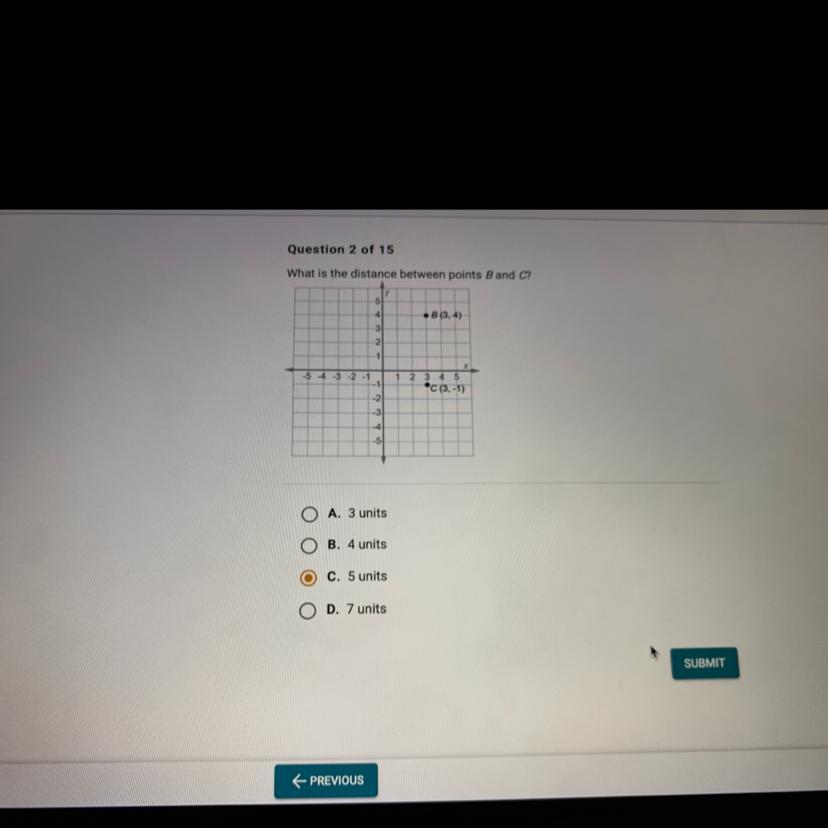
What is the distance between points B and C
Answers
Answer:
5
Step-by-step explanation:
I hope this helps
yea xxx
Decide whether the given number is a solution of the given equation.
Is - 7 a solution of x + 12 = 19?
Answers
Answer:
No
Step-by-step explanation:
-7+12=5
Answer:
\(x=7\)
-7 is not a solution for \(x+12=19\)
Step-by-step explanation:
\(x +12 = 19\)
Subtract 12 from both sides
\(x = 19-12\)
Subtract 12 from 19 to get 7
\(x = 7\)
It would be -7 if it was \(-x+12=19\)
Help Meeeee Pleaseeeee

Answers
Answer:
m∠XYZ = 162°
Step-by-step explanation:
We can see that ∠XYZ is an exterior angle while ∠W and ∠X are the opposite interior angles.
We know that the exterior angle of triangle is equal to the sum of opposite interior angles
Given
m∠XYZ = (15x-18)°
m∠W = (5x+2)°
m∠X = (8x+4)°
Mathematically it can be written as:
m∠X+m∠W = m∠XYZ
\(8x+4+5x+2 = 15x-18\\13x+6 = 15x-18\\13x-15x = -18-6\\-2x = -24\\\frac{-2x}{-2} = \frac{-24}{-2}\\x = 12\)
Putting x=12 in m∠XYZ
\(15x-18\\=15(12)-18\\=180-18=162\)
Hence,
m∠XYZ = 162°
a. NewBank started its first day of operations with $155 million in capital. A total of $92 million in checkable deposits is received. The bank makes a $28 million commercial loan and lends another $23 million in mortgage loans. If required reserves are 5.4%, what does the bank balance sheet look like?
b. Suppose NewBank decides to invest $273 million in 30-day T-bills. The T-bills are currently trading at $4,981 (including commissions) for a $4,940 face value instrument. How many T-bills do they purchase? What does the balance sheet look like?
Answers
The balance sheet attached shows the Total Assets to be $55.968M and Total Liabilities and Capital to be $252M respectively.
Understanding Balance Sheet1. Assets:
a. Cash in Reserves:
The required reserves are 5.4% of checkable deposits.
Therefore, the required reserves amount to 5.4% of $92 million, which is:
(0.054 * $92 million) = $4.968 million.
This amount is considered a liability for the bank, but it is held as an asset in the form of cash reserves.
b. Loans: The bank made a $28 million commercial loan and a $23 million mortgage loan. Therefore, the total loans amount to:
total loan = $28 million + $23 million
= $51 million.
2. Liabilities:
a. Checkable Deposits:
The bank received $92 million in checkable deposits.
b. Required Reserves:
As mentioned above, the required reserves amount to $4.968 million.
3. Capital:
The bank started with $155 million in capital.
Based on the above information, the bank's balance sheet would look as attached.
Learn more about balance sheet here:
https://brainly.com/question/1113933
#SPJ1

PLS HELP -
transponder for a toll bridge costs $22.50. With the transponder, the toll is $4 each time you cross the bridge. The only other option is toll-by-plate, for which the toll is $5.25 each time you cross the bridge with an additional administrative fee of $1.25 for each crossing. How many times would you need to cross the bridge for the costs of the two toll options to be the same?
You need to cross the bride _ times?

Answers
Using linear function you would need to cross the bridge 30 times for the costs of the two toll options to be the same.
What is meant by linear function ?To find out how many times you would need to cross the bridge for the costs of the two toll options to be the same, we need to set up an equation.Let x be the number of times you need to cross the bridge.For the transponder option: 22.50 + 4x = costFor the toll-by-plate option: 5.25x + 1.25x = costSince the costs of the two options need to be equal, we can set the two equations equal to each other and solve for x:22.50 + 4x = 5.25x + 1.25x + 22.504x = 5.25x + 1.25x0.75x = 22.50x = 30So you would need to cross the bridge 30 times for the costs of the two toll options to be the same.To learn more about linear function refer:
brainly.com/question/28441514
#SPJ1
10( x+1/2)=3x+5+7x
Please help
Answers
Answer:
All real numbers are solutions
Step-by-step explanation:
10(x + 1/2) = 3x + 5 + 7x
~Distribute left side
10x + 5 = 3x + 5 + 7x
~Combine like terms
10x + 5 = 10x + 5
~Subtract 5 to both sides
10x = 10x
~Divide 10 to both sides
x = x
~Subtract x to both sides
0 = 0
Best of Luck!
We simplify the equation to the form, which is simple to understand
10(x+1/2)=3x+5+7x
Simplifying:
10*(x + 0.5)=3x+5+7x
Reorder the terms in parentheses
+(+10x+5)=3x+5+7x
Remove unnecessary parentheses
+10x+5=+3x+5+7x
We move all terms containing x to the left and all other terms to the right.
+10x-3x-7x=+5-5
We simplify left and right side of the equation.
0x=0
0=0
This equation is an identity, so all real numbers are solutions.
Which sequence of transformations was applied to the parent tangent function to create the function m(x) = 2tan(3x+4)
Answers
The function m(x) = 2tan(3x+4) is obtained by applying a sequence of transformations to the parent tangent function.
To determine the sequence of transformations, let's break down the given function:
1. Inside the tangent function, we have the expression (3x+4). This represents a horizontal compression and translation.
2. The coefficient 3 in front of x causes the function to compress horizontally by a factor of 1/3. This means that the period of the function is shortened to one-third of the parent tangent function's period.
3. The constant term 4 inside the parentheses shifts the function horizontally to the left by 4 units. So, the graph of the function is shifted to the left by 4 units.
4. Outside the tangent function, we have the coefficient 2. This represents a vertical stretch.
5. The coefficient 2 multiplies the output of the tangent function by 2, resulting in a vertical stretch. This means that the graph of the function is stretched vertically by a factor of 2.
In summary, the sequence of transformations applied to the parent tangent function to create the function m(x) = 2tan(3x+4) is a horizontal compression by a factor of 1/3, a horizontal shift to the left by 4 units, and a vertical stretch by a factor of 2.
Example:
Let's consider a point on the parent tangent function, such as (0,0), which lies on the x-axis.
After applying the transformations, the corresponding point on the function m(x) = 2tan(3x+4) would be:
(0,0) -> (0,0) (since there is no vertical shift in this case)
This example helps illustrate the effect of the transformations on the graph of the function.
For more question on expression
https://brainly.com/question/1859113
#SPJ8
Four big water bottles can hold 8 gallons of water. How much water can ten big water bottles hold.
Answers
Step-by-step explanation:
Part 1
To find out the amount of water ten big water bottles can hold, we have to find out how much water is in each water bottle. To do this, we divide the amount we are looking for by the number of items.
8 ÷ 4 = 2
Part 1 answer: Each water bottle can hold 2 gallons of water.
Part 2
Now that we know the amount of water in each water bottle, we can find out how much water 10 water bottles can hold. To do so, we multiply our previous answer, 2, by the number of items (10).
2 • 10 = 20
Part 2 answer: 10 water bottles can hold 20 gallons of water.
Our final answer: 20 gallons
I hope this helps you!
Which of the following statements are true?
The Fire Station and the Worship Center lie on the same side of the transversal and form a linear pair.
The Museum and the Coffee Shop lie on the opposite sides of the transversal and form a pair of alternate exterior angles.
The Bank, the Museum, the Coffee Shop, the Worship Center are interior angles.
O The Day Care and the Park are on the same side of the transversal and form a linear pair.
The Day Care and the Community Center are supplementary angles and on opposite sides of the transversal.
The Bank and the Community Center are on opposite sides of the transversal and form a pair of alternate interior angles.
The Park and the Museum are adjacent angles and form a vertical pair of angles.
The Fire Station and the Community Center are consecutive interior angles lying on the same side of the transversal.

Answers
Answer:
*The Museum and the Coffee Shop lie on the opposite sides of the transversal and form a pair of alternate exterior angles
*The Day Care and the Community Center are supplementary angles and on opposite sides of the transversal.
*The Fire Station and the Community Center are consecutive interior angles lying on the same side of the transversal
Step-by-step explanation:
The transversal is the major road that crosses the other two roads shown in the diagram above.
Applying the knowledge of properties of lines, let's consider each statement given, to ascertain which is true and which is untrue:
Statement 1: 'The Fire Station and the Worship Center lie on the same side of the transversal and form a linear pair."
The fire station and the Worship center are on the same side of the transversal, however, they do not form a linear pair. They are corresponding angles.
Statement is NOT TRUE.
Statement 2: "The Museum and the Coffee Shop lie on the opposite sides of the transversal and form a pair of alternate exterior angles."
This statement is TRUE.
The Museum and the Coffee shop form alternate exterior angles pair.
Statement 3: "The Bank, the Museum, the Coffee Shop, the Worship Center are interior angles."
This is NOT TRUE.
They are all EXTERIOR angles.
Statement 4: "The Day Care and the Park are on the same side of the transversal and form a linear pair."
This is NOT TRUE.
They are consecutive interior angles.
Statement 5: "The Day Care and the Community Center are supplementary angles and on opposite sides of the transversal."
This is TRUE.
Statement 6: "The Bank and the Community Center are on opposite sides of the transversal and form a pair of alternate interior angles"
This is NOT TRUE.
They are on opposite side of the transversal but one the bank is an exterior angle while the community center is an interior angle.
Statement 7: "The Park and the Museum are adjacent angles and form a vertical pair of angles."
This is NOT TRUE.
They do not share the same side, so they can't be adjacent angles. They only share the same vertex, which makes them vertical angles.
Statement 8: "The Fire Station and the Community Center are consecutive interior angles lying on the same side of the transversal."
This is TRUE.