Hector has $590 in his account. He earned $15 per hour for x hours. Jeremy has $545 in his account. He earned $20 per hour for x hours. They both worked the same number of hours and now have the same amount of money. What is the number of hours that each person worked? Write and solve an equation.
Answers
Answer:
equation = 590 + 15x = 545 + 20x
No. of hours worked = 9
Step-by-step explanation:
Given that both worked for same number of hours
and
Jeremy worked for for x hours
it meant that Hector also worked for x hours(it is also mentioned same in the problem)
now that we know the number of hours worked in form of x
lets find
total money in their account if they worked for x hours
___________________________________________
For Hector
Money in Hector's account = $590
Earning for Hector in 1 hour = $15
Earning for Hector in x hour = x*Earning for Hector in 1 hour = $15x
Total money in with Hector after x hours of work
= Money in Hector's account + Earning for Hector in x hour = $590 + $15x
Similarly
For Jeremy
Money in Jeremys account = $545
Earning for Jeremy in 1 hour = $20
Earning for Jeremy in x hour = x*Earning for Jeremy in 1 hour = $20x
Total money in with Jeremy after x hours of work
= Money in Jeremy's account + Earning for Jeremy in x hour = $545 + $20x
Given that they same amount of money
thus
$590 + $15x = $545 + $20x
$sign gets cancelled from both sides
590 + 15x = 545 + 20x Thus, we got the required equation
=> 590 - 545 = 20x - 15x
=> 45 = 5x
=> x = 45/5 = 9
Thus, both of them worked for 9 hours
Related Questions
given that a is inequal to b, is it ever possible to have square root of a + square root of b = square root a+b
Answers
Answer:
Yes, but only if a=0 or b=0Step-by-step explanation:
\((a+b)^2=a^2+b^2\\\\a^2+2ab+b^2=a^2+b^2\\\\2ab=0\quad\iff\quad a=0\ \ or\ \ b=0\)
Answer:
Yes, it is possible to have the sum of square roots equal the square root of the sum of the radicands. If either a or b equals zero, then the sums would be the same. Since the square root of 0 is 0, adding it to a given radical. Also, adding zero to the radicand would not change the value
Step-by-step explanation:
A rectangle has perimeter 20 m . Express the area of the rectangle as a function of the length of ones its side.
Answers
Answer:
A = 10W - W²
Step-by-step explanation:
Perimeter of a rectangle = 2(L+W)
Area of a rectangle =LW
L is the length
W is the width
Given
Perimeter = 20m
20 = 2 (L+W)
10 = L+W
L = 10 - W ....2
Substitute equation 2 into the formula for calculating the area
Recall that A = LW
A = (10-W)W
A = 10W - W²
Hence the area of the rectangle as a function of the length of ones its side is expressed as A = 10W - W²
please help me!!!!!!
Answers
Cube rolled = 50 times
1 or 2 came up = 19 times
In percentage, that is >>>
\(\begin{gathered} \frac{19}{50}=0.38 \\ 0.38\times100=38\% \end{gathered}\)So, 1 or 2 occured 38% of the times where it should occur around 20% of the times.
Looking at the answer choice, third option (C) is right.
If X is correlated with Y, what must be true about X and Y? Explain your reasoning. a. A corelation exists between two variables when both variables increase together b. Increasing values of X go with either increasing or decreasing values of Y. A comelation exists between two variables when both variables increase or decrease together c. Increasing values of X go with either increasing or deoreasing values of Y. A correlation exiss between X and Y when higher values of X consistently go with higher values of Y or when higher values of X consistently go with lower values of Y d. X causes Y. If Y decreases as X increases, then X must cause Y to change. e. Increasing values of X go with increasing values of Y. A correlation exists between two variables when both viariables decrease togetherf. X causes Y. If Y increases as X increases, then X must cause Y to change-
Answers
Answer:
it is a statistical measure of the relationship between two variables that indicates the extent to which the variables change together in the same or opposite direction. Correlation does not imply causation, meaning that a correlation between two variables does not necessarily mean that one variable causes the other.
Based on this definition, the correct answer is b. Increasing values of X go with either increasing or decreasing values of Y. A correlation exists between two variables when both variables increase or decrease together. This statement captures the idea that correlation can be positive or negative, and that it reflects a linear relationship between two variables.
Step-by-step explanation:
a is wrong because it only describes positive correlation, not negative correlation.
c is wrong because it confuses correlation with consistency. Correlation does not require that higher values of X always go with higher or lower values of Y, only that they tend to do so on average.
d and f are wrong because they assume causation from correlation, which is a logical fallacy.
e is wrong because it contradicts itself. It says that increasing values of X go with increasing values of Y, which is positive correlation, but then it says that a correlation exists when both variables decrease together, which is negative correlation.
If X is correlated with Y, it implies a predictive statistical relationship between X and Y. This correlation can be positive or negative implying respective increase or decrease in values of both variables. But, this correlation doesn't prove causation.
Explanation:If X is correlated with Y, it indicates a statistical relationship between the two variables, X and Y. This relationship can be positive or negative. If it is a positive correlation, as X increases, Y will also increase and similarly, as X decreases, Y will also decrease. Contrarily, in a negative correlation, as X increases, Y decreases and vice versa. However, it is important to understand that correlation does not imply causation. That is, if X and Y are correlated, it does not necessarily mean that changes in X cause changes in Y or vice versa. It only means that they move in a predictable manner relative to each other.
Learn more about Correlation here:https://brainly.com/question/36761554
#SPJ6
Match each word or phrase with the definition hypothesis null alternative Drag each word into the appropriate place below in order to correctly complete each of the following sentences. A _____ is a statement regarding a characteristic of one or more populations. The _____ ______ is a statement of no change, no effect, or no difference. The _____ ______ is a statement we are trying to find evidence to support. Drag your answer(s) to the correct position
Answers
A hypothesis is a statement regarding a characteristic of one or more populations. The null hypothesis is a statement of no change, no effect, or no difference. The alternative hypothesis is a statement we are trying to find evidence to support.
Generally, the null hypothesis expresses that there is no change, no difference, no effect, and in another way, no relationship between the independent and dependent variables. Because we are hypothesizing that nothing is happening, then it is called the null hypothesis.
The null and alternative hypothesis are two conflicting claims which researchers weigh evidence for and against using a statistical test. Null hypothesis (H0) means there is no effect in the population. Meanwhile, alternative hypothesis (Ha or H1) means there is an effect in the population.
Learn more about null and alternative hypothesis at: https://brainly.com/question/28214949
#SPJ4
Solve the equation by completing the square. Round to the nearest tenth, if necessary. Simplify your solutions and enter them from least to greatest, separated by a comma, if necessary. If there are no real solutions, enter no solutions.
−2x²+10x=−14
Answers
Answer:
-1.1, 6.1
Step-by-step explanation:
-2X^2+10X+14=0
(-2X^2+10X+14)/-2=0
X^2-5X-7=0
Then use the quadratic formula because you can't factor
Fill in the equations and solve. One should have the plus and the other should have the minus and that's how you get the 2 different answers.
A=1
B=-5
C=-7

The solutions of the equation −2x²+10x=−14 is -1.1 and 6.1.
What is an equation?An equation is an expression that shows the relationship between two or more numbers and variables.
A mathematical equation is a statement with two equal sides and an equal sign in between. An equation is, for instance, 4 + 6 = 10. Both 4 + 6 and 10 can be seen on the left and right sides of the equal sign, respectively.
We are given that;
−2x²+10x=−14
Now,
Move the constant term to the right side of the equation. For example:
−2x2+10x=−14
−2x2+10x+14=0
Divide both sides of the equation by the coefficient of x2. In this case, the coefficient is -2. For example:
−2−2x2+10x+14=−20
x2−5x−7=0
Write the equation as x² - 5x + ___ - ___ - 7 = 0, leaving two blanks for the constant term.
To find the constant term, divide the coefficient of x by 2 and square it. In this case, -5/2 = -2.5 and (-2.5)² = 6.25. So we fill in the blanks with 6.25 and get x² - 5x + 6.25 - 6.25 - 7 = 0.
(x - 2.5)² - 6.25 - 7 = 0
(x - 2.5)² - 13.25 = 0.
(x - 2.5)² = 13.25.
x - 2.5 = ±√13.25.
Add 2.5 to both sides of the equation: x = 2.5 ±√13.25.
Use a calculator to approximate the solutions and round to the nearest tenth: x ≈ -1.1 or x ≈ 6.1.
Therefore, by the given equation the answer will be -1.1 and 6.1.
Learn more about equations here;
https://brainly.com/question/25180086
#SPJ2
Which statement about -10.5°C and -6°C is true?
0 -10.5°C< -6°C can be used to express the fact that -10.5°C is colder than -6°C.
0 -10.5°C -6°C can be used to express the fact that -10.5°C is warmer than -6°C.
0-10.5°C > -6°C can be used to express the fact that -10.5°C is colder than -6°C.
O -10.5°C > -6°C can be used to express the fact that -10.5°C is warmer than -6°C.
Answers
Answer:
In my view 1st answer is correct..
twenty tiles are numbered through and are placed into box . twenty other tiles numbered through are placed into box . one tile is randomly drawn from each box. what is the probability that the tile from box is less than and the tile from box is either even or greater than ? express your answer as a common fraction.
Answers
The probability of first tile is less than 15, is 70% and the second tile is even or greater than 25, is 60%.
In the given question we have to find the probability of first tile is less than 15 and the second tile is even or greater than 25.
Tiles numbered 1 through 20 are placed in a box.
Tiles numbered 11 through 30 are placed in a second box.
One tile is randomly drawn from each box.
Now finding the probability of first tile is less than 15.
Since in first box tile is numbered as 1 to 20.
So the outcomes of less than 15 = 1, 2, 3, 4, 5, 6, 7, 8, 9, 10, 11, 12, 13, 14
So favourable outcome = 14
Total number of tile = 20
So the probability = 14/20 = 70%
Now finding the probability of second tile is even or greater than 25.
Since in second box tile is numbered as 11 to 30.
So the outcomes of even or greater than 25 = 12, 14, 16, 18, 20, 22, 24, 26, 27, 28, 29, 30
So favourable outcome = 12
Total number of tile = 20
So the probability = 12/20 = 60%
Hence, the probability of first tile is less than 15, is 70% and the second tile is even or greater than 25, is 60%.
To learn more about probability link is here
brainly.com/question/11234923
#SPJ4
The right question
"Tiles numbered 1 through 20 are placed in a box. Tiles numbered 11 through 30 are placed in a second box. One tile is randomly drawn from each box. Find each probability. The first tile is less than 15 and the second tile is even or greater than 25."
for each of the following, give the equation of the line shown
Answers
i didn't know the answer sorry
a motorboat travels -3.4 miles per hour for 0.75 hours how far did it go
Answers
Answer:
239 miles in 0.75 of an hour
Step-by-step explanation:
PLEASE EXPLAIN!!!
You are planning to use a ceramic tile design in your new bathroom. The tiles are equilateral triangles. You decide to arrange the tiles in a hexagonal shape as shown. If the side of each tile measures 11cm, what will be the exact area of each hexagonal shape?
A: 3,993 cm^2
B: 181.5√3 cm^2
C: 132√3 cm^2
D: 33cm^2
Answers
The exact area of each hexagonal shape is 181.5sqrt(3) cm^2. Option B
To determine the exact area of each hexagonal shape formed by the equilateral triangles, we need to calculate the area of one equilateral triangle and then multiply it by the number of triangles that make up the hexagon.
The formula to calculate the area of an equilateral triangle is:
Area = (sqrt(3) / 4) * side^2
Given that the side of each tile measures 11 cm, we can substitute this value into the formula to find the area of one equilateral triangle:
Area = (sqrt(3) / 4) * (11 cm)^2
= (sqrt(3) / 4) * 121 cm^2
= 121sqrt(3) / 4 cm^2
Now, since the hexagon is formed by six equilateral triangles, we can multiply the area of one triangle by 6 to find the total area of the hexagon:
Hexagon Area = 6 * (121sqrt(3) / 4 cm^2)
= 726sqrt(3) / 4 cm^2
= 181.5sqrt(3) cm^2
Therefore, the exact area of each hexagonal shape is 181.5sqrt(3) cm^2.
The correct answer is B: 181.5√3 cm^2.
For more such questions on hexagonal visit:
https://brainly.com/question/25907410
#SPJ8
A friend of yours, a senior, took the Graduate Record Exam in September and scored in the 99th percentile. In February, your friend took the same exam over again. This time your friend scored in the 90th percentile. As a research methods student, you told your friend that his/her lowered score was most likely due to:
Answers
His/her lowered score was most likely due to statistical regression.
How to determine the reason?The missing options in the question are:
A. compensation rivalry B. Demoralization C. Differential selection
D. Testing E. Statistical regression
From the question, we have:
September = 99th percentileFebruary = 90th percentileA change (whether higher or lower) in the score is caused by statistical regression.
This is so because several variables could attribute to the change in the score.
The relationship between these variables is referred to as statistical regression
Read more about statistical regression at:
https://brainly.com/question/25987747
#SPJ12
Solve for x. Round to the nearest tenth, if necessary.

Answers
So the answer is 1.3 after rounding to 10.


A rectangular paperboard measuring 35 in long and 26 in wide has a semicircle cut out of it, as shown below.Find the area of the paperboard that remains. Use the value 3.14 for , and do not round your answer. Be sure to include the correct unit in your answer.

Answers
The area of the remaining paperboard = 644.67in²
Explanations:The length of the rectangular paperboard = 35 in
The width of the rectangular paperboard = 26 in
Area = Length x Width
The area of the rectangular paperboard = 35 x 26
The area of the rectangular paperboard = 910 in²
The diameter of the semicircle cut, d = 26 in
Area of a semicircle = πd²/8
where π = 3.14
The area of the semicircle cut = (3.14 x 26²)/8
The area of the semicircle cut = 265.33 in²
The area of the remaining paperboard = (Area of the rectangular paperboard) - (Area of the semicircular cut)
The area of the remaining paperboard = 910in² - 265.33in²
The area of the remaining paperboard = 644.67in²
Show that the equation x^(1/lnx) = 2has no solution. what can you say about the function
Answers
In conclusion, the function f(x) = x^(1/lnx) is always positive and approaches 0 as x approaches 0+ and approaches 1 as x approaches ∞. The equation x^(1/lnx) = 2 has no solution.
To show that the equation x^(1/lnx) = 2 has no solution, we can analyze the properties of the function f(x) = x^(1/lnx) and examine its behavior.
Let's consider the domain of the function f(x). Since we have a logarithm in the denominator, we need to ensure that x is positive and not equal to 1, so x > 0 and x ≠ 1.
Now, let's investigate the behavior of f(x) as x approaches 0 from the positive side (x → 0+). In this case, ln(x) approaches negative infinity, and the exponent 1/ln(x) approaches 0. Therefore, f(x) approaches 0 as x approaches 0+.
Next, let's examine the behavior of f(x) as x approaches positive infinity (x → ∞). In this case, ln(x) approaches infinity, and the exponent 1/ln(x) approaches 0. Therefore, f(x) approaches 1 as x approaches ∞.
Considering the behavior of the function, we see that it is always positive (since x^(1/lnx) is positive for positive x) and approaches 0 as x approaches 0+ and approaches 1 as x approaches ∞.
Now, let's consider the equation x^(1/lnx) = 2. If such an x exists as a solution, it would mean that there is a point where the function f(x) equals 2. However, based on the behavior of the function described above, we can see that f(x) can never equal 2. Therefore, the equation x^(1/lnx) = 2 has no solution.
In conclusion, the function f(x) = x^(1/lnx) is always positive and approaches 0 as x approaches 0+ and approaches 1 as x approaches ∞. The equation x^(1/lnx) = 2 has no solution.
Learn more about function from
https://brainly.com/question/11624077
#SPJ11
JT
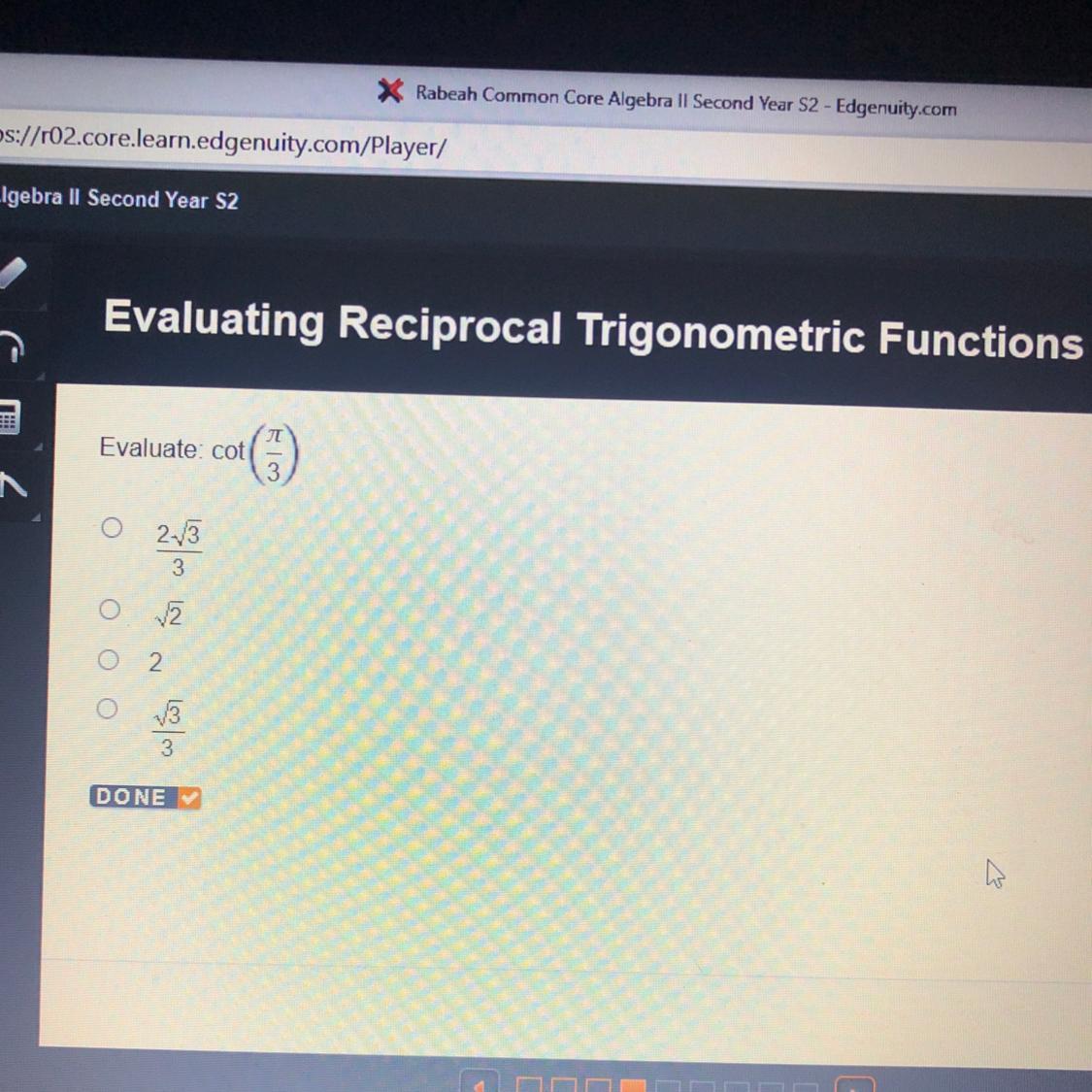
Evaluate cot
3
0
2-3
3
V2
0 2
V3
3
Answers
Answer: D
Step-by-step explanation:
The solution is, the required value is cot(π/3) = √3/3
What are trigonometric relations?Trigonometry is the study of the relationships between the angles and the lengths of the sides of triangles
here, we have,
The six trigonometric functions are sin , cos , tan , cosec , sec and cot
Let the angle be θ , such that
sin θ = opposite / hypotenuse
cos θ = adjacent / hypotenuse
tan θ = opposite / adjacent
here, we have,
we know that,
note :
cot a = cosa /sina
here,
so : cot(π/3) = cos(π/3)/sin(π/3)
but : cos(π/3) = 1/2
and sin(π/3) = √3 /2
now, we get,
cot(π/3) = (1/2) / (√3 /2)
= (1/2)×(2/√3 )
= 1/√3
= (1×√3)/( √3 ×√3)
= √3/3
Hence, The solution is, the required value is cot(π/3) = √3/3
To learn more about trigonometric relations click :
brainly.com/question/14450671
#SPJ7
Z= [?]° i dont know how to type out the question
![Z= [?] i dont know how to type out the question](https://i5t5.c14.e2-1.dev/h-images-qa/contents/attachments/ExseaPN2H9FHXjMHvJJUeZltKQQ55SJg.jpeg)
Answers
Answer: first u have to find the perimiter for each side
Step-by-step explanation:
the answer is 100 d z
in what situations would you want to change from rectangular to cylindrical or to spherical coordinates?
Answers
Carlos was studying whether or not eating fast food had a effect on a person's weight. He surveyed 100 people and recorded the
number of times they ate fast food per week and their weight. Carlos then calculated the correlation value and got a value of 0.93.
Which conclusion could Carlos make?
es )
A)
Eating fast food does not cause an increase in a person's weight.
B)
There is no relationship between eating fast food and a person's weight
0
There is a strong positive relationship between a person's weight and
eating fast food.
D)
There is a definite cause and effect relationship between eating fast food
and gaining weight.
Answers
Answer: C
Step-by-step explanation:
I got this right
-12+3(4-15)-40+10 plizz
Answers
Answer:
-12+3(-11)-40-10
Step-by-step explanation:
Answer:
Step-by-step explanation:
-12+12-45-40+1
0-85+1
-84
A bakery makes 60 different flavors of pies. 25% of the flavors have whipped cream as one of the ingredients. How many DO NOT have whipped cream?
Answers
Answer:
45 flavours of pie do not have whipped cream
Step-by-step explanation:
If 25% has cream, then 75% does not have cream
75% of 60
60×75/100
= 45
The number of pints of water in the bucket is given by the formula P(t) = t + 5, where P(t) is the number of pints of water in the bucket, and t is the number of seconds Christopher ran the hose into the bucket. What does the slope of the formula represent?
Answers
The number of pints of water in the bucket is given by the formula P(t) = t + 5, where P(t) is the number of pints of water in the bucket, and t is the number of seconds Christopher ran the hose into the bucket. The slope of the formula P(t) = t + 5 represents the rate of change of water level in the bucket with respect to time.
The formula P(t) = t + 5, where P(t) is the number of pints of water in the bucket, and t is the number of seconds Christopher ran the hose into the bucket. The formula shows that the number of pints of water in the bucket is increasing linearly with respect to time. That is, for every one-second increment in time, Christopher puts one more pint of water in the bucket.
The formula, therefore, describes a linear relationship between the volume of water in the bucket and the time Christopher spends running the hose. It means that the slope of the formula represents the rate at which the water level in the bucket changes with respect to time.
The slope is 1 or 1/1, which means that the water level in the bucket increases at the rate of one pint per second. Therefore, the slope of the formula represents the rate of change of water level in the bucket with respect to time (or the speed of filling of the bucket with water).
Conclusively, the slope of the formula P(t) = t + 5 represents the rate of change of water level in the bucket with respect to time.
Learn more about slope from the given link
https://brainly.com/question/16949303
#SPJ11
1. What are the next two numbers? 3.2, 7.2. 11.2. 15.2, ... , ...

Answers
Answer:
19.2, 23.2
Step-by-step explanation:
There is a common difference between consecutive terms in the sequence.
7.2 - 3.2 = 11.2 - 7.2 = 15.2 - 11.2 = 4
Thus adding 4 to the previous term gives the next term
15.2 + 4 = 19.2
19.2 + 4 = 23.2
The next 2 terms are 19.2, 23.2
Answer:
19.2 and 23.2 are next
Step-by-step explanation:
Plz, help me plz!!!!!!
Which triangles are congruent?
Image below

Answers
Answer:
B. Triangles A and C
Step-by-step explanation:
Let's find the missing angle of all Triangles:
Triangle A: 180-110-30=40°
Triangle B: 180-30-45=105°
Triangle C: 180-110-40=30°
All triangle angles in numerical order:
ΔA: 30, 40, 110
ΔB: 30, 45, 105
ΔC: 30, 40, 110
We see that only ΔA and ΔC are congruent with the same angle sizes.
The are both have the same measurements
to solve the following equation , 7x - 2 = 12 , which of the choices below is a correct method to find the value of X

Answers
The Answer:the answer is D
Step-by-step explanation:
a point is chosen randomly on a line segment of length l, where we break this line segment into two parts. find the probability that the ratio of the shorter to the longer segment is less than 1/4.
Answers
To find the probability that the ratio of the shorter to the longer segment is less than 1/4 when a point is chosen randomly on a line segment of length 'l,' we can consider the following approach.
Let's denote the position of the chosen point by 'x' where 0 ≤ x ≤ l represents the distance from one end of the line segment.
The ratio of the shorter segment to the longer segment will be less than 1/4 if 'x' lies in the interval (0, l/5).
This is because any point within this interval will divide the line segment into two parts such that the shorter segment is less than 1/4 of the longer segment.
The length of the interval (0, l/5) is l/5, and the total length of the line segment is 'l.' Therefore, the probability of choosing a point within the interval (0, l/5) is given by (l/5) / l = 1/5.
Hence, the probability that the ratio of the shorter to the longer segment is less than 1/4 is 1/5 or 0.2.
To know more about probability, visit:
https://brainly.com/question/31828911
#SPJ11
XX $ 10.Five years ago, the father's age was five times the son's age. In ten years' time, the father will be twice as old as his son. Find their present ages. father =
Answers
Their present ages are given as follows:
Father: 30 years old.Son: 10 years old.How to obtain the ages?The present ages are obtained solving a system of equations, for which the variables are given as follows:
Variable x: present age of the father.Variable y: present age of the son.Five years ago, the father's age was five times the son's age, hence:
x - 5 = 5(y - 5)
x = 5y - 20
In ten years' time, the father will be twice as old as his son, hence:
x + 10 = 2(y + 10)
x = 2y + 10.
Equaling both equations, the value of y is given as follows:
5y - 20 = 2y + 10
3y = 30
y = 10.
The value of x is given as follows:
x = 2(10) + 10 = 30.
More can be learned about a system of equations at brainly.com/question/13729904
#SPJ1
the data in attend for this exercise. (i) obtain the minimum, maximum, and average values for the variables andre, pri gpa, and act. (ii) estimate the model atenderte 5 b0 1 b1 prigpa 1 b2act 1 u, and write the results in equation form. interpret the intercept. does it have a useful meaning? (iii) discuss the estimated slope coefficients. are there any surprises? (iv) what is the predicted atenderte if prigpa 5 3.65 and act 5 20? what do you make of this result? are there any students in the sample with these values of the explanatory variables? (v) if student a has prigpa 5 3.1 and act 5 21 and student b has prigpa 5 2.1 and act 5 26, what is the predicted difference in their attendance rates?
Answers
(i) The average values for the variables andre, pri gpa, and act is sum of all the values divided by the total number of values.
(ii) The model atenderte 5 b0 1 b1 prigpa 1 b2act 1 u in equation form is atenderte = b₀ + b₁ x prigpa + b₂ x act + u
(iii) The slope coefficients is b₁ and b₂
(iv) The predicted atenderte if prigpa 5 3.65 and act 5 20 is atenderte = b₀ + b₁ x 3.65 + b₂ x 20 + u
(v) if student a has prigpa 5 3.1 and act 5 21 and student b has prigpa 5 2.1 and act 5 26, then the predicted difference in their attendance rates is 0.5
In this exercise, we will be exploring a regression model that predicts the attendance rate of students based on their academic performance variables. We will be using three variables to predict the attendance rate: "andre", "pri gpa", and "act". Here are the answers to the questions:
(i) To obtain the minimum, maximum, and average values for the variables "andre", "pri gpa", and "act", we need to first look at the data. The minimum value is the smallest value for each variable, the maximum value is the largest value for each variable, and the average value is the sum of all the values divided by the total number of values.
(ii) The regression model that predicts the attendance rate is written in equation form as
=> "atenderte = b₀ + b₁ x prigpa + b₂ x act + u".
This equation means that the predicted attendance rate (atenderte) is equal to the intercept (b₀) plus the product of the coefficient for "pri gpa" (b₁) and the value of "pri gpa" plus the product of the coefficient for "act" (b₂) and the value of "act".
(iii) The estimated slope coefficients (b₁ and b₂) tell us the expected change in the attendance rate for each one-unit increase in "pri gpa" or "act". If b₁ is positive, it means that as "pri gpa" increases, the attendance rate is expected to increase. Similarly, if b₂ is positive, it means that as "act" increases, the attendance rate is expected to increase.
(iv) To find the predicted attendance rate if "pri gpa" is 3.65 and "act" is 20, we can substitute these values into the regression equation:
atenderte = b₀ + b₁ x prigpa + b₂ x act + u
atenderte = b₀ + b₁ x 3.65 + b₂ x 20 + u
This will give us the predicted attendance rate for a student with "pri gpa" of 3.65 and "act" of 20. If there are any students in the sample with these values of the explanatory variables, then their actual attendance rate should be close to the predicted value.
(v) To find the predicted difference in attendance rates between student A (with "pri gpa" of 3.1 and "act" of 21) and student B (with "pri gpa" of 2.1 and "act" of 26), we can first use the regression equation to predict the attendance rates for each student:
Student A:
atenderteA = b0 + b1 x 3.1 + b2 x 21 + u
Student B:
atenderteB = b0 + b1 x 2.1 + b2 x 26 + u
Then, we can take the difference between the predicted attendance rates for each student:
=> atenderteA - atenderteB
=> 52.6 - 52.1 = 0.5
This will give us the predicted difference in attendance rates between the two students.
To know more about equation here.
https://brainly.com/question/10413253
#SPJ4
Help.....................

Answers
Answer:
180 degrees
Step-by-step explanation:
All interior angles are less than or equal to 180 degrees in a convex polygon.
(I might be wrong. Sorry if I am. Don't get mad at me)
Hope I helped :)
Please consider Brainliest :)
how much work is done when a 100 lb rock is lifted to a height of 3 ft?
Answers
A. The work done is 300 ft-lbs when a 100 lb rock is lifted to a height of 3 ft.
To calculate the work done, we can use the formula: Work = force x distance x cos(Ф).In this case, the force is the force of gravity acting on the rock, which can be calculated using the formula:
force = m * g
where m is the mass of the rock and g is the acceleration due to gravity (32.17 ft/s^2).
force = 100 lb * 32.17 ft/s^2 = 3,217 ft-lbs
The distance is the height to which the rock is lifted, which is 3 ft.
The angle of the rock to the vertical is 90 degrees, so cos(90) = 0.
So,
Work = force x distance x cos(theta) = 3,217 ft-lbs * 3 ft * 0 = 300 ft-lbs
So, the work done is 300 ft-lbs.
For more questions like Work done click the link below:
https://brainly.com/question/13662169
#SPJ4