Given that f(x)=x^2+3x+2 and g(x)=x+5, evaluate the following:
Find f(g(5)).
Answers
Answer:
We conclude that:
f(g(5)) = 132Step-by-step explanation:
Given
f(x) = x² + 3x + 2
g(x) = x + 5
To determine
f(g(5)) = ?
In order to determine f(g(5)), first, we need to determine g(5)
substitute x = 5 in g(x) = x + 5
g(x) = x + 5
g(5) = 5 + 5
g(5) = 10
so
f(g(5)) = f(10)
now determine f(10)
substitute x = 10 in f(x) = x² + 3x + 2
f(x) = x² + 3x + 2
f(6) = (10)² + 3(10) + 2
f(6) = 100 + 30 + 2
f(6) = 132
so
f(g(5)) = f(10) = 132
Therefore, we conclude that:
f(g(5)) = 132Related Questions
Johanna rode her bike 7 miles to a lake . She rode 3/4 of distance to the lake before lunch. How many miles did johanna ride before lunch?
Answers
Answer:
5.25 miles
Step-by-step explanation:
Total distance = 7 miles
Distance she rode before lunch = 3/4 of the total distance
=> 3/4 of 7
=> 21/4
=> 5.25 miles
So, she drove 5.25 miles before lunch.
who is the best in the movie encanto
Answers
Answer:
My opinion Camilo Madrigal
Step-by-step explanation:
Because his gift is shapeshifting.
Answer: Isabela and dolores yes yes:)
who can answer this have 20 points

Answers
First note that \(A_n\) means the nth term in the sequence.
1. First one is a simple arithmetic progression/sequence as the common differences between each two numbers are 1
So the sequence will be
1.) 2,3,4,5,6,7...
And the rule since its +1 each time will be
\(A_n=2+1*(n-1)\)
For the nth term of the sequence.
2.This one can be seen as a simple geometric sequence as the common ratio between the number and the number after it is 1:2
So the sequence will be
2.)2,4,8,16,32,64
And the rule since it is *2 each time is a simple exponential function
\(A_n=2*2^{n-1}\\or\\A_n=2^n\)
3.This one is tricky but it can be seen that the term is double the term before subtract 1
So the sequence will be
3.)5,9,17,33,65,129
And the rule based on this sequence will be
\(A_n=A_{n-1}*2-1\)
**Please note that this rule specifically is written in recursive form as it is a lot more difficult otherwise.
4 This one is similar to problem 1 which is an arithmetic sequence this one just have a common differences of 3 instead of 1.
So the sequence will be
4.)25,28,31,34,37
And the rule based on the sequence will be
\(A_n=25+3*(n-1)\)
I hope this helps and if you don't understand any part of my explanation I would gladly help!
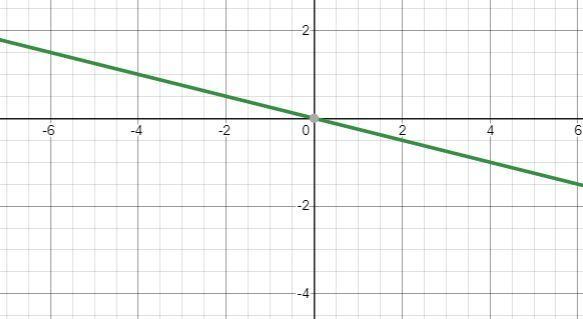
Graph the linear equation f(x)- -1/4x
Answers
From the given question
There are given that the equation:
\(f(x)=-\frac{1}{4}x\)Now,
First, make a table of x and f(x)
Then,
\(\begin{gathered} x\rightarrow f(x) \\ 0\rightarrow0 \\ 1\rightarrow-0.25 \\ 2\rightarrow-0.5 \\ 3\rightarrow-0.75 \end{gathered}\)So,
According to the above value, the graph of the function is shown below:
A customer/member owes $11.02 and pays $100.00 in cash. Change due is $88.98.
Answers
Answer:
Correct
Step-by-step explanation:
Helpi
Identify the domain of the function shown in the graph.

Answers
Answer:
D = all reals (or -7 to 7)
Step-by-step explanation:
If the line continues on for infinity, then the domain is all reals, or negative infinity to positive infinity. If the line ends on the graph that we can see, though, the domain would be [-7 , 7]
which ratio does not belong with the others? Explain your reasoning
3:4
9:12
12:15
12:16
Answers
Answer:
12:15
Step-by-step explanation:
3 simplified to 3:4
12:15 simplified to 4:5
Can someone Find the m

Answers
F(x)=1/ x shift 9 units right and 4 units down
Answers
Answer:
g(x) = 1/(x-9) - 4
Step-by-step explanation:
f(x) shift 9 units right -> f(x-9) = 1/(x-9)
further shift 4 units down: 1/(x-9) - 4

Please help with the problem in the picture ^ I’ll give brainliest if you give me a small explanation! :)

Answers
Answer:
A
Step-by-step explanation:
Because when you see X and Y, x multiplied by -6 is equal to y so if you check -84/-6, your correct answer should be 14 also A, hopefully this gave you the explanation you were looking for!!!!!!!!
There are two openings at a programming company and 40 people apply. How many different ways can those two positions be filled?
Answers
Using the combination formula, it is found that these two positions can be filled in 780 ways.
The order in which the positions are filled is not important, for example, João and Elisa is the same outcome as Elisa and João, hence the combination formula is used to solve this question.
What is the combination formula?\(C_{n,x}\) is the number of different combinations of x objects from a set of n elements, given by:
\(C_{n,x} = \frac{n!}{x!(n-x)!}\)
In this problem, two people are taken from a set of 40, hence the number of ways is given by:
\(C_{40,2} = \frac{40!}{2!38!} = 780\)
More can be learned about the combination formula at https://brainly.com/question/25821700
#SPJ1
A playground 88 ft long and 58 ft wide is to be resurfaced at a cost of $2.75 per sq ft. What will the resurfacing cost?
The resurfacing will cost $.
(Simplify your answer. Type an integer or a decimal.)
Answers
Answer: $1856
Step-by-step explanation: 88 x 58 = 5104. 5104/2.75= 1856
100 POINTS + BRAINLIEST!!

Answers
a is 15 days
b is 20%
hope this helps you
Answer:
a is 15 daysb is 20%
Step-by-step explanation:
I need some assistance please

Answers
-8 - 6
-14
2 (7) - 6
14 - 6
8
Find the critical value z Subscript alpha divided by 2 that corresponds to the confidence level 90%.
Answers
Answer:
,.........................................................
3.-Las 80 habitaciones de un motel se podrían alquilar todas las noches si el director cobrará
40 € o menos por habitación. Si se cobra (40+x) € por habitación, entonces 2x habitaciones
permanecerán vacantes. Si cada habitación alquilada le cuesta al director 10 € al día y cada
habitación no alquilada 2 € al día, ¿qué precio debería cobrar el director por habitación para
maximizar su beneficio diario?
4.- Un fabricante de automóviles vende 2000 coches al mes, con un beneficio medio de 1000 €
por coche. Las prospectivas de mercado indican que por cada 50 € de descuento que el
fabricante ofrezca a los compradores podría vender 200 coches más al mes.
¿Cuánto descuento debería ofrecer para maximizar el beneficio mensual?
Answers
3) Para maximizar su beneficio diario el director debería cobrar cada habitación a €56.
4) El fabricante debería ofrecer un descuento de 150€ para maximizar su beneficio mensual.
3- Dado que las 80 habitaciones de un motel se podrían alquilar todas las noches si el director cobrara 40€ o menos por habitación, y si se cobra (40+x) € por habitación, entonces 2x habitaciones permanecerán vacantes, para determinar, si cada habitación alquilada le cuesta al director 10 € al día y cada habitación no alquilada 2 € al día, qué precio debería cobrar el director por habitación para maximizar su beneficio diario, se deben realizar los siguientes cálculos:
80 x 40 - 80 x 2 = 304070 x 50 - 10 x 10 - 70 x 2 = 326060 x 60 - 20 x 10 - 60 x 2 = 328065 x 55 - 15 x 10 - 65 x 2 = 329566 x 54 - 14 x 10 - 66 x 2 = 329264 x 56 - 16 x 10 - 64 x 2 = 329663 x 57 - 17 x 10 - 63 x 2 = 3295Por lo tanto, para maximizar su beneficio diario el director debería cobrar cada habitación a €56.
3) Dado que un fabricante de automóviles vende 2000 coches al mes, con un beneficio medio de 1000 € por coche, y las prospectivas de mercado indican que por cada 50 € de descuento que el fabricante ofrezca a los compradores podría vender 200 coches más al mes, para determinar cuánto descuento debería ofrecer para maximizar el beneficio mensual se debe realizar el siguiente cálculo:
1000 x 2000 = 2.000.000900 x 2400 = 2.160.000800 x 2800 = 2.240.000700 x 3200 = 2.240.000600 x 3600 = 2.160.000850 x 3000 = 2.550.000Por lo tanto, el fabricante debería ofrecer un descuento de 150€ para maximizar su beneficio mensual.
Aprende más sobre matemática en https://brainly.com/question/25809832
HELP PLEASE! WILL GIVE BRAINLIEST TO THE BEST ANSWER!
There are 35 students in a drama club. 2 out of every 5 students are boys.
How many students in the club are boys?
A. 7
B. 10
C. 14
D. 15
Answers
O. A water jug is filled with 128 fluid ounces. Anna
pours out 3 pints of liquid from the jug. How
many pints remain?
A. 5 pints
B. 6 pints
C. 8 pints
D.
11 pints
Answers
Answer:11
Step-by-step explanation:
Let \(f(x)=2(3)^x^+^1\). Evalulate \(f(2)\) without using a calculator. Do not include \(f(2)\) in your answer.
Answers
\(f(x)=2(3)^{x+1} \\\\[-0.35em] ~\dotfill\\\\ f(2)=2(3)^{(2)+1}\implies f(2)=2(3)^3\implies f(2)=2(3^3) \\\\\\ f(2)=2(27)\implies f(2)=54\)
Which equation shows the point-slope form of the line that passes through (3, 2) and has a slope of y plus StartFraction one-half EndFraction equals 3 left-parenthesis x minus 2 right-parenthesis.?
y + 2 =y plus 2 equals StartFraction one-third EndFraction left-parenthesis x plus 3 right-parenthesis.(x + 3)
y – 2 = y minus 2 equals StartFraction one-third EndFraction left-parenthesis x minus 3 right-parenthesis.(x – 3)
y + 3 = y plus 3 equals StartFraction one-third EndFraction left-parenthesis x plus 2 right-parenthesis.(x + 2)
y – 3 = y plus StartFraction one-half EndFraction equals 2 left-parenthesis x minus 3 right-parenthesis.(x – 2)
Answers
The equation that shows the point-slope form of the line passing through (3, 2) with a slope of (1/2) is:
y - 2 = (1/2)(x - 3)
In the point-slope form of a linear equation, the formula is y - y1 = m(x - x1), where (x1, y1) represents a point on the line, and m represents the slope of the line. By substituting the given values into the formula, we can determine the correct equation.
In this case, the given point is (3, 2) and the slope is (1/2). Plugging these values into the formula, we get:
y - 2 = (1/2)(x - 3)
This equation represents the line passing through the point (3, 2) with a slope of (1/2). It is in the point-slope form, which allows us to easily determine the equation of a line based on a given point and slope.
Therefore, the correct equation is y - 2 = (1/2)(x - 3).
For more such answers on Point slope
https://brainly.com/question/29797287
#SPJ8
Answer: B
Step-by-step explanation:
Find the value of f (3)
y =f(x)
Please help

Answers
Answer:
f=7/3
Step-by-step explanation:
from the figure it can be deduced that x=3 and
y=7
so: y=f(x) → 7=f(3)
put f to the first member: 7=3f → 3f=7 → f=7/3
(I hope that's right)
Answer:
f(3) = 7
Step-by-step explanation:
locate x = 3 on the x- axis, then go vertically up to meet the line at (3, 7) , so
f(3) = 7
Refer to the information below to answer Questions 9 and 10. Value of Property Up to K35 000 K35 000 to K70 000 K70 000 to K140 000 Over K140 000 10. Rate of Stamp Duty 2% 3% 4% 5% 9. Calculate the stamp duty payable on properties whose purchase price is K45 000. (1 mark) Answer: Calculate the stamp duty payable on properties whose purchase price is K150 000. (1 mark) Answer:
Answers
9. The stamp duty payable on a property with a purchase price of K45,000 is K1,350.
10. The stamp duty payable on a property with a purchase price of K150,000 is K7,500.
To calculate the stamp duty payable on properties with a purchase price of K45,000 and K150,000, we need to apply the corresponding rates of stamp duty based on the given information.
Given:
Value of Property:
Up to K35,000: Stamp Duty Rate - 2%
K35,000 to K70,000: Stamp Duty Rate - 3%
K70,000 to K140,000: Stamp Duty Rate - 4%
Over K140,000: Stamp Duty Rate - 5%
9. Calculate the stamp duty payable on properties whose purchase price is K45,000:
Since the purchase price of K45,000 falls within the range of K35,000 to K70,000, the stamp duty rate applicable is 3%.
Stamp Duty Payable = Purchase Price * Stamp Duty Rate
= K45,000 * 3%
= K45,000 * 0.03
= K1,350
Therefore, the stamp duty payable on a property with a purchase price of K45,000 is K1,350.
10. Calculate the stamp duty payable on properties whose purchase price is K150,000:
Since the purchase price of K150,000 is above K140,000, the stamp duty rate applicable is 5%.
Stamp Duty Payable = Purchase Price * Stamp Duty Rate
= K150,000 * 5%
= K150,000 * 0.05
= K7,500
Therefore, the stamp duty payable on a property with a purchase price of K150,000 is K7,500.
for such more question on property
https://brainly.com/question/29667212
#SPJ8
Gabriel brings 25 cupcakes to share with his classmates at school. At the end of the day, he has 3 cupcakes remaining.
What percent of the total cupcakes did Gabriel share with his classmates?
A 12%
B 22%
C75%
D88%
Answers
Answer:
d 88
Step-by-step explanation:
Answer:D
Step-by-step explanation:
88
It takes 20 minutes for a cow to be milked by a milking machine.
How many cows can be milked in 6 hours?
Answers
Answer:
18 cows can be milked in 6 hours
Step-by-step explanation:
hrs.=3
Find the area of this triangle.
10 cm,
8 cm
21 cm
17 cm
A = [?] cm²
Enter
Help
Answers
The area of the given triangle is 84 cm².
The area of any two-dimensional figure is the space occupied within its boundary.
The area of a triangle is calculated using the formula, A = (1/2)*b*h, where A is its area, b is the length of its base, and h is the length of its height.
In the question, we are asked to find the area of the given triangle.
The length of the base of the given triangle, b = 21 cm.
The length of the height of the given triangle, h = 8 cm.
We can calculate the area of the given triangle, using the formula, A = (1/2)*b*h, where A is its area, b is the length of its base, and h is the length of its height.
A = (1/2)*(21)*(8) cm²,
or, A = 84 cm².
Thus, the area of the given triangle is 84 cm².
Learn more about the area of a triangle at
https://brainly.com/question/17335144
#SPJ9
![Find the area of this triangle.10 cm,8 cm21 cm17 cmA = [?] cmEnterHelp](https://i5t5.c14.e2-1.dev/h-images-qa/answers/attachments/ZS3uYuRqHBHLhJS0efle2SSlxC1N7QWr.jpeg)
a chord 7cm long is drawn in a circle of radius 3.7cm. calculate the distance of the chord from the centre of the circle
Answers
Answer: To find the distance of a chord from the center of a circle, we need to use the following formula:
Distance from center = sqrt(r^2 - (c/2)^2)
Where r is the radius of the circle and c is the length of the chord.
In this case, the radius of the circle is 3.7cm and the length of the chord is 7cm.
So, substituting these values in the formula, we get:
Distance from center = sqrt(3.7^2 - (7/2)^2)
= sqrt(13.69 - 12.25)
= sqrt(1.44)
= 1.2 cm
Therefore, the distance of the chord from the center of the circle is 1.2 cm.
Step-by-step explanation:
A fair die is rolled repeatedly. Calculate to at least two decimal places:__________
a) the chance that the first 6 appears before the tenth roll
b) the chance that the third 6 appears on the tenth roll
c) the chance of seeing three 6's among the first ten rolls given that there were six 6's among the first twenty roles.
d) the expected number of rolls until six 6's appear
e) the expected number of rolls until all six faces appear
Answers
Answer:
a. 0.34885
b. 0.04651
c. 0.02404
d. 36
e. 14.7, say 15 trials
Step-by-step explanation:
Q17070205
Note:
1. In order to be applicable to established probability distributions, each roll is considered a Bernouilli trial, i.e. has only two outcomes, success or failure, and are all independent of each other.
2. use R to find the probability values from the respective distributions.
a) the chance that the first 6 appears before the tenth roll
This means that a six appears exactly once between the first and the nineth roll.
Using binomial distribution, p=1/6, n=9, x=1
dbinom(1,9,1/6) = 0.34885
b) the chance that the third 6 appears on the tenth roll
This means exactly two six's appear between the first and 9th rolls, and the tenth roll is a six.
Again, we have a binomial distribution of p=1/6, n=9, x=2
p1 = dbinom(2,9,1/6) = 0.27908
The probability of the tenth roll being a 6 is, evidently, p2 = 1/6.
Thus the probability of both happening, by the multiplication rule, assuming independence
P(third on the tenth roll) = p1*p2 = 0.04651
c) the chance of seeing three 6's among the first ten rolls given that there were six 6's among the first twenty roles.
Again, using binomial distribution, probability of 3-6's in the first 10 rolls,
p1 = dbinom(3,10,1/6) = 0.15504
Probability of 3-6's in the NEXT 10 rolls
p1 = dbinom(3,10,1/6) = 0.15504
Probability of both happening (multiplication rule, assuming both events are independent)
= p1 * p1 = 0.02404
d) the expected number of rolls until six 6's appear
Using the negative binomial distribution, the expected number of failures before n=6 successes, with probability p = 1/6
= n(1-p)/p
Total number of rolls by adding n
= n(1-p)/p + n = n(1-p+p)/p = n/p = 6/(1/6) = 36
e) the expected number of rolls until all six faces appear
P1 = 6/6 because the firs trial (roll) can be any face with probability 1
P2 = 6/5 because the second trial for a different face has probability 5/6, so requires 6/5 trials
P3 = 6/4 ...
P4 = 6/3
P5 = 6/2
P6 = 6/1
So the total mean (expected) number of trials is 6/6+6/5+6/4+6/3+6/2+6/1 = 14.7, say 15 trials
help me find the answer
Answers
the width of the bedroom floor is 5m less than its length and its area is 84m find its dimensions
Answers
Answer :
length = 12 meters
width = 7 meters
whats the answer, i need help cuz i cant figure it out.

Answers
Check the picture below.
\(\stackrel{AC}{x}~~ + ~~\stackrel{CB}{2x}~~ = ~~\stackrel{AB}{33}\implies 3x=33\implies x=\cfrac{33}{3}\implies \boxed{x=11} \\\\[-0.35em] ~\dotfill\\\\ \stackrel{\textit{\LARGE AC}}{11}\hspace{10em}\stackrel{\textit{\LARGE CB}}{2(11)\implies 22}\)
