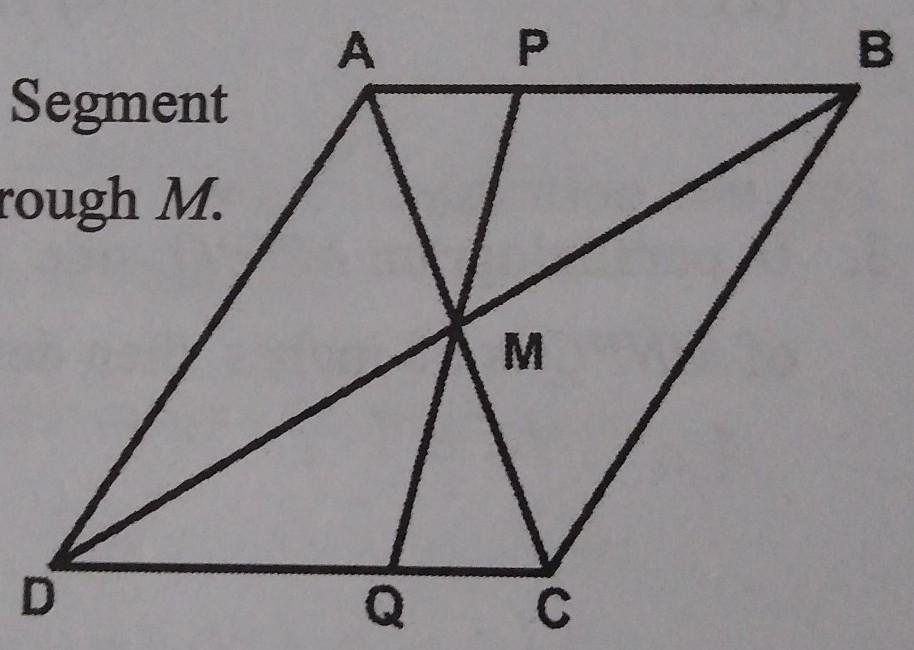
Given that ABCD is a parallelogram with diagonals intersecting at M. Segment PQ is drawn such that P lies on AB and Q lies on DC and it passes through M. Prove that PM is congruent to QM.
Answers
Answer:
we thus have enough informnation to prove that the two triangles are congruent. Because of thism, one side of the triangles, Pm which is the congruent side to that of PQ must be equal as well and
PM = QM
Step-by-step explanation:
because it's a parrallelogram, Ad = BC and AB = DC.
P passes through both AB and DC on a diagonal, angles created by P have oppoiste exterior angles of eachother.
the diagonals of AC create congruent angles at DMC and AMB and because P is cutting through them, the angles P cuts at DMQ and QMC are equal to that of AMP and PMB
that being said, we now see that the angles of APM triangle and AMC triangol are equal and because the diagonal of BD is is being cut by AC, which AD is parralel to BC and AB to Dc, we know now that lines AM and MC are congruent
we thus have enough informnation to prove that the two triangles are congruent. Because of thism, one side of the triangles, Pm which is the congruent side to that of PQ must be equal as well and
thus PM = QM
The alternate interior angles formed by the parallel sides and a common
transversal are equal, such that ΔPBM and ΔQDM are congruent.
Correct response;
PM is congruent to QM by CPCTCHow is the congruency of the segments determined?The two column proof is presented as follows;
Statement \({}\) Reason
ABCD is a parallelogram \({}\) Given
AC and DB are diagonals of ABCD \({}\) Given\({}\)
M is the point of intersection of the diagonals \({}\) Given
MB ≅ DM, and AM ≅ CM;\({}\) Properties of the diagonals of a parallelogram
∠PMB ≅ ∠DMQ \({}\) Vertical angles theorem
∠PBM ≅ ∠QDM \({}\) Alternate interior angles theorem
ΔPBM ≅ ΔQDM \({}\) Angle-Side-Angle Congruency post.
PM ≅ QM \({}\) CPCTC
ΔPBM is congruent to ΔQDM by Angle-Side-Angle congruency
postulate, given that they have two angles and an included side that are
congruent.
Therefore;
PM is congruent to QM by Corresponding Parts of Congruent Triangles are Congruent, CPCTC.Learn more about congruency postulates here:
https://brainly.com/question/17003791
Related Questions
Someone solve this plz

Answers
Answer:
z= 23°
y= 120°
Step-by-step explanation:
For z, the measures of the angles are alternate interior angles, they equal each other. So, the equation would be:
66= 3z-3
Step 1- Add 3 to both sides.
66= 3z-3
+3 +3
69= 3z
Step 2- Divide both sides by 3.
69= 3z
3 3
z= 23°
For y, the measures of 66 and y are alternate exterior angles, they sum up to 180 degrees. So, the equation would be:
180= 60+y
Step 1- Subtract 60 to both sides.
180= 60+y
-60 -60
y= 120°
Hope this helps!
Savannah earned a score of 43 on exam a that had a mean of 36 and a standard
deviation of 5. she is about to take exam b that has a mean of 650 and a standard
deviation of 40. how well must savannah score on exam b in order to do
equivalently well as she did on exam a? assume that scores on each exam are
normally distributed.
Answers
In order for Savannah to do equivalently well on exam B as she did on exam A, she would need to score approximately 671.5 or higher.
To determine how well Savannah must score on exam B to achieve equivalent performance, we can use z-scores. The z-score measures the number of standard deviations a particular score is from the mean.
First, we calculate the z-score for Savannah's score on exam A using the formula: z = (x - mean) / standard deviation.
For exam A, Savannah's score (x) is 43, the mean is 36, and the standard deviation is 5. Plugging these values into the formula, we get z = (43 - 36) / 5 = 1.4.
Next, we use the z-score to find the corresponding score on exam B. The formula to convert a z-score to a raw score is: x = (z * standard deviation) + mean.
For exam B, the mean is 650 and the standard deviation is 40. Substituting the values, we get x = (1.4 * 40) + 650 = 671.5.
Therefore, Savannah would need to score approximately 671.5 or higher on exam B in order to perform equivalently to her score of 43 on exam A.
Learn more about approximately here:
https://brainly.com/question/30941646
#SPJ11
Find two positive consecutive integers such that the square of the first added to three times the second is 24
Answers
Answer:
3 and 5
Step-by-step explanation:
Let the two consecutive odd integers be x and x + 2.
Now,
The given statement is
\(x^2 + 3 \times (x+2)=24\\x^2 + 3x+6-24 = 0 \\x^2 + 3x-18 = 0\\x^2+6x-3x-18=0\\x(x+6)-3(x+6)=0\\(x-3)(x+6)=0\\x=3,-6\)
Taking x=3.
Hence, two consecutive odd integers are 3 and 5.
Consider two digital fuel pumps A and B that could be used in a single gas station. Pump A has a mean effective process time of 4 minutes with squared-coefficient of variation of 0.5. Pump B has a mean effective time of 3 minute with squared-coefficient of variation of 5. Assume that the arrival rate of cars is 0.2 car per minute with squared-coefficient of variation of 1. Which pump will have a longer average cycle time? (Hint: the number of machines, m, is 1.)
Answers
Therefore, Pump B will have a longer average cycle time compared to Pump A.
To determine which pump will have a longer average cycle time, we need to calculate the cycle time for each pump based on the given information and compare the results. The cycle time for a single-server system can be calculated using Little's Law: Cycle Time = (1 / Arrival Rate) * (1 / (1 - Utilization))
Given:
Arrival Rate = 0.2 car per minute
Squared-Coefficient of Variation (CV^2) for Arrival Rate = 1
Utilization can be calculated as the product of the mean effective process time and the arrival rate:
Utilization = Mean Effective Process Time * Arrival Rate
For Pump A:
Mean Effective Process Time (A) = 4 minutes
Squared-Coefficient of Variation for Pump A = 0.5
Utilization (A) = 4 * 0.2 = 0.8
For Pump B:
Mean Effective Process Time (B) = 3 minutes
Squared-Coefficient of Variation for Pump B = 5
Utilization (B) = 3 * 0.2 = 0.6
Now, let's calculate the cycle time for each pump:
Cycle Time (A) = (1 / 0.2) * (1 / (1 - 0.8))
= 5 minutes
Cycle Time (B) = (1 / 0.2) * (1 / (1 - 0.6))
= 2.5 minutes
To know more about Pump,
https://brainly.com/question/32143195
#SPJ11
find the area of a rectangle with a width of 1/2 m and a length that is three times longer. what is the area of the rectangle
Answers
The area of the rectangle is 0.75 square meters.
The area of the rectangle can be found using the formula: A = lw
where A is the area, l is the length, and w is the width.
We are given that the width of the rectangle is 1/2 m and the length is three times longer than the width, which means that l = 3w.
Substituting these values in the formula, we get:
A = (1/2)(3w)A = (3/2)w
Simplifying, we can write the area as:
A = 1.5w
Now we need to substitute the given value of the width in the above formula to find the area:
A = 1.5(1/2)
A = 0.75
For similar question on rectangle.
https://brainly.com/question/19634537
#SPJ11
Can you determine any purpose why these concepts are present in the pictures?
Answers
The purpose why these concepts are present in the pictures is to develop imagination power among students.
As you imagine more, your mind becomes stronger and you have greater mental control. Innovation requires a strong imagination. If you succeed in what you set out to do, the same individuals who now accuse you of daydreaming will begin to aspire to be like you. Keep your aspirations high and your imagination expanding.
Imagination is a potent brain stimulant because it forces you to think differently than most people do. Your imagination can help you come up with scenarios that most effectively handle difficulties, even though your brain might classify them as being unexpected.
Learn more about imagination power here
https://brainly.com/question/8905110
#SPJ9
A company is deciding which can size to use for their soup. The first can has a radius of 1 . 5 inches and a height of 6 inches. The second can has a radius of 3 inches and a height of 3 inches.
Answers
Answer:
A company can use the first can for their soup as that will cost less to the company.
Step-by-step explanation:
Given: The first can has a radius of 1.5 inches and a height of 6 inches. The second can has a radius of 3 inches and a height of 3 inches.
To find: The can that a company can use to use for their soup.
Solution:
Let r, h denote radius and height of the first can and R, H denote radius and height of the second can.
\(r=1.5\,inches\,,\,h=6\,inches\,,\,R=3\,inches\,,\,H=3\,inches\)
Volume of the first can = \(\pi r^2h=\pi (1.5)^2(6)=13.5\,\,square\,\,inches\)
Volume of the second can = \(\pi R^2H=\pi (3)^2(3)=27\,\pi\,\,square\,\,inches\)
So,
Volume of the first can \(<\) Volume of the second can
A company can use the first can for their soup as that will cost less to the company.
Joshua was taking a trip to an amusement park with his family. To get his family in, his parents had to purchase two adult tickets, one child ticket, and one toddler ticket. The cost of an adult ticket was $45.50. A child ticket was 8/10 of the price of an adult ticket, and a toddler ticket was 2/5 of the price of an adult ticket. How much was the toddler ticket cost step by step
Answers
Answer:
How much was the toddler ticket
(45,5*2)/5 == 18,5$
Step-by-step explanation:
You wish to make a snack mixes from peanuts and almonds to sell in your health-food store. Mix A is half peanuts and half almonds. Mix B is one fourth peanuts and three-fourths almonds. If you have 15 pounds of peanuts and 20 pounds of almonds, how many pounds of each mix should you make to exactly use all of your ingredients?
Answers
Answer:
25 pounds of mix A
10 pounds of mix B
Step-by-step explanation:
Each pound of mix A takes half a pound of peanuts and each pound of mix B takes one fourth of a pound of peanuts. Total peanuts consumption is:
\(0.5A+0.25B=15\)
Each pound of mix A takes half a pound of almonds and each pound of mix B takes three fourths of a pound of almonds. Total almonds consumption is:
\(0.5A+0.75B=20\)
Solving the linear system:
\(0.5A+0.25B=15\\0.5A+0.75B=20\\0.5B=5\\B=10\ pounds\\0.5A=15-0.25*10\\A=25\ pounds\)
In order to exactly use all of your ingredients, you should make 25 pounds of mix A and 10 pounds of mix B
Water has a density of about 0.0361 pounds/cubic inch. you might know that wood floats on water. what can you conclude about the densities of objects that float and the densities of objects that do not? review your results from parts b and c before deciding.
Answers
Objects that float typically have densities less than or equal to the density of the liquid they are placed in, while objects that do not float have densities greater than the density of the liquid.
The principle behind floating and sinking lies in the concept of density. Density is defined as the mass of an object divided by its volume. When an object is placed in a liquid, such as water, it experiences an upward buoyant force equal to the weight of the liquid it displaces.
If the density of the object is less than the density of the liquid, the buoyant force will be greater than the weight of the object, causing it to float. In the case of wood floating on water, wood has a lower density than water, allowing it to float.
On the other hand, if the density of an object is greater than the density of the liquid, the buoyant force will be less than the weight of the object, causing it to sink. Objects with densities higher than that of water will sink in water because their weight exceeds the buoyant force exerted by the water.
Based on the given information about water's density, which is approximately 0.0361 pounds/cubic inch, we can conclude that objects with densities less than or equal to 0.0361 pounds/cubic inch will float on water, while objects with densities greater than 0.0361 pounds/cubic inch will sink.
In summary, the densities of objects that float are generally less than or equal to the density of the liquid they are placed in, while objects that do not float have densities greater than the density of the liquid.
Learn more about Density
brainly.com/question/29775886
brainly.com/question/15164682
#SPJ11
A dog buries a bone −1 5/6 inches into the dirt. The dog buries another bone −1 3/4 inches into the dirt. Which bone is buried deeper?
Answers
a teacher must select four members of the math club to participate in an upcoming competition. how many ways are there for her to make her selection if the club has 12 members?
Answers
The teacher has to select four members out of a math club of twelve members. There are 495 possible ways for her to make the selection.
To determine the number of ways the teacher can select four members from a math club of twelve, we can use the concept of combinations. A combination is a selection of items without regard to the order in which they are chosen. In this case, the teacher needs to select four members, and the order in which they are chosen does not matter.
The formula for calculating combinations is given by "n choose k," which is denoted as C(n, k) or nCk. In this case, the teacher needs to choose four members out of twelve, so the calculation would be 12C4.
Using the formula for combinations, 12C4 = 12! / (4!(12-4)!), where "!" represents the factorial function. Simplifying the expression gives us 12! / (4!8!).
The factorial function represents the product of all positive integers up to a given number. So, 12! is equal to 12 × 11 × 10 × 9 × 8 × 7 × 6 × 5 × 4 × 3 × 2 × 1.
Simplifying further, we have 12! / (4!8!) = (12 × 11 × 10 × 9) / (4 × 3 × 2 × 1).
Calculating the expression gives us (11880) / (24) = 495.
Therefore, there are 495 possible ways for the teacher to make her selection of four members from the math club of twelve.
Learn more about combination here: https://brainly.com/question/29595163
#SPJ11
Please help me simplifying algebraic expressions containing parentheses brackets and braces I need help on number four.pls help this needs to be done very soon pls pls

Answers
Answer: x + y - 9
Step-by-step explanation:
3x−(y+3x−(2y+x))−2−7
=3x+−y+−3x+2y+x+−2+−7
Combine Like Terms:
=3x+−y+−3x+2y+x+−2+−7
=(3x+−3x+x)+(−y+2y)+(−2+−7)
=x+y+−9
Solution: x+y−9
if x is a discrete uniform random variable ranging from one to eight, find p(x < 6).
Answers
The probability that x is less than 6 is 5/8.
If x is a discrete uniform random variable ranging from one to eight, then each value from one to eight is equally likely to occur, and the probability of any particular value is 1/8.
To find p(x < 6), we need to add up the probabilities of all the values of x that are less than 6:
p(x < 6) = p(x = 1) + p(x = 2) + p(x = 3) + p(x = 4) + p(x = 5)
Since x is a discrete uniform random variable, the probability of each of these values is 1/8, so we can substitute that into the equation:
p(x < 6) = (1/8) + (1/8) + (1/8) + (1/8) + (1/8)
Simplifying, we get:
p(x < 6) = 5/8
Therefore, the probability that x is less than 6 is 5/8.
To know more about probability , refer here:
https://brainly.com/question/32004014#
#SPJ11
29÷1334 long division I need to show my work
Answers
Answer: 46
Hope this helps

The result of dividing 1334 by 29 is 46 with no remainder.
The long division work for the division problem 29 ÷ 1334:
46
___________
29 | 1334
- 116
_______
174
174
______
0
Start by dividing the leftmost digit of the dividend (1) by the divisor (29). Since 1 is smaller than 29, you bring down the next digit (3) to the right of 1, making the new dividend 13.
Next, divide 13 by 29. The quotient is 0, so you bring down the next digit (4) to the right of 13, making the new dividend 134.
Now, divide 134 by 29. The quotient is 4 (29 × 4 = 116), so you write down 4 above the line.
Multiply 29 by 4 and subtract the result (116) from 134, giving you a new remainder of 18.
Finally, divide 18 by 29. The quotient is 0, so you bring down the next digit (4) to the right of 18, making the new dividend 184.
Since the dividend is smaller than the divisor, you can't divide further.
Therefore, the final quotient is 46, and the remainder is 0.
So, 1334 ÷ 29 = 45 with no remainder.
Learn more about long division click;
https://brainly.com/question/28824872
#SPJ6
Please help I really need ur help please

Answers
Answer:
y = 3x - 30
Step-by-step explanation:
First, put both equations into slope-intercept form.
x + 3y - 4 = 0
3y = -x + 4
y = (-1/3)x + (4/3)
2x + 5y - 20 = 0
5y = -2x + 20
y = (-2/5)x + 4
For a line to be perpendicular to y = (-1/3)x + (4/3), its slope should be the opposite and reciprocal of this line's slope.
The slope of y = (-1/3)x + (4/3) is (-1/3). The slope of a perpendicular line is 3.
To find the x-intercept of y = (-2/5)x + 4, plug in 0 for y and find x.
0 = (-2/5)x + 4
x = 10
The equation of the line right now is y = 3x + b
Plug in (10, 0) to find the y-intercept.
0 = 3(10) + b
b = -30
The equation of the line is y = 3x - 30
A truck can be rented from Company A for $120 a day plus $0.20 per mile. Company B charges $80 a day plus $0.40 per mile to rent the same truck. Find the number of miles in a day at which the rental costs for Company A and Company B are the same.
Answers
Answer:
Let the truck is driven X miles per day
Charges of company A will be = 90+0.4X
Charges of company B will be =30+0.7X
Let us find out value of X when charges of both companies are same
which means that 90+0.4 X= 30+0.7X
90-30 = 0.7X-0.4X
60 = 0.3X
60/0.3 = X
X= 200
The charges of both companies will be same if truck is driven 200 miles per day
Company A will have better deal if truck is driven more than 200 miles per day ( because per mile rate of company A is less than company B)
Step-by-step explanation:
Which graph shows the solution to the system of linear equations?
y equals one half times x
x + 2y = −8
coordinate plane with one line that passes through the points 0 comma negative 4 and 2 comma negative 5 and another line that passes through the points 0 comma 0 and 2 comma 1
coordinate plane with one line that passes through the points 0 comma 2 and negative 3 comma 3 and another line that passes through the points 0 comma 0 and negative 3 comma negative 1
coordinate plane with one line that passes through the points 3 comma negative 3 and 0 comma negative 2 and another line that passes through the points 0 comma 0 and 3 comma 1
coordinate plane with one line that passes through the points 0 comma 4 and negative 1 comma 1 and another line that passes through the points 0 comma 0 and 1 comma 3
Answers
For the given system of linear equations the coordinate with one line passes through the point (0, 0) and (2, 1) and the other line is (0, 4) and (1,3).
What is coordinate plane?The cartesian coordinate system includes a cartesian plane. One, two, and three-dimensional representations of this coordinate system are possible. The cartesian plane is the name of the plane in two dimensions. It is additionally known as the coordinate plane.
Definition of a Cartesian Plane:
A plane created by the intersection of two perpendicular coordinate axes is referred to as a cartesian plane. The x-axis is the horizontal axis, while the y-axis is the vertical axis. These axes cross at the origin, whose position is specified as (0, 0).
The system of linear equations are:
y = 1/2 x
x + 2y = 8
Substitute the value of x = 0 in equation 1 and equation 2:
y = 1/2 x
y = 0
x + 2y = 8
0 + 2y = 8
y = 4
For x = 2
y = 1/2(2)
y = 1
x + 2y = 8
2 + 2y = 8
2y = 6
y = 3
From the above we observe that the points of the equation y = 1/2 x is:
(0, 0) and (2, 1)
For x + 2y = 8 it is (0, 4) and (1,3).
Hence, for the given system of linear equations the coordinate with one line passes through the point (0, 0) and (2, 1) and the other line is (0, 4) and (1,3).
Learn more about line here:
https://brainly.com/question/17188072
#SPJ1
For the given system of linear equations the coordinate with one line passes through the point (0, 0) and (2, 1) and the other line is (0, 4) and (1,3).
What is coordinate plane?
The cartesian coordinate system includes a cartesian plane. One, two, and three-dimensional representations of this coordinate system are possible. The cartesian plane is the name of the plane in two dimensions. It is additionally known as the coordinate plane.
Definition of a Cartesian Plane:
A plane created by the intersection of two perpendicular coordinate axes is referred to as a cartesian plane. The x-axis is the horizontal axis, while the y-axis is the vertical axis. These axes cross at the origin, whose position is specified as (0, 0).
The system of linear equations are:
y = 1/2 x
x + 2y = 8
Substitute the value of x = 0 in equation 1 and equation 2:
y = 1/2 x
y = 0
x + 2y = 8
0 + 2y = 8
y = 4
For x = 2
y = 1/2(2)
y = 1
x + 2y = 8
2 + 2y = 8
2y = 6
y = 3
From the above we observe that the points of the equation y = 1/2 x is:
(0, 0) and (2, 1)
For x + 2y = 8 it is (0, 4) and (1,3).
Hence, for the given system of linear equations the coordinate with one line passes through the point (0, 0) and (2, 1) and the other line is (0, 4) and (1,3).
WILL MARK BRAINLIEST Select the correct answer. Consider these functions: f(x) = 3x^3 + 8x-2 k(x) = 4x What is the value of k(f(x))?

Answers
Answer:
D. 12x³ + 32x - 8
General Formulas and Concepts:
Pre-Algebra
Distributive PropertyAlgebra I
Function NotationComposite FunctionsStep-by-step explanation:
Step 1: Define
f(x) = 3x³ + 8x - 2
k(x) = 4x
k(f(x)) is x = f(x)
Step 2: Find k(f(x))
Substitute: k(f(x)) = 4(3x³ + 8x - 2)Distribute 4: k(f(x)) = 12x³ + 32x - 8if x=2 and t=4 what is the value of 1/8 (x^3 - 4) (t^2 + 8)?
Answers
Answer:
12
Step-by-step explanation:
Finding the 'value' means we need to calculate a number answer.
1/8 (x^3 - 4) (t^2 + 8)
Fill in 2 for x and 4 for t.
=1/8(2^3 - 4)(4^2 + 8)
inside of parenthesis we'll work on exponents first.
= 1/8 (8 - 4) (16 + 8)
Still inside of parenthesis, do the subtracting or adding next.
= 1/8 (4) (24)
This is all multiplying.
= 12
Divide the following 42_2
Answers
42 ÷2 —> 21z
It takes 58 pounds of seed to completely plant a 7-acre field.
How many acres can be planted per pound of seed?
Answers
Answer:
5657.14 square feet
Step-by-step explanation:
question 11 pts suppose is an -matrix such that has only the trivial solution. how many pivot columns does have?
Answers
A matrix A is said to have only the trivial solution if the only solution to the system of equations, A x = 0, is the zero vector, x = 0.
The number of pivot columns in a matrix is equal to the rank of the matrix. Therefore, if A has only the trivial solution, it has rank 0, and so it has 0 pivot columns. To calculate the rank of a matrix, we can use the following formula: rank(A) = min(m, n) - dim(null A), where m and n are the number of rows and columns of A, respectively, and dim(null A) is the dimension of the null space of A.
Learn more about rank of a matrix here:
https://brainly.com/question/29857274
#SPJ4
complete question:
Given an m x n matrix A, what is the number of pivot columns for A if it has only the trivial solution?
PLS HELP ILL MARK YOU BRAINEST THIS IS DUE IN 30 minssss

Answers
This is how it is solved :
13(y+3)=13y+39
Step 1: Simplify both sides of the equation.
13(y+3)=13y+39
(13)(y)+(13)(3)=13y+39(Distribute)
13y+39=13y+39
Step 2: Subtract 13y from both sides.
13y+39−13y=13y+39−13y
39=39
Step 3: Subtract 39 from both sides.
39−39=39−39
0 = 0
Hence we say that 13(y+3)=13y+39 will have infinitely many solutions .
Which statements are true? Select all true statements.

Answers
The following statements are true:
Line m is perpendicular to both line p and line q.
AD is not equal to BC.
How to find the truth statementsTo determine the truth of these statements, we can analyze the given information.
In the diagram, it is shown that line m is parallel to line n and both lines are perpendicular to plane R, and perpendicular to plane R.
However, only line m is stated to be perpendicular to plane S.
Based on diagram, we can conclude that statement 1 is true: Line m is perpendicular to both line p and line q.
AD is not equal to BC. This suggests that plane R is not parallel to plane S, hence the reason why only line m is perpendicular to plane S
Learn more about perpendicular at
brainly.com/question/1202004
#SPJ1
Using the CPT manual, code the following: Five MeV of radiation treatment delivery to a single area for primary breast cancer, right female breast
Answers
According to the CPT manual, the appropriate code for the treatment for primary breast cancer, would be 77427.
In medical coding, it is important to assign the correct CPT code to accurately describe the provided medical service. For the described scenario of delivering five MeV of radiation treatment to a single area for primary breast cancer, the appropriate code is 77427. This code specifically represents the radiation treatment delivery for breast cancer.
The CPT manual is a widely used resource that provides a comprehensive list of medical procedures and services, each assigned a specific code. These codes help healthcare providers communicate and document the services rendered to patients, as well as facilitate accurate billing and reimbursement. The codes in the CPT manual are regularly updated to reflect advancements in medical technology and practices.
By referencing the CPT manual, healthcare professionals can ensure that the services they provide are accurately coded, allowing for consistent and standardized communication across the healthcare industry. This helps in maintaining proper documentation, tracking patient care, and facilitating efficient billing processes.
learn more about cancer :
https://brainly.com/question/32476911
#SPJ4
The CPT manual provides specific codes for radiation treatment delivery, including those for breast cancer. The appropriate code for the given treatment would depend on the specific technique used and can be found in the CPT manual.
In order to code the radiation treatment delivery for primary breast cancer, right female breast, we need to refer to the CPT manual. The CPT manual provides specific codes for different types of radiation treatment delivery. In this case, the treatment involves the delivery of Five MeV of radiation to a single area.
Based on the information provided, the appropriate CPT code for this treatment would be determined by the specific technique used for radiation delivery. The CPT manual provides codes for different techniques, such as external beam radiation therapy (EBRT) and brachytherapy.
Since the question does not specify the technique, we cannot provide a specific CPT code. However, a healthcare professional would consult the CPT manual and select the appropriate code based on the specific details of the treatment.
Learn more:About CPT manual here:
https://brainly.com/question/32296197
#SPJ11
question is in the picture

Answers
Answer:
4th triangle
Step-by-step explanation:
The correct answer for the given problem above would be the fourth triangle. So here is the given solution: Since Triangle 1 is already given with a measurement of 50 inches, and 80% of 50 inches if 40. Triangle 2 then is 40 inches. 80% of 40 is 32, so triangle 3 is 32 inches, and then 80% of 32 is 25.6 inches so triangle 4 is 25.6 inches. Therefore, the triangle that will first have a side length of less than 29 inches is triangle 4.
hope this was helpful :)
all you need is in the photo PLEASE DON'T DO STEP BY STEP BECAUSE IS SO CONFUSING PUT ONLY THE ANSWER

Answers
A) The ball in the ground is represented by h(t)=0, that is, the height is equal to 0, the reference level.
Then, we can find for which values of t we have h(t).
We equal h(t) to 0 and calculate t as:
\(\begin{gathered} h(t)=-16t^2+64t=0 \\ 64t-16t^2=0 \\ 16t(\frac{64}{16}-t)=0 \\ t_1=0\text{ (first solution)} \\ t_2=\frac{64}{16}=4\text{ (second solution)} \end{gathered}\)The ball is in the ground at time t=0 (an instant before it is kicked) and then again at time t=4, that is the value we are looking for: the ball landed again in the ground 4 seconds after kicked.
B) The maximum height can be find in two ways:
- By finding the t-value of the vertex, that in this case will be correspond to the maximum height as this is a concave down parabola with only one extreme point.
- Deriving the function and equaling to 0 and finding t.
If we apply the first method, we have:
\(\begin{gathered} h(t)=-16t^2+64x=-16(x^2-4x) \\ -16(x^2-4x) \\ -16(x^2-4x+4-4) \\ -16((x-2)^2-4) \\ -16(x-2)^2+64\longrightarrow\text{Vertex:}(2,64) \end{gathered}\)As the vertex is at time t=2 seconds, the maximum height happens at t=2.
Answer: A) t = 4 seconds B) t = 2 seconds
NOTE for Part B:
If we derive the expression, we get:
\(undefined\)If f(x)=2^x-1 and g(x)= x^2-1, determine the value of (f o g)(3)
Answers
Answer: 4
Step-by-step explanation:
( f o g ) (3) means f(g(3)) so...
First: plug 3 into g(x) = x^ (2-1)
3^ (2-1) is 3^1 = 3
Next: plug 3 into f(x)= 2^(x-1)
2^(3-1) is 2^(2) > 2×2 = 4
what is the quadratic pattern difference?

Answers
There is no quadratic pattern difference for the given sequence.
How to find the quadratic pattern differenceTo find the quadratic pattern difference for the sequence 4, 6, 10, 18, 34, (as in the y values), we need to calculate the differences between consecutive terms and then examine the differences between those differences.
The differences between consecutive terms are:
6 - 4 = 2
10 - 6 = 4
18 - 10 = 8
34 - 18 = 16
Now, let's calculate the differences between those differences:
4 - 2 = 2
8 - 4 = 4
16 - 8 = 8
The differences between the differences are not constant. In this case, the differences between the differences are 2, 4, and 8, indicating that the sequence does not follow a quadratic pattern.
Learn more about quadratic pattern difference at
https://brainly.com/question/29106053
#SPJ1