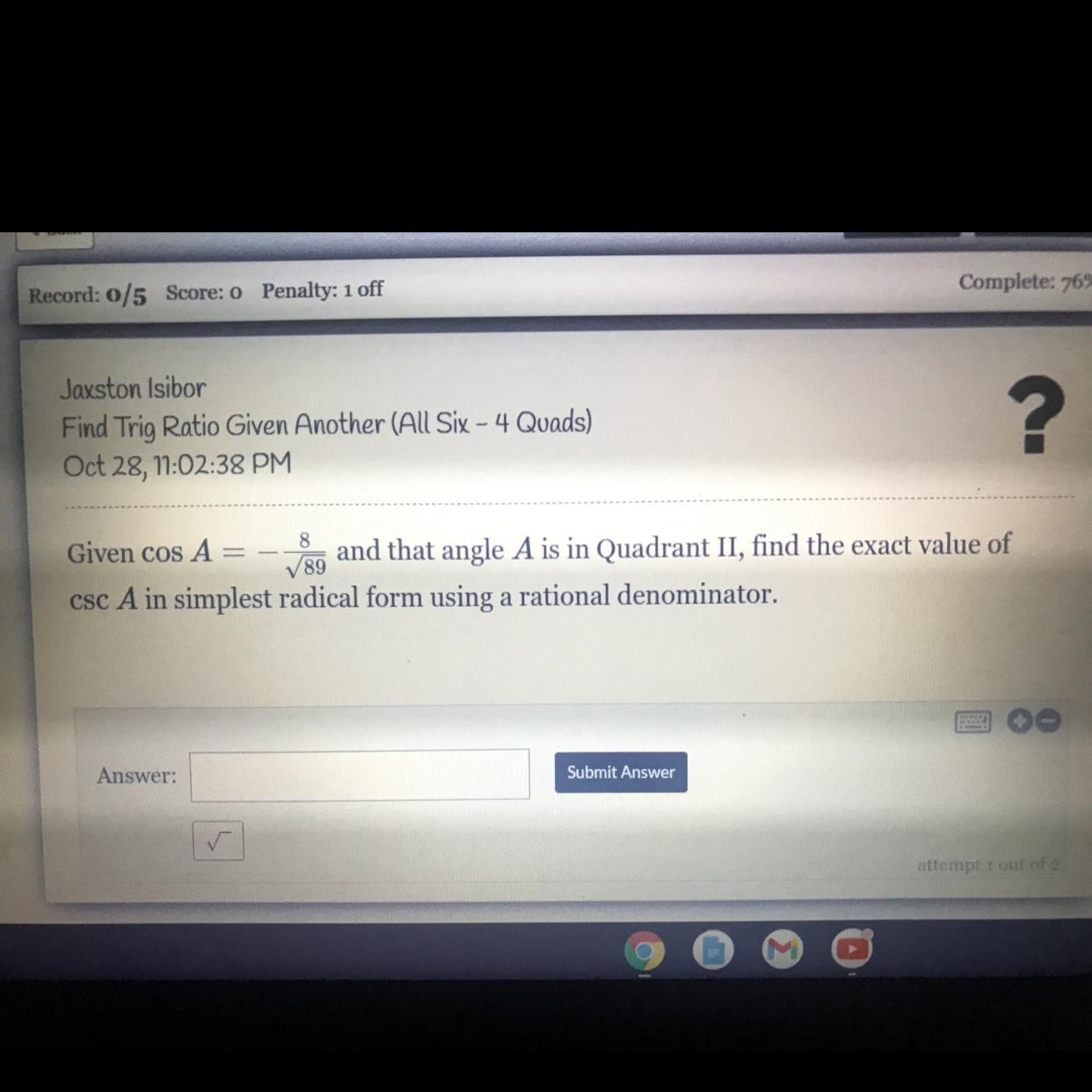
Given cos A = and that angle A is in Quadrant II, find the exact value ofAcsc A in simplest radical form using a rational denominator.89
Answers
cscA is the inverse of the sine of A.
\(cscA=(\sin A)^{-1}\)Since we know the value for the cosine, using the identity
\(\sin ^2A+\cos ^2A=1\)We can calculate the value for the sine.
\(\begin{gathered} (-\frac{8}{\sqrt[\square]{89}})^2+\sin ^2A=1 \\ \frac{64}{89}+\sin ^2A=1 \\ \sin ^2A=1-\frac{64}{89} \\ \sin A=\pm\sqrt[]{\frac{25}{89}} \\ \sin A=\pm\frac{5}{\sqrt[]{89}} \end{gathered}\)Since we know that the angle A is located at the Quadrant II, we know its sine is positive, then
\(\sin A=\frac{5}{\sqrt[]{89}}\)Now, using our first relation
\(\csc A=(\frac{5}{\sqrt[]{89}})^{-1}=\frac{\sqrt[]{89}}{5}\)And this is our final answer.
Related Questions
Name the coeficient in
the expression below.
-10x + 8
Answers
A boy walks 5km due north and then 4km due east. Find the bearing of his current position from the starting point, how far is the boy now from the starting point
Answers
When you have your final draft, you are ready to_________your essay using the work processor.
A. Peer edit
B. Publish
C. Revise
D. Prewrite
Answers
Answer:
C) Revise
Step-by-step explanation:
A final draft needs to be revised before it can be published
To make marbled paper, Shannon filled a rectangular 279/10cm by 178/10cm dish with water. Then they gently swirled paint on top of the water. let a represent the area of the dish.
Select 1 multiplication and 1 division equation to represent the relationship.
choose 2 answers
A) 178/10 x a = 279/10
B) 178/10 x 279/10 = a
C) 279/10 ÷ 178/10 = a
D) a ÷ 178/10 = 279/10
Answers
The area of the dish, a, can be represented by the product of its length and width. Thus, we can write:
a = (279/10) cm x (178/10) cm
Simplifying this expression, we get:
a = 4953/100 cm^2
So, the correct equations are:
B) 178/10 x 279/10 = a
and
D) a ÷ 178/10 = 279/10
What is an equation of the line that passes through the points (-2, 1) and (4, 7)
Answers
y=x+3
hope this helps!
- 3х +Зу = 12
у=х+ 4
How many solutions are there
Answers
Answer:
Step-by-step explanation:
As given system of linear equations,
- 3х +Зу = 12у=х+ 4Hence taking 1st equation ,
-3x+3y=12
-3(x-y)=12 ( common -3 )
x-y=-4now take 2nd equation ,
y=x+4
y-x=4Now add these two equations, we get
x-y+ y- x=-4+4
0x+0y=0
so it have infinite many solution because for any value L.H.S =R.H.SPLS HELP ME WITH THIS QUESTION
PLS SHOW YOUR WORKING OUT

Answers
The length of DE is approximately 7.71 cm which finds by the use of the law of sines to solve for the length of DE.
What is the law of sines?The law of sines is a theorem in trigonometry that relates the sides and angles of any triangle. Specifically, it states that the ratio of the length of a side of a triangle to the sine of the angle opposite that side is equal for all sides of the triangle. Mathematically, the law of sines can be written as:
a/sin(A) = b/sin(B) = c/sin(C)
Trigonometric functions are mathematical functions that relate angles to the ratios of the sides of a right triangle. The six primary trigonometric functions are sine (sin), cosine (cos), tangent (tan), cosecant (csc), secant (sec), and cotangent (cot). Each function represents a different ratio of two sides of a right triangle and can be used to solve problems in geometry, physics, engineering, and other fields that involve angles and triangles. Trigonometric functions are also used to model periodic phenomena, such as sound waves and electromagnetic radiation. They are a fundamental part of mathematics and have numerous applications in science and technology.
According to the given information
We can use the law of sines to solve for the length of DE. Let's start by finding angle BAC:
angle BAC = 180 - angle ABC - angle ACB = 180 - 64 - 90 = 26 degrees
Now we can use the law of sines:
DE/sin(90) = CD/sin(26)
DE = CD * sin(26)
Substituting in the given values, we have:
DE = 16 * sin(26)
DE ≈ 7.71 cm (rounded to 3 significant figures)
Therefore, the length of DE is approximately 7.71 cm.
To know more about law of sines :
https://brainly.com/question/17289163
#SPJ1
If m2WXY =160º, what are m2WXZ and mZZXY?
Z
(5x+2)
(77-4)
w

Answers
Answer:
87, 73 (solution A)
Step-by-step explanation:
We know that angle WXY is 160 degrees. Therefore, (5x+8)+(7x-4)=160.
(5x+8)+(7x-4)=160
5x+8+7x-4=160
12x=156
x=13
Now that we have x, we can plug them in to the expressions to find the measures of the given angles.
7(13)-4=87 degrees (angle WXZ)
5(13)+8=73 degrees (angle YXZ)
Pie chart values
20%. Rice
15%. Others
Pulses. 30%
maize 20%
wheat 15%
Percentage distribution of products in exports of the
given countries.
(a) What is the value (in $ billion) of pulses export
by US? on a billion
(6)
What is the ratio of wheat export of UK to
maize export of IND? 4:10
(e) By what percentage is the maize export of
JAP more than the rice export of AUS?
(d) If the export of AUS is doubled and that of US is
halved but percentage distribution of products of
export remains the same, then find the value of
Export of Rice by US
Export of Pulses by AUS
In USSR, find the ratio of maize export to the
rice export.

Answers
a.) The value of pulses exported by US in billion would be=30 billion.
b.) The ratio of wheat export of UK to maize export of IND would be= 6:5
How to calculate the value of pulses exported?For question a.)
To calculate the pulses, the following steps should be taken as follows:
From the bar chart, the value of pulses in billions = 30 billions.
For question b.)
The ratio of wheat export at UK and maize export at IND would be calculated as follows:
The quantity of wheat export at UK = 24
The quantity of maize export at IND = 20
Therefore, the ratio of wheat to maize = 24:20= 6:5
Learn more about ratio here:
https://brainly.com/question/2328454
#SPJ1
Help please!! The maximum value of total revenue correspond to a price of

Answers
9514 1404 393
Answer:
d. $30
Step-by-step explanation:
When price and demand are linearly related like this, revenue is a quadratic function. Its maximum will be halfway between the prices that give a revenue of 0. Those prices are $60 (where demand is 0) and $0 (where demand is irrelevant). The halfway point is ($60 +0)/2 = $30.
As a check, you can figure revenue for some nearby points.
at $30, revenue is ($30)(15) = $450
at $24, revenue is ($24)(18) = $432
at $36, revenue is ($36)(12) = $432
This confirms revenue is maximized at a price of $30.

Point of intersections=

Answers
answer is attached too

what's the inverse of f(x)=(x+3)^5
Answers
Answer:
The inverse is,
\(f^{-1}(x) = \sqrt[5]{x} - 3\)
Step-by-step explanation:
f(x) = (x+3)^5
Finding the inverse,
\(f(x) = (x+3)^5\\or,\\y = (x+3)^5\)
We replace x with y and vice versa
so,
\(x = (y+3)^5\)
Solving for y,
the the 5th root,
\(\sqrt[5]{x} = y + 3\\y = \sqrt[5]{x} - 3\)
hence the inverse function is,
\(f^{-1}(x) = \sqrt[5]{x} - 3\)
Step-by-step explanation:
f(x)=(x+3)×5
Y=5X+15
now
interxchanging x and y we get,
x=5y+15
5y=x-15
y=x-15/5
therefor f~1(x)=x-15/5
Five friends go to the movies. They each purchase a ticket for t dollars, a popcorn for p
dollars and a soda for s dollars. Which expression represents how much the five friends spent
at the movies altogether? *
O A 5tps
B 5(t + p + s)
O C 5t+p+s
O D5+t+p+s
Answers
Answer:
B 5 (t + p + s)
Step-by-step explanation:
When you add all the things purchased, you just need to multiply by 5 so you get the total!
Answer:
The correct answer would be B
Step-by-step explanation:
What is the volume of the pyramid? Show all work.
6 m
8 m
4 m
Answers
192/3 = 64
Volume = 64m^3
Find the surface area of a square pyramid with side length 2 yd and slant height 2 yd.
Answers
The surface area of the square Pyramid with a side length of 2 yards and a slant height of 2 yards is 12 square yards.
The surface area of a square pyramid, we need to calculate the area of each face and then sum them up.
A square pyramid has four triangular faces and one square base. The area of the base is equal to the side length squared, while the area of each triangular face can be found using the formula: (1/2) * base * height.
Given that the side length of the square pyramid is 2 yards and the slant height is also 2 yards, we can calculate the surface area as follows:
Area of the base = (side length)^2 = 2^2 = 4 square yards
Area of each triangular face = (1/2) * base * height = (1/2) * 2 * 2 = 2 square yards
Now, let's calculate the total surface area of the square pyramid:
Total surface area = Area of the base + 4 * Area of each triangular face
Total surface area = 4 + 4 * 2 = 4 + 8 = 12 square yards
Therefore, the surface area of the square pyramid with a side length of 2 yards and a slant height of 2 yards is 12 square yards.
For more questions on Pyramid .
https://brainly.com/question/30615121
#SPJ8
Jesse and Amir were assigned the same book to read. Jesse started reading on Saturday, and he is reading 30 pages a day. Amir didn't start until Sunday, but he is reading 35 pages a day.
How many days will it take Amir to catch up to Jesse, and how many pages will they each have read?
Answer the questions to solve this problem using a system of equations.
1. Write an equation to represent the number of pages Amir has read. Use x to represent the number of days Amir has been reading and y to represent the number of pages he has read. (1 point)
2. Write an equation to represent the number of pages Jesse has read.
Using x, the number of days Amir has been reading, write an expression to represent the number of days Jesse has been reading. Remember that Jesse started reading one day before Amir. Use this expression to write an equation for the number of pages Jesse has read. Let y represent the number of pages read. (1 point)
3. Write the system of equations using your answers from questions 1 and 2.
(2 points)
5. Solve the system of equations. Show your work. (2 points)
6. Interpret your solution. How many days does it take Amir to catch Jesse? At that time, how many pages have they read? (2 points)
Answers
1. An equation representing the number of days Amir has been reading and the number of pages he has read is y = 35x.
2. An equation representing the number of days Jesse has been reading and the number of pages she has read is y = 30 + 30x.
3. The system of equations from 1 and 2 is y = 35x and y = 30 + 30x.
4. At the end of Friday, after solving the equations, both Jesse and Amir read 210 pages each, with Jesse spending 7 days and Amir 6 days.
5. For Jesse and Amir, the equation solutions are y is 210 pages and x is 6 days.
6. After solving the equations, it will take Amir 6 days to catch up with Jesse and each person must have read 210 pages or a total of 420 pages.
What is a system of equations?A system of equations involves using more than one equation solved simultaneously.
Jesse's reading rate per day = 30 pages
Amir's reading rate per day = 35 pages
The number of pages read by Jesse, y = 30 + 30x
The number of pages read by Amir, y = 35x
Where x = the number of days they have been reading
Solving the equations:y = 30 + 30x and y = 35x
35x = 30 + 30x
35x - 30x = 30
5x = 30
x = 6 (30/5)
Jesse:y = 30 + 30x
y = 30 + 30(6)
y = 210
Amir:y = 35x
y = 35(6)
y = 210
Learn more about simultaneous equations at https://brainly.com/question/16763389
#SPJ1
Work out the surface area of this cylinder.
12 cm
25 cm

Answers
How much will it cost to print a circular sign with a radius of 1.5 feet if the printing company charges $29 per square foot? Use A = πr2, where π is approximately 3.14. (Round your answer to the nearest cent.)
Answers
Answer:
$204.89
Step-by-step explanation:
Step 1
We have to first find the area of the circular sign.
Since the sign is circular in shape, we use the Area of Circle.
Area of a Circle = πr²
r = 1.5 feet
π = 3.14
Area of a Circle = 3.14 × 1.5²
= 7.065ft² or 7.065 square feet.
Step 2
We find out how much it cost to print the circular sign.
We are told in the question that
The printing company charges $29 per square foot
Hence,
1 square foot = $29
7.065 square feet =
Cross multiply
= 7.065 × $29
=$ 204.885
Approximately to the nearest cent, $204.89
Therefore, it will cost $204.89 to print the circular sign
What two numbers multiply to -35 and add to get -18
Answers
he two numbers that multiply to -35 and add to get -18 are -5 and 3.
To see why, you can use the factoring method. First, find two numbers that multiply to give you -35. The factors of -35 are -1, 1, -5, and 5. So, the two numbers that multiply to -35 are either -5 and 7 or 5 and -7.
Next, find which pair of numbers adds up to -18. It's clear that 5 and -7 add up to -2, so they don't work. However, if we choose -5 and 3, we get:
-5 + 3 = -2
So, -5 and 3 are the two numbers that multiply to -35 and add to -18.
Complete this sequence of numbers such that the difference between any two adjacent numbers is the same : 3/k, _, _, 9/2k.
Answers
The completed sequence is: 3/k, 3/k, 3/k, 9/2k.To complete the sequence of numbers with a constant difference between adjacent numbers, we can calculate the common difference by subtracting the first term from the second term.
Let's denote the missing terms as A and B.
The given sequence is: 3/k, A, B, 9/2k.
The common difference can be found by subtracting 3/k from A or B. Therefore:
A - 3/k = B - A = 9/2k - B.
To simplify, we can equate the two expressions for the common difference:
A - 3/k = 9/2k - B.
Next, we can solve for A and B using this equation.
Adding 3/k to both sides gives:
A = 3/k + 9/2k - B.
Now, we can substitute the value of A into the equation:
3/k + 9/2k - B - 3/k = 9/2k - B.
Simplifying further, we have:
9/2k - 3/k = 9/2k - B.
Cancelling out the common terms, we find:
-3/k = -B.
Multiplying both sides by -1, we get:
3/k = B.
For more such questions on Adjacent numbers:
https://brainly.com/question/28207765
#SPJ8
Priya drew a circle whose circumference is 25 cm. Clare drew a circle whose diameter is 3 times the diameter of Priya’s circle. What is the circumference of Clare’s circle?
Answers
Answer:
About 75 (75.0002)
Step-by-step explanation:
25÷3.14=7.9618
7.9618×3=23.8854
23.8854×3.14=74.0002
Hope this helps:)
Please answer 8th grade math

Answers
Answer:
y = -2/3 x + 5
PLEASE HELP!!
What is the volume of A?
What is the height of B?
What is the volume of B?
What is the total volume?

Answers
The height of B is 2
The volume of B is 40
The total volume is 472
I think that’s right, I’m truly sorry if it isn’t.
To find volume you multiple length • width • height
The height of A is 9 and the total height of both figures is 11
So 11-9 leave us with 2 high would be the height of figure B
The total volumes is what is assume are both figures’ volume combined
So 432+40= 472
Is this one correct? Let me know please
Answers
Answer:
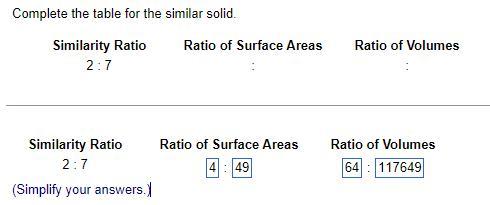
linear dimensions: 2 : 7areas: 4 : 49volumes: 8 : 343Step-by-step explanation:
You want the area and volume ratios when two figures have a similarity ratio of 2 : 7.
AreaThe ratio of areas is the square of the similarity ratio:
2² : 7² = 4 : 49
VolumeThe ratio of volumes is the cube of the similarity ratio:
2³ : 7³ = 8 : 343
__
Additional comment
It can help to think about the units of area and volume. For linear dimensions in inches, area dimensions are in square inches, and volume dimensions are cubic inches. Any ratio of inches will be squared when those inch dimensions are used for area, and will be cubed when volume is computed.
side length of a square or cube: smaller: 2", larger: 7"
area of the square: smaller: 2² in², larger: 7² in² or 4 in² and 49 in²
volume of the cube: smaller: 2³ in³, larger: 7³ in³ or 8 in³ and 343 in³
<95141404393>
How many 4-digit numbers can you write if you can use only digits 0, 1 and 2?
Answers
Answer:
There would 10,000 possible combination with the numbers 0, 1 and 2
Which angles below are equal to ∠CDB?

Answers
Answer:
(x) ∠CAB
Step-by-step explanation:
In ΔCOD and ΔBOA
\(\frac{OA}{OB} = \frac{OD}{OC} \\\\\implies \frac{OC}{OB} = \frac{OD}{OA}\)
Also,
∠COD = ∠BOA (vertically opposite angles)
⇒ ΔCOD and ΔBOA are similar
⇒ ∠CDO = ∠BAO
⇒ ∠CDB = ∠BAC
⇒ ∠CDB = ∠CAB
brainliest to correct answer

Answers
Answer:
3 15/25
3 3/10
-3
Step-by-step explanation:
What is the exact definition of the Pythagorean Theorem and who invented it.
Answers
Answer:
Pythagoras invented it
Step-by-step explanation:
a theorem attributed to Pythagoras that the square of the hypotenuse of a right triangle is equal to the sum of the squares of the other two sides.
Pythagoras was introduced to mathematics by Tales of Miletus and his pupil Anaximander
Trapezoid ABCD is similar to trapezoid EFGH which OF THE FOLLOWING PROPORTIONS MUST BE TRUE ?

Answers
A large rectangle is made by joining three identical small rectangles as shown.
The perimeter of one small rectangle is 21cm. The width of one small rectangle is x cm.
Work out the perimeter of the large rectangle. The final line of your answer should be the form, perimeter of large rectangle is ...cm

Answers
Answer: 35 cm
Step-by-step explanation:
As shown in the image attached, the A large rectangle is made by joining three identical small rectangles,
The width of one small rectangle is x cm and the length of one small rectangle is 2x cm. Therefore the perimeter of the small rectangle is given as:
2(length + width) = Perimeter
2(2x + x) = 21
2(3x) = 21
6x = 21
x = 21/6 = 3.5 cm
x = 3.5 cm
From the image attached, the width of the large rectangle is 2x (x + x) and the length is 3x (2x + x). Therefore, the perimeter of the large rectangle is:
2(length + width) = Perimeter
2(3x + 2x) = Perimeter
Perimeter = 2(5x)
Perimeter = 10x
Perimeter = 10(3.5)
Perimeter = 35 cm
Step-by-step explanation: