g An inspector inspects large truckloads of potatoes to determine Suppose that 12 of the potatoes sampled are found to have major defects. The P-value of this test is: Group of answer choices
Answers
Complete Question
An inspector inspects large truckloads of potatoes to determine the proportion p in the shipment with major defects prior to using the potatoes to make potato chips. Unless there is clear evidence that this proportion, p, is less than 0.10, he will reject the shipment. He will test the hypotheses
H0: p = 0.10, Ha: p < 0.10.
He selects an SRS of 100 potatoes from the over 2000 potatoes on the truck. Suppose that 6 of the potatoes sampled are found to have major defects. The P-value of this test is.......
Group of answer choices
A 0.4082
B 0.0912
C less than 0.002
D 0.0400
Answer:
Correct option is B
Step-by-step explanation:
From the question we are told that
The null hypothesis is
\(H_o: p = 0.10\)
The alternative hypothesis is
\(Ha: p < 0.10.\)
The sample size is n = 100
The probability of getting a potatoes that is not defected is \(p=0.10\)
The probability of getting a defected potatoes is q = 1-p
The proportion of defected potatoes is mathematically evaluated as
\(\r p = \frac{6}{100} = 0.06\)
The test statistics is evaluated as
\(t = \frac{\r p - p}{ \sqrt{ \frac{pq}{n} } }\)
substituting values
\(t = \frac{0.06 - 0.10}{ \sqrt{ \frac{0.10(1-0.10)}{100} } }\)
\(t = -1.333\)
The p-value is 0.0912 from the z-table (you can also use excel formula )
Related Questions
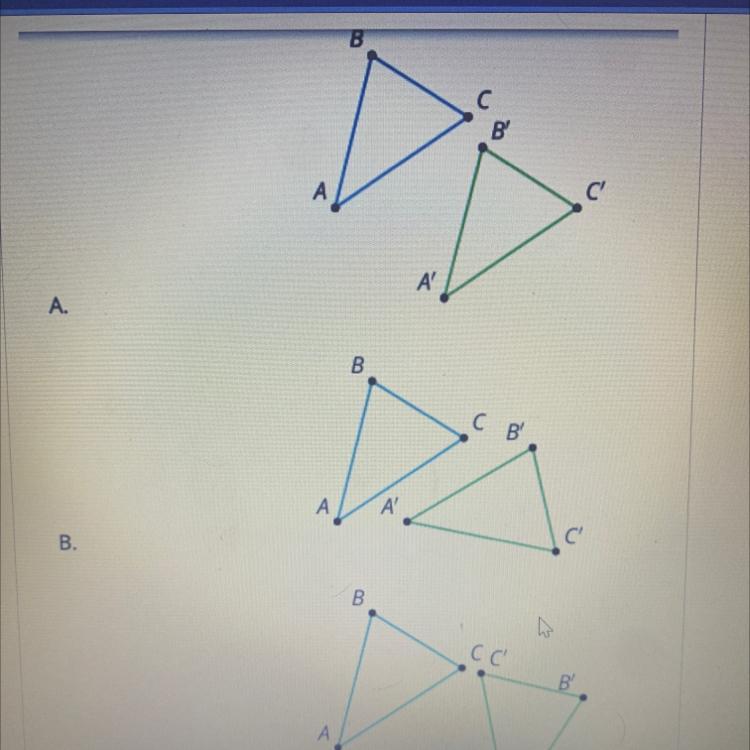
Here are 4 triangles that have each been transformed by adifferent transformation. Which transformation is not a rigidtransformation?
Answers
Rigid transformation is a geometric transformation of a Euclidean space that preserves the Euclidean distance between every pair of points. The rigid transformations include rotations, translations and reflections
Option A is a translation then is rigid
Option B is a rotation then is rigid
Option C is a reflection then is rigid
Option D is a dilation and translation then is not rigid because the dilation is not a rigid transformation because the size of the objects is different
then right o
Mark and robyn used base-ten blocks to show that 200 is 100 times as much as 2. Whose model makes sense whose model is nonsense? Example your reasoning
Answers
Answer:
Robyn model makes more sense and Mark's is nonsense
Step-by-step explanation:
In this question ,calculations not required .All we have to do is consider each model logically .
Marks
Marks model shows 20 rather than 2 which means 200 is 10 times as much as 20. It does not make any sense.
Robyn
Robyn model shows 2 which means 200 is 100 times as much as 2 and this is not only correct but also makes sense because 100 *2=200
Algebraic expression is what I NEED Your summer job pays $8.25 per hour and you must pay for a company shirt that costs $15. If your work x hours per week, how much will you make during the first week? NEEDED NOW!!!
Answers
Answer:
y=8.25x-15
Step-by-step explanation:
From the information provided, the algebraic expression will need to indicate that your earnings during the first week, y, would be equal to multiplying $8.25 for the number of hours, x, minus $15. According to that, the algebraic expression is:
y=8.25x-15
(2) Solve the system of linear equations by elimination. CH
8x - 5y = 11
4x
3y = 5
Answers
By solving the system of linear equations by elimination we get the value of x= 2 and y = 1.
What is the system of linear equations?
A grouping of one or more linear equation containing the same variables is known as a system of linear equations.
Here, we have
Given: 8x - 5y = 11....(1), 4x - 3y = 5...(2)
We solve equation(2) and find the value of x
4x = 5+ 3y
x = 5/4 + 3y/4
Now, we put the value of x in equation (1) and we get
8(5/4 + 3y/4) - 5y = 11
5×2 + 2×3y - 5y = 11
10 + y = 11
y = 1
Now, we put the value of y in equation(2) and we get
4x = 5+ 3(1)
4x = 8
x = 2
Hence, by solving the system of linear equations by elimination we get the value of x= 2 and y = 1.
To learn more about the system of linear equations from the given link
https://brainly.com/question/25976025
#SPJ1
Find the missing side lengths, put answer as radical in simplest form
Look at picture for reference

Answers
The value of the missing side lengths x and y are 5√2 and 5 respectively.
What is the value of side length x and y?The figure in the image is a right triangle.
Angle θ = 45 degree
Hypotenuse = x
Opposite to angle θ = y
Adjacent to angle θ = 5
To solve for side x and side y, we use the trigonometric ratio.
Note that:
Cosine = adjacent / hypotenuse
tangent = opposite / adjacent
Solving for x:
Cosine = adjacent / hypotenuse
Plug in the values
cos( 45 ) = 5/x
x = 5 / cos( 45 )
x = 5√2
Solving for side y:
tangent = opposite / adjacent
Plug in the values
tan( 45 ) = y/5
y = tan( 45 ) × 5
y = 5
Therefore, the value of side length x is 5 units.
Learn more about trigonometric ratio here: brainly.com/question/28016662
#SPJ1
The box and whisker plot shows the recent test scores from WYVA Summit Math 6 class.
A. What is the interquartile range in a box-and-whisker plot?
B. What percent of the students got 80% or higher, which would be a B?
C. Write about Math: Using the interquartile range, explain how well the math class did on this test.

Answers
a. It represents the spread of the middle 50% of the data.
b. At least 50% of the students scored between 80 and 86.
c. Overall, we can say that the Math 6 class had a range of test scores, with some students performing very well and others performing less well.
What is interquartile range?How evenly distributed the middle 50% of the data is is determined by the interquartile range. In order to calculate it, the first quartile is subtracted from the third quartile.
A. The interquartile range (IQR) in a box-and-whisker plot is the distance between the first quartile (Q1) and the third quartile (Q3) of the data. It represents the spread of the middle 50% of the data.
B. To determine what percent of the students got 80% or higher, we need to find the upper fence, which is defined as 1.5 times the IQR above Q3. From the box-and-whisker plot, we can see that Q3 is approximately 86 and Q1 is approximately 71. Therefore, the IQR is 86 - 71 = 15. The upper fence is 1.5 * 15 + 86 = 108.5.
Looking at the plot, we can see that there are no data points above 100, so we can safely assume that no students scored above 100%. The highest score is 94, which is within the whiskers of the box-and-whisker plot. Therefore, we know that the percent of students who scored 80% or higher is between the percent of students who scored 80% or higher and the percent of students who scored 94% or higher.
From the plot, we can see that the median is approximately 80 and the third quartile (Q3) is approximately 86. This means that at least 50% of the students scored between 80 and 86. Additionally, we know that the maximum score is 94, so we can say that at least some students scored higher than 86. However, we don't know how many students scored between 86 and 94.
C. Based on the interquartile range, we can say that the middle 50% of the students scored between approximately 71 and 86. This suggests that there is a significant amount of variability in the test scores, as the range is quite wide. Additionally, we know that at least some students scored above 86, but we don't have enough information to determine how many or how high their scores were. Overall, we can say that the Math 6 class had a range of test scores, with some students performing very well and others performing less well.
To know more about interquartile range visit :-
https://brainly.com/question/29165499
#SPJ1
Evaluate the function over the domain (-2, 0, 2). As the values of the domain increase, do the values of the range increase or decrease?
y=2.7x
When x = -2, y = 0
(Type an integer or decimal rounded to the nearest hundredth as needed.)
When x = 0, y =
(Type an integer or decimal rounded to the nearest hundredth as needed.)
When x=2, y =
(Type an integer or decimal rounded to the nearest hundredth as needed.)
As the values of the domain increase, the values of the range increase
Answers
Answer:
Step-by-step explanation:
each function over the domain (-2,-1,0,1,2,3). As the values of the domain increase, do the values of the range increase or decrease? y=50*0.1^ (x)
Unit 4 Lesson 13 exit ticket (please help me im getting stressed with this)

Answers
Answer:
No solutions.
Step-by-step explanation:
Steps:
I will solve your system by substitution.
y=1/4x−10;y=1/4x+1
Step: Solve y=1/4x−10 for y:
Step: Substitute 1/4x−10 for y in y=1/4x+1:
y=1/4x+1
1/4x−10=1/4x+1
1/4x−10+−1/4x=1/4x+1+−1/4x(Add (-1)/4x to both sides)
−10=1
−10+10=1+10(Add 10 to both sides)
0=11
The given system of equation of No solution.
What is Equation?Equations are mathematical statements with two algebraic expressions flanking the equals (=) sign on either side.
It demonstrates the equality of the relationship between the expressions printed on the left and right sides. LHS = RHS is a common mathematical formula.
Coefficients, variables, operators, constants, terms, expressions, and the equal to sign are some of the components of an equation. The "=" sign and terms on both sides must always be present when writing an equation.
We have the equations:
y= 1/4 x - 10
y = 1/4x + 1
Now, Solve y=1/4x−10 for y by Substituting 1/4x−10 for y in y=1/4x+1 we get
y=1/4x+1
1/4x−10=1/4x+1
1/4x−10+−1/4x=1/4x+1+−1/4x
−10=1
0=11
thus, the equation have No solution.
Learn more about Equation here:
https://brainly.com/question/29657988
#SPJ2
. Suppose a government agency has a monopoly in the provision of internet connections.
The marginal cost of providing internet connections is 1
2
, whereas the inverse demand
function is given by: p = 1
Answers
The government agency as a monopolist will produce and sell internet connections up to the point where the marginal cost is 1/2. The price will be set at 1, given the perfectly elastic demand function.
In the scenario where a government agency has a monopoly in the provision of internet connections and the inverse demand function is given by p = 1, we can analyze the market equilibrium and the implications for pricing and quantity.
The inverse demand function, p = 1, implies that the market demand for internet connections is perfectly elastic, meaning consumers are willing to purchase any quantity of internet connections at a price of 1. As a monopolist, the government agency has control over the supply of internet connections and can set the price to maximize its profits.
To determine the optimal pricing and quantity, the monopolist needs to consider the marginal cost of providing internet connections. In this case, the marginal cost is given as 1/2. The monopolist will aim to maximize its profits by equating marginal cost with marginal revenue.
Since the inverse demand function is p = 1, the revenue received by the monopolist for each unit sold is also 1. Therefore, the marginal revenue is also 1. The monopolist will produce up to the point where marginal cost equals marginal revenue, which in this case is 1/2.
As a result, the monopolist will produce and sell internet connections up to the quantity where the marginal cost is 1/2. The monopolist will set the price at 1 since consumers are willing to pay that price.
For more such question on monopolist. visit :
https://brainly.com/question/28336090
#SPJ8
A thermometer shows a temperature of Negative 20 and three-fourths degrees. A chemist recorded this temperature in her notebook using a decimal. Which number did the chemist write in the notebook?
Negative 21.ModifyingAbove 4 with bar
Negative 21.ModifyingAbove 3 with bar
Negative 20.75
Negative 20.34
Answers
Answer:
The answer is C.
Step-by-step explanation:
3/4 is equal to 0.75. If you combine 0.75 with -20, then it is 20.75.
Answer:
C
Step-by-step explanation:
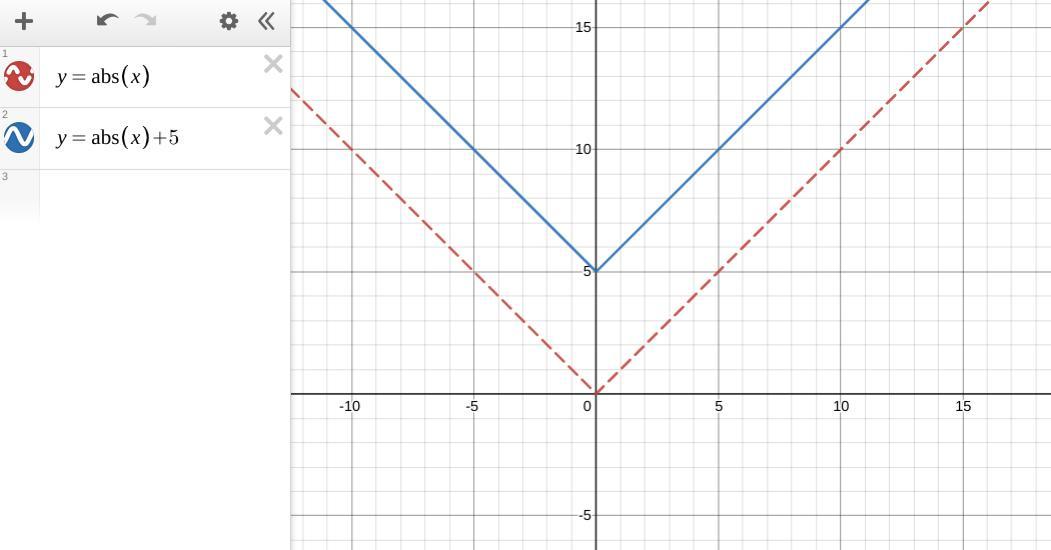
Graph y=|x|+5, how does it compare to parent graph y=|x|
Answers
9514 1404 393
Answer:
it is shifted 5 units upward
Step-by-step explanation:
The y-coordinate is a measure of the distance above the x-axis. When 5 is added to a y-coordinate, the point is shifted 5 units upward.
The function y = |x| +5 adds 5 units to the y-value of every point of the graph of y = |x|. The graph of y=|x|+5 is shifted 5 units upward from the parent graph.
Please help!
What the values of the expression?
A. 3
B. 12
C. 27
D.81

Answers
Answer:
D. 81
Step-by-step explanation:
I am in the same class as you, I took the quiz and the answer was 81
how do you find answer to 9/35 - 1/5?
Answers
Answer:
2/35
Step-by-step explanation:
\(\frac{9}{35}-\frac{1}{5}=\frac{9}{35}-\frac{7}{35}=\frac{2}{35}\)
What is the mode of this set of data?

Answers
Answer:
The mode is 15
Step-by-step explanation:
The mode is the number which appears most often in a set of numbers. Example: in {6, 3, 9, 6, 6, 5, 9, 3} the Mode is 6 (it occurs most often).
Answer:
The mode of this set is 15.
Step-by-step explanation:
the mode is 15 bcoz 15 is repeated two times where as other numbers aren't repeated..
Which steps are needed to solve this equation? . b + 6 = 21 Subtract 6 from both sides of the equation. The answer is b = 15. Check the solution by substituting 15 for b. Subtract 6 from the left side and add 6 to the right side of the equation. The answer is b = 27. Check the solution by substituting 27 for b. Add 6 to both sides of the equation. The answer is b = 27. Check the solution by substituting 27 for b. Add 6 to the left side and subtract 6 from the right side of the equation. The answer is b = 15. Check the solution by substituting 15 for b. edge
Answers
The solution by substituting 15 for b in the Original equation. The answer is true.
The steps needed to solve the equation b + 6 = 21 are:
Subtract 6 from both sides of the equation: b + 6 - 6 = 21 - 6, which simplifies to b = 15.
Check the solution by substituting 15 for b in the original equation: 15 + 6 = 21, which is true.
Therefore, the correct steps to solve the equation are:
Subtract 6 from both sides of the equation. The answer is b = 15
the solution by substituting 15 for b in the original equation. The answer is true.
To know more about Original .
https://brainly.com/question/27960093
#SPJ11
Two slices of Horace's Pizza have 240 Calories in total. How many Calories would you expect to be in 5 slices of the same pizza?
Answers
Create your OWN 2 word problems involving DIRECT PROPORTION
Answers
Problem: The price of 5 drinks is $10. Form an equation that relates the cost (y) with the number of drinks (x).
Answer: y = 2x
Reason: The unit price is k = y/x = 10/5 = 2 dollars per drink. So y = kx becomes y = 2x. Note that plugging in x = 5 leads to y = 10.
---------------------------------
Problem: A car can travel 200 miles on 8 gallons of gas. How far can it travel using five gallons?
Answer: 125 miles
Reason: We have y = 200 and x = 8 lead to the constant of proportionality of k = y/x = 200/8 = 25. The direct proportion equation y = kx becomes y = 25x. Then we plug in x = 5 to lead to y = 125.
[(4 × 2) ÷ ( 4÷ 2 )] × 3
how did u solve it and answer
Answers
[(4 × 2) ÷ ( 4÷ 2 )] × 3
= (8 ÷ 2) × 3
= 4 × 3
= 12
P: Parentheses
E: Exponent
D: Division
M: Multiplication
A: Addition
S: Subtraction
Answer:
12
Step-by-step explanation:
4×2=8
4÷2=2
8÷2=4
4×3=12
please mark brainlist
and have a nice day
If y equals three what is the value of 5Y + 6
Answers
Answer:
21
Step-by-step explanation:
If y = 3 then multiply 5 x 3=15. Add 6 and you get 21. 21 is the correct answer.
2 log5 x=log5 4+log5 9
Answers
The equation 2 log₅ x = log₅ 4 + log₅ 9 has two solutions: x = 6.
To solve the equation 2 log₅ x = log₅ 4 + log₅ 9, we can use logarithmic properties to simplify and find the value of x.
Using the properties of logarithms, we can rewrite the equation as follows:
2 log₅ x = log₅ (4 * 9)
Next, we simplify the right side:
2 log₅ x = log₅ (36)
Now, we can use the property of logarithms that states logₐ b = c is equivalent to aᶜ = b. Applying this property, we have:
x² = 36
Taking the square root of both sides, we get:
x = √36
Since the square root of 36 can be either positive or negative, we have two possible solutions:
x = 6
It's important to note that when working with logarithmic equations, we must always check if the obtained solutions satisfy the domain restrictions of the original equation. In this case, since the logarithm has a base of 5, the solution x = 6.
for more such questions on logarithmic properties
https://brainly.com/question/30226560
#SPJ8
Which expression is equivalent to StartRoot 8 x Superscript 7 Baseline y Superscript 8 Baseline EndRoot? Assume x greater-than-or-equal-to 0.
x y squared StartRoot 8 x cubed EndRoot
2 x cubed y cubed StartRoot x y squared EndRoot
2 x cubed y Superscript 4 Baseline StartRoot 2 x EndRoot
4 x cubed y Superscript 4 Baseline StartRoot x EndRoot
Answers
The expression that is equivalent to StartRoot \(8 x^7 y^8\) EndRoot is (\(2 x^3 y^4\) StartRoot 2 x EndRoot)^2.
To understand why this is the case, let's break down each expression and simplify them step by step:
StartRoot \(8 x^7 y^8\) EndRoot:
We can rewrite 8 as \(2^3\), and since the square root can be split over multiplication, we have StartRoot \((2^3) x^7 y^8\) EndRoot. Applying the exponent rule for square roots, we get StartRoot \(2^3\) EndRoot StartRoot \(x^7\) EndRoot StartRoot \(y^8\) EndRoot.
Simplifying further, we have 2 StartRoot \(2 x^3 y^4\) EndRoot StartRoot \(2^2\) EndRoot StartRoot \(x^2\) EndRoot StartRoot \(y^4\) EndRoot. Finally, we obtain 2 \(x^3 y^4\) StartRoot 2 x EndRoot, which is the expression in question.
(\(2 x y^2\) StartRoot 8 x^3 EndRoot)^2:
Expanding the expression inside the parentheses, we have \(2 x y^2\)StartRoot \((2^3) x^3\) EndRoot. Applying the exponent rule for square roots, we get \(2 x y^2\) StartRoot \(2^3\) EndRoot StartRoot \(x^3\) EndRoot.
Simplifying further, we have \(2 x y^2\) StartRoot 2 x EndRoot. Squaring the entire expression, we obtain (\(2 x y^2\) StartRoot 2 x EndRoot)^2.
Therefore, the expression (\(2 x^3 y^4\) StartRoot 2 x EndRoot)^2 is equivalent to StartRoot \(8 x^7 y^8\) EndRoot.
For more such questions on expression
https://brainly.com/question/1859113
#SPJ8
An entrepreneur invests in a new play. The cost includes an overhead of $33,750 plus production costs of $1700 per performance. A sold-out performance brings in $2325 . Assume every performance is sold out, and let x represent the number of sold-out performances.
Answers
The entrepreneur's revenue is $2325x, entrepreneur's cost is $33,750 + $1700x and entrepreneur's profit from x sold-out performances is $625x - $33,750
The entrepreneur's revenue from x sold-out performances is given by the formula:
Revenue = (Price per Performance) x (Number of Performances)
Revenue = $2325 x x
Revenue = $2325x
The entrepreneur's cost from x sold-out performances is given by the formula:
Cost = Overhead + (Production Cost per Performance) x (Number of Performances)
Cost = $33,750 + $1700x
The entrepreneur's profit from x sold-out performances is the revenue minus the cost:
Profit = Revenue - Cost
Profit = $2325x - ($33,750 + $1700x)
Profit = $625x - $33,750
To learn more on Equation:
https://brainly.com/question/10413253
#SPJ1
Select each transformation that carries a square onto itself.

Answers
Answer:
b,c,d
Step-by-step explanation:
cus I said so and it's right
A farmer has 1,275 seeds. He plants them all in 15 equal rows. A crow comes and eats 5 seeds from each now. How many seeds are left in each row?
Answers
Answer:
17 seeds remain
The equation: \(\frac{1275}{15} / 5\)
\(\frac{1275}{15} = 85\)
\(85 / 5 = 17\)
Simplify 3\(\sqrt\)2-√2
Answers
Answer: (√2)(2) = 2√2
Step-by-step explanation:
To simplify the expression 3√2 - √2, you can factor out the common term √2:
3√2 - √2 = (√2)(3 - 1)
Now, subtract the numbers in parentheses:
(3 - 1) = 2
(√2)(2) = 2√2
Which division problem is represented with this model?
Responses
15÷2
1 fifth divided by 2
15÷6
1 fifth divided by 6
16÷2
1 over 6 end fraction divided by 2
12÷5
1 half divided by 5

Answers
Answer:
C.
Step-by-step explanation:
We have five unshaded, 1 half of unshaded, and 1 shaded, Thus, It will be showed as \(\frac{1}{6}\) ➗ \(2\)
b. Find the value of x below:

Answers
Answer: 5
Step-by-step explanation: it is a supplementary angle so it has to add up to 80
Answer:
5
Step-by-step explanation:
line = 180
therefore 15x + 5 + 100= 180
15x + 105 = 180
15x = 180 - 105
15x = 75
x = 75/15
x = 5
HOPE THIS WILL HELP!
For each equation, determine whether it represents a direct variation, an inverse variation, or neither.
Find the constant of variation when one exists and write it in simplest form.

Answers
The types of variation and their constants are;
1) Direct variation with constant of variation as -1/4
2) Direct variation with constant of variation as ³/₂
How to Interpret Mathematical Variations?A variation is defined as a relation that exists between a set of values of one variable and then a set of values of other variables.
In variation, if the variables change proportionately that is they either increase together or decrease together, then they are said to vary directly.
1) We are given the equation;
4y = -x
Now, y is the output while x is the input and so we make y the subject to get; y = -¹/₄x
Now, writing the relationship between y and x as a variation, we will have; y ∝ x
For this to be equal, there has to be a constant of proportionality which means; y = kx
Comparing with our equation tells us that;
This is a direct variation with constant of variation as -1/4
2) We are given the equation;
3x = 2y - 7
Rearranging gives;
2y = 3x + 7
y = ³/₂x + 7
Now, the greater the value of x, the greater the value of y and as such this is also a direct variation with the constant of variation being 3/2.
Read more about Mathematical Variations at; https://brainly.com/question/6499629
#SPJ1
Which description compares the domains of Function A and Function B correctly?
Function A: f(x)=−3x+2
Function B:
Half of a parabola graphed on a grid in Quadrant One with the x and y axis beginning at negative ten and increasing in increments of two until reaching ten. The parabola, labeled g of x, contains a filled in point at begin ordered pair zero comma zero end ordered pair, passes through begin ordered pair two comma two end ordered pair and begin ordered pair four comma eight end ordered pair, and as a smooth curve while extending to infinity.
The domain of both functions is the set of real numbers greater than or equal to 0.
The domain of both functions is the set of real numbers.
The domain of Function A is the set of real numbers.
The domain of Function B is the set of real numbers greater than 0.
The domain of Function A is the set of real numbers.
The domain of Function B is the set of real numbers greater than or equal to 0.
Answers
The domain of a function is the set of its possible inputs. it means that the set of input values for which the function is defined.
The domain of Function A is the set of real numbers.
The domain of Function B is the set of real numbers greater than or equal to zero.
Here, function A is given that,
Since, above function can take any value as its input.
That is function is defined for every value of x.
Therefore, The domain of Function A is the set of real numbers.
Here, graph of function B is attached.
From graph of function B, it is observed that graph of function is right side of Y - axis and starting from x = 0. It means that function B can take any value greater than equal to zero.
Therefore, The domain of Function B is the set of real numbers greater than or equal to zero.
Learn more about of function here
brainly.com/question/15164206
#SPJ4
The fundamental frequency of a certain 64.5 cm string is 352 Hz. Based on this information, what is the velocity of the wave traveling in this string?
1. 454 m/s
2. 343 m/s
3. 119 m/s
4.
227 m/s
Answers
Answer:
3. 119 m/s
Step-by-step explanation: