FOR 20 POINTS!!!!! Luis has $12 and wants to buy 6.6 pounds of apples. Apples cost $1.80 per pound. Luis rounded each value and estimated that he does not have enough money to cover the cost of the apples before sales tax is applied. Which best explains how his estimate relates to the actual product? Because each value rounds up, his estimate is higher than the actual product. He might have enough money to buy the apples. Because each value rounds up, his estimate is higher than the actual product. He does not have enough money to buy the apples. Because each value rounds up, his estimate is lower than the actual product. He does not have enough money to buy the apples. Because each value rounds up, his estimate is lower than the actual product. He might have enough money to buy the apples.
Answers
Answer: Hope this helps.
Because each value rounds up, his estimate is higher than the actual product. He might have enough money to buy the apples. So A.
Step-by-step explanation:
We don't actually know what it was that Luis was estimating. Assuming he was estimating the cost of the apples he wants to buy, rounding up both the price and quantity will give an estimate of $2/lb × 7 lb = $14, which is more than he has to spend.
Luis could refine his estimate by realizing the actual price is 10% less than the vaue he used, and the actual quantity is not quite 6% less than the value he used. The amount Luis has is about 14% less than the cost he estimated, so considering estimation errors, he probabaly has enough money.
The best choice among the answers is the one shown above.
Related Questions
which of the following should not be used as a guideline for making a purchase
A. you budgeted for it
b. you can afford it
c. you need it
d. you want it
Answers
Answer: d.) You want it
Step-by-step explanation:
People want a lot of things that they don't really need, can't afford, and haven't budgeted for.
That how they build debt that may take years to pay off!
Answer:
Which of the following should not be used as a guideline for making a purchase?
a. ) You budgeted for it.
b. ) You can afford it.
c.) You need it.
d. ) You want it. <<<---CorrectStep-by-step explanation:
Edge 2021
given that the triangles are similar solve for a

Answers
Answer:
a = 24
Step-by-step explanation:
Since the two triangles are similar the ratio of the length of each side of one triangle to the length of the corresponding side of the other triangle must be the same
Looking at the two triangles we see that the side of length a corresponds to the smaller triangle side of length 16
The side of length 15 corresponds to the smaller triangle side of length 10
So we have the ratio equality
\(\dfrac{a}{16} = \dfrac{15}{10} \\\\\\a = 16\cdot \dfrac{15}{10} \\\\\\a = 24\)
b. Express log2 24 in terms of prime factors and leave answer in the most simplified form using properties of logarithms. (2 Marks)
Answers
log₂ 24 can be expressed as 3 + log₂ 3 in terms of prime factors, using the properties of logarithms.
To express log₂ 24 in terms of prime factors, we can use the properties of logarithms and the fact that any positive integer can be expressed as a product of prime factors.
First, let's find the prime factorization of 24.
24 can be divided by 2, so we have 24 = 2 × 12.
12 can be divided by 2, so we have 12 = 2 × 6.
6 can be divided by 2, so we have 6 = 2 × 3.
Therefore, the prime factorization of 24 is 2 × 2 × 2 × 3, or 2³ × 3.
Now, using the properties of logarithms, we can express log₂ 24 as the sum of logarithms of its prime factors.
log₂ 24 = log₂ (2³ × 3)
According to the properties of logarithms, we can separate the factors inside the logarithm as individual terms:
log₂ (2³ × 3) = log₂ 2³ + log₂ 3
Since log₂ 2³ is equal to 3, we can simplify the expression further:
log₂ (2³ × 3) = 3 + log₂ 3
For similar question on logarithms.
https://brainly.com/question/30437705
#SPJ11
Which of the following could cause a 32 oz bag of chips to not weigh exactly 32 oz?
Answers
Answer:
you eat 1 chip
Step-by-step explanation:
eat 1 chip and you get 31 oz
Janet had $105.87 in her savings account. She withdrew $77.35 for a
get-together. What is the new balance in her account?
$28.51
$28.52
$28.53
$28.00
Answers
Answer:
28.52
Step-by-step explanation:
105.87 - 77.35 = 28.52
Estimate the solution to the following system of equations by graphing
3x+5y=14
6x - 4y=9
Answer choices:
• (5/2, 4/3)
• ( 4/3, 5/2)
• ( 7/3 , -7/2)
• (-5/2 , -7/2)
Answers
The solution of Equation are (5/2, 4/3).
What is Equation?Equations are mathematical statements with two algebraic expressions flanking the equals (=) sign on either side.
It demonstrates the equality of the relationship between the expressions printed on the left and right sides. LHS = RHS is a common mathematical formula.
Coefficients, variables, operators, constants, terms, expressions, and the equal to sign are some of the components of an equation. The "=" sign and terms on both sides must always be present when writing an equation.
Given:
3x+5y=14..........(1)
6x - 4y=9..............(2)
Solving equation (1) and (2) we get
3x + 5y = 14
Subtract 3x from both sides.
5y = 14 - 3x
Divide by 5 on both sides.
y = -3/5x + 14/5
and, 6x - 4y = 9
Subtract 6x from both sides.
-4y = 9 - 6x
Divide by -4 on both sides.
y = 3/2x - 9/4
From the graph we get
x = 2.405
y= 1.375
Learn more about Equation here:
https://brainly.com/question/29657983
#SPJ1

Which graph represents the inequality y ≥ 2−2x?
I took a guess on this question. I just want to be sure my guess was right!

Answers
Answer:
Yes, your answer would be correct.
Step-by-step explanation:
That graph intersects at (0, 2), is a solid line, and the slope is -2.
are supplementary angles, then
A) Both should be acute B) Both should be obtuse C) one acute other right D) None of these
Answers
Answer:
D
Step-by-step explanation:
Answer:
D) None of these
Step-by-step explanation:
Supplementary pairs must equal to 180 degrees. They can either be made up of two right angles, or one acute and one obtuse angle.
PLS HELP WILL MARK BRAINIEST!!!!TY

Answers
Answer:
19
Step-by-step explanation:
Notice that these two triangles are comprised of the same two lines. Because of this we can assume that \(39 = (2x+1)\)
We can proceed from here.
The parentheses are unnecessary on the right side of the equation because there is nothing else on that side. Lets remove them
\(39=2x+1\)
Now remember that we must do OPPOSITES. do the opposite on both sides. For example lets get rid of the 1. The opposite of 1 is negative 1. So subtract 1 from both sides. We get
\(38=2x\)
now we are making progress.....
the opposite of 2 times x is 2 divided by x. Lets divide 2 from both sides.
\(19=x\)
SUCCESS!
Suppose a worker makes $22,000 in wages per year. Find the percent increase in salary the worker can expect if he/she trains to be a teacher and can expect to earn a salary of $42,000.
Answers
The solution is, the percent increase in salary is: 90.9%
Here, we have,
given that,
Suppose a worker makes $22,000 in wages per year.
and, he/she trains to be a teacher and can expect to earn a salary of $42,000.
now, we have to find the percent increase in salary the worker can expect.
so, we have,
previous salary = $22,000
expected salary = $42,000.
so, increase = $ 20000
so, the percent increase in salary is:
20000/22000 * 100
=90.90
so, the percent increase in salary is: 90.9%
Hence, The solution is, the percent increase in salary is: 90.9%.
To learn more on percentage click:
brainly.com/question/13450942
#SPJ1
Approximately 15% of Americans have a blood type of B. The local blood bank has 80 donors stop by on a given day (which can be considered a random sample from the population). What is the probability that between 15% and 20% of the donors on a given day have a blood type of B?
Answers
Answer: the probability that between 15% and 20% of the donors on a given day have a blood type of B is 0.3944
Step-by-step explanation:
Given that;
Binomial Distribution
n = 80
p = 0.15
q = 1 - p = 0.85
Mean = μ = np = 80 X 0.15 = 12
SD = σ = √(npq) = √(80 x 0.15 x 0.85) = -3.1937
Now; Assumptions in normal distribution to binomial distribution
- The sample size = n = 80 > 30 . Large sample
- np = 80 × 0.15 = 12 > 10
- nq = 80 × 0.85 = 68 > 10
so
80 × 0.15 = 12
80 × 0.20 = 16
To find P(12 < X < 16):
Z = (16 - 12) / 3.1937
= 4 / 3.1937
= 1.2525
Table of Area Under Standard Normal Curve gives area = 0.3944
Therefore the probability that between 15% and 20% of the donors on a given day have a blood type of B is 0.3944
a fair die is rolled 100 times.the results are shown below
number:. 1. 2. 3. 4. 5. 6
no of times:. 12. 16. 25. 18. 15. 14
what is the probability of getting
1?
2?
3?
4?
5?
6?
Answers
1.) Probability of getting 1: 0.12 or 12%.
2.) Probability of getting 2: 0.16 or 16%.
3.) Probability of getting 3: 0.25 or 25%.
4.) Probability of getting 4: 0.18 or 18%.
5.) Probability of getting 5: 0.15 or 15%.
6.) Probability of getting 6: 0.14 or 14%.
To calculate the probability of getting a specific number on a fair die, we divide the number of times that number appears by the total number of rolls. In this case, the die was rolled 100 times, and the results are given as follows:
Number: 1 2 3 4 5 6
Times: 12 16 25 18 15 14
To find the probability of getting each number, we divide the corresponding number of times by the total number of rolls (100):
Probability of getting 1 = 12 / 100 = 0.12.
Probability of getting 2 = 16 / 100 = 0.16.
Probability of getting 3 = 25 / 100 = 0.25.
Probability of getting 4 = 18 / 100 = 0.18.
Probability of getting 5 = 15 / 100 = 0.15.
Probability of getting 6 = 14 / 100 = 0.14.
Therefore, the probabilities of getting each number on a fair die, based on the given results of 100 rolls, are approximately:
1: 0.12 or 12%,
2: 0.16 or 16%,
3: 0.25 or 25%,
4: 0.18 or 18%,
5: 0.15 or 15%,
6: 0.14 or 14%.
For more question on Probability visit:
https://brainly.com/question/25839839
#SPJ8
Emma needs to order liquid fertilizer for her landscaping company. She plans to keep the fertilizer in a large cylindrical storage tank, but isn’t sure how much it will hold. The tank is 10 feet tall and the circular base has a radius of 5 feet. What is the volume of her storage tank?
Answers
It is to be noted that the volume of Emma's storage tank is: 785.3cubic feet.
What is the rationale for the above calculation?
Start by calculating the area of the base of the storage tank. The area of a circle is calculated by: A = π*r², where r is the radius of the circle.
Where:
π = 22/7
r = radius of the circular base
Recall that for Emma’s cylindrical storage tank, the radius of the base is 5 feet.
So we replace this value in the formula and calculate the area of the base, which is equal to:
A = π*5²
A = 22/7 * 5²
= 78.5714285714
\(\approx\) 78.54 square feet.
Now we need to compute the volume of the cylindrical storage tank. The volume of a cylinder is calculated by:
V = π*r²*h,
where r is the radius of the circle and h is the height of the cylinder.
Recall that for Emma’s tank, the height is 10 feet. Hence,
We substitute these values in the formula and calculate the volume, which is equal to:
V = π*5²*10 = 785.4 cubic feet.
Therefore, Emma’s cylindrical storage tank has a capacity of 785.4 cubic feet.
Learn more about volume:
https://brainly.com/question/13338592
#SPJ1
5. Jennie needs to determine how much money she will have in her bank account after 6 months, if twice a month she has a deposit of $500.00 into her account, and she spends $450 every month on living expenses. Jennie's bank account currently has a balance of $110.00. Write an equation and use it to find the balance of Jennie's bank account after 6 months. Show all work and explain each step.
Answers
Answer:
Step-by-step explanation:
Let's start by figuring out how many deposits Jennie will make over the 6 month period. Since she receives two deposits per month, she will receive a total of 2 x 6 = 12 deposits.
Next, let's calculate how much money she will receive from these deposits. Each deposit is for $500, so over 12 deposits she will receive a total of 12 x $500 = $6000.
Now we need to figure out how much money Jennie will spend on living expenses over the 6 month period. She spends $450 every month, so over 6 months she will spend 6 x $450 = $2700.
To find the balance of Jennie's bank account after 6 months, we can use the following equation:
Balance after 6 months = starting balance + total deposits - total living expenses
Plugging in the values we calculated earlier, we get:
Balance after 6 months = $110 + $6000 - $2700
Balance after 6 months = $4400
Therefore, Jennie will have a balance of $4400 in her bank account after 6 months.
Find the mean, median, and mode for the set of numbers. If necessary, round the mean to one decimal place.
26, 31, 19, 23, 16
Answers
Mean of the set of numbers = 23
Median of the set of numbers = 23
Mode of the set of numbers = 16, 19, 23, 26, 31
What are Mean, Median and Mode?The arithmetic mean is found by adding the numbers and dividing the sum by the number of numbers in the list. This is what is most often meant by an average. The median is the middle value in a list ordered from smallest to largest. The mode is the most frequently occurring value on the list.
Given numbers,
26, 31, 19, 23, 16
Putting in Ascending order
16, 19, 23, 26, 31
No. of elements N = 5
Mean = (26 + 31 + 19 + 23 + 16)/5
Mean = 115/5
Mean = 23
Since N = 5 (Odd)
Median = (N+1)/2th term
= (5+1)/2th term
= 6/2th term
= 3rd term
= 23
Every element has same frequency,
Mode = 16, 19, 23, 26, 31
Hence, Mean = 23, Median = 23 and Mode = 16, 19, 23, 26, 31
of the set of the numbers.
Learn more about Mean, Median and Mode here:
https://brainly.com/question/4010314
#SPJ1
The rear windshield wiper of a car rotated 120 degrees,as shown. Find the area cleared by the wiper. 25inch,120 degrees, 14inch

Answers
The rear windshield wiper of a car rotated 120 degrees, as shown in the figure. The area cleared by the wiper blade is approximately 205.875 square inches.
The problem states that a car’s rear windshield wiper rotates 120 degrees, as shown in the figure. Our aim is to find the area cleared by the wiper.
The wiper's arm is represented by a line segment and has a length of 14 inches.
The wiper's blade is perpendicular to the arm and has a length of 25 inches.
Angular degree measure indicates how far around a central point an object has traveled, relative to a complete circle. A full circle is 360 degrees, and 120 degrees is a third of that.
As a result, the area cleared by the wiper blade is the sector of a circle with radius 25 inches and central angle 120 degrees.
The formula for calculating the area of a sector of a circle is: A = (θ/360)πr², where A is the area of the sector, θ is the central angle of the sector, π is the mathematical constant pi (3.14), and r is the radius of the circle.
In this situation, the sector's central angle θ is 120 degrees, the radius r is 25 inches, and π is a constant of 3.14.A = (120/360) x 3.14 x 25²= 0.33 x 3.14 x 625= 205.875 square inches, rounded to the nearest thousandth.
Therefore, the area cleared by the wiper blade is approximately 205.875 square inches.
For more such questions on area, click on:
https://brainly.com/question/25292087
#SPJ8
What is greater 1.0275 or 1.029
Answers
Answer:
1.029 is greater than 1.0275
Step-by-step explanation:
Answer:
1.029
Step-by-step explanation:
What is greater 1.0275 or 1.029
.027 < .029
So, 1.029 is greater.
In a triangle with angles measuring a, b and c degrees, the mean of b and c is a. What is the
value of a?
Answers
Answer:
60
Step-by-step explanation:
\(a+b+c=180\\\frac{b+c}{2}=a \rightarrow b+c=2a\\\\a+2a=180\\3a=180\\a=60\)
Therefore, the value of a is 60 degrees
Mark has invested in evu confectioners. he owns 220 shares of stock in evu confectioners, with each share costing him $14.79 apiece but paying a yearly dividend of $2.03. mark also owns three par value $500 bonds from evu confectioners, each of which had a market value of 93.630 and which pay 8.8% interest. if mark’s broker charges a commission of $55 per ten shares of stock bought or sold and a commission of 3% of the market value of each bond bought or sold, which aspect of mark’s investment in evu confectioners has the greater percent yield, and how much greater is it?
Answers
Based on the returns on both the stock and bonds, we can find that stocks have a greater percentage yield by 0.88%.
Return on Stock= Dividend on stock / ( Cost of stock + Commission) x 100%
Commission is:
= 55/ 10
= $5.50 per share
Return is therefore:
= 2.03/ (14.79 + 5.5) x 100%
= 10%
Return on Bonds= Interest earned / (Market value of bonds + Commission) x 100%
Interest earned:
= 8.8% x 500 x 3 bonds
= $132
Market value of bonds:
= 0.93630 x 500 x 3 bonds
= $1,404.45
Commission:
= 3% x 1,404.45
= $42.1335
Return on bonds is:
= 132 / (1,404.45 + 42.1335) x 100%
= 9.12%
Difference in return= 10% - 9.12
= 0.88%
In conclusion, stock has a higher yield by 0.88%.
$8 is what percent of $8?
Answers
Answer:
100%?
Step-by-step explanation:
A coordinate plane with a straight line with a positive slope. The line starts at (0, 0) and passes through points labeled A at (2, 1) and B at (4, 2) and through (8, 4). There is a vertical dashed line starting at point A extending two units to the right and one unit up to point B. What is the vertical change from Point A to Point B? 2 What is the horizontal change from Point A to Point B? 1 What is the rate of change shown on the graph? Give the answer as a decimal rounded to the nearest tenth, if necessary
Answers
The vertical change from Point A to Point B is 1 unit.
The horizontal change from Point A to Point B is 2 units.
The rate of change (slope) is the vertical change divided by the horizontal change, which is 1/2 or 0.5.
We have,
Vertical change from Point A to Point B:
Point A is at (2, 1) and point B is at (4, 2).
The vertical change is the difference in the y-coordinates, which is 2 - 1 = 1.
Horizontal change from Point A to Point B:
Point A is at (2, 1), and point B is at (4, 2).
The horizontal change is the difference in the x-coordinates, which is 4 - 2 = 2.
Rate of change on the graph:
The rate of change is the slope of the line, which is the vertical change divided by the horizontal change.
From point A to point B, we have a vertical change of 1 and a horizontal change of 2.
The slope is 1/2, which can be written as 0.5 as a decimal rounded to the nearest tenth.
Thus,
The vertical change from Point A to Point B is 1 unit.
The horizontal change from Point A to Point B is 2 units.
The rate of change (slope) is the vertical change divided by the horizontal change, which is 1/2 or 0.5.
Learn more about coordinates here:
https://brainly.com/question/13118993
#SPJ1
please help me hurry
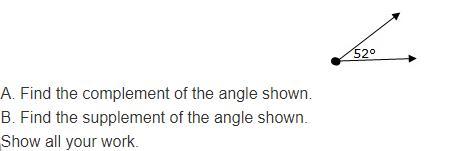
Answers
Answer: A. 38 B. 128
Step-by-step explanation:
Complementary angles add up to 90 degrees , so you can subtract the given angle measurement from 90
Supplementary angles add up to 180 degrees , so you can subtract the given angle measurement from 180
Linda ate lunch at a deli. She ordered a turkey sandwich and a salad for $13.60. The tax was 6.5%.
What was the total amount Linda paid for her lunch?

Answers
Answer:
the answer is 14.48
Step-by-step explanation:
i did the quiz! k12 hope this works
Answer:
$14.48
Step-by-step explanation:
cost x rate (as a decimal) plus the cost = total amount
(13.60 x 0.065) + 13.60 = 14.484 which rounds to $14.84
Rollaway Skates
Number
of People
0
1
2
3
4
5
6
7
8
Cost
$0
$5
$10
$15
$20
$25
$30
$35
$40
Wheelie's Skates
and Stuff
Number
of People
0
1
2
3
4
5
6
7
8
Cost
$100
$103
$106
$109
$112
$115
$118
$121
$124
Describe when Rollaway Skates is cheaper and when Wheelie's is cheaper.
Answers
Rollaway Skates is cheaper when the number of people is less than or equal to 4. For example, the cost for 2 people at Rollaway Skates is $10, while the cost for 2 people at Wheelie's Skates and Stuff is $106.
Wheelie's Skates and Stuff is cheaper when the number of people is greater than or equal to 5. For example, the cost for 6 people at Rollaway Skates is $30, while the cost for 6 people at Wheelie's Skates and Stuff is $118.
I hope this helps! Do you have any other questions?
The designers of a water park have sketched a preliminary drawing of a new slide. The length of the ladder is I - 40 feet, and its angle of elevation is 60 (segure). 60 (a) Find the height of the slide. (Round your answer to two decimal places) - (b) Find the angle of depression from the top of the slide to the end of the slide at the ground in terms of the horizontal distance ander travels (c) Safety restrictions require the angle of depression of the slide to be no less than 25 and no more than 30°. Find an interval for how far ander travels hortzontally (round me values to one decimal place. Enter your answer using interval notation
Answers
(a) The height of the slide is 34.64 feet .
(b) The angle of depression is θ = tan⁻¹(34.64/d)
(c) The interval for which the rider travels horizontally is (60 , 74.3) .
In the question ,
it is given that ,
the length of the ladder is = 40 feet .
the angle of elevation is 60° .
From the figure given below.
Part(a) :
Let the height of the slide be = h.
From the triangle ABC ,
Sin(60°) = h/l
So , h = 40×0.8660
h = 34.64 feet .
Part(b) :
let θ be the angle of depression .
So , From the triangle DEF ;
tanθ = DF/DE
tanθ = h/d
So , θ = tan⁻¹(34.64/d)
Part(c) :
Safety restrictions require the angle of depression of the slide to be no less than 25 and no more than 30° .
let θ = 25° , then
tanθ = 34.64/d
So , tan25° = 34.64/d
d = 34.64/tan25°
d = 34.64/0.4663
Simplifying further ,
we get ,
d = 74.3 feet .
and θ = 30° , then
tan30° = 34.64/d
d = 34.64/tan30°
d = 34.64/0.5773
So , d = 60 feet .
So , the interval for which the rider travels horizontally is (60 , 74.3) .
Therefore , (a) The required height is 34.64 feet , (b) angle of depression is tan⁻¹(34.64/d) and (c) the interval is (60 , 74.3) .
Learn more about Trigonometry here
https://brainly.com/question/10643592
#SPJ4

A rectangle has an area of 40 square meters. If the length is 8 m, what is the width?
Answers
Answer:
5 m
Step-by-step explanation:
The area of a rectangle is found by doing length times width. To find a side length, or the width, do area divided by the length. In this case, it would be 40 divided by 8. 40/8 is 5 so the width is 5 m.
The width is 5 m.
Find x and y in terms of a and b.
Sax + by = 0
x + y = 2
(x, y) =
(a + b)
Answers
From the second equation, we have y = 2 - x.
Substituting this into the first equation, we get:
Sax + b(2 - x) = 0
Expanding this equation, we get:
Sax + 2b - bx = 0
Rearranging the terms, we get:
x(Sa - b) = 2b
Dividing both sides by (Sa - b), we get:
x = 2b/(Sa - b)
Substituting this value of x into the second equation, we get:
2b/(Sa - b) + y = 2
Substituting y = 2 - x, we get:
2b/(Sa - b) + (2 - 2b/(Sa - b)) = 2
Simplifying this equation, we get:
4b/(Sa - b) = 2
Multiplying both sides by (Sa - b)/2, we get:
2b = (Sa - b)
Simplifying this equation, we get:
b = a/2
Substituting this value of b into the equation for x, we get:
x = 2b/(Sa - b) = 2(a/2)/(Sa - a/2) = a/(2S - 1)
Substituting these values of x and y into the given point (x, y) = (a + b), we get:
(a/(2S - 1), 2 - a/(2S - 1)) = (a + a/2, a/2)
Therefore, the solution is:
x = a/(2S - 1) and y = 2 - a/(2S - 1).
Estimate the solution to the following system of equations by graphing.
3x + 5y = 14
6x - 4y = 9
Answers
Answer:
(2.405, 1.537)
Step-by-step explanation:
When you graph these, they intersect at (2.405, 1.537).
You can use desmos as a graphing calculator, it is extremely helpful.
Hope this helps!
A carpenter builds a rectangular bookcase that is 115 cm long and 76 cm tall. The carpenter uses two braces along the diagonals to support the bookcase. What is the length of the one of the braces, to the nearest tenth of a centimeter? Enter your answer as a decimal in the box.
Answers
Therefore, one of the rectangle braces measures 137.3 cm to the closest tenth of a centimetre.
What is a rectangle ?A rectangle is a rectangle with four perpendicularly in the Euclidean plane. It is also known as an apparent equal-sided rectangle or an equiangular parallelogram. Another option for the trapezoid is a straight angle. A square has four edges that are the same length. Quadrilaterals that are rectangular have four identical sides and 4 90° edges. As a result, it is sometimes referred to as a "rectangular trapezoid".
Here,
the vertical brace serves as the hypotenuse of a right triangle, which has the bookcase's sides serving as its legs. The diagonal brace's length can be determined as follows:
length of diagonal brace
=> √(length² + height²)
When we enter the numbers from the problem, we obtain:
length of diagonal brace
= >√(115² + 76²) ≈ 137.3 cm
Using the closest tenth of a centimetre as a guide, we obtain:
diagonal brace length: 137.3 centimetres
As a result, one of the braces measures 137.3 cm to the closest tenth of a centimetre.
To know more about rectangle visit:
brainly.com/question/29123947
#SPJ1
Match the function with the graph.
a. Y=√ x+4
b. Y=√ x-1
c. Y= √ x-1+4
d. Y=√ x+1

Answers
Answer:
c. \(y = \sqrt{x - 1} + 4\\\)
Step-by-step explanation:
The x-1 is there because you can see that the starting point is 1 left from the y axis, and +4 because it starts four points above the x axis.