Answers
Answer:
59
Step-by-step explanation:
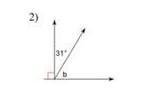
Since b and the angle with measure 31 must add up to 90, you can set up the following equation.
b+31=90
b=90-31
b=59 degrees
Hope this helps!
Answer: 59 degrees
Step-by-step explanation:
Since it is a 90-degree angle all you do is subtract 90 from 31 and get 59.
Related Questions
please help asap asap asap

Answers
Answer:14
Step-by-step explanation:
\(3 \times (4 + 6) - 16 = \)
\(3 \times (10) - 16 = \)
\(3 \times 10 - 16 = \)
\((3 \times 10) - 16 = \)
\(30 - 16 = \)
\(14\)
Show all work to solve these system of equations algebraically.
y = x - 1
y = x2 + 2x - 3
Answers
sorry im not smart. will give brainliest

Answers
Answer:
The answer is 161051
..........
Answer:
161,051
Step-by-step explanation:
\(\frac{(16-5)^{7} }{(3+8)^{2} }\\\)
First solve the parenthesis
\(\frac{11^{7} }{11^{2} }\)
Then multiply by the exponents (Multiply the numerator by itself 7 times, the denominator by itself 2 times)
\(\frac{19,487,171}{121}\)
Divide the numerator by the denominator to get your answer of:
161,051
My car’s gas tank hold 14.5 gallons. If I used 6.85 gallons, how many gallons are left?
Answers
Answer:
7.65 gallons
Step-by-step explanation:
Answer needed by 1:20pm (does anyone know how to find all answers to IXL Y.11???)

Answers
Answer:
91ft^2
Step-by-step explanation:
A = w*l
first, solve for the bottom rectangle
w = 7ft
l = 8ft
7ft * 8ft = 56ft^2
then for the second rectangle
l = 5ft
w = 7ft
5ft*7ft = 35ft^2
total area = rectangle 1+2
so 35ft^2+56ft^2=91ft^2
Answer:
The answer for the Area of the shape is 91ft²
Step-by-step explanation:
Area of the shape =Area of Bigger rectangle+ Area of small rectangle
A=L×B+l×b
A=7×8+5×7
A=56+35
A=91ft²
ill give brainlest....Help plz

Answers
Answer:
256
Step-by-step explanation:
if im wrong sorry but i highly doubt i am
The graph relates the distance traveled by Train A, in miles, and the time taken, in hours. The table shows the distance traveled by Train B, in miles, and the time taken, in hours.
Answers
Answer:A)
Yes, the relationship is proportional.
B)
66,000 miles.
Step-by-step explanation:
A)
Yes, the graph represents a proportional relationship.
Since, A proportional relationship is one in which two quantities vary directly with each other. We say the variable y varies directly as x if:
y=kx
for some constant k , called the constant of proportionality .
As y=12000x hence the relationship is proportional.
B)
We calculate the equation of the graph with the help of two points on the graph namely (2,24000) and (4,48000) with the help of slope-intercept form of the line.
y=mx+c where m denotes the slope of the line and c denotes the y-intercept of the line.
Here when x=2 y=24000 and when x=4 y=48000
Hence, 24000=2x+c
and 48000=4x+c
on subtracting the above two equations we have:
m=12000 and c=0
Hence, the equation of line is y=12000x
Now the value at x=5.5 is:
y=12000×5.5=66,000
Hence, the number of miles the probe travels in 5.5. hours is 66,000 miles.
Step-by-step explanation:
Point of view in a story quick check all answers HELP asap
Answers
Answer:
Maybe write the question for others to help please.
Step-by-step explanation:
Pls help me to find the median and mode, with solution pls

Answers
Answer:
Mode=32
Mean=32
Median=32
Step-by-step explanation:
Mode=highest frequency
Mode=10
Mean=£fx
£f
Mean=1280
40
=32
Median=n/2
=40/2
=20
median=32
Median-32
Hope this helpsssss
4h−13=−9h
What is the value of h?
Answers
Answer:
h=1
Step-by-step explanation:
4h=9h+13 ->changes sides so sign changes
4h+9h=13 ->normal adition
13h=13 ->divide
h=1
Solution:
Subtract 4h both sides and solve for h.
4h − 13 = −9h=> -13 = -9h - 4h=> -13 = -13h => 13 = 13h=> h = 1The value of h is 1.
As the x-value increases by 20, the y-value increases by 10. Which of the following equations represents the relationship between the x and y-values
Answers
Questions 1 and 4
Please help ASAP bc it is due tmr

Answers
Answer: explanation
Step-by-step explanation:
I am unsure about number 1, but for number 4, you have to fund the unit rate.
Answer:
Answer for Number 1: 54 1/2
Answer for Number 4: $2.36
Step-by-step explanation:
Explanation for number 1:
1. length x width = area right? So area divided by length = width!
159 3/8 divided by 18 3/4 = 8 1/2
2. width + width + length + length = perimeter right? Now you know the
width, you can do...
8 1/2 + 8 1/2 + 18 3/4 + 18 3/4 = 54 1/2
Explanation for number 4:
1. You know that 4 cup = 1 quart right?
9.44 = 1 quart
2. So you divide it:
9.44 / 4 = $2.36
A carnival has a duck-pond booth. You choose a rubber duck at random. The mark on the bottom of the duck tells you whether you won a small, medium, or large prize, or no prize at all. There are 73 ducks floating in the pond. There are 5 ducks marked as large-prize winners, 11 ducks marked as medium-prize winners, and 24 ducks marked as small-prize winners. Find the theoretical probability of winning a medium prize at the duck pond. Express your answer as a decimal. If necessary, round your answer to the nearest thousandth.
Answers
Let's break down this problem step by step.
First, let's understand what's happening here. There's a carnival game where you can pick one duck from a pond. Each duck has a mark under it that might make you a winner of a prize. Some ducks are marked with large prizes, some with medium, some with small, and the rest don't win you any prize.
The total number of ducks in the pond is 73.
Out of these 73 ducks:
- 5 are marked for a large prize,
- 11 are marked for a medium prize,
- 24 are marked for a small prize.
We are asked to find the theoretical probability of picking a duck that has a medium prize mark. The theoretical probability is basically a fraction that compares the number of ways something can happen with the total number of outcomes.
Here, the number of ways you can win a medium prize is equal to the number of ducks that have a medium prize mark, which is 11.
The total number of outcomes is just the total number of ducks you can choose from, which is 73.
The probability (P) of winning a medium prize is then:
P(medium prize) = (Number of medium-prize ducks) / (Total number of ducks)
= 11/73
To convert this fraction to a decimal, simply divide 11 by 73:
= 11 ÷ 73
≈ 0.1507 (rounded to the nearest thousandth)
So, the probability of winning a medium prize at the duck pond is about 0.151 or 15.1%. Imagine, for every 100 ducks you pick (if there were that many), about 15 of them would win you a medium prize.
The theoretical probability of winning a medium prize at the duck pond is ≈ 0.150
To find the theoretical probability of winning a medium prize at the duck pond, we need to determine the ratio of the number of medium-prize-winning ducks to the total number of ducks in the pond.
The total number of ducks in the pond is given as 73.
The number of medium-prize-winning ducks is given as 11.
Therefore, the probability can be calculated as follows:
Probability of winning a medium prize = (Number of medium-prize-winning ducks) / (Total number of ducks)
Probability of winning a medium prize = 11 / 73
To express the answer as a decimal, we divide 11 by 73:
Probability of winning a medium prize ≈ 0.150
Rounded to the nearest thousandth, the theoretical probability of winning a medium prize at the duck pond is approximately 0.150
To better understand how to find theoretical probability of winning medium prize at the duck pond:
https://brainly.com/question/1369541
5•1000000 is how many times as large as 5•10000
Answers
Answer:
100 times
Step-by-step explanation:
5•1000000 has 2 more zeros than 5•10000 so that means the first number is 100 times larger than the second number! hope this helps and please mark as brainiest
What is 16-2t
Also are any of my friends on cuz im soooooooooo bored
Answers
Answer:
If you mean factoring then 2(8-t)
Other than factoring I can't think of what you could mean by 16-2t
Step-by-step explanation:
-3 + 6x. Which expression shows the correct factorization?
Here are the ones to pick from
1. -2 + -2 +6 +x
2. 6(-2 +x)
3. 6(-2 +x)
4. -3 (1 - 2x)
Answers
Answer:
Option #4
Step-by-step explanation:
Expand option #4
=-3(1-2x)
=-3 -2x*-3
=-3+6x which is what your original equation was.
PLS HELP I WILL EVEN BRAINLY (even tho I need two answers for that) I WILL EVEN BE UR FRIEND PLSSS HELPPPP!!!!
What are all the factors of the number 33. 1, 3, 14, and 33 1, 6, and 33 1, 3, 11, and 33 1, 2, 16, and 33?!
Answers
Answer: 1,3,11
Step-by-step explanation:
find the values of the variables in each diagram
Plzzz help

Answers
Answer:
60
Step-by-step explanation:
these are alternate angles between two parallel lines.
which means that 120=2x
so u can calculate the value of x through this equation.
120=2x
120/2=x=60
What inequality does this number line show?

Answers
Answer:
x>2
Step-by-step explanation:
The arrow is facing the right hand side and the point on 2 isn't shaded so it's x greater than 2
The arrow is facing right and the point on 2 is not shaded so x is greater than 2
How did you decide where to place your line of best fit? Describe your reasoning.
Based on your data, describe the relationship between age and the number of U.S. states a person can name in 60 seconds.
Do you see any areas in your data or points that could be considered clusters or outliers? Explain your answer in complete sentences.
Trolls will be reported

Answers
Answer:So I don’t know the other 5 points because you didn’t give the data about the age and number of US states named in 60 seconds, but using the 5coordinate points you gave, I was able to make this line of best fit.
So basically the units are counting up by 5.
The x axis is age in years and y axis is the number of US states named in 60 seconds.
Since you didn’t give me the data to make the other 5 points, I can’t really answer the last question, but from the graph that I did make, there are no points that would be considered outliers, and there are no clusters in sight.
(BTW THIS IS IMPORTANT!! - when you use the data to add the other 5 points, there might be an outlier or more then one outlier. And there might be a cluster. Just look at it after you graph the last 5 and change the answer I gave you if there is an outlier or cluster)
Step-by-step explanation:
Consider the situations in the table below
Situation A: A hang glider descended 33.57 feet, and then ascended 14.98 feet.
Situation B: A football team gained 7 2/5 yards in one play, and then lost 3/5 of a yard in the next play.
Situation C: A hiker walked 3 1/6 miles yesterday and 2 1/2 miles today.
Situation D: A worker earned $23.66 Monday and spent $15.84 Tuesday.
Calculate the sum of each situation. Order the situations from least to greatest based on the numeric value of the sums.
Answers
Answer:
Step-by-step explanation:Situation A: The hang glider descended 33.57 feet and again ascended 14.98. So 33.57 - 14.98 = 18.58. So now the hang glider is at 18.58 feet
Situation B: Initially they gained 7 2/5 yards and then lost 3/5 yards.
7 2/5 yards can be written as 37/5. As they lost 3/5 yards, 37/5 - 3/5 = 34/5. So the remaining yards are 34/5 yards.
Situation C: Hiker walked 3 1/6 miles and then 2 1/2 miles. So the total distance is 3 1/6 + 2 1/2 = 5 4/6 miles.
Situation D: Total amount earned is $23.66 + $15.84 = $39.5.
Answer:
Step-by-step explanation:Situation A: The hang glider descended 33.57 feet and again ascended 14.98. So 33.57 - 14.98 = 18.58. So now the hang glider is at 18.58 feet
Situation B: Initially they gained 7 2/5 yards and then lost 3/5 yards.
7 2/5 yards can be written as 37/5. As they lost 3/5 yards, 37/5 - 3/5 = 34/5. So the remaining yards are 34/5 yards.
Situation C: Hiker walked 3 1/6 miles and then 2 1/2 miles. So the total distance is 3 1/6 + 2 1/2 = 5 4/6 miles.
Situation D: Total amount earned is $23.66 + $15.84 = $39.5.
Step-by-step explanation:
Help me out with this please
It’s very hard for me

Answers
Answer:
D
Step-by-step explanation:
Adding two negatives is the same as subtracting two negatives.
Positive and negative is a negative so + (-8) is -8
ASAP HELP NEEDED BRAINLIEST TO WHO IS CORRECT!
A party planner organized a dinner party. The party planner recorded the height of the candlesticks over time and graphed the relationship.
graph with the x axis labeled time in hours and the y axis labeled height of candlestick in inches and a line going from the point 0 comma 9 through the point 3 comma 7
Find and interpret the slope and y-intercept in this real-world situation.
The slope is negative two thirds, and the y-intercept is 9. The candle starts at a height of 9 inches and decreases two thirds of an inch every hour.
The slope is negative three halves, and the y-intercept is 9. The candle starts at a height of 9 inches and decreases three halves of an inch every hour.
The slope is 9, and the y-intercept is negative two thirds. The candle starts at a height of two thirds of an inch and decreases 9 inches every hour.
The slope is 9, and the y-intercept is negative three halves. The candle starts at a height of three halves of an inch and decreases 9 inches every hour.

Answers
Answer:
(a) The slope is negative two thirds, and the y-intercept is 9. The candle starts at a height of 9 inches and decreases two thirds of an inch every hour.
Step-by-step explanation:
You want to find the y-intercept and slope from the given graph of candle height versus time.
Y-interceptThe y-intercept is the point on the y-axis where the graph intercepts the y-axis. This graph has a y-intercept of 9 inches, the height of the candle when it starts burning.
SlopeThe slope of the graph is the ratio of "rise" to "run". Here, we can see that over a period of 3 hours, the candle loses 2 inches in height. That means the slope is ...
slope = rise/run = (-2 in)/(3 h) = -2/3 in/h
This slope means the candle height decreases 2/3 inch every hour.
__
Additional comment
Your problem statement identifies points on the graph as (0, 9) and (3, 7). These are actually the points where we drew the "rise" and "run" lines in the attachment. They are points where the line crosses grid intersections, which are the best choice for finding slope.
The slope can be found algebraically as ...
m = (y2 -y1)/(x2 -x1) = (7 -9)/(3 -0) = -2/3
We find it is often easier to count grid squares.

I had a simalar question where it was the same this but with 8 as the intercept sooooo it's c if ur looking for the answer hope this helps "The slope is negative two thirds, and the y-intercept is 8. The candle starts at a height of 8 inches and decreases two thirds of an inch every hour."
Sam came back from his run and his friend asked how far he ran. Sam figured about 3.5 miles. Later they drove the course and found out it was actually 4.1 miles. Calculate the percent error from Sam's run, rounded to the nearest tenth.
Answers
He was off by about 8% but if you wanna be more specifc it's 8.5%
Min read 1/8 of his book before lunch and 1/4 of his book after his lunch, he says he has read 2/12 of this book! Which statement is most accurate?
HELP PLSSS

Answers
Answer:
It should be the 2nd answer
Step-by-step explanation:
Tyra has 12 2/3 cups of sugar. If r is the amount of sugar called for in one batch of cookies, the expression 12 2/3 ÷ r can be used to find how many batches Tyra can make with the sugar she has. If r is 2/3 cup, how many batches of cookies can Tyra make?
Answers
Answer:
13 batches of cookies
Step-by-step explanation:
12 2/3 ÷ 2/3 = 12.6666667, it's 13 because 2/3 as a decimal is .6666666 and .6666667 is more than 2/3. So you add one to the answer.
Answer:
13
Step-by-step explanation:
because 12 23 divided by 2/3=12.6666667 so .6666667 is greater than 2/3, then simplify your answer to the closest value.
These will be part by part questions. cuz I dont listen well and even if I do I forget. XP
The manager at Jessica's Furniture Store is trying to figure out how much to charge for a couch that just arrived. The couch was bought at a wholesale price of $113.00, and Jessica's Furniture Store marks up all furniture by 45%. At what price should the manager sell the couch?
Answers
Answer:
The couch would be $163.85
Step-by-step explanation:
Write the math sentence as an equation: Negative eight times the sum of a number and 14.5 is 64.5
−8(r − 14.5) = 64.5
−8r + 14.5 = 64.5
−8(r + 14.5) = 64.5
−8r − 14.5 = 64.5
Answers
Answer:
The correct equation is −8(r + 14.5) = 64.5
Step-by-step explanation:
This equation states that negative 8 times the sum of a number (r) and 14.5 is equal to 64.5.
The other equations are not correct because they do not correctly represent the given statement. In equation 1, the minus sign is in the wrong place, and in equation 3, the minus sign is missing before the 14.5. In equation 4, the minus sign is missing before the 8.
I hope this helps. Let me know if you have any further questions.
You start with -8, then to multiply it my a sum you need to put that addition equation in parentheses so -8(r+14.5), then we know the whole thing is equal to 64.5, so -8(r+14.5)=64.5
By process of elimination: We know A is not correct because it has a subtraction problem in the parenthesis, and we know it should be addition because of the key word “sum” with refers to an addition problem.
We know B is not correct because there are no parenthesis, and since we need to multiply -8 to the sum/total of the addition problem, it wouldn’t work without parenthesis.
We know D is not correct for the same reasons as A and B, there are no parenthesis and there is not addition sign
I’m knew to this, and I tried to simplify my answer so if you need any clarification let me know! Good luck!
1 – 7k + 3k 2 + 10k + 7 – 5k 2
What are the variables?
How many terms?
What are the coefficients?
What are the constants?
What are the like terms?
PLEASE HELP IF YOU GET IT RIGHT ILL GIVE YOU BRAINLIEST
Answers
1) The variables are "k"
2) There are 4 terms
3) The coefficients are k
4) The constants are -7, 3, 10, -5
5) The like terms is -7k, 3k, 10k, -5k
The answers are pretty direct but, hope this answers your question.
Have a great day/night!
there are 6 terms (they are separated by plus, minus, etc... signs)
the coefficients are 7, 3, 10, and 5!
the constants are 1, 2, 7, and 2
the like terms is 1k + 16
have a great day/night whatever it is!
(sorry you had to wait lol)
The point P(6, –1) is translated according to the rule (x, y) → (x – 5, y – 2). What are the coordinates of P'?
Answers
Have a good day.
Answer:
c
Step-by-step explanation:
got it right on my assignment