Find the QUADRATIc equation 100 POINTS PLS HELP (1,6),(2,19),(3,38),(4,63),(5,94)
Answers
Answer:
\( \displaystyle 3 {x}^{2} + 4x - 1 = 0\)
Step-by-step explanation:
we are given some coordinates
(1,6),(2,19),(3,38),(4,63),(5,94)
we want to figure out the quadratic equation which passes those coordinates
notice that, the coordinates in quadratic sequence
we know that,
A sequence is quadratic if and only if it has second difference
recall that,
\(\displaystyle 2a=2^{ \text{nd }} \text{diff}\)\( \displaystyle 3a + b = U_{2}-U_1\)\( \displaystyle a + b + c = U_1\)these formulas are necessary to figure out a,b and c
because we know that
Quadratic equation standard form:
\( \displaystyle a {x}^{2} + bx + c = 0\)
therefore to figure out a,b and c these formulas are important
let's figure out a:
we got that 2nd difference is 6 thus
\( \displaystyle 2a = 6\)
divide both sides by 2
\( \displaystyle \frac{2a}{2} =\frac{ 6}{2}\)
\( \displaystyle a = 3\)
let's figure out b:
by using the second formula we can figure out b
our \(U_1\) and \(U_2\) are 6 and 19 respectively
substitute:
\( 3 \cdot 3 + b = 19 - 6\)
simplify multiplication:
\(9+ b = 19 - 6\)
simplify substraction:
\(9+ b = 13\)
cancel 9 from both sides:
\(b = 4\)
let's figure out c:
our \(U_1\) is 6
substitute:
\( \displaystyle 3 + 4 + c = 6\)
simplify addition:
\( \displaystyle 7 + c = 6\)
cancel 7 from both sides:
\( \displaystyle c = - 1\)
altogether substitute a,b and c to quadratic equation:
\( \displaystyle 3 {x}^{2} + 4x - 1 = 0\)
and we are done!


Related Questions
Pls help, screenshot!!
-Brainlist for the correct answer!-

Answers
Answer:
n+139=377
Step-by-step explanation:
the total amount of trees was 377 which means that it has to be the ending sum in the equation. the 2 quantities making up that sum were 139, and an unknown amount, n.
The lengths of the sides of a triangle are 2a 3, a – 2, and 3a. Write a simplified expression for the perimeter of the triangle.
Pls help
Answers
Answer:
2a+3+a-2+3a
6a+1
Step-by-step explanation:
Answer:
The perimeter of a triangle is the measure of side 1 + measure of side 2 + measure of side 3. To find the perimeter of the triangle, simply add these sides together.
(9x - 7w) + (4x + 6y) + (5y + 5w)
Remove the parenthesis
9x - 7w + 4x + 6y + 5y + 5w
Arrange the order so that like terms are together
9x + 4x +6y + 5y -7w + 5w
Combine like terms
13x + 11y - 2w
Step-by-step explanation:
f(x) = (x + 2)(x - 1)[x - (4 + 3)][x - (4 - 31)]
![f(x) = (x + 2)(x - 1)[x - (4 + 3)][x - (4 - 31)]](https://i5t5.c14.e2-1.dev/h-images-qa/contents/attachments/qVJ96umt6IeWq17nGRSi8ZMoFFJ6POG8.png)
Answers
Answer:
- 6 x - 182
Step-by-step explanation:
Find the area of the following parallelograms

Answers
Answer:
Area of parallelogram: 1/2×h×sum of base lengths
Property of parallelogram: 2 parallel sides
Area = 1/2×4×(9+9)
= 36 cm^2
can i have help with this i need to also know the working out

Answers

Answer: 76m
Step-by-step explanation:
First, start by splitting the figure into 2 smaller rectangular prisms; this can be done vertically or horizontally. I'll solve both ways so you can understand better.
Method 1: Splitting the figure into 2 rectangles vertically
The formula for volume or a rectangular prism is V = Bh. So, you start by finding the base of rectangular prism 1, which you can solve by multiplying the width (2m) by the length (4m) which is given in the figure. This gives you 8m which is the base. Now, if you look at the figure you can see that the height is 5m, so to find the volume of rectangular prism 1, you would multiply 8m (the base) by 5m (the height), and the answer is 40m.
Next, you would solve the same way to find the volume of rectangular prism 2. The given length is 4m and you can figure out the width by subtracting 5m - 2m which gives you 3m. Now you know your base which is 4m. To solve for the height you must again subtract 5m - 2m to get 3m. To find the volume, plug the values into the formula and multiply 4 X 3 X 3. The volume of rectangular prism 2 should come out to be 36m.
The last step is to add both of these volumes together. The volume of rectangular prism 1 + volume of rectangular prism 2 = Volume of the entire figure. The final volume is 40m + 36m = 76m.
Method 2: Splitting the figure into 2 rectangles horizontally
The formula for volume or a rectangular prism is V = Bh. So, you start by finding the base of rectangular prism 1, which you can solve by multiplying the length (2m) by the width (4m) which is given in the figure. This gives you 8m which is the base. Now, if you look at the figure you can see that the height is 2m, so to find the volume of rectangular prism 1, you would multiply 8m (the base) by 2m (the height), and the answer is 16m.
Next, you would solve the same way to find the volume of rectangular prism 2. The given length is 5m and the given width is 4m. Now you know your base which is 4m. To solve for the height you must subtract 5m - 2m to get 3m. To find the volume, plug the values into the formula and multiply 5 X 4 X 3. The volume of rectangular prism 2 should come out to be 60m.
The last step is to add both of these volumes together. The volume of rectangular prism 1 + volume of rectangular prism 2 = Volume of the entire figure. The final volume is 16m + 60m = 76m.
Hope this helps!
Find the equation of the line that has a y-intercept of -1 and a slope of 1/2.
y = 1/2 x - 1
y = -x + 1/2
y = -1/2 x + 1
y = 1x - 1/2
Answers
The correct equation is y = 1/2 x - 1.
Answer:
Answer number 1
Step-by-step explanation:
When solving real-world problems involving rational numbers, what can help you determine which operation and strategy to use?
Answers
Sample Answer: Make a table with inputs showing the number of bottles of water and outputs showing the total cost of the water. Use 1, 2, 3, and 4 bottles for the inputs. Find the corresponding outputs. Plot the ordered pairs in the table of the form (input,output).
Which instructions did you include in your explanation? Check all that apply.
Identify the input.
Identify the output.
Create a table for four input values.
Plot the points from the table.
Answers
The instructions that you would include in your explanation are:
Identify the output.
Create a table for four input values.
Plot the points from the table.
The instructions to be includedIn the given question, a series of instructions are provided. To properly explain your process, you have to explain how you got the output. There is no need of explaining the input as they are already provided.
Next, you will Show how you created the table and why you created it in that way. Finally, indicate how the points were plotted on the table. An explanation such as this will help anyone to follow through.
Learn more about ordered pairs here:
https://brainly.com/question/1528681
#SPJ1
Answer:1 to 2
2 to 4
Step-by-step explanation:
Mrs. Cain's Fitbit said that her 1,287 steps equaled 0.55 mile. If she makes her goal of 8,500 steps, how many miles will she walk? (Round to the nearest hundredth.)
Answers
Answer:6.60 miles
Step-by-step explanation:1287=0.55 of a mile. This means 8,500 must be divided by 1,287 to find the total miles that she can walk.
Help please!!! I only have 10 minutes!!
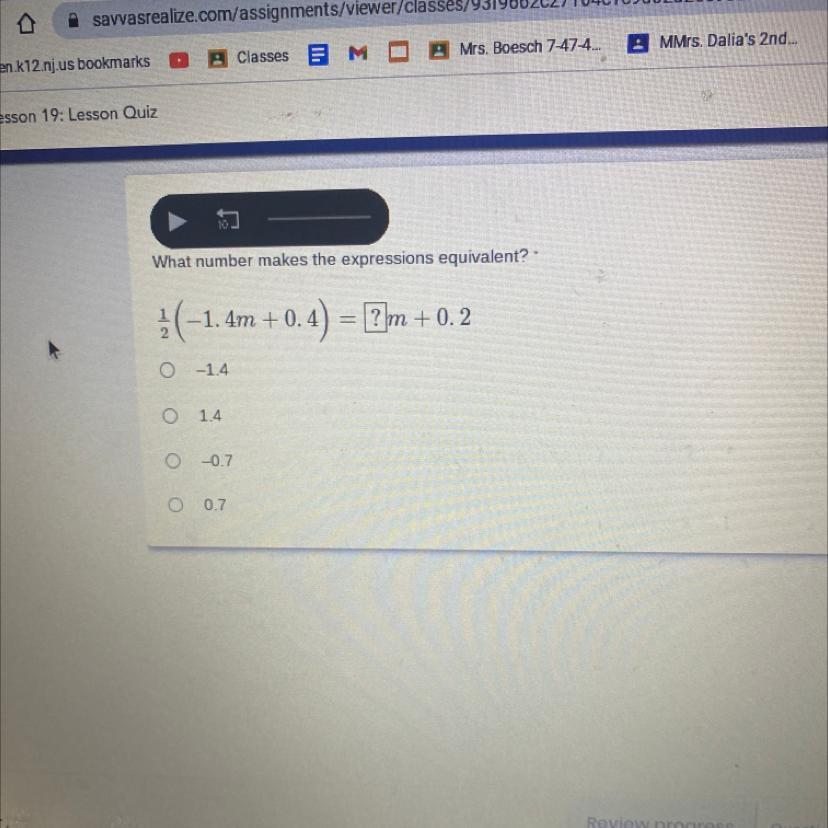
Answers
\( - 0.7\)
Step-by-step explanation:
\( \frac{1}{2} ( - 1.4m + 0.4) \)
\( = - 0.7m + 0.2\)
How many times does 15 go int 135? who ever gets it right gets 500 points
Answers
Answer:
9 times
Step-by-step explanation:
The number 15 multiplied to the number 9 which gives the value 135.
To find the that how many 15 is to get 135, division should be performed.
So, dividing 135 by 15 gives:
= 135 ÷ 15
15 | 135 | 9
135
_______
0
Thus, the quotient is 9.
Therefore, 15 goes into 135 exactly 9 times.
Learn more about Division here:
https://brainly.com/question/2273245
#SPJ6
I did some of it but I don't really know if its correct. I need help with the rest

Answers
......................answer
Answers
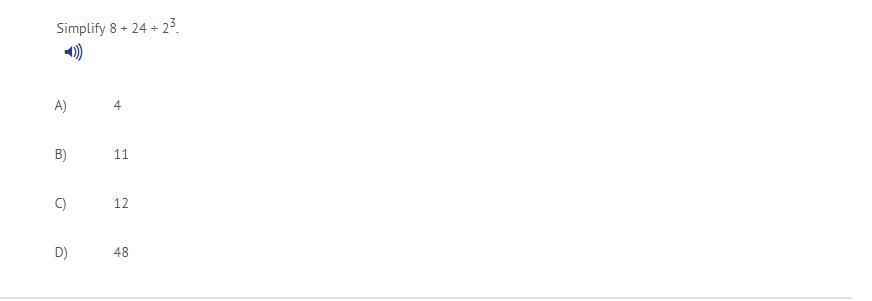
Answer:
11
Step-by-step explanation:
Answer:
The answer is B
PLEASE ASAP HURRY!!!

Answers
Answer:
Strawberry= 3
Watermelon=3
Coconut=9
Orange=5
Step-by-step explanation:
Quite easy, you can use substitution
First look at the simplest row that can be solved by itself
row 2:
2strawberries +4 = 10
2 strawberries= 6
1 strawberry = 3
Row 3: Strawberry(3)+ orange=8
1 orange= 5
Rpw 4: 14= 1coconut +orange(5)
1 coconut= 9
Row 1: Coconut(9)+ watermelon+ coconut(9)= 21
2 coconut(18)= 21
1 watermelon = 3
Watermelon=3
Coconut=9
Orange=5
i need help with this question please help me

Answers
Answer:
The answer is D.
Step-by-step explanation:
y = mx + b
C = 5/9 (F - 32)
C = 5/9F - 5/9 (32)
Option (D) is correct.
pls help me with this math question.
question is below

Answers
Answer:
6x + 13= 19x
Step-by-step explanation:
purple wolf
helps
These can come from many different places including national, state, public, and private sources. This money can be awarded based on a variety of different factors such as financial need, academic or athletic achievement, program of study, and background.
Scholarships
Loans
Work-Study Programs
Grants
Answers
Answer:
D. Grants
Step-by-step explanation:
Although grants and scholarships are similar, grants tend to be for financial reasons, therefore it would be grant. Hope this helped :)
Answer:
It's actually A; Scholarships
l o l
Without using a calculator, convert the fraction to a decimal.
2/4=?
Answers
So .50
To convert the fraction 2/4 to a decimal, we can perform the division 2 divided by 4 using long division or mental math.
2 ÷ 4 = 0.5
Therefore, 2/4 as a decimal is 0.5.
Please help i'm so stuck!
This figure represents an arrow painted on a walkway 12 times.
What is the area of the walkway that is painted with the 12 arrows?
70 cm²
90 cm²
840 cm²
1080 cm²

Answers
Tell which number is prime: 39, 69, 89, 90.
Answers
Answer:
89
Step-by-step explanation:
Help me plsssssssssss

Answers
Answer:
It is 1404
18720
Step-by-step explanation:
x 86
=
1404 ( first one )
+ 18,720 (Second )
1404
+18,720
————
20,124
hope this help sorry i’m late
someone answer this ASAP!!!!!

Answers
Answer:
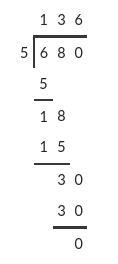
The Quotient is 136 and the Remainder is 0
Step-by-step explanation
( I hope it helps ^^)
Which list orders the numbers from least to greatest?
Negative 2.4, negative 1.5, negative 2 and one-fourth, negative 3, negative 1 and one-eighth
A number line going from negative 4 to positive 4.
Negative 1 and one-eighth, negative 1.5, negative 2 and one-fourth, negative 2.4, negative 3
Negative 3, negative 2.4, negative 2 and one-fourth, negative 1.5, negative 1 and one-eighth
Negative 3, negative 2 and one-fourth, negative 2.4, negative 1 and one-eighth, negative 1.5
Negative 1.5, negative 1 and one-eighth, negative 2.4, negative 2 and one-fourth, negative 3
Answers
Negative 3, negative 2.4, negative 1.5, negative 2 and one-fourth, negative 1 and one-eighth
Hope my answer helps you✌️
PLEASEE HELP ME
Referring to the figure, find the area of the rectangle shown.
a. 48 m2 c. 567 m2
b. 96 m d. 2,268 m2

Answers
Answer:
c
Step-by-step explanation:
area is length multiply width 21 and 27 is 567m2
B IS THE CORRECT ANSWER
Please help 25 points

Answers
Answer:the answer is 36
Step-by-step explanation:i just guessed
A chemist prepares two acid solutions.
Solution 1
3 parts sulfuric acid to 7 parts water
Solution 2
4 parts sulfuric acid to 9 parts water
a. Use a ratio table to determine which solution is more acidic.
Solution 1 Solution 2
Water Sulfuric Acid
Water
Sulfuric Acid
7
9
21
18
42
45
63
63
Question 2
Solution
has the greater concentration.
Question 3
b. Use a graph to determine which solution is more acidic.
Put responses in the correct input to answer the question. Select a response, navigate to the desired input and insert the response. Responses can be selected and inserted using the space bar, enter key, left mouse button or touchpad. Responses can also be moved by dragging with a mouse.
Both graphs begin at $($ Response area, Response area $)$ . The graph for solution Response area is steeper, so it has Response area concentration of acid.
Answers
Answer:
Check Description for answer
Step-by-step explanation
do it urself
Answer:
A) solution 2 is more acidic than solution 1
Step-by-step explanation:
A chemist prepares two acid solutions:
Solution 1: 3 parts sulfuric acid to 7 parts water
Ratio of sulphur to water: 3/7 (3:7)
Solution 2: 4 parts sulfuric acid to 9 parts water
Ratio of sulphur to water: 4/9 (4:9)
___________________________________________________
Part A: (using ratios to determine which solution is more acidic)
First we make same denominator, since the denominators are 9 and 7, we have to find the lcm (lowest common multiple) they both have with is 63. To do that, we must multiply the denominators with either 7 or 9.
Solution 1: Numerator (3) multiplied by 9 and then denominator (7) multiplied by 9. This makes out fraction/ratio 27/63
Solution 2: Numerator (4) multiplied by 7 and then denominator (9) multiplied by 7. This makes out fraction/ratio 28/63
Since 28/63 (or just 28) is a larger quantity than 27/63 (or just 27) this means solution 2 is more acidic than solution 1.
Mathematical Line (Not sure what you would call this lol): 28 > 27
Part B: (Let 'y' amount of sulfuric acid mix with 'x' amount of water)
Equation of solution 1: y = 3/7x
Equation of solution 2: y = 4/9x
Please find attachment for graph.
Part C: Don't have a graph, sorry! (part a. method is more preferred to find more acidic because it gives the actual acidic amount.)
A scale model of the U.S. National Monument is 10 inches tall. The actual monument is 100 feet tall. Write a scale using the same units on both sides. Example: 1cm = 100cm. (remember, there are 12 inches in 1 foot)
Answers
Answer:
The height of the scale model is 10 inches, and the height of the actual monument is 100 feet. Since there are 12 inches in 1 foot, we can convert the height of the actual monument to inches:
100 feet × 12 inches/foot = 1200 inches
Now we can write the scale as:
1 inch : 120 feet
This means that one inch on the scale model represents 120 feet of the actual monument.
Please explain your answer :D
don’t answer if you will not provide an explanation please :”)

Answers
Answer:
Step-by-step explanation:
QUESTION 7:
We are trying to find angles 1 and 2.
Known angle: 107˚.
In this question, we have 2 parallel lines with a transversal. A transversal is a line that passes through 2 parallel lines making it so that the angles on both sides are exactly the same.
Step 1: Find the measures of all the angles using the one we already know.
I will start with the angle adjacent (right next to) the angle that measures 107˚. As you can see, it is a supplementary angle because both of them form a straight line, or 180˚.
Therefore,
107+x= 180
x= 180-107
x= 73˚
Next, I will find the measure of the angle that is vertical to the one that measures 107˚. Note that angles that are vertical to each other are always identical, or in other words they have the same measure. Hence, the angle "vertical", or opposite to the one that measures 107˚ has to measure 107˚ as well. You can also tell this is true because they look the same.
Now I'll find the measure of the angle vertical to the one that measures 73˚. As we know, vertical angles are identical, so the one vertical to it is 73˚.
Here, I'll solve for angles 1 and 2. Like I said earlier, when a transversal crosses through 2 parallel lines, there will be 2 sets of angles that all have the same measurements.
To solve for angle 1, simply know what angle is right below it, and that is the one that measures 107˚. (If you look at the 2 lines, you will see that both angle sets are essentially duplicates of each other.) Likewise, angle 2 has to be 73˚ because the one under it is also 73˚.
Angle 1: 107˚
Angle 2: 73˚
QUESTION 8:
Again, we have a transversal that passes through 2 parallel lines. One angle measures 95˚. When there are 3 seperate angles along a straight line, the one next to the one with the given measurement will be the same as that one.
So angle 3 is 95˚. To find angle 4, find the angle measurement that's vertical to angle 3, which is 95˚. Now, since that angle and angle 4 are supplementary (both form a straight line which is always 180˚), 95+x= 180.
(x stands for angle 4)
x+95= 180
x= 180-95
x= 85
Angle 4= 85˚.
QUESTION 9:
ANGLE 5: 49˚
When there is a transversal, there are 2 identical pairs of angles. Therefore, angle 5 must be 49˚.
ANGLE 6: 131˚
angle 5 and angle 6 form a straight line which means they are supplementary angles. Therefore, both angles must add up to 180˚. So 49+x= 180
x= 180-49= 131
(x stands for angle 6)
Hope this helps!! Also I worked pretty hard on this so brainliest would be appreciated :D
Practice problems if it helps :) : https://www.khanacademy.org/math/cc-eighth-grade-math/cc-8th-geometry/cc-8th-angles-between-lines/e/parallel_lines_1

Which expression would be easier to simplify if you used the commutative property to change the order of the numbers?
A. 120 + 80 + (-65)
B. +(-1) +
C. 40 + 10 + (-12)
D. - 15+ (-25) + 43
Answers
In the neighborhood park there is a circular grassy picnic area, but half of the grass has died. The city wants to replant the grass, but needs to know the square footage of the damaged area. If the circular picnic area is 150 feet across, what is the square footage of the damaged area? Let π = 3.14.
Question 2 options:
471 sq. feet
8831.25 sq. feet
17662.5 sq. feet
35325 sq. feet

Answers
Answer:
8831.25
Step-by-step explanation: