• Find the length of a 50° arc of a circle whose radius is 4 cm. • explain why the arc length in part (a) above is longer or shorter in centimeters if the radius had been 6 cm. • Find the arc length when the radius is increased to 6cm.
Answers
The length of the arc subtended by an angle θ with a radius r can be computed using the equation
\(l=\frac{2\pi r\theta}{360^{\circ}}\)a) On the first problem, the radius of the circle is 4 cm while the degree angle of the arc subtended is 50°. Just substitute these values on the equation above and solve. We get
\(\begin{gathered} l=\frac{2\pi(4cm)(50^{\circ})}{360^{\circ}} \\ l=\frac{10}{9}\pi\approx3.5\operatorname{cm} \end{gathered}\)b) We can see that from the equation to solve the arc length, the length is proportional with the radius of the circle, hence, the longer the radius of the circle, the longer the arc length.
c) Using the same working idea to solve the arc length of the circle on the problem (a), we have
\(\begin{gathered} l=\frac{2\pi(6cm)(50^{\circ})}{360^{\circ}} \\ l=\frac{5}{3}\pi\approx5.2\operatorname{cm} \end{gathered}\)As you can see, a longer arc length is observed in a 6 cm circle than on a 4 cm circle.
Related Questions
Write a recursive sequence that represents the sequence defined by the following explicit formula:

Answers
The recursive sequence that represents the sequence defined by the following explicit formula is given as follows:
\(a_1 = -32\)\(a_{n + 1} = -\frac{1}{4}a_n\)What is a geometric sequence?A geometric sequence is a sequence of numbers where each term is obtained by multiplying the previous term by a fixed number called the common ratio q.
The explicit formula of the sequence is given as follows:
\(a_n = a_1q^{n-1}\)
In which \(a_1\) is the first term.
The first term and the common ratio for this problem is given as follows:
\(a_1 = -32, q = -\frac{1}{4}\)
The common ratio means that each term is the previous term multiplied by -1/4, hence the recursive formula is given as follows:
\(a_{n + 1} = -\frac{1}{4}a_n\)
More can be learned about geometric sequences at https://brainly.com/question/24643676
#SPJ1
if you know how to do math 30 probability please help answer this question
three events, A, B, C are all equally. If there are no other possible events which of the following statements is true?
a) P(A) = 0
b) P(B) = 1
c) P(C) = 1/3
d) P(D) = 1/2
Answers
Answer: c) P(C) = 1/3
Step-by-step explanation:
P(A) + P(B) + P(C) = 1 (100%)
P(A) = P(B) =P(C)
Using substitution:
P(C) + P(C) + P(C) = 1
3 P(C) = 1
P(C) = 1/3
Which function is a quadratic function?
A. y= 1/x
B. y= 5x - 7
C. y=-3x^2 + 2x
D. y= |x|
Answers
Answer:
C
Step-by-step explanation:
?
Answer:
C
Step-by-step explanation:
It is C because it has a quadratic polynomial, a polynomial of degree 2
A student studies how an object's mass and speed are related to its kinetic
energy. The table shows the results of the investigation.
X Speed (m/s)
N
1
1
2
2
3
N
12
Which two terms are most likely to be used to label column Y?
A. (J)
D B. Mass
C. Kinetic energy
OD. (kg)

Answers
Answer:
Joules (J)
Step-by-step explanation:
treat x as mass and y as joules then apply to kinetic energy formula
Answer:
Its Kinetic energy and Joules (J)
Step-by-step explanation:
I got it correct
Why is the answer e and not c?

Answers
Step-by-step explanation:
π ∫₀¹ x² dx
This integral is obtained using disk method. Each disk has a volume of V = πr²t, so the radius is r = x.
The region is 0 ≤ y ≤ x, 0 ≤ x ≤ 1.
Revolved around the x-axis, the resulting shape is a cone.
If the shape were a paraboloid, the integral would have been:
π ∫₀¹ (x²)² dx
π ∫₀¹ x⁴ dx
what is 5(12-9)^2-4•7 use pemdas :)
Answers
Answer:
17
Step-by-step explanation:
PEMDAS
parentheses, exponents, multiply, divide, add, subtract
5(12-9)^2 -4×7
5(3)^2 -4×7
5(9)-4×7
45 -28
17
Which table shows values for the equation y=3x+2
?


Answers
Answer:
Answer is option D
Step-by-step explanation:
Hope this helps:)

WILL MARK BRAINLIEST PLEASE HELP

Answers
Answer:
Step-by-step explanation:

How many website graphics can be created?

Answers
I do not understand what do you mean
Coldstone Creamery has a variety of different ice-cream flavors that they offer, and they have a variety of different serving sizes as well. An employee at Coldstone wanted to see if there was a relationship between a customers favorite flavor (vanilla, chocolate, or strawberry) and what serving size they ordered (small, medium, or large). He surveyed 100 customers and recorded both their favorite flavor and their preferred serving size. What are the appropriate null and alternative hypotheses?
Answers
Answer:
H0 : flavor and serving size are independent
H1: Flavor and serving size are not independent
Step-by-step explanation:
The claim or hypothesis is to test if there is a relationship between the different types of flavor (vanilla, strawberry and chocolate) and the size (large, medium and. Small) being ordered. This is the the Alternative hypothesis, in other words to establish that flavor type and size are not independent, (that is the two variables are correlated).
The Null hypothesis will be the opposite of the alternative, establish that both variables are independent.
Hence ;
Null hypothesis ; H0 : flavor and serving size are independent
Alternative ; H1: Flavor and serving size are not independent
x^4 y^2+x^3 y^7-x^2 y^3+x^ y^9 the degree of the polynomial is _______
Answers
The degree of a polynomial is the highest power.
If we look at the polynomial, we can see that 9 is the greatest power here.
Therefore, the degree is 9.
Best of Luck!
HELP PLZZ ill give u brainlest !!!
Hakeem owns seven less than 3/5
the number of DVDs that Manuel owns. Hakeem owns 20 DVDs. How many DVDs does Manuel own? Show your work.
Answers
Answer: 45 DVDs
Step-by-step explanation:
Assume that the number of DVDs owned by Manuel is x.
In comparison to Manuel therefore, the DVDs owned by Hakeem can be expressed as:
= 3/5 * x - 7
We know that Hakeem owns 20 DVDs so we can use this number to solve for x:
20 = 3/5x - 7
3/5x = 20 + 7
3/5x = 27
x = 27 ÷ 3/5
x = 27 * 5/3
x = 45 DVDs
Find the output, d, when the input, t, is 11. d= -20+11t d= ______
Answers
Answer:
d = 101
Step-by-step explanation:
d= -20+11t
Let t=11
= -20 + 11(11)
= -20 + 121
101
Answer:
the output is 101
Step-by-step explanation:
d= -20+11t
in the question it is given that t=11
substituting t=11 in the given equation
d=-20+11(11)d=-20+121d=101so the output is 99
hope it will help ^_^
The perimeter of △ABC equals 26 in and the midpoints of the sides are M, N and K. Find the perimeter of △MNK.
Answers
Answer:
13 in.
Step-by-step explanation:
Theorem:
The segment that joins the midpoints of two sides of a triangle is parallel to the third side and half the length of the third side.
Each side of triangle MNK has as endpoints two midpoints of sides of triangle ABC, so each side of triangle MNK is half the length of a side of triangle ABC.
p = 26 in./2 = 13 in.
What is the area of the figure?

Answers
Answer: 23.76 sq yds
Step-by-step explanation:
0.5*9.9*4.7=23.76
Area of triangle: 0.5*b*h
a line that passes thru (-3,4) and is parallel to y=2
Answers
Parallel lines have the same slope.
y=2 is a horizontal line and has a slope of 0, so the line parallel to it must also be horizontal and have a slope of 0.
Horizontal lines always have the form " y = k " for some number k and every point on that line has a y-value of k.
In this case, if you want the line to go through the point (-3,4), then the equation will be " y = 4 ", since that's the y-value of the point on the line.
Answer:
y = 4
Step-by-step explanation:
A line with the equation y = a is a horizontal line that intercepts the y-axis at (0, a).
A line parallel to a horizontal line is another horizontal line.
If a horizontal line passes through point (p, q), then its equation is y = q, where q is the y-value of the point.
Therefore, the equation of a line that passes through (-3, 4) and is parallel to y = 2 is:
y = 4which property of exponents must you apply to the express p 1/2 to derive p as the result
Answers
The expression becomes: p^(1/2) = p^(1/2 * 1) = p^(1/2) Now we can simplify p^(1/2) as p^1/2 which equals the square root of p.
The property of exponents that must be applied to the expression p^(1/2) to derive p as the result is the Power of a Power Property.
The Power of a Power Property states that when a power is raised to another power, the exponents are multiplied.
For instance, consider the expression p^(1/2). We can apply the Power of a Power Property to this expression as follows: p^(1/2) = (p^(1/2))^1 By applying the Power of a Power Property, the exponent (1/2) is multiplied by the exponent 1, giving a result of 1/2.
Therefore, the expression becomes: p^(1/2) = p^(1/2 * 1) = p^(1/2)Now we can simplify p^(1/2) as p^1/2 which equals the square root of p.
So we have derived p as the result using the Power of a Power Property.
In summary, we must apply the Power of a Power Property to the expression p^(1/2) to derive p as the result.
For more such questions on square root
https://brainly.com/question/428672
#SPJ8
3 times the sum of r and d minus 2 times the difference of r and d squared. Translate the above sentence into algebraic expression. Now simplify that expression.
Answers
answer 1 :
3 ( r + (d - 2(r - d^2)))
answer 2 :
-6d^2 + 3d - 3r
The Monday relates to the Thursday so than, the Friday relation the ….? A: Tuesday B : Saturday C : Sunday D: Monday E:
Wednesday
Answers
Answer:
The correct answer is B: Saturday.
The relationship between Monday and Thursday is that they are two days apart in a typical Monday-to-Sunday week. Similarly, Friday is also two days apart from Tuesday in a typical week, so the relationship between Friday and Tuesday would be the same as the relationship between Monday and Thursday. Therefore, the correct answer is B: Saturday.
Ty bought a new computer for $499. This brand depreciates at a rate of 12% of the original price per year. The value y of Ty's computer, x years after he purchased it, is found using an equation in the form y = mx + b. What is the approximate value of m?
Answers
Answer:
the approximate value of m is -0.12, indicating that the value of Ty's computer decreases by 0.12 (or 12%) each year.
Step-by-step explanation:
o express this depreciation rate as a slope in the equation y = mx + b, we need to determine how much the value changes (the "rise") for each year (the "run").
Since the value decreases by 12% per year, the slope (m) would be -12%. However, we need to express the slope as a decimal, so we divide -12% by 100 to convert it to a decimal:
m = -12% / 100 = -0.12
28:32 simplified
Does any one know?
Answers
it will be 7:8
Step-by-step explanation:
28/4 32/4
7 8
Guys please help me it’s geometry and I really don’t know how to do these
Answers
m is the midpoint of AB
A——4x-1———M——3x+3—-B
Find the values of
X=
AM=
MB=
AB=
Since this is like a line, we know it totals up to 180°.
A + (4x-1) + M + (3x+3) + B = 180
Simplify the two values with "x" in them
(7x+2) + A + M + B = 180
First, let's find x.
7x = 178-A-M-B
x = \(\frac{178-A-M-B}{7}\)
Next, let's find AM.
A + M + B = 178-7x
A+M = 178-7x-B
\(A = (178-7x-B) - M \\ and \\M = (178-7x-B)-A\)
multiply them together and get the answer then do the same for everything else.
sorry i cant help with everything.
if i am on the computer for 5 hours every weekday for a year how long am i on the computer?
Answers
Answer: 300
Step-by-step explanation:
You are on the computer 5 hrs/per weekday, 25 hrs per week, 1300 hrs per year
PLEASE ANSWER
Consider the data set displayed on the following box plot.
Which of the following statements about the data set are true? Select all that apply.
A.The interquartile range is 10.
B.There is one outlier.
C.There are no outliers.
D.The data is skewed.
E.The interquartile range is 8.
F.There are two outliers
G.The data is symmetric.

Answers
The true statements are:
The interquartile range is 10.
The data is skewed.
What are the true statements?A box plot is used to study the distribution and level of a set of scores
The end of the first whisker represents the minimum number and the end of the second whisker represents the maximum number.
On the box, the first line to the left represents the lower (first) quartile. The next line on the box represents the median. The third line on the box represents the upper (third) quartile. The interquartile range is the difference between the first and third quartile.
Interquartile range = 9 - (-1) = 10
A box plot is negative skewed because the median is not at the center of the box.
An outlier would be within: (Q1 - 1.5 * IQR or Q3 + 1.5 * IQR).
- 1 - (1.5 x 10 ) = -16
9 + (1.5 x 10) = 24
To learn more about box plots, please check: https://brainly.com/question/27215146
#SPJ1
Equation of Exponential Functions
The table of values below represent an exponential function.
Write an exponential equation that models the data.
a. y = 11.76(1.3)× c. y = 11.76(0.7)×
b. y = 24(07)× d. y = 16.8(1.7)×
Please select the best answer from the choices provided.

Answers
Answer:
C. y = 11.76(0.7)×
Step-by-step explanation:
I calculated it logically
The exponential equation that models the data is y = 16.8×1.7ˣ.
What is a function?A relation is a function if it has only One y-value for each x-value.
y = a.rˣ is the exponential function.
We can see that the y-values are decreasing, which means that the growth factor must be between 0 and 1.
Additionally, we can divide the y-value for each x by the y-value for the previous x to get an estimate of the growth factor.
Using this method, we find that the growth factor is approximately 0.85, which means that a possible equation is y = a × 0.85ˣ.
To find the value of a, we can substitute one of the data points into the equation.
Lets use the point (-2, 24), we get:
24 = a × 0.85⁻²
a = 24 / 1.551
a = 15.456
Therefore, the exponential equation that models the data is y = 16.8×1.7ˣ.
To learn more on Functions click:
https://brainly.com/question/30721594
#SPJ7
What is the value of the point on the number line below?
Answers
The Point C is designated as the point on the number line below that has a value of 0.75.
A number line is what?The horizontal line is referred to as a number line. The numbers on the line in this measure how the number on the line might be responded to.
Since each line should be measured in increments of 5, the result should be 0.75, or three-fourths, if we were to count.
In basic mathematics, a number line is a visual depiction of real numbers. A magnitude line is depicted in the illustration. Each real number is taken to represent a point on the number line, where each point represents a real number. A number line has equal spaces between each increment. Only the actions indicated by the numbers on a line are acceptable responses. The question that corresponds with the number dictates how it should be used. B: State your case.
As a result, Point C on the number line below represents a value of 0.75 and should be taken into consideration.
To learn more about number line from given link
https://brainly.com/question/18883893
#SPJ1
Complete question -

Which of the following equations describes the line shown below? Check all
that apply.
(1, 13)
10
(-2, 4)
X
- 10
10
-10-

Answers
Answer: A&D
Step-by-step explanation:
because the first point is (x is 1,y is 13) and it fits with what your given then you move on to the next problem is (x is -2, y is 4) and it fits with what your given.
All your doing is finding the same point
p.s. sorry if i wrong
3)A ball is kicked from a height of 2 feet off the ground, after 1 second the ball rea
nes a height
A ball is kicked from a height of 2 feet off the ground. After 1 second the ball reaches a height of 22 feet, and it reaches its maximum height of 38 feet after 3 seconds.
• Write the quadratic equation that represents the height of the ball at any given time
• Find the height of the ball at 4 seconds
Solve the following quadratic equations
Answers
Answer:
y = - 2x + (1/2 38) + 2 = y = -2x + 19x + 2 at any second and y = -2x^2 / 2 + 19/2 + 2/2 = - x^2 + 19/2 + 2 = - x (4) + 19/2(4) + 1 = -4+ 38 + 1 = 35 seconds
Step-by-step explanation: We see that 38-2ft = 36ft and y intercept = 2 and then -2x allows us to represent the starting point 2 as -2 (1) to allow a descend to our back to 0 for y one we find y intercept we know - x^2 is our simplified equation and an input into this to find the static and slowed descend back to 0 if you keep inputting at 5 and 6 you see the equation speed up Anyway at (4) substitute = 4 seconds we divide our simplified equation a = -x2 into a b c and divide each by 2 before working out the decline of the equation (as equation still represents all ascending and descending) for the 4th second as the height was already said to be at its max at 38 feet see equation in answer to find 4 as substitute for x
What is the meaning of "\( \varphi (x,y)\) be \( y\wedge \phi (x)\) "?
![What is the meaning of "[tex] \varphi (x,y)[/tex] be [tex] y\wedge \phi (x)[/tex] "?](https://i5t5.c14.e2-1.dev/h-images-qa/contents/attachments/IEnaK9Mnw3ftGn7VoWymvKjzqCukNTp6.png)
Answers
The given passage provides a proof that the Separation Axioms follow from the Replacement Schema.
The proof involves introducing a set F and showing that {a: e X : O(x)} is equal to F (X) for every X. Therefore, the conclusion is that the Separation Axioms can be derived from the Replacement Schema.In the given passage, the author presents a proof that demonstrates a relationship between the Separation Axioms and the Replacement Schema.
The proof involves the introduction of a set F and establishes that the set {a: e X : O(x)} is equivalent to F (X) for any given set X. This implies that the conditions of the Separation Axioms can be satisfied by applying the Replacement Schema. Essentially, the author is showing that the Replacement Schema can be used to derive or prove the Separation Axioms. By providing this proof, the passage establishes a connection between these two concepts in set theory.
Learn more about axioms here:
https://brainly.com/question/2857184
#SPJ8
Quadrilateral JKLM is rotated - 270° about the origin.
Draw the image of this rotation
Need a visual answer please! Thanks!

Answers
Answer:
Step-by-step explanation:
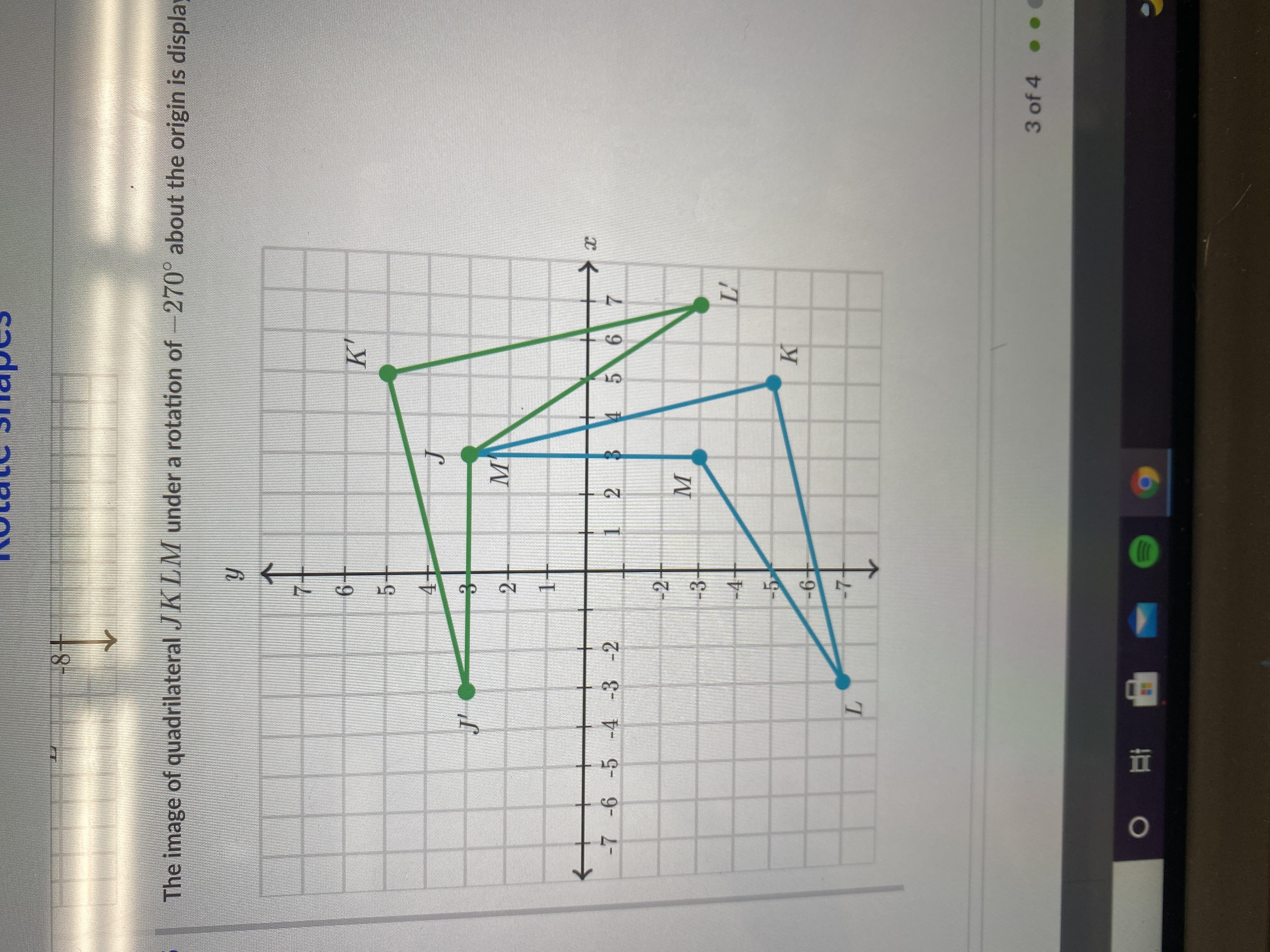
When the quadrilateral JKLM is rotated - 270° about the origin then the image of rotated quadrilateral is shown below.
What is rotation?"It is a transformation in which the object is rotated about a fixed point. "
For given question,
Quadrilateral JKLM is rotated - 270° about the origin.
This means, quadrilateral JKLM is rotated 270° clockwise about the origin.
We know, if point P(x, y) is rotated 270° clockwise or 90° anticlockwise then the coordinated of rotated point would be (-y, x).
From figure, the coordinates of the quadrilateral JKLM are:
J = (3, 3)
K = (5, -5)
L = (-3, -7)
M = (3, -3)
After rotating -270° about the origin the coordinates of the quadrilateral would be,
J' = (-3, 3)
K' = (5, 5)
L' = (7, -3)
M' = (3, 3)
And the image of the rotated quadrilateral J'K'L'M' is shown below.
Therefore, when the quadrilateral JKLM is rotated - 270° about the origin then the image of rotated quadrilateral is shown below.
Learn more about rotation here:
https://brainly.com/question/16710736
#SPJ2
