Find the distance between the points (9, –6) and (–4, 7). Question 15 options: A) B) C) D)
Answers
Answer:
\( \huge \boxed{ \boxed{ \tt \sqrt{170} }}\)
Step-by-step explanation:
to understand thisyou need to know about:coordinatesPEMDASgiven:point:(9,-6),(-4,7)tips and formulas:\(d = \sqrt{(x _{2} - x _{1} ) ^{2} + (y_{2} - y_1 {)}^{2} } \atop\)let's solve:\( \sf substitute \: the \: value \: o f \:x _{2} \: x _{1} \: y_{2} \: y_1 \: respectively : \\ \sqrt{(9-(-4) ) ^{2} + (-6 - (-7){)}^{2} } \)\(\sf simplify : \\ \sqrt{(9-(-4) ) ^{2} + (-6 - (-7){)}^{2} } \\ \sqrt{(9 + 4 {)}^{2} + ( - 6 + 7 {)}^{2} } \\ \sqrt{ {13}^{2} + {1}^{2} } \\ \sqrt{169 + 1} \\ \sqrt{170} \\ \)Related Questions
Josefina deposited $250 into her savings account. She then saved $40 per month. Which of the following equations shows a, the amount in Josefina’s saving account after t months?
a = 250 + 40•t
a = 250 — 40•t
a = 40 + 250•t
a = 40 + 210•t
Answers
Answer:
a=250+40*t
Step-by-step explanation:
Answer:
a = 250 + 40•t
Find the equation of a line that passes through the point (0,1) and has a gradient of 2.
Answers
Answer:
y = 2x + 1Step-by-step explanation:
Given point (0, 1) and the slope m = 2
Use point- slope form to find the equation of the line:
y - y₁ = m(x - x₁)y - 1 = 2(x - 0)y - 1 = 2xy = 2x + 1BNATT73ZGEZZU63F
free reedem code
Answers
Thanks! But what is it for??
Answer:
Thanks I got my free thing from this code that points out where to redeem it
Step-by-step explanation:
Whats the common difference between 34,31,28,25
Answers
34-31 is 3, 31-28 is 3, 28-25 is 3. so it keeps going down by 3
123, 472 to two decimal places
Answers
Answer:
123.00 and 472.00
Step-by-step explanation:
can't really do much except add 0's since those numbers are whole numbers
Find the slope of a line that passes through points (–1, –5) and (6, 9).
Answers
Answer:
2
Step-by-step explanation:
The work is linked below. 69 lol.

Answer:
a=yB - yA/ xB - xA =9 +5 /6+1 = 14 /7 =2
a(slope) =2
Hope this helps...
A drill is used to dig down into the earth. After 2 hours, the drill is 12 meters below the surface. After 5 hours, the drill is 30 meters below the surface. Which equation represents the depth of the drill in meters, y, after x hours of drilling?
Answers
Answer:
6y = x
Step-by-step explanation:
All that equation is saying is that for every 1 hour drilled (x), 6 meters (y) are drilled.
y = distance in meters
x = time
12y = 2x
12y/2 = 2x/2
6y = x
30y = 5x
30y/5 = 5x/5
6y = x
The equation representing the depth of the drill in meters, y, after x hours of drilling is y = -6x
Since the slope is 3, hence it passes through the point (-4.67, 0). Hence the equation of the line is y = 3x + 14.
A linear equation is in the form:
y = mx + b;
where m is the slope, b is the y intercept and y, x are variables.
Let y represent the depth of drill in meters after x hours of drilling. Hence:
Since after 2 hours, the drill is 12 meters below the surface, it can be represented by (2, 12). Also after 5 hours, the drill is 30 meters below the surface, it can be represented by (5, 30)
The equation of the line is given by:
\(y-y_1=\frac{y_2-y_1}{x_2-x_1}(x-x_1) \\\\y-(-12)=\frac{-30-(-2)}{5-2}(x-2) \\\\y+12=-6(x-2)\\\\y+12=-6x+12\\\\y=-6x\)
The equation representing the depth of the drill in meters, y, after x hours of drilling is y = -6x
Find out more at: https://brainly.com/question/19426333
Therefore the graph is attached below.
Find out more at: https://brainly.com/question/13911928
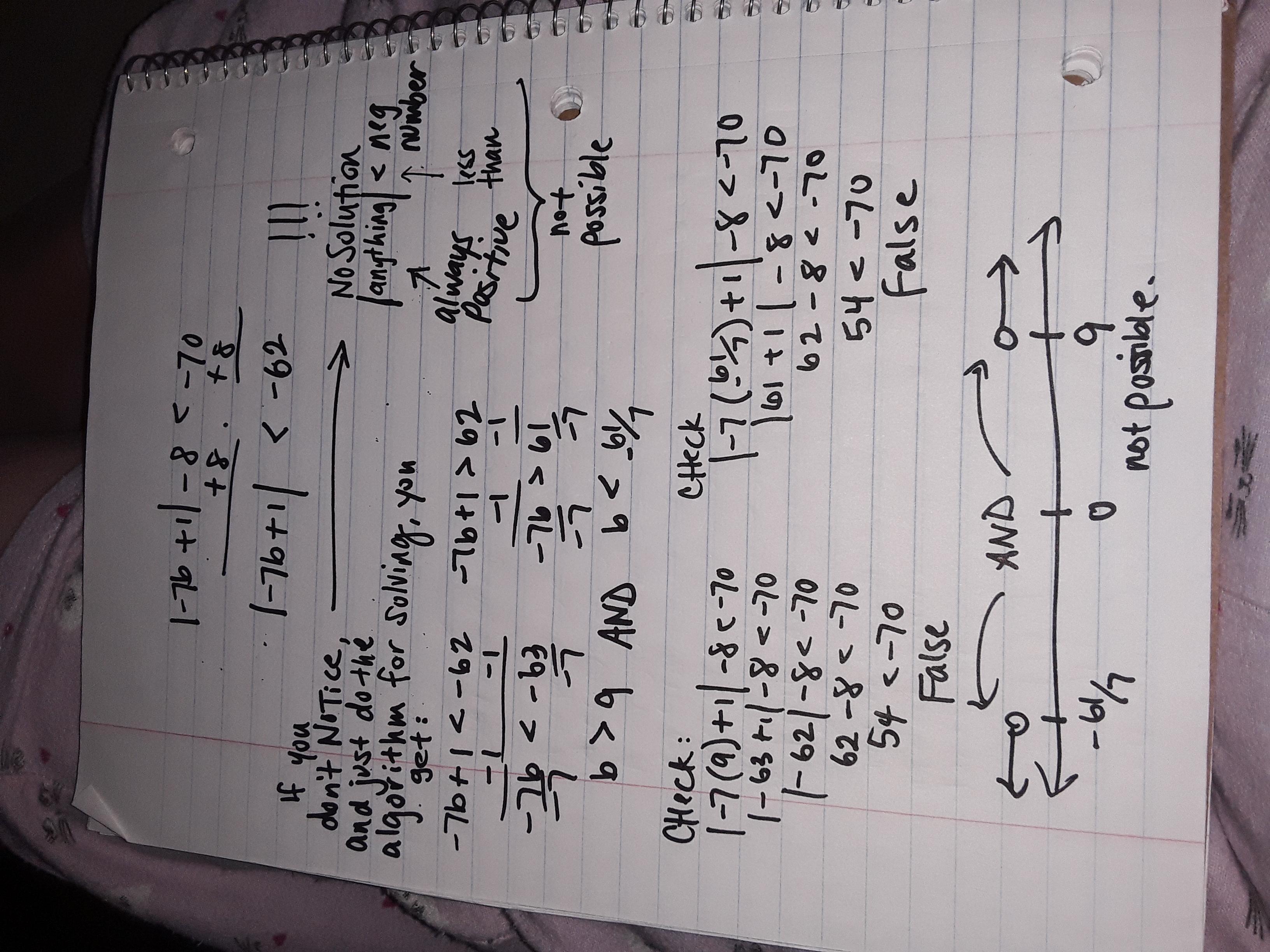
Somebody please solve the Absolute Value Inequality.: |-7b+1|-8<-70
Answers
Answer: the answer is no solution
Step-by-step explanation:
Answer:
No Solution
Step-by-step explanation:
An absolute value will always have a positive value. If you isolate the absolute value it shows the abs val LESS THAN a negative number. Its not possible to have a positive less than a negative.
If you just go on and do the problem in auto-pilot, the answers don't check. ALSO since it it a LESS THAN inequality statement BOTH of the inequalities have to be true at the same time which is not possible.
See image.
PLEASE PLEASE HELP ME ASAP
simplify -2x -2(3x-7) + 4(3x-5) - (4x-9)
Answers
Answer:
3
Step-by-step explanation:
Answer:
3
Step-by-step explanation:
Show that if A and B are sets with A ⊆ B, then a. A ∪ B = B b. A ∩ B = A
Answers
If A and B are sets with A⊆B the a) A ∪B = B, b) A∩B = A.
a) Let A⊆B
Let x ∈ A∪B
Then x ∈ A or x ∈ B .....(i)
By definition of union we have
x ∈ A ⇒ x ∈ B .....(ii)
Using (i) and (ii), if x ∈ A, then x ∈ b. If x ∈ B, then clearly x ∈ B.
Thus given A⊆ B, then A∪B = B.
b) First assume A∩B which implies that x ∈ A and x ∈ B.
Hence we can implies the
A∩ B ⊆ A (we started with the element in A∩B and concluded that it is in A) ------(i)
Now, let x ∈ A which implies x ∈ B ( as A⊆ B)
Hence, x ∈ A∩B, which in turn imply
A ⊆ A∩B -----(ii)
From (i) and (ii) we get
A∩B = A
Therefore if A and B are sets with A⊆B, then A ∩B = B and A∩B = A.
To know more about the sets refer to the link given below:
https://brainly.com/question/13458417
#SPJ4
HI I really need help with this its in the picture

Answers
Explanation:
The blue rectangle has area of 4a^2*6a^2 = 24a^4
The red rectangle has area 4a^2*9a = 36a^3
The green rectangle has area 4a^2*3 = 12a^2
The total area is 24a^4 + 36a^3 + 12a^2
50-(7•8)+9 please help! I think it is 3 but I am not positive
Answers
Solve each system using Cremer’s rule and please describe how you got the answer

Answers
9. The solution is (x, y) = (4/3, -5/3).
10. The solution is (x, y) = (1, 2).
The coefficient matrix is:
| -1 5 |
| 1 -2 |
The determinant of the coefficient matrix is:
|-1 5 | |-2 5 |
| 1 -2 | = (-1)(-2) - (5)(1) = 3
The matrix formed by replacing the first column of the coefficient matrix with the constants on the right side of the equation is:
| 2 5 |
|-2 -2 |
The determinant of this matrix is:
| 2 5 | | -2 5 |
|-2 -2 | = (2)(-2) - (5)(-2) = -4 + 10 = 6
|-1 2 |
| 1 -2 |
The determinant of this matrix is:
|-1 2 | | 1 2 |
| 1 -2 | = (-1)(-2) - (2)(1) = 2
Using Cramer's rule:
x = |2 5| / 3 = 4/3
|-2 -2|
y = |-1 2| / 3 = -5/3
|1 -2|
10.The coefficient matrix is:
| -5 -5 |
| -2 -4 |
The determinant of the coefficient matrix is:
|-5 -5 | |-2 -5 |
|-2 -4 | = (-5)(-4) - (-5)(-2) = -10
The matrix formed by replacing the first column of the coefficient matrix with the constants on the right side of the equation is:
| 25 -5 |
| 16 -4 |
The determinant of this matrix is:
| 25 -5 | | 16 -5 |
| 16 -4 | = (25)(-4) - (-5)(16) = -100 + 80 = -20
|-5 25 |
|-4 16 |
The determinant of this matrix is:
|-5 25 | |-4 25 |
|-4 16 | = (-5)(16) - (25)(-4) = -80 -(-100) = 20
Using Cramer's rule:
x = |-5 -5| / -10 = 1
|-2 -4|
y = |-5 25| / -10 = 2
|-4 16|
For such more questions on solution
https://brainly.com/question/24644930
#SPJ8
a factor in an anova test describes the cause of the variation in the data. TRue or false
Answers
In the ANOVA test, factors don't directly explain variation, levels don't account for external variation, and the blocking factor's significance should be considered despite a significant main factor for accurate interpretation.
1. A factor in an ANOVA test that does not necessarily describe the cause of the variation in the data is False. A factor represents a categorical variable or an independent variable that is believed to have an effect on the dependent variable. It is used to explain the observed differences among groups or treatments, but it does not directly explain the cause of the variation.
2. A level in an ANOVA test does not account for the variation outside of the main factor is False. A level refers to the different values or categories within a factor. It represents the specific groups or treatments being compared within a factor.
Levels do not account for variation outside of the main factor; rather, they help analyze the variation within the factor and assess the differences between the levels.
3. The significance of the blocking factor is still important even if the main factor is statistically significant in a randomized block ANOVA is False. A blocking factor is included to account for potential sources of variation that are not of primary interest but might affect the outcome variable.
It helps control for confounding variables or other sources of variation, and its significance should be considered in interpreting the results accurately. Both the main factor and the blocking factor need to be evaluated to understand the overall significance and impact of different factors on the outcome variable.
Therefore, all the answers are false.
To learn more about ANOVA Test from the given link
https://brainly.com/question/15084465
#SPJ4
Note: The question would be as
1. A Factor In An ANOVA Test Describes The Cause Of The Variation In The Data. True Or False?
2. A Level In An ANOVA Test Accounts For The Variation Outside Of The Main Factor. True Or False?
3. As Long As The Main Factor Is Statistically Significant With Randomized Block ANOVA, There Is No Concern About The Significance Of The Blocking Factor. True
5n + 20 -10 + 15n=50
Solve for the variable
Answers
Step-by-step explanation:
2n is the answer because you combined the two variables then you do 20n plus 20n minus. 10 equals 50 then subtract 10 from 50 and get forty the divide that by 20 which equals 2
class extends value undefined is not a constructor or null
Answers
What? What do you mean?
The sum of the digits of a two-digit number is 5. If nine is subtracted from the number, the digits will be reversed. Find the number. If the numbers 32, What's the equation?
Answers
Answer:
Step-by-step explanation:
Hello,
let's note a and b the two digits, the number is then a*10+b
and the digits in revers mode give b*10 + a so we can write
(1) a + b = 5
(2) 10a+ b - 9 =10b + a
From(1) I get b = 5-a
I replace in (2)
10a + 5 - a - 9 = 10(5-a) + a = 50 - 10a = a = 50 - 9a
9a - 4 = 50 - 9a
18a = 50 + 4 = 54 so
a = 54/18 = 3
and then from (1) b = 5 - 3 = 2
So the number is 32
Please help with this question???

Answers
Answer:
33
Step-by-step explanation:
Supplementary angles total 180°.
__
A + B = 180 . . . . . . . . . . . . . definition of supplementary angles
(3x +45) + (2x -30) = 180 . . . . . substitute the given expressions
5x +15 = 180 . . . . . . . . . collect terms
x +3 = 36 . . . . . . . . divide by 5
x = 33 . . . . . . . subtract 3
_____
Additional comment
The angles are ...
A = 3(33) +45 = 144°B = 2(33) -30 = 36°Answer:
x = 33
Step-by-step explanation:
supplementary angles are two angles whose sum is 180°
viusal example, check attached image
Step 1: Find x
(3x + 45) + (2x - 30) = 180
(3x + 2x) + (45 -30) = 180
5x + 15 = 180
5x + 15 - 15 = 180 - 15
5x = 165
5x / 5 = 165 / 5
x = 33
checking work:
Step 2: Finding Angle A by plugging x in
3x + 45
3(33) + 45 = 144
Anglw A = 144°
Step 3: Finding Angle B by plugging x in
2x - 30
2(33) - 30 = 36
Angle B = 36°
Angle A + Angle B = 180°
144° + 36° = 180° TRUE x is correct

Which variable of time could cause a student's GPA to increase? (A) watching TV (B) eating (C) working (D) studying
Answers
Out of the given options, the variable of time that could cause a student's GPA to increase is studying.
A student's Grade Point Average (GPA) is calculated by dividing the total number of grade points earned by the total number of credit hours attempted. It's a measure of a student's academic performance.
Studying is the act of engaging in focused mental activity in order to acquire and retain knowledge. Students who spend more time studying are likely to perform better academically and, as a result, achieve higher GPAs.
Therefore, studying is the variable of time that could cause a student's GPA to increase. The correct option is (D) studying.
#SPJ11
Learn more about GPA and variable https://brainly.com/question/28248724
(q59) Evaluate the integral

Answers
The value of the integral ∫√x/(x - 4) dx from 9 to 16 is 3.022
How to evaluate the integralFrom the question, we have the following parameters that can be used in our computation:
∫√x/(x - 4) dx from 9 to 16
The above expression can be integrated using integration by parts method
When integrated, we have
∫√x/(x - 4) dx = 2(√x - ln(√x + 2) + ln(|√x - 2|))
Recall that the x values are from 9 to 16
This means that
∫√x/(x - 4) dx = 2(√16 - ln(√16 + 2) + ln(|√16 - 2|)) - 2(√9 - ln(√9 + 2) + ln(|√9 - 2|))
So, we have
∫√x/(x - 4) dx = 2(4 - ln(4 + 2) + ln(|4 - 2|)) - 2(3 - ln(3 + 2) + ln(|3 - 2|))
Solving further, we get
∫√x/(x - 4) dx = 2(4 - ln(6) + ln(2)) - 2(3 - ln(5) + ln(1))
Evaluate
∫√x/(x - 4) dx = 3.022
Hence, the value of the integral is 3.022
Read more about derivatives at
https://brainly.com/question/5313449
#SPJ1
When employees have different responsibilities, those ______ can be modeled with multiple associations between the employee class and the linked class.
Answers
When employees have different responsibilities, those relationships can be modeled with multiple associations between the employee class and the linked class.
In object-oriented programming, a class is a blueprint for creating objects that have similar properties and behaviors. One of the key concepts in class design is associations, which represent relationships between classes. Associations are used to define how objects of one class are connected to objects of another class.
When employees have different responsibilities, it means that there are multiple ways in which they can be associated with other classes. For example, a software company may have a class of employees who are responsible for developing software, and another class of employees who are responsible for testing the software. Each of these classes has a different set of responsibilities and requires different skills and knowledge.
To model these relationships, we can create multiple associations between the employee class and the linked class. For example, we could create one association between the employee class and the software development class, and another association between the employee class and the software testing class. Each of these associations would have different attributes, such as the employee's role, responsibilities, and qualifications.
By modeling these relationships with multiple associations, we can create more accurate and flexible class designs that reflect the real-world relationships between employees and their responsibilities. This approach also allows us to easily modify or extend the class design as the requirements change, without having to make major changes to the existing code. Overall, multiple associations provide a powerful tool for designing robust and adaptable class structures.
To learn more about relationships refer here:
https://brainly.com/question/28498065
#SPJ11
Use the Lagrange Multipliers to maximize f(x,y)=x^3y^5 subject to the constraint x+y=8.
Answers
The maximum value of f(x,y)=x^3y^5 subject to the constraint x+y=8 is 0, which occurs when x=0 or y=0.
To use the method of Lagrange multipliers, we first define the Lagrange function:
L(x, y, λ) = x^3y^5 + λ(x + y - 8)
Now, we find the partial derivatives of L with respect to x, y, and λ:
∂L/∂x = 3x^2y^5 + λ
∂L/∂y = 5x^3y^4 + λ
∂L/∂λ = x + y - 8
We set the partial derivatives equal to zero to find the critical points:
3x^2y^5 + λ = 0
5x^3y^4 + λ = 0
x + y = 8
Solving the first two equations for x and y gives:
x = √(3/5)
y = 8 - √(3/5)
Substituting these values into the third equation gives:
√(3/5) + 8 - √(3/5) = 8
So, the critical point is:
(x, y) = (√(3/5), 8 - √(3/5))
Now, we need to check if this point corresponds to a maximum, minimum, or saddle point. To do this, we find the second partial derivatives of L with respect to x and y:
∂^2L/∂x^2 = 6xy^5
∂^2L/∂y^2 = 20x^3y^3
∂^2L/∂x∂y = 15x^2y^4
Evaluating these at the critical point, we get:
∂^2L/∂x^2 = 6(√(3/5))(8 - √(3/5))^5 > 0
∂^2L/∂y^2 = 20(√(3/5))^3(8 - √(3/5))^3 > 0
∂^2L/∂x∂y = 15(√(3/5))^2(8 - √(3/5))^4 > 0
Since the second partial derivatives are all positive, the critical point corresponds to a minimum of f(x,y)=x^3y^5 subject to the constraint x+y=8. Therefore, the maximum value of f occurs at the boundary of the constraint, which is when x or y is zero. Evaluating f at these points, we get:
f(0,8) = 0
f(8,0) = 0
So, the maximum value of f(x,y)=x^3y^5 subject to the constraint x+y=8 is 0, which occurs when x=0 or y=0.
Learn more about constraint here:
https://brainly.com/question/31605599
#SPJ11
In a school 4/9 are boys. During a school tour 1/3 of the girls took part. If 220 girls did not go,how many boys are in the school?
Answers
Answer:
There are 294 boys in the school
Step-by-step explanation:
1/3=220
220*3=660
Total Girls in the school = 660
4/9= boys in school
1=9/9-4/9=5/9
5/9=0.666665
0.666665*660=366.66666=366
660-366=294
Answer:
254?
I think the other guy deserves brainiest
Step-by-step explanation:
The combined perimeter of an equilateral triangle and square is 13.
Find the dimensions of the triangle and square that produce a minimum total area.
The measurement of square on each side
The measurement of triangle on each side
Find the dimensions of the triangle and square that produce a maximum total area.
The measusrement of square on each side
The measurement of triangle on each side
Answers
To minimize the total area of an equilateral triangle and square, the side length of the square should be 2.167 and the side length of the triangle should be 3.833.
To find the dimensions that minimize the total area, we can set up equations based on the given information. Let's denote the side length of the square as 's' and the side length of the equilateral triangle as 't'. The perimeter of the square is 4s, and the perimeter of the equilateral triangle is 3t. Given that the combined perimeter is 13, we have the equation 4s + 3t = 13.
To minimize the total area, we need to consider the formulas for the areas of the square and equilateral triangle. The area of the square is given by A_square = \(s^2\), and the area of the equilateral triangle is given by A_triangle = (\(\sqrt{(3)}\)/4) *\(t^2\).
To find the values that minimize the total area, we can substitute s = (13 - 3t)/4 into the equation for A_square and solve for t. By finding the derivative of the total area with respect to t and setting it equal to zero, we can find the value of t that minimizes the area.
Similarly, to find the dimensions that maximize the total area, we follow the same process but this time maximize the total area by finding the value of t that maximizes the area.
Performing the calculations, we find that to minimize the total area, the side length of the square is approximately 2.167 and the side length of the triangle is approximately 3.833. To maximize the total area, the side length of the square is approximately 4.333 and the side length of the triangle is approximately 1.667.
Learn more about equilateral triangle here:
https://brainly.com/question/30176141
#SPJ11
What is the density of an object that has a mass of 20 grams and has a length of 8cm and a width of 2cm and a height of 5cm????
Answers
Answer:
Volume is the amount of space an object occupies. To determine the volume of any rectangular object, multiply the measurements of length, width, and height.
Volume = Length × Width × Height
Calculate the volume of this rectangular object.
Length = 3 cm
Width = 3 cm
Height = 12 cm
Volume = l × w × h
Volume = 3 cm × 3 cm × 12 cm
Volume = 108 cm3
Notice that the units for volume are cubic centimeters (cm3).
So 8 ÷ 25 = 0.32 and the units would be g/ cm3 . Other units of density could be g/L or g/ml or mg/ cm3 or kg/ m3 and the list could go on and on. Any unit of mass divided by any unit of volume.
Step-by-step explanation:
hope this helpa
What is the area of the trapezoid? If necessary, round your answer to the nearest tenth.
A trapezoid with bottom side length of 8.5 feet, top side length of 5.5 feet, and height of 6.5 feet.
35.8 feet squared
45.5 feet squared
46.8 feet squared
Answers
The area of the trapezoid is calculated as 45.5 feet squared.
What does Area of Trapezoid mean?
The entire area occupied by the sides of a trapezoid is its area. It's important to notice that if we know the lengths of all the sides, we can divide the trapezoid into smaller polygons, such as triangles and rectangles, calculate their areas, and then sum them all together to determine the area of the trapezoid.
The formula for Trapezoid Area:If the parallel sides of the trapezoid are known, along with their height, it is possible to determine their area. It is expressed as,
A=\(1/2\)(a+b) h
where, A= the area of the trapezoid
h= height
'a' & 'b' = parallel side bases
Solution:a=5.5 feet , b= 8.5 feet & h=6.5 feet
A=\(1/2\)(a+b)h
∴A=\(1/2\)(5.5+8.5)*6.5
⇒A=\(1/2\)(14)*6.5
⇒A=7*6.5
⇒A=45.5 feet squared
Therefore, the solution is (b) 45.5 feet squared.
Learn more about Trapezoid:
https://brainly.com/question/12451654?referrer=searchResults
#SPJ10

Express the decimal as a percent 1. 276
Answers
Have a nice day!!!
(If this helps don’t forget to mark branliest :) )
Answer:
ummm to round it, it would round to 1. To say it, it would be one and two hundred seventy six thousandths.
Step-by-step explanation:
Mark as brainliest plz
5
Which line is parallel to the line y = -5/2x - 7
A) 2x + 5y = -5
B) 2x - 5y = 30
C) 5x + 2y = 4
D) 5x – 2y = 8

Answers
Answer:
The answer is C) 5x + 2y = 4
Step-by-step explanation:
5(x + 1) - 8 = 5x(2-4)
what is the value of x?
a. -5
b. -1/5
c. 5
d. 1/5
Answers
Answer:
d) 1/5
Step-by-step explanation:
5(x + 1) - 8 = 5x(2-4)
5x+5-8 = 5x(-2)
5x-3=-10x
15x = 3
x = 1/5
Answer:
d. 1/5Step-by-step explanation:
5(x + 1) - 8 = 5x(2-4)
=> 5x + 5 - 8 = 10x - 20x
=> 5x + 20x - 10x = 8 - 5
=> 15x = 3
\( = > x = \frac{3}{15} \)
=> x = 1/5 (option d) (Ans)
Some one please help me solve this
Solve each system by elimination.
1) -3х – бу = -3
5x + 5y = 0
Answers
Answer: look at the picture
Step-by-step explanation: Hope this help :D
