Find the difference between the square of the sum and the sum of the squares of the first one hundred natural numbers.
Answers
The difference between the square of the sum and the sum of the squares of the first one hundred natural numbers is 25,164,150.
To find the difference between the square of the sum and the sum of the squares of the first one hundred natural numbers, we can follow these steps:
Calculate the sum of the first one hundred natural numbers.
The sum of the first n natural numbers can be calculated using the formula:
Sum = (n * (n + 1)) / 2
For n = 100, we have:
Sum = (100 * (100 + 1)) / 2
Sum = (100 * 101) / 2
Sum = 5050
So, the sum of the first one hundred natural numbers is 5050.
Calculate the sum of the squares of the first one hundred natural numbers. To find the sum of the squares of the first n natural numbers, we use the formula:
Sum of Squares = (n * (n + 1) * (2n + 1)) / 6
For n = 100, we have:
Sum of Squares = (100 * (100 + 1) * (2 * 100 + 1)) / 6
Sum of Squares = (100 * 101 * 201) / 6
Sum of Squares = 338350
So, the sum of the squares of the first one hundred natural numbers is 338350.
Calculate the difference between the square of the sum and the sum of the squares.
Difference = (Sum)^2 - Sum of Squares
Difference = 5050^2 - 338350
Difference = 25502500 - 338350
Difference = 25164150
Therefore, the difference between the square of the sum and the sum of the squares of the first one hundred natural numbers is 25,164,150.
for such more question on natural numbers
https://brainly.com/question/24672369
#SPJ11
Related Questions
burt is making a pie chart which will represent how he spent the last 24 hours. if he slept for 2 hours, what will be the measure of the central angle, in degrees, of the slice of the pie chart representing sleep?
Answers
The measure of the central angle for the slice of the pie chart representing sleep is 30 degrees.
To find the measure of the central angle of the slice representing sleep, we need to know what percentage of the 24 hours was spent sleeping.
If Burt slept for 2 hours, then the remaining time he was awake for 24 - 2 = 22 hours.
Therefore, the percentage of time spent sleeping is
2 / 24 * 100% = 8.33%
To convert this percentage to an angle in degrees, we use the formula
Angle = Percentage * 360
So, the central angle of the slice representing sleep is
8.33% * 360 = 30 degrees (rounded to the nearest degree).
To know more about pie chart:
https://brainly.com/question/9979761
#SPJ4
List 6 words that relate to area and explain why you chose/selected them.
Answer Please.
Answers
The Consumer Price Index (CPI) indicates cost of living for a typical consumer and is used by government economists as an economic indicator. The data below show the CPI for large urbanareas in midwestern and western states in the United States. Compare the CPI of the two regions. Start with a graph to determine shape; then compare appropriate measures of center andspreadand mention any potential outliers.
Answers
Answer:
Step-by-step explanation:
I need help with this ASAP!! I’ll give you brainliest

Answers
Answer:
points needed hope you under stand
Step-by-step explanation:
stay safe though
Max scored 253 points on a video game. Shayla scored 12 times as many points. Draw a model and solve for how many points Shayla scored.
Im an idiot so just don’t mind me just looking for answers
Answers
Answer:
3,036
Step-by-step explanation:
x=12*253
Find BR if D is the circumcenter of △ABC, CD=11.1 and RD=5.2. Round to the nearest tenth
Answers
Answer:
BR=9.8
Step-by-step explanation:
a²+b²=c²
5.2²+b²=11.1²
27.04+b²=123.21
b²=96.17
b=\(\sqrt{ 96.17}\)
b=9.8
a number is greater than 12
Answers
Answer:
anything above 12
Step-by-step explanation:
would be greater than 12. 13, 14, 16...etc
Answer:
n > 12
Step-by-step explanation:
Represent the number by n. Then "a number is greater than 12" expressed symbolically is n > 12.
State the equation of the graphed function.

Answers
The equation of the graphed function is given as follows:
f(x) = x³ + 2x² - 5x - 6.
How to obtain the equation of the function?
The equation of the function is obtained considering the Factor Theorem, as a product of the linear factors of the function.
From the graph, the zeros of the function are:
x = -3.x = -1.x = 2.Hence the function is:
f(x) = a(x + 3)(x + 1)(x - 2).
In which a is the leading coefficient.
Expanding the product, we have that:
f(x) = a(x² + 4x + 3)(x - 2)
f(x) = a(x³ + 2x² - 5x - 6).
When x = 0, y = -6, hence the leading coefficient a is obtained as follows:
-6a = -6
a = 1.
Hence the function is:
f(x) = x³ + 2x² - 5x - 6.
More can be learned about functions at https://brainly.com/question/24808124
#SPJ1
What is the constant term of 4x-2y+3
Answers
Answer:
3
Step-by-step explanation:
Answer: 3
Step-by-step explanation:
constant: a number that has no variable bounded to it (very lonely number)
---------------------
4x-2y+3
constant: 3 (it does not have any variable)
Hope this helps!! :)
Please let me know if you have any question or need further explanation
The mean length of 10 childrens' index finger is 6.8cm.
The mean length of 7 adults' index finger is 12.8cm.
What is the mean length (rounded to 2 DP) of these 17 people's index finger?
Answers
Answer:
hhhhhhhhhhhhhhhhhhhhhhhhhhhhhhhhhhhhhhhhhhhhhhhhhhhhhhhhhhhhhhhhhhhhhhhhhhhhhhhh
Step-by-step explanation:
Which statement correctly compares the function shown on this graph with
the function y = 4x+ 2?
8
7
6
5
4
12
-5 -4 -3 -2 -1
1 2 3
4 5
-2

Answers
Answer:
B. The function shown on the graph has a smaller rate of change but a higher starting point
Step-by-step explanation:
Question options obtained from a similar question are;
A. The function shown on the graph has a greater rate of change and a higher starting point
B. The function shown on the graph has a smaller rate of change but a higher starting point
C. The function shown on the graph has a greater rate of change but a lower starting point
The function shown on the graph has a smaller rate of change but a higher starting point
Explanation;
The given function with which the graph is compared is y = 4·x + 2
From the given function, we have;
The rate of change of the function is the coefficient of 'x', therefore, the rate of change of the function = 4
When y = 0, 4·x + 2 = 0,
∴ x = -2/4 = -0.5
The y-intercept is given when x = 0
∴ The y-intercept, y = 4 × 0 + 2 = 2
The starting point of the function, is (0, 2)
From the graph, we have;
The y-intercept = (0, 4)
Therefore, the starting point of the line, the y-intercept, (0, 4), is higher than the starting point of the given function, (0, 2)
The coordinates of two (clear) points on the line in the graph are (0, 4) and (-2, -2)
The rate of change of the line, m = (4 - (-2))/(0 - (-2)) = 3
Therefore, the graph has a lesser rate of change, 3, than the rate of change of the given function, 4
When compared with the given function, 'the function shown on the graph has a smaller rate of change and a higher starting point'.
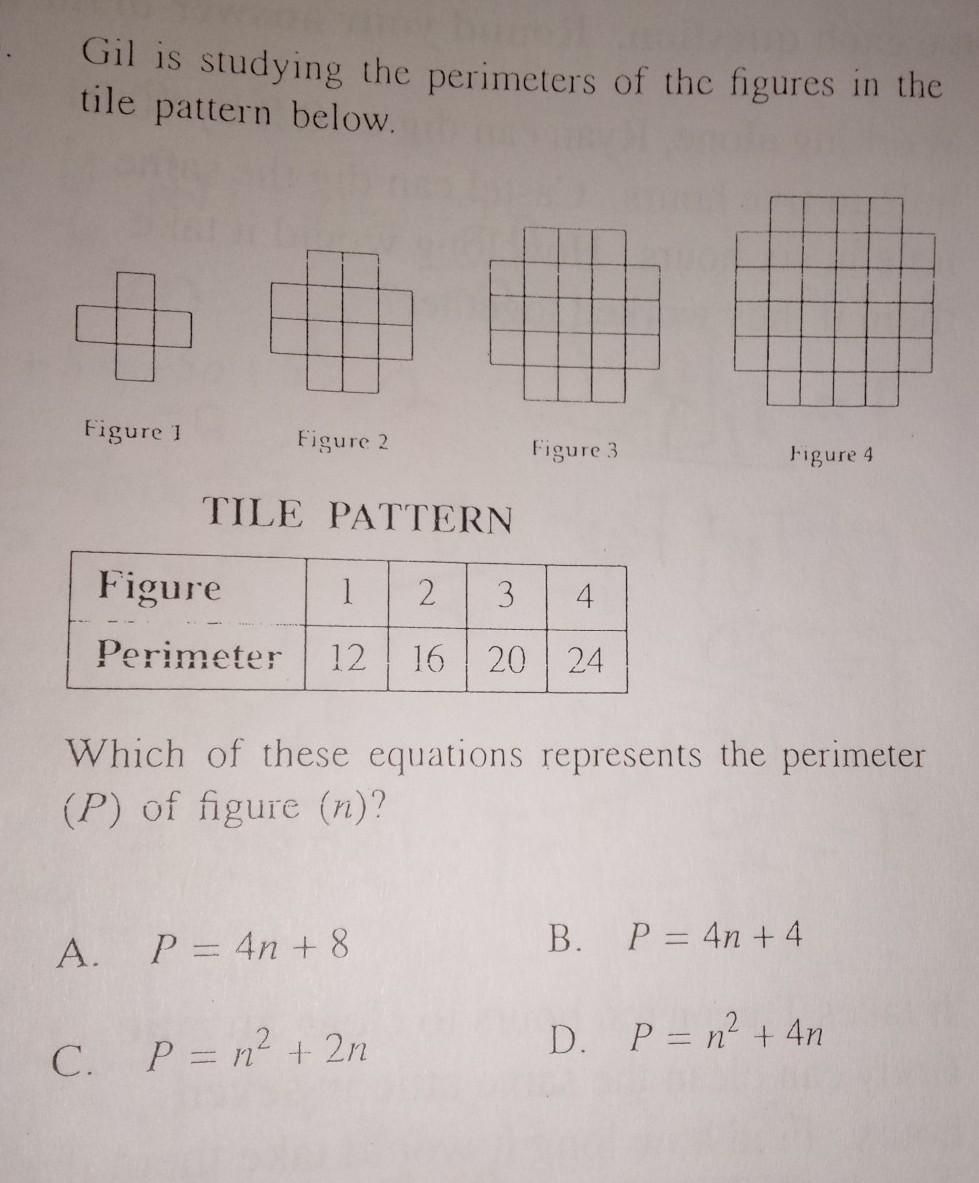
Can someone help please
Answers
Answer:
option a
Step-by-step explanation:
in figure 1: 4n+8 = 4×1=4+8=12
figure 2:4n+8 =4×2=8+8=16 and so on
What is the following product?

Answers
Answer:
\(10\sqrt{3}\)
Step-by-step explanation:
One is given the following expression:
\(\sqrt{30}*\sqrt{10}\)
One property of multiplying square roots is that one can multiply the numbers under the radical by each other, and then put the radical on top of the result. The following is an example of this general format of this property:
\(\sqrt{a}*\sqrt{b}=\sqrt{ab}\)
Apply this to the real problem:
\(\sqrt{30}*\sqrt{10}=\sqrt{30*10}\)
Simplify,
\(\sqrt{30*10}=\sqrt{300}\)
Rewrite as (300) as the product of two numbers, such that one number is a perfect square:
\(\sqrt{300}=\sqrt{3*10^2}\)
Simplify, take a term out of the radical:
\(\sqrt{3*10^2}=10\sqrt{3}\)
which of the following, when included, distorts the effectiveness of charting data points? a) too many series b) too many data points c) too much variance in the values of the data d) aggregates
Answers
Aggregates is distorts the effectiveness of charting data points. So the option d is correct.
In the given question, we have to select which of the following, when included, distorts the effectiveness of charting data points.
Charts are a quick and efficient way to communicate information to your audience. If the charts are properly created, that is.
A lot goes into creating the ideal visual material, and it's simple to let some components slip. Charts that are hurriedly created are frequently more detrimental than beneficial.
We've compiled a list of useful do's and don'ts to bear in mind while building your own data representations, whether they take the shape of straightforward bar charts and graphs or more intricate interactive visualizations, in order to help you prevent this.
To learn more about interactive visualizations link is here
brainly.com/question/28110252
#SPJ4
Emma is making posters by hand to advertise her school play, but her posters are not the same
length as a standard sheet of paper (the width is the same, though). She has 3 1/2 sheets of paper
left over, which she says is enough to make 2 1/3 posters. How many sheets of paper (and parts of
a sheet) does each poster use?
Answers
Answer:
1 1/2 sheets
Step-by-step explanation:
7/3 x = 7/2
x=3/2
The ages of 20 school children are recorded as follows:. 13 19 15 17 13 9 11 9 11 15 17 15 11 9 9 11 15 11 11 11. a. Make a frequency for the data b. What is the modal age c. Calculate. i) The mean age correct to the nearest whole number. ii) The range. d. What is the probability of selecting a child between the ages of 12 and 14
Answers
Answer:
The modal age is 11
The range is the highest minus the Lowe's which is 19-9=10
5) let the random variable x be the apgar score of a randomly selected newborn baby. the table gives the probability distribution of x. calculate and interpret the mean and standard deviation of x.
Answers
The mean and standard deviation of the random variable X, representing the Apgar score of a randomly selected newborn baby, can be calculated using the given probability distribution table. The mean is a measure of the average score, while the standard deviation indicates the variability or spread of the scores.
To calculate the mean, multiply each score by its corresponding probability and sum the results. For example, if the Apgar score is 0, the probability is 0.05. If it is 1, the probability is 0.10, and so on. Multiply each score by its respective probability and sum the products. This will give you the mean.
The standard deviation is a bit more complex to calculate. First, subtract the mean from each score, square the differences, multiply them by their respective probabilities, and sum the products. Then, take the square root of this sum. The result is the standard deviation.
Interpreting the mean, it represents the expected average Apgar score of the randomly selected newborns based on the given probability distribution. The standard deviation, on the other hand, provides a measure of the variability or spread of the Apgar scores around the mean. A higher standard deviation indicates a wider range of scores, suggesting more variability in the newborns' conditions at birth.
Learn more about probability here: https://brainly.com/question/31828911
#SPJ11
PLEASE HELP QUICK TYSM
Answers
Answer:
Step-by-step explanation:oooooooooooooooooooooooooooooooooooooo
o
A box contains a total of 30 paper clips with colors in the ratio red:white:blue = 2:5:3. Suppose that one paper clip of each color is removed from the box and not replaced. What is the probability that the next paper clip chosen will be blue?
A: 5/27
B: 2/7
C: 8/27
D: 3/10
Answers
Answer:
C.8/27
Step-by-step explanation:
PLEASE HELP MARK BRAINLIESTS!!!!

Answers
Answer:
x=15 y=3
Both (4x+10y) and (6x) equal 90 degrees, as angle 4x+10y is vertical to a 90 degree right angle, and angle 6x is directly beneath the right angle, making it equivalent. To find x, you simply do 90/6, which is 15, meaning x=15. Now plug in that into 4x+10y=90, which will make it 60+10y=90. Subtract 60 from 90, and divide the difference, 30, by 10, giving you 3, thus showing that y=3. You can double check by plugging in the x and y values.
What is 2x^2+ 3x -5 in factored form ?
Answers
the answer in factored form is (2x+5) (x-1)
Given f(x) = 3x^2 - 6x + 2 find f(3)
HELP PLEASE ‼️‼️‼️

Answers
Answer: 47
Step-by-step explanation:
You simplify it giving you 47
Answer:
f(3)=11
Step-by-step explanation:
3(3)^2=27
-6(3)=-18
27-18+2=11
two positive numbers have a sum of 24. what is the maximum product of one number times the square of the second number?
Answers
The required numbers is x=12 and y=24−x=24−12=12 i.e.(12,12).
What is differentiation ?
In math, isolation is one of the two important generalities piecemeal from integration. Isolation is a system of chancing the outgrowth of a function. Isolation is a process, in Maths, where we find the immediate rate of change in function grounded on one of its variables. The most common illustration is the rate change of relegation with respect to time, called haste. The contrary of chancing a outgrowth isanti-differentiation.
still, also the rate of change of x with respect to y is given by dy/ dx, If x is a variable and y is another variable. This is the general expression of outgrowth of a function and is represented as f'( x) = dy/ dx, where y = f( x) is any function.
Let the two number is x and y
According to given question.
Sum of two number =24
x+y=24
Then, y=24−x.......(1)
Again, product
P=maximum=x × y
P=x(24−x 2)
P=24x−24x^2 .......(2)
We know that,
For maximum value
dP/dx =0
Now differentiating equation (2) with respect to x and we get,
dP/dx =24−2x
⇒ 24−2x=0
⇒ 2x=24
⇒x=12
Again, differentiating equation (2) with respect to x and we get,
\(\frac{d^2p}{dx^2} = -2 < 0\)
Then,P is minimum at point x=12
Hence, the required numbers is x=12 and y=24−x=24−12=12 i.e.(12,12)
This is the solution.
Learn more about differentiation click here:
https://brainly.com/question/23819325
#SPJ1
please help me!! show the work so I can understand!

Answers
Answer: $160.16
Step-by-step explanation:
$154 is equal to 100%. They way I do it for smaller percents (like 1% -10%) is I find 1% of the number by dividing by 100. In this case, that is $1.54. To find 4%, you multiply that 1% by 4 to get $6.16. By adding that 4% to the 100% you get 104%, or the total price including tax, which is $160.16.
Please tell me the answer I have been struggling. PS this is middle school math

Answers
Answer:8
Step-by-step explanation
Answer:
\(\frac{4}{8}\)=\(\frac{50}{100}\)
Step-by-step explanation:
phân số 2/5 trừ cho 8/4
Answers
Answer:
The answer in fraction is -1.6
Câu trả lời ở dạng phân số là -1.6
Step-by-step explanation:
Answer:
2/5 - 8/4 = 8/20 - 40/20 = -32/20
kết quả là -32/20
What is the amplitude of g(x)=8cos(5πx+3π/2)-9
Answers
Answer:
8
Step-by-step explanation:
The value of the amplitude is always positive and it tends to be number in front of the cosine function so for example by using the form 'a.cos(bx - c) + d', we can know that the amplitude is the number in front of the function so its 'a'
Which of the following cells secrete nerve growth factors that stimulate outgrowth of severed axons?
Neurolemmocytescranial nerves
spinal nervesoligodendrocyte
Answers
The cells that secrete nerve growth factors that stimulate outgrowth of severed axons are neurolemmocytes. therefore option a. neurolemmocytes is correct.
Neurolemmocytes, also known as Schwann cells, are cells that surround and support neurons in the peripheral nervous system.
They play a vital role in the regeneration of damaged axons by secreting nerve growth factors that stimulate outgrowth of severed axons, as well as by forming a path for new axonal growth during the healing process.
They also provide insulation to axons, which is essential for efficient conduction of nerve impulses.
Therefore, neurolemmocytes play a critical role in the proper functioning of the peripheral nervous system.
for such more question on neurolemmocytes.
https://brainly.com/question/29816449
#SPJ11
Please help
It’s due tonight

Answers
Answer:
it -8 2÷-14=-7 x=-7
-7+-1=-8
Keenan fills a box with 3 layers of blocks. Each layer has 16 blocks. The volume of
each block is 1 cubic inch. What is the volume of the box?

Answers
Answer:
the answer is 48 cubic inches please mark me as brainliest please