-Exponential and Logarithmic functions- Write an exponential function of the form...

Answers
We are asked to write an exponential function of the form
\(y=ab^x\)The function passes through the following two points
(3, 2) and (6, 16)
Let us substitute these two points into the above equation.
For point (3, 2):
\(\begin{gathered} 2=ab^3 \\ a=\frac{2}{b^3} \end{gathered}\)For point (6, 16):
\(\begin{gathered} 16=ab^6 \\ a=\frac{16}{b^6} \end{gathered}\)Equate the two equations to solve for b
\(\begin{gathered} \frac{2}{b^3}=\frac{16}{b^6} \\ 2\cdot b^6=16\cdot b^3 \\ \frac{2b^6}{2b^3}=\frac{16b^3}{2b^3} \\ b^3=8 \\ b=\sqrt[3]{8} \\ b=2 \end{gathered}\)So, the value of b is 2
Finally, the value of a is given by
\(a=\frac{2}{b^3}=\frac{2}{(2)^3}=\frac{2}{8}=\frac{1}{4}\)So, the value of a is 1/4
Therefore, the exponential function is
\(y=\frac{1}{4}\cdot2^x\)Related Questions
Identifying the values a, b, and c is the first step in using the Quadratic Formula to find solution(s) to a quadratic equation. What are the values a, b, and c in the following quadratic equation? -3x^2 -5x +9 =0
Answers
Answer:
The quadratic equation is in the standard form: ax^2 + bx + c = 0. To use the quadratic formula to find the solutions, we need to identify the values of a, b, and c in the equation:
a is the coefficient of the x^2 term, which is -3 in this case.
b is the coefficient of the x term, which is -5 in this case.
c is the constant term, which is 9 in this case.
Therefore, the values of a, b, and c in the quadratic equation -3x^2 - 5x + 9 = 0 are:
a = -3
b = -5
c = 9
Factor: -5a - 16 =
Answer?
Answers
Answer:
Do you need the answer or the factor??
Step-by-step explanation:
Answer: -(5a+16)
Step-by-step explanation:
help me please please

Answers
The length of the pool would be 8.5 x 4.5 = 38.25 meters.
Using the Pythagorean theorem the diagonal is:
Diagonal = sqrt(38.25^2 + 8.5^2)
Diagonal = 39.183 meters
You swim it 6 times.
Total distance = 39.183 x 6 = 235.098 meters.
Round to 2 decimals = 235.10 meters
What is the probability that either event will occur?
A
30
8
B
7
P(A or B) = P(A) + P(B)
P(A or B) = [?]
Enter as a decimal rounded to the nearest hundredth.
![What is the probability that either event will occur?A308B7P(A or B) = P(A) + P(B)P(A or B) = [?]Enter](https://i5t5.c14.e2-1.dev/h-images-qa/contents/attachments/qz1Ahrt6PyIwHX0nEOEQWHayCEmFtUNi.png)
Answers
The probability that either event will occur is 0.33
What is the probability that either event will occur?From the question, we have the following parameters that can be used in our computation:
Event A = 8Event B = 7Other Events = 30Using the above as a guide, we have the following:
Total = A + B + C
So, we have
Total = 8 + 7 + 30
Evaluate
Total = 45
So, we have
P(A) = 8/45
P(B) = 7/45
For either events, we have
P(A or B) = 8/45 + 7/45
P(A or B) = 15/45
Evaluate
P(A or B) = 0.33
Hence, the probability that either event will occur is 0.33
Read more about probability at
brainly.com/question/251701
#SPJ1
(q − 10) (q² + q +1)
Answers
q^3-9q^2-9q-10
- Suppose y varies directly as x. If y = -7 when x = -14, find y when x=3
Answers
Answer:1.5
Step-by-step explanation:
Y=1/2 of x
The Melbourne Formula 1 track is 5.303 km in length.
The track record is 1 minute and 24 seconds. What is
the average speed (km/h) for the lap record? Answer
correct to two decimal places.
Answers
To calculate the average speed of the lap record, we need to know the distance covered and the time taken.
Distance = 5.303 km
Time = 1 minute and 24 seconds = 84 seconds
To convert seconds to hours, we divide by 3600 (the number of seconds in an hour):
\( \frac{84 \: seconds \:}{3600} = 0.02333 \: hours\)
Now we can calculate the average speed:
\(Average \: speed = \frac{d}{t} = \frac{5.303km}{0.02333} \)
Average speed = 227.59 km/h
A different customer wants Ellie to spread fertiliser on a lawn.
A shop sells these bags of fertiliser.
Lawn fertiliser 750 grams £2.95
Ellie uses 40 grams of fertiliser for every square metre of lawn.
The area of the lawn is 145 square metres.
She needs to buy enough bags for the whole lawn.
Work out the total cost of the fertiliser Ellie needs.
Answers
Ellie needs 5050 grams extra fertilizer and total cost of fertilizer = 22.81-pound sterling.
what is multiplication and division?Multiplication is the product of two or more numerical terms. Division is the process of dividing any numbers into equal parts.
What is the total cost of fertilizer that Ellie needs?
Cost of 750 grams fertilizer = 2.95-pound sterling,
the area of the lawn = 145 square meters.
Ellie uses 40 grams fertilizer for every square meter of lawn.
So, fertilizer needed for the 145 square meters of land = (145 × 40)
= 5800 grams
it stated earlier that 750-gram fertilizer was bought but Ellie needs 5800 grams fertilizer.
the extra amount of fertilizer that Ellie needs = (5800 - 750) = 5050 grams.
cost of 750 gram fertilizer = 2.95-pound sterling
cost of 5050-gram fertilizer = (2.95 × 5050) / 750 = 19.86-pound sterling
cost of extra fertilizer = 19.86-pound sterling.
Total cost of fertilizer = (2.95 + 19.86) pound sterling
= 22.81-pound sterling
To learn more about division and multiplication visit:
https://brainly.com/question/1292482
#SPJ1
A summer camp rewards campers and counselors with badges. The camp orders 200 badges. They plan to give 25 badges to counselors. They ordreed at least 3 badges for each camper.
a. How many campers could be at the camp?
b. Are all the values on the graph of c is less than or equal to 58 possible solutions? Explain.
correct answer gets a brainless
Answers
Answer:
58 campers,
Step-by-step explanation:
you do 200 - 25 then 175 divided by 3
The British Department of Transportation studied to see if people avoid driving on Friday the 13th. They did a traffic count on a Friday and then again on a Friday the 13th at the same two locations ("Friday the 13th," 2013). The data for each location on the two different dates is in table #9.2.6. Estimate the mean difference in traffic count between the 6th and the 13th using a 90% level. Dates 6th 13th 1990, July 139246 138548 1990, July 134012 132908 1991, September 137055 136018 1991, September 133732 131843 1991, December 123552 121641 1991, December 121139 118723 1992, March 128293 125532 1992, March 124631 120249 1992, November 124609 122770 1992, November 117584 117263
Answers
Answer: The mean difference is between 799586.3 and 803257.9.
Step-by-step explanation: To estimate the mean difference for confidence interval:
Find the statistic sample:
d = value of 6th - value of 13th;Sample mean of difference: mean = ∑d / nSample standard deviation: s = ∑(d - mean)² / n - 1;For the traffic count, mean = 1835.8 and s = 1382607.3
The confidence interval is 90%, so:
α = \(\frac{1-0.9}{2}\)
α = 0.05
The degrees of dreedom are:
df = n - 1
df = 10 - 1
df = 9
Using a t-ditribution table, the t-score for α = 0.05 and df = 9 is: t = 1.833.
Error will be:
E = \(t.\frac{s}{\sqrt{n} }\)
E = 1.833.(\(\frac{1382607.3}{\sqrt{10} }\))
E = 801422.1
The interval is: mean - E < μ < E + mean
1835.8 - 801422.1 < μ < 1835.8+801422.1
-799586.3 < μ < 803257.9
The estimate mean difference in trafic count between 6th and 13th using 90% level of confidence is between 799586.3 and 803257.9.
What is 130 rounded to the nearest hundred?
Answers
Answer:
100
Step-by-step explanation:
30 rounds down
I am doing principle rate and time and trying to figure out how to find out what the missing number is whether it be rate time or principle
Answers
Generally, the equation representing the simple interest on a deposited amount is;
\(I\text{ = }\frac{PRT}{100}\)where ;
I is the simple interest
R is the rate
T is the time
We have other varaints of this formula, depending on the term missing
All we have to is to make the missing term the subject of the equation and input the other given values to get the missing term
We can have the variants of this formula as follows
a) Missing Principal
\(P\text{ = }\frac{100I}{RT}\)b) Missing Rate
\(R\text{ = }\frac{100I}{PT}\)c) Missing Time
\(T\text{ = }\frac{100I}{PR}\)f(x) = x³ + 2x - 1, a = -4
(f⁻¹)′( - 4) = ?
Answers
Recall the inverse function theorem. If \(f\) is invertible and differentiable in all the right places, then
\(f^{-1}\bigg(f(x)\bigg) = x \\\\ ~~~~~~~~ \implies \left(f^{-1}\right)'\bigg(f(x)\bigg) f'(x) = 1 \\\\ ~~~~~~~~ \implies \left(f^{-1}\right)'\bigg(f(x)\bigg) = \dfrac1{f'(x)} \\\\ ~~~~~~~~ \implies \left(f^{-1}\right)'(x) = \dfrac1{f'\left(f^{-1}(x)\right)} \\\\ ~~~~~~~~ \implies \left(f^{-1}\right)'(-4) = \dfrac1{f'\left(f^{-1}(-4)\right)}\)
Solve for \(x\) such that \(f(x)=-4\).
\(x^3 + 2x - 1 = -4 \\\\ x^3 + 2x + 3 = 0 \\\\ (x + 1) (x^2 - x + 3) = 0\)
\(x^2-x+3=0\) has non-real solutions, so we're left with
\(x+1 = 0 \implies x = -1\)
Then we have
\(f(-1) = -4 \implies f^{-1}(-4) = -1 \implies \left(f^{-1}\right)' (-4) = \dfrac1{f'(-1)} = \boxed{\dfrac15}\)
since
\(f(x) = x^3 + 2x - 1 \implies f'(x) = 3x^2 + 2 \implies f'(-1)=5\)
A group of ten friends played a number guessing game. They were asked to pick a number
between 1 and 20. The person closest to the target number wins. The ten people made these
guesses:

Answers
The table with the absolute guessing errors should be completed as follows;
Guess 2 15 10 8 12 19 20 5 7 9
Absolute guessing error 12 1 4 6 2 5 6 9 7 5
A graph of the guess and absolute guessing error is shown in the image attached below.
Yes, the absolute guessing error is a function of the guess because every guess (input value) has one absolute guessing error (output value).
What is the margin of error?In Mathematics, the margin of error (MOE) is sometimes referred to as an absolute guessing error and it can be defined as a measure of the difference that exist between an observed value and a true value of the population parameter.
Mathematically, the absolute guessing error for the guesses made by these group of ten friends with respect to the actual number of 14 as follows;
Absolute guessing error = 14 - 2 = 12
Absolute guessing error = 14 - 15 = 1
Absolute guessing error = 14 - 10 = 4
Absolute guessing error = 14 - 8 = 6
Absolute guessing error = 14 - 12 = 2
Absolute guessing error = 14 - 19 = 5
Absolute guessing error = 14 - 20 = 6
Absolute guessing error = 14 - 5 = 9
Absolute guessing error = 14 - 7 = 7
Absolute guessing error = 14 - 9 = 5
Read more on absolute value function here: brainly.com/question/1616026
#SPJ1

Use the distributive property to remove the parentheses.
-2(5u - 3x-6)
Answers
Answer:
I think it would be: -10u - 6x 12
Step-by-step explanation:
(step 1) -2(5u - 3x-6) "First you need to times -2 by 5, 3 and -6"
that should give you -10u - 6x 12
HELPPP MEEEEE PLSSS PLSSS

Answers
Answer:
Below
Step-by-step explanation:
-4 1/4 + 5 3/8
-17/4 + 43/8
-34/8 + 43/8 = 9/8 = 1 1/8
Answer:
Step-by-step explanation:
1 1/8
I converted the numbers into a mixed number
The first one was -17/4 and the other one was -43/8 but I had to find a common denominator so I multiplied the first one by 2 and the 2nd by one getting -34/8 and then for the 2nd one it stayed the same which is -43/8.
After I subtracted -34 and -43 and got 9/8 which is equal to 1 1/8
(Hope this is right...if wrong I'm sorry)
Place the numbers 2,4,6,8,10,12, 14, 16,18 in the squares below so that the sum of the numbers in every column, row, and diagonals is equal to 30.
Answers
The way the numbers will be placed in the square box will be:
First row = 4 12 14
Second row = 2 10 18
Third row = 6 8 16
How to illustrate the information?It should be noted that the question is simply about adding the numbers and getting 39 in each place.
This will be:
First row = 4 12 14 = 4 + 12 + 14 = 30
Second row = 2 10 18 = 2 + 10 + 18 = 30
Third row = 6 8 16 = 6 + 8 + 16 = 30
Learn more about squares on:
brainly.com/question/24673551
#SPJ1
if opposite angles of a quadrilateral are supplementary then the quadrilateral is a parallelogram? true or false?
Answers
False. If opposite angles of a quadrilateral are supplementary then the quadrilateral is not a parallelogram.
What are supplementary angles?Two angles are said to be supplementary angles if their sum is equal to 180 degrees.
What are the angle properties of a parallelogram?In a parallelogram the sum of adjacent angles is equal to 180 degrees which means that the adjacent angles are supplementary. Whereas, the opposite angles in a parallelogram are congruent (equal). Hence, the statement is false.
To learn more about supplementary angles visit the link below:
https://brainly.com/question/27624512
#SBJ4
A parking manager recorded the number of cars in a city parking lot. She found that 90% of the parking spaces in the lot were occupied. If there are 30 spaces in the parking lot, how many are occupied with a car?
Answers
Answer:
divide 90 and 30 to see what you got
Step-by-step explanation:
A marketing firm conducts a survey to determine the ages of their survey subjects who like a new health drink.
This is the resulting data from their survey:
49, 63, 78, 22, 41, 39, 75, 61, 63, 65,
58. 37. 45, 52, 81, 75, 78, 72, 68, 59,
72, 85, 63, 61, 75, 39, 41, 48, 59,55
61, 25, 61, 52, 58, 71, 75, 82, 49, 51
The mean age of the subjects who like the new health drink is (type your answer...)
and the median age of the subjects is (type your answer..)
Answers
Answer:
Mean = 59.1, Median = 61
(there might have been a mistake in calculation (a lot of numbers!))
Step-by-step explanation:
The sample size is 40,
Now, the formula for the mean is,
Mean = (sum of the sample values)/(sample size)
so we get,
\(Mean = (49+63+78+22+41+39+75+61+63+65+58+37+45+52+81+75+78+72+68+59+72+85+63+61+75+39+41+48+59+55+61+25+61+52+58+71+75+82+49+51)/40\\Mean = 2364/40\\Mean = 59.1\)
To find the median, we have to sort the list in ascending (or descending)order,
we get the list,
22,25,37,39,39,41,41,45,48,49,
49,51,52, 52,55,58, 58, 59, 59, 61,
61, 61, 61, 63, 63, 63, 65, 68, 71, 72,
72, 75, 75, 75, 75, 78, 78, 81, 82, 85
Now, we have to find the median,
since there are 40 values, we divide by 2 to get, 40/2 = 20
now, to find the median, we takethe average of the values above and below this value,
\(Median = ((n/2+1)th \ value + (n/2)th \ value )/2\\where, \ the\ (n/2)th \ value \ is,\\n/2 = (total \ number \ of \ samples) /2\\n/2=40/2\\(n/2)th = 20\\Hence\ the (n/2)th \ value \ is \ the \ 20th \ value\)
And the (n+1)th value is the 21st value
Now,
The ((n/2)+1)th value is 61 and the nth value is 61, so the median is,
Median = (61+61)/2
Median = 61
PLZZZZ HELLP MEEEEEEEEE IL GET U BRIANIEST
(or whatever its called)
what value of y makes the equation true -6( y + 15) = -3y + 6
Answers
Answer:
-32
Step-by-step explanation:
do you need me to explain?
Answer:
y = -32
Step-by-step explanation:
thanks for helping me
answer 2-4 and 8-20 please it does not need to be correct but please havve them be plausible answers
Answers
The algebraic values of x include:
2. 51 3. 50 4. 82simplest radical form: 8. 2√85 9. √89 10. 2√181 11. 2√181 12. 3√5 13. 10√516. right triangle.17. not a right triangle.18. not a right triangle.19. acute 20. acuteHow to calculate sides of a triangle?Using the same reasoning as in the previous problem:
24² + 45² = x²
576 + 2025 = x²
2601 = x²
x = ±51
Since x represents a length, discard the negative solution. Therefore, the value of x is 51.
Using the Pythagorean Theorem:
30² + 40² = x²
900 + 1600 = x²
2500 = x²
x = ±50
Since x represents a length, discard the negative solution. Therefore, the value of x is 50.
Using the Pythagorean Theorem:
18² + 80² = x²
324 + 6400 = x²
6724 = x²
x = ±82
Since x represents a length, discard the negative solution. Therefore, the value of x is 82.
Using the Pythagorean Theorem:
18² + 4² = x²
324 + 16 = x²
340 = x²
x = √340 = 2√85
Therefore, the value of x is 2√85 in simplest radical form.
Using the Pythagorean Theorem:
8² + 5² = x²
64 + 25 = x²
89 = x²
x = √89
Therefore, the value of x is √89 in simplest radical form.
Using the Pythagorean Theorem:
20² + 18² = x²
400 + 324 = x²
724 = x²
x = √724 = 2√181
Therefore, the value of x is 2√181 in simplest radical form.
Using the Pythagorean Theorem:
25² + 3² = x²
625 + 9 = x²
634 = x²
x = √634
Therefore, the value of x is √634 in simplest radical form.
Using the Pythagorean Theorem:
3² + 6² = x²
9 + 36 = x²
45 = x²
x = √45 = 3√5
Therefore, the value of x is 3√5 in simplest radical form.
Using the Pythagorean Theorem:
22² + 4² = x²
484 + 16 = x²
500 = x²
x = √500 = 10√5
Therefore, the value of x is 10√5 in simplest radical form.
To determine if a triangle is a right triangle, we can use the Pythagorean Theorem, which states that for any right triangle, the square of the length of the hypotenuse is equal to the sum of the squares of the lengths of the other two sides. Therefore:
a² + b² = c²
Substituting a = 8, b = 15, and c = 17:
8² + 15² = 17²
64 + 225 = 289
289 = 289
Since the equation is true, the triangle satisfies the Pythagorean Theorem and is therefore a right triangle.
Using the same method:
27² + 36² = 45²
729 + 1296 = 2025
2025 ≠ 2025
Since the equation is false, the triangle does not satisfy the Pythagorean Theorem and is therefore not a right triangle.
Using the same method:
9² + 11² = 4²
81 + 121 = 16
202 ≠ 16
Since the equation is false, the triangle does not satisfy the Pythagorean Theorem and is therefore not a right triangle.
To determine the classification of this triangle, compare the lengths of its sides. If all sides are less than the sum of the other two, then the triangle is acute; if one side is greater than or equal to the sum of the other two, then the triangle is obtuse; and if one side is equal to the sum of the other two, then the triangle is degenerate (a straight line).
Substituting a = 3, b = 4, and c = 6:
a + b = 3 + 4 = 7 < c
b + c = 4 + 6 = 10 > a
a + c = 3 + 6 = 9 > b
Since none of the sides are equal to or greater than the sum of the other two, the triangle is acute.
Substituting a = 9, b = 11, and c = 16:
a + b = 9 + 11 = 20 < c
b + c = 11 + 16 = 27 > a
a + c = 9 + 16 = 25 > b
Since none of the sides are equal to or greater than the sum of the other two, the triangle is acute.
Find out more on triangles here: https://brainly.com/question/1058720
#SPJ1
Image transcribed:
Algebra Find the value of x.
1. 12, 9, x
To start, use the Pythagorean Theorem. Then substitute 9 for a, 12 for b, and x for c.
2. 45 24 x
3. 30, 40, x
4. 80, 18, x
Algebra Find the value of x. Express your answer in simplest radical form.
8. 18, 4, x
9. 8, 5, x
10. 20, 18, x
11. 25, 3, x
12. 3, 6, x
13. 22, 4, x
Is each triangle a right triangle? Explain.
16. 15, 17, 8
17. 27, 45, 36
18. 9, 11, 4
The lengths of the sides of a triangle are given. Classify each triangle as acute, right, or obtuse.
19. 3,4,6
To start, compare to a+b. Substitute the greatest length for c.
20. 9, 11, 16
Find the measure of the angle to the nearest degree. Make sure to include your steps. PLEASE I NEED HELPPPP FASTT
a) sin A = 0.6018
b) cos B = 0.9205
c) tan C = 0.0349
Answers
Answer:
Sure, I can help with that! Here are the steps to solve each problem:
a) Since sin A = 0.6018, we can use the inverse sine function (sin^-1) to find the measure of angle A. Taking the inverse sine of 0.6018 gives us 37.19 degrees rounded to the nearest degree.
b) Since cos B = 0.9205, we can use the inverse cosine function (cos^-1) to find the measure of angle B. Taking the inverse cosine of 0.9205 gives us 23.06 degrees rounded to the nearest degree.
c) Since tan C = 0.0349, we can use the inverse tangent function (tan^-1) to find the measure of angle C. Taking the inverse tangent of 0.0349 gives us 2.00 degrees rounded to the nearest degree.
I hope that helps! Let me know if you need any further assistance.
[~S & (R V S) ] ≡ (Q ⊃ S) where A = T, S = F, R = F, Q = T
Answers
[~S & (R V S)] ≡ (Q ⊃ S) is true when A = T, S = F, R = F, and Q = T by substituting the propositional variables.
What is truth table?A truth table is a table used to determine the truth values of a compound proposition, which is a logical statement made up of simpler propositions using logical operators such as "and" (represented by "&"), "or" (represented by "V"), "not" (represented by "~"), conditional (represented by "⊃"), and biconditional (represented by "≡").
According to question:Let's substitute the given truth values for the propositional variables in the given statement:
[~F & (F V F)] ≡ (T ⊃ F)
Using the truth table for conjunction (represented by "&") and disjunction (represented by "V"), we can simplify the left-hand side of the equivalence:
[T & F] ≡ (T ⊃ F)
Using the truth table for conditional (represented by "⊃"), we can simplify the right-hand side of the equivalence:
F ≡ F
Since both sides of the equivalence have the same truth value, the statement is true.
Therefore, [~S & (R V S)] ≡ (Q ⊃ S) is true when A = T, S = F, R = F, and Q = T.
Learn more about truth table visit:
https://brainly.com/question/29155453
#SPJ1
what is the area of the shaded region in the figure below
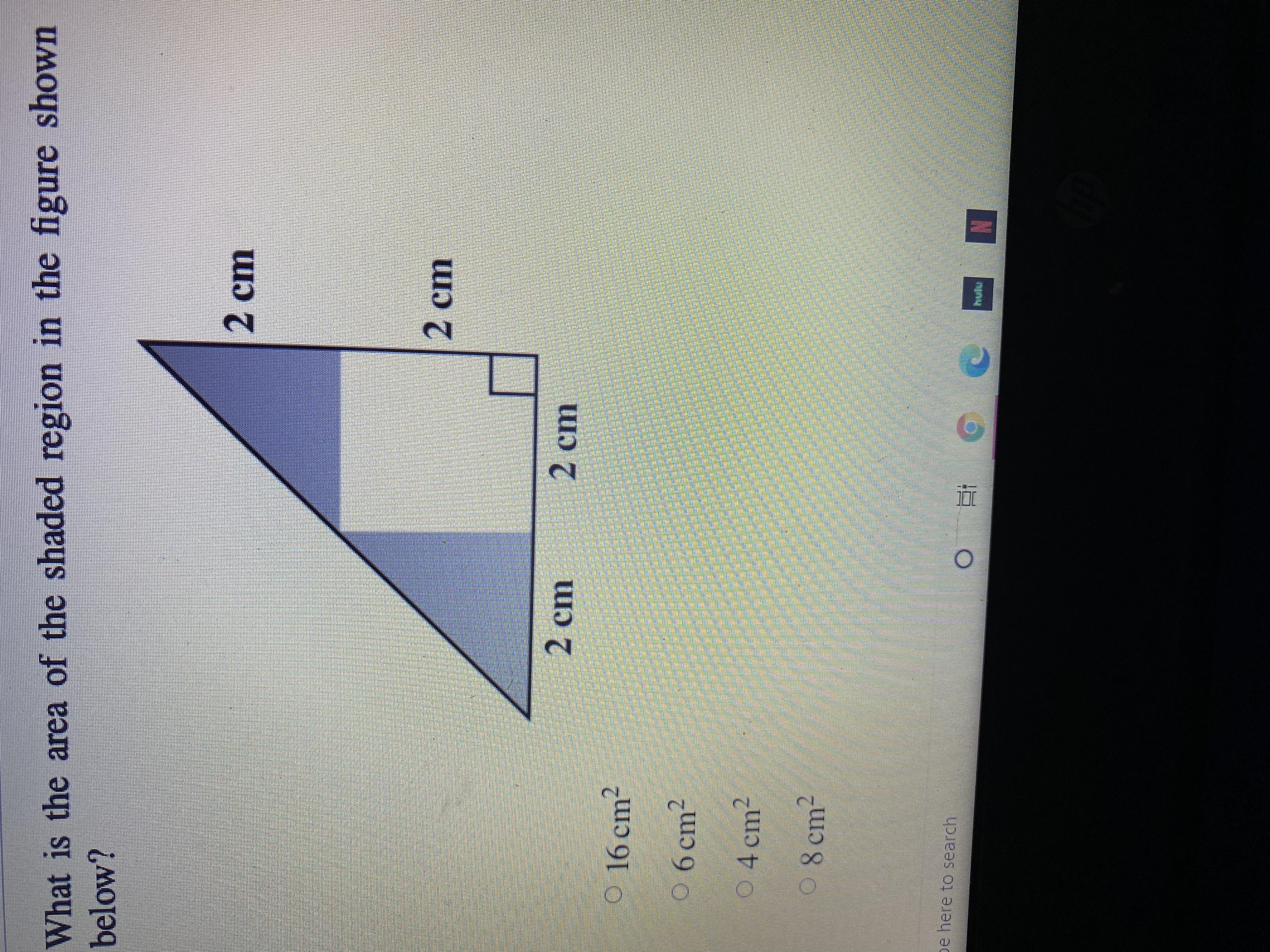
Answers
Answer:
4 cm^2
Step-by-step explanation:
2 x 2 x 0.5 x 2 = 4 cm^2
Hi there!
\(\huge\boxed{4 \text{ cm}^{2}}\)
Find the area of the shaded area using the given dimensions:
The shaded area is divided up into two triangles, each with a base of 2 cm and a height of 2 cm. Use the following equation to solve for area:
A = 1/2(bh)
A = 1/2(2 · 2)
A = 1/2(4) = 2 cm²
There are two triangles, therefore:
2 × 2 = 4 cm²
I want a correct answer you can take your time. If I was born on December 24, two thousand and four and my classmate was born on April 9, two thousand and six, how many months, years and days are we apart?
Answers
Answer:
5years, 3months, 16 days
A bus company took a tour bus on the ferry when there were 30 people aboard. The ferry charged the bus company $180. The following week, the bus had 50 people on board and the ferry charged them $220. How much is the "base rate" for the empty bus? hint: look at the difference between number of people and cost to get cost per person and then cost without people
How much does each person cost?
Write an equation to show cost, c, of a bus with x number of people on it
Answers
Answer:
Base rate: $120
Rate: $2 per person
Equation: f(x)=2x+120
Step-by-step explanation:
If 30 people cost $180 and 50 people cost $220, the charge for 20 extra people is $40. This means, \(\frac{220-180dollars}{50-30people}=\frac{40dollars}{20people}=2\frac{dollars}{person}\).
These values correspond to a base rate for the bus of $120.
The function for the cost per bus with x number of people on it would be:
\(f(x)=2x+100\)
This can be checked by using the values given in the problem:
\(f(30)=2(30)+120=180\\f(50)=2(50)+120=220\)
The base rate of $120 and $2 per person satisfies the given equation and established values.
Cliff takes out a $5,000 personal loan with 7
fixed annual interest compounded monthly to pay for his wedding. He repays the loan in 2 year.s
How much total interest does Cliff pay on his loan?
Answers
Cliff pays a total interest of approximately $679.90 on his $5,000 loan.
To calculate the total interest paid on the loan, we need to use the formula for compound interest:
\(A = P(1 + r/n)^{(nt)}\)
Where:
A is the final amount (loan amount + interest)
P is the principal (loan amount)
r is the annual interest rate (in decimal form)
n is the number of times interest is compounded per year
t is the number of years
Given that Cliff takes out a $5,000 loan with a fixed annual interest rate of 7% compounded monthly, we can substitute the values into the formula:
P = $5,000
r = 7% = 0.07
n = 12 (monthly compounding)
t = 2 years
\(A = 5000(1 + 0.07/12)^{(12 \times 2)\)
Calculating this expression:
A ≈ 5000\((1.00583)^{(24)\)
A ≈ 5000(1.13598)
A ≈ 5679.90
The final amount (A) is the loan amount plus the total interest paid. Therefore, to find the total interest paid, we subtract the principal (P) from the final amount (A):
Total Interest = A - P
Total Interest = 5679.90 - 5000
Total Interest ≈ $679.90
For similar question on total interest.
https://brainly.com/question/29415701
#SPJ8
Evaluate 3x^2-2x+8 when x=3
Answers
Step-by-step explanation:
f(x) = 3x² - 2x + 8 , x = 3
f(3) = 3.3² - 2.3 + 8
= 27 - 6 + 8
= 29
Please help fast!!!!!!!

Answers
Answer: 156.38 m
Step-by-step explanation:
Using the arc length formula, the answer is \(2\pi(8^2) \cdot \frac{140}{360} \approx 156.38\)