Evaluate.
16 ÷ (2 + 1/2) ^2
A) 2 14/25
B) 4 1/4
C) 6 2/5
D) 8 1/4
Answers
Answer:
\(\bold{2\frac{14}{25}}\)
Step-by-step explanation:
Follow the PEMDAS order of operations
P = Parenthesis
E = Exponents
M = Multiplication
D = Division
A = Addition
S = Subtraction
Step 1: Parenthesis
The first operation is parenthesis "()", and we have parenthesis so we solve the parenthesis first.
\(16\div(2+\frac{1}{2})^2\\\\=\frac{16}{\left(2+\frac{1}{2}\right)^2}\)
\(\underline{\mathrm{Solve}}\\\\(2+\frac{1}{2})\\\\=2+\frac{1}{2}\\\\=2\frac{1}{2}\)
\(\frac{16}{\left(2\frac{1}{2}\right)^2}\)
Step 2: Exponents
The Exponent is the tiny number on top of a bigger number. For example, we have \(2\frac{1}{2}^\bold{2}\), and the bolded part is the exponent. And the number there is how many times you will multiply the bigger number to itself. So we can simplify:
\((2\frac{1}{2})^2\\\\=2\frac{1}{2}\times2\frac{1}{2}\\\\=6\frac{1}{4}\)
\(\frac{16}{6\frac{1}{4}}\)
Step 3: Division
We don't have any multiplication, so we skip to the next operation in the order. Division:
\(\frac{16}{6\frac{1}{4}}=2\frac{14}{25}\\\\\bold{2\frac{14}{25}}\)
Related Questions
(a) The number of terms in an arithmetic progression is 40 and the last is -54. Given that the sum of the 15 terms added to the sum of the first 30 terms is zero. Calculate (1) The first term and common difference, (ii) the sum of the progression.
Answers
(i) The first term (a) is 24 and the common difference (d) is -2.
(ii) The sum of the progression is 2520.
i) Finding the first term and common difference:
Given that the number of terms in the arithmetic progression is 40 and the last term is -54, we can use the formula for the nth term of an arithmetic progression to find the first term (a) and the common difference (d).
The nth term formula is: An = a + (n-1)d
Using the given information, we can substitute the values:
-54 = a + (40-1)d
-54 = a + 39d
We also know that the sum of the first 15 terms added to the sum of the first 30 terms is zero:
S15 + S30 = 0
The sum of the first n terms of an arithmetic progression can be calculated using the formula:
Sn = (n/2)(2a + (n-1)d)
Substituting the values for S15 and S30:
[(15/2)(2a + (15-1)d)] + [(30/2)(2a + (30-1)d)] = 0
Simplifying the equation:
15(2a + 14d) + 30(2a + 29d) = 0
30a + 210d + 60a + 870d = 0
90a + 1080d = 0
a + 12d = 0
a = -12d
Substituting this value into the equation -54 = a + 39d:
-54 = -12d + 39d
-54 = 27d
d = -2
Now we can find the value of a by substituting d = -2 into the equation a = -12d:
a = -12(-2)
a = 24
Therefore, the first term (a) is 24 and the common difference (d) is -2.
ii) Finding the sum of the progression:
The sum of the first n terms of an arithmetic progression can be calculated using the formula:
Sn = (n/2)(2a + (n-1)d)
Substituting the values:
S40 = (40/2)(2(24) + (40-1)(-2))
S40 = 20(48 - 39(-2))
S40 = 20(48 + 78)
S40 = 20(126)
S40 = 2520
Therefore, the sum of the arithmetic progression is 2520.
for such more question on common difference
https://brainly.com/question/25731911
#SPJ8
help, I'm very lost. I dont know what to do.

Answers
Answer:
x=11
Step-by-step explanation:
(3x-1)+(6x-8)= 90
9x- 9= 90
+9 +9
9x=99
/9 /9
x=11
A 100 N boxer punches a 10 kg punching bag with his fist using a 25 N force. Describe the
forces on the fist and the punching bag.
A) The force on the fist is greater than the force on the punching bag.
B) The force on the fist is equal to the force on the punching bag.
C) The force on the fist is smaller than the force on the punching bag.
D) Not enough information is given to determine which force is larger or smaller
Answers
Answer:
B
Step-by-step explanation:
B is the answer to your question
— 12 – 6р – (-2)
help pls
Answers
Answer: -6P - 10
Step-by-step explanation:
STEP 1. -12 - 6P + 2
STEP 2. -6P + ( -12 + 2 )
STEP 3. -6P - 10
What is the difference between the sum of the measures of the interior angles in an octagon and the sum of the measures of the interior angles in a
hexagon?
540 degrees
180 degrees
360 degrees
720 degrees
PLS ANSWER IF YOU KNOW!!!
Answers
Interior angle refers to the angle inside a polygon that is formed by two of its adjacent sides. The sum of the measures of the interior angles of a polygon is given by the equation:
180°(n - 2)
where n is the number of sides
An octagon is a polygon that has 8 vertices and 8 sides. The sum of the measures of the interior angles of an octagon is:
180°8 - 2) = 180°6) = 1080°
On the other hand, a hexagon is a polygon that has 6 vertices and 6 sides. The sum of the measures of the interior angles of an octagon is:
180°6 - 2) = 180°4) = 720°
Subtracting the sum of the interior angles of the two polygons,
1080° - 720° = 360°
Parametric point from A (2,1,0) to B(-2,0,1)
Answers
The parametric equations are mathematically given as
(x(t), y(t), z(t))= (2-4t, 1-t, t)
What is a Parametric point?Generally, To express the parametric point from A (2,1,0) to B(-2,0,1) in parametric form, we can use the following equation:
P(t) = (2-4t, 1-t, t)
To find the parametric equations for a point moving from A to B, we can use the following formula:
x = x₁ + t(x₂ - x1)
y = y₁ + t(y₂ - y₁)
z = z₁ + t(z₂ - z₁)
Where (x₁, y₁, z₁) is the starting point (A), (x₂, y₂, z₂) is the ending point (B), and t is a parameter that varies from 0 to 1.
Using this formula, the parametric equations for a point moving from A (2,1,0) to B(-2,0,1) are:
x = 2 + t(-2 - 2)
= 2 - 4t
y = 1 + t(0 - 1)
= 1 - t
z = 0 + t(1 - 0)
= t
These equations describe the motion of a point that starts at A, moves along the line segment from A to B, and arrives at B when t = 1.
Read more about Parametric point
https://brainly.com/question/28537985
#SPJ1
The complete Question was found
Find parametric equations for the line. (Use the parameter t.)
The line through points A (2,1,0) to B(-2,0,1)
(x(t), y(t), z(t))= \((\square)\)
Are the lines -x-5y= 7 and the lines 5x-y=-9 perpendicular?
Answers
Any line that is perpendicular to a given line y = ax + b must have slope -1/a
For the lines -x - 5y = 7 and 5x - y = -9, first, we rewrite them in the slope-intercept form:
y = -x/5 - 7/5
y = 5x + 9
We can check that the slope of the first line is the negative inverse of the slope of the second line. Therefore, the lines are perpendicular.
Which expression has a negative value?
-12 x (-8)
-72 divided by (-9)
-11x6
-14 + 24

Answers
g(x) = 3x – 3, Find g(-3x)
Answers
Answer:
g(-3x) = -9x - 3
Step-by-step explanation:
Step 1: Define function
g(x) = 3x - 3
g(-3x) = x = -3x
Step 2: Substitute
g(-3x) = 3(-3x) - 3
g(-3x) = -9x - 3
Imagin math 40 points

Answers
Answer:
sale price of video game
Step-by-step explanation:
Mr. Marshal spent his salary of $8 400 in the following manner: Rental .....1/5 Food.......1/10 Bank ......1/4 Miscellaneous ......... the remainder. what fraction of the money was spent on miscellaneous. how much did he spend on rental. if marshal spent 4/9 of miscellaneous on a trip what fraction of his entire salary was spent on the trip ?
Answers
Mr. Marshal spent 1/4 of his salary on miscellaneous expenses and $1,680 on rental; therefore, he spent 1/36 of his entire salary on the trip.
To find the fraction of money spent on miscellaneous, we need to calculate the sum of the fractions spent on rental, food, and bank and subtract it from 1.
Rental: 1/5
Food: 1/10
Bank: 1/4
To find the fraction spent on miscellaneous:
Fraction spent on miscellaneous = 1 - (Rental + Food + Bank)
Rental + Food + Bank = 1/5 + 1/10 + 1/4 = (8 + 4 + 5)/40 = 17/40
Fraction spent on miscellaneous = 1 - 17/40 = 23/40
So, Mr. Marshal spent 23/40 of his salary on miscellaneous.
To find the amount spent on rental, we multiply the fraction spent on rental by his salary:
Amount spent on rental = (1/5) \(\times\) $8,400 = $1,680
Therefore, Mr. Marshal spent $1,680 on rental.
If Mr. Marshal spent 4/9 of the miscellaneous amount on a trip, we need to calculate the fraction of his entire salary spent on the trip.
Fraction spent on the trip = (4/9) \(\times\) (23/40) = 92/360 = 23/90
For similar question on fraction.
https://brainly.com/question/30154928
#SPJ8
pls help and explain how you got the answer

Answers
The class of the equation and the cross section equation are;
The equation is a hyperboloid of two sheets
The cross sections are;
Equation at z = 0 is; y²/8 - x²/8 = 1
Equation at y = -4 is; x²/8 + z² = 1
Equation at y = 0 is; x²/8 + z² = -1
Equation at y = 4 is; x²/8 + z² = 1
Equation at x = 0 is; y²/8 - z² = 1
What is an equation ?An equation is a mathematical statement which indicates the equivalence two expressions by joining them with the '=' sign.
The equation can be presented as follows;
y² = x² + 8·z² + 8
y² - x² - 8·z² = 8
y²/8 - x²/8 - z² = 1
The above equation is the equation of an hyperboloid of two sheets, where;
a² = 8, b² = 1, and c² = 8
Please find attached the diagram of the surface, created with an online 3D graphing tool.
The equation for the cross section at z = 0, can be obtained by plugging in z = 0, into the equation as follows;
y²/8 - x²/8 - 0 = 1
y²/8 - x²/8 = 1
The above equation is the equation of an hyperbola in the xy plane
The equation for the cross section at y = -4, can be obtained by plugging in y = -4, into the equation as follows;
4²/8 - x²/8 - z² = 1
- x²/8 - z² = 1 - 4²/8 = -1
- x²/8 - z² = -1
x²/8 + z² = 1
The above is an equation of an ellipse in the xz plane
The equation for the cross section at y = 0, can be obtained by plugging in y = 0, into the equation as follows;
0²/8 - x²/8 - z² = 1
- x²/8 - z² = 1
Therefore; x²/8 + z² = -1
The equation for the cross section at y = 4, can be obtained by plugging in y = 4, into the equation as follows;
4²/8 - x²/8 - z² = 1
- x²/8 - z² = 1 - 2 = -1
x²/8 + z² = 1
The above equation is the equation of an ellipse in the xz plane
The equation for the cross section at x = 0, can be obtained by plugging in x = 0, into the equation as follows;
y²/8 - 0²/8 - z² = 1
y²/8 - z² = 1
The equation is the equation of an hyperbola in the yz plane
Learn more on equations of conic sections here: https://brainly.com/question/30989935
#SPJ1

what is the value of the expression (47+4^2)/3^2
Answers
Answer:
7
Step-by-step explanation:
Lets use Pemdas for this
Parenthesis
Exponents
Multiplication
Division
Addition
Subtraction
First you always do parenthesis, (47+4^2)
Then Exponents 4^2 this means 4x4 and 4x4=16
So (47+16)= 63
so we have 63/3^2
We go to exponents before division according to pemdas
3^2=3x3=9
63/9
63/9=7
What is the solution for 2(5+3x)=4(x+4)?
Answers
Answer:
x=8
Step-by-step explanation:
you distribute and solve
For each value of w, determine whether it is a solution to -13=
W
9
27

Answers
\( - 13 = \frac{w}{9} - 6 \\ - 13 + 6 = \frac{w}{9} \\ - 7 = \frac{w}{9} \\ w = - 63\)
so only -63 is the solution, the rest three are NOT solution for this equation.
Which statement about the function f(x) = 4x2 + x – 3 is true?
and
The expression 4x2 + x – 3 has factors (4x – 3) and (x + 1).
, and f(x) has zeros at = -1 and 1 =
The expression 4x2 + x – 3 has factors (4x – 3) and (x + 1). f(x) has zeros at
3 and 2 = 1.
The expression 4x2 + x – 3 has factors (4x + 3) and (x - 1), and f(x) has zeros at x = -1 and 2
The expression 4x2 + x – 3 has factors (4x + 3) and (x - 1), and f(x) has zeros at a = - and = 1.
Answers
Answer:
B
Step-by-step explanation:
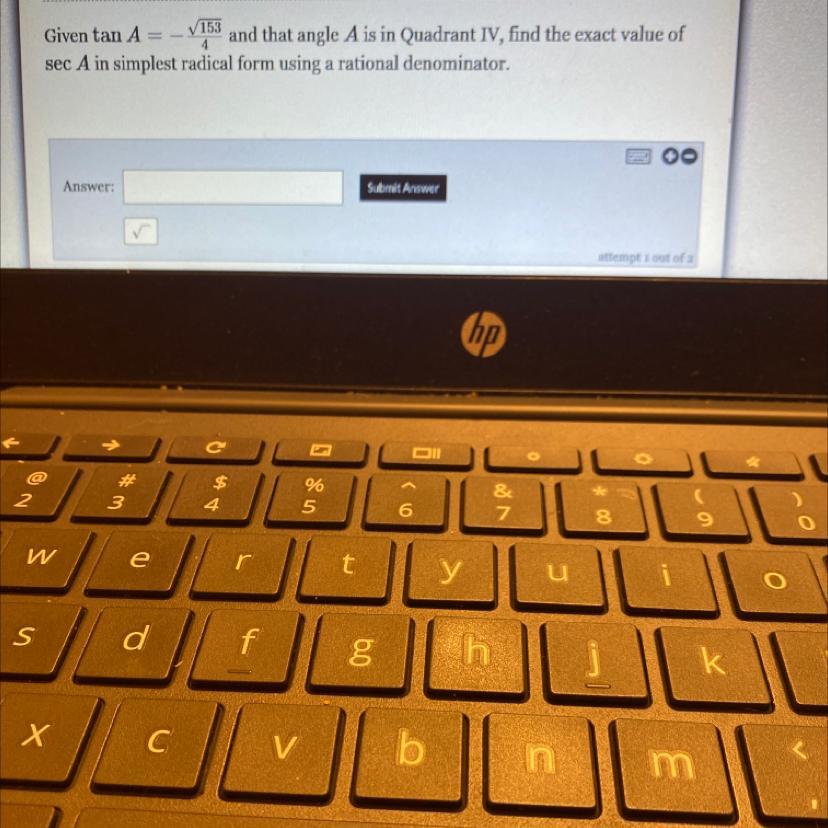
V 153
Given tan A= - and that angle A is in Quadrant IV, find the exact value of
sec A in simplest radical form using a rational denominator.
4
Answers
The secant of the angle A is 13/4
How to determine the value of sec(A)?The given parameter is:
\(\tan(A) = -\frac{\sqrt{153}}{4}\)
Using the trigonometry identity, we have:
\(\sec^2(A) = \tan^2(A) + 1\)
This gives
\(\sec^2(A) = (-\frac{\sqrt{153}}{4})^2 + 1\)
Evaluate the exponent
\(\sec^2(A) = \frac{153}{16} + 1\)
Evaluate the sum
\(\sec^2(A) = \frac{169}{16}\)
Take the square root of both sides
\(\sec(A) = \pm \frac{13}{4}\)
Secant in quadrant IV is positive.
So, we have:
\(\sec(A) = \frac{13}{4}\)
Hence, the secant of angle A is 13/4
Read more about trigonometry ratios at:
https://brainly.com/question/11967894
#SPJ1
PLEASE HELP ME ON QUESTION ASAP!!
IF YOU HAVE A TOPIC LIST IN YOUR EXAMS AND IT SAYS AVERAGES AND THE RANGE ARE YOU GOING TO BE HAVING MEAN AND RANGE IN YOUR TEST OR MEAN, RANGE MODE, MIDPOINT BASICALLY ALL OF IT ? IF ANSWERS CORRECT ILL RATE YOU FIVE STARS, GIVE YOU A THANKS AND MAYBE EVEN BRAINLIEST (sorry for caps)
Answers
Answer:
Step-by-step explanation:
Typically yes you need to know
Mean
Median
Mode
and Range
Mean = average, add all numbers then divide by how many
Median = midpoint, middle number. Be sure to list numbers from small to large if there are 2 middle numbers (this happens when there are an even amount), take the average of the 2 middle numbers
Mode = numbers that occurs the most in the list of numbers
Range = This is the largest number minus the smallest number.
In a cafeteria,
1/6
of the students are eating salads , and
2/6
are eating sandwiches. There are 12 students in the cafeteria. How many students are eating lunches other than salads or sandwiches
Answers
Answer:
I think 3/6 or 3/12
Step-by-step explanation:
because either way we are adding 1/6+2/6=3/6
Answer:
4 are eating sandwhiches and 2 are eating salads
Step-by-step explanation:
1/6 of 12 is 2 2/6 of 12 is 4
A rental car company charges $22 per day to rent a car and $0.08 for every mile driven. Samuel wants to rent a car, knowing that:
He plans to drive 450 miles.
He has at most $80 to spend.
Write and solve an inequality which can be used to determine xx, the number of days Samuel can afford to rent while staying within his budget.
Answers
Using the inequality concept, the expression models the number of days Samuel can afford to rent while staying within his budget is 11x + 18 ≤ 40
What is inequality?Inequality is defined as mathematical statements that have a minimum of two terms containing variables or numbers that are not equal.
A rental car company charges $22 per day to rent a car and $0.08 for every mile driven
The maximum amount to spend = $80
Fixed charge per day $22
Charge per mile = $0.08
The inequality which represents the number of days Can be expressed thus :
(Charge per day × number of days) + (charge per mile × number of miles) ≤ 80
22x + 0.08× 450 ≤ 80
22x + 36 ≤ 80
Divided by 2 both sides of an inequality,
11x + 18 ≤ 40
Hence, the required inequality expression is 11x + 18 ≤ 40
Learn more about inequalities here :
brainly.com/question/20383699
#SPJ1
What is an equation of the line that passes through the points (5, 0) and (-5, -8)
Answers
Answer:
Step-by-step explanation:
m = (y2-y1) / (x2-x1)
m = (-8-0) / (-5-5) = 4/5
note that it does not matter which points you chose to be second or first
then use slope point equation again it does not matter which point from the slope you use
y - y1 = m ( x - x1 )
y - 0 = 4/5 ( x - 5)
y = 4/5x -4
please if you find my answer helpful mark it brainiest
Someone please help!!!!!

Answers
Where the friend made the error was in step 2. She should have squared the 4 first before multiplying by 2. The correct answer is 44
How to simplify mathematical expressions?We want to simplify the mathematical expression;
2(10 - 6)² + 3*4
The correct steps are as follows;
Step 1; Using BODMAS Acronym, let us deal with the bracket first to get;
2(4)² + 3*4
Step 2; Still dealing with the bracket, we will now have;
2(16) + 3*4
Step 3; Still dealing with the bracket, we will now have; 32 + 3*4
Step 4; Next sign to be used is multiplication sign and as such we now have; 32 + 12
Step 5; Using the addition sign, we now have 44
Thus, where the friend made the error was in step 2. She should have squared the 4 first before multiplying by 2.
Read more about Simplifying Mathematical Expressions at; https://brainly.com/question/723406
#SPJ1
anyone know the answer to number 4?

Answers
answer my questions plz
If 12.6cm on the map is equal to 1262km in real life, determine the unit scale of the map
Answers
Answer:
1unit scale on map is equal to 100.16 km in real life
Step-by-step explanation:
since in map 12.cm =1262km in real life
1cm=(1262/12.6) km
therefore it gives us 100.158km which is approximately 100.16 km .
After training for and running a marathon, an athlete wants to reduce her daily run
by half each day. The marathon is about 26 mi. How many days will it take after the
marathon before she runs less than a mile a day? Show your work.
Answers
Answer:
6 days
Step-by-step explanation:
This question becomes much easier when written out per day (shown below). The question tells us that she is reducing her run by half every day, so all we need to is divide the previous day by 2 to get the current day. She starts out with 26 miles so this is our day 1 value.
Day 1 = 26 miles
Day 2 = 13 miles (26÷2=13)
Day 3 = 6.5 miles (13÷2=6.5)
Day 4 = 3.25 miles (6.5÷2=3.25)
Day 5 = 1.625 miles (3.25÷2=1.625)
Day 6 = 0.8125 miles (1.625÷2=0.8125)
We can see that by day 6, her total running amount is less that 1 mile, so the final answer is 6 days.
Identify each number between 2.6×10^-1 and 29.5%. Select all that apply. Responses 2.7×10^1
0.2875
2/7
2.8%
Answers
Numbers between 2.6×10^-1 and 29.5% are
0.28752/7How to write the numbers to decimal2.6 × 10^-1 in exponential form written in decimal as 0.26
29.5% in percentage written in decimal as 0.295
2/7 in fraction written in decimal as 0.2857
2.8% in percentage written in decimal as 0.028
0.2875 already in decimal form
the problem asks of numbers from 0.26 to 0.295
comparing the numbers shows that the numbers in this range are
0.2875 and 2/7
Learn more about decimal here:
https://brainly.com/question/29420599
#SPJ1
A race car traveled for 2 1/2hours with an average speed of 132 5/8 km per hour. Find the total distance it covered.
Answers
Answer: The total distance covered by the car is 331 9/16 km.
Step-by-step explanation:
We know that, speed= distance/time taken
Therefore, distance = speed x time taken
= 132 5/8 x 2 1/2
= 5/2 x 1061/8
= 5305/16
= 331 9/16 km
Therefore, total distance is 331 9/16 km.
Read more about the calculations of Distance,
https://brainly.com/question/51872423
find the value of (x-6)/3 if x =21
Answers
Greetings.
The answer is 5.
Explanation:
\(\frac{x-6}{3}\)
We want to know the value when x = 21. Therefore, substitute x = 21 in the expression.
\(\frac{21-6}{3}\)
Evaluate 21-6 = 15
\(\frac{15}{3}\)
Therefore, the answer is 5.
Suppose that E and F are mutually exclusive events of an experiment. Suppose that E and F are mutually exclusive events of an experiment. Show that if independent trials of this experiment are performed, then E will occur before F with probability P(E)/[P(E) + P(F)].
Thus,
p=∑i∈ℕP[(E∪F)c]iP(E)
=P(E)∑i∈ℕP[(E∪F)c]i
=P(E)11−P[(E∪F)c]
The formula for the probability of complement then P(EF)=0 gives:
p=P(E)1P(E∪F)
=P(E)1P(E)+P(F)−P(EF)
=P(E)P(E)+P(F)
Answers
The probability of Event E occurring before Event F with independent trials of an experiment is given by P(E)/[P(E) + P(F)].
The probability of E occurring before F with independent trials of an experiment can be calculated using the formula P(E)/[P(E) + P(F)]. This formula is derived from the principle that the probability of an event is the sum of its individual probabilities, and the probability of a mutually exclusive event is the sum of the probabilities of the individual events minus the probability of their intersection. Thus, the formula for the probability of E occurring before F is P(E) divided by the sum of P(E) and P(F). This gives us the probability of E occurring before F with independent trials of the experiment as P(E)/[P(E) + P(F)].
The probability of Event E occurring before Event F with independent trials of an experiment is given by P(E)/[P(E) + P(F)].
Learn more about probability here:
https://brainly.com/question/30034780
#SPJ4
Find the number of ways of
arranging the letters of the
words DANGER, so that no vowel
occupies odd place.
Answers
Answer: 6 * 24 = 144 ways.
Step-by-step explanation:
Solution:
Given word => DANGER.
The condition is that vowels can't occupy odd places so, we will let them occupy even places.
A total number of arrangements will be = 6 * 24 = 144 ways.
Answer: 6x24 = 144 ways.