Evaluate 4 + s × 12, where s= 1/2
(A) 6
(B) 10
(C) 24
(D) 54
Answers
Answer:
(B) 10
Step-by-step explanation:
f(s) = 4 + s × 12
f(1/2) = 4 + (1/2) × 12
= 4 + 6
= 10
Answer:
10
Step-by-step explanation:
4 + s x 12
4 + (s x 12)
s = 1/2
substitute for s
4 + (1/2 x 12)
4 + 6 = 10
Related Questions
A teacher has a large container of blue, red, and green beads. She reports to the students that the proportion of blue beads in the container is 0.30. The students feel the proportion of blue beads is lower than 0.30. A student randomly selects 60 beads and finds that 12 of the beads are blue. The P-value for the test of the hypotheses, H 0: p = 0.30 and H alpha: p less-than 0.30, is 0.045. What is the correct conclusion given Alpha = 0.05?
Because the P-value is less than Alpha = 0.05, the student should reject H0.
Because the P-value is less than Alpha = 0.05, the student should fail to reject H0.
Because the P-value is greater than Alpha = 0.05, the student should reject H0.
Because the P-value is greater than Alpha = 0.05, the student should fail to reject H0.
answer is a
Answers
Answer:
Red I think maybe we should try hi friends I am new to this app
a diver was collecting water samples from a lake. he collected a sample at every 3m, starting at 5m below water surface. the final sample was collected at a depth of 35m.how many sample did he collected
Answers
The diver collected water samples at every 3 meters, starting from 5 meters below the water surface, up to a final depth of 35 meters.
We can find the number of samples collected by dividing the total depth range by the distance between each sample and then adding 1 to include the first sample.
The total depth range is:
35 m - 5 m = 30 m
The distance between each sample is 3 m, so the number of samples is:
(30 m) / (3 m/sample) + 1 = 10 + 1 = 11
Therefore, the diver collected a total of 11 water samples.
Which property is used to eliminate the parentheses when solving the equation 2/3 − 8x=16(4x−1)?
Addition Property
Associative Property
Distributive Property
Multiplication Property
Answers
Answer:
Distributive Property
Step-by-step explanation:
16(4x -1) = 16 · 4x - 16·1
16 is distributed across both terms and multiplied by each term
1. If f(x) = (3x-2)/(2x+3), then f'(x) =
Answers
Answer:
\(f'(x)= \frac{13}{(2x+3)^2}\\\)
Step-by-step explanation:
\(f(x)= \frac{3x-2}{2x+3} \\\)
\(f'(x)=\frac{dy}{dx} = \frac{d}{dx}(\frac{3x-2}{2x+3})\\ f'(x)= \frac{(2x+3)\frac{d}{dx}(3x-2)-(3x-2)\frac{d}{dx}(2x+3) }{(2x+3)^{2} } \\f'(x)= \frac{(2x+3)(3)-(3x-2)(2)}{(2x+3)^{2} } \\\)
\(f'(x)= \frac{6x+9-6x+4}{(2x+3)^{2} }\\ f'(x)= \frac{13}{(2x+3)^2}\\\)
It took six people four days to build a wall.
a) Working at the same rate, how long would it have taken eight people to build the wall?
b) Working at the same rate, how many people would have been needed if the wall had
to be completed in two days?
Answers
Answer:
a=5 days, 3 hours
b= 3 people


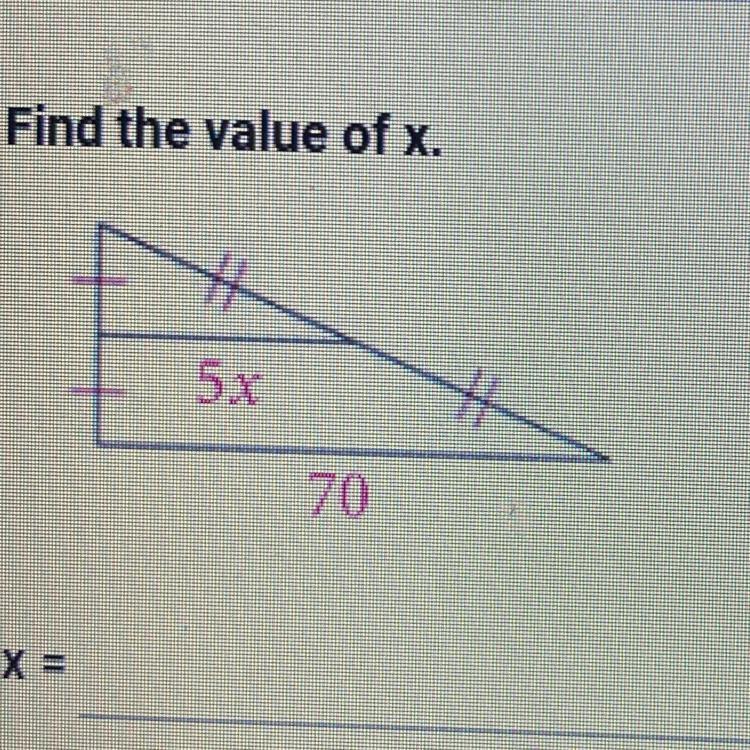
Find the value of x.
Answers
Answer:
x = 7
Step-by-step explanation:
The dashes on the lines show they are equal in length.
Therefore, by inspection of the diagram, we can see that the measures of the sides of the smaller triangle (with base 5x) are half the measures of the sides of the larger triangle (with base 70).
Therefore, creating an equation with this information:
5x = 1/2 x 70
⇒ 5x = 35
⇒ x = 7
Solution:
Note that:
2(Perimeter of smaller triangle) = Perimeter of larger triangle.This means that...
2(5x) = 70Simplify the equation and solve for x.
2(5x) = 70=> 10x = 70=> 10x/10 = 70/10=> x = 7The value of x is 7.
Explain how to simplify the expression 5n + n.
Answers
\(5n+n=n+n+n+n+n+n=6n\)
Hope this helped
Angie's Bake Shop makes birthday chocolate chip cookies that cost $2 each. Angie expects that 9% of the cookies will crack and be discarded. Angie wants a 65% markup on cost and produces 100 cookies. What should Angie price each cookie? (Round your answer to the nearest cent.) Price per cookie T 1 s
Answers
Angie should price each cookie at approximately $3.63.
Cost and desired markup must be taken into account when calculating the cookie price.
Cost per treat:
Each cookie costs $2.
Markup:
Angie wants a markup of 65% on the price. We divide the cost of each cookie by the markup percentage to determine the markup:
Markup = 2 * 0.65 = $1.30
All out cost per treat:
The sum of the cost per cookie and the markup amount is the total cost per cookie:
The anticipated amount of waste: $3.30
Angie anticipates that nine percent of the cookies will break and be thrown away. Hence, 91% of the treats will be sold.
Anticipated squander = 0.09
Cost per treat:
To find the cost per treat, we partition the absolute expense per treat by the level of treats that will be sold:
Cost per treat = Absolute expense/(1 - Anticipated squander)
Cost per treat = 3.30/(1 - 0.09)
Cost per treat = 3.30/0.91
Cost per treat ≈ $3.63 (adjusted to the closest penny)
Along these lines, Angie ought to value every treat at roughly $3.63.
To know more about percentage refer to
https://brainly.com/question/28998211
#SPJ11
Someone plz help me I beg u plz I need this I’ll really appreciate it

Answers
Answer:
i cant see the words
Step-by-step explanation:
See attachments!
Paolo wrote the following equation for the perimeter of a rectangle.
Which equation is equivalent to the equation Paolo wrote?


Answers
Answer:
p = 2 + l w
Step-by-step explanation:
ow assume that a person is tested twice and that the results of the tests are independent from each other. if the person tests positive twice, now what is the probability that this person has the disease?
Answers
The probability of having the disease given that the person tests positive twice depends on the prevalence of the disease and the accuracy of the test.
Assuming that a person is tested twice and the results are independent of each other, we can calculate the probability of having the disease given that the person tests positive twice. Let's say the probability of testing positive given that the person has the disease is p, and the probability of testing negative given that the person does not have the disease is q. Also, let's assume that the prevalence of the disease in the population is r.
The probability of testing positive twice given that the person has the disease is p^2. The probability of testing positive twice given that the person does not have the disease is (1-r)^2q^2. The probability of testing positive twice is the sum of these probabilities, which is p^2 + (1-r)^2q^2.
Now we can use Bayes' theorem to calculate the probability of having the disease given that the person tests positive twice. The formula is P(D|++) = P(++|D)P(D) / P(++), where P(D|++) is the probability of having the disease given that the person tests positive twice, P(++|D) is the probability of testing positive twice given that the person has the disease (p^2), P(D) is the prevalence of the disease (r), and P(++) is the probability of testing positive twice (p^2 + (1-r)^2q^2).
Substituting the values, we get P(D|++) = p^2*r / (p^2*r + (1-r)^2q^2). Therefore, the probability of having the disease given that the person tests positive twice depends on the prevalence of the disease and the accuracy of the test. If the prevalence of the disease is high and the test is accurate, then the probability of having the disease given a positive result is also high.
Learn more about probability brainly.com/question/30034780
#SPJ11
Due today.. ixl assignments. I have to pick the equation, then solve it.

Answers
He sold in total (all ) 97
The 1st week of December he sold only 43 so that means he sold more so you have to add.
You need to find F
So F= 97-43
F= 54
So if you add 54+ 43= 97
Your company takes out a loan for $750 and
makes a profit of $350 a week every week after
that. Write and solve an inequality to show how
many weeks it would take to make a profit of at
least $15,000 in your math notebook. Enter the
minimum number of weeks it would take to
make at least $15,000.
Answers
-750 + 350x \(\geq\) 15000
and so it would take 45 weeks to make at least a 15000 dollar profit.
We know right away that the company's profit will be -750 dollars because they took out the loan. Every week then they will be gaining a positive 350 dollars of profit which we will add to that starting value of -750. This "350 per week" is a variable where x is the number of weeks. Due to us having to make at least 15000 dollar profit, we will use a greater than or equal to sign.
-750 + 350x \(\geq\) 15000
Now to solve we have to isolate x
-750 + 350x \(\geq\) 15000
350x \(\geq\) 15750
x \(\geq\) 45
45 weeks
Tyrone receives a discount of $8.40 on a hat that normally costs $28.00 .
what percent discount did he receive on the hat
explain how you know
please explain for me
Answers
Answer:
30%
Step-by-step explanation:
percentage = (discount/total amount)*100
= (8.40/28)*100=30%
Round the factors and estimate the products 1. 656 x 106 Below as a number
Answers
656 x 106
We will round to nearest hundreds and then multiply.
106 is in between 100 and 200
100 --- 106 ---------------------------------------------------------------------------------------200
The nearest hundred?
It is 100.
Now,
656 is in between 600 and 700,
600 ------------------------------------------------------656-------------------------------------700
It is nearest to 700
So, the problem becomes
700 x 100
7 times 1 is 7, then we put the number of zeros, that is 4 of them, so
700 x 100 = 70000
A triangle has side lengths of 3x, 24, and 5x. The side with 5x is the longest side. What value of x would make a right triangle?
Answers
Answer:
To form a right triangle, one of the sides of the triangle must be the hypotenuse and the other two sides must be the legs. The hypotenuse is the longest side of a right triangle and the side opposite the right angle. In this case, the side with length 5x is the hypotenuse. Therefore, the sides with lengths 3x and 24 must be the legs.
We can use the Pythagorean Theorem to determine the value of x that will make this a right triangle. The Pythagorean Theorem states that the square of the length of the hypotenuse (the side opposite the right angle) is equal to the sum of the squares of the lengths of the other two sides. In this case, we have:
5x^2 = 3x^2 + 24^2
Solving for x, we get:
x = sqrt(24^2/(5^2 - 3^2)) = sqrt(576/16) = 6
Therefore, a value of x = 6 will make this a right triangle.
Step-by-step explanation:
2:15 + 3:55 Give the correct answer
Answers
Answer:
6:10
Step-by-step explanation:
solve the equation
\( \frac{2x}{3} - \frac{3x}{4} = \frac{3}{10} \)
Answers
please mark me as brainlest
![solve the equation[tex] \frac{2x}{3} - \frac{3x}{4} = \frac{3}{10} [/tex]](https://i5t5.c14.e2-1.dev/h-images-qa/answers/attachments/dQ6CrpYlHn5Hj8BxYSWUPPySNMKhQzk7.jpeg)
hi! please help in math!
i need the solution/explanation on how you got the answer
(y + 3) = -8(x - 4)
what is the slope?
Answers
Answer:
slope m = - 8
Step-by-step explanation:
the equation of a line in point- slope form is
y - b = m(x - a)
where m is the slope and (a, b ) a point on the line
y + 3 = - 8(x - 4) ← is in point- slope form
with slope m = - 8
The slope is :
↬ -8Solution:
Given: \(\bf{y+3=-8(x-4)}\)
To determine the slope, it's important to know the form of the equation first.
There are 3 forms that you should be familiar with.
The three forms of equations of a straight line are:
Slope Intercept (y = mx + b)Point slope (y-y₁) = m(x - x₁)Standard form (ax + by = c)This equation matches point slope perfectly.
The question becomes, how do you work with point slope to find slope?
Point slopeIn point slope, m is the slope and (x₁, y₁) is a point on the line.
Similarly, the slope of \(\bf{y+3=-8(x-4)}\) is -8.
Hence, the slope is -8.
Solve 5 (r +9) – 2 (1 - r) = 1.
The solution is r= ????
Answers
Step-by-step explanation:
5(r + 9) - 2(1 - r) = 1
5r + 45 - 2 + 2r = 1
7r + 43 = 1
7r = -42
r = -6.
Answer:
r = -6
Step-by-step explanation:
Given equation,
→ 5(r + 9) - 2(1 - r) = 1
Now the value of r will be,
→ 5(r + 9) - 2(1 - r) = 1
→ 5r + 45 - 2 + 2r = 1
→ 5r + 2r + 43 = 1
→ 7r = 1 - 43
→ 7r = -42
→ r = -42/7
→ [ r = -6 ]
Hence, the value of r is -6.
the lifetimes of lightbulbs of a particular type are normally distributed with a population mean of 153 hours and a population standard deviation of 17 hours. what percentage of the bulbs have lifetimes that lie within 2.00 population standard deviation(s) to either side of the population mean? round your answer to two decimal places. %
Answers
The percentage of the bulbs that have lifetimes that lie within 2 population standard deviations to either side of the population mean is 95.00%.
To solve the problem, we can use the Empirical Rule or the 68-95-99.7 rule, which states that
Approximately 68% of the data falls within one standard deviation of the mean
Approximately 95% of the data falls within two standard deviations of the mean
Approximately 99.7% of the data falls within three standard deviations of the mean
In this case, we want to find the percentage of bulbs that have lifetimes within 2 standard deviations of the mean. We know that the population mean is 153 hours and the population standard deviation is 17 hours.
To find the range of lifetimes that is within 2 standard deviations of the mean, we can use the formula:
Range = mean ± (standard deviation × number of standard deviations)
So, the range of lifetimes that is within 2 standard deviations of the mean is
Range = 153 ± (17 × 2) = 119 to 187
Therefore, approximately 95% of the bulbs have lifetimes that lie within this range.
Learn more about standard deviation here
brainly.com/question/23907081
#SPJ4
PLZ HELP!! brainliest and 40pnts
PT 1
Find the volume of a cone that has a radius of 1/2 and a height of 1.
a) 3/2 pi b) 3/4 pi c) 1/12 pi D) 1/6 pi
PT 2
Find the volume of a cylinder that has a radius of 1/2 and a height of 1.
a) 1/2 pi b) 1/4 pi c) 3/2 pi d) 4 pi
Answers
Answer:
PT 1: C
PT 2: B
Step-by-step explanation:
In order to find the volume of a cone use equation
\(V=\pi r^2\frac{h}{3}\)
To find the volume of a cylinder use equation
\(V=\pi r^2h\)
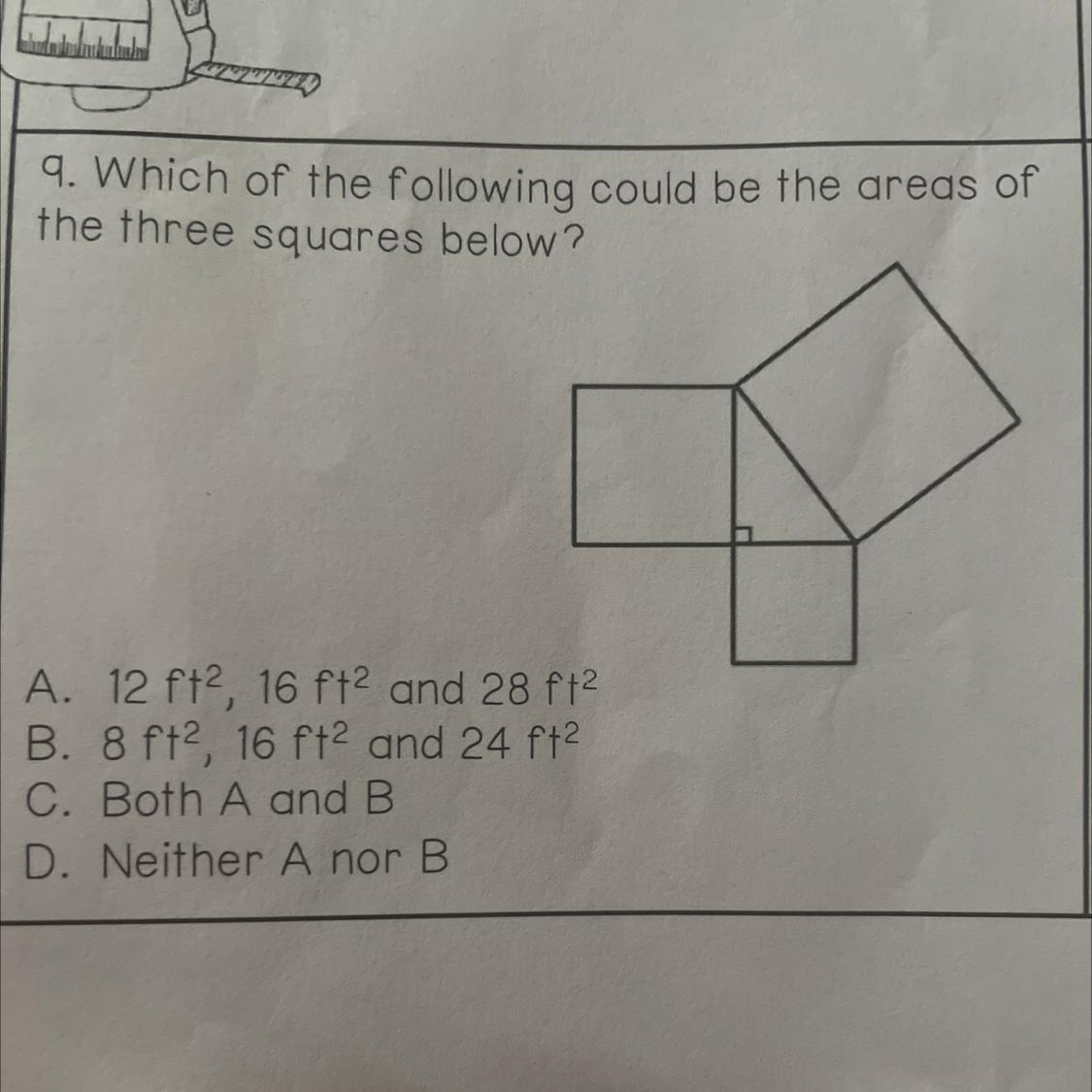
Which of the following could be the areas of
the three squares below?
A. 12 f12, 16 f12 and 28 f12
B. 8912, 16 pt2 and 24 P12
C. Both A and B
D. Neither A nor B
Answers
Answer:
A. 12 f12, 16 f12 and 28 f12
Step-by-step explanation:
The Pythagoras theorem states the addition of squares of the lengths of the two short sides of the right triangle is the same as the square of the length of the hypotenuse. Using the Pythagoras theorem, you may find the correct answer option A
Learn more: https://brainly.com/question/19528577
Write the equation of the line that passes through the points (-9, -8) and (-9,0).
Put your answer in fully reduced point-slope form, unless it is a vertical or horizontal
line.
Answers
Answer:
y + 8 = 0 (x + 9)
Step-by-step explanation:
y2 - y1 / x2 - x1
0 - (-8) / -9 - (-9)
8/0
0
y + 8 = 0 (x + 9)
we wish to see if the electronic control indicating the oven temperature for a certain model oven is properly calibrated. four ovens of this model are selected at random. the electronic control on each is set to 300°f; after 1 hour, the actual temperature of each is measured. the temperatures measured are 305°f, 310°f, 300°f, and 305°f. assume that the distribution of the actual temperatures for this model when the electronic control is set to 300°f is normal. to test if the electronic control is properly calibrated, we will test the following hypotheses: h 0: begin mathsize 16px style mu end style
Answers
The measured temperatures were 305°F, 310°F, 300°F, and 305°F. The hypothesis testing will compare the observed temperatures to the assumed normal distribution of actual temperatures when the control is set to 300°F.
The hypothesis being tested is denoted as H0, where μ represents the mean actual temperature when the electronic control is set to 300°F. The observed temperatures are compared to the assumed normal distribution to determine if they are significantly different. The hypothesis testing procedure involves calculating the sample mean of the observed temperatures and comparing it to the hypothesized mean of 300°F. Additionally, the variability of the observed temperatures is assessed using statistical methods such as the standard deviation.
Further steps would include determining an appropriate significance level (α) to define the threshold for accepting or rejecting the null hypothesis. This level of significance determines the probability of incorrectly rejecting the null hypothesis. Statistical tests such as a t-test or z-test can be employed depending on the sample size and known population parameters. By comparing the calculated test statistic to the critical value associated with the chosen significance level, a decision can be made regarding the calibration of the electronic control. If the test statistic falls within the critical region, the null hypothesis is rejected, indicating a need for calibration adjustment. Conversely, if the test statistic does not fall within the critical region, the null hypothesis is not rejected, suggesting that the electronic control is properly calibrated.
Learn more about distribution here:
https://brainly.com/question/33255942
#SPJ11
what is ordered pair
Answers
Answer:
see explanation
Step-by-step explanation:
An ordered pair is a set of coordinates (x, y )
This can be o point on a graph or the solution to a system of equations or values from a table
Answer: It's a point on a graph (y,x)
Step-by-step explanation:
What is the area of a rhombus with diagonals that measure 7 inches and 5 inches? 35 in2 8.75 in2 12 in2 17.5 in2
Answers
The area of the rhombus is 17.5 square inches.
The formula to find the area of a rhombus is:
Area = (diagonal1 x diagonal2) / 2
where diagonal1 and diagonal2 are the lengths of the diagonals.
diagonal1 = 7 inches and diagonal2 = 5 inches.
we can plug these values into the formula:
Area = (7 x 5) / 2
Area = 35 / 2
Area = 17.5 square inches
Therefore, the area of the rhombus is 17.5 square inches.
To learn more on Rhombus click:
https://brainly.com/question/27870968
#SPJ1
How do you prove that two angles are congruent in two triangles?
Answers
To prove that two angles in two triangles are congruent, you must use the Angle-Angle Postulate (AA). The Angle-Angle Postulate states that if two angles of one triangle are congruent to two angles of another triangle, then the two triangles are congruent.
Therefore, to prove that two angles in two triangles are congruent, you must first show that the two angles have the same measure. This can be done by using the Angle Addition Postulate or by using subtracting the measure of one angle from the measure of the other.
How are triangles formed?Three vertices and three sides make up a triangle, which is a polygon. The triangle's angles are created when the three sides are joined end to end at a point. The three angles of the triangle sum up to 180 degrees.
To know more about triangle visit:
https://brainly.com/question/2773823
#SPJ4
need help on khan NOW! question is on picture. will report link and mark brainliest if right
Answers
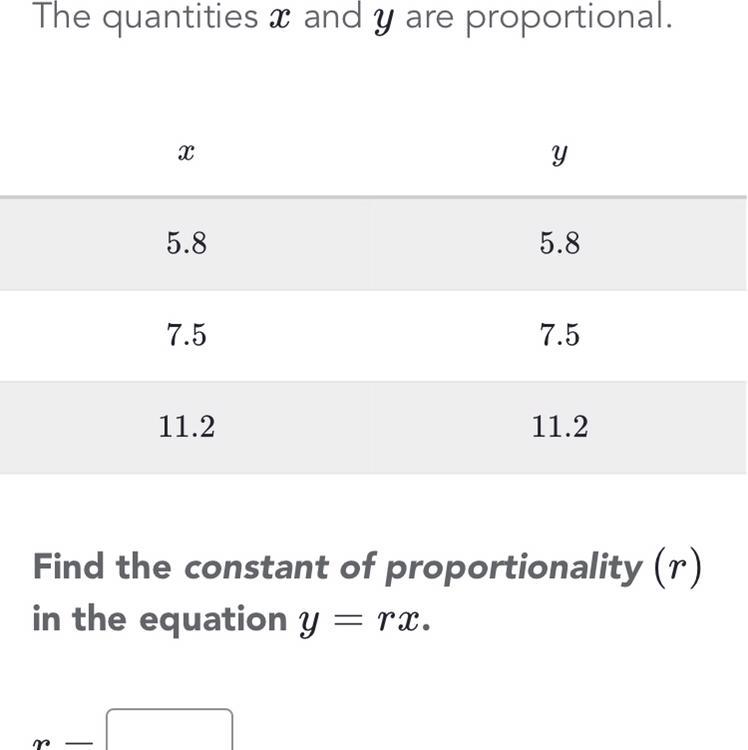
Explanation: no matter how you do it you still get 1 bc its x divided by y which is 1
Plz, Help me!
What is the equation of a circle with a radius of 5 and a center located at (7,9)?
a. (x - 9)^2 + (y - 7)^2 = 5
b. (x - 7)^2 + (y - 9)^2 = 5
c. (x - 7)^2 + (y - 9)^2 = 25
d. (x - 9)^2 + (y - 7)^2 = 25
Answers
Answer:
(x-7)^2 + (y-9)^2 = 25
Step-by-step explanation: