Describe two ways to add heat to liquid water.
Answers
Answer:
There are several ways to add heat to liquid water. Some common methods include:
Using a heating element: This involves using a device such as a stovetop burner, electric heater, or immersion heater to transfer heat to the water. The heating element is typically in direct contact with the water, allowing heat to be transferred quickly and efficiently.
Using a heat exchanger: This involves using a device such as a radiator or heat pump to transfer heat from a hot fluid (such as steam or hot water) to the water. The heat exchanger typically has a separate flow of hot fluid on one side and the water on the other, with a metal or other material separating the two to allow heat to be transferred.
Using a phase change: This involves adding a substance to the water that can absorb heat as it changes phase, such as a solid that melts or a liquid that evaporates. For example, adding ice to water will cause the ice to melt, absorbing heat from the water in the process. Similarly, adding a volatile liquid such as alcohol to water will cause the alcohol to evaporate, absorbing heat from the water as it does so.
Related Questions
How many grams is 5.4x10 to the 23 molecules of al2o3?
Answers
Answer:
91.49 grams
Explanation:
No of molecules = no of moles × Avogadro's number
No of moles = No of molecules / Avogadro's number
Number of moles = 5.4×10^23/6.02×10^23
Number of moles = 0.897 moles of Al2O3
Number of moles = mass in gram / molar mass
Mass in gram = number of moles× molar mass
Mass in gram = 0.897× 10²
91.49 grams
Lily replicates an experiment that found that the number of calories in a particular food is 50 kcal. She obtained data from
five trials: 50 kcal 72 kcal, 50 kcal, 12 kcal, and 50 kcal. Which best desribes her data results? A. accurate B. incorrect C. invalid D. precise
Answers
Answer:
invalid
Explanation:
Just imagine doing this experiment MULTIPLE TIMES and one of the trials you get 72 Kcal while in another u get 12kcal. It doesn't make sense. Somewhere in the experiment she went wrong. So its invalid
The excess reactant... a. provides more product in the reaction b. is left over, after the reaction is complete c. has the highest coefficient in every balanced reaction d. is the gas in a balanced reaction
50 POINTS HELP
Answers
Answer:
\(\boxed {\boxed {\sf Option: B }}\)
Explanation:
The excess reactant is the reactant left over after a chemical reaction. It is found when the limiting reactant is completely done. The answer to your question is option B. The excess reactant is what is found after the reaction is complete. Our answer is Option B.
Answer:B
Explanation: Excess Reactant - The reactant in a chemical reaction that remains when a reaction stops when the limiting reactant is completely consumed consumed. The excess reactant remains because there is nothing with which it can react.
Given the balanced chemical equation for the decomposition for INO, and the rate of disappearance of INO, write the expressions for the rates of appearance of I_2 and NO.
2 INO(g) > I_2(g) + 2 NO(g)
Reactant Product (I_2) Product (NO)
- ?[INO] x y
--------- = ------- = --------
2 ?t w z
Fill w,x,y,z.
Answers
According to chemical equilibrium, \(\frac{d[I_2]}{dt}\) and \(\frac{d[NO]}{dt}\) is the expressions for the rates of appearance of I₂ and NO respectively.
Chemical equilibrium is the state that develops during a reversible chemical reaction when there is no net change in the ratio of reactants to products. When a chemical reaction is reversible, the products immediately after they are generated combine to form the reactants once more. There is no net change in the quantity of the chemicals involved in the chemical reaction when the two opposing processes are in equilibrium and happening at equal rates. When the reaction is in equilibrium, it is deemed finished. The quantitative formulation identifies the conditions needed for equilibrium. Changes in concentration, changes in pressure and temperature, and the presence of a catalyst are all factors that influence chemical equilibrium.
Learn more about chemical equilibrium.
brainly.com/question/3920294
#SPJ4
If 6.49 mol of ethane (C2H6) undergo combustion according to the unbalanced equation
C2H6 + O2 −→ CO2 + H2O ,
how many moles of O2 is required?
1. 27.79
2. 7.63
3. 8.4
4. 25.48
5. 12.635
6. 21.035
7. 23.8
8. 19.04
9. 22.715
10. 26.775
Answer in units of mol.
Answers
Answer:
22.715 moles of oxygen are used
Explanation:
Given data:
Number of moles of ethane = 6.49 mol
Number of moles of O₂ required = ?
Solution:
Chemical equation:
2C₂H₆ + 7O₂ → 4CO₂ + 6H₂O
Now we will compare the moles of oxygen with ethane.
C₂H₆ : O₂
2 : 7
6.49 : 7/2×6.49 = 22.715 mol
Thus, 22.715 moles of oxygen are used.
basalt flowing out across miles of land
Answers
An eruption from a volcano can cause massive flows of basalt, a common kind of volcanic rock.
What brings about basalt flows?Due to the low viscosity of molten basalt lava (between 45% and 52%) and its low silica concentration, lava flows can spread over large areas quickly before cooling and solidifying.
Where are the basalt flows?One of the world's largest volcanic provinces is the flood basalt province known as the Deccan Traps, which is situated on the Deccan Plateau in west-central India. The Deccan Plateau, which spans about 500 000 km2, is made up of a series of flat-lying basalt lava flows that are more than 2000 m thick.
To know more about basalt visit:-
https://brainly.com/question/28268226
#SPJ1
Air is a natural resource .
Ture
False
Answers
what are 5 causes of global warmings
Answers
Five causes of global warming are: 1. Burning of Fossil Fuels, 2. Deforestation, 3. Industrial Processes, 4. Fertilizers, 5. Transportation.
These can be explained further:
1. Burning of Fossil Fuels: The burning of fossil fuels such as coal, oil, and natural gas releases large amounts of carbon dioxide into the atmosphere, contributing to the greenhouse effect and causing global warming.
2. Deforestation: Forests absorb carbon dioxide from the atmosphere, but deforestation releases that stored carbon back into the atmosphere. This makes deforestation a significant contributor to global warming.
3. Industrial Processes: Industrial processes such as cement production, steel making, and chemical manufacturing release large amounts of carbon dioxide and other greenhouse gases into the atmosphere, contributing to global warming.
4. Fertilizers: Agriculture is responsible for around 14% of global greenhouse gas emissions. The use of fertilizers, livestock, and transportation all contribute to the emission of greenhouse gases.
5. Transportation: The burning of gasoline and diesel in vehicles releases large amounts of carbon dioxide and other greenhouse gases into the atmosphere. The growth of the transportation sector and the increase in the number of cars on the road is a significant contributor to global warming.
To learn more about global warming here: https://brainly.com/question/3553382
#SPJ1
A student has 4 unlabelled beakers, each containing s colourless solution of a different salt. The four solutions are potassium carbonate, potassium chloride, potassium iodide, sodium chloride. Describe a method to identify each solution
Answers
The substances can only be properly identified if we carry out flame tests and qualitative analysis on the samples.
How can we identify the four solutions?We know that the only way that we can be able to identify a substances in chemistry is to be able to perform a series of tests on the substances. In this case, we are told that we have the substances potassium carbonate, potassium chloride, potassium iodide, sodium chloride in solution.
We can only be able to identify the solutions by the use of flame tests and qualitative analysis. Flame test would show the colors that are characters of the cation while we could use qualitative analysis to identity the anion present.
Learn more about qualitative analysis:https://brainly.com/question/6955504
#SPJ1
Chemical Reactions:Question 1
Liquid water (H₂O) is formed when two gases, hydrogen (H₂)
and oxygen (O₂), react. Why are the properties of water
different than those of the reactant gases?
Select one:
O
When substances chemically combine, products with
completely different properties form.
Answers
Chemical reactions produce compounds with entirely distinct features.
Can hydrogen gas Hydrogen and oxygen gas Oxygen react to produce water Water?For instance, it is well known that two molecules of the gas hydrogen and one molecule of the gas oxygen combine to generate two molecules of the gas water. Chemically, this reaction can be described by the equation 2Hydrogen + Oxygen 2Water.
What kind of interaction does Water undergo?The creation of water is an illustration of a synthesis reaction (Water). When hydrogen gas and oxygen gas interact, this process takes place. Water that is in liquid form is the end outcome. A chemical equation is displayed.
To know more about Chemical reactions visit:-
https://brainly.com/question/29762834
#SPJ9
Question:
Liquid water (H₂O) is formed when two gases, hydrogen (H₂) and oxygen (O₂), react. Why are the properties of water different than those of the reactant gases?
A. When substances chemically combine, products with completely different properties form.
B. Water is a liquid, while hydrogen and oxygen are gases.
C. Water has a lower density than hydrogen and oxygen.
D. Water has a higher boiling point than hydrogen and oxygen.
Why do we need to use Roman Numerals in the names for Transition metals, Inner Transition metals and Group 14 metals in simple terms?
Answers
According to the graph, which element is most abundant in Earth’s crust? According to the graph, what percent of Earth’s crust is made up of titanium? % of calcium? %

Answers
Answer:
oxygen . 1 percent and 4 percent the are the awnsers
The element most abundant in Earth’s crust is oxygen. The percentage of titanium in the earth's crust is 1%.
What is the abundance of the elements in the Earth’s crust?The abundance of the elements is a measurement of the occurrence of one particular chemical element relative to all other elements in our environment.
The nine most abundant elements in the Earth's crust: oxygen(O) 46%, silicon (Si) 28%, aluminum (Al) 8.3%, iron (Fe) 5.6%, calcium (Ca) 4.2%, sodium (Na) 2.5%, magnesium (Mg) 2.4%, potassium (K) 2.0%, Other elements occur less than 0.15%.
The most abundant chemical element in the earth’s crust is oxygen (46%). The abundance of hydrogen is only 0.14%(percent by mass) in the earth’s crust which is the 10th most abundant element on the earth.
From the given graph, oxygen is the most abundant element in the earth's crust and the percentage of the abundance of titanium is 1% and calcium is 4%.
Learn more about the abundance of the elements, here:
https://brainly.com/question/12971445
#SPJ5
what are four characteristics that early geologists noticed while studying sedimentary rock layers
Answers
Early geologists identified four features while examining sedimentary rock layers: strata or layering, fossils, angular unconformities, and cross-bedding.
What are the 3 the primary types of sedimentary rocks?Rock fragments from other types of existing rocks or organic substance are used to create sedimentary rocks. Clastic, organic (biological), and chemical sedimentary rocks are the three distinct types of sedimentary rocks. Sandstone is a type of clast sedimentary rock, which is formed from fragments of other minerals.
Is granite a sedimentary rock?Igneous rock includes granite. Material is deposited, weathered, and other mechanisms that cause organic or mineral particles to settle down and collect result in the formation of sedimentary rock. All varieties of marble, as well as volcanic rocks like travertine and onyx, contain fossils.
To know more about sedimentary rock visit :
https://brainly.com/question/26142315
#SPJ1
What happens to air pressure as altitude increases
Answers
Answer:
the air pressure decreases
explanation
as altitude increases air pressure decreases the surface of the Earth is bottom of the ocean of the are the layer on top increase pressure so that sea levels a body is under 14.7 pounds of pressure per square inch moving up in altitude decreases weight of the air that causes the pressure
Answer: It decreases.
Explanation: As altitude rises, air pressure drops. In other words, if the indicated altitude is high, the air pressure is low.
03.04MC
What is the correct name for P4S3?
A) Phosphorus (III) sulfide
B)Phosphorus sulfate
C)Tetraphosphorus trisulfide
D)Tetraphosphorus trisulfate
Answers
Answer:
c
Explanation:
Tetraphosphorus trisulfide is the correct name for \(P_4S_3\). Hence, option C is correct.
What is IUPAC name?IUPAC nomenclature is based on naming a molecule's longest chain of carbons connected by single bonds, whether in a continuous chain or in a ring.
Tetraphosphorus trisulfide is the correct name for \(P_4S_3\).
Hence, option C is correct.
Learn more about IUPAC name here:
https://brainly.com/question/13099024
#SPJ2
Microscopic interface asymmetry and spin-splitting of electron subbands in semiconductor quantum structures. Solid State Commun
Answers
The microscopic interface asymmetry of grown semiconductor heterostructures.
The dispersion of restricted electrons. beginning from a multiband envelope formulation we practice matrix perturbation theory to derive specific expressions. Interface asymmetry, which in the conduction band Hamiltonian appear as a warping and a spin-splitting term. The warping term consequences in an inequivalence of the dispersion.
The microscopic interface asymmetry of grown semiconductor heterostructures that gives upward thrust to heavy-light hole coupling even at 0 in-plane wave vector, modifies also the dispersion of restricted electrons. beginning from a multiband envelope method we practice matrix perturbation principle to derive explicit expressions as a result of this interface asymmetry, which inside the conduction band.
Learn more about Microscopic interface here:-https://brainly.com/question/26348652
#SPJ4
Delaney is putting together a motor for her
science project. She needs a material that
conducts electricity for the circuits and a
material that does not conduct electricity for insulators

Answers
Answer:
40. B
41. B
Explanation:
Copper is a good insulator and conducts electricity.
.When sodium atoms (Na) and chlorine atoms (Cl) join to make sodium chloride, or table salt, they form an ionic bond. Using this information, which pair of elements is most likely to form an ionic bond?
potassium (K) and fluorine (F)
aluminum (Al) and aluminum (Al)
sulfur (S) and oxygen (O)
calcium (Ca) and neon (Ne)
Answers
Answer:
potassium (K) and fluorine (F)
Explanation:
Potassium is an alkali metal just like sodium and fluorine is a halogen just like chlorine. A metal and nonmetal will often join to form an ionic compound.
Aluminum, if it was going to bond to itself, would be a metallic bond.
Sulfur and oxygen are both nonmetals and would form a covalent bond.
Calcium would not bond with neon as neon is a noble gas.
Answer:
A) potassium (K) and fluorine (F)
Explanation:
got it right on time for learning :)
Sandy wanted to find out if the color of food would affect..
Answers
HELPPPP!!! I NEED IT VERY MUCHHHH

Answers
Answer:
mabye C at least if its not right sorry .
if you had a buret with an initial reading of 1.23 ml and a final volume of 34.56 ml, how much liquid was delivered from the buret?
a.33.33 ml b.-33.33 ml c.33.3 ml d.-33.3 ml
Answers
33.33 mL much liquid was delivered from the buret. Hence, the correct option is A.
The volume of liquid delivered from the buret can be calculated as the difference between the final and initial readings:
Volume delivered = final reading - initial reading
Volume delivered = 34.56 mL - 1.23 mL
Volume delivered = 33.33 mL
A buret is a laboratory apparatus used to dispense and measure volumes of liquid with high accuracy and precision. It is commonly used in titration experiments where a measured volume of a solution of known concentration is added to a solution of unknown concentration until the reaction reaches completion.
Hence, the correct option is A.
To know more about buret here
https://brainly.com/question/28353349
#SPJ4
A published hypothesis:
A: does not need to be tested
B: becomes a scientific law
C: should be tested by the scientific community
D: is accepted by the scientific community
Answers
Answer:
C
Explanation:
I hypothesis needs to be tested to know whether it is true or not. Here is the definition:
A supposition or proposed explanation made on the basis of *limited evidence as a started point for further investigation*
Dax has been learning about chemical reactions, and he now understands that chemical reactions occur at different rates. Some are very fast, while others are quite slow. Depending on the conditions, a particular reaction can happen at different rates. Describe the conditions that affect the rate of a chemical reaction
Answers
Answer:
concentrationtemperaturesurface area (for solid reactants ONLY)pressure (for gaseous reactants ONLY)catalystExplanation:
Concentration- rate of the reaction increases with the increase of concentration of the reactants. More particles per unit volume leads to the frequency of collisions to increase. The number of successful collisions thereby increase and overall, lesser time is needed to complete the reaction (upon a higher concentration)Temperature- With the increase of temperature, rate of reaction increases. Particles have more kinetic energy and they move faster. Due to this, number of successful collisions increases/number of effective collisions increases. More particles have energy greater than the activation energy and, activation energy can't change. If number of moles are changed, then number of product will vary.Surface Area- Rate of reaction increases with the increase of surface area of the solid reactant. More particles are exposed to react and the frequency of collisions increases. Less time is needed to complete the reaction and with the decrease of size, surface area increases.Pressure- Rate of reaction increases with the increase of pressure of the gaseous reactants. Gas molecules are closer/ more particles per unit volume is found. The frequency of collisions increase and number of effective collisions increases.Catalyst- Substances which can speed up a chemical reaction by lowering the activation energy by creating an alternative route are called catalysts. They take part in a chemical reaction but after the reaction, they remains chemically unchanged. Catalysts can change the value of enthalpy change and increases both forward and backward reaction rates. They can't change the yield of a chemical reaction and can't change the equilibrium composition. (ex: usage of Vanadium (V) Oxide to manufacture sulfuric acid).Any factor that increases the Collison rate definitely increase the rate of reaction, concentration, temperature, surface area, pressure and catalyst are the major factor that affect the rate of reaction.
What is rate of reaction?The rate of reaction is the study of change of concentration of reactant or product with respect to time.
There are so many factors that affect the rate of reaction
1)concentration: As the concentration of reactant increases the number of collisions increases so rate of reaction also increases.
2)temperature: As the temperature increases the movement of gaseous molecule increases hence the Collison rate increases and hence the rate.
3)surface area (for solid reactants ONLY): As the surface area of the catalyst increases, more molecule can sit on the reactive site hence more is the rate of reaction.
4)pressure (for gaseous reactants ONLY): As pressure increases the randomness increases and hence the Collison and hence the rate of reaction
5)catalyst: Catalyst increase the rate of reaction as they decrease the activation energy
Thus concentration, temperature, surface area ,pressure and catalyst are the factor that increases rate of reaction
To learn more about rate of reaction, here:
https://brainly.com/question/8592296
#SPJ2
If a reaction starts woith 0.480 mol Mg, how many moles of silver are produced?
Answers
Answer:
The reaction you are referring to is:
Mg + 2AgNO3 → Mg(NO3)2 + 2Ag
0.960 moles of silver will be produced
Explanation:
The balanced equation shows that 1 mole of Mg reacts with 2 moles of AgNO3 to produce 2 moles of Ag.
If we start with 0.480 moles of Mg, then we will produce 0.480 * 2 / 1 = 0.960 moles of Ag.
Here is the calculation:
Number of moles of Ag produced = (Number of moles of Mg) * (Moles of Ag produced per mole of Mg)
= 0.480 moles * 2 moles/mole
= 0.960 moles
Therefore, 0.960 moles of silver will be produced if the reaction starts with 0.480 moles of Mg.
Explain why iron from the blast furnace is harder than pure iron .
Answers
Iron produced in a blast furnace is harder than pure iron due to the presence of impurities and the way it is produced.
What happens in a blast furnace?In a blast furnace, iron ore is reduced to iron using coke as a reducing agent and a source of carbon. The high temperatures involved in this process result in the formation of a cast iron product that contains carbon and other impurities in the form of carbides and other compounds.
The presence of carbon and other impurities in the iron makes it harder and stronger than pure iron, which is relatively soft and ductile. The carbides formed during the reduction process act as tiny cutting edges, strengthening the iron and increasing its hardness.
This hardened iron is then melted and poured into molds to form pig iron, which can then be further processed to remove impurities and refine its properties. The end result is a stronger and harder iron product that is better suited for various applications, such as construction or manufacturing.
Learn more on blast furnace here: https://brainly.com/question/4259456
#SPJ1
What is Electrovalant Bond?
Answers
Answer:
ionic bond, also called electrovalent bond, type of linkage formed from the electrostatic attraction between oppositely charged ions in a chemical compound. Such a bond forms when the valence (outermost) electrons of one atom are transferred permanently to another atom.
Explanation:
what is the element ?
Answers
Answer:
like a element is like water
Answer:
periodic table
Write the chemical equation that the diagram
represents.

Answers
In the given diagram, the first atom contains one valence electron and the second have 7 valence electrons. The first atom donates the one electron to the second atom and both achieve octet and forms and ionic compound.
What are ionic compounds?Ionic compounds are formed between a metal and non-metal. Metals are rich in electrons and easily loss one or more electrons to other atoms. Non-metals are electron deficient and can gain electron from metals. These electron loss and gain between atoms forms the ionic bond between them.
In the diagram the first atom contains total 11 electron of which one is valence electron. By donating this extra electron the atom can achieve octet. The second one contains total 17 electrons of which 7 are valence electrons, thus need one more electron to attain octet.
The first atom represents sodium atom and the second one is chlorine atom. Sodium donates its valence electron to Cl and form the ionic compound NaCl.
Na⁺ + Cl⁻ ⇒ NaCl
Find more on ionic compounds:
https://brainly.com/question/9167977
#SPJ1
Help me pleaseeeeeee!!!!
Answers
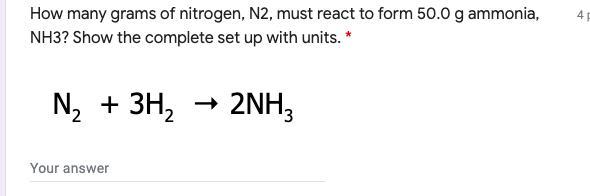
Earth's atmosphere is composed primarily of nitrogen and oxygen, which coexist at 25°C without
reacting to any significant extent. However, the two gases can react to form nitrogen monoxide
according to the following reaction: N,(g) + 0, (g) - 2 NO (g)
(a) Calculate AG° and K for this reaction at 25°C.
(b) Is the reaction spontaneous at 25°C?
Answers
a) The amount of K for this reaction at 25°C is 3.95 x 10¹⁴.
b) The standard free energy change for the reaction is positive (ΔG° > 0), indicating that the reaction is non-spontaneous under standard conditions.
The standard free energy change for the reaction can be calculated using the following equation:
ΔG° = ΔH° - TΔS°
where ΔH° is the standard enthalpy change, ΔS° is the standard entropy change, and T is the temperature in Kelvin.
We can find the standard enthalpy and entropy changes for the reaction from standard formation data:
ΔH°f(N2) = 0 kJ/mol
ΔH°f(O2) = 0 kJ/mol
ΔH°f(NO) = 91.8 kJ/mol
ΔS°f(N2) = 191.6 J/(mol K)
ΔS°f(O2) = 205.0 J/(mol K)
ΔS°f(NO) = 210.0 J/(mol K)
Using these values, we can calculate the standard free energy change:
ΔG° = (2 ΔG°f(NO)) - (ΔG°f(N2) + ΔG°f(O2))
ΔG° = (2 x 91.8 kJ/mol) - (0 kJ/mol + 0 kJ/mol)
ΔG° = 183.6 kJ/mol
We can also calculate the equilibrium constant (K) for the reaction using the standard free energy change:
ΔG° = -RTlnK
K = e^(-ΔG°/RT)
At 25°C (298 K), we have:
K = e^(-183600 J/mol / (8.314 J/(mol K) x 298 K))
K = 3.95 x 10¹⁴
However, the actual free energy change for the reaction will depend on the concentrations of N2, O2, and NO present. If the concentrations are such that the actual free energy change is negative (ΔG < 0), the reaction can be spontaneous under those conditions.
Learn more about The Enthalpy: https://brainly.com/question/29145818
#SPJ11