
Answers
Note that :
n! = n(n-1)(n-2)(n-3)...(2)(1)
Example :
3! = 3(2)(1) = 6
4! = 4(3)(2)(1) = 24
5! = 5(4)(3)(2)(1) = 120
From a. :
\(\begin{gathered} \frac{9!}{3}=\frac{9\times8\times7\times6\times5\times4\times\cancel{3}\times2\times1}{\cancel{3}} \\ =9\times8\times7\times6\times5\times4\times2 \end{gathered}\)which is obviously not equal to 3! = 3 x 2 x 1 = 6
So, "a" is false
From b :
\(\begin{gathered} \frac{9!}{8!}=\frac{9\times\cancel{8\times7\times6\times5\times4\times3\times2\times1}}{\cancel{8\times7\times6\times5\times4\times3\times2\times1}} \\ =9 \end{gathered}\)which is also obvious that it is not equal to 9! = 9 x 8 x 7 x ... x 1
So, "b" is also false
From c :
\(\begin{gathered} \frac{9!}{4!5!}=\frac{9\times8\times7\times6\times\cancel{5\times4\times3\times2\times1}}{4\times3\times2\times1\times\cancel{5\times4\times3\times2\times1}} \\ =\frac{9\times8\times7\times\cancel{6}}{4\times\cancel{3\times2}\times1} \\ =\frac{9\times8\times7}{4\times1} \\ =\frac{504}{4} \\ =126 \end{gathered}\)Since the result is equal to 126, therefore c. is TRUE
The cancel symbol, it is used when the numerator and the denominator has the same value.
For example :
\(\frac{ab}{b}=\frac{a\cancel{b}}{\cancel{b}}=a\)ab/b will result to a
Lets try an example :
when a = 2
b = 3
\(\frac{2(3)}{3}=\frac{6}{3}=2\)It is the same as :
\(\frac{2\cancel{(3)}}{\cancel{3}}=2\)It is like multiplying 2 x (3/3) = 2 x (1) = 2
Related Questions
solve the inequality. 1/4w ≥ 4
Answers
Answer:
16
Step-by-step explanation:
Ariana is going to invest in an account paying an interest rate of 1.9% compounded monthly. How much would Ariana need to invest, to the nearest ten dollars, for the value of the account to reach $110,000 in 14 years?
Answers
Answer:
110000=p(1+0.019)^168
23.62p=110000
p=4660
credit: sqdancefan
Answer:
84330
Step-by-step explanation:
The compound interest formula gives the value of an investment.
A = P(1 +r/n)^(nt)
where principal P is invested at annual rate r compounded n times per year for t years. Using your given values, we can solve for P.
110,000 = P(1 +0.019/12)^(12·14)
P = 110,000/(1 +0.019/12)^(12·14) ≈ 110,000/1.00158333...^168
P ≈ 110,000/1.30446
P ≈ 84326.04 ≈ 84,330 . . . . dollars

HELP!!!!!!!!!!!! TELL ME WHERE THE NUMBERS GO
Answers
Answer:
Do you have an image?
Step-by-step explanation:
Answer:
do u have the info? :0
Step-by-step explanation:
the roof of a gazebo is a regular octagonal pyramid. if the base of the pyramid has sides of 0.5 meter and the slant height of the roof is 1.9 meters, find the area of the roof
Answers
The area of the roof of the gazebo is approximately 3.7424 square meters.
What is surface area?
The space occupied by a two-dimensional flat surface is called the area. It is measured in square units. The area occupied by a three-dimensional object by its outer surface is called the surface area.
The area of the roof of a regular octagonal pyramid can be found by summing the areas of the eight triangular faces.
Each triangular face is an isosceles triangle, with two sides of length 0.5 meters (the sides of the octagon at the base) and one side of length 1.9 meters (the slant height of the pyramid). We can use the Pythagorean theorem to find the height of each triangular face:
h² = (1.9)² - (0.5/2)²
h² = 3.5025
h = 1.871 meters (rounded to three decimal places)
The area of each triangular face is then:
A = (1/2) * b * h
A = (1/2) * 0.5 * 1.871
A = 0.4678 square meters (rounded to four decimal places)
The total area of the roof is the sum of the areas of the eight triangular faces:
A_total = 8 * A
A_total = 8 * 0.4678
A_total = 3.7424 square meters (rounded to four decimal places)
Therefore, the area of the roof of the gazebo is approximately 3.7424 square meters.
To know more about surface area visit :
https://brainly.com/question/16519513
#SPJ4
A trader bought a TV set for birr 2000 and sold it at a loss of 11% what was the selling price?
Answers
Answer:
Step-by-step explanation:
loss of 11%
2000*(1-0.11)
2000*(0.89)
1780 birr
you subtract the 0.11 from 1 because you don't want to know how much he lost but you want to know how much he sold it for
you could also multiply 2000 from 0.11 and then subtract that from 2000
you would get the same answer
Answer:
1780
Step-by-step explanation:
Loss = 11% of cost price
= 0.11 * 2000
= 220
Selling price = Cost price - loss
= 2000 - 220
= 1780
what is the measure of the unknown segment? pls help i keep getting bots :(
Answers
To determine the measure of the unknown segment, it's essential to first gather information about the given problem, such as the context, any provided measurements, and any relationships between the segments or angles involved. Once you have this information, you can utilize relevant geometric principles and theorems to establish connections and solve for the unknown value.
For example, if the unknown segment is a side in a triangle, you may apply the Pythagorean theorem, triangle inequality theorem, or trigonometric functions such as sine, cosine, or tangent to calculate its length. If the unknown segment is part of a circle, you might use the properties of arcs, chords, or the circumference to determine its measure. In cases where the unknown segment is part of a polygon, you can consider properties like diagonals, perimeter, or area to derive its length.
After identifying the appropriate method and relationships, you can set up equations and solve for the unknown variable. To verify the solution, you can plug it back into the original problem to ensure it satisfies all given conditions. In conclusion, finding the measure of an unknown segment involves understanding the problem's context, applying relevant geometric concepts, and using mathematical techniques to solve for the desired value.
To know more about unknown segment refer here
https://brainly.com/question/26407978#
#SPJ11
What is the image point of (2, -7) after a translation right 4 units and up 3 uni

Answers
RULES
The necessary translation rules for the required translation are given below:
1) Translation to the right by c units:
\((x,y)\to(x+c,y)\)2) Translation up by d units:
\((x,y)\to(x,y+d)\)SOLUTION
The point to be transformed is given to be:
\((2,-7)\)Translation to the right by 4 units will make the coordinates become:
\((2,-7)\to(2+4,-7)=(6,-7)\)Translation up by 3 units will be:
\((6,-7)\to(6,-7+3)=(6,-4)\)The image point will be:
\((6,-4)\)PLZ HELP WILL MARK BRAINLIEST!!!

Answers
Answer:
(0-8)
Step-by-step explanation:
the z represents a unknown number.=, and because it equals y it starts at 0. so (0-8)
Suppose that 300 students are taking introductory physics from a particularly boring professor. Each student has a 50% chance of falling asleep at some point during lecture and staying asleep until the end of class. What is the mean and variance of the number of students asleep at the end of class
Answers
The problem can be solved by using the binomial distribution, since there are a fixed number of trials (300 students) and each trial (student) has two possible outcomes (asleep or not asleep) with a fixed probability (50%). The mean number of students asleep at the end of class is 150 and the variance is 75.
Let X be the number of students asleep at the end of class. Then X is a binomial random variable with parameters n = 300 (number of trials) and p = 0.5 (probability of success).The mean of a binomial distribution is given by:μ = npSo, the mean number of students asleep at the end of class is:μ = np = 300 × 0.5 = 150The variance of a binomial distribution is given by:σ² = np(1 - p)So, the variance of the number of students asleep at the end of class is:σ² = np(1 - p) = 300 × 0.5 × (1 - 0.5) = 75Therefore, the mean number of students asleep at the end of class is 150 and the variance is 75.
The binomial distribution is a discrete probability distribution that describes the number of successes in a fixed number of independent trials, each with the same probability of success. The mean and variance of a binomial distribution are given by:μ = np and σ² = np(1 - p)where n is the number of trials, p is the probability of success, μ is the mean, and σ² is the variance.In this problem, we are given that 300 students are takings introductory physic from a boring professor, and each student has a 50% chance of falling asleep at some point during lecture and staying asleep until the end of class. We want to find the mean and variance of the number of students asleep at the end of class.Let X be the number of students asleep at the end of class. Then X is a binomial random variable with parameters n = 300 and p = 0.5. The probability mass function of X is given by:P(X = k) = (300 choose k)(0.5)^k(0.5)^(300-k)where (300 choose k) is the binomial coefficient, which is the number of ways to choose k items from a set of 300 items. We can use this probability mass function to find the mean and variance of X.The mean of a binomial distribution is given by:μ = npSo, the mean number of students asleep at the end of class is:μ = np = 300 × 0.5 = 150The variance of a binomial distribution is given by:σ² = np(1 - p)So, the variance of the number of students asleep at the end of class is:σ² = np(1 - p) = 300 × 0.5 × (1 - 0.5) = 75Therefore, the mean number of students asleep at the end of class is 150 and the variance is 75.
To know more about binomial distribution visit :-
https://brainly.com/question/29163389
#SPJ11
y = I - 4 y = -1 +6 y Ꮖ h What is the solution for this system of equations? O (6, - 4 ) O(-4, 6) , 6 (5, 1) O (1,5) A Question 2 5 points) Reque
Answers
Answer:
y=1/5=0.5
Step-by-step explanation:
do all square numbers have an odd number of factors
Answers
No, not all square numbers have an odd number of factors. In fact, square numbers can have either an odd or an even number of factors, depending on their prime factorization.
A square number is a number that can be expressed as the product of an integer multiplied by itself. For example, 4 is a square number because it can be written as 2 * 2.
When we analyze the factors of a square number, we find that each factor has a corresponding pair that multiplies to give the square number. For instance, the factors of 4 are 1, 2, and 4. We can see that the pairs are (1, 4) and (2, 2). Thus, 4 has an even number of factors.
However, there are square numbers that have an odd number of factors. Consider the square number 9, which is equal to 3 * 3. The factors of 9 are 1, 3, and 9. In this case, 9 has an odd number of factors.
In conclusion, while some square numbers have an odd number of factors (like 9), others have an even number of factors (like 4). The determining factor is the prime factorization of the square number.
To know more about factors, refer here:
https://brainly.com/question/5468231#
#SPJ11
Can you guys help me

Answers
Answer:
1. 8 pounds= 128 ounces ---> 3 pounds = 48 ounces
2. There are 207 calories in 3 pounds of ice cream
Step-by-step explanation:
For the first question, for the ounces, I'm pretty sure that they will want you to just multiply 8x16 to get the number of ounces of the total equation
For the next step, you will need to divide 552 by 8 to find how many calories per pound, and you will get 69. Next you will want to multiply this by 3 to find the answer
Answer:
The answer is 48 ounces in 3lbs. and there is 3312 calories in three pounds.
Step-by-step explanation: You multiply 16 times 3 for the number of ounces in 3 lbs. Then u divide the answer by 8 which is 6 then you multiply that by 552 for the number of calories.
The range of computer-generated random numbers is
[0, 1)
[–8, 8]
[–8, 0)
[1, 8]
The confusion matrix for a classification method with Class 0 and Class 1 is given below. What is the percent overall error rate? a. \( 45.67 \% \) b. \( 37.50 \% \) c. \( 55.82 \% \) d. \( 38.70 \% \
Answers
The correct option is option (b). The percent overall error rate for the given confusion matrix is approximately 37.5%.
In the confusion matrix, the diagonal elements represent the correct predictions, while the off-diagonal elements represent the incorrect predictions. The overall error rate is calculated by summing up the incorrect predictions and dividing it by the total number of predictions.
In this case, the total number of predictions is the sum of all the elements in the confusion matrix, which is 80 + 100 + 20 + 120 = 320.
The total number of incorrect predictions is the sum of the off-diagonal elements, which is 100 + 20 = 120.
The percent overall error rate is then calculated by dividing the total number of incorrect predictions by the total number of predictions and multiplying by 100:
(120 / 320) * 100 = 37.5%.
Therefore, the percent overall error rate is approximately 37.5%, which corresponds to option b.
To learn more about confusion matrix visit:
brainly.com/question/30764998
#SPJ11
The range of computer-generated random numbers is
[0, 1)
[–8, 8]
[–8, 0)
[1, 8]
The confusion matrix for a classification method with Class 0 and Class 1 is given below. What is the percent overall error rate?
confusion matrix
actual/predicted 0 1
0 80 100
1 20 120
\(a. \( 45.67 \% \)\\b. \( 37.50 \% \)\\ c. \( 55.82 \% \)\\ d. \( 38.70 \% \\)
During summer vacation,julie read 45 pages each day. her brother bret read 15 pages each day complete the tables to show how many pages each of them read after 5 days, what relationship do you notice between the terms and pattern?
Answers
After 5 days of summer vacation, Julie would have read 225 pages (45 pages x 5 days) and Bret would have read 75 pages (15 pages x 5 days). Therefore, ulie reads at a faster pace than Bret and both of their reading rates remain consistent over the course of 5 days.
Looking at the terms and pattern, we can see that Julie's daily reading rate is three times that of Bret's (45 pages compared to 15 pages). This means that Julie reads at a faster pace than Bret.
Additionally, we can see that both Julie and Bret's total number of pages read after 5 days is a multiple of their daily reading rate. Julie's total pages read is a multiple of 45 and Bret's total pages read is a multiple of 15. This shows that their daily reading rate is consistent over the 5 day period.
Overall, we can conclude that Julie reads at a faster pace than Bret and both of their reading rates remain consistent over the course of 5 days.
To know more about Vacation visit:
https://brainly.com/question/7593109
#SPJ11
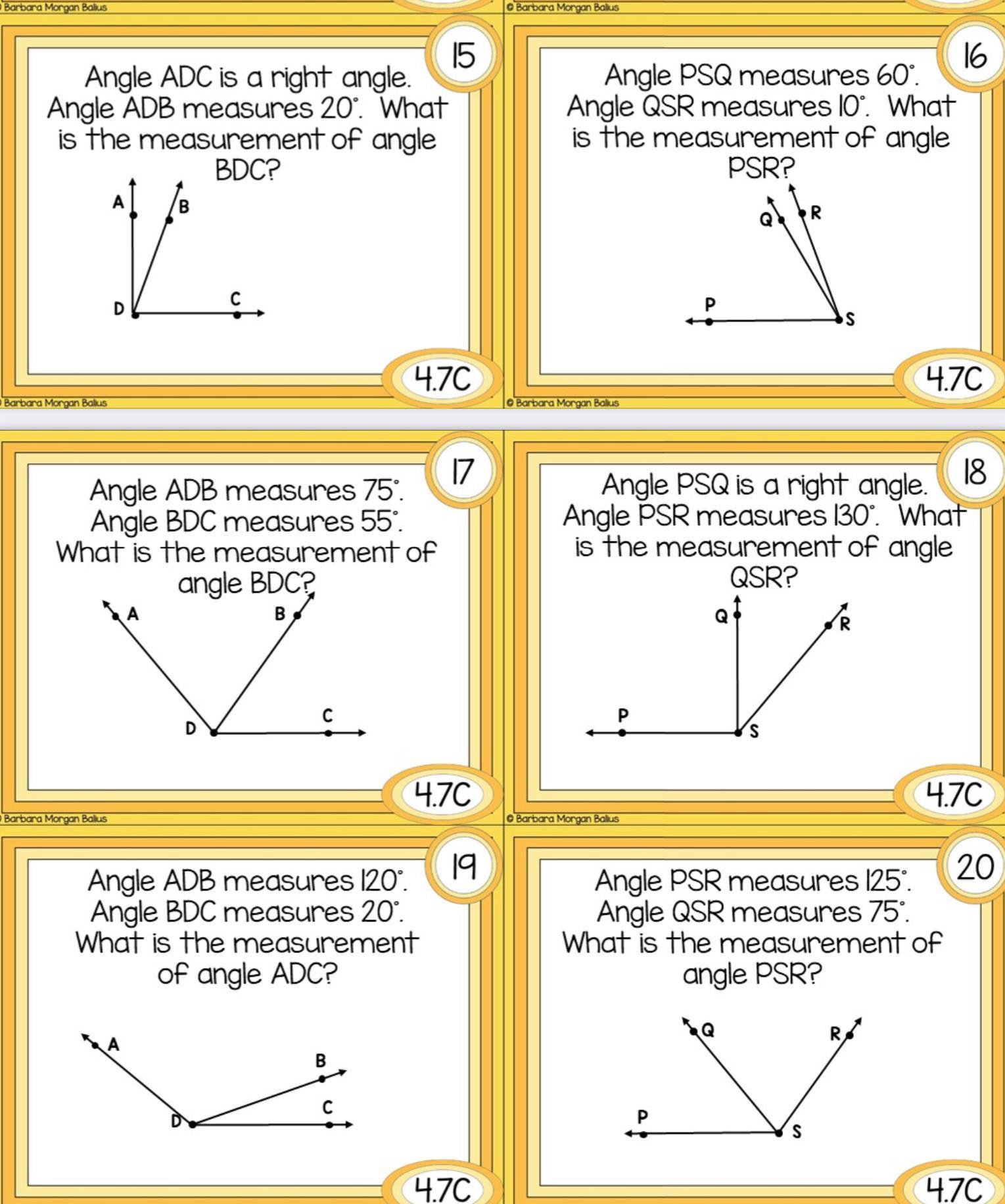
Help pls!! this is a presentation I’m doing in class and I NEED this completed rn, ASAP!!! . What I need is just the answers for the picture below and I NEED the explanation to all of them, and if you can pls try to give a similar example to these and solve it or what did u use to solve it. (Only 1 example that is similar) Thank you so much!
Answers
15. 70° because a right angle is 90° and we have the angle of ADB which is 20°. So 90°-20°=70°.
16. 70° because angle PSQ is 60° and angle QSR is 10°. So 60°+10°=70°.
17. 55° because it says it in the explanation. I assume this is a typo and they meant to ask the measurement of ADC and in that case it would be 130° because angle ADB is 75° and angle BDC is 55°. 75°+55°=130°.
18. 40° because angle PSQ is a right angle which means it's 90°. So 130°-90°=40°.
19. 140° because angle ADB is 120° and angle BDC is 20° so 120°+20°=140°.
20. 125° because again it's in the explanation. But if it's a typo and they meant what is the measurement of PSQ then it is 50° because PSR is 125° and QSR is 75° so 125°-75°=50°.
Hope this helps! :)
This is khan and I have 10 more problem academy. Some help please?

Answers
Answer:
67 degrees
Step-by-step explanation:
the shape is a tryangle so it will have the same angle measurements, just make sure you look if it has the slash next to the letter or not in the future
Hope this helps girly!!
Answer:
\(\angle{C}=54\)
Step-by-step explanation:
Let's first start by establishing that when it comes to a reflection, side lengths and angle measurements remain the same. With that being said, let's identify our angle measurements:
\(\angle{A=}\\\angle{B}= 67\\\angle{C}=\\\angle{A'}=59\\\angle{B'}=\\\angle{C'}=\\\)
As mentioned earlier, angle measurements will remain the same, so we can go ahead and identify the values of \(\angle{A}\) & \(\angle{B'}\)
\(\angle{A=59}\\\angle{B}= 67\\\angle{C}=\\\angle{A'}=59\\\angle{B'}=67\\\angle{C'}=\\\)
The sum of the angles in a triangle will always be equal to 180°.
Add the two identified angles of the original figure.
\(59+67=126\)
Subtract the sum from 180:
\(180-126=54\)
Therefore:
\(\angle{C}=54\)
_
Check your work by adding the three identified angle measurements to see if they measure to 180°:
\(59+67+54\)
\(=180\)
The answer is correct!
In a classroom 1/5 student get grade A; 3/10 got grade B and rest get grade C in math. Total number of students in the class is 50. Find how many students got grade C
Answers
Answer:
25
Step-by-step explanation:
make 1/5 and 3/10 with equivalent denominator which will give us 2/10 and 3/10 now add them and we get 5/10 5 is the half of ten so we will divide 50 over 2 and we will get 25
Simplify the expression by combining like terms: 4x - 2 - 8x + 1
Answers
Answer:
-4x-1
Step-by-step explanation:
combine 4x and -8x to make -4x and combine -2 and 1 to make -1
What is the measurement of SV

Answers
Answer:
1.5
Step-by-step explanation:
The person who deleted my answer needs to read next time.....
But yeah I should have just put this, to begin with.
Anyways...... It's the basically the Pythagorean-theorem but easier because if you look you know the full side of 1 line and they are perfectly parallel therefore you do 4.1-2.6 to get the answer
PLZ GIVE BRAINLIEST
Please help!!! Urgent for homework

Answers
Answer: 7 and 8
Step-by-step explanation:
Square root and squared cancel out
Answer:
a=7
b=32
Step-by-step explanation:
The first one (a) is 7 because if you square a square root, you get the number inside the root. Also, technically a square root has an exponent of (1/2) so when you have a power-to-a-power (power rule of exponents) you multiply the exponents. So (\(7^{1/2}\))^2 is 7.
For (b) you have to take it in two parts. Square the square root and you get 2. Square the 4 in front, you get 16. Multiply those two numbers (16 and 2) together and you get 32.
Edit: Check on your calculator, you get the same answers I got! :)
4. You (or your parents) plan to pay $1,275.00/month for a mortgage. How much is the minimum (1 point)
realized income per month to the nearest penny?
Answers
i just did the test....^
The minimum realized income is $2,965.12 per month.
What is the debt-to-income ratio?Lenders typically use the debt-to-income ratio to assess a borrower's ability to repay a mortgage loan.
The debt-to-income ratio = borrower's total monthly debt payments ÷ gross monthly income.
We have,
To determine the minimum realized income per month we need to consider the debt-to-income ratio.
Lenders typically require a debt-to-income ratio of 43% or less.
So,
Assuming a debt-to-income ratio of 43%.
The minimum realized income per month.
= 1,275 / 43%
= 1275 / 0.43
= 2,965.12
Therefore,
The minimum realized income per month required to afford a mortgage payment of $1,275.00, assuming a debt-to-income ratio of 43%, is approximately $2,965.12 per month.
Learn more about debt to income ratio here:
https://brainly.com/question/20901566
#SPJ5
Please help me I will scream I need help please Its a math problem

Answers
Answer:
It is the second one , I'm pretty sure
Answer:
Factored form: \(2(x+4)(x-1)\)
vertex form: \(2(x+1.5)^{2} -12.5\)
Step-by-step explanation:
Factored form:
\(2(x+4)(x-1)=2(x^{2} +4x-x-8)=2(x^{2} +3x-4)=2x^{2} +6x-8\)
Vertex form:
\(2(x+1.5)^{2} -12.5=2(x^{2} +3x+2.25)-12.5\)
\(=2x^{2} +6x+4.5-12.5=2x^{2} +6x-8\)
Hope this helps
A painter leans a 30 foot ladder against one wall of a house. At what height
does the ladder touch the wall if the foot of the ladder is 10 feet from the base
of the wall?
Answers
Answer:
20ft
Step-by-step explanation:
The height at which the ladder touch the wall when the ladder is 30 feet long, and the ladder is 10 feet from the base of the wall is 20√2 feet.
What is Pythagoras Theorem?If ABC is a triangle with AC as the hypotenuse and angle B with 90 degrees then we have:
\(|AC|^2 = |AB|^2 + |BC|^2\)
where |AB| = length of line segment AB. (AB and BC are rest of the two sides of that triangle ABC, AC being the hypotenuse).
Consider the diagram below.
We've got:
Length of the ladder = |AC| = 30 ftDistance between ladder's bottom and base of wall = |BC| = 10 ftHeight of wall from base to the point where ladder touches = |AB| is to be known.The wall is usually perpendicular to ground, therefore making 90° angle with it. Thus, ABC is a right angled triangle.
Using Pythagoras theorem in it, we get:
\(|AC|^2 = |AB|^2 + |BC|^2\\\\30^2 = |AB|^2 + 10^2\\|AB|^2 = 900 - 100\\\\|AB|^2 = 800\\\\\text{Taking sq. root of both the sides}\\\\|AB| = \sqrt{800} = \sqrt{ (\pm 20\sqrt{2})^2}\\\\|AB| = \pm 20\sqrt{2} \: \rm ft\)
But as length cannot be a negative quantity, so we get:
\(|AB| = 20\sqrt{2} \: \rm ft\)
Thus, the height at which the ladder touch the wall when the ladder is 30 feet long, and the ladder is 10 feet from the base of the wall is 20√2 feet.
Learn more about Pythagoras theorem here:
https://brainly.com/question/12105522
#SPJ2

U.S. Treasury Bond
Junk Bond
Certificate of Deposit
$3,500
$1,300
$4,200
O Portfolio 1, portfolio 3, portfolio 2
O Portfolio 2, portfolio 1, portfolio 3
$5,500
O Portfolio 2, portfolio 3, portfolio 1
$1,200
$3,000
$600
$600
Which of the following shows the portfolios' levels of risk from lowest to highest?
O Portfolio 3, portfolio 2, portfolio 1
$1,100
$500
$1,700

Answers
Based on the results, the comparison of the overall performance of the portfolios, from best to worst, is: from "Portfolio 1, Portfolio 2, Portfolio 3". Therefore, the Option C is correct.
We have,
To calculate the weighted mean of the RORs for each portfolio, we need to multiply each ROR by its corresponding investment amount, sum the products, and divide by the total investment amount:
Weighted mean ROR for Portfolio 1:
= ((3.9% x $1,250) + (1.7% x $575) + (10.6% x $895) + (-3.2% x $800) + (8.1% x $1,775)) / ($1,250 + $575 + $895 + $800 + $1,775)
= 5.12%
Weighted mean ROR for Portfolio 2:
= ((3.9% x $950) + (1.7% x $2,025) + (10.6% x $1,185) + (-3.2% x $445) + (8.1% x $625)) / ($950 + $2,025 + $1,185 + $445 + $625)
= 0.04464053537
= 4.46%
Weighted mean ROR for Portfolio 3:
= ((3.9% x $900) + (1.7% x $2,350) + (10.6% x $310) + (-3.2% x $1,600) + (8.1% x $2,780)) / ($900 + $2,350 + $310 + $1,600 + $2,780)
= 0.03550251889
= 3.55%
Based on the results, the comparison of the overall performance of the portfolios, from best to worst, is: from "Portfolio 1, Portfolio 2, Portfolio 3". Therefore, the Option C is correct.
Read more about weighted mean
brainly.com/question/24215541
#SPJ1
complete question:
Calculate the weighted mean of the RORs for each portfolio. Based on the results, which list shows a comparison of the overall performance of the portfolios, from best to worst?
A)Portfolio 1, Portfolio 3, Portfolio 2
B) Portfolio 2, Portfolio 3, Portfolio 1
C) Portfolio 1, Portfolio 2, Portfolio 3
D) Portfolio 3, Portfolio 2, Portfolio 1
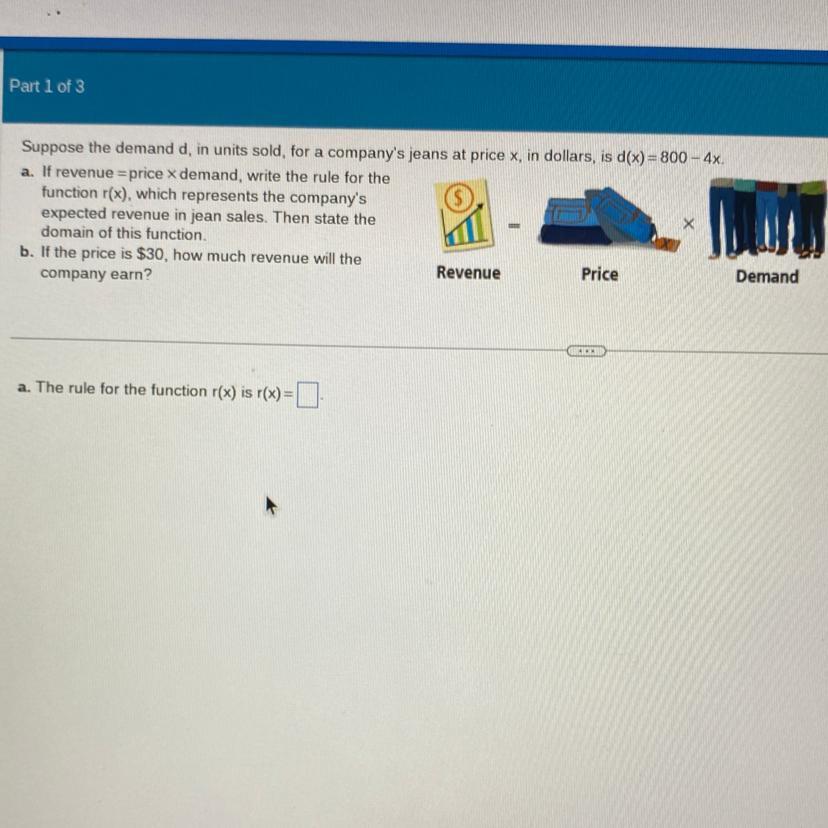
Suppose the demand d, in units sold, for a company's jeans at price x, in dollars, is d(x)=800−4x.
A. If revenue=price×demand, write the rule for the function r(x), which represents the company's expected revenue in jean sales. Then state the domain of this function.
B. If the price is $30, how much revenue will the company earn?
A. The rule for the function r(x) is r(x)=
Answers
Answer:
Sorry let me try to understand the question
Step-by-step explanation:
The domain of the function r(x) is (0, 200).
The revenue earned when the price is $30 is $20400.
The rule for the function r(x) is x(800 - 4x).
What is a function?A function is a relationship between inputs where each input is related to exactly one output.
Example:
f(x) = 2x + 1
f(1) = 2 + 1 = 3
f(2) = 2 x 2 + 1 = 4 + 1 = 5
The outputs of the functions are 3 and 5
The inputs of the function are 1 and 2.
We have,
Demand:
d(x) = 800 - 4x
Price = x
Revenue = Price x demand
Revenue = r(x)
A)
The rule for r(x).
r(x) = x d(x) = x(800 - 4x)
The domain of r(x) is 0 < x < 200 i.e (0, 200).
B)
x = 30
r(x) = 30(800 - 4 x 30)
r(x) = 30(800 - 120) = 30 x 680 = 20400
C)
r(x) = x(800 - 4x)
Thus,
The answers are given above.
Learn more about functions here:
https://brainly.com/question/28533782
#SPJ2
Jaime has lunch at a restaurant and needs to determine how
much tip to leave based on his bill. If his bill was $14.41 and
Jaime wants to leave a 20% tip, what is a reasonable estimate
for how much he should leave?
Answers
Answer:
2.88
Step-by-step explanation:
How many edges does a cube has?
A. 10
B. 12
C. 14
D. 16
Answers
Answer:
Hellooo
ur answer is B. 12
Step-by-step explanation:
hope it helps.. thanks
pls consider brainliest
A cube has 12 edges and 6 faces
A heavy rope, 50 ft long, weighs 0.5 lb/ft and hangs over the edge of a building 120 ft high.
(a) How much work is done in pulling the rope to the top of the building?
(b) How much work is done in pulling half the rope to the top of the building?
Answers
An ndhs asked subjects whether family planning has any benefits. of 1245 sampled subjects, 651 responded definitely or probably beneficial, and 594 responded definitely or probably not beneficial. the proportion responding definitely or probably beneficial was 651/1245 = 0.523.
Answers
This indicates that approximately 47.7% of the sampled subjects responded definitely or probably not beneficial to family planning.
From the given data, we can analyze the proportions of respondents who considered family planning beneficial and those who did not.
The proportion of respondents who responded definitely or probably beneficial is 651 out of 1245 sampled subjects. Therefore, the proportion can be calculated as:
Proportion = 651/1245 ≈ 0.523
This indicates that approximately 52.3% of the sampled subjects responded definitely or probably beneficial to family planning.
On the other hand, the proportion of respondents who responded definitely or probably not beneficial is 594 out of 1245 sampled subjects. The proportion can be calculated as:
Proportion = 594/1245 ≈ 0.477
This means that roughly 47.7% of the sampled participants indicated that family planning was either definitely advantageous or probably not beneficial.
Learn more about proportion on:
https://brainly.com/question/870035
#SPJ11
Malachy, Sushil and Fiona share some sweets in the ratio 3:2:3. Malachy gets 33 sweets. How many sweets are there altogether?
Answers
Answer:
88
Step-by-step explanation:
if the ratio is 3:2:3 and the first one is 33 then that means they all get timesed by 11 so the first is 33 the second 22 and the third 33 add them together and you get 88