D. 20sworoSamiyah has been spending time practiciting her dance moves to get readyfor a dance competition at her school. On Tuesday, she danced for 45minutes, which was 5 times more that the amount of time she danced onMonday. How many minutes did Samiyah spend dancing on Monday?A. 9B.) 220C. 40D. 50
Answers
Samiyah is practicing for 45 minutes on Tuesday.
And that is 5 times more than she practice on monday.
She spend dancing on monday by 45/5 = 9 minutes
The answer is A. 9
Related Questions
Please help with this math worksheet

Answers
Value of x
Multiply
4x+28=80
4x=80-28
4x=52
X=52/4
X=13
I need help with this math
Answers
Answer:
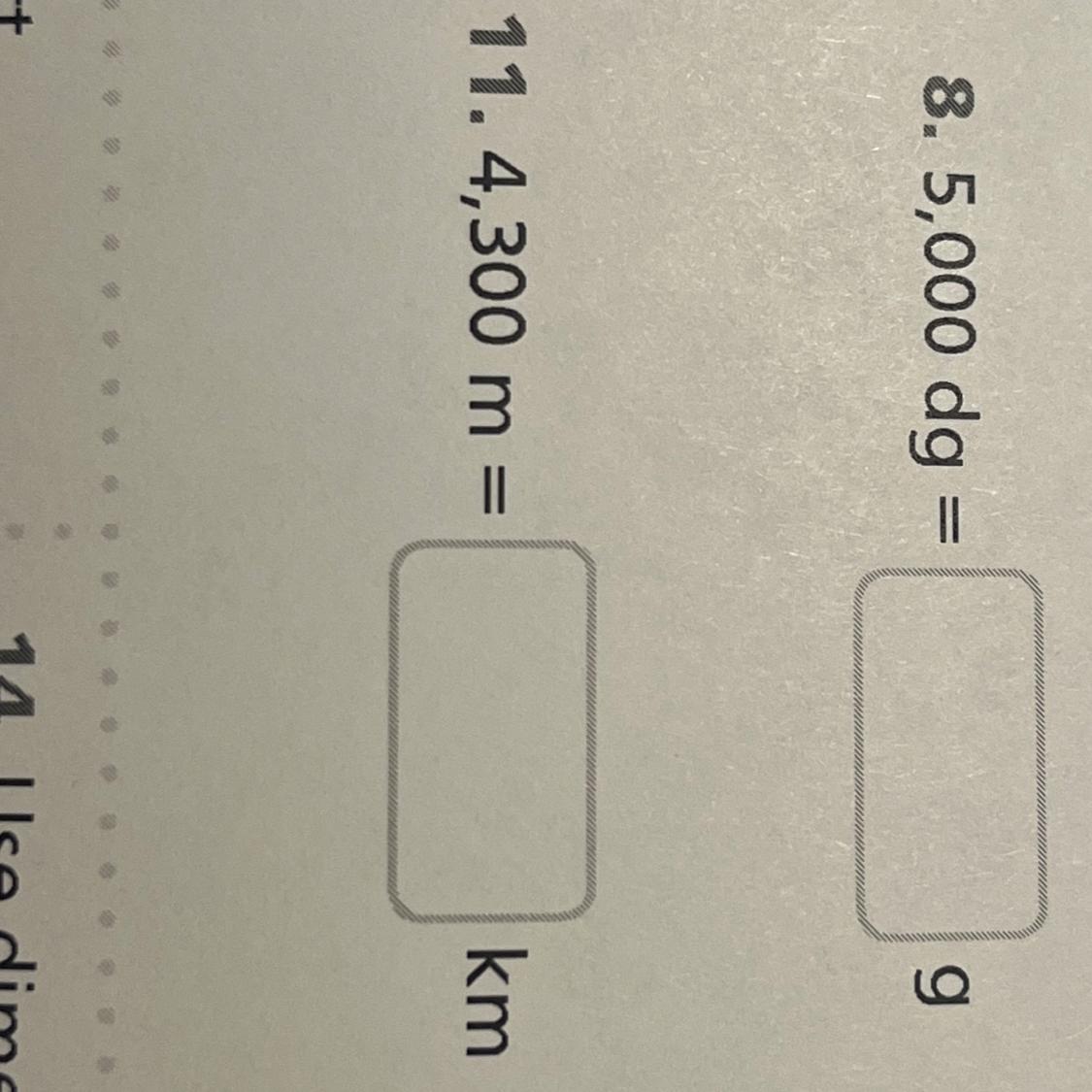
500 and 4.3
Step-by-step explanation:
A decigram is one-tenth of a gram and a kilometer is one-thousandth of a meter. Using this information, we must multiply the given amounts by the values.
5000 × 0.1 = 500
4300 × 0.001 = 4.3
Thus, the answers [in order] are 500 and 4.3
Hope this helps and feel free to ask any questions.
An IQ test is designed so that the mean is 100 and the standard deviation is 15 for the population of normal adults. Find the sample size necessary to estimate the mean IQ score of the residents of a state if you want to be 95% confident that the sample mean is within 4 IQ points of the true mean.
What is the required sample size?
Answers
Answer:
55
Step-by-step explanation:
\(\displaystyle MOE = z\biggr(\frac{\sigma}{\sqrt{n}}\biggr)\\\\4=1.96\biggr(\frac{15}{\sqrt{n}}\biggr)\\\\4=\frac{29.4}{\sqrt{n}}\\\\\sqrt{n}=\frac{29.4}{4}\\\\\sqrt{n}=7.35\\\\n=54.0225\\\\n\approx55\uparrow\)
Make sure to always round up the required sample size to the nearest integer!
find (f o f) x f(x) = 6x+9 and g(x)= x^2
Answers
Step-by-step explanation:
given
f(x)=6x+9
solve
6(6x+9)+9=0
36x+54+9=0
36x+63=0
36x=_63
36x/36 = _63/36
x=_63/36
Here's a graph of a linear function. Write the equation that describes that function. Express in slope-intercept form.

Answers
Simplify fully
9/4x - 2/x
Answers
Answer:1/4x
Step-by-step explanation:
Hope it helped
Find the measure of each angle of the quadrilateral.

Answers
all work should be in the picture, lmk if theres anything confusing

point a is at (6,-6) and point c is at (-6, -2)
Find the cooridantes of point b on AC such that AB=3/4 AC
Answers
Answer:
(-3,-3)
B=(6-9,6+3)
Now write the numbers 1 through 10 using exactly four 4s.
Value
Expression using four 4s
1
I
2
3
4
5
6
7
8
9
10
Answers
Step-by-step explanation:
By using exactly four 4s it is possible to write a few numbers: at least from 0 - 30.
=> For example, using exactly four 4s, we can write 1 as follows
1 = 44 / 44
The right hand side of the above equation has exactly four 4s and solving it will give 1.
=>Using exactly four 4s, we can write 2 as follows;
2 = (4/4) + (4/4)
Also, there are exactly four 4s in the right hand side of the above equation and solving it gives 2
=> Using exactly four 4s, we can also write 6 as follows;
6 = 4 x .4 + 4.4
The above equation also contains exactly four 4s which will give 6 when solved. i.e
(4 x .4) + 4.4 = (4 x 0.4) + 4.4 = 6
The expressions for numbers 1 through 10 using exactly four 4s have been tabulated and shown in the image attached to this response.

Which of the following is not a polynomial identity?
O A. a? (b+c) = a(®+c)
a
O
O B. (22+3)(c + dla) = (ac-bet)* + (ad + bc)
+
O C. 22 - B° = (a - b)(a2 + ab + b)
OD. (a+b)2 = 22 + 2ab+ b2
=

Answers
Answer:
A
Step-by-step explanation:
If we start from top to bottom all we have to do is check which ones are not equal.
The first one is
\(a^2(b+c) = a^3(\frac{b}{a}+c)\)
If we multiply is out we get
\(a^2b+a^2c = a^3*\frac{b}{a}+a^3c\\\text{which turns into}\\a^2b+a^2c=a^2b+a^3c\)
That is NOT equal to the other. Making the answer A.
a pair of dice are rolled. (a) what is the probability space s? (b) determine the probability of each of the following events: i. the sum of the rolls is even. ii. the first roll is equal to the second. iii. the first roll is larger than the second.
Answers
a)The probability Space, S = {(1,1) (1,2) (1,3) (1,4) (1,5) (1,6), (2, 1) (2, 2) (2,3) (2,5) (2,4),(2,6), (3,1) (3,2) ,(3,3), (3,4) (3,5)(3,6), (4,1) (4,2) (4,3) (4,4) (4,5) (4,6), (5,1) (5,2) (5,3) (5,4) (5,5) (5,6),(6,1) (6,2) (6,3) (6,4) (6,5) (6,4), (6,5),(6,6)}
b) i) Probability that the sum of the rolls is even, P(A) = 0.5
ii)Probability that first roll is equal to the second, P(B) 0.166
iii) Probability that the first roll is larger than the second, P(C) = 0.4166.
We have a pair of dice are rolled, then the Sample space is same as probability space.
a) The probability space , S is a non-empty set contains all possible outcomes. The probability space is written as
S = {(1,1) (1,2) (1,3) (1,4) (1,5) (1,6), (2, 1) (2, 2) (2,3) (2,5) (2,4),(2,6), (3,1) (3,2) ,(3,3), (3,4) (3,5)(3,6), (4,1) (4,2) (4,3) (4,4) (4,5) (4,6), (5,1) (5,2) (5,3) (5,4) (5,5) (5,6),(6,1) (6,2) (6,3) (6,4) (6,5) (6,4), (6,5),(6,6)}
b) Total possible outcomes from rolling = 36
Let us consider the events,
A : sum of the rolls is even
B : first roll is equal to the second
C : first roll is larger than the second.
Now, favourable outcomes for event A = 18
i) Probability (Sum is even), P( A) = 18/36
= 0.5
Favourable outcomes for event B = 6 = { (1,1),(2,2),(3,3),(4,4), (4,1) (4,2) (4,3), (5,5),(6,6)}
ii) So, Probability that first roll is equal to the second, P(B) = 6/36 = 0.166
Favourable outcomes for event C = 15 = { (2,1),(3,2),(3,1),(4,1),(5,1) (5,2) (5,3) (5,4),(6,1) (6,2) (6,3) (6,4) (6,5) (6,4), (6,5)}
iii) So, probability that the first roll is larger than the second, P(C) = 15/36
= 0.4166.
Hence, we get all required probabilities.
To learn more about Probability, refer:
https://brainly.com/question/13604758
#SPJ4
The probability of P(Sum is even)=0.5, P(the first roll is equal to the second)=\(\frac{1}{6}\), P(the first roll is larger than the second)=0.4167.
A pair of dice are rolled
Probability is a measure of the likelihood of an event to occur. Many events cannot be predicted with total certainty. We can predict only the chance of an event to occur.
The probability formula is defined as the possibility of an event to happen is equal to the ratio of the number of favourable outcomes and the total number of outcomes.a) Sample space,
\($$\begin{aligned}S= & \left\{\begin{array}{l}(1,1)(1,2)(1,3)(1,4)(1,5)(1,6) \\(2,1)(2,2)(2,3)(2,4)(2,5)(2,6)\end{array}\right. \\& (3,1)(3,2)(3,3)(3,4)(3,5)(3,6) \\& (4,1)(4,2)(4,3)(4,4)(4,5)(4,6) \\& (5,1)(5,2)(5,3)(5,4)(5,5)(5,6) \\& (6,1)(6,2)(6,3)(6,4)(6,5)(6,2)\}\end{aligned}$$\)
(b).
(i).The probability of each of the following events
Probability of event to happen
P(E) = Number of favourable outcomes/Total Number of outcomes⇒P(Sum is even)=\(\frac{18}{36} =\frac{1}{2}\)=0.5
⇒P(Sum is even)=0.5
(ii). P(the first roll is equal to the second)=\(\frac{6}{36} =\frac{1}{6}\)
⇒P(the first roll is equal to the second)=\(\frac{1}{6}\)
(iii). P(the first roll is larger than the second)=\(\frac{15}{36}=0.4167\)
⇒P(the first roll is larger than the second)=0.4167
Therefore, the P(Sum is even)=0.5, P(the first roll is equal to the second)=\(\frac{1}{6}\), P(the first roll is larger than the second)=0.4167.
For more such questions on probability
https://brainly.com/question/9793303
#SPJ4
The diameter of the circle below measures 7 cm,
What is the approximate area of the circle?
A. 14 cm2
B. 22 cm2
C. 38 cm2
D. 154 cm2
Answers
Answer: D
Step-by-step explanation:
Remember the formula -
\(A = \pi\) × \(r^{2}\)
π = 3.14
\(r^{2}\) = 7
7² = 49
3.14 x 49 = 153.94
A = π · r² = π · 72 ≈ 153.93804
153.93804 ⇒ 154 (rounded)
Your answer is D.
Anderson uses the discriminant to correctly find the number of real solutions of the quadratic equation one-halfx2 + 4x + 8 = 0. Which explanation could Anderson provide?
The equation has no real number solutions because the discriminant is 0.
The equation has one real number solution because the discriminant is 0.
The equation has no real number solutions because the discriminant is less than 0.
The equation has two real number solutions because the discriminant is greater than 0.
Answers
Answer:
The equation has one real number solution because the discriminant is 0.
Step-by-step explanation:
If the discriminant is less than 0, there are no real number solutions.If the discriminant is equal to 0, there is one real number solution.If the discriminant is greater than 0, there are two real number solutions.Formula: D = \(b^{2}\) - 4ac
\(\frac{1}{2} x^{2}+4x+8=0\)
⇒ a = 1/2, b = 4, c = 8
⇒ D = 4*4 - 4*0.5*8 = 16 - 16 = 0
⇒ The equation has one real number solution because the discriminant is 0.
Answer: B
Step-by-step explanation:
Find the first five terms of the following sequence, starting with n=1.

Answers
Answer:
-2,1,6,13,22
Step-by-step explanation:
cn = n^2 -3
Let n=1
c1 = 1^2 -3 = 1-3 = -2
Let n=2
c2 = 2^2 -3 = 4-3 = 1
Let n=3
c3 = 3^2 -3 = 9-3 = 6
Let n=4
c4 = 4^2 -3 = 16-3 = 13
Let n=5
c5 = 5^2 -3 = 25-3 = 22
Select all statements that are true.

Answers
Answers:
A, B, D, E
Nearly everything except choice C is true.
====================================================
Explanation:
Choice A is true because sine = opposite/hypotenuse.Choice B is true as well because cosine = adjacent/hypotenuseTangent is opposite/adjacent. The 4/9 should be 9/4. Therefore, choice C is false. If beta was theta, then tan(theta) = 4/9 would be true.Choice D is true because of the pythagorean theorem a^2+b^2 = c^2.Choice E is true because tan = opposite/adjacent, and the 9 and 4 are in the correct order (see choice C).you want to install molding around the circular room. How much it would cost you to install the molding that you picked if it cost $4.22 per foot?
Answers
The cost of the molding is given as follows:
$119.30.
What is the measure of the circumference of a circle?The circumference of a circle of radius r is given by the equation presented as follows:
C = 2πr.
The parameters for this problem are given as follows:
d = 9 -> r = 4.5.
(as the radius is half the diameter)
Hence the circumference is given as follows:
C = 2 x π x 4.5
C = 28.27 ft.
The cost is of $4.22 per ft, hence the total cost is given as follows:
4.22 x 28.27 = $119.30.
More can be learned about the circumference of a circle at brainly.com/question/12823137
#SPJ1

What percent is16 out of 64? It is _ .
Answers
Solve the system of equations

Answers
R= 584
If have any problem, tell me^_^

Is a quadrilateral a trapezoid? (True or False)
PLEASE HELP QUICKLY THANK YOU
Answers
Answer:
False
Step-by-step explanation:
All trapezoids are quadrilaterals, not all quadralaterals are trapezoids.
Answer:
A quadrilateral is any shape with four sides. So yes a trapezoid is a quadrilateral.
Step-by-step explanation:
who can helppppppppppppppppppppppppppppppppppppppppppppppppppppppppppp

Answers
Answer:
24 units
Step-by-step explanation:
6 times 8 =48
48 divided by 1/2 = 24
Select all the expressions equivalent to (0.5p+7)+(0.3p-6)
Answers
Answer:0.8p+1 and 1+0.8p
Step-by-step explanation:
0.5p+0.3p=0.8p
7-6=+1
0.8p+1
and
Swap both numbers
(0.5p+7)+(0.3p-6)=1+0.8p
derivate (cos(3x^2). (5x^3 -1)^1/3 +sin 4x^3)^4
\( \: \: \: \: find \: first \: derivative \\ ( cos(3x {}^{2} ) \times ( \sqrt[3]{5x {}^{3} - 1} ) + \sin(4x {}^{3} ) {}^{4} \)
Answers
Answer:
Step-by-step explanation:
\(\frac{d}{dx} [cos(3x^2) \sqrt[3]{5x^3 -1} +sin(4x^3)]^4\\\\=4[cos(3x^2) \sqrt[3]{5x^3 -1} +sin(4x^3)]^3\; \frac{d}{dx} [cos(3x^2) \sqrt[3]{5x^3 -1} +sin(4x^3)] --- eq(1)\)
Lets look at the derivative part:
\(\frac{d}{dx} [cos(3x^2) \sqrt[3]{5x^3 -1} +sin(4x^3)] \\\\= \frac{d}{dx}[cos(3x^2) \sqrt[3]{5x^3 -1} ] + \frac{d}{dx}[sin(4x^3)]\\\\=cos(3x^2) \frac{d}{dx}[ \sqrt[3]{5x^3 -1} ] + \sqrt[3]{5x^3 -1}\frac{d}{dx}[ cos(3x^2) ] + cos(4x^3) \frac{d}{dx}[4x^3]\\\\=cos(3x^2) \frac{1}{3} (5x^3 -1)^{\frac{1}{3} -1} \frac{d}{dx}[5x^3 -1] + \sqrt[3]{5x^3 -1} (-sin(3x^2))\frac{d}{dx}[ 3x^2] + cos(4x^3)[(4)(3)x^2]\)
\(=\frac{cos(3x^2) 5(3)x^2}{3(5x^3 - 1)^{\frac{2}{3} }} -\sqrt[3]{5x^3 -1}\; sin(3x^2) (3)(2)x + 12x^2 cos(4x^3)\\\\=\frac{5x^2cos(3x^2) }{(5x^3 - 1)^{\frac{2}{3} }} -6x\sqrt[3]{5x^3 -1}\; sin(3x^2) + 12x^2 cos(4x^3)\)
Substituting in eq(1), we have:
\(\frac{d}{dx} [cos(3x^2) \sqrt[3]{5x^3 -1} +sin(4x^3)]^4\\\\=4[cos(3x^2) \sqrt[3]{5x^3 -1} +sin(4x^3)]^3\; [\frac{5x^2cos(3x^2) }{(5x^3 - 1)^{\frac{2}{3} }} -6x\sqrt[3]{5x^3 -1}\; sin(3x^2) + 12x^2 cos(4x^3)]\)
In Exercises 1-3, the perpendicular blsectors of ABC Intersect at point G, or the anglebisectors of AXYZ intersect at point P. Find the Indicated measure. Tell which theoremyou used.

Answers
We have a line:
And we draw its perpendicular bisector:
Then, any point on the bisector is equidistant to the endpoints of the line:
This is called: the perpendicular bisector theorem.
1In this case we have that:
Since the line is the black one, the bisector is the purple one, then both red segments measure the same : 9.
Answer: BG = 9 (bisector theorem)
2In this case, as we can observe in the image, the red lines are equidistant then CG = 10
Answer: CG = 10 (bisector theorem)


15 plants in 3 rows =
plants per row
HELPPPPP
Answers
Answer:
Step-by-step explanation:
45
Answer:
Step-by-step explanation:
5
how much money will be in Devon's retirement account if she continues to make the same monthly investment for 40 years

Answers
Annuities
It refers to a special form to accumulate interest over a regular payment or cash flow (C) per period.
Devon decides to save money for her retirement by depositing C=$524 each month in an account that is expected to earn interest with an APR of r=5.25% compounded monthly.
We will calculate the future value (FV) of her investment over a period of n=40 years.
The future value can be calculated with the formula:
\(FV=C\cdot\frac{(1+i)^n-1}{i}\)Where i is the interest rate adjusted for the compounding period. Since there are 12 months in one year:
\(i=\frac{r}{12}=\frac{0.0525}{12}=0.004375\)The number of periods is also adjusted for monthly compounding:
n = 40*12 = 480
Now apply the formula:
\(FV=524\cdot\frac{(1+0.004375)^{480}-1}{0.004375}\)Calculating:
\(\begin{gathered} FV=524\cdot1,629.45 \\ FV=853,832.69 \end{gathered}\)There will be $853,832.69 in Devon's retirement account in 40 years
nine less than the product of 8 and a number is 5
Answers
Answer:
1.75
Step-by-step explanation:
1. Algebraic equation: 8x - 9 = 5
2. Add 9 on both sides; 8x=14
3. Divide both sides by 8
4. x=1.75
Answer:
Number = 1/2
Step-by-step explanation:
9 - 8a = 5
9 - 5 = 8a
4 = 8a
4/8 = a
a = 1/2
Check:
9 - 8*1/2 = 5
9 - 4 = 5
If a rotation takes triangle CAT to C’A’T where is AT

Answers
Answer:
The measure of C'T' after rotation of transformation is option (B) square root of 17 is the correct answer.
Step-by-step explanation:
What is a rotation transformation?
A rotation is a transformation that turns the figure in either a clockwise or counterclockwise direction on the coordinate plane. In both transformations the size and shape of the figure stays exactly the same.
For the given situation,
The graph shows the triangle CAT.
If a rotation takes triangle CAT to C'A'T',
then from the definition of rotation transformation the size and shape of the figure stays exactly the same.
Thus the measure of C'T' is same as CT.
Hence we can conclude that the measure of C'T' after rotation of transformation is option (B) square root of 17 is the correct answer.
Learn more about rotation transformation here: brainly.com/question/12865301
#SPJ1
The Department of Commerce in a state has determined that the number of small businesses that declare bankruptcy per month is approximately a Poisson distribution with a mean of 3.4. Find the probability that more than 3 bankruptcies occur next month.
Answers
Answer:
0.44164
Step-by-step explanation:
Given that :
Mean (λ) = 3.4
probability that more than 3 bankruptcies occur next month
Using the poisson distribution formula :
P(x ; λ) = P[(e^-λ) * (λ^x)] ÷ x!
Probability of obtaining more than 3 bankruptcies :
To save computation time, we can use the poisson distribution calculator :
P(x >3 ; λ = 3.4)
P(x > 3) = 0.44164
P(x > 3) = 0.44164
Using a meter stick, I measured the width of the classroom to the nearest cm. The classroom is 11 meter sticks long plus 49 cm on the 12th meter stick. How wide is the classroom in m? how wide is it in cm? how are the two numbers different?
Answers
Answer:
11.49 Meters 1149 cm
Step-by-step explanation:
What is the decay factor in the exponential decay function y=a(1−r)^t
Answers
Answer:
(1 - r)Step-by-step explanation:
Given function:
y = a (1−r)^tHere we have:
y - future value, a- present value, (1 - r) - decay factor, t- number of decay periods