Compare the table and equation. x y 1 3 2 6 3 9 Equation: y = 4x Which representation has the greatest slope?
a) The equation has the greatest slope.
b) The table has the greatest slope.
c) The table and equation have the same slope.
d) Their slopes cannot be determined.
Answers
Answer:
a) The equation has the greatest slope.
Step-by-step explanation:
The table has the values as shown below;
x y
1 3
2 6
3 9
The gradient of the line can be found as;
m=Δy/Δx
m= 9-3 /3-1
m= 6/2
m₁= 3
The equation of the other line is : y=4x
The gradient is , m₂ = 4
The presentation with the greatest slope is the equation that has a slope of 4.
Related Questions
A swimming pool is to be drained. The pool is shaped like a rectangular prism with length 45 ft, width 20 ft, and depth 5 ft. Suppose water is pumped out of the
pool at a rate of 250 ft per hour. If the pool starts completely full, how many hours does it take to empty the pool?
hours
2
Answers
Explanation:
WILL GIVE BRAINLIEST + MAX POINTS!!!
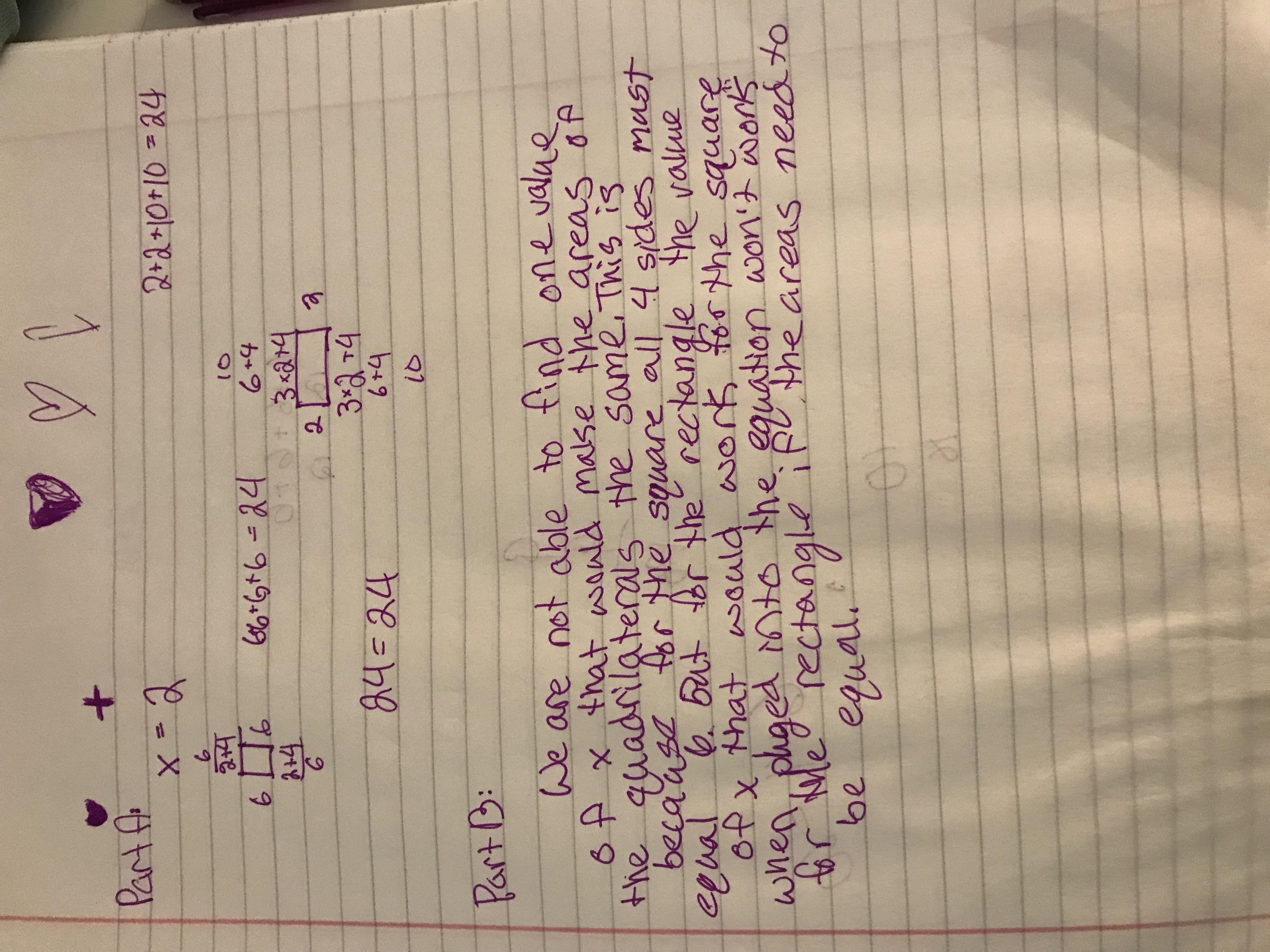
Sara is working on a Geometry problem in her Algebra class. The problem requires Sara to use the two quadrilaterals below to answer a list of questions. Part A: For what one value of are the perimeters of the quadrilaterals the same? (Hint: The perimeter of a quadrilateral is the sum of its sides.) Part B: For what one value of are the areas of the quadrilaterals the same? (Hint: The area of a quadrilateral is the product of its base and height.) Please help me outtt!
Answers
HELLO
I NEEDED HELP WITH THE SAME QUESTION SO I PUT IT UP WITH A PIC SO U CAN ALSO GET AN ANSWER FROM THERE
HERE YA GO <3
https://brainly.com/question/24188218?referrer=searchResults
Answer:
heyy i did this problem a while ago and got kinda stuck on it
Which expressions describe the end behaviors of the function, f(x)= (3.25)^x+6, modeled by the graph? An exponential curve on a coordinate plane with horizontal x axis ranging from negative 10 to 10 in increments of 1. The vertical y axis ranges from negative 4 to 14 in increments of 1. The curve begins infinitely close to the line y equals 6 in the second quadrant. The curve increases through begin ordered pair 0 comma 7 end ordered pair. The curve passes through begin ordered pair 1 comma 9.25 end ordered pair and exits the first quadrant.
Answers
The expression that describe the end behavior of the expression f(x)= (3.25)^x + 6 is The curve begins infinitely close to the line y equals 6 in the second quadrant.
What is end behavior as used in math?The behavior of the graph of a function at its "ends" on the x-axis is referred to as the end behavior of a function, f.
For example, if we look at the right end of the x-axis (as x approaches + ∞) and the left end of the x-axis (as x approaches - ∞), the end behavior of a function explains the trend of the graph.
The graph of the function is attached and from the graph it shows that the graph continued to tend towards towards line y = 6
Learn more about end behavior here:
https://brainly.com/question/28954897
#SPJ1

propose new names for the numbers 11 12 13 14 15 16 17 18 19 so at the naming scheme is consistent with the number 20 and above?
Answers
Answer:
that is your answer 10.34
solve this indices a²b + a³b / a²b²
Answers
Step-by-step explanation:
Notice: The literal factors are all the combinations of a and b where the sum of the exponents is 4: a4, a³b, a²b², ab³, b4 ... The solution to the problem of the binomial coefficients without actually ... The upper index n is the exponent of the expansion; the lower index k indicates which term ... 1a5 + a4b + a3b² + a²b3 + ab4 + b5.
if (-1,4) and (3,-2) are end points of diameter of the circle, then the equation of the circle is
Answers
Answer:
If you've more doubts you can ask :)
Step-by-step explanation:
If the centre of a circle is (a, b) and radius r, then the equation of the circle is :
\((x - x)^2 + (y-b)^2 = r^2\)
First we will find the centre, (a , b):
\(a = \frac{3+(-1)}{2} = \frac{2}{2} = 1\\\\b = \frac{-2 + 4}{2} = \frac{2}{2} = 1\)
Find radius:
\(Radius, r = \frac{Diameter}{2}\)
Diameter is the distance between (-1, 4) and (3, -2)
\(diameter = \sqrt{(x_2 - x_1)^2 +(y_2-y_1)^2} \\\\\)
\(= \sqrt{(3-(-1)^2 + (-2-4)^2} \\\\=\sqrt{16 + 36}\\\\=\sqrt{52}\\\\=\sqrt{4 \times 13}\\\\=2\sqrt{13} \ units\)
Therefore , \(r = \frac{2 \times \sqrt{13} }{2} = \sqrt{13} \ units\)
Equation of the circle is :
\((x - 1)^2 +(y-1)^2 = 13\)
QUICK ANSWER PLEASE 25 POINTS
These city streets are laid out in a rectangular grid and the distance between point A and point B is 34 ft., and the distance between point A and point C is 16 ft.
What is the distance between points B and C?
Answers
Answer:
18 ft or 37.6 ft
Step-by-step explanation:
A + B = 34
A + C = 16
34^2 + 16^2 =BC^2
1156 + 256 = BC^2
1412 = BC^2
37.57=BC
Answer:
there you go
Step-by-step explanation:
have a good day/night


what is
1 1/4 + 2/14

Answers
Answer:
1.39285714286
Step-by-step explanation:
\(1\frac{1}{3} + 2\frac{1}{4} = \frac{3*1+1}{3} + \frac{4*2+1}{4} = \frac{4}{3} + \frac{9}{4} = \frac{4*4}{3*4} + \frac{9*3}{4*3} = \frac{16}{12} + \frac{27}{12} = \frac{16+27}{12}=\frac{23}{12} = 1\frac{11}{12}\)
Please help me?!!!!!!!!!

Answers
Step-by-step explanation:
blue=60%
yellow= 30%
red=10%
hope it helps
please mark me brainliest
For the following event, state whether you think the difference between what occurred and what you would expect by chance is statistically significant. Explain.
An airline with a 95% on-time departure rate has 16 out of 300 flights with late departures.
Answers
The difference between the observed and expected number of late departures is statistically significant, we need to perform a binomial test by calculating the probability of observing 16 or more late departures out of 300 flights assuming the null hypothesis is true. If the resulting p-value is less than 0.05, we can conclude that the difference is statistically significant.
Based on the given information, an airline with a 95% on-time departure rate has 16 out of 300 flights with late departures. The question asks whether the difference between what occurred (16 late departures) and what you would expect by chance is statistically significant.
To determine if the difference is statistically significant, we need to conduct a hypothesis test. In this case, we can use a binomial test since we are dealing with two possible outcomes: on-time departure or late departure.
The null hypothesis (H0) assumes that the observed number of late departures is equal to what would be expected by chance. The alternative hypothesis (Ha) assumes that there is a significant difference between the observed and expected values.
In this case, the expected number of late departures can be calculated by multiplying the total number of flights (300) by the expected on-time departure rate (95%). This gives us an expected value of 300 * 0.05 = 15.
To perform the binomial test, we can calculate the probability of observing 16 or more late departures out of 300 flights, assuming the null hypothesis is true. This probability can be calculated using the binomial probability formula or by using statistical software.
If the resulting probability (also known as the p-value) is less than the significance level (usually 0.05), we can reject the null hypothesis and conclude that the difference between what occurred and what would be expected by chance is statistically significant. Otherwise, if the p-value is greater than 0.05, we fail to reject the null hypothesis and conclude that the difference is not statistically significant.
For more such questions on probability
https://brainly.com/question/30390037
#SPJ8
Answer The Question for Brainliest

Answers
Answer:
turn it 90 degrees, hope this helps
Step-by-step explanation:
Answer:
so go to the 120 degree line and make sure the line is straight across from zero and thin dray a line going from 120 down to the bottom of where the zero is
Step-by-step explanation:
Sound waves travel through the air at approximately 343 meters per second. A tuba player plays a constant note that has a wavelength of 4.61 meters.
Determine the period of the sound wave created by the tuba in seconds.
Answers
The period of the sound wave created by the tuba is approximately 0.0134 seconds.
The speed of sound in air is given as 343 meters per second. The formula relating the speed of sound, wavelength, and period of a wave is:
v = λ × f
Where:
v = speed of sound (343 m/s)
λ = wavelength (4.61 m)
f = frequency (unknown)
To find the period, we need to determine the frequency of the sound wave. The period (T) is the reciprocal of the frequency (f), so we can rewrite the formula as:
v = λ / T
Rearranging the equation to solve for the period (T), we get:
T = λ / v
Substituting the given values, we have:
T = 4.61 m / 343 m/s
Calculating the value, we find:
T ≈ 0.0134 seconds
Therefore, the period of the sound wave created by the tuba is approximately 0.0134 seconds.
for such more question on wavelength
https://brainly.com/question/10728818
#SPJ8
Ms. Hodge receives 20 phone calls every 60 minutes. How many calls will she expect to receive in 180 minutes?
Ms. Hodge will expect to receive _____ phone calls in 180 minutes.
Answers
Answer:
60
Step-by-step explanation:
20 calls / 60 minutes
x calls / 180 minutes
60 x 3 = 180 minutes
20 x 3 = 60 calls
Answer:
Ms hodge will expect to receive 60 phone calls in 180 minutes.
Step-by-step explanation:
180 divided by 60 is 3
3x20= 60
Ms hodge will expect to receive 60 phone calls in 180 minutes.
Trey has plastic cubes stored in a box that measures 4 ft long, 212ft wide, and 2 ft tall.
The edge length of each plastic cube is 12ft.
How many plastic cubes can fit into the box?
Answers
there are 160 plastic cubes that can fit into the box.
Step-by-step explanation:
brainlist plz
Answer:
27
Step-by-step explanation:
I took the same test
find the number of sides of a regular prism which has 10 faces and 12 vertices
I NEED THE ANSWER THE QUESTION QUICK
Answers
Answer:
A regular prism with 10 faces and 12 vertices has 6 sides. This is because the number of faces and vertices are related by the equation F+2 = E+2V, where F is the number of faces, E is the number of edges, and V is the number of vertices. In this case, 10+2 = 12+2V, so V = 6 and the number of sides of the prism is also 6
Step-by-step explanation:
1. A regular prism has 10 faces and 12 vertices.
2. The number of faces and vertices is related by the equation F+2 = E+2V.
3. Where F is the number of faces, E is the number of edges, and V is the number of vertices.
4. In this case, 10+2 = 12+2V, so V = 6.
5. Therefore, the number of sides of the prism is also 6.
A triangular pyramid is formed from three right triangles as shown below.
Use the information given in the figure to find the length AC.
If applicable, round your answer to the nearest whole number.
The lengths on the figure are not drawn accurately.
A
41
B
85

Answers
Answer:
76 units
Step-by-step explanation:
You want the length of AC in the given triangular pyramid.
Pythagorean theoremThe Pythagorean theorem can be used to find the lengths of AD and CD.
AD² + 40² = 41²
AD² = 41² -40² = 81 . . . . . = 9²
and
CD² +40² = 85²
CD² = 85² -40² = 5625 . . . . . = 75²
It can also be used to find AC:
AD² + CD² = AC²
81 + 5625 = AC²
AC = √5706 = 3√634 ≈ 76
The length of side AC is about 76 units.
__
Additional comment
The Pythagorean theorem tells you the square of the hypotenuse is the sum of the squares of the legs of a right triangle.
<95141404393>

What is the quotient of
15y^3+ 28y^2+ 7y-6 / 5y+6?
Answers
Answer: The quotient is 3y² + 2y - 1.
Step-by-step explanation:
You can use long division to solve this expression by setting the dividend under the roof and the divisor outside as you would normally do when dividing numbers.
1) Look at the first term of the dividend, 15y³, and the first term of the divisor, 5y. Determine what value multiplied by 5y would give you 15y³. The answer is 3y², and given the number, you multiply it by the WHOLE divisor.
3y²(5y + 6) = 15y³ + 18y² <-- subtract this from the dividend.
2) Continue this process and make sure to drag down the next term for each new value you form after subtracting. Keep in mind of any negative values! When you reach up to -5y, determine what value multiplied by 5y would give you the value of -5y, which would be -1.
3) You should be left with a remainder of 0, leaving you with a quotient of 3y² + 2y - 1.
The weekly amount spent by a small company for in-state travel has approximately a normal distribution with mean $1450 and standard deviation $220. What is the probability that the actual expenses will exceed $1560 in 20 or more weeks during the next year?
Answers
Answer:
0.0903
Step-by-step explanation:
Given that :
The mean = 1450
The standard deviation = 220
sample mean = 1560
\(P(X > 1560) = P( Z > \dfrac{x - \mu}{\sigma})\)
\(P(X > 1560) = P(Z > \dfrac{1560 - 1450}{220})\)
\(P(X > 1560) = P(Z > \dfrac{110}{220})\)
P(X> 1560) = P(Z > 0.5)
P(X> 1560) = 1 - P(Z < 0.5)
From the z tables;
P(X> 1560) = 1 - 0.6915
P(X> 1560) = 0.3085
Let consider the given number of weeks = 52
Mean \(\mu_x\) = np = 52 × 0.3085 = 16.042
The standard deviation = \(\sqrt {n \time p (1-p)}\)
The standard deviation = \(\sqrt {52 \times 0.3085 (1-0.3085)}\)
The standard deviation = 3.3306
Let Y be a random variable that proceeds in a binomial distribution, which denotes the number of weeks in a year that exceeds $1560.
Then;
Pr ( Y > 20) = P( z > 20)
\(Pr ( Y > 20) = P(Z > \dfrac{20.5 - 16.042}{3.3306})\)
\(Pr ( Y > 20) = P(Z >1 .338)\)
From z tables
P(Y > 20) \(\simeq\) 0.0903
square root of -20
someone please help
Answers
Answer:
I think its either 5 or 4 one of the 2
Use slopes and y-intercepts to determine if the lines 5x + 2y = -3 and 2x - y = -2 are parallel.
Answers
Use slopes and y-intercepts to determine if the lines 5x + 2y = -3 and 2x - y = -2 are parallel.
step 1
we have the line
5x + 2y = -3
isolate the variable y
2y=-5x-3
y=-2.5x-1.5
the slope is m=-2.5
y-intercept b=-1.5
step 2
we have
2x - y = -2
y=2x+2
the slope is m=2
the y-intercept is b=2
step 3
Compare their slopes
m=-2.5
m=2
the slopes are not equal
that means
the lines are not parallel
1. Select all equations that have two solutions.
A.x² = 16
B. 4x² = 0
C. x² = -16
D. 3x + 2 = 14
Ex² - 1 = 24
F) (x + 8) (x - 8) = 0
Answers
A) x² = 16 (solutions: x = 4, x = -4)
B) 4x² = 0 (solutions: x = 0)
F) (x + 8)(x - 8) = 0 (solutions: x = -8, x = 8)
If x3 = 216, what is the value of x?
A. 3
B. 4
C. 6
D. 9
Answers
C: 6 hope
it helps
X^3=6^3
Step 3: Apply Quantitative Tools
Use computational and algebraic tools to quantify the total costs (gas, maintenance/repairs, purchase price) for each scenario over the three years.
Round your answers to the nearest dollar.
Scenario
Total Cost for Three Years
Keep the old car
$
Number
Buy the fuel-efficient used car
$
Number
Step 4: Make an Informed Decision
Based on the information presented what do think Manny should decide?
Option #1: Keep the old car
Option #2: Buy the fuel-efficient used car
Option #
Number
Answers
Answer: Total old car is $2955.89, new car $1080.94 *for 3yrs
Step-by-step explanation:
Old= [(100/19)($2.36)(52)+$770]*3 = $2955.89
New=[(100/34)($2.36)(52)+20(12)]*3= $1080.94
I keep the old car # 1
What is the present value of R13 000 p.a. invested at the beginning of each year for 8years at 10%p.a. compound interest? (NB Use the compound interest tables provided or work to three decimal places only.)
Answers
Given statement solution is :- The present value of R13,000 per year invested for 8 years at 10% compound interest is approximately R69,776.60.
To calculate the present value of an investment with compound interest, we can use the formula for the present value of an annuity:
PV = A *\((1 - (1 + r)^(-n)) / r\)
Where:
PV = Present value
A = Annual payment or cash flow
r = Interest rate per period
n = Number of periods
In this case, the annual payment (A) is R13,000, the interest rate (r) is 10% per year, and the investment is made for 8 years (n).
Using the formula and substituting the given values, we can calculate the present value:
PV = \(13000 * (1 - (1 + 0.10)^(-8)) / 0.10\)
Calculating this expression:
PV = \(13000 * (1 - 1.10^(-8)) / 0.10\)
= 13000 * (1 - 0.46318) / 0.10
= 13000 * 0.53682 / 0.10
= 6977.66 / 0.10
= 69776.6
Therefore, the present value of R13,000 per year invested for 8 years at 10% compound interest is approximately R69,776.60.
For such more questions on present value
https://brainly.com/question/30390056
#SPJ8
-3x^2+33=48x complete the square
Answers
The complete square form of - 3x² + 33 = 48x is [x + 8]² = 75
Completing the square:
To do this, we add and subtract a constant term to the quadratic expression to make it a perfect square.
In this case, we use the formula x² + 2bx + b² = (x + b)² to rewrite the quadratic expression as a perfect square trinomial, and then we solved for the variable by isolating the squared term and taking the square root.
Here we have
- 3x² + 33 = 48x
Keep 'x' terms on one side and constant terms sides on another side
=> - 3x² - 48x = - 33
Divide by - 3 on both sides
=> -3(x² + 4x)/3 = - 33/3
=> x² + 16x = 11
Take half of the 'x' term and square it and add on both sides
=> x² + 2(8x) (x) + (8)² = 11 + (8)²
Which is in the form of x² + 2bx + b² = (x + b)²
=> [x + 8]² = 75
Therefore,
The complete square form of - 3x² + 33 = 48x is [x + 8]² = 75
Learn more about Completing the square at
https://brainly.com/question/14270950
#SPJ1
Answer the questions below to find the total surface area of the can.

Answers
Ab=3.14xRadious to the power of 2
then to the area of the rectange you do B x H = YOUR ANSWER
in a classroom there are 28 tablets which includes 5 that are defective. if seven tablets are chosen at random to be used by student groups. 12. how many total selections can be made? a. 140 b. 98280 c. 11793600 d. 4037880 e. 1184040 13. how many selections contain 2 defective tablets? a. 10 b. 21 c. 336490 d. 706629 e. 33649
Answers
Using the combination formula, it is found that:
The number of total selections that can be made is: e. 1184040.The number of selections that contain two defective tablets is: c. 336490.Combination formula\(C_{n,x}\) is the number of different combinations of x objects from a set of n elements, given by the following formula, involving factorials. It is used when the order in which the elements are chosen does not matter.
\(C_{n,x} = \frac{n!}{x!(n-x)!}\)
In the context of this problem, we have that seven tablets are chosen from a set of 28 tablets, hence the number of selections that can be made is given by:
\(C_{28,7} = \frac{28!}{7!21!} = 1,184,040\)
For two defective tablets, the selections are given as follows:
Two defective from a set of five.Five non-defective from a set of 23.Hence the number of selections is calculated as follows:
\(C_{23,5}C_{5,2} = \frac{23!}{5!18!} \times \frac{5!}{2!3!} = 336,490\)
A similar problem, also about the combination formula, is given at https://brainly.com/question/25821700
#SPJ1
A 2-yard piece of brass wire costs $21.96. What is the price per foot?
Answers
Answer:
$3.66.
Step-by-step explanation:
1 yard is equal to 3 feet. So, a 2-yard piece of brass wire is equivalent to 6 feet of brass wire. To find the price per foot, we need to divide the total cost by the total length. So, the price per foot is
8. Write a paragraph proof.
Proof Given: In a plane, a is perpendicular to b, b id perpendicular to c, and c || d.
Prove: a || d
Answers
To prove that line segment a is parallel to line segment d, based on the given information, we can utilize the properties of perpendicular and parallel lines.
Given that a is perpendicular to b and b is perpendicular to c, we know that angles formed between a and b, as well as between b and c, are right angles. Let's denote these angles as ∠1 and ∠2, respectively.
Now, since c is parallel to d, we can conclude that the corresponding angles ∠2 and ∠3, formed between c and d, are congruent.Considering the fact that ∠2 is a right angle, it can be inferred that ∠3 is also a right angle.
By transitivity, if ∠1 is a right angle and ∠3 is a right angle, then ∠1 and ∠3 are congruent.Since corresponding angles are congruent, and ∠1 and ∠3 are congruent, we can deduce that line segment a is parallel to line segment d.
Thus, we have successfully proven that a is parallel to d based on the given information and the properties of perpendicular and parallel lines.
For more such questions on line segment
https://brainly.com/question/30756145
#SPJ8
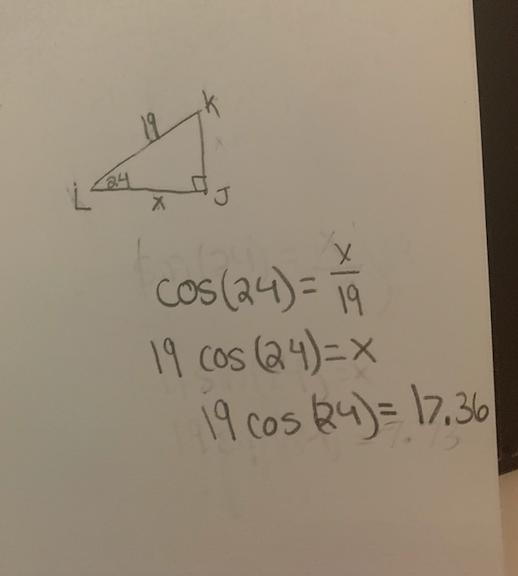
The angle of elevation from L to K measures 24°. If KL = 19, find JL. Round your answer to the nearest tenth. 17.4
Answers
Answer:
17.36
Step-by-step explanation:
since there was not a diagram, this is only how i assume the problem would be set up. see the attachment for how i solved it