Cedric multiplied (6x+11) by a second factor to get a product of 36x^2-121. Find the second factor.

Answers
Answer:
6x-11
Step-by-step explanation:
36x² - 121 is the difference of squares.
36x² - 121 = (6x+11)(6x-11)
Related Questions
Write a quadratic equation in standard form that has two solutions, 9 and -2
(the leading coefficient must be 1.)
Answers
x^2 + 2x -9x -18 = 0
x^2 - 7x - 18 = 0
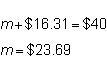
Morgan needs to earn $16.31 more to have $40.00. Four students wrote and solved equations to find m, the amount of money that Morgan has now. Which student wrote and solved the equation correctly?
Sid’s work:
m minus 16 dollars and 31 cents = 40 dollars. M = 56 dollars and 31 cents.
Sora’s work:
m + 16 dollars and 31 cents = 40 dollars. M = 23 dollars and 69 cents.
Matt’s work:
16 dollars and 31 cents + 40 dollars = m. m = 56 dollars and 31 cents.
Zyad’s work:
16 dollars and 31 cents m = 40 dollars. M = 23 dollars and 69 cents.
Answers
Answer:
Sora's work:m + 16 dollars and 31 cents = 40 dollars. M = 23 dollars and 69 cents. is correct
Answer:
Sora’s work, B on edge 2022! i took the test :)
f(x) =x(x-1) on R to R
find A and B such that g: A to B defined by g(x)=f(x) is bijective
this is an algebra question, help.
details are needed
Answers
Answer: To find A and B such that g(x) = f(x) is bijective, we need to ensure that g(x) satisfies the conditions for a bijective function, namely, that it is both injective and surjective.
To show that g(x) is injective, we need to show that for any distinct x1, x2 in A, g(x1) ≠ g(x2). We can do this by assuming that g(x1) = g(x2) and then showing that it leads to a contradiction.
So, let's assume that g(x1) = g(x2). Then, we have:
f(x1) = f(x2)
x1(x1-1) = x2(x2-1)
x1^2 - x1 = x2^2 - x2
x1^2 - x2^2 - x1 + x2 = 0
(x1 - x2)(x1 + x2 - 1) = 0
Since x1 and x2 are distinct, we must have x1 + x2 = 1.
But this is impossible, since x1 and x2 are both real numbers, and the sum of two real numbers cannot equal 1 unless one of them is complex. Therefore, our assumption that g(x1) = g(x2) must be false, and g(x) is injective.
To show that g(x) is surjective, we need to show that for any y in B, there exists at least one x in A such that g(x) = y. In other words, we need to find an expression for x in terms of y.
So, let's solve the equation f(x) = y for x:
x(x-1) = y
x^2 - x - y = 0
Using the quadratic formula, we get:
x = (1 ± √(1 + 4y))/2
Since we want to define g(x) on R, we need to ensure that the expression under the square root is non-negative. This means that 1 + 4y ≥ 0, or y ≥ -1/4.
Therefore, we can define A = [-1/4, ∞) and B = [0, ∞), and g(x) = f(x) is a bijective function from A to B.
Seema used compatible numbers to estimate the product of (–25.31)(9.61). What was her estimate?
Answers
When Seema used compatible numbers to estimate the product of (–25.31)(9.61), her estimate is A. -250.
How to illustrate the information?From the information, it should be noted that Seema used compatible numbers to estimate the product of (–25.31)(9.61).
It should be noted that -25.31 when rounded will be -25.
It should be noted that 9.61 when rounded will be 10.
Therefore, the multiplication will be:
= -25 × 10
= -250.
Learn more about numbers on:
brainly.com/question/1972535
#SPJ1
Seema used compatible numbers to estimate the product of (–25.31)(9.61). What was her estimate?
-250
-240
240
250
If 2 people have $720 between them and one has $106 more than the other. How much do they each have?
Answers
Answer:
$720 divided by 2 = $360
$360-106=$254
$360+106=$466
$254+$466=$720
Person 1 has $254
Person 2 has $466
PLEASE HELP!! (QUESTION 1)

Answers
9514 1404 393
Answer:
a. reflection over the x-axis
b. vertical expansion by a factor of 2
c. right shift 3 units
d. shift upward 4 units
Step-by-step explanation:
It is a good idea to become familiar with what these various factors do. You will see them repeatedly.
__
a. Multiplying a function by a negative value reflects its graph over the x-axis.
__
b. A multiplier of 2 will expand the graph vertically by a factor of 2.
__
c. Subtracting 3 from each x-value will shift the graph right 3 units.
__
d. Adding 4 to each function value will shift the graph up 4 units.
PLEASE HELP!
Solve the equation using any method. Show all work:
y+3x=0, y-6=-3x^2
Answers
The solution of the equation using the substitution method is given as x = -1 and x = 2.
What is substitution method?The algebraic approach to solving simultaneous linear equations is known as substitution method. The value of one variable from one equation is substituted in the second equation in this procedure, as the name implies. By doing this, a pair of linear equations are combined into one linear equation with just one variable, making it much simpler to solve.
The two equations are y+3x=0 and y-6=-3x².
The first expression can be written as:
y + 3x = 0
y = -3x
Substitute the value of y in the second equation:
y-6=-3x²
-3x - 6 = - 3x²
Rearrange the equation:
3x² - 3x - 6 = 0
Take 3 as the common term from the equation:
x² - x - 2 = 0
x² - 2x + x - 2 = 0
x(x - 2) + 1(x - 2) = 0
(x + 1) (x - 2) = 0
x = -1 and
x = 2
Hence, the solution of the equation using the substitution method is given as x = -1 and x = 2.
Learn more about substitution method here:
https://brainly.com/question/22340165
#SPJ1
(12²-15+17)+16= what is the answer
Answers
162
Step-by-step explanation:
(12 square - 15 + 17) + 16
=(144 - 15 + 17) + 16
=146 + 16
=162
which expression can you use to find the probability that the spinner lands on 1 or 4
Answers
The probability for the given case is 1/3.
What is probability?Probability is the branch of Mathematics that deals with the measurement of the chance of occurrence of a random event.
The probability of any event always lie in the close interval of 0 and 1 [0,1].
A spinner has numbers indicated on it from one to six.
Suppose A be the event spinner lands on 1.
And, B be the event the spinner land on 4.
Now, the probability of any event is the ratio of number of favorable outcome to the total number of outcomes which is given as,
P(A) = 1/6
And, P(B) = 1/6
Thus, the probability of event A or B is given as,
P(A or B) = P(A) + P(B)
= 1/6 + 1/6
= 1/3
Hence, the probability that the spinner lands on 1 or 4 is 1/3.
To know more about probability click on,
https://brainly.com/question/11234923
#SPJ1
As the lighted part of the moon appears to get smaller, we say that the moon is _______.
Question 2 options:
waxing
swelling
disappearing
waning
Answers
Answer:
i pretty sure it is waxing
Step-by-step explanation:
9 If 10,000 Birr is invested for 6 years at annual simple interest rate of 16%, what will be interest earned and annount of the investment at the end of the 6 years respectively? (A) 600, & 19600 (B) 9600, & 600 (C) 9600, & 19600 (D) 6900, &16900 (E) None of the above
Answers
9514 1404 393
Answer:
(C) 9600, 19600
Step-by-step explanation:
The interest is given by ...
I = Prt
I = 10,000×0.16×6 = 9,600 . . . interest earned
The amount of the investment is the total of the principal and the interest earned:
10,000 +9,600 = 19,600 . . . amount of investment after 6 years
pls help
Midsegment of a triangle
In AJKL, JE = EL, KF = FL, JD = DK. Complete the statements below.
If JK = 9x - 5 and EF = 6x - 13, what is DK?

Answers
The required side length DK is 15 units for the given triangle JKL.
What is Thales's Theorem?When a line parallel to one side of a triangle intersects the other two sides in distinct spots, the other two sides are separated in the same ratio.
Given that,
JK = 9x - 5 and EF = 6x - 13,
As we can see that ΔJKL and ΔDEF are similar triangles,
According to Thales's Theorem,
EF/JK = DE/KL
(6x - 13) / (9x - 5) = 1/2
2(6x - 13) = 9x - 5
12x - 26 = 9x - 5
3x = 21
x = 7
Substitute the value of x = 7 in JK = 9x - 5,
JK = 9 × 7 - 5 = 30 units
So DK = JK/2 = 30/2 = 15 units.
Thus, the required side length DK is 15 units.
Learn more about Thales's Theorem here:
https://brainly.com/question/29626660
#SPJ9
What is the pattern for the sequence 1.3, 8.3, 27.3, 64.3,…?
Answers
The pattern for the sequence 1.3, 8.3, 27.3, 64.3,… is f(n) = (n)³.3
Calculating the pattern for the sequenceThe pattern in the question is given as
1.3, 8.3, 27.3, 64.3,…
In the above expressions and pattern, we can see that
The decimal part remain unchangedThe digit before the decimal is the cube of its positionFrom the above, we have the following
Current term = (n)³.3
Note that the decimal does not represent product
And also the pattern is a geometric sequence
Hence, the pattern for the sequence is f(n) = (n)³.3
Read more about sequence at
brainly.com/question/6561461
#SPJ1
Match each pair of equivalent fractions. 1 4. 1. 4/16 8 1 4/10 ni - 17 MI10 10 2 3. 3 12/18 5 4 4. 2. 16/20 6 NEXT QUESTION ASK FOR HELP
Answers
Answer:
You divide each fraction by the highest multiple.
4/16 can be divided by 4 to get 1/4
12/18 can be divided by 6 to get 2/3
4/10 can be divided by 2 to get 2/5
16/20 can be divided by 4 to get 4/5
Step-by-step explanation:
hope this helps
In Fairbanks, Alaska, the average temperature in January is -9.7°F. The
average temperature in July is 62.4°F. On average, how many degrees
colder is Fairbanks in January than in July?
Answers
Answer:
72.1 degrees... 72 point 1 degress in case you cant see the ( . )
Step-by-step explanation:
62.4 minus -9.7= is 72.1
Justin runs each lap in 8 minutes. He will run at most 10 laps today. What are the possible numbers of minutes he will run today?
Answers
Graph a line with a slope of 4 that contains point (4,3)
Answers
Answer:
y-3= 4(x-4)
y-3= 4x-4
y=4x-4+3
y=4x-1
17 The table below shows the distance a car has traveled.
50
20
f
40
Minutes
Distance
Traveled
(in miles)
What is the meaning of the slope of the linear model for the data?
60
100
a) The car travels 5 miles every minute.
b) The car travels 4 miles every minute.
c) The car travels 4 miles every 5 minutes.
d) The car travels 5 miles every 4 minutes.
125
80
100
Answers
Given statement solution is :- None of the given options (a, b, c, or d) match the meaning of the slope. The correct interpretation is that the car travels approximately 0.8 miles every minute.
To determine the meaning of the slope of the linear model for the given data, let's analyze the information provided. The table represents the distance traveled by a car at different time intervals.
Minutes | Distance Traveled (in miles)
50 | 20
20 | f
40 | 60
100 | a
125 | 80
100 | 100
To find the slope of the linear model, we need to calculate the change in distance divided by the change in time. Let's consider the intervals where the time changes by a fixed amount:
Between 50 minutes and 20 minutes: The distance changes from 20 miles to 'f' miles. We don't have the exact value of 'f', so we can't calculate the slope for this interval.
Between 20 minutes and 40 minutes: The distance changes from 'f' miles to 60 miles. Again, without knowing the value of 'f', we can't calculate the slope for this interval.
Between 40 minutes and 100 minutes: The distance changes from 60 miles to 'a' miles. We don't have the exact value of 'a', so we can't calculate the slope for this interval.
Between 100 minutes and 125 minutes: The distance changes from 'a' miles to 80 miles. Since we still don't have the exact value of 'a', we can't calculate the slope for this interval.
Between 125 minutes and 100 minutes: The distance changes from 80 miles to 100 miles. The time interval is 25 minutes, and the distance change is 100 - 80 = 20 miles.
Therefore, based on the given data, we can conclude that the car travels 20 miles in 25 minutes. To determine the meaning of the slope, we divide the distance change by the time change:
Slope = Distance Change / Time Change
= 20 miles / 25 minutes
= 0.8 miles per minute
So, none of the given options (a, b, c, or d) match the meaning of the slope. The correct interpretation is that the car travels approximately 0.8 miles every minute.
For such more questions on Car travels
https://brainly.com/question/32301907
#SPJ8
Yoshi completed a table with the justifications for each step of solving the equation 1/2s =112 Does each of Yoshi’s justifications fit with the corresponding step?
A.
Yes, Yoshi's justifications fit.
B.
No; justification 2 should be “Multiplication property of equality.”
C.
No; justification 3 should be “Commutative property of multiplication.”
D.
No; justification 5 should be “Inverse property of multiplication.”
Answers
What Yoshi uses is the multiplication property of equality, so the correct option is B.
Yoshi’s justifications fit with the corresponding step?
The step that Yoshi did is:
(1/2)*s = 112
s = 112*(2/1) = 224.
What Yoshi does there is multiplicating both sides by the inverse of (1/2), so it is cancelled in the left side and the variable is isolated.
What he is using there is "Multiplication property of the equality".
Then that is what he should have written, the correct option is B.
If you want to learn more about multiplication:
https://brainly.com/question/10873737
#SPJ1
AaBbCc x AaBbCc (use for all 3 questions) 1. What is the probability that this individual will: AABBcc 2. What is the probability that this individual will: AaBBcc 3. What is the probability that this individual will: AaBbCc
Answers
Answer: 1. P = 1/64
2. P = 1/32
3. P = 1/8
Step-by-step explanation:
In genetics, an ofspring inherits one copy of an allele of each parent, which can be described in the tables below called Punnett Square:
For crossing Aa x Aa:
A a
A AA Aa
a Aa aa
For crossing Bb x Bb:
B b
B BB Bb
b Bb bb
For crossing Cc x Cc:
C c
C CC Cc
c Cc cc
We can separate them because they are assorted independently.
For offspring with genotype AABBcc, probability will be:
P(AA) = 1/4
P(BB) = 1/4
P(cc) = 1/4
As all three probabilities has to happen at the same time, it is a "E" rule:
P(AABBcc) = \((\frac{1}{4}) (\frac{1}{4}) (\frac{1}{4})\)
P(AABBcc) = 1/64
Probability for the individual to be AABBcc is 1/64 or 1.56%.
Genotype AaBBcc:
P(Aa) = 2/4 = 1/2
P(BB) = 1/4
P(cc) = 1/4
P(AaBBcc) = \((\frac{1}{2}) (\frac{1}{4}) (\frac{1}{4})\)
P(AaBBcc) = 1/32
Probability for the individual to be AaBBcc is 1/32 or 3.12%
Genotype AaBbCc:
P(Aa) = 1/2
P(Bb) = 1/2
P(Cc) = 1/2
P(AaBbCc) = \((\frac{1}{2}) (\frac{1}{2}) (\frac{1}{2})\)
P(AaBbCc) = 1/8
Probability for the individual to be AaBbCc is 1/8 or 12.5%.
When will the graph meet the line y=5?
Answers
Answer:
Step-by-step explanation:
The graph of the linear equation cuts the x-axis at (5,0)
A coral reef grows 0.14 m every week. How much does it grow in 13 weeks?
Answers
Answer: 1.82 m
Step-by-step explanation:
Ratios
0.14 n 0.14 x 13 = 1.82
1. 13 1.82/1 = 1.82
Solve the system by substitution. x−5y=13 4x−3y=1 Enter your answer as an ordered pair (x,y).
Answers
Answer:
(-2,-3)
Step-by-step explanation:
Well in the system,
x−5y=13
4x−3y=1
We need to find x or y in either equation.
Let's do x - 5y = 13 for x.
+5y to both sides
x = 5y + 13
Now we substitute 5y + 13 for y in 4x - 3y = 1.
4(5y + 13) - 3y = 1
20y + 52 - 3y = 1
17y + 52 = 1
-52 to both sides
17y = -51
Divide all by 17
y = -3
Now we can substitute -3 for y in 4x - 3y = 1.
4x - 3(-3) = 1
4x + 9 = 1
-9 to both sides
4x = -8
Divide 4 to both sides
x = -2
Thus,
the solution is (-2,-3).
Hope this helps :)

Answer:
( - 2 , - 3 )Step-by-step explanation:
x - 5y = 13
4x - 3y = 1
Solve the equation for x
\(x - 5y = 13\)
Move '5y' to R.H.S and change it's sign
\(x = 13 + 5y\)
Substitute the given value of X into the equation
4x - 3y = 1
\(4(13 + 5y) - 3y = 1\)
Solve the equation for y
distribute 4 through the parentheses
\(52 + 20y - 3y = 1\)
Collect like terms
\(52 + 17y = 1\)
Move constant to R.H.S and change it's sign
\(17y = 1 - 52\)
Calculate
\(17y = - 51\)
Divide both sides of the equation by 17
\( \frac{17y}{17} = \frac{ - 51}{17} \)
Calculate
\(y = - 3\)
Now, substitute the given value of y into the equation
x = 13 + 5y
\(x = 13 + 5 \times ( - 3)\)
Solve the equation for x
Multiply the numbers
\( = 13 - 15\)
Calculate the difference
\( = - 2\)
The possible solution of the system is the ordered pair
( x , y )
( x , y ) = ( - 2 , - 3 )
-----------------------------------------------------------------------
Check if the given ordered pair is the solution of the system of equation
\( - 2 - 5 \times ( - 3) = 15\)
\(4 \times ( - 2) - 3 \times ( - 3) = 1\)
Simplify the equalities
\(13 = 13\)
\(1 = 1\)
Since all of the equalities are true, the ordered pair is the solution of the system
( x , y ) = ( - 2 , - 3 )Hope this helps..
Best regards!!
What is the solution to this equation?
X-8 = 15
Α. x= 17
Β. χ= 13
C. χ= 7
D. χ= 23
Answers
Answer:
D.) X=23
Step-by-step explanation:
cause you add 8 to each side then simplify and you get 23
Taxi A charges $8 to get in the cab and $0.75 per mile. Taxi B charges $3 to get in the cab and $1.25 per mile. For how many miles must you go for the taxis to cost the same? Be sure to write your equation in order to solve the problem.
Answers
Answer:
50 Miles
Step-by-step explanation:
Let the miles traveled be x when cost for both taxi A and Taxi B is same
Lets calculate for Taxi A
charge to get in cab = $8
cost of traveling 1 mile = $ 0.75
cost of traveling for x miles = x * cost of traveling 1 mile= $ 0.75x
Total cost for traveling x miles = charge to get in cab +cost of traveling for x mile
Total cost for traveling x miles in Taxi A = $8 + $ 0.75x
______________________________________________
Lets calculate for Taxi B
charge to get in cab = $3
cost of traveling 1 mile = $ 1.25
cost of traveling for x miles = x * cost of traveling 1 mile= $ 1.25x
Total cost for traveling x miles = charge to get in cab +cost of traveling for x mile
Total cost for traveling x miles in Taxi B= $3 + $ 1.25x
As we have to find distance when cost for both is same
Thus
Total cost for traveling x miles in Taxi A=Total cost for traveling x miles in Taxi B
8 + 0.75x = 3 + 1.25x
8 - 3 = 1.25x - 0.75x
5 = 0.5x
x = 5/0.5 = 50
Thus, you must travel 50 miles so that cost in both the taxi A and Taxi B is the same
Yolanda used her graphing calculator to graph y= 3x. Her graph is shown at right. Do you think she
did it correctly? Explain.

Answers
Which equation represents the Line of Best Fit?
A y=x +7
B y=-x – 7
C y=-1/4x+5
D y= 1/4x+ 5

Answers
Answer:
B. y=-x – 7
Step-by-step explanation:
Hope this helps!

Question 3 (1 point)
Karl wants to find the width RQ of a river. He starts at point R, and walks
perpendicular along the edge of the river 42 ft and marks point S. He then walks 28
ft further and marks point T. He turns 90° and walks until his location (point U), point
S, and point Q are collinear. Suppose TU= 68 ft. What is the width of the river in
feet?
Answers
The width RQ of the river is approximately 61.98 ft.
To find the width RQ of the river, we can use the properties of perpendicular lines and collinearity.
Given that Karl starts at point R and walks perpendicular along the edge of the river 42 ft to point S, we can draw a line segment RS of length 42 ft.
From point S, Karl walks 28 ft further to point T. We can draw another line segment ST of length 28 ft.
Now, Karl turns 90° from point T and walks until his location (point U), point S, and point Q are collinear. Let's denote the length of this line segment as UQ.
From the given information, we know that TU = 68 ft.
Since U, S, and Q are collinear, we can form a right triangle by connecting UQ and US.
The length of UQ can be found using the Pythagorean theorem, which states that in a right triangle, the square of the hypotenuse is equal to the sum of the squares of the other two sides.
In this case, we have:
UQ² = TU² - US²
UQ² = 68² - 28²
UQ² = 4624 - 784
UQ² = 3840
Taking the square root of both sides, we have:
UQ = √3840
UQ ≈ 61.98 ft
Therefore, the width RQ of the river is approximately 61.98 ft.
Note: It's important to keep in mind that this solution assumes the river is a straight line and that Karl's path is perpendicular to the river's edge. In reality, the river's edge may not be perfectly straight, and the path Karl walks may not be exactly perpendicular.
For more such questions on width visit:
https://brainly.com/question/25292087
#SPJ8
Kim's new printer can print 480 pages in 6 hours. In pages per hour, what is the printing rate of Kim's new printer?
Answers
Answer:
80 pgs per hour
Step-by-step explanation:
480 divided by 6 = 80
If QRST is a kite, find mZQRS. R (11x - 6) 79° S (4x + 13) T mZQRS
I really need help!

Answers
Step-by-step explanation:
4x +13 +79+79+ 11x-6 = 360
15x +165 = 360
15x = 195
x =13
QRS = 11(13)-6 = 137