What is the first step in solving a quadratic equation of the form given below?
(ax + b)^2 = 0
A. Take the square root of both sides
B. Factor out a common factor
C. Divide both sides by c
D. Use the zero product rule
Answers
Answer:
A.
Step-by-step explanation:
Related Questions
Jada's parents purchase furniture for their new home. They buy 2 couches for $677 each, 4 beds for $465 each, and 3 lamps for $94 each. They decide to pay for all of the items in 4 equal payments. How much is each payment? $
Answers
Answer
$850.50
I think
Step-by-step explanation:
Answer:
874
Step-by-step explanation:
Couches: 2 × 677 = 1,354
Beds: 4 × 465 = 1,860
Lamps: 3 × 94 = 282
1,354 + 1,860 + 282 = 3496
Four equal payments: 3496 ÷ 4 = 874
EASY 100 POINTS!
The distribution of the number of children per family in the United States is strongly skewed right with a mean of 2.5 children per family and a standard deviation of 1.3 children per family.
a) Without doing any calculations, which event is more likely? Explain.
Event A: Randomly selecting a family from the United States that has 3 or more children.
Event B: Randomly selecting 40 families from the United States and finding an average of 3 or more children.
b) The probability of one of the two events listed in part (a) can be calculated even though the distribution of the population is strongly skewed right. For which event can the probability be calculated? Explain.
c) Calculate the probability of the event that you selected in part (b).
Answers
Answer:
A
Step-by-step explanation:
Find the Slope and Y-intercept of: Y=2x+4
Answers
Answer:
the slope is 2 or 2 over 1
Step-by-step explanation:
the y intercept is 4
Given:
A = [ 1 -1 -2 3]
B = [ 1 5 8 -8 ]
C = [ 1 2 3 4 ]
Solve: AX + B = C
![Given: A = [ 1 -1 -2 3] B = [ 1 5 8 -8 ] C = [ 1 2 3 4 ] Solve: AX + B = C](https://i5t5.c14.e2-1.dev/h-images-qa/contents/attachments/YUjdoum0nWGHAUbVjpWFTn47NTxkLccp.jpeg)
Answers
Answer:
[-5 3] [-5 6]
Step-by-step explanation:
Answer:
Your answer is on the pic...mate
![Given: A = [ 1 -1 -2 3] B = [ 1 5 8 -8 ] C = [ 1 2 3 4 ] Solve: AX + B = C](https://i5t5.c14.e2-1.dev/h-images-qa/answers/attachments/bnexcHVkh8nPMi7oKPuBkbvgL7jn6jKO.jpeg)
Given a sample mean of 27 and a sample standard deviation of 3.5 computed from a sample of size 36, find a 95% confidence interval on the population mean.
A. [25.8158, 28.1842]
B. [25.8170, 28.1830]
C. [26.0142, 27.9858]
D. [26.9930, 27.0070]
Answers
The correct for confidence interval is A. [25.8158, 28.1842].
What is confidence interval?The percentage (frequency) of acceptable confidence intervals that include the actual value of the unknown parameter is represented by the confidence level. In other words, a limitless number of independent samples are used to calculate the confidence intervals at the specified level of assurance.
To find the 95% confidence interval for the population mean, we can use the formula:
Confidence Interval = Sample Mean ± (Critical Value) × (Standard Deviation / √(Sample Size))
Since the sample size is large (n = 36), we can use the z-score critical value for a 95% confidence level. The z-score for a 95% confidence level is approximately 1.96.
Plugging in the values:
Sample Mean = 27
Standard Deviation = 3.5
Sample Size = 36
Critical Value (z-score) = 1.96
Confidence Interval = 27 ± (1.96) × (3.5 / √36)
Calculating the confidence interval:
Confidence Interval = 27 ± (1.96) × (3.5 / 6)
Confidence Interval = 27 ± (1.96) × (0.5833)
Confidence Interval = 27 ± 1.1417
Confidence Interval = [25.8583, 28.1417]
Therefore, the correct answer is A. [25.8158, 28.1842].
Learn more about confidence interval on:
https://brainly.com/question/17034620
#SPJ4
How long does it take for an investment to double in value if it is invested at 2% compounded monthly? Compounded continuously
Answers
Answer:
34.69 years for the first part.
Step-by-step explanation:
I got it right
Given m || n, find the value of x and y

Answers
Answer:
x=33 and y= 75 is the answer.

Prove that three times the square of any side of an equilateral triangle is equal to four times the square of the altitude.
Answers
The equation cannot be proven as it is not true. The statement is incorrect.
The statement provided is not true. Three times the square of any side of an equilateral triangle is not equal to four times the square of the altitude.
Let's consider an equilateral triangle with side length "s" and altitude "h". The area of an equilateral triangle can be calculated using the formula:
Area = (sqrt(3)/4) * s^2
The altitude divides the equilateral triangle into two congruent right-angled triangles. Using the Pythagorean theorem, we can find the relationship between the side length, altitude, and half the side length:
(h^2) + (s/2)^2 = s^2
Simplifying the equation:
h^2 + (s^2)/4 = s^2
h^2 = (3/4) * s^2
The equation shows that the square of the altitude is three-fourths the square of the side length, not four times. Therefore, the statement is incorrect, and we cannot prove that three times the square of any side of an equilateral triangle is equal to four times the square of the altitude.
To learn more about “altitude” refer to the https://brainly.com/question/1159693
#SPJ11
1
The graph shows an image of a dilation about the origin with a scale factor of 2.
-10-8-6-4-
2
40
1
What are the coordinates of the pre-image of A', point A?
(-8,-12)
01
8 10 X

Answers
As a result, the answer to the provided coordinate plane problem is only choice C), which is the right answer.
What is a coordinate plane?The term "coordinate plane" refers to a two-dimensional region that consists of two number lines. It emerges when the X-axis & Y-axis intersect at a location known as the origin. Using the numbers on a coordinate grid, one can locate points.
Here,
Since, If there is a coordinate plane with both parallel lines, go with option A.
Therefore, there is no cure.
There are hence a finite number of solutions that could be found.
If two lines cross, there is only one potential result for Option B. Consequently, the quantity of potential solutions is.
According to Option C, there must be an endless number of solutions to the system because there are two coinciding lines that provide us an infinite number of junction sites.
The difference between Option D) and Option B) is noted.
Only choice C) is hence the proper one.
Therefore , the solution to the given problem of coordinate plane comes out to be Only choice C) is hence the correct one.
To know more about coordinate plane , visit
brainly.com/question/28471473
#SPJ1
Answer the following questions a Find A b 3 whose eigenvalues are 1 and 4, and whose eigenvectors are *> respectively b Find B whose eigenvalues are 1 and 3
Answers
This gives us the equation -2x + y = 0 and 4x - 3y = 0, which has the solution x = y/2. Therefore, the eigenvector for λ = 3 is v2 = [1; 2].
a) To find matrix A with eigenvalues 1 and 4 and corresponding eigenvectors v1 and v2 respectively, we can use the formula A = PDP^-1 where P is the matrix of eigenvectors and D is the diagonal matrix of eigenvalues.
We know that v1 and v2 are eigenvectors with eigenvalues 1 and 4 respectively, so we can set up the following equations:
Av1 = 1v1 and Av2 = 4v2
Multiplying both sides of each equation by P^-1, we get:
PDv1 = v1 and PDv2 = 4v2
Therefore, P = [v1 v2] and D = [1 0; 0 4], which gives us the matrix A = PDP^-1.
b) To find matrix B with eigenvalues 1 and 3, we can use the same formula A = PDP^-1. However, we don't know the eigenvectors yet. To find them, we can use the characteristic polynomial of B, which is (1-λ)(3-λ) = 0. This gives us eigenvalues λ = 1 and λ = 3.
To find the eigenvectors for λ = 1, we need to solve the equation (B-λI)v = 0, which gives us:
(B-1I)v = 0
[0 1; 1 2][x; y] = [0; 0]
This gives us the equation x + y = 0, so the eigenvector for λ = 1 is v1 = [1; -1].
To find the eigenvectors for λ = 3, we need to solve the equation (B-λI)v = 0, which gives us:
(B-3I)v = 0
[-2 1; 4 -3][x; y] = [0; 0]
Using these eigenvectors and the formula A = PDP^-1, we can find the matrix B = PDP^-1 where P = [v1 v2] and D = [1 0; 0 3].
To learn more about : eigenvector
https://brainly.com/question/17079851
#SPJ11
How is field data aggregated? Number of failed parts Number of failures Hours of operation Maintenance time Mark for follow up Question 3 of \( 7 . \) Data collection extends over a large number of it
Answers
Field data aggregation is the process of summarizing, combining, and analyzing data that has been collected from various sources. The following are some of the common ways that field data is aggregated: Count of Failures: A count of how many times a failure has occurred within a given period of time,
such as a day or a week. Number of Failed Parts: The number of parts that have failed over a given period of time, such as a day or a week. Hours of Operation: The amount of time that a machine or system was operational during a given period of time, such as a day or a week. Maintenance Time: The amount of time that was spent maintaining a machine or system during a given period of time, such as a day or a week.
Mark for Follow-Up: An indication of which issues need to be addressed or followed up on to prevent future failures or improve performance. Field data aggregation is the process of summarizing, combining, and analyzing data that has been collected from various sources. The following are some of the common ways that field data is aggregated: Count of Failures: A count of how many times a failure has occurred within a given period of time,
To know more about summarizing visit:
https://brainly.com/question/20058250
#SPJ11
Can somebody please help me with this three part question problem? It’s due today
Part A: Gloria’s math teacher asked her to create a triangle with the given angle measures shown below. What measures of 2 angles shown? Use the provided protectors
Part B: What is the measure of the third angle? Show your work to explain your answer.
Part C: Write a complex sentence to explain the process of creating a triangle given three angle measures. Be sure to include the tools you must use

Answers
Part A: The measure of the two angles are 50° and 40° respectively.
Part B: The measure of the third angle is 90°
Part C: To construct a triangle when given the three angles, a compass, a ruler, and a protractor are required. The angles are constructed using the compass and the protractor, then, the sides of the triangle are joined together using a ruler.
What is the construction of triangles?Triangle construction is the process of drawing a triangle with particular dimensions while taking into account all of the relevant triangle attributes.
Triangles can be created with the aid of a protractor, a ruler, and a compass.
The construction of triangles can be carried out based on:
Construction of Triangles Based on SidesConstruction of Triangles Based on AnglesFor the given triangles, the measurements of the two angles are 50° and 40° respectively from the protractor measurements
The measure of the third angle = 180° - (50° + 40°)
The measure of the third angle = 90°
Learn more about triangles at: https://brainly.com/question/17335144
#SPJ1
I dont get this. please help

Answers
Answer:
Step-by-step explanation:
All of these are done exactly the same way so I will work out one of them for you, and you can follow my example to get the answers to the rest of them. I will do #5. The formula for this is
7(7 + x) = 8(8 + 13) and then solve the equation to find x:
49 + 7x = 168 and
7x = 119 so
x = 17.
Follow that pattern for each of your problems and you should be fine.
Point N(8, 2) is reflected across the y-axis. What are the COordinates of the image? I
Answers
Answer:
N' (- 8, 2 )
Step-by-step explanation:
under a reflection in the y- axis
a point (x, y ) → (- x, y ) , then
N (8, 2 ) → N' (- 8, 2 )
Which of the following expressions is equivalent to.
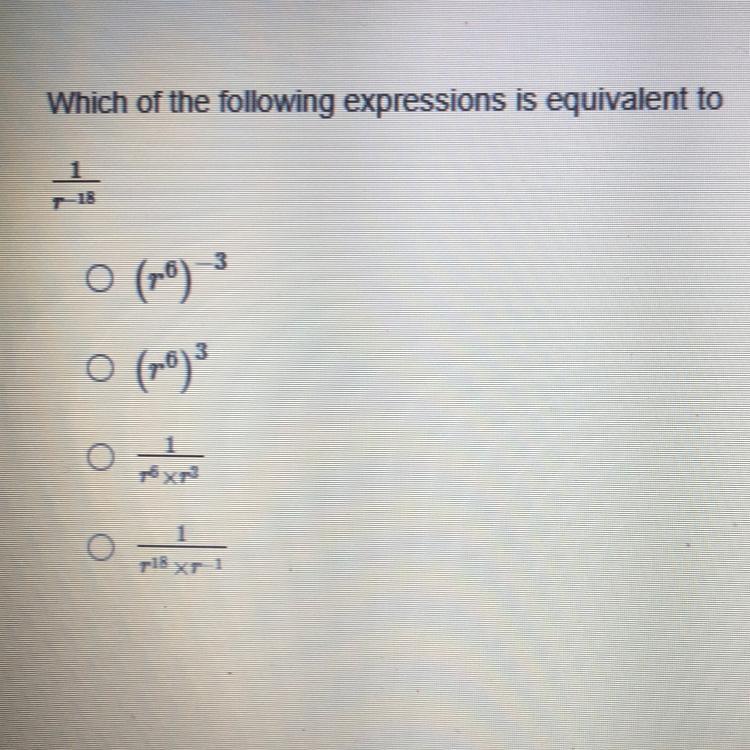
Answers
Answer:
the answer is this hope it helps

On a map, 1 inch equals 20 miles. Two cities are 6 inches apart on the map. What is the actual distance between the cities?
Answers
Answer:
idk
Step-by-step explanation:
idk just responding
for points
Answer:
120 miles
Step-by-step explanation:
If 1 inch = 20 miles, you can multiply both sides by 6 to figure out how many miles 6 inches represent.
The graph shows the total numbet of inches of snow that fell in a town in February over ten year period. What is the approximate probability that Year 11 will have more than 15 inches of snow?
A. 0.6
B. 5
C. 6
D. 0.25
Plz hurry
Answers
Answer:
0.6
Step-by-step explanation:
A coach gives down and Anya a jug containing one and 5/8 gallons of water they will pour the water into three bottles Dan says he can pour 5/8 of a gallon into the first bottle one eighth of a gallon into the second bottle and 7/8 of a gallon into the third bottle Anja says she can pour 6/8 of a gallon into the first bottle 2/8 of a gallon into the second bottle and 5/8 of a gallon into the third bottle who is correct use the drop-down menus to explain
Answers
Answer:
Dan and Anja are both correct.
Step-by-step explanation:
Base on the given;
Total: \(1 \frac{5}{8}\)
Dan:
1st Bottle: \(\frac{5}{8}\)
2nd Bottle: \(\frac{1}{8}\)
3rd Bottle: \(\frac{7}{8}\)
Anja:
1st Bottle: \(\frac{6}{8}\)
2nd Bottle: \(\frac{2}{8}\)
3rd Bottle: \(\frac{5}{8}\)
Since we know all the info now. Let's first add up all the bottles.
Dan:
\(\frac{5}{8}+\frac{1}{8}+\frac{7}{8}=[?]\) ⇒ Only add the numerator.
\(\frac{5}{8}+\frac{1}{8}+\frac{7}{8}=\frac{13}{8}\) ⇒ Simplify
\(\frac{13}{8}=1\frac{5}{8}\)
Anja:
\(\frac{6}{8}+\frac{2}{8}+\frac{5}{8}=[?]\) ⇒ Only add the numerator.
\(\frac{6}{8}+\frac{2}{8}+\frac{5}{8}=\frac{13}{8}\)⇒ Simplify
\(\frac{13}{8}=1\frac{5}{8}\)
Base on the given;
Total = \(1\frac{5}{8}\)
From what we solve:
Dan and Anja are both correct.
Since the drop-down menus wasn't given. I can not farther given more info. Please have a link to the image if help is needed.
RevyBreeze
The purchase of a diamond ring is a large expense, requiring advanced planning. To estimate how much you would need to spend on a diamond, a random sample of 351 diamonds is taken from the website AwesomeGems.com on July 28, 2005. The sample mean cost per carat is $6242.40 and the sample standard deviation cost is $2895.41.
The 95% confidence interval for the population mean is ($5938.42, $6546.32). At the 5% level, what is the correct decision for the hypothesis test with the null and alternative hypotheses below?
H0: M=5850
Ha: M not equal to 5850
Answers
The correct decision is to accept the alternative hypothesis (Ha: M ≠ 5850) and conclude that the population mean is not equal to 5850 based on the given sample data.
To determine the correct decision for the hypothesis test, we need to compare the 95% confidence interval for the population mean with the null hypothesis value.
Null hypothesis (H0): M = 5850
Alternative hypothesis (Ha): M ≠ 5850
In this case, the null hypothesis assumes that the population mean (M) is equal to 5850, while the alternative hypothesis suggests that M is not equal to 5850.
The 95% confidence interval for the population mean is ($5938.42, $6546.32). If the null hypothesis value of 5850 falls within this confidence interval, we fail to reject the null hypothesis. If the null hypothesis value is outside the confidence interval, we reject the null hypothesis in favor of the alternative hypothesis.
Comparing the null hypothesis value with the confidence interval:
5850 < $5938.42 or 5850 > $6546.32
Since the null hypothesis value of 5850 falls outside the confidence interval, we reject the null hypothesis at the 5% level of significance. The correct decision is to accept the alternative hypothesis (Ha: M ≠ 5850) and conclude that the population mean is not equal to 5850 based on the given sample data.
Learn more about confidence interval from:
https://brainly.com/question/20309162
#SPJ11
6) Compute the derivative of the function k(x) = x2+x-1 VX-1 7) Compute the derivative of the function m(x) = -5xğ · V(x2 – 9)3. =
Answers
1. the derivative of the function\(k(x) = x^2 + x - 1 / \sqrt{(x-1)}\)is:\(k'(x) = [(2x+1)\sqrt{(x-1)} - (x^2+x-1)] / [(x-1)\sqrt{(x-1)}\)
2. the derivative of the function\(m(x) = -5x\sqrt{ (x^2 - 9)^3}\) is: \(m'(x) = -5\sqrt{(x^2 - 9)^3} - 15x^2 / \sqrt{(x^2 - 9)}\)
To compute the derivative of the function we will use the quotient rule of differentiation.
First, let's simplify the expression under the square root sign:
√(x-1) = (x-1)^(1/2)
Now, we can rewrite the original function as:
\(k(x) = (x^2 + x - 1) / (x - 1)^{(1/2)\)
Using the quotient rule, we get:
\(k'(x) = [(2x+1)(x-1)^(1/2) - (x^2+x-1)(1/2)(x-1)^{(-1/2)}] / (x-1)\)
Simplifying this expression, we get:
\(k'(x) = [(2x+1)\sqrt{(x-1} ) - (x^2+x-1) / \sqrt{(x-1} )}] / (x-1)\)
\(m'(x) = -5\sqrt{(x^2 - 9)^3} - 15x^2 / \sqrt{(x^2 - 9)}\)
Therefore, the derivative of the function\(k(x) = x^2 + x - 1 / \sqrt{(x-1)}\)is:
\(m'(x) = -5\sqrt{(x^2 - 9)^3} - 15x^2 / \sqrt{(x^2 - 9)}\)
2.To compute the derivative of the function \(m(x) = -5x\sqrt{ (x^2 - 9)^3}\), we will use the chain rule of differentiation.
Let's first find the derivative of the expression inside the square root:
\(d/dx (x^2 - 9) = 2x\)
Using the chain rule, we get:
\(m'(x) = -5√(x^2 - 9)^3 + (-5x)(3(x^2 - 9)^2)(2x) / 2\sqrt{(x^2 - 9)}\)
Simplifying this expression, we get:
\(m'(x) = -5\sqrt{(x^2 - 9)^3} - 15x^2(x^2 - 9) / \sqrt{(x^2 - 9)^3}\)
\(m'(x) = -5\sqrt{(x^2 - 9)^3} - 15x^2(x^2 - 9) / \sqrt{(x^2 - 9)^3}\)
Therefore, the derivative of the function\(m(x) = -5x\sqrt{ (x^2 - 9)^3}\) is:
\(m'(x) = -5\sqrt{(x^2 - 9)^3} - 15x^2(x^2 - 9) / \sqrt{(x^2 - 9)^3}\)
For more such questions on derivative :
https://brainly.com/question/23819325
#SPJ11
f(1) = 1
f(2) = 2
f(n) = f(n − 2) + f(n − 1)
f(3)
Answers
Answer:
f(3) = 3
Step-by-step explanation:
f(1) = 1
f(2) = 2
f(n) = f(n − 2) + f(n − 1)
f(3) = f(3 - 2) + f(3 - 1)
= f(1) + f(2) = 1 + 2 = 3
Special Note: Have you heard of the Fibonacci sequence?
The formula f(n) = f(n − 2) + f(n − 1) is used to find the terms of the of the Fibonacci sequence
please help with this 8x2+4y÷z when x=12, y=34, and z=2 I don't know this
Answers
Answer:
3
Step-by-step explanation:
8x2+4y÷z
when x=12,
y=34,
and z=2?
Which is the value of this expression when m = 3 and n = negative 5?
(6 m Superscript negative 1 Baseline n Superscript 0 Baseline) Superscript negative 3
Answers
Answer:
StartFraction 1 Over 8 EndFraction
Step-by-step explanation:
if x=5, y=-3, and z=-7 z=-7, evaluate 3x^2-9y/yz
Answers

Which of these two fractions are equivalent to 1/4:
3/15
2/8
5/20
11/40
Thankyou for helping :) x
Answers
Answer:
3\15
Step-by-step explanation:
hope this helps
Answer:
\(\frac{2}{8}and\frac{5}{20}\)
Step-by-step explanation:
\(\frac{3}{15}=\frac{1}{5}\)
\(\frac{2}{8}=\frac{1}{4}\)
\(\frac{5}{20}=\frac{1}{4}\)
\(\frac{11}{40}=\frac{11}{40}\)
a total of tickets were sold for the school play. they were either adult tickets or student tickets. there were 53 more student tickets sold than adult tickets. how many adult tickets were sold?
Answers
Total 250 adult tickets are sold.
Let a = number of adult tickets sold
Let s = number of student tickets sold
a + s = 553
s = a + 53
From above equations;
a + a + 53 = 553
2a = 553 - 53
2a = 500
a = 250
Total 250 adult tickets are sold.
To learn more about equation click here:
https://brainly.com/question/14686792
#SPJ4
Select the correct solution for the expression.
2
5
+
3
8
Answers
Answer:
25+38= 63
Step-by-step explanation:
Used a calculator.
here are 5 airplanes ready to depart. runway a and runway d are available. how many ways can 2 planes be assigned to runways without using the same runway?
Answers
Hence, the number of ways be assigned to runways without using the same runway is \(240\) ways.
What is the permutation?
The term permutation refers to a mathematical calculation of the number of ways a particular set can be arranged.
Put simply, a permutation is a word that describes the number of ways things can be ordered or arranged.
Here given that,
Here are five airplanes ready to depart. runway \(A\) and runway \(D\) are available.
Number of ways to assign \(3\) planes to that runway is
\(^5C_3=^5C_2=10ways\)
Then for each group
Each group of three planes can be arranged in \(^3P_3=3!=6ways\)
Each group of three planes can be arranged in \(^2P_2=2!=2ways\)
So total number of arrangements are
\((2)(10)(6)(2)=240ways\)
Hence, the number of ways be assigned to runways without using the same runway is \(240\) ways.
To know more about the permutation
https://brainly.com/question/1216161
#SPJ1
Mary borrowed $840 from her friend to help pay for a trip. She paid him $40 every
week until the debt was paid.
How many weeks did it take Mary to pay her debt?
A. 40
B. 35
C. 32
D. 21
Answers
Answer:
d.21
Step-by-step explanation:
840/40=21
Answer:
21 Weeks
Step-by-step explanation:
$840 ÷ 4 weeks = 21
You can also reverse work this by multiplying $40 by the other choices!
$40 x 40 = $1600
$40 x 35 = $1400
$40 x 32 = $1280
$40 x 21 = $840
As we can see, D is the only answer that makes sense, therefore 21 weeks is the answer.
≧◡≦
Mocha here! If this answer helped you, please consider giving it brainliest because I would appreciate it greatly. Have a wonderful day!
Solve this for most Brainly

Answers
Answer:
1 - 22
2 -
\( - 4x {y}^{3} - 6 {x}^{4} {y}^{3} + 7 {y}^{4} - 8 {x}^{4} {y}^{4} \)
3- ( x = -4)
4 - Irrational numbers
\( \sqrt{53} \: \: \: \: \: \sqrt{19} \: \: \: \: \pi\)
integers
\(0 \: \: \: \: \: \frac{ - 12}{6} \)
rational
\( \frac{2}{3} \: \: \: \: \frac{6}{45} \)
natural numbers 8