Sam can make 15 pizzas in 2.5 hours. At this rate, how many could he make in an 8 hour work day? What is Sam´s rate per hour?
A copy machine makes 45 copies in 25 second. Find the unit rate of copied per second.
A sign in a store says 3 pens for $2.70. How much would 10 pens cost?
What is the unit price of 10 pounds of potatoes that cost $2.80?
Answers
Answer:
1) Sam makes 48 pizzas in 8 hours. Sam makes 6 pizzas per hour.
2) The machine makes 1.8 copies per second.
3) 10 pens cost $9.00
4) $0.28
Step-by-step explanation:
1)
\(\frac{15}{2.5} =\frac{x}{8} \\\\2.5x=120\\x=48\)
\(\frac{15}{2.5} =\frac{x}{1} \\\\2.5x=15\\x=6\)
2)
\(\frac{45}{25} =\frac{x}{1} \\\\25x=45\\x=1.8\)
3)
\(\frac{3}{2.7} =\frac{10}{x} \\\\3x=27\\x=9\)
4)
2.8/10 = 0.28
Related Questions
Please help asap thank you!!!

Answers
Answer: (3,-5) minimum
Step-by-step explanation:
the vertex is at the bottom so it is a minimum
What is the range of the function graphed below?
A. 1 <= f(x) < infinity
B. negative infinity< f(x) < infinity
C. negative infinity < f(x) <= 1
D. 0 <= f(x) < infinity


Answers
Answer:
C.
Step-by-step explanation:
Maximum value of f(x) is 1 and it goes on without bound in negative f(x) direction.
So the range is - infinity < f(x) <= 1.
Find the distance between A(2,5) and B(-2,9)
Answers
Answer:
The answer is
\(4 \sqrt{2} \: \: or \: \: 5.656 \: \: \: units\)Step-by-step explanation:
The distance between two points can be found by using the formula
\(d = \sqrt{( {x1 - x2})^{2} + ({y1 - y2})^{2} } \\ \)where
(x1 , y1) and (x2 , y2) are the points
From the question the points are
A(2,5) and B(-2,9)
The distance between them is
\( |AB| = \sqrt{ ({2 + 2})^{2} + ({5 - 9})^{2} } \\ = \sqrt{ {4}^{2} + ({ - 4})^{2} } \\ = \sqrt{16 + 16} \\ = \sqrt{32} \\ \)We have the final answer as
\(4 \sqrt{2} \: \: or \: \: 5.656 \: \: \: units\)Hope this helps you
the two lines graphed on the coordinate grid each responds an equation witch orderd pairs represents a solution to both equations
Answers
Answer:
Step-by-step explanation:
Graphing ordered pairs is only the beginning of the story. Once you know how to place points on a grid, you can use them to make sense of all kinds of mathematical relationships.
You can use a coordinate plane to plot points and to map various relationships, such as the relationship between an object’s distance and the elapsed time. Many mathematical relationships are linear relationships. Let’s look at what a linear relationship is.
Find a linear regression model for the weekly cost data, using z as the independent variable. C(z) = ma +k Round m to 1 decimal place, and round k to the nearest integer. Use the weekly cost model to estimate the total weekly cost when the weekly demand is 210. Round to the nearest dollar $_____. What is the per unit variable cost? Round to 1 decimal place. $_____. per sleeping bag What is the weekly fixed cost of producing sleeping bags? Round to the nearest integer $_____.
Answers
The linear regression model for the weekly cost data is given by C(z) = ma + k, where z is the independent variable representing the weekly demand.
The values of m and k are determined through the regression analysis. Using this model, we can estimate the total weekly cost for a given weekly demand and calculate the per unit variable cost and weekly fixed cost.To find the linear regression model, we need to perform a regression analysis on the given weekly cost data. This analysis will determine the values of m and k in the equation C(z) = ma + k, where C(z) represents the weekly cost and z represents the weekly demand.
Once the values of m and k are obtained, we can use the model to estimate the total weekly cost when the weekly demand is 210. By plugging in z = 210 into the equation C(z) = ma + k, we can calculate the total weekly cost rounded to the nearest dollar.The per unit variable cost can be determined by the value of m in the model. It represents the change in cost per unit change in demand. By rounding m to one decimal place, we can obtain the per unit variable cost rounded to one decimal place.
The weekly fixed cost can be determined by the value of k in the model. It represents the cost that does not depend on the weekly demand. By rounding k to the nearest integer, we can obtain the weekly fixed cost rounded to the nearest dollar.Overall, by applying the linear regression model to the given data, we can estimate the total weekly cost, calculate the per unit variable cost, and determine the weekly fixed cost of producing sleeping bags.
Learn more about linear regression model here: brainly.com/question/30470285
#SPJ11
(x^2+3x+1)(x^2-2x+5)
Answers
Answer:
x^4 + x^3 + 13x + 5
Step-by-step explanation:
the letters of the word sixteen are randomly arranged what is the probability that 2 e's are not next to each other?
Answers
The probability that two e's are not next to each other when the letters of the word "sixteen" are randomly arranged is approximately 96.67%.
In the word "sixteen," there are three e's. We are asked to find the probability that two e's are not next to each other. Let's first calculate the total number of arrangements of the letters of the word "sixteen."Total number of arrangements = 7! / (2! * 3!) = 420There are three ways in which two e's can be next to each other: ee is the first pair, ee is the second pair, and ee is the third pair. If the first two e's are next to each other, there are five choices for where to place the third e: _e_e_e_, _e_ee_, _ee_e_, _ee_e_, and _eee_. If the second two e's are next to each other, there are four choices for where to place the first e: e_e_e_, e_ee_, _ee_e, _ee_e_, and _eee_. Finally, if the last two e's are next to each other, there are five choices for where to place the first e: e_e_ee, e_e_e_, _ee_e, _ee_e_, and _eee_.So there are a total of 14 arrangements where two e's are next to each other. Therefore, the probability that two e's are not next to each other is:Probability = (total number of favorable outcomes) / (total number of possible outcomes) = (420 - 14) / 420 = 406/420 = 0.9667, or approximately 96.67%.In conclusion, the probability that two e's are not next to each other when the letters of the word "sixteen" are randomly arranged is approximately 96.67%.
Learn more about probability here:
https://brainly.com/question/31828911
#SPJ11
Once upon a time, on an island in the middle of an ocean, several tribes lived and fought with each other. A time came when all the tribes agreed to everlasting peace. So, they decided to build a giant monument to celebrate this Peace Treaty. The monument required a certain number of logs, and the tribes had to agree on the number of logs that each tribe was to provide. Had there been two fewer tribes on the island, this number of logs would have been 6. Had there been one more tribe on the island, this number would have been 5. Unfortunately, the tribes could not agree on what number of logs would be fair for the actual number of tribes. So the tribes announced an eternal war - and were not heard from ever again. How many tribes were on the island?
Answers
Answer:
4 tribes. I don't even know how to do this question at all since it's way too difficult for me but this is an attempt.
Step-by-step explanation:
Let's use negative terms.
-2 = 6
-1 = 5
0 = 4
1 = 3
2 = 2
3 = 1
4 = 0
I am stuck on the last part can u please help me?

Answers
Answer:
\(\frac{2}{3}\)
Step-by-step explanation:
66.6% = 0.6666... = \(\frac{2}{3}\)
Answer:
Fraction = 2/3
Step-by-step explanation:
Given information,
→ Percentage = 66.6%
→ Decimal = 0.6
→ Fraction = ??
Then the required fraction is,
→ Percentage ÷ 100
→ 66.6/100
→ 2/3
Hence, the fraction is 2/3.
A store pays $697 for a snow board and marks the price up by 42%. What is the amount of the mark-up? please help
Answers
Answer:
$292.74 :)
Step-by-step explenation
i searchd it
pls help) The vertices of a triangle are as follows: (2, 3), (4, -4), and (2, -2) If you dilate the triangle by a scale factor of 2, what are the vertices of the new triangle?
(4, 5), (6, -2), (4, 0)
(4, 6), (8, -8), (4, -4)
(4, 9), (16, 16), (4, 4)
(1, 1.5), (2, -2), (12, -12)
Answers
Answer:
(4, 6), (8, -8), (4, -4)
Step-by-step explanation:
Answer:
(4, 6), (8, -8), (4, -4)
Step-by-step explanation:
Hope this helps
Find the sales tax to the nearest hundredth. $22.95 jeans, 7% tax
Answers
A DMM in ABC stock on the NYSE is approached at the same time by a floor broker who wishes to buy ABC stock at the market and another floor broker who wishes to sell ABC stock at the market. The DMM buys the stock from the floor broker who wants to sell; and then immediately sells that stock for $.01 more to the floor broker who wants to buy. This is an example of:
Answers
The DMM buys the stock from the floor broker who wants to sell; and then immediately sells that stock for $.01 more to the floor broker who wants to buy. This is an example of scalping or trading ahead.
Designated Market Maker (DMM) on the New York Stock Exchange (NYSE), the DMM has certain obligations and responsibilities to maintain fair and orderly markets for the stocks they oversee. They are expected to provide liquidity by facilitating trades and maintaining an orderly market.
However, in the scenario you provided, the DMM takes advantage of the situation by executing a trade with a floor broker who wants to sell ABC stock and immediately selling it to another floor broker who wants to buy at a slightly higher price. By doing so, the DMM profits from the price difference, earning an extra $.01 per share.
This practice goes against the principles of fair and orderly markets, as the DMM is essentially prioritizing their own profit over providing fair execution prices for buyers and sellers. It can be considered unethical and may be subject to regulatory scrutiny or penalties, as it undermines the integrity and fairness of the market.
To know more about stock click here :
https://brainly.com/question/32077505
#SPJ4
Use the alternating series test to determine whether the series Σn=3 (-1)n In n/n coverges.
Answers
The series Σn=3 (to infinity)\((-1)^n ln(n)/n\) converges based on the Alternating Series Test.
To determine whether the series Σn=3 (to infinity) \((-1)^n ln(n)/n\) converges, we need to check two conditions:
1. The absolute value of the terms should be decreasing: |a_n+1| ≤ |a_n|
2. The limit of the sequence should be 0 as n approaches infinity: lim(n→∞) a_n = 0
First, let's define\(a_n = (-1)^n ln(n)/n\).
Condition 1: To check if the absolute values of the terms are decreasing, we can use the first derivative test:
f(n) = ln(n)/n
\(f'(n) = (1 - ln(n))/n^2\)
We can observe that f'(n) is negative for n > e (Euler's number). Therefore, the function is decreasing for n ≥ 3.
Condition 2: Now, let's check if the limit of a_n is 0 as n approaches infinity:
lim(n→∞) ln(n)/n
Using L'Hopital's rule, we have:
lim(n→∞) (1/n) / 1
lim(n→∞) 1/n = 0
Both conditions are met, so the series Σn=3 (to infinity) (-1)^n ln(n)/n converges based on the Alternating Series Test.
To know more about Alternating Series Test refer to-
https://brainly.com/question/16969349
#SPJ11
The area A of a rectangle is represented by formula A = lw where l is the length and w is the width. Write an equation that would make it easy to find the length of the rectangle.
Answers
The equation that would make it easy to find the length of the rectangle is l = Area/ w
What is subject of formula?The subject of a formula can be defined as the variable that is expressed in terms of the other variables in a given expression or equation.
Given the formula for area of a rectangle as;
Area = lw
Where;
l is the length of the rectanglew is the width of the rectangleNow, let's make 'l' the subject of formula
Divide both sides by the coefficient of l
We have;
lw/w = Area/ w
Then,
l = Area/ w
Thus, the equation that would make it easy to find the length of the rectangle is l = Area/ w
Learn more about subject of formula here:
https://brainly.com/question/21140562
#SPJ1
this is math please help me asap

Answers
\( \\ \\ \)
To find:-Area of circle\( \\ \\ \)
Let :Area of circle be A.\( \\ \\ \)
We know:
\( \\ \)
\( \bigstar \boxed{ \rm Area \: of \: circle \: = \pi {r}^{2} }\)
\( \\ \\ \)
So:-
\( \dashrightarrow\sf A= \pi {r}^{2} \)
\( \\ \\ \)
\( \dashrightarrow\sf A=\pi \times {8}^{2} \)
\( \\ \\ \)
\( \dashrightarrow\sf A= \pi \times 8 \times 8\)
\( \\ \\ \)
\( \dashrightarrow\sf A= \pi \times 64\)
\( \\ \\ \)
\( \dashrightarrow\sf A= 64\pi \: ft {}^{2} \)
\( \\ \\ \)
Therefore option A is correct
know more:-\(\small\begin{gathered}\begin{gathered}\begin{gathered}\boxed{\begin {array}{cc}\\ \dag\quad \Large\underline{\bf \small{Formulas\:of\:Areas:-}}\\ \\ \star\sf Square=(side)^2\\ \\ \star\sf Rectangle=Length\times Breadth \\\\ \star\sf Triangle=\dfrac{1}{2}\times Base\times Height \\\\ \star \sf Scalene\triangle=\sqrt {s (s-a)(s-b)(s-c)}\\ \\ \star \sf Rhombus =\dfrac {1}{2}\times d_1\times d_2 \\\\ \star\sf Rhombus =\:\dfrac {1}{2}d\sqrt {4a^2-d^2}\\ \\ \star\sf Parallelogram =Base\times Height\\\\ \star\sf Trapezium =\dfrac {1}{2}(a+b)\times Height \\ \\ \star\sf Equilateral\:Triangle=\dfrac {\sqrt{3}}{4}(side)^2\end {array}}\end{gathered}\end{gathered}\end{gathered}\)
How many groups of 1/2 pound are in 2 pounds
Answers
Answer:
4
Step-by-step explanation:
2 ÷ 1/2 = 4
Two people answer = one brainliest for best answer 100pts
Use the following figure to answer the questions. Isosceles trapezoids ABCD and WXYZ are similar to each other.
For similar isosceles trapezoids ABCD and WXYZ, determine which of the following proportions are equivalent to each other. Select all situations that apply.
Thank you
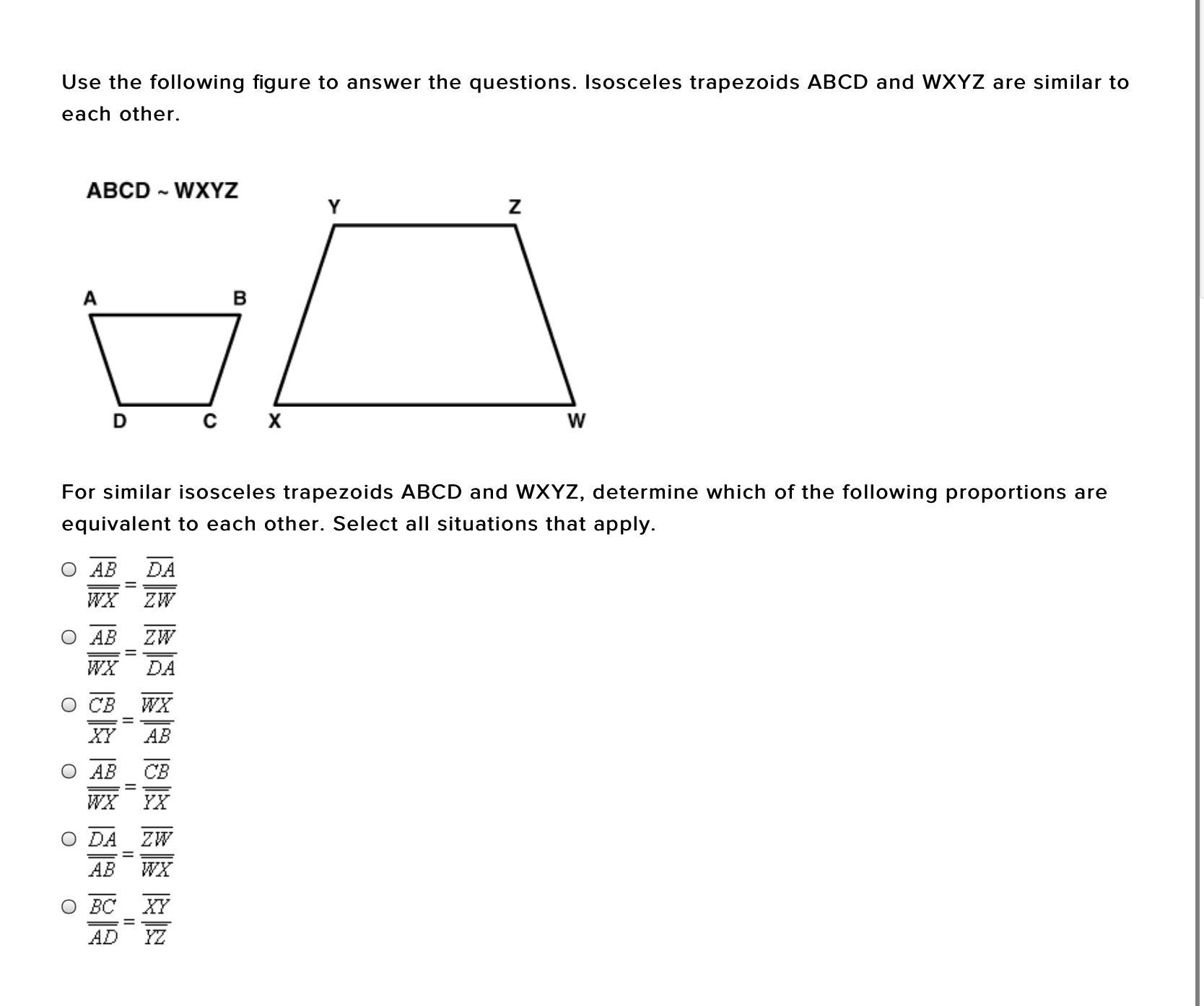
Answers
Answer:
The first, third, and fourth answers are correct!
Calculate the potential profit. Calculate one for a mortgage and
the other if you were to rent.
Here is the information you need: Profit = number of seats (259
seats and 90% will be occupied on averag
Answers
Therefore, the potential profit from the mortgage scenario would be 233.1 seats.
To calculate the potential profit for a mortgage and renting scenario, we need the number of seats available (259 seats) and the average occupancy rate (90%). The profit can be determined by multiplying the number of seats by the occupancy rate.
For the mortgage scenario, assuming you own the property and generate revenue through ticket sales, the potential profit can be calculated as follows:
Profit = Number of seats * Occupancy rate
Profit = 259 seats * 0.90 (90% occupancy rate)
Profit = 233.1 seats
Therefore, the potential profit from the mortgage scenario would be 233.1 seats.
For the renting scenario, assuming you are leasing the property and generating revenue through rent payments, the potential profit calculation would be different. In this case, the profit would be determined by the rent amount minus any associated expenses (e.g., property taxes, maintenance costs, etc.).
To calculate the potential profit from renting, more information is needed, such as the rental rate and expenses associated with the property. Without these specific details, it is not possible to provide an accurate calculation of the potential profit.
In summary, the potential profit for the mortgage scenario would be 233.1 seats, based on the given occupancy rate. However, without additional information regarding the rental scenario, a specific calculation for the potential profit from renting cannot be provided.
Learn more about profit here:
https://brainly.com/question/28856941
#SPJ11
The graph of y=f(x) is shown on the grid. The graph G is a translation of the graph y=f(x)

Answers
The translated function is:
G(x) = f(x) - 1
b) The maximum of y = 2*f(x) is the point (0, 8).
How to write the equation of the translated function?
We know that G(x) is a translation of f(x), and the graph of G(x) is the pink one.
We can see that it is 1 unit below f(x), then we have a translation of one unit downwards, so we can write:
G(x) = f(x) - 1
This is the rule for G(x).
b) If the maximum of f(x) is (0, 4), then:
f(0) = 4
The maximum of 2*f(x) is also at x = 0, we will get:
2*f(0) = 2*4 = 8
So the maximum here is (0, 8).
Learn more about translations:
https://brainly.com/question/24850937
#SPJ1
the line of best fir for a set of data is y=13x-4.7 a point in the set of data is when x is 4 and y is 53 what is the residual for this point when x is 4
Answers
Answer:
4.7
Step-by-step explanation:
Best fit line :
y = 13x - 4.7
At x = 4 ; actual value of y = 53
Predicted value of y at x = 4 ;
y = 13(4) - 4.7
y = 52 - 4.7
y = 47.3
Ypredicted = 47.3
Residual value :
Yactual - Ypredicted
52 - 47.3
= 4.7
There is a 60% chance that your car will get stuck in the snow during the next big snowfall. Given that you are alre
What is the chance that you will get stuck in the snow with your car and will require a tow truck to pull you out? (4
Hint: P(A/B) =
13%
75%
48%
54%
P(ANB)
P(B)
Answers
Answer:48%
Step-by-step explanation:
have a good day
help need plzzzzzzzzz

Answers
Answer:
The answer to the question provided is possibly 2.
Step-by-step explanation:
\( \: \: \: \: \: \: \: \: \: \: \: \: 3y + 77 = 2y + 79 \\ \frac{ - 2y \: \: \: \: \: \: = - 2y}{1y + 77 = 79} \\ \frac{ \: \: \: \: \: \: \: \: - 77 = - 77}{ \frac{1y}{1} = \frac{2}{1} } \\ \\ y = 2\)
List five vectors in Span {v_1, v_2}. Do not make a sketch. v_1 = [8 2 -7], v_2 = [-6 4 0] List five vectors in Span {v_1, v_2} (Use the matrix template in the math palette. Use a comma to separate vectors as needed. Type an integer or a simplified fraction for each vector element.)
Answers
The integer for vector 1 {2,6,-7}, integer for vector 2 is 10,8,-14}, integer for vector 3 is {4,12,-14}, integer for vector 4 is {14,-2,-7} and integer for vector 5 is {22,0,-14}. (all these vectors are in span {V1 and V2})
List five vectors in Span {v_1, v_2}?
1) V1+v2={8,2,-7 }+{-6,4,0 }
={2,6,-7}
2) 2v1+v2={16,4,-14}+{-6,4,0}
={10,8,-14}
3)2v1+2v2={16,4,-14}+{-12,8,0}
={4,12,-14}
4)V1-v2={8,2,-7}-{-6,4,0}
={14,-2,-7}
5)2v1-v2={16,4,-14}-{-6,4,0}
={22,0,-14}
All of these vectors are contained within the span.
{v1,v2}={av1+bv2:ab∈r}
A matrix is a rectangular variety of ordered numbers (real or complex) or functions .Assume we want to express the following information about Ram and his two friends Rohan and Yash's possession of pens and pencils:
Ram has 20 pens and 7 pencils,
Rohan has 15 pens and 5 pencils,
Yash has 12 pens and 3 pencils
Now, this could be arranged in tabular form as follows,
⎢20 7⎢
⎢15 5⎢
⎢12 3⎢
To learn more about vectors
https://brainly.com/question/13322477
#SPJ4
la factorizacion de x2 -8x + 15
Answers
What is the equation for line D?
a. y = 2.5x
b. y = x + 10
c. y = -x + 10
d. y = -x + 60

Answers
Answer:
D
Step-by-step explanation:
Why is it that the statement "all rhombuses are squares" is false, but the statement "all squares are rhombuses" is true? Use an example to help with your explanation.
Answers
Answer:
Step-by-step explanation:
The following are properties of a rhombus:
i) All sides are equal
ii) The diagonals bisect each other at right angle.
iii) Diagonals bisect the angles
iv) Sum of consecutive angles is 180°
The following are properties of a square:
i) All sides are equal
ii) The diagonals bisect each other at right angle.
iii) Diagonals bisect the angles
iv) All angles are right angle
A rhombus is a square only when all its angles are right angles (90°) but all squares are rhombuses because squares have the same property as rhombuses(since All angles are right angles, consecutive angles would add up to 180°). Therefore all rhombuses are not squares but all squares are rhombuses
How many pairwise non-isomorphic 6-vertex simple graphs are there with degree sequence 2, 2, 3, 3, 3, 3?
Answers
To determine the number of pairwise non-isomorphic 6-vertex simple graphs with the given degree sequence, we can use the Havel-Hakimi algorithm.
Arrange the degree sequence in non-increasing order: 3, 3, 3, 3, 2, 2.
Check if the degree sequence is graphical, i.e., if it is possible to construct a simple graph with the given degree sequence. To do this, we repeatedly apply the following steps:
a. Start with the first element in the sequence (3 in this case).
b. Subtract 1 from the first element and remove it.
c. For the next 3 elements (3, 3, 3), subtract 1 from each of them.
d. Remove the first 2 elements (2, 2).
e. Repeat steps a-d until either all elements become 0 or we encounter a negative number.
If all elements become 0, then the degree sequence is graphical and a simple graph can be constructed. Count it as a valid graph.
Learn more about graphs here
https://brainly.com/question/17267403
#SPJ11
TRUE OR FALSE!! Please help me . Im giving brainliest :)

Answers
Answer:
false because that is 5 not 1/5
Please see the image below(math)

Answers
Answer:
21
Step-by-step explanation:
If a line parallel to one side of a triangle intersects the other two sides of the triangle, then the line divides these two sides proportionally.
AD AH
----- = ---------
AB AH +y
3 9
---- = ------
10 9+y
Using cross products:
3(9+y) = 9*10
27+3y = 90
3y = 90-27
3y =63
y = 63/3
y = 21
Answer:
y = 21
Step-by-step explanation:
According to the Side Splitter Theorem, if a line parallel to one side of a triangle intersects the other two sides, then this line divides those two sides proportionally.
Therefore, according to the Side Splitter Theorem:
\(\boxed{\sf AD : DB = AH : HC}\)
From inspection of the given triangle, the lengths of the line segments are:
AD = 3DB = 7AH = 9HC = yTo find the value of y, substitute the given line segment lengths into the proportion and solve for y:
\(\begin{aligned}\sf AD : DB &=\sf AH : HC\\\\3:7&=9:y\\\\\dfrac{3}{7}&=\dfrac{9}{y}\\\\3 \cdot y&=9 \cdot 7\\\\3y&=63\\\\\dfrac{3y}{3}&=\dfrac{63}{3}\\\\y&=21\end{aligned}\)
Therefore, the value of y is 21.