Is the point (1,5) a solution to the equation below?
y = 2x + 4.
A. No
B. Yes
C. More information is needed.
Answers
Answer:
A. No
Step-by-step explanation:
y = 2x + 4
(5) = 2(1) + 4
5 = 2 + 4
5 = 6 (false statement)
Related Questions
A bicycle repair shop offers two service packages to its customers: a tune up or a complete overhaul, which includes the tune up plus some additional services. All bicycles go through wheel balancing before leaving the shop. The repair shop is open 60 hours per week and receives an average of 180 bicycles each week. The shop employs three "tune up" technicians, one "additional services" technician, and two wheel balancing" specialists. Past data indicates that 25% of customers opt for the "additional services" option. Wheel Tune Up Balancing T = 75 T= 20 minutes minutes Additional Services T = 72 minutes a) Create a demand matrix for this process b) What will be the daily capacity at each stage of the process? c) Find the implied utilizations for each stage of the process. d) What will be the weekly capacity of the process? e) Is the flow rate of this process capacity-constrained or demand-constrained?
Answers
A bicycle repair shop that offers two service packages: a tune-up and a complete overhaul.
The shop operates for 60 hours per week and receives an average of 180 bicycles each week. To analyze the capacity and utilization of the process, we need to consider the time taken at each stage and the demand for each service option. We'll break down the problem into multiple parts and provide a detailed explanation using mathematical terms.
a) Creating the Demand Matrix:
To create a demand matrix, we need to determine the number of bicycles going through each stage of the process. Let's denote the demand for tune-up as T and the demand for additional services as A.
Given that the average number of bicycles received per week is 180 and 25% of customers opt for additional services, we can calculate the demands as follows:
Demand for tune-up (T) = Total demand - Demand for additional services
T = 180 - (0.25 * 180)
T = 180 - 45
T = 135
Demand for additional services (A) = 0.25 * Total demand
A = 0.25 * 180
A = 45
Now, we can create a demand matrix based on the demand for each service option:
Demand Matrix:
Tune-up Additional Services Wheel Balancing
Tune-up [135 0 0]
Additional [0 45 0]
Services
Total [ 135 45 0 ]
The demand matrix shows the number of bicycles flowing through each stage of the process.
b) Daily Capacity at Each Stage:
To calculate the daily capacity at each stage, we need to consider the time taken for each service option. Given that the shop operates for 60 hours per week, we can calculate the daily capacity at each stage:
Tune-up technician time per bicycle (\(T_{tuneup}\)) = 75 minutes
Additional services technician time per bicycle (\(T_{additional}\)) = 72 minutes
Wheel balancing specialist time per bicycle (\(T_{balancing}\)) = 20 minutes
Daily Capacity (C) = (60 hours * 60 minutes) / (\(T_{tuneup}\) + \(T_{additional}\) + \(T_{balancing}\))
Substituting the given values:
C = (60 * 60) / (75 + 72 + 20)
C = 21600 / 167
C ≈ 129.34 bicycles per day
Therefore, the daily capacity at each stage of the process is as follows:
Tune-up: 129 bicycles per day
Additional Services: 129 bicycles per day
Wheel Balancing: 129 bicycles per day
c) Implied Utilizations:
To find the implied utilizations, we need to compare the demand and the capacity at each stage of the process. Utilization can be calculated as the demand divided by the capacity.
Implied Utilization (U) = Demand / Daily Capacity
For the Tune-up stage:
\(U_{tuneup}\) = 135 / 129 ≈ 1.05
For the Additional Services stage:
\(U_{additional}\) = 45 / 129 ≈ 0.35
For the Wheel Balancing stage:
\(U_{balancing}\) = 0 / 129 = 0
The implied utilizations show how efficiently each stage of the process is being utilized. Utilization values greater than 1 indicate that the stage is operating beyond its capacity.
d) Weekly Capacity of the Process:
To calculate the weekly capacity of the process, we multiply the daily capacity by the number of days the shop is open per week:
Weekly Capacity = Daily Capacity * Number of days shop is open per week
Given that the shop is open for 60 hours per week, the number of days the shop is open per week can be calculated as follows:
Number of days shop is open per week = 60 hours / 24 hours per day = 2.5 days
Therefore, the weekly capacity of the process is:
Weekly Capacity = Daily Capacity * Number of days shop is open per week
Weekly Capacity = 129 bicycles per day * 2.5 days
Weekly Capacity = 322.5 bicycles per week
e) Flow Rate and Constraint Analysis:
To determine if the flow rate of the process is capacity-constrained or demand-constrained, we compare the weekly capacity to the demand for each service option.
Demand for Tune-up (\(T_{demand}\)) = 135 bicycles per week
Demand for Additional Services (\(A_{demand}\)) = 45 bicycles per week
Comparing the demands with the weekly capacity:
\(T_{demand}\) < Weekly Capacity (135 < 322.5)
\(A_{demand}\) < Weekly Capacity (45 < 322.5)
Since both the demands for tune-up and additional services are less than the weekly capacity, the flow rate of the process is demand-constrained. This means the shop has the capacity to handle the current demand without operating beyond its limits.
To know more about Demand Matrix here
https://brainly.com/question/13012912
#SPJ4
The snack stand at the local baseball field sells cherry and lemon snow cones. Yesterday, the stand sold 4 cherry snow cones for every 1 lemon snow cone sold. If there were 30 more cherry snow cones than lemon snow cones sold yesterday, how many snow cones were sold altogether?
Answers
Given:
The stand sold 4 cherry snow cones for every 1 lemon snow cone sold.
There were 30 more cherry snow cones than lemon snow cones sold yesterday.
To find:
The number of snow cones which were sold altogether.
Solution:
Let x be the number of lemon snow cone sold.
The stand sold 4 cherry snow cones for every 1 lemon snow cone sold.
So, number of cherry snow cone sold = 4x
There were 30 more cherry snow cones than lemon snow cones sold yesterday.
\(4x-x=30\)
\(3x=30\)
Divide both sides by 3.
\(x=\dfrac{30}{3}\)
\(x=10\)
Total number of snow cones sold is
\(\text{Total number of snow cones sold }=x + 4x\)
\(\text{Total number of snow cones sold }=5x\)
\(\text{Total number of snow cones sold }=5(10)\)
\(\text{Total number of snow cones sold }=50\)
Therefore, 50 snow cones were sold altogether.
What is the length of the diagonal PS
A.39.9
B.19.9
C.18.6
D.23.9

Answers
Answer:
Your answer......39.9.....A
WANT MORE THEN FOLLOW ME, LIKE & MARK MY ANSWER AS BRAINLIST ANSWER
Choose ALL answers that describe the quadrilateral below.
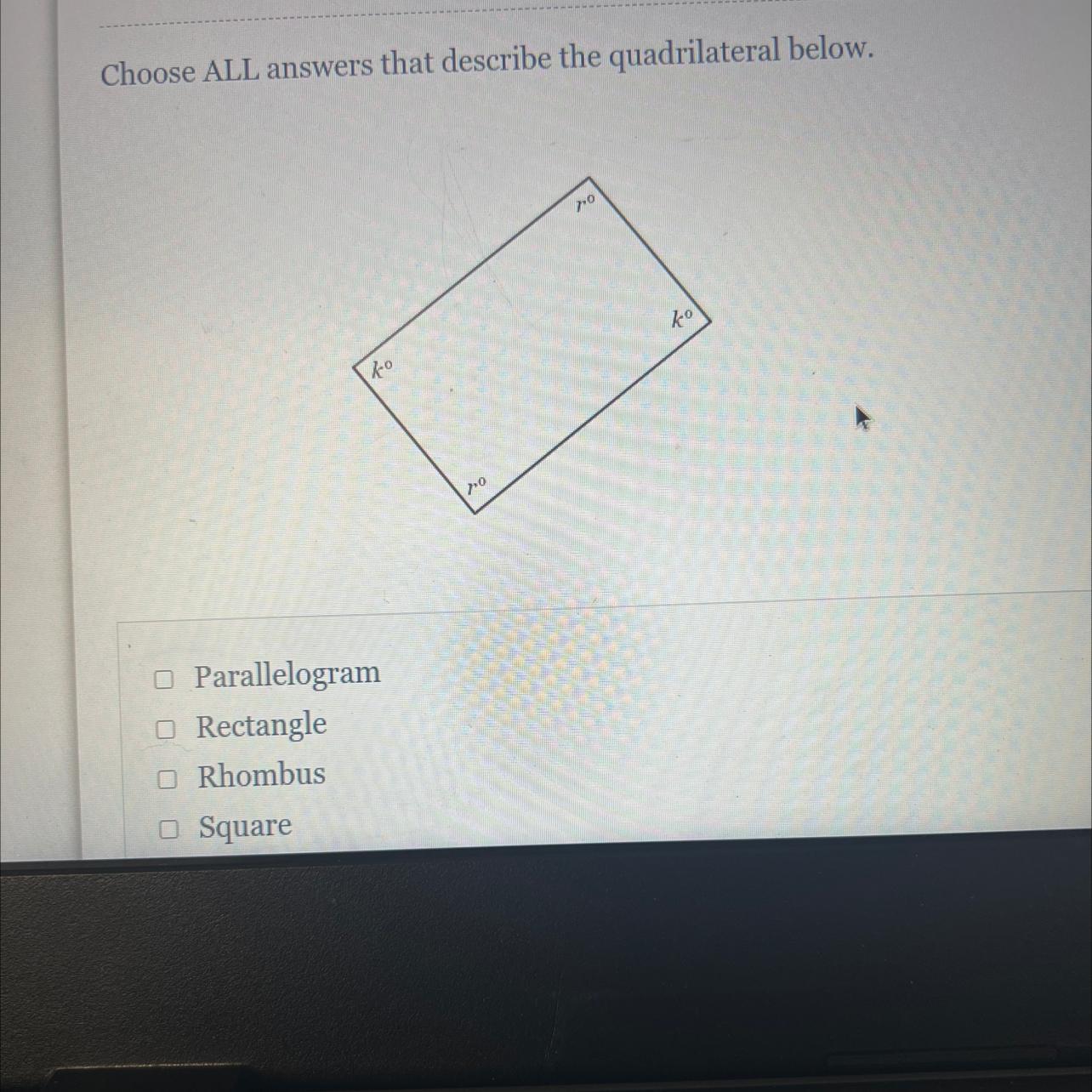
Answers
Answer:
parallelogram and rectangle
Step-by-step explanation:
the shape can’t be a rhombus or a square, because all sides of it are not the same length. it’s a parallelogram, because all 4 sides are parallel to each other, and it’s a rectangle, because it’s a parallelogram and all of its sides aren’t equal.
Solving two step equations
3m/4 = 12/8
Answers
Answer:
m = 2
Step-by-step explanation:
3m / 4 = 12/8
6m / 8 = 12/8
48m = 96
m = 2
Hopefully this helped!
Brainliest please?
Consider a committee consists of three members Rita, Sid and Tina. The Committee purports to decide between TWO options each time. The committee decision is determined by majority voting. There are four options A,B,C and D in total. We define the committee's preference Com based on the voting outcome: Suppose two options X and Y are put to vote. If committee always selects X, then X Com Y. If committee sometimes chooses X and sometimes chooses Y, then X Com Y Every committee member's preference is rational. They sincerely vote for their own preferred option (a) Suppose the committee members' preferences are given by • Rita's preference is ABD >C. • Sid's preference is B>D>A> C. Tina's preference is C > B>A> D. Write down a utility function representing the committee's preference. That is, what are the utility levels assigned to the options? (b) Suppose Rita leaves the committee and is succeeded by Ray. Ray's preference is A>D>> B. The committee's decision will be different. Find out the new committee's preference, and explain whether the new committee's preference can be represented by a utility function. Hint: The committee's preference needs not be rational. In this case, you should first work out the committee's preference for every pair of options.
Answers
The utility function representing the committee's preference is as follows: A > B > D > C. The committee's preference can be represented by a utility function based on the rational preferences of its members and the majority voting system.
To determine the utility function representing the committee's preference, we consider the preferences of each member. Rita's preference is ABD > C, which means she prefers options A, B, and D over option C. Sid's preference is B > D > A > C, indicating that he prefers option B over options D, A, and C. Tina's preference is C > B > A > D, meaning she prefers option C over options B, A, and D.
Using the majority voting system, we compare the preferences of each pair of options. Comparing A and B, Rita prefers A, Sid prefers B, and Tina has no preference. Thus, A is preferred over B. Comparing A and D, Rita prefers A, Sid prefers D, and Tina prefers D. Therefore, A is preferred over D. Comparing A and C, Rita prefers A, Sid has no preference, and Tina prefers C. Hence, A is preferred over C.
Comparing B and D, Rita has no preference, Sid prefers D, and Tina prefers D. Thus, D is preferred over B. Comparing B and C, Rita prefers C, Sid has no preference, and Tina prefers C. Therefore, C is preferred over B. Lastly, comparing D and C, Rita prefers D, Sid has no preference, and Tina prefers C. Hence, D is preferred over C.
Based on these comparisons, we can conclude that the committee's preference is A > B > D > C. This preference can be represented by a utility function where each option is assigned a specific utility level based on its position in the preference order.
Learn more about utility function here:
https://brainly.com/question/31055643
#SPJ11
Find f/(x). (a) f(x) = xsinx (b) f(x) = sech-1x²
Answers
The derivative of f(x) = sech^(-1)(x^2) is f'(x) = 2x/sqrt(1 - x^4).
a) To find f'(x) for f(x) = x*sin(x), we can use the product rule and the derivative of the sine function.
Using the product rule, we have:
f'(x) = (xsin(x))' = xsin'(x) + sin(x)*x'
The derivative of sin(x) is cos(x), and the derivative of x with respect to x is 1. Therefore:
f'(x) = x*cos(x) + sin(x)
So, the derivative of f(x) = xsin(x) is f'(x) = xcos(x) + sin(x).
(b) To find f'(x) for f(x) = sech^(-1)(x^2), we can use the chain rule and the derivative of the inverse hyperbolic secant function.
Let u = x^2. Then, f(x) can be rewritten as f(u) = sech^(-1)(u).
Using the chain rule, we have:
f'(x) = f'(u) * u'
The derivative of sech^(-1)(u) can be found using the derivative of the inverse hyperbolic secant function:
(sech^(-1)(u))' = 1/sqrt(1 - u^2)
Since u = x^2, we have:
f'(x) = 1/sqrt(1 - (x^2)^2) * (x^2)'
Simplifying:
f'(x) = 1/sqrt(1 - x^4) * 2x
So, the derivative of f(x) = sech^(-1)(x^2) is f'(x) = 2x/sqrt(1 - x^4).
learn more about derivative here
https://brainly.com/question/29144258
#SPJ11
Please help me I will mark brainlest

Answers
Answer:
C
Step-by-step explanation:
Answer:
C
Step-by-step explanation:
A is at -2 so D has to be at positive 2, C is located at -3 1/2, and B is at 3.5.
A teacher write the inequality x ÷ 7 > 14 on the board. A tudent olve the inequality incorrectly and get the reult x>2. What i the correct reult. What i the tudent' error?
Answers
The correct value of the inequality as solves is x > 14 , and the error made by the student was that he directly divided the RHS by 7.
To simplify the equation we will multiply 7 on both the sides.
Then we will get the result as 7x > 98
Thus, we can say that the new inequality will be x > 14 ,
Hence , the mistake made by the student was that he didn't divided both the sides by 7 but only one side.
So a result, he obtained the incorrect result x>2.
Inequality is a concept in mathematics and uses symbols such as > , < , <= , >= etc.
To learn more about inequality
brainly.com/question/28823603
#SPJ4
Match each word or phrase with the definition hypothesis null alternative Drag each word into the appropriate place below in order to correctly complete each of the following sentences. A _____ is a statement regarding a characteristic of one or more populations. The _____ ______ is a statement of no change, no effect, or no difference. The _____ ______ is a statement we are trying to find evidence to support. Drag your answer(s) to the correct position
Answers
A hypothesis is a statement regarding a characteristic of one or more populations. The null hypothesis is a statement of no change, no effect, or no difference. The alternative hypothesis is a statement we are trying to find evidence to support.
Generally, the null hypothesis expresses that there is no change, no difference, no effect, and in another way, no relationship between the independent and dependent variables. Because we are hypothesizing that nothing is happening, then it is called the null hypothesis.
The null and alternative hypothesis are two conflicting claims which researchers weigh evidence for and against using a statistical test. Null hypothesis (H0) means there is no effect in the population. Meanwhile, alternative hypothesis (Ha or H1) means there is an effect in the population.
Learn more about null and alternative hypothesis at: https://brainly.com/question/28214949
#SPJ4
Ct = x + 3 te = 2x - 6
find ce.
d
t
b
e
ce =
type your answer...
Answers
The length of CE is given by -x + 9.
To find the length of CE, we need to determine the value of x first by solving the given equations:
Ct = x + 3 ...(1)
Te = 2x - 6 ...(2)
To find x, we can set the expressions for Ct and Te equal to each other:
x + 3 = 2x - 6
Now, let's solve this equation to find the value of x:
x - 2x = -6 - 3
-x = -9
x = 9
With x = 9, we can substitute this value back into equation (1) to find Ct:
Ct = 9 + 3
Ct = 12
Now, let's find the length of CE by subtracting the lengths of Ct and Te:
CE = Ct - Te
CE = 12 - (2x - 6)
CE = 12 - (2 * 9 - 6)
CE = 12 - (18 - 6)
CE = 12 - 12
CE = 0
Therefore, the length of CE is 0.
To learn more about length Click Here: brainly.com/question/32060888
#SPJ11
A person invests $485 in an account that earns 2.2% annual interest compounded continuously. Find
when the value of the investment reaches $2,200. If necessary, round to the nearest hundredth.
The investment will be reach $2,200 in approximately ______ years.
Answers
Answer:
12 years
Step-by-step explanation:
in 2000, india's population reached 1 billion, and it's projected to be 1.45 billion in 2025. use the function f(x)
Answers
a) The value of p₀=1
b) The population in the year 2020 is 1.3 billion.
c) The function f(x)=1.5 billion reaches India's population in the year 2030.
What is meant by a function?A function is a relationship between two or more inputs, each of which corresponds to exactly one output. A domain and a codomain or range are assigned to each function.
a) Given, The population of India after x years is f(x)=p₀(1.01355)ˣ⁻²⁰⁰⁰
Also in 2000, the population reached 1 billion.
That is when x=2000, f(x)=1
f(2000)=1
p₀(1.01355)ˣ⁻²⁰⁰⁰⁻²⁰⁰⁰=1
p₀×1=1
p₀=1
Hence p₀=1
b) Here the objective is we have to find the population in the year 2020
Then the value of f(x) when x=2020
Hence,
f(2020)=p₀(1.01355)ˣ⁻²⁰²⁰⁻²⁰²⁰
f(2020)=1(1.01355)²⁰
f(2020)=1.3
Therefore, the population in the year 2020 is 1.3 billion.
c) f(x)=1.5
p₀(1.01355)ˣ⁻²⁰⁰⁰=1.5
1×p₀(1.01355)ˣ⁻²⁰⁰⁰=1.5
p₀(1.01355)ˣ⁻²⁰⁰⁰=1.5
ln(p₀(1.01355)ˣ⁻²⁰⁰⁰)=ln(1.5)
(x-2000)ln(1.01355)=ln(1.5)
x-2000=ln(1.5)/ln(1.01355)
x=(ln(1.5)/ln(1.01355))+2000
x=30.12+2000
x=2030.12
Hence in the year 2030, the population might reaches to 1.5 billion.
Therefore, f(x)=1.5 billion
To know more about function, visit:
https://brainly.com/question/21145944
#SPJ4
The complete question is:
In 2000 , India's population reached 1 billion, and its projected to be \( 1.45 \) billion in 2025 . Use the function \( f(x
Show transcribed data
In 2000 , India's population reached 1 billion, and it's projected to be
1.45
billion in 2025 . Use the function
f(x)=P0(1.01355)
x−2000
find the help find the following a) What is p₀
? billion b) Predict India's population in 2020 to the nearest tenth of a billion. billion c) Use the function to determine the year when India's population might reach
1.5
billion. (Round to the nearest year) Question 21 Out of pocket spending for healthcare in the United States increased between 2000 and 2008 . The function
f(x)=2572e
0.0359x
models the average annual expenditures per household, dollars, In this model,
x
represents the year,
x=0"
I really need help..im confused

Answers
The coefficient of determination, also known as R-squared, represents the proportion of the dependent variable's variance that can be explained by the independent variable(s) in a regression model. A higher R-squared indicates a better fit of the model to the data and suggests that a greater proportion of the variation in the dependent variable (lobster length in this case) can be attributed to the independent variable (age).
In this scenario, the linear model has a coefficient of determination of 0.8724503, indicating that approximately 87% of the variation in lobster length can be explained by age. This suggests a strong relationship between age and length in a linear fashion.
Conversely, the exponential model has a lower coefficient of determination of 0.6730372, indicating that only about 67% of the variation in lobster length is associated with age. While this is still a moderate level of association, the linear model provides a better fit to the data and explains a higher proportion of the variation in length.
Therefore, based on the coefficient of determination, the linear model would be the better choice for projecting the length of a lobster.
Solve the following recurrence relations (b) \( a_{n}=2 a_{n-1}+(-1)^{n}, a_{0}=2 \)
Answers
The given recurrence relation is \( a_{n} = 2a_{n-1} + (-1)^n \), with the initial condition \( a_{0} = 2 \).
Recurrence relation: \( a_{n} = 2 a_{n-1} + (-1)^{n} \), \( a_{0} = 2 \)To solve this recurrence relation, we can observe that the coefficient of \( a_{n-1} \) is a constant (2), indicating a linear homogeneous recurrence relation.
We can find the general solution by assuming \( a_{n} = r \) and substituting it into the relation.
By solving the resulting characteristic equation \( r = 2r - (-1)\), we obtain two distinct solutions: \( r_1 = 1 \) and \( r_2 = -1 \).
Therefore, the general solution is \( a_{n} = A \cdot 1 + B \cdot (-1) \). Using the initial condition, we find that \( A = 1 \) and \( B = 1 \).
Hence, the solution to the recurrence relation is \( a_{n} = 1 + (-1) \).
Learn more about recurrence relation
brainly.com/question/32773332
#SPJ11
Which table correctly shows all the sample spaces for tossing a coin to get heads and rolling a number on a six-sided number cube? Coin Number cube Outcome Tails 1 Tails, 1 Tails 2 Tails, 2 Tails 3 Tails, 3 Tails 4 Tails, 4 Tails 5 Tails, 5 Tails 6 Tails, 6 Coin Number cube Outcome Heads 1 Heads, 1 Heads 2 Heads, 2 Heads 3 Heads, 3 Heads 4 Heads, 4 Heads 5 Heads, 5 Heads 6 Heads, 6 Coin Number cube Outcome Heads 1 Heads, 2 Heads 2 Heads, 4 Heads 3 Heads, 6 Tails 4 Tails, 2 Tails 5 Tails, 4 Tails 6 Tails, 6 Coin Number cube Outcome Heads 2 Heads, 1 Heads 4 Heads, 3 Heads 6 Heads, 5 Tails 2 Tails, 1 Tails 4 Tails, 3 Tails 6 Tails, 5
Answers
Answer:
I am pretty sure that it is
heads 1
heads 2
heads 3
heads 4
heads 5
heads 6
Step-by-step explanation:
because in the question it says to roll a six sided die and a coin that lands on heads so there are all the numbers on die and heads only
Answer:
I think its all head
Step-by-step explanation:
Coin Number
cube Outcome
Heads
1
Heads, 1
Heads
2
Heads, 2
Heads
3
Heads, 3
Heads
4
Heads, 4
Heads
5
Heads, 5
Heads
6
Heads, 6
PLEASE HELP!
What is the price of 8 notebooks and 7 pens if 4 notebooks and 3 pens cost $96, while 2 pens and 2 notebooks cost $54?
Answers
Answer:
$204
Step-by-step explanation:
Create a system of equations where p is the price of a pen and n is the cost of a notebook:
4n + 3p = 96
2n + 2p = 54
Solve by elimination by multiplying the bottom equation by -2:
4n + 3p = 96
-4n - 4p = -108
-p = -12
p = 12
So, a pen costs $12. Plug this in as p into one of the equations, and solve for n:
2n + 2p = 54
2n + 2(12) = 54
2n + 24 = 54
2n = 30
n = 15
So, a notebook costs $15.
Using this, find the price of 8 notebooks:
15(8)
= 120
Find the price of 7 pens:
12(7)
= 84
Add this together:
120 + 84
= 204
So, the price of 8 notebooks and 7 pens is $204
A planet rotates through one complete revolution every 17 hours. Since the axis of rotation is perpendicular to the equator, you can think of a person standing on the equator as standing on the edge of a disc that is rotating through one complete revolution every 17 hours. Find the angular velocity of a person standing on the equator.
Answers
The angular velocity of a person standing on the equator is ω = 1.026 × 10⁻⁴ rad/s
What is angular velocity?Angular velocity is the number of revolution per second of an object.
How to find the angular velocity of a person standing on the equator?Since a planet rotates through one complete revolution every 17 hours and since the axis of rotation is perpendicular to the equator, you can think of a person standing on the equator as standing on the edge of a disc that is rotating through one complete revolution every 17 hours. We thus require its angular velocity.
The angular velocity is given by ω = 2π/T where T = period of revolution
Since the planet rotates through one complete revolution every 17 hours, its period, T = 17 hours = 17 h × 60 min/h × 60 s/min = 61200 s
So, substituting the period into the equation for the angular velocity, we have
ω = 2π/T
ω = 2π/61200 s
ω = π/30600 s
ω = 0.0001026 rad/s
ω = 1.026 × 10⁻⁴ rad/s
So, the angular velocity is ω = 1.026 × 10⁻⁴ rad/s
Learn more about angular velocity here:
https://brainly.com/question/28155635
#SPJ1
Which inequality represents all the solutions of -2(3x + 6) ≥ 4(x + 7)?
Answers
The inequality that represents all the solutions of -2(3x + 6) ≥ 4(x + 7) is x ≤ -4
How to determine the solution of the inequality?From the question, we have the following parameters that can be used in our computation:
-2(3x + 6) ≥ 4(x + 7)
Divide both sides of the inequality by -2
So, we have the following representation
3x + 6 ≤ -2(x + 7)
Open the brackets
This gives
3x + 6 ≤ -2x - 14
Add 2x to both sides of the inequality
So, we have the following representations
5x + 6 ≤ -14
Subtract 6 from both sides of the inequality
So, we have the following representations
5x ≤ -20
Divide both side of the inequality
x ≤ -4
Hence, the solution is x ≤ -4
Read more about inequality at
https://brainly.com/question/25275758
#SPJ1
Marc, a single taxpayer, earns $260,000 in taxable income and $8,000 in interest from an investment in city of Birmingham bonds. Using the U.S. tax rate schedule for year 2021, what is his current marginal tax rate
Answers
Marc's current marginal tax rate can be determined by referring to the U.S. tax rate schedule for the year 2021 based on his taxable income.
To calculate Marc's current marginal tax rate, we need to look at the U.S. tax rate schedule for the year 2021. The tax rate schedule consists of several tax brackets, each with its corresponding tax rate. As taxable income increases, individuals move into higher tax brackets and are subject to higher tax rates. Based on Marc's taxable income of $260,000, we would need to refer to the tax rate schedule to determine his marginal tax rate. As the exact tax rates within the brackets can vary, it's important to consult the specific tax rate schedule for the given year.
By locating the corresponding tax bracket for $260,000 in taxable income, we can identify the applicable tax rate. Marc's current marginal tax rate would be the tax rate associated with the bracket that includes his interest.
Learn more about interest here:
https://brainly.com/question/30955042
#SPJ11
A museum charges $12.50 for admission. Each special exhibit costs an extra $2.00.
Part A
Write an expression that represents the cost, in dollars, of admission to the museum including admittance to n special exhibits.
Expression:
Part B
How much would it cost for admission to the museum and 5 special exhibits?
It would cost $
Answers
22.5$, would be cost for admission to the museum and 5 special exhibits
What is unitary method?A single unit's value can be determined from the values of multiple units, and multiple units' values can be determined from the values of single units using the unitary method.
We typically use this technique for math calculations. This approach will be helpful to you when tackling problems involving ratio and proportion, algebra, geometry, etc.
We are able to locate the missing value using the unitary method.
The value of many things is provided in the unitary method, and we must either determine the value of more or fewer things.
To do that, we must first determine the value of one object by division before determining the value of additional or fewer items.
According to our question-
a) 2n+12.5
b) 2*5 + 12.5 = 10+12.5 = 22.5$
learn more about unitary method click here:
https://brainly.com/question/23423168
#SPJ1
Plssss helppp w this maths question!

Answers
In the figure below, mZ1 = (x + 24) and m2 2=5x
Find the angle measures.
Answers
The remaining space in the box will be filled with packing material. How much packing material will be needed to fill the remaining space? Express your answer in cubic inches. Show or explain how you got your answer. Enter your answer and your work or explanation in the space provided.
Answers
Step-by-step explanation:
To determine the amount of packing material needed to fill the remaining space in the box, we would need additional information. Specifically, we would need the dimensions or measurements of the remaining space.
Once we have the measurements of the remaining space (length, width, and height), we can calculate the volume of the space in cubic inches. The volume represents the amount of packing material needed to fill that space.
The formula to calculate the volume of a rectangular box is:
Volume = length x width x height
Once we have the volume, that will be the amount of packing material needed to fill the remaining space in cubic inches.
what is f(3) if f(x) = 2x + 1?
Answers
Answer:
f(3) = 7
Step-by-step explanation:
Set x equal to 3
2(3) + 1
7
Answer:
7
Step-by-step explanation:
A bakery sells 6 bagels for $2.99. What is the cost, in dollars, for 48 bagels?
A. $10.76
B. $13.16
C. $23.92
D. $37.08
Answers
Answer: $23.92
Step-by-step explanation:
First, we know that 6 bagels is $2.99.
48/6=8
This means that 6 is a multiple of 48, which makes it easier to solve.
$2.99 x 8 = 23.92
= $23.92
6 bagels for 2.99: 2.99/6
48 bagels for x cost: x/48
2.99/6 and x/48
2.99(48)=143.52
6(x)=6x
6x=143.52
/6 /6
x=23.92
The total cost is C: $23.92.
a ladder 21 feet long leans up against a house. the bottom of the ladder starts to slip away from the house at 0.29 feet per second. how fast is the tip of the ladder along the side of the house slipping when the ladder is 6.4 feet away from the house? (round to 3 decimal places.)
Answers
The tip of the ladder along the side of the house is slipping at a rate of approximately 0.110 feet per second when the ladder is 6.4 feet away from the house.
Let's denote the distance between the bottom of the ladder and the house as x, and the distance between the tip of the ladder and the ground as y. We have a right triangle formed by the ladder, the ground, and the side of the house.
Using the Pythagorean theorem, we can establish the relationship between x, y, and the length of the ladder (21 feet):
x^2 + y^2 = 21^2
Differentiating both sides of the equation with respect to time (t), we get:
2x(dx/dt) + 2y(dy/dt) = 0
We are given that dx/dt = 0.29 ft/s and we need to find dy/dt when x = 6.4 ft. Plugging these values into the equation, we can solve for dy/dt:
2(6.4)(0.29) + 2y(dy/dt) = 0
Simplifying the equation:
3.712 + 2y(dy/dt) = 0
2y(dy/dt) = -3.712
(dy/dt) = -3.712 / (2y)
Now we can substitute the value of y when x = 6.4 ft into the equation and solve for dy/dt:
y = √(21^2 - 6.4^2) ≈ 20.2 ft
(dy/dt) = -3.712 / (2 * 20.2) ≈ -0.110 ft/s
Therefore, the tip of the ladder along the side of the house is slipping at a rate of approximately 0.110 feet per second when the ladder is 6.4 feet away from the house.
When the ladder is 6.4 feet away from the house, the tip of the ladder along the side of the house is slipping at a rate of approximately 0.110 feet per second.
To know more about rate visit:
https://brainly.com/question/119866
#SPJ11
Solve the given system by adding or subtracting equations in steps
x + 4y = 11
x - 6y = 11
Answers
Answer:
\(x = 11\\\\y = 0\)
Step-by-step explanation:
Given equations are
x + 4y = 11 ....... [1]
x - 6y = 11 ....... [2]
[1] - [2]
\(x-6y& =11\\-\\\underline{x+4y=11}\\\\-10y &= 0\\\\y = 0\\\\\)
Substitute y = 0 in equation [1]
x + 4y = 11
x + 4(0) = 11
x = 11
-
In a state's Pick 3 lottery game, you pay $1.23 to select a sequence of three digits (from 0 to 9), such as 199. If you select the same sequence of three digits that are drawn, you win and collect $320.68.
a. How many different selections are possible?
b. What is the probability of winning? (Type an integer or a decimal.)
c. If you win, what is your net profit? (Type an integer or a decimal.)
d. Find the expected value. (Round to the nearest hundredth as needed.)
Answers
a. There are 720 different selections possible in the Pick 3 lottery game.
b. The probability of winning is approximately 0.14%.
c. If you win, your net profit would be $319.45.
d. Therefore, the expected value is -$0.21, which means that on average, you can expect to lose $0.21 per ticket.
a. In a Pick 3 lottery game, there are 10 digits (0-9) and you are selecting a sequence of three digits. Therefore, the total number of different selections possible can be calculated using the formula for permutations, which is:
10P₃ = 10!/7! = 10 x 9 x 8 = 720
b. The probability of winning is the number of winning outcomes divided by the total number of possible outcomes. Since there is only one winning sequence of three digits, the probability of winning is:
1/720 = 0.0014
c. If you win, your net profit would be the prize amount ($320.68) minus the cost of the ticket ($1.23), which is:
$320.68 - $1.23 = $319.45
d. The expected value is the sum of the products of each outcome and its probability. In this case, the expected value can be calculated as:
(1/720) x ($320.68) + (719/720) x (-$1.23) = -$0.21
This negative expected value indicates that the lottery is not a good investment as the cost of playing exceeds the expected payout.
To learn more about probability click on,
https://brainly.com/question/14562035
#SPJ4
Mark invests $500 on a saving plan.The bank pays 5% interest each year on his investment. How much interest will he have after 2 years? (40 points NEED HELP WITH WORK PLS)
Answers
Answer:
551
Step-by-step explanation:
5% of 500 25
5 of 525 26.25
525+26.25
551.25
Sine interest formula: total = start amount x 1 + interest rate x time)
Total = 500 x (1+ 0.05 x 2)
Total = $550
Interest = 550 - 500 = $50