As a result of the interaction of 22 g of higher oxide of the element of the main subgroup of group IV with water, 31 g of acid was formed. Set the name of an unknown chemical element.
Answers
Answer:
Carbon (C)
Explanation:
Because the element is the element of the main subgroup of group IV , it has oxidation number +4 in the oxide, and oxide formula is EO2.
reaction:
EO2 + H2O ---> H2EO3
from reaction 1 mol 1 mol 1 mol
31 g acid - 22 g oxide = 9 g water
M(H2O) = 18 g/mol
9g * 1 mol/18 g = 0.5 mol H2O
As we see from reaction molar ratios EO2 : H2O : H2EO3 = 1 : 1 : 1,
so if we have 0.5 mol H2O , we also have 0.5 mol EO2.
0.5 mol EO2 has mass 22 g.
Molar mass(EO2) = mass/ number of moles = 22 g/ 0.5 mol = 44 g/mol
Molar mass (EO2) = M(E) + 2M(O) = 44 g/mol
M(E) + 2 *16 g/mol = 44 g/mo
M(E) = 44-32 = 12 g/mol
Molar mass 12 g/ mol is molar mass of carbon.
So, element is carbon (C).
Related Questions
what is the name for the ionic compound pu(oh)3
Answers
The name for the ionic compound pu(oh)3 is Plutonium(III) hydroxide.
An ionic compound is formed by the electrostatic force of attraction between the elements.The element is plutonium and the charge is +3 so the compound is Plutonium(III) hydroxide.So you can get an ion when an atom gains or loses an electron. An atom's charge changes when an electron is added to it or removed from it because the electrons already have a net negative charge. It occurs as a result of an imbalance between the protons, which have a positive charge, and the number of electrons.Ionic compounds are solid and difficult to break because positive and negative ions attract one another strongly. However, they are brittle due to the fact that they crumble under pressure.To learn more about ionic compound visit:
brainly.com/question/9167977
#SPJ9
Lewis Dot structure for N2?
PHOTO ABOVE
Is not D I got it wrong

Answers
Answer: C
Explanation:
The N2 should have a triple bond because it needs three covalent bonds to fill its outer shell. This means the two atoms need to share three electrons each.
It also serves as a nice illustration of a triple-bonded molecule. For the Lewis structure of N2, there are ten accessible valence electrons. Therefore, option C is correct.
What is lewis structure ?The diagrams known as Lewis structures, often referred to as Lewis dot formulas, Lewis dot structures, electron dot structures, or Lewis electron dot structures, depict the interactions between the atoms in a molecule as well as any lone pairs of electrons that may be present.
It contradicts the octet rule, as shown by the production of molecules, and could not account for the release of energy during the formation of covalent bonds.
The three parallel lines between the N atoms represent three bonds. This is a triple bond, with one electron from each N atom contributing to each bond. A total of 6 electrons are thus represented by this triple bond.
Thus, option C is correct.
To learn more about lewis structure, follow the link;
https://brainly.com/question/4144781
#SPJ2
Please help!!!
True or False: A physical property is a property of a substance that can be observed or measured without changing the chemical identity of the substance.
True? Or False?
Answers
Answer:True
Explanation:
Which of the following is/are true about electrolytes?

Answers
If right please give me a brainy list
Select the curve that is produced by adding hydrochloric acid to 25 cm3 of sodium hydroxide.A,B,C or D

Answers
B
The sodium hydroxide (NaOH) solution is a basic solution, so the pH of that solution should be close to 14
then when adding hydrochloric acid (HCl) we start to neutralice the solution, meaning the pH must sift slowly to lower pH.
Assuming both solutions have similar concentration the pH shall shift form basic (above 7) to acid pH (below 7). Until now both B and D images agreed with the explanation given. To chose between them we need to remember that HCl is a very strong acid, which means that in solution will get to very acid solutions (very low pH values) which leaves only B as possible answer
If the freezing point depression for a solution is 2. 5°c and kf = 4. 5°c/m, what is the molality of the solution?
Answers
Given the freezing-point depression for a solution is 2. 5 °C and the cryoscopic constant is 4.5 °c/m, the molality of the solution is 0.56 m.
What is the freezing-point depression?Freezing-point depression is a drop in the temperature at which a substance freezes, caused when a smaller amount of another, non-volatile substance is added.
The freezing-point depression for a solution is 2. 5 °C. We can calculate the molality of the solution using the following expression.
ΔT = Kf × b
b = ΔT / Kf = 2.5 °C / (4.5 °C/m) = 0.56 m
where,
ΔT is the freezing-point depression. Kf is the cryoscopic constant of the solvent.b is the molality of the solution.Given the freezing-point depression for a solution is 2. 5 °C and the cryoscopic constant is 4.5 °c/m, the molality of the solution is 0.56 m.
Learn more about freezing-point depression here: https://brainly.com/question/14115775
The molality of a solution will be 0.56 m. if the freezing point depression for a solution is 2.5° C.
What is molality?Molality is the measure of the moles of any solute in a solution per unit kg of the solvent.
Given, the freezing-point depression for a solution is 2. 5 °C
The kf is 4.5° c/m
\(\rm \Delta T = Kf \times b\\\\b = \dfrac{\Delta T}{kf} \\\\b = \dfrac{2.5^ \circ C}{4.5 \circ C/m} = 0.56 m\)
Where T is freezing point depression
kf is cryoscopic constant of the solvent
b is molality of the solution
Thus, the molality of the solution is 0.56 m.
Learn more about molality
https://brainly.com/question/20366625
#SPJ4
The pH of solution A is 7 and the pH of solution B is 5. Solution A has ____ times ______ hydrogen ion concentration compared to solution B.
Answers
Answer: 100, less
Explanation:
How many Hydrogen (H) atoms are in the Chemical Formula(C2H2O2)2?
Answers
Answer:
4
Explanation:
in (C2H2O2)2 there are 4 hydrogen atoms
Please help
Please answer this for me! I hope that it is clear enough and zoom in if you need too!! I will mark brainliest if you complete this for me :)

Answers
Answer:
1 atom of carbon on the reactant side (CH₄ is methane, 1 carbon, 4 hydrogen).
1 atom of carbon on product side (Law of Conservation of energy proves this).
4 hydrogen on reactant side (CH₄ is methane, 1 carbon, 4 hydrogen).
4 hydrogen on product side (Again, the Law of Conservation of energy proves this)
4 oxygen atom on the reactant side (2O₂ means two diatomic molecules, or two oxygen molecules of 2 atoms each).
4 oxygen atoms on the product side (Law of Conservation of energy).
2 molecules of oxygen on the reactant side.
2 molecules of water on the product side
Yes, the chemical equation is balanced. The amount of atoms is the constant on both the reactant and product side.
A Ionic bond is chemical bond between two oppositely charged ions because of the transfer of valence electrons between them.
A covalent bond is a chemical bond in which two or more atoms share electrons between them. They can also form polar covalent bond or non-polar covalent bonds (Although that depends on the electronegativities of the atom).
The bond of a carbon dioxide molecule is covalent bond (Polar covalent bond if you've learned that yet)
Potassium Fluoride (KFl) form an ionic bond.
2Al₂O₃ --> 4Al + 3O₂
A reducing agent loses electrons while and oxidizing agent gains electrons.
In an endothermic reaction, the total bond energy in the reactants is greater than the bond energy of products so energy is absorbed by the reaction. (For an endothermic reaction, more energy needs to be absorbed than released).
_____ is a volume in which no matter exists.
Answers
A vacuum is a volume in which no matter exists. It is essentially an empty space with no particles or atoms present. In the natural world, a perfect vacuum does not exist, but we can create near-vacuum conditions in a laboratory setting. In addition, vacuums can be created artificially using various techniques, such as pumping out all the air from a container or using high-powered vacuum pumps. In space, there are areas with very low densities of particles, which are often referred to as vacuum environments. However, even if these areas contain no matter, it still has properties such as pressure, temperature, and energy, which can be measured and manipulated. #SPJ11
HELP 20 points!
In a manufacturing process why would you prefer not to have a limiting reactant?
Answers
Answer:
The limiting reagent is the reactant that is completely used up in a reaction, and thus determines when the reaction stops. ... The limiting reagent is the one that is totally consumed; it limits the reaction from continuing because there is none left to react with the in-excess reactant.
Explanation:
The limiting reagent is the reactant that is completely used up in a reaction, and thus determines when the reaction stops. ... The limiting reagent is the one that is totally consumed; it limits the reaction from continuing because there is none left to react with the in-excess reactant.
explain why the ability of plp to catalyze an amino acid transformation is greatly reduced if a plp-requiring enzymatic reaction is carried out at a ph at which the pyridine nitrogen is not protonated.
Answers
If the pH of the environment is such that the pyridine nitrogen of PLP is not protonated, the ability of PLP to catalyze amino acid transformations is significantly reduced. The protonation of the pyridine nitrogen is necessary for the formation of Schiff base intermediates and subsequent enzyme-catalyzed reactions involving PLP.
Pyridoxal 5'-phosphate (PLP) is a coenzyme that plays a crucial role in many enzymatic reactions involving amino acids. PLP acts as a cofactor, facilitating the transfer of functional groups during these transformations. The ability of PLP to catalyze amino acid transformations relies on its protonated state, which is influenced by the pH of the environment.
At physiological pH, the pyridine nitrogen atom of PLP is protonated, meaning it carries a positive charge. This protonation is essential for PLP's interaction with substrates and the subsequent catalytic activity. The positively charged pyridine nitrogen allows PLP to form Schiff base intermediates with amino acids, forming a covalent bond between the substrate and PLP.
However, if a PLP-requiring enzymatic reaction is carried out at a pH where the pyridine nitrogen is not protonated (i.e., under alkaline conditions or high pH), the ability of PLP to catalyze amino acid transformations is greatly reduced. The loss of the positive charge on the pyridine nitrogen disrupts the formation of Schiff base intermediates, thereby inhibiting the catalytic activity of PLP-dependent enzymes.
The protonation state of the pyridine nitrogen is crucial because it enables the nucleophilic attack by the substrate on the carbonyl carbon of PLP, leading to the formation of a transient Schiff base intermediate. This intermediate then undergoes various chemical transformations, such as decarboxylation, transamination, racemization, or other reactions involved in amino acid metabolism.
In summary, if the pH of the environment is such that the pyridine nitrogen of PLP is not protonated, the ability of PLP to catalyze amino acid transformations is significantly reduced. The protonation of the pyridine nitrogen is necessary for the formation of Schiff base intermediates and subsequent enzyme-catalyzed reactions involving PLP.
learn more about pyridine nitrogen here
https://brainly.com/question/30545214
#SPJ11
Write the correct abbreviation for each metric unit.
1) Kilogram __ 4) Milliliter __ 7) Kilometer __ 2) Meter 5) Millimeter __
8) Centimeter __ 3) Gram __ 6) Liter __ 9) Milligram __
Answers
The correct abbreviation for each metric unit is:
Kilogram - kg, Milliliter - ml, Kilometer- Km, Meter- m, Millimeter - mm, Centimeter - cm, Gram - g, Liter - L, and Milligram - mg.
What is the metric system?The metric system can be described as a system of measurement that succeeded the decimalized system based on the meter. Each of the fundamental dimensions can be expressed by a single base unit of measure.
For quantities derived from the base units of the system, units derived from the base units are used such as the square meter being the derived unit for the area, a quantity derived from length.
Metric units can be described as units based on the meter, gram, or second and decimal multiples or sub-multiples of these. The units of the International System of Units (SI). By extension, they involve units of electromagnetism from the CGS units and SI units systems.
Learn more about Metric units, here:
https://brainly.com/question/19483018
#SPJ1
YO SOMEONE ANSWER DIS ASAP I GOT 2 MINUTES

Answers
Answer:
Solids 1 and 3
Explanation:
Their melting points are almost identical and each element has a unique melting point.
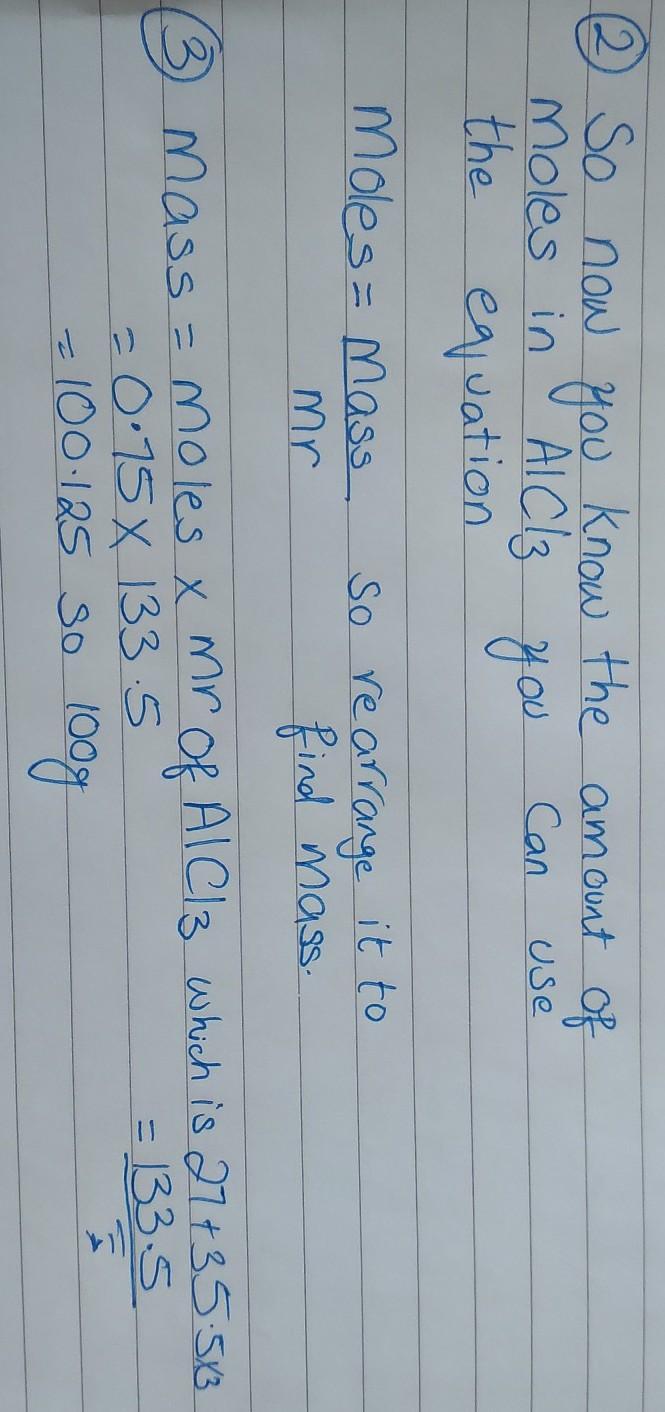
How many grams of AlCl3 are needed to completely react with 2.25 of NaOH?
Answers
Explanation:
hope the picture above help u understand I did it in step so it would be easier to understand:)

Which method would provide the best synthesis of ethyl isopropyl ether? b) CH3CH2ONa + (CH3)2CHBr H2S04, 140 °C H2SO4, 180 °C d) CH3CH2OH +(CH3)2CHOH e) CH3CH2ONa +(CH3)2CHOH
Answers
CH\(_{3}\)CH\(_{2}\)ONa + (CH\(_{3}\))\(_{2}\) CHBr H\(_{2}\)S0\(_{4}\), 140 °C would provide the best synthesis of ethyl isopropyl ether. The correct answer is option b).
This is because the method involves the use of sodium ethoxide (CH\(_{3}\)CH\(_{2}\)ONa) and isopropyl bromide ((CH\(_{3}\))\(_{2}\) CHBr) in the presence of sulfuric acid. This process is known as the Williamson ether synthesis and is an effective method for the preparation of ethers.
The other options are not suitable for the synthesis of ethyl isopropyl ether. Option d) involves the use of ethanol and isopropyl alcohol which would not react to form the desired ether product. Option e) involves the use of sodium ethoxide and isopropyl alcohol which would result in the formation of isopropyl ethyl ether instead of ethyl isopropyl ether.
Overall, the Williamson ether synthesis is the most appropriate method for the synthesis of ethyl isopropyl ether. The correct answer is option b.
You can learn more about ethyl isopropyl at
https://brainly.com/question/31044163
#SPJ11
Do you think it’s important that forensics is categorized as a science? Why or why not?
Answers
At STP, iodine, I2, is a crystal, and fluorine, F2, is a gas. Iodine is soluble in ethanol, forming a tincture of iodine. A typical tincture of iodine is 2% iodine by mass.
66 Compare the strength of the intermolecular forces in a sample of I2 at STP to the strength of the intermolecular forces in a sample of F2 at STP
Answers
At STP (Standard Temperature and Pressure), iodine is present in a crystalline form, whereas fluorine is in a gaseous form. Iodine is also soluble in ethanol and produces a tincture of iodine. Typically, a 2% iodine mass is present in a tincture of iodine.
The strength of the intermolecular forces in I2 (iodine) at STP is significantly higher than the strength of the intermolecular forces in F2 (fluorine) at STP. This is because of the difference in the bonding type, which is the primary factor that affects the strength of the intermolecular forces. Iodine is bonded covalently in its crystalline form, with every I2 molecule sharing electrons with another I2 molecule, making it a very strong intermolecular force. This bond is also known as a covalent bond. On the other hand, fluorine is bound by weak van der Waals forces due to its gaseous form, which are primarily dipole-dipole interactions. Since they are less polar, the van der Waals forces in F2 are weaker than in I2. These intermolecular forces are weaker because fluorine is in a gaseous form, while iodine is in a crystalline form. Hence, the strength of the intermolecular forces in I2 is much greater than the strength of the intermolecular forces in F2.For such more question on intermolecular
https://brainly.com/question/12243368
#SPJ8
At STP, iodine (I2) is a solid crystal and fluorine (F2) is a gas. A sample of I2 at STP is held together by van der Waals forces, which are weaker intermolecular forces. On the other hand, a sample of F2 at STP is held together by much stronger intermolecular forces than I2 due to its smaller size.
Therefore, F2 has stronger intermolecular forces than I2. It can be explained in a long answer as follows:At standard temperature and pressure, iodine (I2) is a solid crystalline substance. Its physical state is a solid because the intermolecular forces that bind the iodine molecules together are weak van der Waals forces. These forces are much weaker than chemical bonds, and they hold molecules in a condensed phase like a liquid or a solid. The forces of attraction between the iodine atoms in I2 are much weaker than the forces of attraction between the fluorine atoms in F2.
As a result, the boiling point of I2 is much lower than the boiling point of F2. F2 is a gas at STP since it is held together by much stronger intermolecular forces than I2 due to its smaller size. Fluorine has an electron density that is spread out over a larger area than iodine, making it more polarizable. The larger polarizability leads to stronger instantaneous dipoles and, as a result, stronger London dispersion forces. Since intermolecular forces are responsible for determining the physical state of a substance, F2 is a gas, whereas I2 is a solid. As a result, F2 has stronger intermolecular forces than I2.
To know more about intermolecular forces visit:-
https://brainly.com/question/31797315
#SPJ11
how much energy would it take to heat a section of the copper tubing that weighs about 630.0 g , from 14.80 ∘C to 27.32 ∘C ? Copper has a specific heat of 0.3850 J/(g⋅∘C)
Answers
so 630 x 0.3850 x 12.52 = 3036.726
A solution is made containing 8.4 g
of potassium nitrate per 125 g of
water.
What is the weight/weight % or
percent by mass of the solute?
Answers
The percent by mass : 6.3%
Further explanationThe concentration of a substance can be expressed in several quantities such as moles, percent (%) weight/volume,), molarity, molality, parts per million (ppm) or mole fraction. The concentration shows the amount of solute in a unit of the amount of solvent.
mass of potassium nitrate = 8.4 g⇒solute
mass of solution = mass of solute+mass of solvent(water)mass of potassium nitrate + mass of water = 8.4 g + 125 g =133.4 g
Percent by mass of the solute :
\(\tt =\dfrac{mass~solute}{mass~solution}\times 100\%\\\\=\dfrac{8.4}{133.4}\times 100\%\\\\=6.3\%\)
A chemist performs a reaction by adding 50g of NaOH pellets to 500 mL of a 3.0 M HCl solution. What could the chemist do to increase the rate of the reaction
Answers
To increase the rate of reaction the chemist could increase the temperature, surface area of NaOH or the concentration of HCl.
The chemist could crush the NaOH pellets into a finer powder. A greater surface area allows more NaOH particles to come into contact with HCl particles at the same time, leading to a faster rate of reaction.
The chemist could use a higher concentration of HCl solution, which would provide more HCl molecules to react with the NaOH, resulting in a faster reaction rate.
By increasing the temperature, the kinetic energy of the particles increases, leading to more frequent and energetic collisions between NaOH and HCl molecules. This will result in a faster rate of reaction.
To learn more about rate of reaction visit:
https://brainly.com/question/12904152
#SPJ11
Help me please will give brainliest

Answers
Answer:
It equals 826
Explanation:
Cos that's ur moms weight in pounds
1. Consider the reaction: 5 A + 3 B → 2 C The rate of the reaction is found to be 0.0486 M/s. What is the rate of change of B? Be sure to consider whether the substance is disappearing or appearing in your answer.
2. For the following zero order reaction, the rate constant is 0.0311. If [A]0 = 8.68, calculate [A] at 2.9 seconds.
2 A →→ 3 B
Answers
1. Consider the reaction: 5 A + 3 B → 2 C The rate of the reaction is found to be 0.0486 M/s. Then, The rate of change of B is 0.01215 M/min.
2. For the following zero order reaction, the rate constant is 0.0311.
If [A₀] = 8.68, calculate [A] at 2.9 seconds. Then, [A] = 8.66445 ≈ 8.7.
(1) For Reaction : 5A + 3B → 2C
R₁ : 0.080486 M/s = K[A][B]² ---------------------- (1)
When half of the B has reacted, then,
⇒ R₂ = k[A][B/2] -------------------------- (2)
Dividing (2) and (1), we get:
R₂÷ R₁ = K[A] [B/2] ÷ K[A] /[B]
⇒ R₂÷ R₁ = B²/4 ÷ B²
⇒ R₂÷ R₁ = 1/4
Therefore,
R₁ /4 = 0.0486/ 4
= 0.01215 M/minute.
Therefore,
Consider the reaction: 5 A + 3 B → 2 C The rate of the reaction is found to be 0.0486 M/s. Then, The rate of change of B is 0.01215 M/min.
(2) For a Zero Order reaction:
t = K[A₀] [A] ÷ K ------------------------- (1)
Given that:
t = 2.9 Second
and, k = 0.0311
Converting Seconds into minutes:
t = 2.9 second = 0.048 Minutes ≈ 0.5 Minutes.
Putting the values in equation (1)
⇒ 0.5 = 8.68 - [A] ÷ 0.0311
⇒ 0.5 × 0.0311 = 8.68 - [A]
⇒ 0.01565 - 8.68 = - [A]
⇒ [A] = 8.66445
Therefore, [A] = 8.66445 ≈ 8.7
Based on the zero order reaction, the rate constant is 0.0311. If [A]0 = 8.68, calculate [A] at 2.9 seconds. Then, [A] = 8.7
Learn more about Reaction:
https://brainly.com/question/17434463
#SPJ4
Identify each of the following changes of state as melting, freezing, sublimation, or deposition:
1)The solid structure of a substance breaks down as liquid forms.
2)Coffee is freeze-dried.
3)Water on the street turns to ice during a cold wintry night
4)Ice crystals form on a package of frozen corn.
Answers
The solid structure of a substance breaks down as liquid forms: This is a process known as melting. Melting occurs when a solid substance is heated to a temperature above its melting point, causing the solid structure to break down and transform into a liquid state.
The energy supplied to the solid during heating increases the kinetic energy of the particles, which causes the intermolecular forces holding the solid structure together to weaken, eventually leading to a liquid state.
Coffee is freeze-dried: This process is called sublimation. In freeze-drying, a substance is first frozen and then exposed to low pressure, causing the frozen water in the coffee to sublime directly from a solid to a gas without passing through a liquid state. This removes the water from the coffee, resulting in a dry, lightweight product that can be rehydrated when needed.
Water on the street turns to ice during a cold wintry night: This process is known as freezing. When the temperature of water drops below its freezing point, the water molecules slow down and begin to form a crystal lattice structure, resulting in ice formation. This process is commonly observed during winter months when water freezes to form ice on roads, sidewalks, and other surfaces.
Ice crystals form on a package of frozen corn: This process is called deposition. Deposition occurs when a substance in a gas state is converted directly into a solid state without passing through a liquid state. In the case of frozen corn, water vapor in the air around the package can deposit directly onto the surface of the cold package, forming ice crystals. This process is commonly observed in cold environments, such as when frost forms on a cold window.
Learn more about melting here:
https://brainly.com/question/31109629
#SPJ11
Help with chemistry problem 6 please and how to put values in equation in the brackets underneath of the problem (so I can show my work)

Answers
Answer
449.4 grams
Explanation
The balanced chemical equation of the reaction is;
\(N_2+3H_2\rightarrow2NH_3\)From the balanced chemical equation;
3 moles of H₂ reacted with 1 mole of N₂ to produce 2 moles of NH₃
Molar mass of H₂ = 2.016 g/mol
Molar mass of N₂ = 28.0134 g/mol
Molar mass of NH₃ = 17.031 g/mol
Convert mole to gram using the formula;
\(Mole=\frac{\text{mass}}{\text{Molar mass}}\)For 1 mole N₂
\(\begin{gathered} 1=\frac{\text{mass}}{28.0134} \\ mass=28.0134\text{ grams} \end{gathered}\)For 3 moles H₂
\(\begin{gathered} 3=\frac{\text{mass}}{2.016} \\ m=3\times2.016=6.048\text{ grams} \end{gathered}\)For 2 moles NH₃
\(\begin{gathered} 2=\frac{\text{mass}}{17.031} \\ m=2\times17.031=34.062\text{ grams} \end{gathered}\)We can now calculate, the mass of NH₃ that can be produced from 79.8 grams of H₂ as follows:
From the balanced equation we can say;
6.048 grams H₂ → 34.062 grams NH₃
∴ 79.8 grams H₂ → x grams NH₃
\(\begin{gathered} \text{x grams }NH_3=\frac{34.062\times79.8}{6.048} \\ \text{x grams }NH_3=\frac{2718.1476}{6.048} \\ \text{x grams }NH_3=449.4291667\text{ grams} \\ \text{x grams }NH_3=449.4\text{ grams} \end{gathered}\)Therefore, 449.4 grams of Ammonia is produced if you started with 79.8 grams of Hydrogen.

TRUE or FALSE: The Periodic table is full of periodic trends and patterns.
True
False
Answers
Answer: false
Explanation:
Draw The Structure Of Phthalic Anhydride, Which Is Also Known As 2‑Benzofuran‑1,3‑Dione.
Answers
Here's the structure of phthalic anhydride, also known as 2-benzofuran-1,3-dione.
Phthalic anhydride is an organic compound with the molecular formula C8H4O3. It consists of a six-membered benzene ring fused to a five-membered ring containing two carbonyl (C=O) groups and an oxygen atom. The benzene ring, a cyclic structure with alternating single and double carbon-carbon bonds, is the basic unit of many aromatic compounds. The two carbonyl groups in phthalic anhydride are connected to adjacent carbon atoms in the five-membered ring, while the oxygen atom bridges the gap between the other two carbons, forming a furan-like structure.
In terms of IUPAC numbering, the benzene ring carbons are numbered 1 to 6, and the five-membered ring carbons are numbered 2 and 3, with the oxygen atom connecting carbons 1 and 4. The carbonyl groups are attached to carbons 2 and 3, making the compound a 1,3-dione.
Phthalic anhydride is an important industrial chemical and is used as a precursor for the production of various chemicals, such as plasticizers, dyes, and resins. Its structure is essential in understanding its reactivity and properties, as the functional groups and aromatic nature influence its chemical behavior.
Learn more about phthalic anhydride here:
https://brainly.com/question/10926647
#SPJ11
The conductance of the electric current through the electrolytic solution increases with
a)decrease in dilution
b)increase in dilution
c)increase in concentration
d)low degree of ionization
Answers
The conductance of the electric current through the electrolytic solution increases with increase in concentration.
What is electrolytic solution?
Electrolytic solutions are solutions that are capable of conducting an electric current due to presence of ions.
The current flowing in an Electrolytic solutions is calculated as;
Q = It
I = Q/t
where;
Q is chargesIncrease in the concentration of the charges, increases the amount of charges in the solution and hence the conductance of the solutions will increase as well.
Learn more about Electrolytic solutions here: https://brainly.com/question/14654936
#SPJ1
Which statement below best describes a catalyst?
Question 3 options:
An item that can slow reactions rates
A molecule that is consumed in a chemical reaction
An item that can increase reaction rates
An item that increases the concentration of reactions
Answers
what ir bands are most useful in distinguishing a carboxylic acid from a neutral organic compound?
Answers
The most useful IR bands for distinguishing a carboxylic acid from a neutral organic compound are: IR Bands: 1700-1725 cm−1
Infrared spectroscopy is a tool used to investigate chemical bonds and is used to distinguish a carboxylic acid from a neutral organic compound.
IR Bands: 1700-1725 cm−1are bands associated with the C=O group present in carboxylic acids. These bands correspond to the stretching of the C=O double bond. This region of the IR spectrum provides a great deal of information about the sample being tested. It is used to differentiate between a carboxylic acid and an ester, which has a similar band at 1735-1740 cm−1, but a lower intensity.
Overall, the 1700-1725 cm−1 band region is the most important indicator of the presence of a carboxylic acid in an IR spectrum and is the most useful band for distinguishing carboxylic acids from neutral organic compounds.
know more about IR Bands here : https://brainly.com/question/32802504
#SPJ11