Answers
Answer:
Step-by-step explanation:
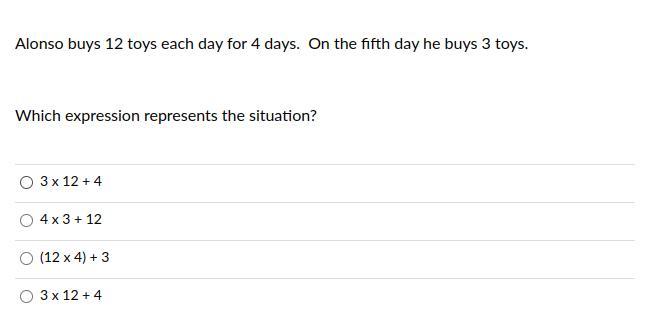
(12*4)+3
Answer:
(12 x 4) + 3
Step-by-step explanation:
He buys 12 toys every day for 4 days = (12 x 4)
He buys 3 more toys on the fifth day = (12 x 4) + 3
Related Questions
Write a fraction that is equivalent to 3/5 that has a denominator of 20.
5
15
20
20
12
12
20
3
20
Answers
Answer:
12/20
Step-by-step explanation:
\(\displaystyle \frac{3}{5}=\frac{3}{5}\cdot\frac{4}{4}=\frac{12}{20}\)
The answer is:
12/20In-depth-explanation:
The denominator of 3/5 is 5. To get from 5 to 20, we multiply it by 4.
We need to multiply both the numerator and the denominator by 4, so we do this:
\(\sf{\dfrac{3\times4}{5\times4}}\)
\(\sf{\dfrac{12}{20}}\)
Hence, the answer is 12/20.I need Help please!!!

Answers
Step-by-step explanation:
it seems you solved the tricky part yourself already.
just to be sure, let's do the first derivative here again.
the easiest way would be for me to simply multiply the functional expression out and then do a simple derivative action ...
f(t) = (t² + 6t + 7)(3t² + 3) = 3t⁴ + 3t² + 18t³ + 18t + 21t² + 21 =
= 3t⁴ + 18t³ + 24t² + 18t + 21
f'(t) = 12t³ + 54t² + 48t + 18
and now comes the simple part (what was your problem here, don't you know how functions work ? then you are in a completely wrong class doing derivatives; for that you need to understand what functions are, and how they work). we calculate the function result of f'(2).
we simply put the input number (2) at every place of the input variable (t).
so,
f'(2) = 12×2³ + 54×2² + 48×2 + 18 = 96 + 216 + 96 + 18 =
= 426
Show what a monomial expression looks like
Give me a monomial expression and solve it, step-by-step, thoroughly, show your work and explain with each step how your doing it
(New to this, thanks in advance for the extra help!!!)
Answers
Answer:
Refer to the step-by-step explanation.
Step-by-step explanation:
Come up with a monomial expression and solve it.
What is a monomial expression?A monomial expression is an algebraic expression that consists of a single term. It is an expression that can contain variables, constants, and non-negative integer exponents, but there should be no addition or subtraction between different terms.
Here are a few examples of an monomial expression:
5x-2xy²3a⁵7m³n²\(\hrulefill\)
Let's work with the monomial expression, 3x²y³z.
To solve this expression, I assume you would like to evaluate it for specific values of the variables x, y, and z. So let x=3, y=2, and z=1.
Plug these values into the expression:
3x²y³z
=> 3(3)²(2)³(1)
=> 3(9)(8)(1)
=> 27(8)(1)
=> 216(1)
=> 216
Thus, the expression is solved.
Lin runs 5 laps around a track in 8 minutes.
a. How many minutes does it take to run 1 lap?
b.
How many laps did Lin run in 1 minute?
Please hurry
Answers
Answer:
1.2 minutes, hope this helps (owo)/
Step-by-step explanation:
They got the 1.2 minutes by taking the total number of minutes (6) and dividing them by the number of laps run (5). So 6 divided by 5 gives you the 1.2.

Which polynomial function could be represented by the graph below?

Answers
If you were to roll a six-sided number cube 60 times, about how many times would you expect the number cube to land on a 1?
Answers
Answer:
10
Step-by-step explanation:
Probability is the likeliness of happening of an event.
Probability of any event A can be be defined by
no. of time event A happens/ total no. all possible event that can occur
___________________________________
In the problem
probability of occurrence of 1 on rolling a cube is needed.
A cube has six sides with one written on one sides and rest has 2,3,4,5,6.
No of times 1 can occur on rolling the dice once will be = 1
Since there six sides and and each has different number (1,2,3,4,5,6)
There is chance that each of the number can come.
Thus, total no possible outcome = 6
Probability of occurrence of 1 = No of times 1 occurs on rolling the dice /total no possible outcome = 1/6
_____________________________________________
If dice is rolled 1 time there is 1/6 chance that 1 will be the outcome.
If dice is rolled 1*60 time then there is 1/6*60= 10 chance that 1 will be the outcome
Thus , If you were to roll a six-sided number cube 60 times, about 10 times it is expected that the number cube to land on a 1.
Answer:
20
Step-by-step explanation:
£2,300 is invested for 4 years at 5% per year simple interest work out the total interest
Answers
Answer:
£460
Step-by-step explanation:
First, converting R percent to r a decimal
r = R/100 = 5%/100 = 0.05 per year,
then, solving our equation
I = 2300 × 0.05 × 4 = 460
I = £ 460.00
The simple interest accumulated
on a principal of £ 2,300.00
at a rate of 5% per year
for 4 years is £ 460.00.
WILL GIVE BRAINLIEST SO DESPERATE PLS
The life zones on Mount Rainier, a mountain in Washington, can be approximately classified by elevation, as follows.
Low-elevation forest: above 1700 feet to 2500 feet
Mid-elevation forest: above 2500 feet to 4000 feet
Subalpine: above 4000 feet to 6500 feet
Alpine: above 6500 feet to the summit
Write a compound inequality that represents the elevation range h
for each type of plant life.
Answers
Answer:
Look down below
Step-by-step explanation:
It's been a little while since I've looked at compound inequalities, so forgive me if this is a bit long.
Let's start with the Low Elevation Forest. Let x represent what is considered the forest. If this is above 1700, x>1700 (which can be rewritten as 1700<x). (Remember, as silly as this may sound, the mouth of the alligator eats the larger part! So the large number has the wide part of the symbol. Remember also that if the sign is < or >, then it includes the number the 'mouth' is facing.) If the forest is up to 2500, you'll generally include 2500 in your equation, so x<2500. This means 1700<x<2500 or x>1700 and x<2500.
Now let's repeat that with the other parts of the question. Mid elevation is x>2500 and x<4000. Subalpine would be x>4000 and x<6500. Alpine is then x>6500 and x< the summit (which is probably the elevation of Mount Rainer in this problem or 14410 feet).
Now we have the question itself. Let's replace x with t for trees for part a. This would mean in the low elevation forest, t>1700 and t<2500 which can be rewritten 1700<t<2500. Now we have flowers in the subalpine AND alpine zones. Let's use f for flowers. If flowers can be in either zone, let's combine them! Because t>4000 and t<6500 in the subalpine level and t>6500 and < the summit (aka 14410 feet), flowers can grow anywhere above 4000 feet. So flowers would be f>4000 and f<14410. Again, you can combine these into: 400<f<14410.
Sorry this is so long, but I hope it helps :)
Anna wants to borrow $15,000 to buy a used sail boat. After looking at her financial situation, she realizes that she can only afford monthly payments of $300. The bank is offering financing at 6.1%. For how long will Anna need to finance the boat to stay within her monthly payment?
Answers
Answer:
47 months
Step-by-step explanation:
find 6.1% of 15k then divide that by 300
6.1% = 915
15,000 - 915 = 14085
14085 divided by 300 is 46.95 then rounded is 47
Find the indicated term of the arithmetic sequence.
22nd term: a1 = 4; d = 4
The 22nd term of the arithmetic sequence is:
.
Answers
Answer:
88
Step-by-step explanation:
Answer:
88
Step-by-step explanation:
plz give brainliest
Write the quadratic equation whose roots are -2 and -6, and whose leading coefficient is 1.
(Use the letter x to represent the variable.)
Answers
To have a root of -2, you want a factor of (x+2) in your equation.
To have a root of -6, you want a factor of (x+6) in your equation.
Multiplying those together, you have y=(x+2)(x+6) or y=x^2+8x+12
This also has a leading coefficient of 1.
The width of a rectangle is 3 cm less than twice its length. If the perimeter of the
rectangle is 18 cm, find its dimensions.
Answers
Answer:
length=4
Width=2×4-3=5
Step-by-step explanation:
Let length =X
Width =2x-3
Perimeter=18
2(length+width)=18
2(X+2x-3)=18
3x-3=9
3x=12
X=12/3
X=4
So length=4
Width=2×4-3=5
Answer:
\( \huge{ \boxed{ \bold{ \sf{Length \: = \: 4 \: cm}}}}\)
\( \huge{ \boxed{ \bold{ \sf{Width = 5 \: cm}}}}\)
▁▁▁▁▁▁▁▁▁▁▁▁▁▁▁▁▁▁▁▁▁▁▁▁▁▁▁▁
☯ Question :
The width of a rectangle is 3 cm less than twice its length. If the perimeter of the rectangle is 18 cm, find its dimensions.☯ Step - by - step explanation :
✒ First, Let length of a rectangle be ' L '.
✑ Given :
Width of a rectangle = 3 cm less than twice its length ( i.e W = 2L - 3 )Perimeter of a rectangle ( P ) = 18 cm☞ Finding value of length of a rectangle :
\( \boxed{ \sf{Perimeter \: of \: a \: rectangle = 2(L + W)}}\)
Plug the values and solve for L
➺ \( \sf{18 = 2(L+ 2L - 3)}\)
➺ \( \sf{18 = 2(3L - 3)}\) { Add : 2L and L )
➺ \( \sf{18 = 6L - 6}\) { Distribute 2 through the parentheses )
➺ \( \sf{6L - 6 = 18}\) { Swipe the sides of the equation }
➺ \( \sf{6L = 18 + 6}\) { Move 6 to right hand side and change it's sign )
➺ \( \sf{6L = 24}\) { Add the numbers : 18 and 6 }
➺ \( \sf{ \frac{6L}{6} = \frac{24}{6}} \) { Divide both sides by 6 }
➺ \( \boxed{ \sf{length \: ( \: L\: ) \: = \: 4 \: cm}}\)
☞ Now , Evaluating 2L - 3 when L = 4 cm in order to find the value of width of a rectangle : \( \sf{2l - 3}\)
➺ \( \sf{2 \times 4 - 3}\) { Plug the value of length }
➺ \( \sf{8 - 3}\) { Multiply 2 by 4 }
➺ \( \boxed{ \sf{Width \: ( \: W \: ) \: = \: 5 \: cm}}\)
Hence ,
Length of a rectangle ( L ) = 4 cmWidth of a rectangle ( W ) = 5 cmHope I helped!
Have a wonderful day! ツ
~TheAnimeGirl ♡
▁▁▁▁▁▁▁▁▁▁▁▁▁▁▁▁▁▁▁▁▁▁▁▁▁▁▁

On a coordinate plane, a curved line labeled f of x with a minimum value of (1.9, negative 5.7) and a maximum value of (0, 2), crosses the x-axis at (negative 0.7, 0), (0.76, 0), and (2.5, 0), and crosses the y-axis at (0, 2).
Which statement is true about the graphed function?
F(x) < 0 over the intervals (-∞, -0.7) and (0.76, 2.5).
F(x) > 0 over the intervals (-∞, -0.7) and (0.76, 2.5).
F(x) < 0 over the intervals (-0.7, 0.76) and (2.5, ∞).
F(x) > 0 over the intervals (-0.7, 0.76) and (0.76, ∞).
Answers
The statement that is true about the function is:
F(x) < 0 over the intervals (-∞, -0.7) and (0.76, 2.5).What is the function of a graph?A function, in mathematics, an expression, rule, or law that defines a relationship between one variable (the independent variable) and another variable (the dependent variable).
Given:
The minimum value of the curve = (1.9, -5.7),
The maximum value = (0, 2)
The point the function crosses the x-axis (the x-intercept) = (-0.7, 0), (0.76, 0), and (2.5, 0)
The point the function crosses the y-axis (the y-intercept) = (0, 2)
The given points can be plotted using MS Excel, from which we have:
F(x) is less than 0 over the interval from x = -∞, to x = -0.7, and the interval from x = 0.76 to x = 2.5.
Hence, the correct option is A.
To know more about the function of a graph, visit:
https://brainly.com/question/32687137
help please, ive been cutting for a long time and i cant break the habit, no one will give me a straight answer. Ive lived a live full on pain, my cutting is just one of those things. i dont know when im cutting until i see the blood on the floor. I just need some help, hotlines are not an option and counseling is not possible because of my position in the military. anything helps.
Answers
Answer:
do you have any people who could make you happy from where you are?
Answer:
I've been through this too.
I know it's hard. I know there are many things that trigger your cutting. I noticed you said you live on your pain. I did too. One way I coped was instead of cutting myself, I would have a rubber band on my self and snap the rubber band to my wrist when I felt like cutting. This helped a lot, and I still do it to this day. Please trust me, when you look back at yourself in the future you won't believe you did that to your beautiful body. Please trust me on this one. <3
whats the answer? please help meeeeeeee Asap

Answers
Answer:
8/9 is correct
Step-by-step explanation:
8/9 is your answer!
~iwa-chan
three consecutive even integers have a sum of 42. find the intergers
Answers
Answer:
12, 14, 16
Step-by-step explanation:
Let's say x is the lowest number:
x+x+2+x+4=42
Simplify the equation:
3x+6=42
Subtract 6 on each side to isolate 3x:
3x=36
x=12
So the lowest number is 12, which means the next number(x+2) would be 14, and the following number(12+4) would be 16.
Happy learning!
--Applepi101
Answer:
let x be = three consecutive even numbers
x, (x+2),(x+4) = 42
x+x+2+x+4 = 42
3x+6 = 42
3x = 42-6
3x = 36
x = 12
so the first consecutive number is x = 12
second consecutive number is x+2 = 14
third consecutive number is x+4 = 16
2x + 8 X-2 B In this diagram, mZACD = [?]°
Answers
EXPLANATION:
STEPS:
1.First we have to find the partial distances in the two equations given and then find the total, but to do so we must find the value of x, then replace it in each of the equations and finally the sum will give us the total of all the magnitudes.
2.
Consider the following data of mathematics students.
60 study French, 30 study French and German
55 study German, 25 study French and Russian
75 study Russian, 35 study German and Russian
12 students study all the three languages.
Let F, G, R denote the set of students studying French, German and Russian respectively. Then find the number of students studying at least one of the three languages i.e, n(FUGUR)
Answers
The value of n (FUGUR) will be;
⇒ n (FUGUR) = 112
What is an expression?
Mathematical expression is defined as the collection of the numbers variables and functions by using operations like addition, subtraction, multiplication, and division.
Given that;
The data of mathematics students is,
60 study French, 30 study French and German
55 study German, 25 study French and Russian
75 study Russian, 35 study German and Russian
12 students study all the three languages.
Now,
Let F, G, R denote the set of students studying French, German and Russian respectively.
And, The data of mathematics students is,
n (F) = 60, n (F ∩ G) = 30
n (G) = 55, n (F ∩ R) = 25
n (R) = 75 , n (G ∩ R) = 35
n (F ∩ G ∩ R) = 12
Since, We know that;
⇒ n (FUGUR) = n (F) + n (G) + n (R) - n (F ∩ G) - n (F ∩ R) - n (G ∩ R)
+ n (F ∩ G ∩ R)
Substitute all the values, we get;
⇒ n (FUGUR) = n (F) + n (G) + n (R) - n (F ∩ G) - n (F ∩ R) - n (G ∩ R)
+ n (F ∩ G ∩ R)
⇒ n (FUGUR) = 60 + 55 + 75 - 30 - 25 - 35 + 12
⇒ n (FUGUR) = 112
Thus, The value of n (FUGUR) will be;
⇒ n (FUGUR) = 112
Learn more about the mathematical expression visit:
brainly.com/question/1859113
#SPJ1
What is the area of this
parallelogram?
3 in
6 in
Answers
Answer:
A = 18 in2
Step-by-step explanation:
Paralelogram area is A = b*h
then
A = 6*3
A = 18 in2
Note: Enter your answer and show all the steps that you use to
solve this problem in the space provided.
You have a credit card with a balance of $1,367.90 at a 9.5%
APR. You pay $400.00 each month on the due date until the
card is paid off. How many months does it take to pay off the
card, and what is the total amount paid including interest?
Be sure to include in your response:
• the answer to the original question
. the mathematical steps for solving the problem
demonstrating mathematical reasoning
Answers
Given statement solution is :- It takes 4 months to pay off the card, and the total amount paid, including interest, is $1600.
To determine the number of months it takes to pay off the credit card and the total amount paid, including interest, we can follow these steps:
Step 1: Calculate the monthly interest rate.
The APR (Annual Percentage Rate) is given as 9.5%. To find the monthly interest rate, we divide this by 12 (the number of months in a year):
Monthly interest rate = 9.5% / 12 = 0.0079167
Step 2: Determine the monthly payment.
The monthly payment is given as $400.
Step 3: Calculate the interest and principal paid each month.
The interest paid each month can be calculated by multiplying the monthly interest rate by the current balance.
Principal paid = Monthly payment - Interest paid
Step 4: Track the remaining balance each month.
Starting with the initial balance of $1,367.90, subtract the principal paid each month to determine the new balance.
Step 5: Repeat Steps 3 and 4 until the balance reaches zero.
Continue calculating the interest and principal paid each month, updating the balance, until the remaining balance becomes zero.
Step 6: Determine the total number of months and the total amount paid.
Count the number of months it takes to reach a balance of zero. Multiply the number of months by the monthly payment ($400) to find the total amount paid.
Let's calculate the number of months and the total amount paid, including interest:
Month 1:
Interest paid = 0.0079167 * $1,367.90 = $10.84
Principal paid = $400 - $10.84 = $389.16
New balance = $1,367.90 - $389.16 = $978.74
Month 2:
Interest paid = 0.0079167 * $978.74 = $7.75
Principal paid = $400 - $7.75 = $392.25
New balance = $978.74 - $392.25 = $586.49
Month 3:
Interest paid = 0.0079167 * $586.49 = $4.64
Principal paid = $400 - $4.64 = $395.36
New balance = $586.49 - $395.36 = $191.13
Month 4:
Interest paid = 0.0079167 * $191.13 = $1.51
Principal paid = $400 - $1.51 = $398.49
New balance = $191.13 - $398.49 = -$207.36 (Paid off)
It takes 4 months to pay off the credit card. Now, let's calculate the total amount paid, including interest:
Total amount paid = 4 * $400 = $1600
Therefore, it takes 4 months to pay off the card, and the total amount paid, including interest, is $1600.
For such more questions on Credit Card Payoff
https://brainly.com/question/26867415
#SPJ8
5. A patient consumed the following fluids:
1000 ml of IV, 4 oz of juice, 8 oz of milk, ½ cup of chicken broth, 5 Tbsp of jello (counts as liquid). How many milliliters of
fluids did the patient intake total?
Answers
The patient consumed 1547.1098 milliliters of fluids in total. By converting the given units into milliliters, we get the required value.
What are the required conversions?The required conversions are:
1 ounce (oz) = 29.5735 ml
1 cup = 236.588 ml
1 tbsp = 14.7868 ml
Converting the given units into milliliters:Given that, a patient consumed the following fluids:
1) 1000 ml of IV
2) 4 oz of juice ⇒ 4 × 29.5735 ml = 118.294 ml
3) 8 oz of milk ⇒ 8 × 29.5735 ml = 236.588 ml
4) 1/2 cup of chicken broth = 236.588/2 = 118.294 ml
5) 5 tbsp of jello = 5 × 14.7868 ml = 73.9338 ml
So, the total milliliters of liquid taken by the patient is
= 1000 + 118.294 + 236.588 + 118.294 + 73.9338 = 1547.1098 ml
Learn more about conversions of units here:
https://brainly.com/question/26259781
#SPJ1
Is (1,2), (2,3) (3,4), (4,5) a function?
Answers
Answer:
yes
Step-by-step explanation:
The domain is the set of x-values: {1, 2, 3, 4}. None of these are repeated, so this relation is a function.
A parabola opening up or down has vertex (0, -3) and passes through (4, -7). Write its
equation in vertex form.
Answers
Answer:
Since the vertex is (0,-3), we know that the equation of the parabola will have the form:
y = a(x - 0)^2 - 3
where "a" is the coefficient that determines whether the parabola opens up or down.
To find the value of "a", we can use the fact that the parabola passes through the point (4, -7):
-7 = a(4 - 0)^2 - 3
-7 + 3 = 16a
-4 = 16a
a = -1/4
Substituting this value of "a" into the equation for the vertex form, we get:
y = -(1/4)x^2 - 3
So the equation of the parabola in vertex form is y = -(1/4)x^2 - 3, with vertex (0, -3) and passing through (4, -7).
Step-by-step explanation:
Question 2 of 10
If A PQR = ASTU, which statement must be true?

Answers
Answer:
PQ = ST
Step-by-step explanation:
..................
Answer:
pq = st
Step-by-step explanation:
Please answer ASAP i will brainlist

Answers
(a) The average cost in 2011 is
(b) A graph of the function g for the period 2006 to 2015 is shown below.
(c) Assuming that the graph remains accurate, its shape suggest that the average cost increases at a slower rate as time goes on.
How to estimate the average cost in 2011?Based on the information provided, we can logically deduce that the average annual cost (in dollars) for health insurance in this country can be approximately represented by the following function:
g(x) = -1736.7 + 1661.6Inx
where:
x = 6 corresponds to the year 2006.
For the year 2011, the average cost (in dollars) is given by;
x = (2011 - 2006) + 6
x = 5 + 6
x = 11 years.
Next, we would substitute 11 for x in the function:
g(11) = -1736.7 + 1661.6In(11)
g(11) = $2247.64
Part b.
In order to plot the graph of this function, we would make use of an online graphing tool. Additionally, the years would be plotted on the x-axis while the average annual cost would be plotted on the x-axis of the cartesian coordinate as shown below.
Part c.
Assuming the graph remains accurate, the shape of the graph suggest that the average cost of health insurance increases at a slower rate as time goes on.
Read more on exponential functions here: brainly.com/question/28246301
#SPJ1
Complete Question:
The average annual cost (in dollars) for health insurance in a country can be approximated by the function g(x) = -1736.7 + 1661.6Inx, where x = 6 corresponds to the year 2006.
(a) Estimate the average cost in 2011.
(b) Graph the function g for the period 2006 to 2015
(c) Assuming that the graph remains accurate, what does the shape of the graph suggest regarding the average cost of health insurance?

-15>-11+w solve inequality for W
Answers
Answer:
Starting with:
-15 > -11 + w
Add 11 to both sides:
-15 + 11 > w
Simplifying:
-4 > w
Therefore, the solution for the inequality -15 > -11 + w, when solved for w, is:
w < -4
Line segment AB is equal to 40cm. What is the length of the middle part in terms of x?
Answers
Answer:
Step-by-step explanation:
40/30=409
Last year, Greg got a new job managing the gift shop at the Bern Valley Zoo. One of his responsibilities was to track the shop's total sales each day. This box plot shows the results. Gift shop sales ($) 200 250 300 350 400 450 What percent of the time did the gift shop have sales of $350 or less? %
Answers
Answer:
Step-by-step explanation:
There were 4 days when sales were 350 or less out of 6 days so
100(4/6)=400/6=\(66\frac{2}{3}\% $ or rounded to 66.67% $ \)
The percentage of the time did the gift shop have sales of $350 or less should be considered as the 66.67%.
Calculation of the percentage:Sinceas we can see that there are total 6 things out of which 4 should be within 350 or less than 350
So here the percentage be like
\(= 4\div 6\)
= 66.67%
Hence, The percentage of the time did the gift shop have sales of $350 or less should be considered as the 66.67%.
Learn more about percentage here: https://brainly.com/question/24552083
A taxi company is trying to decide whether to purchase brand A or brand B tires for its fleet of taxis. To estimate the difference in the two brands, an experiment is conducted using 8 of each brand, assigned at random to the left and right rear wheels of 8 taxis. The tires are run until they wear out and the distances, in kilometers, are recorded in the accompanying data set. Find a 95% confidence interval for mu1minusmu2. Assume that the differences of the distances are approximately normally distributed.
Answers
Multiply 4/5 by 10 , and then multiply that product by 17 .
Answers
Answer:
your answer is 406.
Step-by-step explanation:
4/5 x 10 will equal to 8. 8 times 17 equals 406.