according to John Locke , what is the purpose of government ?
Answers
Answer:
John lock believed that the purpose of government was to protect the natural rights ( which is life, liberty and property ) that a single person cant always protect when it comes to a state of nature.
Hope this helped
Related Questions
4. Why is the "War of 1812" not a fitting name for the war?

Answers
Answer:
Explanation:
Called the War that Nobody Won because not much was accomplished compared to other wars. Also, both countries were in a stalemate, and Britain surrendered because they had had enough.
Which description below would LEAST likely account for the dramatic shifts in birth and mortality rates portrayed in the chart during the Great Leap Forward?
A) Farmers were expected to give up most of their harvests for urban populations and for export to other nations.
B) The Third Plague, an influenza pandemic, swept through China in this period of time.
C) Widespread famine and poor planning contributed to significantly lower yields on Chinese farms.
D) Families were broken up as many small-time farmers were forced to move to large agricultural communes with harsh working conditions.
Answers
The description that LEAST likely accounts for the dramatic shifts in birth and mortality rates during the Great Leap Forward is B) The Third Plague, an influenza pandemic, swept through China in this period of time.
The Great Leap Forward was a period of radical social and economic change in China initiated by Mao Zedong in 1958. The period was marked by a series of reforms designed to modernize the country and increase food production. However, the reforms were poorly executed, resulting in widespread famine, mass migrations, and ultimately a significant death toll.
Several factors contributed to the dramatic shifts in birth and mortality rates during this period. A and D are both plausible factors that could have contributed to the shifts in birth and death rates. The forced redistribution of food from farmers to city dwellers or for export (A) and the forced collectivization of farms and the dismantling of family units (D) could have both contributed to malnutrition, starvation and ultimately increased mortality rates. Additionally, widespread famine and poor planning could also have significantly lower yields on Chinese farms, resulting in increased mortality rates (C).
Option B, however, seems unlikely as a cause because the Third Plague (or flu pandemic) is not known to have had a major impact on China or the world in the late 1950s when the Great Leap Forward policies were being implemented. While pandemics can, of course, have an impact on birth and death rates, it is not a plausible direct explanation for the shifts in birth and mortality rates during the Great Leap Forward.
In conclusion, during the Great Leap Forward period, a variety of factors contributed to the dramatic shifts in birth and mortality rates observed in the chart. While some factors, such as poor planning, forced redistribution of resources, and collectivization, were likely contributory factors, the influenza pandemic (Third Plague) is the least likely explanation for the observed shifts.
To know more about influenza pandemic, visit:
https://brainly.com/question/4035897
#SPJ11
What five revolutionary innovations made possible the Industrial Revolution? Give one example of each of these innovations, and describe how each was adapted. Must be 5 paragraphs
Answers
Answer:
analysis
Although Chinese culture is replete with lists of significant works or achievements (e.g. Four Great Beauties, Four Great Classical Novels, Four Books and Five Classics, etc.), the concept of the Four Great Inventions originated from the West, and is adapted from the European intellectual and rhetorical commonplace of the Three Great (or, more properly, Greatest) Inventions.[citation needed] This commonplace spread rapidly throughout Europe in the 16th century and was appropriated only in modern times by sinologists and Chinese scholars. The origin of the Three Great Inventions—these being the printing press, firearms, and the nautical compass—was originally ascribed to Europe, and specifically to Germany in the case of the printing press and firearms. These inventions were a badge of honor to modern Europeans, who proclaimed that there was nothing to equal them among the ancient Greeks and Romans. After reports by Portuguese sailors and Spanish missionaries began to filter back to Europe beginning in the 1530s, the notion that these inventions had existed for centuries in China took hold. By 1620, when Francis Bacon wrote in his Instauratio magna that "printing, gunpowder, and the nautical compass . . . have altered the face and state of the world: first, in literary matters; second, in warfare; third, in navigation," this was hardly an original idea to most learned Europeans.[30]
In the 19th century, Karl Marx commented on the importance of gunpowder, the compass and printing, "Gunpowder, the compass, and the printing press were the three great inventions which ushered in bourgeois society. Gunpowder blew up the knightly class, the compass discovered the world market and found the colonies, and the printing press was the instrument of Protestantism and the regeneration of science in general; the most powerful lever for creating the intellectual prerequisites."[31]
Western writers and scholars from the 19th century onwards commonly attributed these inventions to China. The missionary and sinologist Joseph Edkins (1823–1905), comparing China with Japan, noted that for all of Japan's virtues, it did not make inventions as significant as paper-making, printing, the compass and gunpowder.[32] Edkins' notes on these inventions were mentioned in an 1859 review in the journal Athenaeum, comparing the contemporary science and technology in China and Japan.[33] Other examples include, in Johnson's New Universal Cyclopædia: A Scientific and Popular Treasury of Useful Knowledge in 1880,[34] The Chautauquan in 1887,[35] and by the sinologist, Berthold Laufer in 1915.[36] None of these, however, referred to four inventions or called them "great."
In the 20th century, this list was popularized and augmented by the noted British biochemist, historian, and sinologist Joseph Needham, who devoted the later part of his life to studying the science and civilization of ancient China.[11]
Recently, scholars have questioned the importance placed on the inventions of paper, printing, gunpowder, and the compass. Chinese scholars in particular question if too much emphasis is given to these inventions, over other significant Chinese inventions. They have pointed out that other inventions in China were perhaps more sophisticated and had a greater impact within China.[6]
In the chapter "Are the Four Major Inventions the Most Important?" of his book Ancient Chinese Inventions, Chinese historian Deng Yinke writes:[37]
The four inventions do not necessarily summarize the achievements of science and technology in ancient China. The four inventions were regarded as the most important Chinese achievements in science and technology, simply because they had a prominent position in the exchanges between the East and the West and acted as a powerful dynamic in the development of capitalism in Europe. As a matter of fact, ancient Chinese scored much more than the four major inventions: in farming, iron and copper metallurgy, exploitation of coal and petroleum, machinery, medicine, astronomy, mathematics, porcelain, silk, and wine making. The numerous inventions and discoveries greatly advanced China's productive forces and social life. Many are at least as important as the four inventions, and some are even greater than the four.
Explanation:
suppose that you were a participant in the Boston Tea Party. Write a diary entry describing the event.
Answers
Answer:
It is estimated that hundreds took part in the Boston Tea Party. For fear of punishment, many participants of the Boston Tea Party remained anonymous for many years after the event. To date it is known that 116 people are documented to have participated. Not all of the participants of the Boston Tea Party are known; many carried the secret of their participation to their graves. The participants were made up of males from all walks of colonial society. Many were from Boston or the surrounding area, but some participants are documented to have come from as far away as Worcester in central Massachusetts and Maine. The vast majority was of English descent, but men of Irish, Scottish, French, Portuguese, and African ancestry were documented to have also participated. The participants were of all ages, but the majority of the documented participants was under the age of forty. Sixteen participants were teenagers, and only nine men were above the age of forty. Many of the Boston Tea Party participants fled Boston immediately after the destruction of the tea to avoid arrest. Thousands witnessed the event, and the implication and impact of this action were enormous ultimately leading to the start of the American Revolution.
david john moore cornwell is the real name of what british spy who went on to become a successful espionage author?
Answers
Answer: John le Carre
Explanation:
"The New Deal was more than just a relief expedition for a desperate middle class in the depth of the Depression... It established the federal governments responsibility to intervene in order to guarantee the collaboration of all of us to provide security for all of us. But beyond this.....lay its larger achievement, the recognition that social and economic problems in this great nation required national political solutions and national political responsibility, that the old order would not and could not work any more. More important than its inconsistencies or its faltering conception of economic planning was this signal achievement."
-David H. Bennett, "Significant Change," 1994
"The liberal reforms of the New Deal did not transform the American system: they conserved and protected American corporate capitalism....There was no significant redistribution of power in American society.... The New Deal neglected many Americans - sharecroppers, tenant farmers, migratory workers and farm laborers, slum dwellers, unskilled workers, and the unemployed Negroes. They were left outside the new order."
-Barton Bernstein, Towards a New Past, 1968
2. Using the above excerpts, answer parts a, b, and c.
a). Briefly compare or contrast the points made in the two quotations.
b). Provide ONE piece of specific evidence from 1929-1941 not directly mentioned in either quotation and briefly explain how it either supports or refutes the position taken in the first quotation.
c). Provide ONE piece of specific evidence from 1929-1941 not directly mentioned in either quotation and briefly explain how it either supports or refutes the position taken in the second quotation.
Answers
a) The first quotation by David H. Bennett presents a positive view of the New Deal, arguing that it not only provided relief for the middle class during the Great Depression, but also established the federal government's responsibility to intervene in order to guarantee security for all citizens.
The second quotation by Barton Bernstein presents a more critical view of the New Deal, arguing that it did not significantly transform the American system and that it neglected many Americans, such as sharecroppers, tenant farmers, migratory workers, and the unemployed.
What is the The New Deal?b) One piece of specific evidence that supports the position taken in the first quotation is the establishment of the Social Security Act in 1935. This legislation provided retirement benefits for American workers, and it established the principle that the federal government has a responsibility to provide for the welfare of its citizens. This supports the idea that the New Deal recognized the need for national political solutions to social and economic problems.
c) One piece of specific evidence that refutes the position taken in the second quotation is the Fair Labor Standards Act of 1938, which established minimum wage and maximum hour standards for most American workers. This legislation protected workers from exploitation and helped to redistribute economic power in American society. This refutes the idea that the New Deal neglected many Americans and that it did not lead to a significant redistribution of power in American society.
Learn more about The New Deal from
https://brainly.com/question/11739226
#SPJ1
Name at least 3 important people of World War 1.
Answers
Answer:
Herbert Asquith, Chancellor Bethmann Hollweg,and General Aleksey Brusilov
Explanation:
Answer:
-Kaiser Wilhelm II
-Thomas Edward Lawrence (of Arabia)
-Woodrow Wilson
One gang of particular note, __, became the symbol of the Mexican-American pride during the Zoot Suit riots because they battled the U.S. Sailors. This gang remains powerful in a number of East Los Angeles neighborhoods today
Answers
One gang of particular note, Pachucos, became the symbol of the Mexican-American pride during the Zoot Suit riots because they battled the U.S. Sailors. This gang remains powerful in a number of East Los Angeles neighborhoods today.
The gang of particular note is the Pachucos, which became the symbol of the Mexican-American pride during the Zoot Suit Riots in the 1940s. Today, the Pachucos remain powerful in a number of East Los Angeles neighborhoods.
For more such questions on Symbol of the Mexican-American pride.
https://brainly.com/question/14196325#
#SPJ11
Diseases from Europe had a devastating effect on _____.?
Answers
Answer:
native american, measles, smallpox, and typhus were common in Europe. ... The scattering of Africans throughout America due to the slave trade. More than 12 million Africans were shipped to the Americans, many more were impacted by this.
Explanation:
hope it helps lol
how do you think those involved in the slave trade justifies their actions?
Answers
Answer:
they cant
Explanation:
thoose people are just not ment to be in this earth
Match each term with the correct item Not all choices will be used.
Founded by Clovis I, this kingdom occupied much of
what is now France during the early Middle Ages (400s-
700s)
This Pope ruled 1073 to 1085, during which time he
clashed with Holy Roman Emperor Henry IV over the
supremacy of the Catholic Church
This refers to the conflict between the Holy Roman
Emperor Henry IV and Pope Gregory VII over who would
control appointments of bishops
He was the Holy Roman Emperor from 1084 to 1105,
suffering through the Investiture Controversy with Pope
Gregory Vill during that time
He was King of the Franks from 768 to his death and was
crowned Imperator Augustus by Pope Leo III, on 25
December 800, as a rival to the Byzantine Emperor in
Constantinople. This was the beginning of what become
knowns as the Holy Roman Empire
Answers
the Early Middle Ages. A new civilisation founded on Christian, Roman, and Germanic practices was developed in Western Europe throughout the Middle Ages. Feudalism.
What were the three foundational elements of medieval Western European culture?Its foundations were found in three places: (1) Rome's classical past; (2) Catholicism; and (3) the traditions of numerous Germanic tribes.
What were the Early Middle Ages in Europe?Image for Match the appropriate item to each word. Not every option will be implemented. This kingdom, established by Clovis I, ruled over a large portion of what is now France during the early Middle Ages (400s–700s)?
The Migration Period was a time in history that was also known as the Dark Ages, Late Antiquity, and the Early Middle Ages.
To know more about the Roman visit:
https://brainly.com/question/12101833
#SPJ4
president zachary taylor wanted to admit california as a state immediately because he:
Answers
President Zachary Taylor wanted to admit California as a state immediately because he believed that the state had met all the requirements necessary to become a state.
California had a booming population, a stable economy, and was a major contributor to the growth of the United States. Additionally, California was also a vital location due to its proximity to the Pacific Ocean and its potential to serve as a gateway to the Asia-Pacific region. Furthermore, Taylor believed that the admission of California would have important political implications. California's admission as a free state would have upset the balance of power in the United States, as it would have added another free state to the Union and shifted the power away from the slave states. This would have been a significant win for the abolitionist movement, which was gaining momentum at the time.
Ultimately, Taylor's efforts to admit California as a state were successful, and California was admitted to the Union in 1850. This move had a significant impact on the history of the United States, as it helped to cement California's status as a major player in the country's economic and political landscape. Today, California remains one of the most important states in the country, both in terms of its economy and its political influence.
Learn more about economy here: https://brainly.com/question/29775102
#SPJ11
PLEASE HELP ASAP NO LINKS
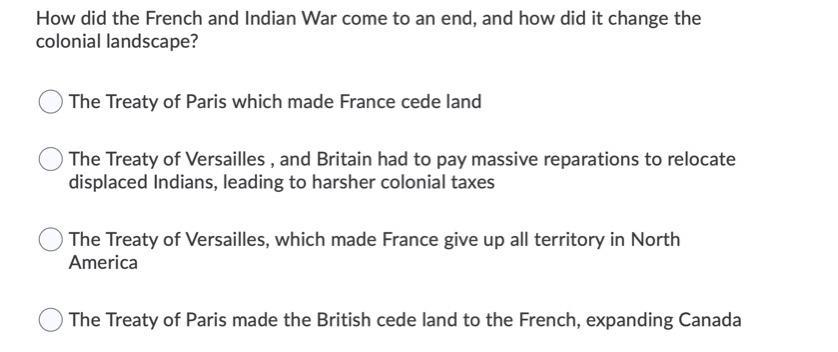
Answers
Answer:
Treaty of Paris. which made france cede land.
I believe this is right I apolgise if not.
Answer:
answer is second option
Explanation:
How did the Supreme Court decide the case mentioned in the Supreme Court argument in kelo v new London?
Answers
In the case of Kelo v. City of New London (2005), the Supreme Court ruled in favor of the city's use of eminent domain to seize private property for economic development. The majority opinion held that the city's plan qualified as a public use under the Fifth Amendment. The decision sparked debate over property rights and the scope of eminent domain powers.
\(\huge{\mathfrak{\colorbox{black}{\textcolor{lime}{I\:hope\:this\:helps\:!\:\:}}}}\)
♥️ \(\large{\underline{\textcolor{red}{\mathcal{SUMIT\:\:ROY\:\:(:\:\:}}}}\)
Why would the colonist be hebistant to having a chief excutive
Answers
Answer:Concerned with the accumulation of power in too few hands, the Articles did not establish an executive branch and they greatly circumscribed the role of courts. Even Congress had only those powers “expressly delegated” to it by the states.
Explanation:
Created disunity among states. W Teacher's Guide 1.3A Page 5 Placard One feature of the Articles of Confederation was that the government had no chief executive, such as a president or a king. As a result, the government under the Articles suffered from a lack of leadership since there was no single leader.
8. How did most children learn to read and write?
Answers
Which of the following is NOT considered a contributing factor to the
colonist declaring their independence from England
•The Stamp Act
•British Parliament outlawed anti British songs to be sung
•The Intolerable Acts
•King George refused previous attempts of the colonists to negoatiate
Answers
In terms of political behavior, the Irish: Group of answer choices generally supported Democrats. were easily manipulated into voting against their interests. seldom voted. idolized John Quincy Adams. started a new party for immigrants.
Answers
In terms of political behavior, the Irish generally supported Democrats.
This was due in part to the fact that the Democratic Party had a more welcoming stance towards immigrants and had a reputation for being more sympathetic to the working class. However, it is important to note that political behavior is not monolithic and there were certainly Irish individuals who supported other parties or candidates. There is no evidence to suggest that the Irish were easily manipulated into voting against their interests, and in fact, many Irish immigrants were politically engaged and active in shaping American politics.
While there were certainly individuals who did not vote, there is no evidence to suggest that this was a widespread phenomenon among the Irish. Finally, while there were certainly Irish individuals who admired John Quincy Adams, there is no evidence to suggest that the Irish as a group idolized him. There is also no evidence to suggest that the Irish started a new party for immigrants.
Learn more about political behavior here:https://brainly.com/question/17164785
#SPJ11
What was the order of the main events around the Haymarket Riot ? Explain what happened before , during , and after the riot .
Answers
Answer:
union workers organized a protest/strike against their factory, because they wanted an 8 hour work day. then, during the protest, somebody threw a bomb at police, resulting in the police opening fire on the protestors. this killed 8 people and wounded more. as a result, everybody in the country began to believe that unions were violent and membership decreased
Explanation:
What words describe oligarchy?
Answers
One of the words used in English to describe a particular form of authority or government is "oligarchy." A few of these terms, such plutocracy,
What would you say about an oligarchy?A form of government known as an oligarchy is characterized by the control of a small number of people or families. More particularly, the phrase was employed by Greek philosopher Aristotle to contrast with aristocracy, another term for the control of a select few who enjoy privileges.
What three traits does oligarchy have?If a business group fits all of the following criteria, it may be referred to as an oligarchy: The majority of private owners in the nation are owners. It has enough political influence to advance its own goals. Owners run several enterprises, and they closely coordinate their efforts.
To know more about oligarchy visit:
https://brainly.com/question/16687722
#SPJ4
What is one specific example of the use of legal pressure by the civil rights movement of the 1960s?
Answers
Answer:
Brown v. Board
Explanation:
One specific example of the use of legal pressure by the civil rights movement of the 1960s is the case of Brown v. Board of Education (1954).
In this landmark Supreme Court decision, the NAACP's legal team, led by Thurgood Marshall, argued against racial segregation in public schools. The case challenged the "separate but equal" doctrine established by Plessy v. Ferguson (1896).
The Court ruled that segregation in public education was unconstitutional, setting a precedent for dismantling racially segregated institutions and advancing the cause of civil rights for African Americans. This legal victory marked a pivotal moment in the movement's efforts to combat racial discrimination and foster integration.
Learn more about civil rights movement here:
https://brainly.com/question/32042116
#SPJ7
how did john brown's raid on harpers ferry, virginia, affect the south?
Answers
John Brown's raid on Harpers Ferry, Virginia had a significant impact on the South. It was a violent event that escalated tensions between the North and South, and it ultimately contributed to the start of the Civil War.
The raid itself was an attempt by Brown and his followers to seize a federal armory in order to arm slaves and start a rebellion against slaveholders. However, the raid failed and Brown and his followers were captured and later executed. This event was widely publicized and outraged many people in the South, who saw it as an attack on their way of life and their property rights.
The raid also increased fear among slaveholders and their supporters, who were already worried about the growing abolitionist movement in the North. They saw the raid as evidence that abolitionists were willing to use violence to achieve their goals, and they became more determined to defend their way of life.
Overall, John Brown's raid on Harpers Ferry helped to further divide the North and South and contributed to the start of the Civil War. It demonstrated the deep ideological differences between the two regions and helped to solidify the South's commitment to preserving slavery.
Know more about Harpers Ferry here:
https://brainly.com/question/10301178
#SPJ11
Why did the Roman Republic transition to an empire? Choose two answers.
Farmers experienced poverty and had to shut down their farms.
Roman cities became overpopulated and people could not find jobs.
Roman armies were costing the cities too much money.
Rulers in the government were giving out too many free resources to the people.
Help pls
Answers
Imagine that you were in the audience for King's
speech and write a one-page first-person account of your experience
Answers
i need heelp
can u answer me
?
Poem about George Washington using the letters of his last name
Answers
Answer: The letters of his last name Washington.
Why are committees considered to be more important in the House than in the Senate?
a. The House is responsible for all of the legwork involved in creating legislation, making committees
more of a necessity.
b. The House is larger and therefore the representatives form committees to effectively address the
variety of issues presented to them.
The Senate is the upper house and needs to work cohesively at all times, thus making committees
irrelevant
d. The House needs to address a greater number of issues and needs committees to deal with all of
them.

Answers
I’m pretty positive it’s D
Hope this helps!
In the presidential election of 1876, the
results of the Electoral College were
A. a tie
B. a landslide
C. rigged
D. uneven

Answers
Where is the largest percentage of Earth’s marine-dwelling species concentrated?
in coral reefs
in deep-water ocean trenches
in middle regions of the ocean
in rivers please choose one of the four
Answers
Answer:
Now I'm not positive this is correct but I do think the answer for this is Coral Reef.
Explanation:
The largest percentage of Earth’s marine-dwelling species is concentrated in coral reefs. Thus, option A is correct.
What are coral reefs?An underwater environment known as a coral reef is characterized by corals that construct reefs. Coral polyp colonies are bound together by calcium carbonate to build reefs. Stony corals, whose polyps gather together, make up the majority of coral reefs.
Sea anemones and jellyfish are members of the animal phylum Cnidaria, and coral is a member of the class Anthozoa. Contrary to sea anemones, corals develop tough carbonate exoskeletons that serve as the coral's support and defense. The majority of reefs thrive in warm, shallow, clear, bright, and turbulent water. At the beginning of the Early Ordovician, 485 million years ago, coral reefs first emerged, replacing the microbial and sponge reefs of the Cambrian.
Shallow coral reefs make up some of the planet's most diversified ecosystems and are sometimes referred to as "rainforests of the sea". They make up under 0.1%.
Learn more about coral reefs here:
https://brainly.com/question/15794949
#SPJ3
Which of the following statements is FALSE?

Answers
Which of the following is the most important impact of trade?
A. The exposure to improved tools.
B. The access to raw materials.
C. The exchanging of new and different ideas.
Answers
The most important impact that trade has is C. The exchanging of new and different ideas.
What is the importance of trade?Trade allows for goods and services to be traded across societies such that people are introduced to new and cheaper goods.
Because these goods can be new, they are also considered to be new ideas because the processes by which they are made will then be emulated.
Find out the importance of trade at https://brainly.com/question/17727564.
#SPJ1