Answers
Answer:
–2.25 m/s²
Explanation:
From the question given above, the following data were obtained:
Initial velocity (u) = 15 m/s
Distance travelled (s) = 50 m
Final velocity (v) = 0 m/s
Deceleration (a) =?
v² = u² + 2as
0² = 15² + (2 × a × 50)
0 = 225 + 100a
Collect like terms
0 – 225 = 100a
– 225 = 100a
Divide both side by 100
a = –225/100
a = –2.25 m/s²
Thus, the deceleration of the vehicle is –2.25 m/s²
Related Questions
Can someone do this for me?

Answers
The earth conducts seismic waves-- when an earthquake occurs, stations farther and farther away from the quake see the S and P waves propagated through deeper and deeper layers. By measuring the arrival time of the waves, the velocity of the waves can be found as a function of depth. There is clear evidence for several layers in the earth which both refract the waves and below which the velocities are different. This is a bit like holding a book under your desk while a friend (gently) taps the other end of the desk. If you listen closely to the sound (i.e. with your ear on the top of the desk) the sound changes noticeably if a large book is pressed up against the bottom of the desktop. You might also try to figure out how to tell if a golf ball is wound, liquid filled, or solid-- without looking at it. (You can tell if you hit one!)
Scientists can tell by observing the seismic waves that are recorded all over the surface of the earth from distant earthquakes. The seismic waves are reflected (bounced off) layers of different densities, and they are refracted (bent) when they enter layers of different densities. Some of them don't go through liquid at all (the S waves). Scientists have been monitoring earthquakes and studying the phases of seismic waves that arrive at different stations for - hmm, well I don't exactly know - but certainly at least the last 75 years, with more and more sophisticated equipment. Seismologists look at the little wiggles that are made by pens on paper, connected to seismometers, every time a wave from an earthquake anywhere in the world passes under their station. It is by studying many of these seismic records, for many years, and pooling all our knowledge, that we have been able to come up with a working model of what the inside of the earth is made of, where the boundaries between layers of different density and composition lie, and why we have earthquakes where we do.
to Something you can do to model how seismologists "listen" to earthquakes is densitieshave a friend tap on a big table while you put your ear on the table at the other end. We put sensitive instruments in the ground that act like ears so we can detect seismic waves from distant earthquakes.
Mark Me Brainliest
I'LL MARK BRAINLIST
• A steel wire 4.7 m long stretches 0.11 cm when it is subjected to a tension of 360 N. What is the spring constant of the wire?
Answers
Answer:
Explanation:
length = 4.7 m
extension x = (0.11 /100) m + 4.7 m
= 4.7011 m
force = 360 N
spring constant k = ?
formula : F = kx
k = F/ x
k = 360 ÷ 4.7011
k= 76.578 Nm^-1
The spring constant of the wire of a steel wire 4.7 m long stretches 0.11 cm when it is subjected to a tension of 360 N is 76.57 N/m.
What is the spring constant?Simple, symmetrical motion i.e., SHM is a genuinely fascinating kind of agitation. It is continuously used in the objects' oscillatory motion. Most springs have SHM. The "spring constants" that are intrinsic to springs determine how stiff they are. A well-known law, Hooke's law, describes the SHM and provides a formula for the applied force using the spring constant.
Simple harmonic motions and Hooke's law are related to the definition of the spring constant. Therefore, we must first examine Hooke's rule before attempting to define the spring constant and comprehend how it operates.
Given:
The tension force, T = 360 N,
The length of the wire, L = 4.7 meters,
The elongation, l = 0.11 cm,
Calculate the spring constant by the following formula,
k = T / l
( l = x(0.11 /100) m + 4.7 m= 4.7011 m)
Here, k is the spring constant.
Substitute the values,
k = 360 / 4.7011
k = 76.57 N / m
Therefore, the spring constant of the wire of a steel wire 4.7 m long stretches 0.11 cm when it is subjected to a tension of 360 N is 76.57 N/m.
To know more about Spring constant:
https://brainly.com/question/20388857
#SPJ2
A ball rows off a table with a horizontal velocity of four (ms/s). If it is 0.5 seconds for the ball to reach the floor, how high above the floor is the table top? Using g=10(m/s2)
Answers
Since the velocity roll off the table with a horizontal velocity this means that the vertical initial velocity is zero. Now, while the ball is falling, the vertical motion is a free fall motion, which means that we can use the following equation:
\(y=y_0+v_0t-\frac{1}{2}gt^2\)In this case we know that:
• The final height, y, is zero (the ground).
,• The initial velocity is zero.
,• The time it takes to hit the ground is 0.5 s.
,• The acceleration of gravity is 10.
Plugging these and solving for the initial height, y0, we have:
\(\begin{gathered} 0=y_0+(0)(0.5)-\frac{1}{2}(10)(0.5^2) \\ y_0=(5)(0.25) \\ y_0=1.25 \end{gathered}\)Therefore, the initial height is 1.25 m
A boat travels at 17mi/h for 1.50h. How far does the boat travel?
Answers
Answer:
\(\huge\boxed{25.5mi}\)
Explanation:
Simply multiply the rate by the time
17 * 1.5 = 25.5 mi
Hope it helps :) and let me know if you want me to elaborate.
a frog jumps as is moves. what is the relationship between maximum height & maximum range.
Answers
Explanation: A projectile motion is characterized by a motion whose path is alike to that of an arc. It already has its derived equations. For the maximum height H and the maximum range R, the equations are:
H = v₀²sin²θ/2g ; R = v₀²sin(2θ)/g
As you can observe, they are almost alike. Since they both contain v₀²/g, let's isolate this term for both equations:
v₀²/g = 2H/sin²θ
v₀²/g = R/sin (2θ)
Equating both equations:
2H/sin²θ = R/sin (2θ)
H = Rsin²θ/2sin(2θ)
To know more about h to r relation questions
brainly.com/question/28260925
brainly.com/question/11033032
an electric train moving at 5m/s accelerates to a speed of 8m/s in 20 seconds. Fine the distance travelled in meters during the period of acceleration
Answers
===================================================
Explanation:
vi = 5 and vf = 8 are the initial and final velocities respectively. The change in time is t = 20 seconds.
So,
x = 0.5*(vi + vf)*t
x = 0.5*(5+8)*20
x = 130 meters
represents the distance traveled. The first equation shown above is one of the four kinematics equations.
The figure shows a circuit consisting of a 30V battery, a 5Ω resistor, and an open switch in series, with a parallel combination of a 7.5H ideal inductor and a 15Ω resistor. The switch is closed, and the circuit is allowed to reach steady state. What is the resulting steady-state current supplied by the battery?

Answers
Answer: E: 6.0
Explanation:
If the switch is closed, and the circuit is allowed to reach steady state. The resulting steady-state current supplied by the battery is 6 A, hence option E is correct.
How to find steady-state current?When the voltage across the resistor is equal to the battery voltage, we can use Ohm's Law to determine the steady state current. Where I is the current in amps and V is the voltage in volts.
At steady state, the equivalent circuit will look like there is no current flowing across the resistor because the inductor has zero resistance and behaves like a piece of wire that is short-circuited.
Due to the same potential difference across, the battery's steady-state current supply is,
i = e ÷ R
= 30 ÷ 5
= 6 A
Therefore, the resulting steady-state current supplied by the battery is 6 A.
Learn more about current, here:
https://brainly.com/question/15726481
#SPJ2
An unmanned spacecraft leaves census which statements about the spacecraft journey are true
Answers
An unmanned spacecraft is a type of spacecraft that does not carry any crew members and is operated remotely. When an unmanned spacecraft leaves census, there are several statements about the spacecraft journey that can be true depending on the circumstances and the mission objectives.
Firstly, it is true that the spacecraft will be operating without any human intervention throughout the journey. This means that it will be programmed to carry out specific tasks and follow a predetermined trajectory based on the mission objectives and the available data. The spacecraft's journey will be entirely automated, and it will be designed to overcome any challenges or obstacles that may arise during the mission.
Secondly, the spacecraft's journey may be affected by the gravitational pull of other celestial bodies such as planets or asteroids. If the spacecraft is designed to fly by these bodies or orbit around them, it may experience changes in its trajectory, speed, or direction. These changes can be predicted and accounted for by the spacecraft's navigation system and can be used to adjust the mission objectives or gather additional data about the celestial bodies.
Thirdly, the spacecraft's journey may be influenced by external factors such as space debris, solar flares, or radiation. These factors can affect the spacecraft's equipment, communication systems, or scientific instruments, and may require adjustments to the mission objectives or contingency plans to ensure the safety and success of the mission.
Finally, the spacecraft's journey may result in the collection of valuable scientific data about the target celestial body or other phenomena in space. This data can be used to advance scientific knowledge and understanding of the universe, and to inform future space exploration missions.
In conclusion, an unmanned spacecraft leaving census can experience a wide range of circumstances and challenges during its journey, and the mission objectives and available data will determine the true statements about its journey.
For more such questions on spacecraft, click on:
https://brainly.com/question/30385726
#SPJ8
Why do economists measure the gross domestic product?
Answers
Answer: Economists measure the gross domestic product to see how much economic activity there is in a particular country.
Explanation:
(a) Name a part of the electromagnetic spectrum with:
a longer wavelength than microwaves:
(i)
(ii) greater energy than X-rays:
(iii) a higher frequency than ultraviolet:
Answers
For both circuits: Determine the potential difference on and the current through each resistor. Show your work and then check your answer with PhET
Answers
Answer:
Answer is explained in the explanation section below.
Explanation:
Note: This question is incomplete and lacks the necessary diagram of the circuits to solve for this question. However, I have found similar question on the internet and dragged the diagrams out of it. I have attached the diagrams of the circuits for your ease. It has two circuits to be solved. Attachment 1 refers to first circuit and Attachment 2 refers to second circuit.
Solution:
We are asked to find the potential difference and current through each resistor.
So,
Calculations for Circuit 1: Please refer to Attachment 1
First we need to find the Resistance:
Req = \(\frac{9 . 6}{9+6} +3\)
R = 6.6 Ohm
Now, we know that:
V = IR
So,
I = V/R
V = 12 V
I = 12 V/ 6.6 ohm
I = 1.82 Amperes.
Now,
The Potential Difference through 3 ohm resistor:
P.D = \(V_{3}\) = 1.82 x 3
\(V_{3}\) = 5.45 V
Now,
The Potential Difference through 6 ohm and 9 ohm resistor:
\(V_{6/9}\) = 12V - 5.45V
\(V_{6/9}\) = 6.545V
Now,
The current through 6 ohm is:
\(I_{6}\) = \(\frac{6.545}{6}\)
\(I_{6}\) = 1.09 A
Now,
The Current through 9 ohm is:
\(I_{9}\) = \(\frac{6.545}{9}\)
\(I_{9}\) = 0.72 A
Similarly,
Calculations for Circuit 2: Please refer to attachment 2:
Req = \(\frac{(30+50).90}{90+(30+50)} +20\)
Req = 62.35 ohm
I = V/R
I = 12 V/ 62.35ohm
I = 0.192 Amperes.
Now,
The The Potential Difference through 20 ohm resistor:
\(V_{20}\) = 20 x 0.192
\(V_{20}\) = 3.849 V
Now,
The The Potential Difference through 90 ohm resistor:
\(V_{90/(30+50)}\) = 12 - 3.849
\(V_{90/(30+50)}\) = 8.150
Now,
The Current through 90 ohm is:
\(I_{90}\) = 8.1509/90
\(I_{90}\) = 0.0905 Amperes
Now,
The Current through 30 and 50 ohm is:
\(I_{30/50}\) = 0.192 - 0.0905
\(I_{30/50}\) = 0.101 A
Now,
The Potential Difference through 50 ohm resistor:
\(V_{50}\) = 50 x 0.101
\(V_{50}\) = 5.094 V
The Potential Difference through 30 ohm resistor:
\(V_{30}\) = 30 x 0.101
\(V_{30}\) = 3.0566 V


How has Physics improved
or affected our society?
Answers
By supplying the fundamental knowledge required to create new instruments and techniques for medical use, physics enhances our quality of life
From can openers, light bulbs, and mobile phones to muscles, lungs, and brains; from paintings, piccolos, and pirouettes to cameras, vehicles, and cathedrals; from earthquakes, tsunamis, and storms to quarks, DNA, and black holes, physics aids us in understanding the workings of the world around us.
The science of physics is the most fundamental and has many applications in contemporary technology. Because it makes it possible for smartphones, computers, televisions, watches, and many other modern technologies to function automatically, physics is crucial to modern technology.
To learn more about physics please visit-
https://brainly.com/question/14338730
#SPJ9
How is the acceleration of a falling object calculated
Answers
Answer:
F=w=ma OR by using equations of motions vf=vi-at : a=vf-vi/t eq 1 s=vit+1/2at squre eq 2 2as=vf squre - vi squre eq 3
Explanation:
where m is the mass of falling body , f is the weight is the force acting down ward , vf is the final velocity, vi is the inetial velocity , t is the time and s is the distance covered by a body.
I need to write 200 words about: boys are most influenced by their fathers and girls are most influenced by their mothers. Do you agree or disagree?
Answers
Answer:
I agree
Explanation:
I agree because most of the times girls pass more time with their mom since they hace more things in common, it’s the same with the boys.
A 30.0 g object fell from a height y = 2.94 m. It’s velocity when y is zero is approximately equal to (in m/s) (a) 0 (b) 19.6 (c) 29.4 (d) 8.64
Answers
Analysing the question:
We are given:
mass of object (m) = 0.03 kg
height of object (h) = 2.94 m
acceleration due to gravity (a) = 10 m/s²
initial velocity (u) = 0 m/s [the object fell, we are NOT given any initial velocity]
final velocity (v) = v m/s
Solving for Final velocity:
from the third equation of motion:
v² - u² = 2ah
replacing the variables
(v)² - (0)² = 2(10)(2.94)
v² = 58.8
v = 7.67 m/s
How does the density of water change when: (a) it is heated from 0o
C to
4o
C; (b) it is heated from 4o
C to 10o
C ?
Answers
Answer:
[b] it id heated from 4o
Explanation:
A steel ball is dropped onto a thick piece of foam. The ball is released 2.5 meters above the foam. The foam compresses 3.0 cm as the ball comes to rest. What is the magnitude of the ball's acceleration as it comes to rest on the foam
Answers
Answer:
the magnitude of the ball's acceleration as it comes to rest on the foam is 817.5 m/s²
Explanation:
Given the data in the question;
initial velocity; u = 0 m/s
height; h = 2.5 m
we find the velocity of the ball just before it touches the foam.
using the equation of motion;
v² = u² + 2gh
we know that acceleration due gravity g = 9.81 m/s²
so we substitute
v² = ( 0 )² + ( 2 × 9.81 × 2.5 )
v² = 49.05
v = √49.05
v = 7.00357 m/s
Now as the ball touches the foam
final velocity v₀ = 0 m/s
compresses S = 3 cm = 0.03 m
so
v₀² = v² + 2as
we substitute
( 0 )² = 49.05 + 0.06a
0.06a = -49.05
a = -49.05 / 0.06
a = -817.5 m/s²
Therefore, the magnitude of the ball's acceleration as it comes to rest on the foam is 817.5 m/s²
A man runs 300 m West in 60 seconds. He then runs 100 m
North-west in 20 seconds.
What is his average velocity in metres per second?
Answers
Answer:
5 m/s
Explanation:
Total distance = 300 + 100 = 400m
Total time = 60 + 20 = 80s
Velocity = 400/80 = 5m/s
Average velocity of man is 5 meter per second.
To find the average speed of an object we divide the total distance travelled by the total time time taken by object.
Total distance travelled by man = 300 + 100 = 400 m
Total time taken by man = 60 + 20 = 80 seconds
Average velocity,\(=\frac{400}{80} =5m/s\)
Thus, Average velocity of man is 5 meter per second.
Learn more:
https://brainly.com/question/23856383
Part 3 Waves on a string-with a loose end The reflected
wave interferes with the original wave and creates standing wave composed of
nodes and antinodes if the frequency is just right: Instead of a node an antinode
will always exist at the loose end: (This happens because the phase of the wave
is not inverted upon reflection from loose end and therefore always constructively
interfere at that position:) Draw and measure the frequency of the 1st harmonic
(node near driver end followed by an antinode on loose end) Settings: amplitude:
0.05 cm tension: high damping: none turn on: Loose End What fraction of a
wavelength is this? Hz Click Restart' to observe the standing wave. 2. Predict the
frequencies of several higher harmonics: Use the wave simulator to test each of
your calculated harmonics Draw and label the standing waves for each of the
harmonics you discovered: Divide each higher harmonic by the first harmonic:
Are the higher harmonics even-number or odd-number multiples of the first
harmonic?
Answers
The first harmonic of the standing wave on a string with a loose end represents half a wavelength.
The fraction of a wavelength represented by the first harmonic is 1/2.
The higher harmonics of a standing wave on a string with a loose end are odd-number multiples of the first harmonic.
1. The first harmonic of a standing wave on a string with a loose end occurs when there is a node near the driver end and an antinode at the loose end. To measure the frequency of the first harmonic, we need to determine the fraction of a wavelength represented by this standing wave.
The first harmonic of the standing wave on a string with a loose end represents half a wavelength.
The first harmonic of a standing wave on a string with a loose end consists of a node near the driver end and an antinode at the loose end. This configuration creates the simplest standing wave pattern.
In a standing wave, a node is a point where the amplitude of the wave is always zero, representing a point of minimum displacement. An antinode, on the other hand, is a point of maximum displacement, where the amplitude is at its highest.
Since the loose end does not invert the phase of the wave upon reflection, the reflected wave and the original wave constructively interfere at the loose end, resulting in an antinode.
In the first harmonic, there is exactly half a wavelength between the node near the driver end and the antinode at the loose end.
Therefore, the fraction of a wavelength represented by the first harmonic is 1/2.
2. To predict the frequencies of higher harmonics, we can use the relationship that the frequency of each harmonic is a multiple of the frequency of the first harmonic. The higher harmonics can be calculated as follows:
Second Harmonic: The second harmonic consists of two nodes and one additional antinode compared to the first harmonic. The fraction of a wavelength for the second harmonic is 1/2 * 2 = 1. Thus, the second harmonic has a frequency that is twice that of the first harmonic.
Third Harmonic: The third harmonic consists of three nodes and two additional antinodes compared to the first harmonic. The fraction of a wavelength for the third harmonic is 1/2 * 3 = 1.5. Thus, the third harmonic has a frequency that is three times that of the first harmonic.
Fourth Harmonic: The fourth harmonic consists of four nodes and three additional antinodes compared to the first harmonic. The fraction of a wavelength for the fourth harmonic is 1/2 * 4 = 2. Thus, the fourth harmonic has a frequency that is four times that of the first harmonic.
In general, the higher harmonics of a standing wave on a string with a loose end are odd-number multiples of the first harmonic.
For more such questions on wavelength, click on:
https://brainly.com/question/10728818
#SPJ8
BRAINLIEST!!!
YOU HAVE 5 MINUTES!!!!
Design an easy do-it-yourself compost bin that can be put (exnfe ffpao)
together at home. You can describe it, draw and label it, or both!
Include the following in your design:
• drawing or description of design
• materials used for the bin
• size of the bin
• substances used to fill it
• household items that can go in it
• how long it takes before it is ready
• how you use the compost
2)
Compost bin design: Add these household items to
your compost bin:
Compost is ready to use in this
much time:
Use your compost this way:
Answers
The finished compost can be used to enrich soil for planting and gardening. Mix the compost into the soil or use it as a top dressing around plants.
Substances Used to Fill It:
A mixture of "brown" and "green" organic materials such as leaves, grass clippings, fruit and vegetable scraps, coffee grounds, and shredded paper can be used to fill the bin.
Household Items That Can Go in It:
Most fruit and vegetable scraps, eggshells, tea bags, coffee grounds, yard waste such as grass clippings and leaves, and shredded paper can be added to the compost bin. Meat, dairy, and fatty foods should be avoided.
How Long It Takes Before It Is Ready:
The compost should be ready to use in approximately 6 to 12 months, depending on the environmental conditions and the frequency of turning and mixing the compost.
How You Use the Compost:
The finished compost can be used as a nutrient-rich soil amendment for planting and gardening.
Compost Bin Design:
To add household items to your compost bin, simply add any of the following organic materials to the bin: fruit and vegetable scraps, coffee grounds and filters, tea bags, eggshells, yard waste such as leaves and grass clippings, and shredded paper.
Compost is ready to use in this much time:
The compost should be ready to use in approximately 6 to 12 months, depending on the environmental conditions and the frequency of turning and mixing the compost.
Use your compost this way:
The finished compost can be used to enrich soil for planting and gardening. Mix the compost into the soil or use it as a top dressing around plants.
For more question on compost
https://brainly.com/question/31910974
#SPJ11
A 2.5 kg block is initially at rest on a horizontal surface.A horizontal force of magnitude 6.0 N and a vertical force are
then applied to the block (Fig. 6-17).The coefficients of friction for
the block and surface are ms " 0.40 and mk " 0.25. Determine the
magnitude of the frictional force acting on the block if the magnitude
of is (a) 8.0 N, (b) 10 N, and (c) 12 N.
Answers
To solve this problem, we need to determine the frictional force acting on the block with different magnitudes of the applied force.
First, we need to find the normal force on the block, which is equal to the weight of the block. The weight of the block is given by:
W = mg = 2.5 kg x 9.8 m/s^2 = 24.5 N
Next, we need to find the force of the applied vertical force, which is given in the problem as "is". We can use trigonometry to find the vertical component of the force:
Fv = is sinθ
where θ is the angle between the force and the horizontal surface. Since the problem does not give us the value of θ, we will assume it to be 0°, which means the force is purely horizontal.
(a) If the magnitude of the applied force is 8.0 N, then the frictional force can be calculated as:
Ff = μsFn = μs(mg - Fv) = 0.40(24.5 - 0) = 9.8 N
(b) If the magnitude of the applied force is 10 N, then the frictional force can be calculated as:
Ff = μsFn = μs(mg - Fv) = 0.40(24.5 - 10) = 5.8 N
(c) If the magnitude of the applied force is 12 N, then the frictional force can be calculated as:
Ff = μkFn = μk(mg - Fv) = 0.25(24.5 - 12) = 3.1 N
Therefore, the magnitude of the frictional force acting on the block is 9.8 N, 5.8 N, and 3.1 N, for applied forces of 8.0 N, 10 N, and 12 N, respectively.
(a) When the horizontal force is 8 N the frictional force is 11.8 N.
(b) when the applied force is 10 N; the frictional force is 13.8 N.
(c) when the applied force is 12 N; the frictional force is 15.8 N.
What is the magnitude of the frictional force acting on the block?(a) The magnitude of the frictional force on the block when the horizontal force is 8 N is calculated as;
F - Ff = ma
where;
F is the horizontal force appliedFf is the frictional forcem is the massa is the accelerationF - μmg = ma
6 - 0.4 x 2.5 x 9.8 = 2.5 a
2.5 a = -3.8
a = -3.8/2.5
a = -1.52 m/s²
when the applied force is 8 N;
8 N - Ff = -1.52 m/s² x 2.5 kg
Ff = 11.8 N
(b) when the applied force is 10 N;
10 N - Ff = -1.52 m/s² x 2.5 kg
Ff = 13.8 N
(c) when the applied force is 12 N;
12 N - Ff = -1.52 m/s² x 2.5 kg
Ff = 15.8 N
Learn more about frictional force here: https://brainly.com/question/4618599
#SPJ1
Two car's are racing! The winner of the race will always be be the vehicle with the greater...
Answers
5.33 A constant force F= (4.70-379, 2.09) N. acts on an object of mass 180 kg, causing a displacement of that object by F= (4.25, 3.69-245) m What is the total work done by this force
Answers
The total work done by this force is 28.9-1457.86 N m.
What is total work?Total work is the sum of all the energy expended in completing a job or task. It is the amount of effort and energy expended to accomplish a goal or complete a task. Total work can be calculated by adding up all of the individual components of the job or task, such as time, effort, and materials.
The total work done by this force can be calculated using the formula W = F * Δx, where F is the force vector, and Δx is the displacement vector. In this case, the total work done is:
W = (4.70-379, 2.09) * (4.25, 3.69-245) = (19.9-944.81, 8.00-513.05) N m
Therefore, the total work done is 28.9-1457.86 N m.
To learn more about total work
https://brainly.com/question/25573309
#SPJ1
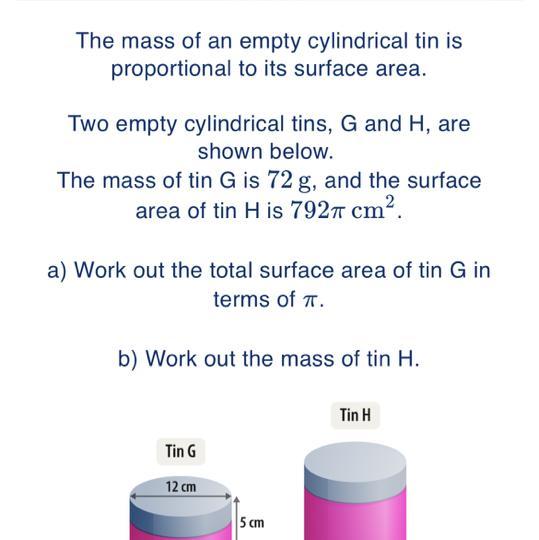
The mass of an empty cylindrical tin is
proportional to its surface area.
Two empty cylindrical tins, G and H, are
shown below.
The mass of tin G is 72 g, and the surface
area of tin H is 792π cm².
2
a) Work out the total surface area of tin G in
terms of π.
b) Work out the mass of tin H.
Tin G
12 cm
5 cm
Tin H
Not drawn accurately
Answers
a) The total surface area of tin G in terms of π is 170π cm².
b) The mass of tin H is 336 g.
To solve the given problem, we need to determine the total surface area of tin G in terms of π and the mass of tin H. Since the mass of an empty cylindrical tin is proportional to its surface area, we can use the given information to find the solutions.
a) Total surface area of tin G in terms of π:
The surface area of a cylinder consists of two circular bases and the lateral surface area. The formula for the lateral surface area of a cylinder is given by:
Lateral surface area = 2πrh
where r is the radius of the base and h is the height of the cylinder.
In the case of tin G, the given dimensions are a radius of 5 cm and a height of 12 cm. Substituting these values into the formula, we can calculate the lateral surface area:
Lateral surface area = 2π(5 cm)(12 cm)
Lateral surface area = 120π cm²
Since the total surface area of the cylinder includes the two circular bases as well, we need to add their areas. The area of a circle is given by:
Area of a circle = πr²
The radius of the circular base of tin G is 5 cm, so the area of each circular base is:
Area of each circular base = π(5 cm)²
Area of each circular base = 25π cm²
To find the total surface area of tin G, we sum the lateral surface area and the areas of the two circular bases:
Total surface area of tin G = Lateral surface area + 2 × Area of each circular base
Total surface area of tin G = 120π cm² + 2 × 25π cm²
Total surface area of tin G = 120π cm² + 50π cm²
Total surface area of tin G = 170π cm²
Therefore, the total surface area of tin G in terms of π is 170π cm².
b) Mass of tin H:
We are given that the surface area of tin H is 792π cm². We can assume that the same proportionality factor applies as in tin G, so we can set up the following proportion:
(surface area of tin G) / (mass of tin G) = (surface area of tin H) / (mass of tin H)
Using the given values, we have:
(170π cm²) / (72 g) = (792π cm²) / (mass of tin H)
Cross-multiplying and solving for the mass of tin H, we get:
(170π cm²) × (mass of tin H) = (72 g) × (792π cm²)
mass of tin H = (72 g) × (792π cm²) / (170π cm²)
mass of tin H = 336 g
Therefore, the mass of tin H is 336 g.
For more such information on: surface area
https://brainly.com/question/30231626
#SPJ8
On a given microscope, the numerical apertures of the condenser and low-power objective lenses are 1.25 and 0.25. You are supplied with a filter that selects a wavelength of 520nm.
Required:
a. What is the limit of resolution on this microscope?
b. Will you be able to distinguish 2 points that are 300nm apart as being separate, or will they blur into one?
Answers
Answer:
- colony: mass of single-type cells formed from single cell/small chain; pair or small cluster of cells; visible to naked eye
- colony forming unit: not visible to eye, original single cell or small chain/pair or small cluster of cells FROM WHICH colony forms
- Streaking plate: producing isolated colonies upon incubation using streak plate methods in agar
- Quadrant streak: used when sample is of high density
- Zigzag pattern: used when sample is of low density
a. The limit of resolution on this microscope is approximately 1254nm.
b. Two points that are 300nm apart will blur into one and cannot be distinguished as separate using this microscope.
The formula for the limit of resolution (d) is given by:
d = (0.61 × λ) / NA
where λ is the wavelength of light and NA is the numerical aperture.
a. To find the limit of resolution:
Given:
Wavelength of light (λ) = 520nm
Numerical aperture of the low-power objective lens (NA) = 0.25
Substituting these values into the formula, we have:
d = (0.61 × 520) / 0.25
d = 1254nm
Therefore, the limit of resolution on this microscope is approximately 1254nm.
b. To determine if two points 300nm apart can be distinguished:
Given:
Separation between the points (d) = 300nm
Since the separation between the points (300nm) is smaller than the limit of resolution (1254nm), the two points will blur into one and will not be distinguishable as separate entities.
In conclusion:
a. The limit of resolution on this microscope is approximately 1254nm.
b. Two points that are 300nm apart will blur into one and cannot be distinguished as separate using this microscope.
To know more about the resolution of the microscope:
https://brainly.com/question/30612401
#SPJ6
pathogens grow best at which temperature
Answers
Pathogens grow best at temperatures between 5°C and 60°C.
The ideal temperature range for food-poisoning bacteria to develop is between 5°C and 60°C. The temperature danger zone is the name given to this temperature zone.
The bacteria can't thrive if potentially dangerous items are kept heated (above 60°C) or cold (below 5°C). Bacteria can double in number in as little as 20 minutes at temperatures between 40 °F and 140 °F, where they proliferate the fastest.
FATTOM, an acronym for food, acidity, time, temperature, oxygen, and moisture, stands for the elements necessary for bacterial growth.
Due to their availability of nutrition, energy, and other elements that the bacteria require for growth, foods offer the ideal conditions for bacterial growth.
To read more about pathogens, visit https://brainly.com/question/18918957
#SPJ4
Velocity
(m/s) 5
*****
-1
2
1
3
0
1
Car
03
B
2
Time
3
1
onun
1. What is the
acceleration of the
car?
2. How can you
calculate the
displacement?
velocityx time + 1/2
Answers
The vehicle accelerates at 3 m/s² when velocity changes from 5 m/s to 2m/s.
What is the car's acceleration?Detailed explanations are provided below. Step 1: Determine the initial speed (v). The car's initial speed in this instance is 5 m/s.
Step 2: Determine the final speed (vf). The car's final speed is 2 m/s in this instance.
Step 3: Determine the variation in velocity (v).
In this instance, the change in velocity is 3 m/s (5 m/s – 2 m/s), which is the difference between the initial velocity and the final velocity.
Step 4: Determine the acceleration in a.
The acceleration in this instance is 3 m/s², which is calculated by dividing the change in velocity by the amount of time taken.
Describe acceleration in detail.The rate at which velocity changes is acceleration. Acceleration typically indicates a change in speed, but not always. Because its velocity is changing in the opposite direction, even if an object moves in a circle at the same speed, it will still accelerate.
Learn more about Acceleration :
brainly.com/question/460763
#SPJ1
A boy slides a book across the floor, using a force of 5 N over a distance of 2
m. What is the kinetic energy of the book after he slides it? Assume there is
no friction.
A. 5 J
B. 10 J
C. 20 J
D. 2.5 J
SUBMIT
Answers
The kinetic energy of the book after it is slids a distance of 2 meters will be 10 Joules.
How to determine the kinetic energy of an object?The work-energy theorem states that "the work done on an object is the change in its kinetic energy".
Hence;
Kinetic energy = work done
Note that: work-done is expressed as:
Work done = f × d
Where f is force applied and d is distance traveled.
Given that:
Force applied f = 5 newton
Distance d = 2 meters
Work done = ?
Plug these values into the above formula and solve for the workdone.
Work done = f × d
Work done = 5N × 2m
Work done = 10Nm
Work done = 10 Joules
Therefore, the kinetic energy is 10 Joules.
Option B) 10 J is the correct answer.
Learn more about work done: brainly.com/question/26115962
#SPJ1
what are the two main areas of pyisical scienece
Answers
Answer:
The two main areas of physical science are chemistry and physics. Chemistry is the study of the composition, structure, proper- ties, and reactions of matter. Physics is the study of matter and energy and the interactions between the two through forces and motion.
Explanation:
Problem
THE FLIGHT OF A BALL A ball is launched at 5.5 m/s at 76° above
the horizontal. It starts and lands at the same distance from the
ground. What are the maximum height above its launch level and the
flight time of the ball?
Answers
1. The maximum height above its launch level is 1.45 m
2. The time of flight of the ball is 1.1 s
1. How do I determine the maximum height?
From the question given above, the following data were obtained:
Initial velocity (u) = 5.5 m/sAngle of projection (θ) = 76 °Acceleration due to gravity (g) = 9.8 m/s²Maximum height (H) =?The maximum height can be obatianed as follow:
H = u²Sine²θ / 2g
H = [5.5² × (Sine 76)²] / (2 × 9.8)
Maximum height = 1.45 m
How do I determine the time of flight?
The time of flight of the ball can be obtained as follow:
Initial velocity (u) = 5.5 m/sAngle of projection (θ) = 76 °Acceleration due to gravity (g) = 9.8 m/s²Time of flight (T) = ?T = 2uSineθ / g
T = [2 × 5.5 × Sine 76] / 9.8
Time of flight = 1.1 s
Learn more about maximum height:
https://brainly.com/question/13388285
#SPJ1