A statistical analysis of 1,000 long-distance telephone calls made by a company indicates that the length of these calls is normally distributed, with a mean of 230 seconds and a standard deviation of 40 seconds. Complete parts (a) through (d).
a. What is the probability that a call lasted less than 180seconds?
b. What is the probability that a call lasted between 180 and 310 seconds?
c. What is the probability that a call lasted more than 310seconds
d. What is the length of a call if only 10% of all calls areshorter
Answers
a) The probability that a call lasted less than 180 seconds is 0.1056.
b) The probability that a call lasted between 180 and 310 seconds is 0.8716.
c) The probability that a call lasted more than 310 seconds is 0.0228
d) The length of a call if only 10% of all calls are shorter is 178.736 seconds.
Given,
Statistical analysis of 1000 calls .
Normal distribution with mean of 230 seconds and standard deviation of 40 seconds .
a)
Firstly,
Calculating the z-score:
z = (x - μ) / σ
z = (180 - 230) / 40
z = -50 / 40
z = -1.25
Probability of a z-score of -1.25 is approximately 0.1056.
b)
First, calculate the z-scores:
z1 = (180 - 230) / 40 = -1.25
z2 = (310 - 230) / 40 = 2
Probabilities associated with these z-scores are:
P(z < -1.25) ≈ 0.1056
P(z < 2) ≈ 0.9772
To find the probability between 180 and 310 seconds, we subtract the two probabilities:
P(180 < x < 310) = P(z < 2) - P(z < -1.25)
P(180 < x < 310) ≈ 0.9772 - 0.1056
P(180 < x < 310) ≈ 0.8716
c)
Calculate the z-score:
z = (310 - 230) / 40 = 2
Probability associated with a z-score of 2 is:
P(z > 2) ≈ 1 - P(z < 2)
P(z > 2) ≈ 1 - 0.9772
P(z > 2) ≈ 0.0228
d.
Calculate the z-score for the 10th percentile (0.10):
z = invNorm(0.10) ≈ -1.2816
The z-score formula is used to find the length of the call:
x = μ + z * σ
x = 230 + (-1.2816) * 40
x ≈ 230 - 51.264
x ≈ 178.736
Learn more about probability,
brainly.com/question/25839839
#SPJ4
Related Questions
You decide to buy a tablet for college. The tablet you want is currently on sale for 29% off the original price. If the original price was $899, what is the current price? Round your answer to the nearest cent (2 decimal places).
Answers
Answer:
638.29
Step-by-step explanation:
This is the answer because 29 percent of 899 is somewhere around 260.71
Substract that and you get 638.29
-7x –9 > 61
-14
-12
-10
-8
-6

Answers
-7(-10)-9 > 61
Express in the form n : 1. Give n as a decimal. 8:16
Answers
Answer:
8:16 can be written as 1:2.
Now, 1:2 can be written as 0.5:1.
It is in the form of n:1 where n is 0.5.
brainliest if im correct? :)
Step-by-step explanation:
State with reasons whether the following signals are periodic or aperiodic. For periodic signals, find the period and state which harmonics are present in the series. (a) 3sin t +2sin 3r
Answers
The signal has a fundamental period of 6 and contains exclusively odd harmonics (n = 1, 3, 5,...).
What is periodic signal?A periodic signal is one that repeats the same pattern or sequence of values over a set period of time, referred to as the period or duration of one cycle.
The given signal is:
f(t) = 3sin(t) + 2sin(3t)
To determine whether this signal is periodic or aperiodic, we need to check whether it repeats itself after a certain time interval.
For a signal to be periodic, there must be a value T such that:
f(t) = f(t+T) for all t
Let's first consider the first term of the signal: 3sin(t). This term is a sinusoidal function with a period of 2π. That is, it repeats itself every 2π units of t.
Now let's consider the second term of the signal: 2sin(3t). This term is also a sinusoidal function, but with a period of 2π/3. That is, it repeats itself every 2π/3 units of t.
To check whether the sum of these two terms is periodic, we need to find the smallest value of T for which the two terms will repeat themselves simultaneously. This is known as the fundamental period.
The fundamental period of a sum of two sinusoidal functions with different periods is given by the least common multiple (LCM) of the individual periods.
In this case, the individual periods are 2π and 2π/3. The LCM of these periods is:
LCM(2π, 2π/3) = 6π
Therefore, the fundamental period of the signal is 6π.
Since the signal is periodic, we can write it as a Fourier series:
f(t) = a0/2 + ∑(n=1 to infinity) [an*cos(nωt) + bn*sin(nωt)]
where:
ω = 2π/T = π/3 (fundamental angular frequency)
an = (2/T) ∫(0 to T) f(t)*cos(nωt) dt
bn = (2/T) ∫(0 to T) f(t)*sin(nωt) dt
Using the formulae for an and bn, we can calculate the coefficients of the Fourier series:
a0 = (1/T) ∫(0 to T) f(t) dt = 0 (since f(t) is odd)
an = (2/T) ∫(0 to T) f(t)*cos(nωt) dt = 0
bn = (2/T) ∫(0 to T) f(t)*sin(nωt) dt =
(2/6π) ∫(0 to 6π) [3sin(t) + 2sin(3t)]*sin(nωt) dt
Evaluating this integral, we get:
bn = \((2/π) [(-1)^{n-1} + (1/3)(-1)^{n-1}]\)
Therefore, the Fourier series of the signal is:
f(t) = ∑(n=1 to infinity) [(2/π) [(-1)^n-1 + (1/3)(-1)^n-1]]*sin(nπt/3)
So, the signal is periodic with a fundamental period of 6π, and it contains only odd harmonics (n = 1, 3, 5, ...).
Learn more about periodic signals on:
https://brainly.com/question/30426575
#SPJ11
Glenn needs to cut pieces of ribbon that are each 1 meter long to make ribbon key chains. If he has 6 pieces of ribbon that are each 1 dekameter long, how many 1−meter pieces of ribbon can he cut?
Answers
Answer: 60
Step-by-step explanation:
1=10. x6=60
10. the probability of winning at the board game monopoly is 32.5% if you move first. if you play 20 games of monopoly where you move first, what is the probability that you win at least 10 out of 20 times?
Answers
The probability of winning the board game Monopoly is 32.5% if you move first. If you play 20 games of monopoly where you move first, the probability that you win at least 10 out of 20 times is 0.334.
Monopoly is a game of chance where the probability of winning changes depending on the variables. When you move first in a game of Monopoly, the probability of winning is 32.5%. If you play 20 games of Monopoly where you move first, you need to determine the probability of winning at least ten games.
We can determine this by using a binomial distribution. A binomial distribution is used to determine the probability of the number of successes or failures in a fixed number of independent trials.
The formula for the binomial distribution is:
P(X=k) = C(n,k) * p^k * (1-p)^(n-k)
Where:
P(X=k) = probability of k successes
n = number of trials
k = number of successes
p = probability of success
(1-p) = probability of failure
C(n,k) = the number of combinations of n things taken k at a time.
Using this formula, we can determine the probability of winning at least ten games of Monopoly out of twenty. We need to find the probability of winning exactly ten games, eleven games, twelve games, and so on, up to twenty games. We can then add these probabilities together to get the probability of winning at least ten games.
P(X>=10) = P(X=10) + P(X=11) + P(X=12) + ... + P(X=20)
P(X=k) = C(20,k) * 0.325^k * 0.675^(20-k)
Therefore, the probability that you win at least 10 out of 20 times is:
P(X>=10) = 0.334
Hence, the answer is 0.334.
To learn more about the probability of winning the board game Monopoly visit: https://brainly.com/question/16590842
#SPJ11
Use Pascal's Triangle to expand (5x + 5)³. Express your answer in simplest form.
Submit Answer
Answers
Using Pascal's triangle the expansion of the expression \((5x+5)^3\) is \(125x^3+375x^2+375x+125\).
What is Pascal's triangle?
The triangle can be used to calculate the coefficients of the expansion of \((a+b)^n\) by taking the exponent n and adding 1. The coefficient will correspond with line n+1 of the triangle.
Here for \((5x+5)^3\) , n= 3 so the coefficient of the expansion will correspond with line 4.
The expansion follow the rule ,
\((a+b)^n=c_{0}a^nb^0+c_{1}a^{n-1}b^1+c_{n-1}a^1b^{n-1}+c_{n}a^0b^n\)
The values of the coefficients, from the triangle, are 1-3-3-1.
=> \(1a^3b^0+3a^2b+3a^1b^2+1a^0b^3\)
Here substitute a=5x and b=5 then,
=> \(1(5x)^35^0+3(5x)^25+3(5x)^25^2+1(5x)^15^3\)
=> \(125x^3+375x^2+375x+125\)
Hence the expansion of the expression \((5x+5)^3\) is \(125x^3+375x^2+375x+125\).
To learn more about Pascal's triangle refer the below link
https://brainly.com/question/29549944
#SPJ1
Applying PL, construct a symbolicmodel of the logical structure of the following argument. Construct a truth table to determine if the argument is valid. Be sure to state whether the argument is valid or invalid. If the argument is invalid then indicate a row that shows this. (4 points)
Jayco qualifies as a small business if and only if it has sales that are not large enough to influence its environment and it is privately owned by a small group of individuals. Jayco does not qualify as a small business. Therefore, Jayco must not be privately owned by a small group of individuals.
Please use these symbols: ~, v, • , ⊃, ≡
Answers
We can see that there is at least one row where all premises are true (row 7), but the conclusion is false. Therefore, the argument is invalid.
To construct a symbolic model of the argument, let's define the following symbols:
P: Jayco qualifies as a small business.
Q: Jayco has sales that are not large enough to influence its environment.
R: Jayco is privately owned by a small group of individuals.
Now we can represent the statements in symbolic form:
Premise 1: P ≡ (Q • R)
Premise 2: ~P
Conclusion: ~R
To determine if the argument is valid or invalid, we can construct a truth table:
| P | Q | R | P ≡ (Q • R) | ~P | ~R |
|---|---|---|-------------|----|----|
| T | T | T | T | F | F |
| T | T | F | F | F | T |
| T | F | T | T | F | F |
| T | F | F | F | F | T |
| F | T | T | F | T | F |
| F | T | F | T | T | T |
| F | F | T | F | T | F |
| F | F | F | T | T | T |
From the truth table, we can see that there is at least one row where all premises are true (row 7), but the conclusion is false. Therefore, the argument is invalid.
Learn more about argument from
https://brainly.com/question/29980980
#SPJ11
A study of the amount of time it takes a mechanic to rebuild the transmission for a 2005 Chevrolet Cavalier normally distributed and has the mean 8.4 hours and the standard deviation 1.8 hours. If 40 mechanics are randomly selected, find the probability that their mean rebuild time exceeds 8.7 hours
Answers
The mean of the time taken by a mechanic to rebuild the transmission of 2005 Chevrolet Cavalie μ = 8.4 hours The standard deviation of the time taken by a mechanic to rebuild the transmission of 2005 Chevrolet Cavalier, σ = 1.8 hours.
The sample size, n = 40 We have to find the probability that their mean rebuild time exceeds 8.7 hours. We know that the sampling distribution of the sample means is normally distributed with the following mean and standard deviation.
We have to find the probability that the sample mean rebuild time exceeds 8.7 hours or Now we need to standardize the sample mean using the formula can be found using the z-score table or a calculator. Therefore, the probability that the mean rebuild time of 40 mechanics exceeds 8.7 hours is 0.1489.
To know more about standard deviation visit :
https://brainly.com/question/29115611
#SPJ11
the radius of the base of a cylinder is 7cm and height is 8cm find the volume and surface area of the solid cylinder
Answers
Answer:
Volume=1232cm Surface area=660cm
Step-by-step explanation:
Volume=π x r² x t
=22/7 x 7 x 7 x 8
=1232cm
Surface area=2 x π x r x (r+t)
=2 x 22/7 x 7 x (7+8)
=44 x 15
=660cm
SORRY IF I AM WRONG, I'M TRYING MY BEST
please help me answer this question asap

Answers
Answer:
It's quite easy
Step-by-step explanation:
people less than 30 years = frequency of people 0 to 15 + 15 to 30 = 8+15 =23
Therefore there are 23 people less than 30 years old.
pls mark me as brainliest pls.
In a certain state, about 3/5th of the registered voters participated in 2016 election. What fraction of registered voters did not participate?
Answers
Answer:
2/5 (or 2/5th) of the registered voters did not participate in the 2016 election for the state
Step-by-step explanation:
The total probability is 1 (if you add the fraction who did participate and the fraction that didn't, then you get 1), and since you have 2 choices, either you participate or you don't participate in the election, we conclude that the remaining fraction is,
(fraction of Those who didn't participate) = 1 - (fraction of those who did participate)
fraction of Those who didn't participate = 1 - 3/5
fraction of Those who didn't participate = 5/5 - 3/5
fraction of Those who didn't participate = 2/5
Hence, 2/5th of the registered voters did not participate in the 2016 election for the state
assume that x has a normal distribution, with the specified mean and standard deviation. find the indicated probabilities. p(13 ≤ x ≤ 32); μ = 18; σ = 5
Answers
The probability P(13 ≤ x ≤ 32) for a normal distribution with mean μ = 18 and standard deviation σ = 5 is approximately 0.8556.
To find the probability P(13 ≤ x ≤ 32) for a normal distribution with mean μ = 18 and standard deviation σ = 5, we need to standardize the values using the standard normal distribution.
The standard normal distribution has a mean of 0 and a standard deviation of 1. We can convert the given values to z-scores using the formula: z = (x - μ) / σ.
For the lower limit of 13, the corresponding z-score is z1 = (13 - 18) / 5 = -1.
For the upper limit of 32, the corresponding z-score is z2 = (32 - 18) / 5 = 2.8.
Using a standard normal distribution table or a statistical calculator, we can find the probabilities associated with these z-scores.
The probability corresponding to the lower limit z1 = -1 is P(Z ≤ -1) ≈ 0.1587.
The probability corresponding to the upper limit z2 = 2.8 is P(Z ≤ 2.8) ≈ 0.9974.
To find the probability of the interval 13 ≤ x ≤ 32, we subtract the probability corresponding to the lower limit from the probability corresponding to the upper limit: P(13 ≤ x ≤ 32) = P(Z ≤ 2.8) - P(Z ≤ -1) ≈ 0.9974 - 0.1587 ≈ 0.8387.
Therefore, the probability P(13 ≤ x ≤ 32) for a normal distribution with mean μ = 18 and standard deviation σ = 5 is approximately 0.8556.
To learn more about Probability - brainly.com/question/31828911
#SPJ11
The premiter of a rectangular rug is 40 feet. Its length is 12 feet. What is the width
Answers
40= 2(12) + 2W
40= 24 + 2W
16 = 2W
W= 8
...................kke

Answers
Answer:
A) c=3
Step-by-step explanation:
This question is asking you to find a quantity that makes the inequality true. For this is to be true the right side of the inequality must be less than 2.
A, c=3, satisfies the inequality because when 3 is plugged in for c the inequality becomes 2 > 3/3. This simplifies to 2 > 1, which is a true statement. The other constants do not satisfy the inequality
suppose you have the three scenarios proposed below. using the language of the levy and meltzer paper, scenario(s) can best be described as an observational study, and scenario(s) can best be described as a randomized experiment. scenario a: suppose researchers have a pool of individuals they can assign treatment status to and survey. suppose further that they randomly assign some individuals to very generous health insurance coverage and others to less generous coverage. they then track the participants to see how frequently they visit the primary care physician. scenario b: suppose researchers have data on health insurance type and the frequency of primary care visits. they use this data to describe the relationship between health insurance generosity and how often people visit their primary care physician. scenario c: suppose researchers have data on the price of an mri at every hospital and imaging center throughout the region. suppose further that they also have data on the number of patients each clinic sees over time. they use this data to describe the relationship between the price of an mri and the quantity of mris performed. incorrect answer: a and b; c a; b and c , not selected c; b and a , not selected b; a and c , not selected b and c; a
Answers
Scenario A can best be described as a randomized experiment and Scenarios B and C can best be described as observational studies.
Scenario A can best be described as a randomized experiment because researchers randomly assign individuals to certain health insurance coverage and track the frequency of primary care visits.
Scenario B can best be described as an observational study because researchers use existing data to describe the relationship between health insurance generosity and how often people visit their primary care physician.
Scenario C can best be described as an observational study because researchers use existing data to describe the relationship between the price of an MRI and the quantity of MRIs performed.
Scenario A can best be described as a randomized experiment and Scenarios B and C can best be described as observational studies.
Learn more about random here
https://brainly.com/question/27975182
#SPJ4
What separate the population into nonoverlapping groups?
Answers
Stratified Sampling separates the population into nonoverlapping groups. By using specific criteria to split the population, we may use this strategy to draw a proportional random sample from each division.
The population is divided into non-overlapping groups or strata, and a proportional simple random sample is taken from each stratum to create a stratified sample. Each group's members ought to have some things in common. We must choose the number of people to choose from each stratum after the strata have been established. Here, the proportionality of the chosen number is crucial. In order to make the characteristic of interest more homogeneous inside a stratum than between strata, strata are based on information other than the characteristic being measured that is known to or thought to fluctuate with the characteristic of interest. Hence, strata can be defined based on any property that explains variation in the characteristic of interest.
Learn more about Non-overlapping groups here: brainly.com/question/13664502
#SPJ4
What is the least common multiple of 4 and 6? *
1. 24
2. 12
3. 4
4. 6
Answers
Answer:
12
Step-by-step explanation:
a store prints a request on each receipt asking customers to fill out a satisfaction survey online if they are willing. what type of sample is this?
Answers
The type of sample that a store prints a request on each receipt asking customers to fill out a satisfaction survey online if they are willing is a voluntary response sample.
In the statistics world, a voluntary response sample is a research sample that relies on individual self-selection. This is in opposition to random sampling, in which the samples are gathered in a way that ensures everyone in a particular population has an equal chance of being chosen. This method of self-selection is also known as self-selection bias or sampling bias.Voluntary response samples are subject to a variety of flaws. The responses may not be representative of the population as a whole, and they may be skewed by numerous factors, such as which individuals are most likely to volunteer, how these volunteers differ from the population as a whole, and how the survey questions are phrased.The results of a voluntary response survey may be useful in generating hypotheses or gaining a general sense of how individuals feel about a particular subject. However, they are not reliable enough to draw any conclusions or to be taken seriously in the scientific sense.
To know more about sample refer here:
https://brainly.com/question/13287171
#SPJ11
cholesterol levels among fourteen-year-old boys are roughly normal, with mean 170 and standard deviation 30 milligrams per deciliter (mg/dl). you choose an srs of 4 fourteen-year-old boys and average their cholesterol levels. if you do this many times, the standard deviation of all the average cholesterol levels you get will be close to
Answers
The standard deviation of all the average cholesterol levels we get will be close to 15 mg/dl.
The standard deviation of the average cholesterol levels will be given by the standard error of the mean, which is calculated as
standard error of the mean = standard deviation / sqrt(sample size)
In this case, the sample size is 4, so we have
standard error of the mean = 30 / sqrt(4) = 15
Therefore, if we take many samples of 4 fourteen-year-old boys and average their cholesterol levels, the standard deviation of all the average cholesterol levels we get will be close to 15 mg/dl.
Learn more about standard deviation here
brainly.com/question/23907081
#SPJ4
Sydney applied the steps below to find the product of (3.1)(–1.6). Step 1: (3.1)(–1.6) = (–1.6)(3.1) Step 2: = _______________ Step 3: = (–4.8) + (–0.16) Step 4: = –4.96 Which expression correctly fills in the blank in Step 2?
Answers
Answer:
(-1.6)(3 + 0.1)
Step-by-step explanation:
Sidney applied the steps to find the product of two numbers (3.1) and (-1.6),
Step 1,
(3.1)(-1.6) = (-1.6)(3.1)
Step 2,
(-1.6)(3.1) = (-1.6)(3 + 0.1)
Step 3,
(-1.6)(3 + 0.1) = -4.8 + (-0.16) [Distributive property]
Step 4,
-4.8 + (-0.16) = -4.96
Therefore, expression that correctly fits in step 2 will be,
(-1.6)(3 + 0.1)
Answer:
it might be D
Step-by-step explanation:
sorry is im wrong
EDIT
on edge im right!!!!!!!!!!!!!!
one of the sides of a triangle is divided into segments of 6 and 8 units by the points of tangency of the inscribed circle. if the radius of the circle is 4, then what is the length of the shortest side of the triangle?
Answers
The length of the shortest side of the triangle is 13.
We are given a triangle. One of the sides of the triangle is divided into segments of 6 and 8 units by the points of tangency of the inscribed circle. The radius of the circle is 4 units. We need to find out the length of the shortest side of the triangle. The diagram is attached below for reference.
The lengths of the corresponding tangents must be equal. Let the length of the remaining tangents be denoted by the variable "m". The area of the triangle can be calculated in two ways.
The first way is to add the sum of three triangles.
A = (1/2)×(6 + 8)×(4) + (1/2)×(6 + m)×(4) + (1/2)×(m + 8)×(4)
A = 28 + 12 + 2m + 2m + 16
A = 4m + 56
The second way is to use the formula having semi-perimeter.
A = √[s(s - a)(s - b)(s - c)]
A = √[(m + 14)(m)(8)(6)]
A = √[48m(m + 14)]
Both quantities must be equal.
4m + 56 = √[48m(m + 14)]
16(m + 14)² = 48m(m + 14)
m + 14 = 3m
2m = 14
m = 7
The lengths of the sides of the triangle are 13, 14, and 15. Hence, the length of the shortest side of the triangle is 13.
To learn more about triangles, visit :
https://brainly.com/question/2773823
#SPJ4

What is money?
1. A store of value
2. A medium of exchange
3. A measure of value
a. Money simplifies the exchange process because it’s a means of indicating how much something costs.
b. To use money to buy the goods and services you want.
c. People are willing to hold onto it because they’re confident that it will keep its value over time.
Answers
Answer:
its 2 it is a medium of exchange
Answer:
B
Step-by-step explanation:
It a medium of exchange
Please help with A.
Write the product, and then write the expression in standard form by removing parentheses and combining like terms. Justify each step.
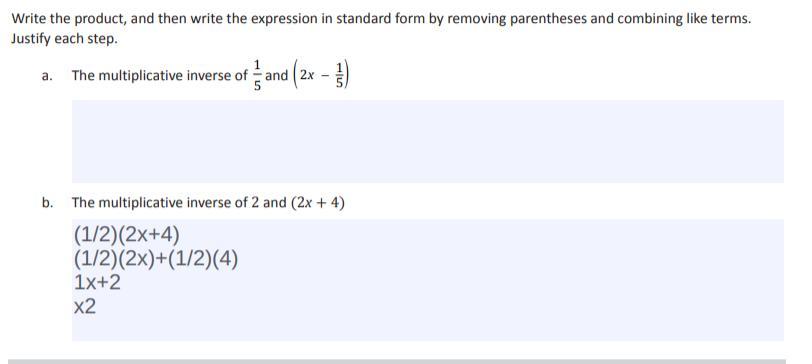
Answers
Answer:
ok so I dont have the answer but I suggest if u can u do the tutor they help a lot u can only ask 1 question per session but trust me it's helpful
they also say the answer at the end
so first they explain how to get the answer like they do the math
The top of square table has an area of 24 square feet. What is the length of 1 edge of the tabletop?
Answers
The length of one edge of the tabletop is 4.89 feet.
We know that square is a shape that has all the side equal. Based on this using the formula to find the length of edge of the tabletop.
The area of square table is given by the formula -
Area of square table = side²
We will keep the value of area of square table to find the value of side which will be length of edge
24 = side²
Side = ✓24
Taking square root for the value on right side of the equation
Side = 4.89
Hence, the length of one edge of the tabletop is 4.89 feet.
Learn more about square -
https://brainly.com/question/25092270
#SPJ4
PLEASE I REALLY NEED HELP ASAP!!! I’M REALLY DESPERATE
Su Li has 13 kg of almonds costing $5 per kilogram. How many kilograms of cashews costing $12 per kg should be added to get a mixture of the two nut types costing $7.45 per kg?
Answers
solve for x
if i did the math correct x=7
approximately 7 kilograms of cashews costing $12 per kilogram should be added to get a mixture of the two nut types costing $7.45 per kilogram.
Let x be the number of kilograms of cashews needed to be added.
The total weight of the mixture will be the sum of almonds and cashews:
Total weight = 13 kg (almonds) + x kg (cashews)
The cost of the mixture will be the sum of the costs of almonds and cashews:
Total cost = Cost of almonds + Cost of cashews
The cost of almonds is 13 kg (almonds) * $5/kg = $65.
The cost of cashews is x kg (cashews) * $12/kg = $12x.
The total cost of the mixture is the cost per kilogram of the mixture (which is $7.45/kg) multiplied by the total weight of the mixture:
Total cost = $7.45/kg * (13 kg + x kg)
Now, we can set up an equation to find the value of x:
$65 + $12x = $7.45/kg * (13 kg + x kg)
Now, solve for x:
$65 + $12x = $96.85 + $7.45x
Combine like terms:
$12x - $7.45x = $96.85 - $65
$4.55x = $31.85
Now, divide both sides by $4.55 to find the value of x:
x = $31.85 / $4.55
x ≈ 7 kg (rounded to two decimal places)
So, approximately 7 kilograms of cashews costing $12 per kilogram should be added to get a mixture of the two nut types costing $7.45 per kilogram.
Learn more about cost here
https://brainly.com/question/3055190
#SPJ2
Suppose Appendix Table A.3 contained Φ(z) only for z ≥0 Explain how you could still computea. P( –1.72≤ Z ≤–.55)b. P( –1.72≤ Z ≤ .55)Is it necessary to tabulate Φ(z) for z negative? What property of the standard normal curve justifies your answer?
Answers
It is not necessary to tabulate Φ(z) for negative z-values since we can always use the symmetry property to find the corresponding area for positive z-values. This property holds because the standard normal curve is symmetric around its mean of 0.
a. To compute P(-1.72 ≤ Z ≤ -0.55) when Appendix Table A.3 only contains Φ(z) for z ≥ 0, you can use the property of symmetry of the standard normal curve. Since the curve is symmetric around z = 0, Φ(-z) = 1 - Φ(z). So, you can find the values for positive z and use the symmetry property:
P(-1.72 ≤ Z ≤ -0.55) = Φ(-0.55) - Φ(-1.72) = (1 - Φ(0.55)) - (1 - Φ(1.72)) = Φ(1.72) - Φ(0.55)
b. To compute P(-1.72 ≤ Z ≤ 0.55), you can break it into two parts: P(-1.72 ≤ Z ≤ 0) and P(0 ≤ Z ≤ 0.55). Then, use the symmetry property for the negative part:
P(-1.72 ≤ Z ≤ 0.55) = P(-1.72 ≤ Z ≤ 0) + P(0 ≤ Z ≤ 0.55) = Φ(0) - Φ(-1.72) + Φ(0.55) - Φ(0) = Φ(1.72) + Φ(0.55)
It is not necessary to tabulate Φ(z) for z negative because the standard normal curve is symmetric around z = 0, and we can use the property Φ(-z) = 1 - Φ(z) to find probabilities for negative z values. This property allows us to calculate probabilities for negative z values without needing a separate table for them.
If Appendix Table A.3 only contained Φ(z) for z ≥0, we could still compute P( –1.72≤ Z ≤–.55) and P( –1.72≤ Z ≤ .55) by using the symmetry property of the standard normal curve. This property states that the area under the curve to the left of a negative z-score is the same as the area to the right of the corresponding positive z-score.
To apply this property, we would first find the z-scores for the given ranges by using the formula z = (x – μ)/σ, where μ and σ are the mean and standard deviation of the standard normal distribution, respectively. For P( –1.72≤ Z ≤–.55), the negative z-scores would correspond to positive x-values, so we would need to use the symmetry property to find the corresponding area for positive z-scores. Specifically, we would find P( .55 ≤ Z ≤ 1.72) using the table, and then subtract this from 1 to get P( –1.72≤ Z ≤–.55).
Similarly, for P( –1.72≤ Z ≤ .55), the negative z-score would correspond to negative x-values, so we would use the symmetry property to find the area for positive z-scores from 0 to .55, and then double this to account for the area to the left of 0.
It is not necessary to tabulate Φ(z) for negative z-values since we can always use the symmetry property to find the corresponding area for positive z-values. This property holds because the standard normal curve is symmetric around its mean of 0, meaning that the area to the left of any negative z-score is the same as the area to the right of the corresponding positive z-score.
Learn more about probabilities here: brainly.com/question/30034780
#SPJ11
Find the distance across the lake. Assume the triangles are similar.
A. 190 m
B. 235 m
C. 210 m
D. 490 m

Answers
Answer:
210
Step-by-step explanation:
20 * 3 = 60
since the trianlges are similar we know that
70 * 30 =210
Simplify: I3 - 6| - (12 ÷ 6 + 1)3

Answers
Solution
The question would like us to evaluate the following expression
\(|3-6\left|-(12\div6+1\right)^2\)- We should deal with the modulus and bracket separately.
- After that, we can then perform the subtraction operation on the results of the modulus and bracket.
- This is done below:
\(\begin{gathered} |3-6|=|-3\left|\right? \\ |-3\left|\right?=3\text{ \lparen Because the modulus always returns a positive number\rparen} \end{gathered}\)Also,
\(\begin{gathered} \lparen12\div6+1)^2 \\ By\text{ the rules of PEDMAS,} \\ Division\text{ comes before Addition, thus, we should perform the division operation first} \\ 12\div6=2 \\ \\ \lparen2+1)^2=3^2=9 \end{gathered}\)Thus, combining both results, we have:
\(\begin{gathered} 3-9 \\ =-6 \end{gathered}\)Final Answer
The answer is -6
Answer:
-6 hope it helps
thank you
In right angled triangle ABC, ABC = 90°, AC = 17 cm, BC = 15 cm then find the value of AB.
Answers
Therefore , the solution of the given problem of Pythagoras theorem is the value of AB is 8cm.
The Pythagoras Theorem is what?The Pythagorean Theorem states that the squares on the hypotenuse (the side across from the right angle) of a right triangle, or, in familiar algebraic notation, , are equal to the squares on the legs.
Here,
Given, in △ABC, ∠B=90
∴AC²=AB²+BC²
By Pythagoras theorem
=> AC²=AB²+BC²
=> 17² = 15² + AB²
=> 289 = 225 + AB²
=> 289 - 225 = AB²
=>AB = 64
=>AB = 8
thus , 8cm is the side length of AB
Therefore , the solution of the given problem of Pythagoras theorem is the value of AB is 8cm.
To know more about Pythagoras theorem visit:-
brainly.com/question/343682
#SPJ1