A grocer wants to mix two kinds of candy. One kind sells for $1.20 per pound, and the other sells for $2.00 per pound.He wants to mix a total of 26 pounds and sell it for $1.65 per pound. How many pounds of each kind should he use inthe new mix? (Round off the answers to the nearest hundredth.)
Answers
We will call the amount of each candy as X and Y.
Candy X sells for $1.20 per pound.
Candy Y sells for $2.00 per pound.
The total mix weights 26 pounds, so we can write:
\(X+Y=26\)Then, the final price of the mix will be 26 pounds * 1.65 $/pound = $42.9. This final price is equal to the sum of X by its price and Y by its price:
\(\begin{gathered} 1.20\cdot X+2.00\cdot Y=1.65\cdot26 \\ 1.20X+2.00Y=42.9 \end{gathered}\)Now we have a system of equations with two unknowns.
We can replace X in the second equation knowing that:
\(X=26-Y\)\(\begin{gathered} 1.20\cdot(26-Y)+2Y=42.9 \\ 31.2-1.2Y+2Y=42.9 \\ -1.2Y+2Y=42.9-31.2 \\ 0.8Y=11.7 \\ Y=\frac{11.7}{0.8} \\ Y=14.625 \end{gathered}\)With the value of Y, we can calculate X as:
\(X=26-Y=26-14.625=11.375\)Answer:
The amount of the $1.20 candy is 11.38 pounds and the amount of the $2 candy is 14.62 pounds.
Related Questions
The function y = 40x describes the distance Shu Ling has traveled in miles after x hours. Use the graph to estimate how many miles Shu Ling will travel in 12 hours.
Answers
Answer: y = 40*12 = 480
Step-by-step explanation:
Current
How many years will it take for an initial investment of $60,000 to grow to $90,000? Assume a rate of interest of
4% compounded continuously.
>It will take about _years for the investment to grow to $90,000.
(Round to two decimal places as needed.)
Answers
Answer:
I think i don't know the answer i am so sorry!!!
maybe someone else can Answer
Which is more, 6 liters or 6,001 milliliters?
Answers
Answer: 6,001 milliliters
Step-by-step explanation: 6 Liter translates to 6,000 milliliters, which is 1 less than 6,001 milliliters.
Answer:
I believe 6 liters is more.
Use Venn Diagrams in the error detection process to find when a “word” has been
transmitted incorrectly.


Answers
For the Venn Diagram with the code 0000, the 7-bit Hamming code extended is 0011000.
What is a Venn Diagram?
In order to solve problems based on the sets, we can use a Venn diagram to depict the logical relationship between sets and their components. Although other closed figures like squares may be used, a Venn diagram commonly uses intersecting and non-intersecting circles to indicate the relationship between sets.
To extend the four-bit code word "0000" to a seven-bit Hamming code word, we need to add three parity bits to the code word.
These parity bits are calculated based on the positions of the 1's in the code word.
To determine which subset of the Venn Diagram to put each parity bit in, we can use the following rules -
Parity bit 1 covers all bit positions that have an odd index (i.e., 1, 3, 5, 7, etc.).
Parity bit 2 covers all bit positions that have a "2" bit in their binary representation (i.e., 2, 3, 6, 7, etc.).
Parity bit 3 covers all bit positions that have a "4" bit in their binary representation (i.e., 4, 5, 6, 7, etc.).
Using these rules, we can fill in the Venn Diagram as follows -
Subset 1: 0 (bit position 1)
Subset 2: 00 (bit positions 2, 3)
Subset 3: 000 (bit positions 4, 5, 6)
Subset 4: 0000 (bit positions 7, 8, 9, 10)
Parity bit 1: 1 (covers bit positions 1, 3, 5, 7, 9, 11, 13)
Parity bit 2: 1 (covers bit positions 2, 3, 6, 7, 10, 11, 14)
Parity bit 3: 0 (covers bit positions 4, 5, 6, 7, 12, 13, 14)
So, the seven-bit Hamming code word that extends the four-bit code word "0000" is -
0011000
The first three bits (001) represent Subset 3, which contains the original code word "0000".
The next three bits (100) are the parity bits, and the last bit (0) represents Subset 4.
Therefore, the 7-bit code is obtained as 0011000.
To learn more about Venn Diagram from the given link
https://brainly.com/question/2099071
#SPJ1
To swimmers Angie aTwo swimmers Angie and Beth from different states wanted to find out who had the fastest time for the 50 m freestyle when compared to her team which swimmer had the fastest time when compared to her team
Answers
Using z-scores, it is found that due to the lower z-score, Beth had the fastest time when compared to her team.
What is the missing information?This problem is incomplete, but researching on the internet, we have that:
Angie had a time of 26.2 seconds, while her team had a mean time of 27.2 seconds with a standard deviation of 0.8 seconds.Beth had a time of 27.3 seconds, while her team had a mean time of 30.1 seconds with a standard deviation of 1.4 seconds.What are z-scores?The z-score of a measure X in a distribution with mean \(\mu\) and standard deviation \(\sigma\) is given by:
\(Z = \frac{X - \mu}{\sigma}\)
The z-score measures how many standard deviations the measure is above or below the mean. Looking at the z-score table, the p-value associated with this z-score is found, which is the percentile of X.For this problem, lower times means that the swimmer is faster, hence the swimmer that had the fastest time when compared to her team is the swimmer with the lowest z-score.
Angie's z-score is given by:
\(Z = \frac{X - \mu}{\sigma}\)
Z = (26.2 - 27.2)/0.8
Z = -1.25.
Beth's z-score is given by:
\(Z = \frac{X - \mu}{\sigma}\)
Z = (27.3 - 30.1)/1.4
Z = -2.
Due to the lower z-score, Beth had the fastest time when compared to her team.
More can be learned about z-scores at https://brainly.com/question/24537145
#SPJ1
Solve each system of equations please show your work! 3x+y-2z=22 x+5y+z=4 x=-3z

Answers
The solution of the system of equations are x = - 6 , y = 44 and z = 2
Given,
The system of equations;
3x + y - 2z = 22
x + 5y + z = 4
x = -3z
We have to solve the given equations;
Substitute x = -3z in both equations;
3x + y - 2z = 22
⇒ 3 × -3z + y - 2z = 22
⇒ - 9z + y - 2z = 22
⇒ - 11z + y = 22
And,
x + 5y + z = 4
⇒ - 3z + 5y + z = 4
⇒ 5y - 2z = 4
Solve the equations - 11z + y = 22 and 5y - 2z = 4
We get,
⇒ y = 44 and z = 2
So, x = - 3z
⇒ x = - 3 × 2
⇒ x = - 6
Thus, The solution of the system of equations are;
⇒ x = - 6 , y = 44 and z = 2
Learn more about solution for system of equations here;
https://brainly.com/question/29040805
#SPJ1
using the centriod explain the relationship between point z and the triangle. justify with applicable theorem.
4. if the length of gu is 18 units, what is the length of gz?
5. if the length of zt is 4.8 units, what is the length of ot?
show all work

Answers
Length of gz = 12 units
Length of ot = 14.4 units
Given,
Triangle EGD with centroid at Z .
Now,
As we know that centroid divides the line segment in the ratio 2:1 .
Firstly calculate the length of gz,
gu = 18 unit
gz:zu = 2:1
gz = 2/3 * 18
gz = 12 units .
Secondly calculate the length of ot,
zt = 4.8 units
oz:zt = 2:1
oz = 4.8 * 2
oz = 9.6 units
ot = 9.6+ 4.8
ot = 14.4 units
Hence with the centroid length of ot and gz can be found out .
Know more about triangles,
https://brainly.com/question/30420011
#SPJ1
Question 2(Multiple Choice Worth 2 points)
(Rewriting Rational Numbers LC)
Which number gives the exact value of 45?
6
O
4.83
6
29
4.8
hj
Answers
The computation shows that the examples of values that will give the exact value of 45 will be:
✓9 × 156 × 9✓25 × ✓81How to compute the value?It should be noted the information is incomplete as the options aren't given and not properly written.
In this case, the examples will be given:
An example of value that will give 45 will be:
= ✓25 × ✓81
= 5 × 9
= 45
The other examples will be 6 × 9 which will give 45 and ✓9 × 15 which will be 45.
Learn more about computations on:
brainly.com/question/4658834
#SPJ1
Any help with this question kinda
brained

Answers
Without multiplying, how can you tell which product will be greater, 3 x 4 or 6 x 2?
Answers
Answer:
we can compare 4 x 3 and 2 x 6, equal to 12. So, we can see that both products are similar and neither is greater.
Step-by-step explanation:
We can use the commutative property of multiplication to see that 3 x 4 is the same as 4 x 3 and 6 x 2 is the same as 2 x 6. When multiplying two numbers, the order of the numbers does not affect the product. Therefore, we can compare 4 x 3 and 2 x 6, equal to 12. So, we can see that both products are similar and neither is greater.
NEED MORE EXPLANATION?
The commutative property of multiplication states that when multiplying two numbers, the order of the numbers does not affect the product. This means that 3 x 4 is the same as 4 x 3, and 6 x 2 is the same as 2 x 6. We can use this property to compare 4 x 3 and 2 x 6, equal to 12. Therefore, we can see that both products are identical and neither is greater.
‼️‼️‼️PLEASE HELP ME OUT IM BEGGINGGGGGG‼️‼️‼️

Answers
Answer:
1) m = 9/2, n = 9
3) x = y = (3√2)/2
Step-by-step explanation:
1) We have a 30°-60°-90° right triangle, so the length of the longer leg is √3 times the length of the shorter leg, and the length of the hypotenuse is twice the length of the shorter leg. The length of the longer leg is (9√3)/2, so m, the length of the shorter leg, is 9/2, and n, the length of the hypotenuse, is 18/2, or 9.
3) We have an isosceles right triangle, so the length of the hypotenuse is √2 times the length of each leg. The length of the hypotenuse is 3, so x and y, the lengths of the two congruent legs, are 3/√2, or (3√2)/2.
Given the geometric sequence an with the following information, find a7.

Answers
To find the value of Az in the geometric sequence, we can use the given information. The geometric sequence is represented as follows: A3, 60, 160, 06 = 9.
From this, we can see that the third term (A3) is 60 and the common ratio (r) is 160/60.
To find Az, we need to determine the value of the nth term in the sequence. In this case, we are looking for the term with the value 9.
We can use the formula for the nth term of a geometric sequence:
An = A1 * r^(n-1)
In this formula, An represents the nth term, A1 is the first term, r is the common ratio, and n is the position of the term we are trying to find.
Since we know A3 and the common ratio, we can substitute these values into the formula:
60 =\(A1 * (160/60)^(3-1)\)
Simplifying this equation, we have:
\(60 = A1 * (8/3)^260 = A1 * (64/9)\)
To isolate A1, we divide both sides of the equation by (64/9):
A1 = 60 / (64/9)
Simplifying further, we have:
A1 = 540/64 = 67.5/8.
Therefore, the first term of the sequence (A1) is 67.5/8.
Now that we know A1 and the common ratio, we can find Az using the formula:
Az = A1 * r^(z-1)
Substituting the values, we have:
Az =\((67.5/8) * (160/60)^(z-1)\)
However, we now have the formula to calculate it once we know the position z in the sequence.
For more such questions on geometric sequence
https://brainly.com/question/24643676
#SPJ8
Some students performed an experiment in which they dropped a rubber ball from a height of 920 centimeters. They noticed that after each bounce, it reached 56% of its previous height. Which equation models the height, H, for n bounces?
Answers
The equation models the height, H, for n bounces, will be H = 920 (0.56)ⁿ.
What is an exponent?Consider the function:
y = a (1 ± r) ˣ
Where n is the number of times this growth/decay occurs, a = initial amount, and r = fraction by which this growth/decay occurs.
If there is a plus sign, then there is exponential growth happening by r fraction or 100r %
If there is a minus sign, then there is exponential decay happening by r fraction or 100r %
Some students performed an experiment in which they dropped a rubber ball from a height of 920 centimeters.
They noticed that after each bounce, it reached 56% of its previous height.
Then the equation models the height, H, for n bounces will be
H = 920 (0.56)ⁿ
More about the exponent link is given below.
https://brainly.com/question/5497425
#SPJ1
writing an equation and drawing its graph to model a real-world situation

Answers
Answer:
A = B + 15
Step-by-step explanation:
Let Diane sold B books in one hour,
Additional earning by selling 1 book = 1$
Additional earning by selling B books = Number of books sold × Additional earning by selling one book
= B × ($1.00)
= $B
Fixed earning of Diane in one hour of part time = $15
Total earnings = B + 15
A = B + 15
Table to find the input-output values for the graph,
A 15 16 17 18
B 0 1 2 3
Now we can plot the points on the graph.

find the smallest value of an expression
(without using a calculator)
\(\bf\sqrt{(x-8)^2+(y+4)^2} +|y+3x|\)
Answers
Step-by-step explanation:
to eliminate the always positive absolute value at the end let's set y = -3x
that makes the absolute value term = 0 in all cases.
then we have
sqrt((x - 8)² + (-3x + 4)²)
the x-value that makes this a minimum result also makes
(x - 8)² + (-3x + 4)²
a minimum.
x² - 16x + 64 + 9x² - 24x + 16
10x² - 40x + 80
the x that makes this a minimum, also makes
x² - 4x + 8
a minimum.
we get the extreme value as zero of the first derivative :
0 = 2x - 4
4 = 2x
x = 2
so, we get the minimum of all these expressions for x = 2.
as y = -3x, we get y = -3×2 = -6.
the minimum value for the expression is with
x = 2
y = -6
so, the minimum value is
sqrt((2 - 8)² + (-6 + 4)²) + |-6 + 3×2| =
= sqrt((-6)² + (-2)²) + |-6 + 6| =
= sqrt(36 + 4) + 0 =
= sqrt(40) = 6.32455532...
g (3 points)Set up but do no solve the integral required to calculate the volume formed by rotating the region bounded by f(x) = 1/x,g(x) = 1/x^3, andx= 2, andx= 4 around they-axis. Also draw a picture of the region (non-revolved).
Answers
Answer:
Hello,
Step-by-step explanation:
\(\displaystyleV=2*\pi*\int\limits^4_2 {(\dfrac{1}{x}-\dfrac{1}{x^3} )*x } \, dx \\=2*\pi*\int\limits^4_2 {(1-\dfrac{1}{x^2} ) } \, dx \\=2*\pi* [x+\dfrac{1}{x}]^4_2\\\\\boxed{V=\dfrac{7\pi}{2}}\\\)

summarize the relationship between the number of Faces, the number of Vertices and the number of Edges of a three-dimensional object
Answers
Answer:
The relationship between the number of faces, vertices, and edges of a three-dimensional object is described by Euler's formula, which states that for any polyhedron (a solid object bounded by flat faces), the number of faces (F), vertices (V), and edges (E) satisfy the equation F + V - E = 2. This formula is true for any convex polyhedron, such as a cube or a regular tetrahedron.
The formula is based on the fact that every face of a polyhedron is bounded by a closed loop of edges, and each vertex is where three or more edges meet. The total number of edges is the sum of the number of edges around each face, which is equal to twice the number of faces since each edge is shared by two faces, and the number of edges meeting at each vertex, which is equal to the degree of the vertex (the number of edges meeting at the vertex).
Therefore, by knowing the number of faces, vertices, and edges of a three-dimensional object, we can determine if it is a convex polyhedron and use Euler's formula to check if the numbers are consistent with a solid shape.
Find the angle measure of a blue wedge

Answers
Answer:
14 +15 the answer is this
Create a table
please help me with this one more.a bag contains 120 marbles some are red and the rest are black there are 19 red marbles for every black marble how many red marbles are in the bag
Answers
Answer:
pls like if not my mom will die
Step-by-step explanation:
Evaluate Sin^-1 sqrt2/2

Answers
Step-by-step explanation:
Let x = arcsin(√2/2).
We have sinx = √2/2, which is a basic trignometry identity. (sin45° = √2/2)
Since the range of arcsinx is [-90°, 90°] and 45° is within the range, the answer is 45° or π/4.
A ship is anchored off a long straight shoreline that runs north and south. From two observation points
miles apart on shore, the bearings of the ship are
and
. What is the distance from the ship to each of the observation points? Round each answer to the nearest tenth of a mile.
The distance from the north most ship to the observation is
miles.
The distance from the south most ship to the observation is
miles.
Answers
The distance from the north most ship to the observation is 2.9 miles and the distance from the south most ship to the observation is 9.9 miles.
The bearing is defined as the angle measured clockwise from the north direction. A ship is anchored off a long straight shoreline that runs north and south.
From two observation points miles apart on shore, the bearings of the ship are 52 degrees and 134 degrees respectively. To find the distance from the ship to each of the observation points, we can use trigonometry.
Let's call the distance from the north observation point to the ship x, and the distance from the south observation point to the ship y. The bearings from the north and south observation points can be drawn as follows:
[asy]
unitsize(1cm);
pair O = (0,0), N = (-2,0), S = (2,0), A = (-2,1), B = (2,-1);
draw(O--N--A,Arrow);
draw(O--S--B,Arrow);
\(label("$52^\circ$", N + 0.3*dir(52), NE);\)
\(label("$134^\circ$", S + 0.3*dir(134), SE);\)
draw(O--A--B--cycle,dashed);
\(label("$x$", (N+A)/2, W);\)
\(label("$y$", (S+B)/2, E);\)
[/asy]
We can use the tangent function to find x and y, since we have the angle and opposite side.
From the north observation point, we have:
\($$\tan(52^\circ) = \frac{x}{2}$$$$x = 2\tan(52^\circ) \approx 2.95$$\)
From the south observation point, we have:
\($$\tan(134^\circ) = \frac{y}{2}$$$$y = 2\tan(134^\circ) \approx 9.88$$\)
Therefore, the distance from the north most ship to the observation is 2.9 miles and the distance from the south most ship to the observation is 9.9 miles.
Know more about trigonometry here:
https://brainly.com/question/13729598
#SPJ8
What is the solution to the equation 3 − 5 + 10 = 36
Answers
Answer:
False (no solution)
Step-by-step explanation:
What is the solution to the equation 3 − 5 + 10 = 36?
3 − 5 + 10 = 36
8 = 36
it's false
John’s mom is making lemonade. Her recipe calls for 3 1/2 cups of lemon juice per pitcher. How many quarts will she need would to make 10 pitchers?
Answers
Answer:
2 3/16 gallons
Step-by-step explanation:
To make 10 pitchers Johan's mom needs to use 35 cups of lemon juice with the given ratio.
What are the ratio and proportion?The ratio is the division of the two numbers.
For example, a/b, where a will be the numerator and b will be the denominator.
Proportion is the relation of a variable with another. It could be direct or inverse.
As per the given,
Number of cups per pitcher= 3 1/2 = 3 + 1/2 = 7/2 cups/pitcher
With this rate, with 10 pitchers,
7/2 x 10 = 35 cups.
Hence "To make 10 pitchers Johan's mom needs to use 35 cups of lemon juice with the given ratio".
For more information about ratios and proportions,
brainly.com/question/26974513
#SPJ2
Can someone help me with this? Please and thank you!
Answers
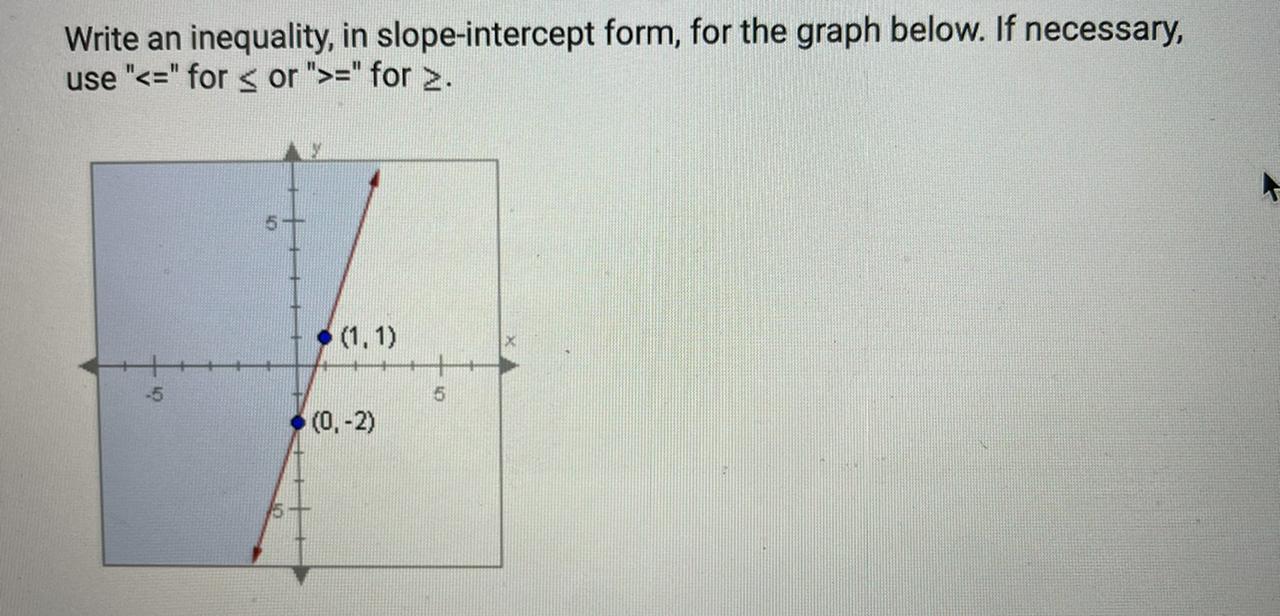
The Solution:
Given:
We are to write an inequality in slope-intercept form for the graph.
By the formula for the equation of a line, we have:
\(\frac{y-y_1}{x-x_1}=\frac{y_2-y_1}{x_2-x_1}\)In this case,
\(\begin{gathered} x_1=0 \\ y_1=-2 \\ x_2=1 \\ y_2=1 \end{gathered}\)Substituting these values, we get
\(\frac{y--2_{}}{x-0_{}}\leq\frac{1_{}--2_{}}{1_{}-0_{}}\)\(\begin{gathered} \frac{y+2_{}}{x_{}}\ge\frac{1_{}+2_{}}{1_{}_{}} \\ \\ \frac{y+2_{}}{x_{}}\ge3 \\ \\ \text{ Multiplying both sides by x.} \\ y+2\ge3x \\ y\ge3x-2 \end{gathered}\)Therefore, the correct answer is:
\(y\ge3x-2\)
5 cm
6 cm
13 cm
Help me find the area of this please

Answers
The area should be 47.5 CM.
Answer:
Step-by-step explanation:
The figure you see here is a trapezoid.
Area = \(\frac{(a + b)h}{2}\) = \(\frac{(6 + 13)(5)}{2}\) = \(\frac{(19)(5)}{2}\) = \(\frac{95}{2}\) = 47.5 cm

dp/dt = t²p − p + t2 − 1.
Answers
dp/dt = t ² p - p + t ² - 1
Factorize the right side:
dp/dt = p (t ² - 1) + (t ² - 1)
dp/dt = (p + 1) (t ² - 1)
So the differential equation is separable as
dp/(p + 1) = (t ² - 1) dt
Integrate both sides:
∫ dp/(p + 1) = ∫ (t ² - 1) dt
ln|p + 1| = t ³/3 - t + C
Solve for p :
p + 1 = exp(t ³/3 - t + C )
p + 1 = C exp(t ³/3 - t )
p = C exp(t ³/3 - t ) - 1
Define and give a visual example of the Commutative Property. 2. Explain the process ( Every Step ) that you would use to simplify the following expression. 7 ( c + 3 ) + -4 (3c -2 )
Answers
Answer:
The Commutative Property is a property that states the order of the numbers in addition and multiplication don't matter. 2+3+7 = 7+2+3
Step-by-step explanation:
7(c+3)+ -4(3c-2)
Distribute the 7 and the -4 to each of their parentheses.
7c+21-12c+8
You can use the Commutative Property to move the terms to places where they can be easily simplified.
7c-12c+21+8
Simplify.
-5c+29
Problem 1
Imagine a rectangle that is 2 by 3. You would have an area of 2*3 = 6 and it is the same as saying 3*2 = 6. The order of multiplication doesn't matter. Visually, we can rotate the rectangle to have the shorter side be horizontal and then make it vertical, and the area is still the same. All we're doing is shifting things around.
Another example is say you had a marching band with 10 rows and 2 columns. That gives 10*2 = 20 people total. Then we could easily form the same number of people into 2 rows and 10 columns. The order of rows and columns doesn't matter because we get the same total number as a result.
======================================================
Problem 2
7(c+3) + -4(3c-2) ..... is the original expression
7(c+3) - 4(3c - 2) .... adding a negative is the same as subtracting
7*c + 7*3 - 4*3c - 4*(-2) .... distributive property
7c + 21 - 12c + 8 .... multiply
(7c-12c) + (21+8) .... group like terms
-5c + 29 ... combine like terms
The original expression simplifies to -5c+29
For the following type of data set, would you be more interested in looking at the mean, median, or mode? State your reasoning. The price of cars on a car lot Answer First, select the correct measure of center and then select the justification for your choice Correct measure of center O mean O median O mode Justification O The prices of cars are quantitative data with no outliers. O The prices of cars are quantitative data with outliers. O The prices of cars are qualitative data.
Answers
Yes, we would be more intrigued by looking so at mean, median, or mode for the below type of data set.
Explain the term center measurement?A value known as a measure of central tendency (measure of center) aims to characterize a set of data by pinpointing the set's geographic center. The mean, median, and mode are well-known central tendency measures.Choose the proper center measurement first, and then decide how to support your decision.
Correct center measurement
median, mean.modeJustification:
Car prices are quantitative data that don't include any outliers.Outliers exist in quantitative data about car pricing.Car costs are an example of qualitative data.To know more about the center measurement, here
https://brainly.com/question/15214370
#SPJ4
The correct question is-
For the following type of data set, would you be more interested in looking at the mean, median, or mode? State your reasoning.
The price of cars on a car lot-
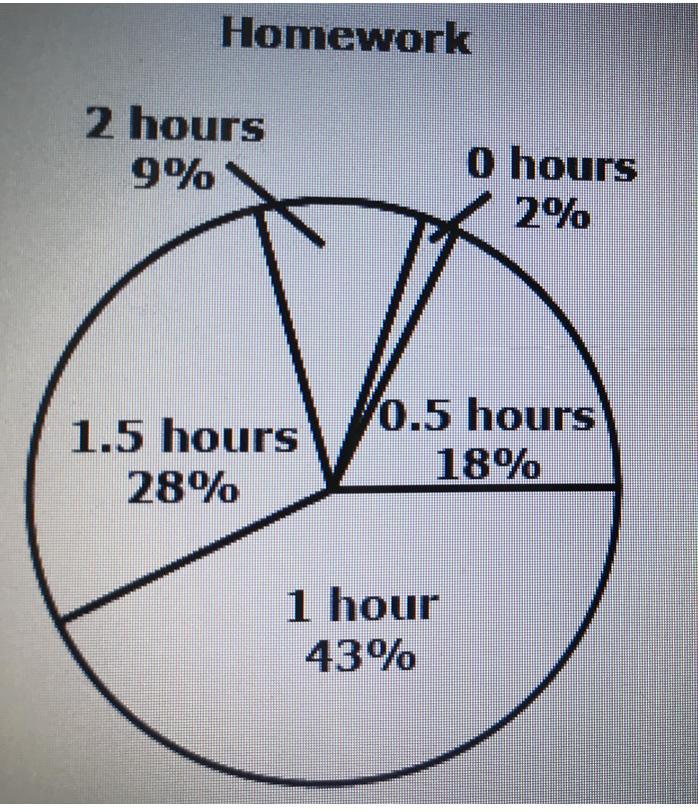
One hundred teenagers are sampled at random about how much time (in hours) they spend doing homework on a given night. The results are displayed in the graph below. Predict about how many teenagers out of 250,000 would spend 1 hour doing homework on a given night.
image 0db1c5215f1e4d9997025234b7f1621f
Answers
Answer:107,500
Step-by-step explanation:
250,000/100=2500
2500*43=107,500
The number of 107500 teenagers out of 250,000 would spend 1 hour doing homework on a given night.
What is a percentage?A ratio or value that may be stated as a fraction of 100 is called a percentage. And it is represented by the symbol '%'.
Given:
One hundred teenagers are sampled at random about how much time (in hours) they spend doing homework on a given night.
The results are displayed in the graph below.
To find the number of teenagers:
Apply the percentage formula,
43% of 250,000
= 0.43 x 250000
= 107500
Therefore, the required number of teenagers are 107500.
To learn more about the percentage;
https://brainly.com/question/24159063
#SPJ6
Which term is −20,155,392 for the following sequence, assuming that the pattern continues?
2, −12, 72, −432, ...
a
a9
b
a10
c
a11
d
a12
Answers
The term that is the −20,155,392 in the sequence is a₁₀.
What is sequence?A sequence is defined as an arrangement of numbers in a particular order.
The given sequence is 2, -12, 72, -432
a = first term
n = number of terms
r = common ratio
r = -12 / 2 = 72 / -12 = -432 / 72 = -6
a = 2
Therefore, nth term = arⁿ⁻¹
−20,155,392 = 2 × -6ⁿ⁻¹
−20,155,392 / 2 = -6ⁿ⁻¹
- 10077696 = -6ⁿ⁻¹
6ⁿ⁻¹ = 10077696
6ⁿ⁻¹ = 6⁹
n - 1 = 9
n = 9 + 1
n = 10
Hence, it's the 10th term.
learn more on sequence here:
brainly.com/question/22696821
#SPJ1