A friend who works in a big city owns two cars, one small and one large. One-quarter of the time he drives the small car to work, and three-quarters of the time he takes the large car. If he takes the small car, he usually has little trouble parking and so is at work on time with probability 0.7. If he takes the large car, he is on time to work with probability 0.5. Given that he was at work on time on a particular morning, what is the probability that he drove the small car? (Give the answer to three decimal places.)
Answers
Answer:
The probability that he drove the small car is 0.318.
Step-by-step explanation:
We are given that a friend who works in a big city owns two cars, one small and one large. One-quarter of the time he drives the small car to work, and three-quarters of the time he takes the large car.
If he takes the small car, he usually has little trouble parking and so is at work on time with probability 0.7. If he takes the large car, he is on time to work with probability 0.5.
Let the Probability that he drives the small car = P(S) = \(\frac{1}{4}\) = 0.25
Probability that he drives the large car = P(L) = \(\frac{3}{4}\) = 0.75
Also, let WT = event that he is at work on time
So, Probability that he is at work on time given that he takes the small car = P(WT / S) = 0.7
Probability that he is at work on time given that he takes the large car = P(WT / L) = 0.5
Now, given that he was at work on time on a particular morning, the probability that he drove the small car is given by = P(S / WT)
We will use the concept of Bayes' Theorem for calculating above probability;
So, P(S / WT) = \(\frac{P(S) \times P(WT/S)}{P(S) \times P(WT/S)+P(L) \times P(WT/L)}\)
= \(\frac{0.25 \times 0.7}{0.25 \times 0.7+0.75 \times 0.5}\)
= \(\frac{0.175}{0.55}\)
= 0.318
Hence, the required probability is 0.318.
Related Questions
simplify 9/14divided7/10
Answers
Answer:
45/49
Step-by-step explanation:
The first step to dividing fractions is to find the reciprocal (reverse the numerator and denominator) of the second fraction. Next, multiply the two numerators. Then, multiply the two denominators. Finally, simplify the fractions if needed.
9/14 * 10/7 = 90/98
divide the numerator and the denominator by 2.
90 * 2 = 45
98 * 2 = 49
45/49
The roots of a quadratic equation are 5 and 2/3. If one of the two factors is x-5, what could be a second
factor?
Explain your reasoning.
Answers
Answer:
Step-by-step explanation:
Given the roots of quadratic equation to be 5 and 2/3, the two factors are x-5 and x-2/3.
The variable in question are both subtracted from the root given to get the actor of the quadratic equation or polynomial. We can get the resulting quadratic function by multiplying both factors together as shown;
(x-5)(x-2/3)
= x²- 2x/3 -5x +10/3
= x²-(2x-15x)/3+10/3
= x²-17x/3 +10/3
Multiply through by 3
= 3x²-17x +10 = 0
The resulting quadratic equation for both factors will be 3x²-17x +10 = 0 and the other factor is x-2/3
A random sample of 40 collision claims of 30 to 49 year old drivers results in a mean claim of $3669 with a standard deviation of $2029. Another random sample of 40 collision claims of 20 to 29 year old drivers results in a mean claim of $4586 with a standard deviation of $2302. Is there evidence that 20 to 29 year old drivers have a higher mean accident claim? (Let population 1 be 20-to-29 yr old drivers and population 2 be the 30 to 49 year old drivers.) Calculate the appropriate test-statistic. Round your answer to 2 decimal places.
Answers
The appropriate test statistic is approximately 1.89.
To determine if there is evidence that 20 to 29-year-old drivers have a higher mean accident claim compared to 30 to 49-year-old drivers, we can perform a two-sample t-test.
The test statistic can be calculated using the following formula:
\(t = (mean1 - mean2) / \sqrt{(s1^2 / n1) + (s2^2 / n2)}\)
where:
mean1 and mean2 are the sample means of the two populations,
s1 and s2 are the sample standard deviations of the two populations,
n1 and n2 are the sample sizes of the two populations,
Given the following information:
For population 1 (20 to 29-year-old drivers):
Sample mean (mean1) = $4586
Sample standard deviation (s1) = $2302
Sample size (n1) = 40
For population 2 (30 to 49-year-old drivers):
Sample mean (mean2) = $3669
Sample standard deviation (s2) = $2029
Sample size (n2) = 40
Calculate the test statistic (t):
\(t = (4586 - 3669) /\sqrt{ (2302^2 / 40) + (2029^2 / 40))\)
Calculating this expression:
t ≈ 917 / √(132360.1 + 102996.025)
t ≈ 917 / √(235356.125)
t ≈ 917 / 485.086
t ≈ 1.89
Therefore, the appropriate test statistic is approximately 1.89.
Learn more about test statistic click;
https://brainly.com/question/31746962
#SPJ1
please answer fast...............................

Answers
The coordinate of point R after the rotation is determined as = ( - 4, 7).
option A.
What is the rotation of a figure?A rotation is a transformation that turns the figure in either a clockwise or counterclockwise direction.
You can turn a figure 90°, a quarter turn, either clockwise or counterclockwise. When you spin the figure exactly halfway, you have rotated it 180°. Turning it all the way around rotates the figure 360°.
When a figure is rotated 180 degrees, each point of the figure is moved to a new position that is exactly opposite its original position with respect to a fixed center of rotation.
The initial coordinate of point R = ( 4, 7),
The new coordinate of point R after the rotation = ( - 4, 7)
Learn more about rotation of figures here: https://brainly.com/question/13286537
#SPJ1
1350 + 100 - 399 ......
Answers
Answer:
1,051
Step-by-step explanation:
1350 + 100 = 14501450 - 399 = 1051I hope this helps!
Answer:
1051
Step-by-step explanation:
1350+100-399
1051
Each side length of a triangle is 4 cm. What type of triangle is it?
☐ right
□acute
Equilateral
Isosceles
Answers
Answer: Equilateral
Step-by-step explanation:
It's equilateral because it says that each side of the triangle is 4cm. In simple words, all the sides of triangle are equal. Such a triangle is called an equilateral triangle.
Hope you understood.
Question 8 Multiple Choice Worth 1 points)
(05.01 MC)
If the sin 90° is 1, then the cos
O 90°:
O 0°;
V2
2
O 90°:
V3
2
O 0°: 1
Answers
Answer:
cos 0=90 degrees
Step-by-step explanation:
If sin of 90 is 1 then cos 90 is 0. Since sin and cos are like complementary angles they angles add up to 90 degrees.
\( \sin(90) = \cos(0) \)
and since sin 90 equal 1 cos of 0 equal 1.
What if we switch angles
Well they are still equal
\( \sin(0) = \cos(90) \)
But this time sin of 0 is 0 and cos 90 is 0.
If the function sin 90° is 1, then the cos90° value is zero.
What is Trigonometry?Trigonometry is a branch of mathematics that studies relationships between side lengths and angles of triangles.
Given that sin 90° is 1
We need to find the cos 90°.
We know that the function sine is Opposite side/ hypotenuse
cosine is Adjacent side/ hypotenuse.
sine is reciprocal of cosec
Sine = 1/ cosec
cosine = 1/ sec
The value of cos90 is zero.
Hence, If the sin 90° is 1, then the cos90° value is zero.
To learn more on trigonometry click:
https://brainly.com/question/25122835
#SPJ7
You sailed 0.055 units to the left and found treasure at 0.085 units find where the ship started
Answers
Starting position = Treasure location + distance sailed to the left
Since we know going in the left direction typically is a means of subtraction, we can use inverse operations to solve this. We can set up an addition problem to solve this:
Starting position = 0.085 + 0.055
Starting position = 0.03 units
Therefore, the ship started at 0.03 units.
How much of other chemicals must be evaporated from 400 grams of a hand sanitizer that is 24% alcohol to strengthen it to a hand sanitizer that is 30% alcohol? Correct your answer to the nearest whole number
Answers
Answer:
Mass of other chemicals to be evaporated is 24 grams.
Step-by-step explanation:
The initial mass of the hand sanitizer = 400 grams, and has an alcohol content of 24%.
mass of its alcohol content = \(\frac{24}{100}\) × 400
= 96 grams
mass of non-alcoholic content = 400 - 96
= 304 grams
If the percentage of alcohol is increased to 30%, then;
mass of its alcohol content = \(\frac{30}{100}\) × 400
= 120 grams
The mass of other chemicals to be evaporated = 120 - 90
= 24 grams
Use synthetic division to find the quotient and remainder when x^3-4x^2+7 is divided by x-3 by completing the parts below
Complete this synthetic division table.
3\(\sqrt{x}\) 1 -4 0 7
Answers
By using the synthetic division we have find that the quotient of x³-4x²+7 divided by x-3 is x² - x - 3, with a remainder of 4.
To use synthetic division, we first need to set up the equation in the correct format. We write the coefficients of the polynomial equation in descending order, and then we include any missing coefficients as 0. In this case, the equation x^3-4x²+7 can be written as:
1x^3 - 4x² + 0x + 7
Next, we write the linear equation in the format (x-a), where "a" is the value being divided out of the polynomial equation. In this case, a = 3, so we write the linear equation as:
(x-3)
We start by copying the first coefficient (1) from the top row to the bottom row.
We then multiply this coefficient by the value of "a" (3) and write the result (3) under the next coefficient (which is -4).
We add these two values together to get -1, which we write under the 0 coefficient.
We then repeat this process by multiplying -1 by 3 to get -3, which we write under the last coefficient (which is 7). We add these two values together to get 4.
Our synthetic division table should look like this:
3 | 1 -4 0 7 | 3 -1 -3
-----------------------------
| 1 -1 -3 4
The bottom row of the table shows the coefficients of the quotient, which are 1, -1, and -3. These coefficients form the quotient of the division, which can be written as:
x² - x - 3
The last number in the bottom row of the table (4) is the remainder of the division. This means that our original equation x³-4x²+7, when divided by x-3, has a remainder of 4.
To know more about synthetic division here
https://brainly.com/question/28824872
#SPJ1
13 A young girl standing on a cliff is throwing stones up into the air so that they land in the ocean below. The height h, in meters, of each stone above the ocean is related to the
time 1, in seconds, after it has been thrown by the function
h = -21? + 21 + 40. What is the maximum height reached by
each stone?
Answers
The maximum height reached by each stone is 40.5 meters.
The height of each stone above the ocean is given by the function:
h = -2t² + 2t + 40
This is a quadratic function in standard form, with a = -2, b = 2, and c = 40.
The maximum height reached by the stone occurs at the vertex of the parabolic curve described by this function.
The t-coordinate of the vertex is given as:
t = -b / 2a
Substitute the values of a and b,
t = -2 / (2×(-2)) = 0.5
So the maximum height is reached 0.5 seconds after the stone is thrown.
To find the maximum height, substitute the value of t into the function:
h = -2(0.5)² + 2(0.5) + 40 = 40.5 meters
Therefore, the maximum height reached by each stone is 40.5 meters.
Learn more about the maximum height here:
https://brainly.com/question/15025354
#SPJ1
A physical education teacher shares 21 bean bags equally between 4 students. The number of bean bags that each student gets lies between what two whole numbers.
A: 3 and 4
B: 5 and 6
C: 2 and 3
D: 7 and 8
Answers
Answer:
B. 5 and 6
Step-by-step explanation:
21 bean bags divided by 4 students will give you 5.25. That lies between 5 and 6. Hope this helps you and that little brainliest crown in the corner looks mighty tempting to click ;))
Answer:
B
Step-by-step explanation:
I think i'm close on this one but I want to be sure. What's the answer?
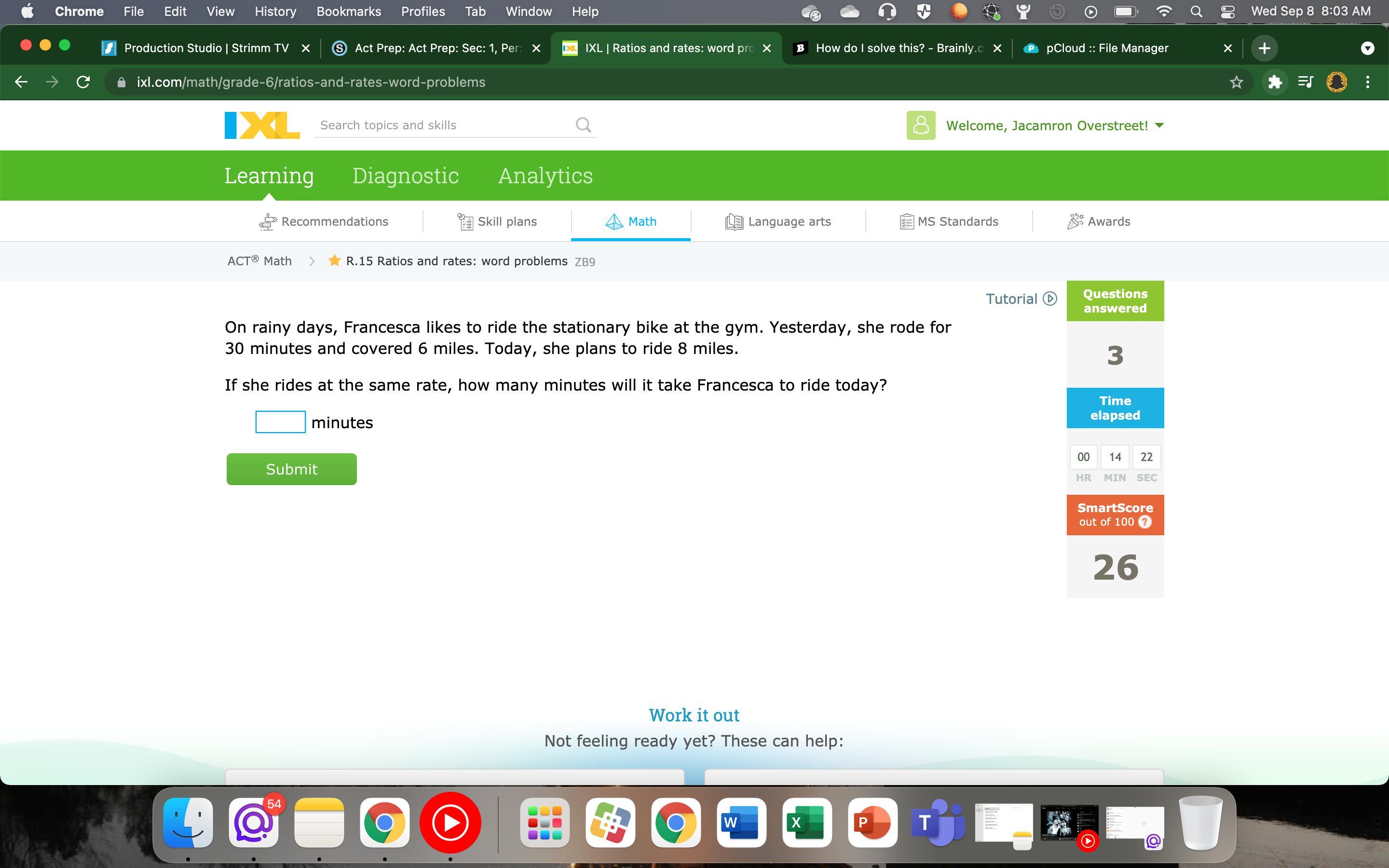
Answers
Answer:
40 min
Step-by-step explanation:
She is riding at 5 minutes per mile
Answer:
40 min
Step-by-step explanation:
Currently, she is riding 6 miles/ 30 min
simplified, this fraction becomes 1 mile / 5 minutes.
Therefore, if she rides 8 miles, 8 x 5 = 40 minutes.
what is the solution to 2(3m+4)=6(1-2m)
a) m=2
b) m=-2
c)m=-10
d.)m=1/5
Answers
Answer:
The answer is in the picture below.
Step-by-step explanation:

Evaluate the numerical expression. 30 - [(9 X 2) - (3 X 4)]
Answers
Answer:
Step-by-step explanation:
30 - [(9 X 2) - (3 X 4)]
30 - [ 18 - 12 ]
30 - 18 + 12
= 42 - 18
= 24
Hope this helps
plz mark as brainliest!!!!!!
Answer:
24
Step-by-step explanation:
30-[18-12]
30-18+12
12+12
=24
what is 8.1% of 252?
Answers
Answer:
20.412
Step by step explanation:
8.1% of 252 = 0.081 × 252 = 20.412
an airplane flies with constant speed of 880km/h how far can it travel in 2 hours
Answers
ANSWER
\(1760\operatorname{km}\)EXPLANATION
The airplane flies at a constant speed of 880 km/h.
The formula for speed is:
\(\text{speed}=\frac{\text{distance}}{\text{time}}\)Therefore, to find the distance the plane can travel in 2 hours, substitute the values of speed and time into the formula and find distance:
\(\begin{gathered} 880=\frac{d}{2} \\ \Rightarrow d=880\cdot2 \\ d=1760\operatorname{km} \end{gathered}\)That is the answer.
You and a friend went to the movies. You decide to get some snacks. You got 2 boxes of candy that cost $3.49 for each box. You also purchased a soda for $4.82. Your friend wants to share and split the cost ($5.50) of a large popcorn. How much did you spend on your snacks all together?
Answers
Answer:
$14.55
Step-by-step explanation:
that is the total cost of the snax
Compounding comparing accounts
Answers
Answer:
hi
Step-by-step explanation:
what's up
What is the area of the square that measures 3.1 m on each side
Answers
The area of the square with a side length of 3.1 meters is 9.61 square meters.
To find the area of a square, we need to multiply the length of one side by itself. In this case, the square has a side length of 3.1 m.
Area of a square = side length × side length
Substituting the given side length into the formula:
Area = 3.1 m × 3.1 m
To perform the calculation:
Area = 9.61 m²
It's worth noting that when calculating the area, we are working with squared units. In this case, the side length is in meters, so the area is expressed in square meters (m²). The area represents the amount of space enclosed within the square.
Remember, to find the area of any square, you simply need to multiply the length of one side by itself.
The area of the square with a side length of 3.1 meters is 9.61 square meters.
For more such questions on square
https://brainly.com/question/27307830
#SPJ8
The solution of the inequality 20 >= 5 + 3x. is
Answers
Answer:
x ≤ 5
Step-by-step explanation:
20 ≥ 5 + 3x
20 - 5 ≥ 3x
3x ≤ 15
x ≤ 5
if 5/7 of x is 5/21 then what's x?
Answers
\( \frac{5}{7} \: \: \: of \: \: \: x = \frac{5}{21} \\ = > \frac{5x}{7} = \frac{5}{21} \\ = > 5x = \frac{5}{21} \times 7 \\ = > 5x = \frac{5}{3} \\ = > x = \frac{5}{3} \times \frac{1}{5} \\ = > x = \frac{1}{3} \)
Answer:
\(x = \frac{1}{3} \)
Hope you could get an idea from here.
Doubt clarification - use comment section.
Susan has a piggy bank with 28 coins in it, all dimes and quarters. She has been collecting state quarters and so far has no repeats. If the piggy bank has $5.50. how many more quarters does Susan need before she has a quarter from each of the 50 states?
HELP I WILL GIVE POINTS AND BRAINLIEST
Answers
Answer:
She needs 32 quarters.
Step-by-step explanation:
d = dime q = quarters
d + q = 28 so d = 28-q
0.1d + 0.25q = 5.50
0.10 * (28-q) + 0.25q = 5.50
2.80 - 0.10q + 0.25q = 5.50
0.15q = 5.50 - 2.80
0.15q = 2.70
q = 2.70 / 0.15
q = 18 quarters (she has)
50-18= 32 quarters (she needs)
What is the answer I don't know how to solve this!

Answers
\(a = 9\)
\(b = 12\)
\(c = \sqrt{ {a}^{2} + {b}^{2} } = \sqrt{ {9}^{2} + {12}^{2} } = \sqrt{81 + 144} = \sqrt{225} = 15\)
\(p = a + b + c = 9 + 12 + 15 = 36\)
Answer: 36.
What is 4/5 times 1/4
Answers
Answer:
4/5 x 1/4 = 4/20 as simplified as 1/5 in fraction form.
4/5 x 1/4 = 0.2 in decimal form.
Step-by-step explanation:
Answer:
0.2
Step-by-step explanation:
hope it helps dawg
9. Hachi uses 2 tablespoons of peanut butter on each slice of toast she prepares. Let s represent the number of slices of toast, and let t represent the number of tablespoons of peanut butter she needs. Write an equation to represent this relationship, and use it to determine how many tablespoons of peanut butter she would need for 5 slices of toast.
Answers
The following vitamins, minerals, and nutrients are particularly notable in each 2-tablespoon (tbsp) portion of smooth peanut butter: Protein. Protein content per 2-tbsp portion of peanut butter is 7.02 grammes (g).
How much protein is in 2 spoons of peanut butter?Although peanut butter is high in protein, vitamins, and minerals, it may also be quite calorie-dense, salty, and high in unsaturated fat. Given that many commercial brands include sugar and oil additives, low-sugar homemade peanut butter can be a decent alternative.Nutrients included in peanuts and peanut butter could help people with their blood sugar levels and heart health.Depending on how peanut butter is incorporated into a person's diet, it may aid in weight loss or weight gain during bodybuilding or weightlifting.The high calorie and fat content of peanut butter, however, means that it should only be consumed in moderation.In this piece, we examine the advantages of consuming peanut butter and outline its hazards.The Complete Question.
To Learn more About smooth peanut butter Refer To:
https://brainly.com/question/767445
#SPJ1
Factor the following expression:
2/3x - 8
Answers
Answer:
2/3 (x-12)
Step-by-step explanation:
2/3x-8
2/3(x-3x4)
2/3(x-12)
what is 12+6x>99 help plz asaaap
Answers
Answer:
\( \frac{29}{2} \)
Polygon ABCD with vertices at A(−4, 6), B(−2, 2), C(4, −2), and D(4, 4) is dilated using a scale factor of three fifths to create polygon A′B′C′D′. If the dilation is centered at the origin, determine the vertices of polygon A′B′C′D′.
A′(5.8, −3), B′(1.6, −1.5), C′(−1.6, 3), D′(2.5, 3)
A′(−12, 18), B′(−6, 6), C′(12, −6), D′(12, 12)
A′(2.4, −3.6), B′(1.2, −1.2), C′(−2.4, 1.26), D′(−2.4, −2.4)
A′(−2.4, 3.6), B′(−1.2, 1.2), C′(2.4, −1.2), D′(2.4, 2.4)
Answers
If the dilation is centered at the origin, determine the vertices of polygon A′B′C′D′ are: D. A′(−2.4, 3.6), B′(−1.2, 1.2), C′(2.4, −1.2), D′(2.4, 2.4).
What is dilation?In Geometry, dilation can be defined as a type of transformation which typically changes the size of a geometric object, but not its shape. This ultimately implies that, the size of the geometric object would be increased or decreased based on the scale factor used.
Next, we would have to dilate the coordinates of the preimage by using a scale factor of 3/5 centered at the origin as follows:
Ordered pair A (-4, 6) → Ordered pair A' (-4 × 3/5, 6 × 3/5) = Ordered pair A' (-2.4, 3.6).
Ordered pair B (-2, 2) → Ordered pair B' (-2 × 3/5, 2 × 3/5) = Ordered pair B' (-1.2, 1.2).
Ordered pair C (4, -2) → Ordered pair C' (4 × 3/5, -2 × 3/5) = Ordered pair C' (2.4, -1.2).
Ordered pair D (4, 4) → Ordered pair D' (4 × 3/5, 4 × 3/5) = Ordered pair D' (2.4, 2.4).
Read more on dilation here: https://brainly.com/question/11812796
#SPJ1
3. A model of a building is made using a scale of 1 in to 50 feet.
What is the height of the actual building if the height of the model is 25 inches?
Answers
Answer:
1250 feet
Step-by-step explanation:
1 inch = 50 feet
25 inches = 50 x 25 feet
25 inches = 1250 feet
Please mark brainliest