A baseball is thrown into the air from a height of 5 feet. The ball reaches a maximum height of 43.5 feet and spends a total of 3.2 seconds in the air. Which equation models the height of the baseball? Assume that acceleration due to gravity is –16 ft/s2.
Answers
Answer:
Step-by-step explanation:
Since we know that the max height is 43.5 feet, we can use that in the work form of a parabola to solve for the time it was at its max height. This time will serve as the h value in the vertex of the parabola. Then we can rewrite the parabola in terms of time.
The work form of a parabola is
\(y=-|a|(x-h)^2+k\) and believe it or not, we have everything we need to solve for h. We know the k of the vertex (43.5) and we also know that at time 0, before any time at all went by, the object started out at 5 feet. So we have a coordinate to use (0, 5) as x and y. We also know that a = 16. Plugging all that in to the work form:
\(-16(0-h)^2+43.5=5\) and
\(-16(h^2)=-38.5\) and
\(h^2=2.40625\) so
h = 1.551209206 sec
This gives us a vertex of (1.551209206, 43.5).
Now let's plug in and find the rest of the equation.
\(s(t)=-16(t-1.551209206)^2+43.5\) and expanding that binomial:
\(s(t)=-16(t^2-3.102418412t+2.406250001)+43.5\) and distributing the -16 in:
\(s(t)=-16t^2+49.63869459t-38.50000002+43.5\) and combining like terms:
\(s(t)=-16t^2+49.63869459t+4.9999999\)
so if we round to the nearest whole number, the quadratic will be
\(s(t)=-16t^2+50t+5\) which tells us that this object was lauched from an initial height of 5 feet and that it was launched at an upward velocity of 50 feet/sec.
Related Questions
relative frequency distributions are generally more useful than frequency distributions when
Answers
Relative frequency distributions are generally more useful than frequency distributions when comparing data sets of different sizes.
Frequency distributions can show the actual number of observations falling in each range or the percentage of observations. In the latter sample, the distribution is called a relative frequency distribution.
Frequency distribution tables can be utilised for both categorical and numeric variables. Continuous variables should only be used with class intervals, which will be described shortly.
A relative frequency distribution displays the proportion of the total number of observations associated with each value or class of values and is related to a probability distribution, which is extensively used in statistics.
--This question is incomplete; the complete question is
"Relative frequency distributions are generally more useful than frequency distributions when _____."--
To know more about Relative frequency distributions, here
https://brainly.com/question/28341501
#SPJ4
Poppy gives one half of a cake to her big brother and the other half to her three friends who share it equally. What fraction of the cake does each friend get?
Please help!!
Answers
Answer:
1/12
Step-by-step explanation:
Look at image for question

Answers
Answer:
P = 19.76 unitsStep-by-step explanation:
1. Finding \(\overrightarrow{AB}\) (or \(\overrightarrow{BA}\)):
\(\overrightarrow{AB}=\overrightarrow{OA}-\overrightarrow{OB}= \left[\big5\atop\big3\right]-\left[\big2\atop-\big5\right]= \left[\big5-\big2\atop\big3-(-\big5)\right]=\left[\big3\atop\big8\right]\)
2. Calculating length of \(\overrightarrow{OA}\,,\ \overrightarrow{OB}\ \text{and}\ \overrightarrow{AB}\):
\(|\overrightarrow{OA}|=\sqrt{5^2+3^2}=\sqrt{25+9}=\sqrt{34}\approx5.831\\\\ |\overrightarrow{OB}|=\sqrt{2^2+(-5)^2}=\sqrt{4+25}=\sqrt{29}\approx5.385\\\\ |\overrightarrow{AB}|=\sqrt{3^2+8^2}=\sqrt{9+64}=\sqrt{73}\approx8.544\)
3. Calculating perimeter:
\(P=|\overrightarrow{OA}|+|\overrightarrow{OB}|+|\overrightarrow{AB}|=\sqrt{34}+\sqrt{29}+\sqrt{73}\approx5.831+5.385+8.544=19.76\)

What is the volume of this cone?

Answers
Answer:
r=6.1cm
volume=1/3πr^2
=1/3×22/7×6.1^2
=818.62/21
=38.98cm^3
A2 Shape C is similar to shape D
9 cm
C
x cm
9.6 cm
Work out the value of x.
D
6 cm
T
10

Answers
Answer:
If Shape C is similar to Shape D, then we know that the ratio of corresponding side lengths is the same. In this case, we can set up the following proportion:
9 / 6 = x / 10
To solve for x, we can cross-multiply and simplify:
9 * 10 = 6 * x
90 = 6x
x = 15
Therefore, the value of x is 15 cm.
Answer:
The answer for x is approximately 5.6
Step-by-step explanation:
9/9.6=x/6
cross multiply
9.6x=9×6
9.6x=54
divide both sides by 9.6
9.6x/9.6=54/9.6
x=5.625
x≈5.6
what is the slope of ( 3,1 ) and ( 6,4 )
Answers
Answer:
The slope of the line would be 1
(4-1)/(6-3)= 1
Please help with this question if you can

Answers
Answer:
5.1
Step-by-step explanation:
so the leaning ladder makes a right angled triangle so we can use pythagoras to calculate the the length (the hypotenuse):
5²+1²=x²
25+1=x²
√26=x
x=5.099...
and now we round to one d.p so it becomes 5.1 (1 d.p) as the hundreths digit is 9 and 9 is rounded up.
The ladder leaning on the wall forms a right triangle. And we have the 2 sides we need:
5 meters and 1 meter, now you do the calculations:

Which expression represents the number -2i(5- i) + (17- 8i) rewritten in a + bi
form?
O 15-18i
O 15-2i
O 19 - 18i
O 11 + 8i
Answers
Answer:
(a) 15 -18i
Step-by-step explanation:
You want the simplified form of the expression -2i(5- i) + (17- 8i).
Complex numbersFor many purposes, the value i in a complex number can be treated in the same way a variable would be treated. When simplifying an expression involving i, any instances of i² can be replaced with the real value -1.
-2i(5- i) + (17- 8i) = -10i +2i² +17 -8i
= -2 +17 +(-10 -8)i
= 15 -18i
__
Additional comment
Your scientific or graphing calculator can probably help you evaluate such expressions.

Select all of the equations that have graphs with the same y-intercept (starting amount).

Answers
Answer: y=3x-8, y=5x-8, and y=2x-8
Step-by-step explanation:
These equations are all lines in slope-intercept form (y=mx+b where b is the y-intercept). y=3x-8, y=5x-8, and y=2x-8 all have -8 as the b value. Therefore, these equations have the same y-intercept.
Can y’all plz help me !!!!!

Answers
Answer:
2
Step-by-step explanation:
4*2=8 and 8+4=12
4x+4=12
- 4
4x=8/4
X=2
On a test called the MMPI-2, a score of 30 on the Anxiety Subscale is considered
very low. Felipe participates in a yoga group at his gym and decides to give this
subscale to 18 people in his yoga group. The mean of their scores is 35.2, with a standard deviation of 10.4. He wants to determine whether their anxiety scores are statistically equal to 30.
What are the groups for this one-sample t-test?
What is the null hypothesis for this one-sample t-test?
What is the value of "?
Should the researcher conduct a one- or two-tailed test?
What is the alternative hypothesis?
What is the value for degrees of freedom?
What is the t-observed value?
What is(are) the t-critical value(s)?
Based on the critical and observed values, should Felipe reject or retain the null
hypothesis? Does this mean that his yoga group has scores that are above 30, below 30, or
statistically equal to 30?
What is the p-value for this example?
What is the Cohen’s d value for this example?
If the " value were dropped to .01, would Felipe reject or retain the null hypothesis?
Calculate a 42% CI around the sample mean.
Calculate a 79% CI around the sample mean.
Calculate a 95% CI around the sample mean.
Answers
The MMPI-2 test is used for the assessment of psychopathology and personality of patients.
It includes 567 true-false questions, resulting in 10 clinical scales, among which one is the anxiety subscale.
A score of 30 or less is usually considered very low.
The questions are answered by the patient, usually in a clinical or research setting.
A one-sample t-test is conducted in the problem, whereby a sample of 18 participants in a yoga group is tested for anxiety scores.
The following are the parameters of the one-sample t-test:Groups:
18 participants
Null hypothesis: The anxiety scores of Felipe's yoga group are statistically equal to 30." value: 30
Type of test: One-tailed test
Alternative hypothesis: The anxiety scores of Felipe's yoga group are greater than 30.
Degrees of freedom: n - 1 = 17T-observed value: (35.2 - 30) / (10.4 / sqrt(18)) = 2.41T-critical value: 1.734
Reject or retain null hypothesis: Since the t-observed value (2.41) is greater than the t-critical value (1.734), Felipe should reject the null hypothesis, which implies that his yoga group's scores are greater than 30.P-value: 0.014Cohen’s d value: (35.2 - 30) / 10.4 = 0.5
If the " value were reduced to 0.01, Felipe would still reject the null hypothesis, since the p-value (0.014) is lower than the alpha level (0.01).
For the sample mean: 35.2CI for 42%: 35.2 ± 0.58CI for 79%: 35.2 ± 1.16CI for 95%: 35.2 ± 2.13
To know more about Degrees of freedom click here:
https://brainly.com/question/32093315
#SPJ11
Please hep me answer this question.
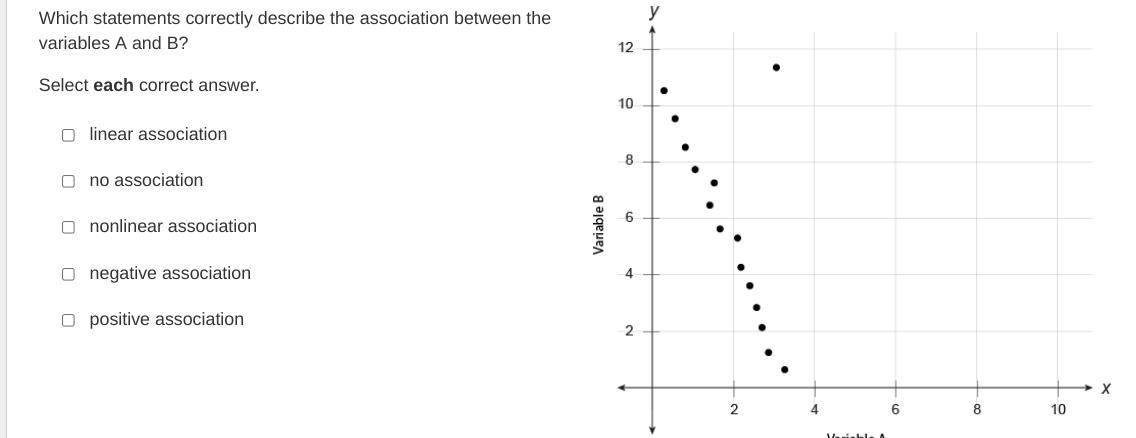
Answers
Answer:
positive association and linear association
Step-by-step explanation:
From a point on a cliff 75 feet above water level, an observer can see a shipThe angle of depression to the ship is d^ How far is the ship from the base of the to the nearest foot?
Answers
Answer:
52feet
Step-by-step explanation:
The set up will be a right angle
Let the angle of depression be 30°
The height above the sea level will be the opposite
The distance of the ship from the base is x (adjacent)
Using TOA
Tan theta = opposite/adjacent
Tan 30 = 30/x
x = 30/tan 30
x = 30/0.5774
x = 51.96
x ≈ 52 feet to the nearest foot
A certain shade of pink is created by adding 3 cups of white paint to 2 cups
of red paint. Using the information above, if 1 cup of white paint is used, how
many cups of red paint is needed to make the certain shade of pink?

Answers
Answer:
The answer is 1.5
3/2=1.5
I need a help on this one asap it can be without step by step just please asap for 25 points.

Answers
b) j= 9 4/5
c) b= 7
d) h= 3/2
e) k= 11
f) p= 6
g) y= 7 1/2
h) f= 123.12
2) 9.8
3) 7
4) 3/2
5) 11
6) 6
7) 7.5
8) 123.12
the absolute value of the difference between the point estimate and the population parameter it estimates is ? precision. the sampling error. the error of confidence. the standard error.
Answers
The absolute value of the difference between the point estimate and the population parameter it estimates is sampling error.
What is absolute value?The number's absolute value, which ignores orientation, indicates how far it is from zero on the number line. A number can never be negative in absolute terms.
Concepts which are used in the given problems:
Standard error - It is a gauge of how closely a sample statistically approximates the entire population. Standard deviation in sampling distribution refers to standard error.Sampling error - Instead of studying the entire population, a sample is used to determine the sampling error. The distinction between sample statistics and population parameter estimation is what causes this.Precision - It is described as how closely two estimates from several samples agree with one another.Error of confidence - A statistic that indicates the degree of sampling error in a specific research is known as the error of confidence. Additionally, the margin of error indicates the percent by which the actual findings would deviate from the stated population figure.Point estimates - Point estimates refer to population parameters that are calculated using sampling statistics.The incorrect options can be found below:
Because the precision is the estimate that is near from the various samples, the absolute magnitude of the difference between the point estimate and the population parameter would not be a precision. Additionally, it is not a standard error since a standard error is an error that is far beyond the range of the sample mean. However, it is not a confidence error since a confidence error is a measure of how far the findings would deviate from the population under consideration.
By using the concept of precision, standard error and error of confidence, the incorrect choices are discovered.
The correct choice may be found below:
Sampling error is the measurement of the distance or difference between the population parameter and the sample's point estimate. The sampling mistake is an inaccuracy that results from drawing conclusions about the sample rather than the population being studied.
The idea of sampling error is used to calculate the absolute value of the distinction between both the point estimate and the population parameter is predicts.
Thus, the absolute value of the difference between the point estimate and the population parameter it estimates is sampling error.
To know more about absolute value refer to:
https://brainly.com/question/12928519
#SPJ4
Consider the statement: Subtract 28 from t and multiply the difference by 4.
Which expression represents the statement above?
A. 4(28*t)
B.t-28*4
C.28-t*4
D.4(t-28)
Answers
Answer:
D!
Step-by-step explanation:
We need to obviously subtract, only C and D do thatt. But, you don't multiple t or 28 by 4. You need to multiply the difference, so you need parentheses!
What is the product of 2x3 +9 and x3 +7?
Answers
The product of the expression is 2x⁶ + 23x³ + 63
How to determine the productFirst, we should note that algebraic expressions are described as expressions that are composed of coefficients, terms, constants, variables and factors.
These algebraic expressions are also made up of mathematical operations, such as;
BracketAdditionMultiplicationDivisionParenthesesSubtractionFrom the information given, we have that;
2x3 +9 and x3 +7?
Then,
(2x³ + 9)(x³ + 7)
expand the bracket
2x⁶ + 14x³ + 9x³ + 63
add like terms
2x⁶ + 23x³ + 63
Learn about algebraic expressions at: https://brainly.com/question/4344214
#SPJ1
12. The Ryans are researching venues for their family reunion. The Picnic Place charges $150 toreserve a picnic shelter and $20 per hour to use the shelter. Totally Tents charges $300 for therental and setup of a tent and $10 per hour to use their land. How much will each company chargefor a 5-hour reunion?+At how many hours will you need to reserve the shelters for both choices to cost the same?
Answers
Answer:
5-hour reunion at Picnic Place will cost $250.
5-hour reunion at Total Tent will cost $350.
15 hours for both choices to cost the same.
Explanation:
Let x represent the number of hours.
Let y represent the total cost.
For Picnic Place, our equation can be written as;
\(y=20x+150\)For a 5-hour reunion at Picnic Place, the charge will be;
\(\begin{gathered} y=20(5)+150 \\ =100+150 \\ =250 \end{gathered}\)For Total Tent, our equation can be written as;
\(y=10x+300\)For a 5-hour reunion, the cost will be;
\(\begin{gathered} y=10(5)+300 \\ y=50+300 \\ y=350 \end{gathered}\)To determine how many hours onwill need to reserve both shelters for both choices to cost the same, we just need to equate both equations and solve for x;
\(\begin{gathered} 20x+150=10x+300 \\ 20x-10x=300-150 \\ 10x=150 \\ x=\frac{150}{10}=15\text{hours} \end{gathered}\)Mike used of a cup of vinegar in his salad dressing recipe. He made 3 salad dressing recipes. Between which two whole numbers does the number of cups of vinegar that Mike used lie?
Answers
The number of cups of vinegar that Mike used lies between the whole numbers 2 and 4
If Mike used one cup of vinegar for each salad dressing recipe, then he used a total of 3 cups of vinegar (1 cup x 3 recipes = 3 cups).
However, the question states that he used "a cup of vinegar" in each recipe, which could mean that he used slightly less than one cup, exactly one cup, or slightly more than one cup.
Assuming that Mike used at least 3/4 cup of vinegar in each recipe (which is still close to "a cup"), then he used a minimum of 2 and 1/4 cups of vinegar in total (3/4 cup x 3 recipes = 2 and 1/4 cups).
Assuming that Mike used at most 1 and 1/4 cups of vinegar in each recipe (which is still close to "a cup"), then he used a maximum of 3 and 3/4 cups of vinegar in total (1 and 1/4 cups x 3 recipes = 3 and 3/4 cups).
Learn more about whole numbers here
brainly.com/question/19161857
#SPJ4
a survey was conducted to study the relationship between the annual income of a family and the amount of money the family spends on entertainment. data were collected from a random sample of 280 families from a certain metropolitan area.
Answers
The scatterplot is the correct answer.
A scatter plot uses dots to represent values for two different numeric variables. The position of each dot on the horizontal and vertical axis indicates values for an individual data point. Scatter plots are used to observe relationships between variables.
The dots in a scatter plot not only report the values of individual data points but also patterns when the data are taken as a whole.
Identification of correlational relationships is common with scatter plots. In these cases, we want to know, if we were given a particular horizontal value, what a good prediction would be for the vertical value.
For more information on scatterplots click on the link below:
https://brainly.com/question/6592115
#SPJ4
awnser
what is 1+1/0=x
Answers
Answer:
0
Step-by-step explanation:
Answer:
x = 1
Step-by-step explanation:
1 + 1/0 = x
-1
1/0 = x
x0
1 = x
Backwards PEMDAS where each thing you do backwards cancles itself out.
3 The ratio of boys to girls at the dance was 10 to 15. How many girls were at the dance if there were 60 boys at the dance? Answer
Answers
Step-by-step explanation:
90 girls were at the dance
Answer:
60:90
Step-by-step explanation:
use cross multiplication :)))
A composite figure is comprised of a semicircle, trapezoid, and 2 rectangles.
How can you decompose the composite figure to determine its area?
as a circle, three rectangles, and a triangle
as a circle, a trapezoid, and four triangles
as a semicircle, three rectangles, and a square
as a semicircle, a trapezoid, and two rectangles
Answers
The area of the composite figure is the sum of the area of a semicircle, the area of a trapezoid, and the area of two similar rectangles. Then the correct option is D.
What is Geometry?It deals with the size of geometry, region, and density of the different forms both 2D and 3D.
Two rectangles, a trapezoid, and a semicircle make form a composite figure.
The diagram of the composite figure is given below.
The area of the composite figure is the sum of the area of a semicircle, the area of a trapezoid, and the area of two similar rectangles. Then the correct option is D.
More about the geometry link is given below.
https://brainly.com/question/7558603
#SPJ1

Answer:
D
Step-by-step explanation:
write the number positioned at point A
Answers
The number positioned at point A is -4.25.
What is a number line?A number line can be defined as a type of graph with a graduated straight line which contains both positive and negative numbers (numerical values) that are placed at equal intervals along its length.
This ultimately implies that, a number line can be used to compare two numbers such as 4 and 1. Also, a number line typically increases in numerical value towards the right and decreases in numerical value towards the left.
In this scenario, the given number line uses a scale of 1:0.25. Therefore, the number (numerical value) that is placed at point A is given by:
Point A = -4.5 - 0.25
Point A = -4.25.
Read more on number line here: https://brainly.com/question/17230085
#SPJ1

Barbara bought a piece of rope that was 6 3/4 meters long. She cut the rope into 6 equal pieces. How long is each piece of rope?

Answers
Answer:
1 1/8
Step-by-step explanation:
Make this an improper fraction for simplicity: 27/4
now divide into six portions: (27/4)/6 = (27/6)/4 = 27/24 = 1 3/24 = 1 1/8
Tanisha, Elicia, and Ajua are cousins. Tanisha is twice as old as Ajua, and Elicia is two years older than Tanisha. The sum of all their ages is 37. Use variable expressions and calculate the age of each girl
Answers
Answer:
Step-by-step explanation:
Tanisha, Elicia, and Ajua are cousins. Tanisha is twice as old as Ajua, and Elicia is two years older than Tanisha. The sum of all their ages is 37. Use variable expressions and calculate the age of each girl
Let us represent:
The age of :
Tanisha = a
Elicia = b
Ajua = c
Tanisha, Elicia, and Ajua are cousins. Tanisha is twice as old as Ajua
a = 2c
c = 2/a
Elicia is two years older than Tanisha.l
b = a + 2
The sum of all their ages is 37.
a + b + c = 37
We substitute
a + a + 2 + 2/a = 37
2a + 2 + 2/a = 37
Use variable expressions and calculate the age of each girl
I have tried a good 7 practice problems but for some reason I just can’t understand it, I need help. The end answer is a fraction times pi (NOT 3.14)

Answers
Answer:
1/2 pi
Step by step explanation:
Find the circumference
2πr = 2xπx2 = 4π
Find the angle of JHI
Since 1/2π is 1/8 of 4π,
Angle JHI should also be 1/8 of 360 = 45 degrees
To find area, 45/360 x π X 2^2
= 1/8 x 4π
= 1/2 π
Show that if X and Y are independent rv’s, then E(XY) = E(X) . E(Y). Then apply this in Exercise 25. [Hint: Consider the continuous case with f(x, y) = fX(x) . fY (y).]
Reference exercise 25
A surveyor wishes to lay out a square region with each side having length L. However, because of a measurement error, he instead lays out a rectangle in which the north–south sides both have length X and the east–west sides both have length Y. Suppose that X and Y are independent and that each is uniformly distributed on the interval [L–A, L+A] (where 0
Answers
The surveyor, on average, lays out a rectangle whose area is only 1/9 of the area of the square.
Given:X and Y are independent random variables.E(XY) = E(X) . E(Y).
The problem wants us to show that E(XY) = E(X) . E(Y) and apply this result in Exercise 25, where X and Y are independent random variables following uniform distribution in a certain interval.
Proof:Let X and Y be independent random variables, and their joint probability density function (PDF) be f(x, y).
Now, E(XY) can be expressed as follows:E(XY) = ∫∫ xy f(x, y) dxdy [double integral of xy f(x, y) w.r.t x and y]
By definition, E(X) = ∫∫ x fX(x) dxand E(Y) = ∫∫ y fY(y) dy
By definition of independence of X and Y, their joint PDF is equal to the product of their marginal PDFs, i.e., f(x, y) = fX(x) . fY (y).
Therefore, E(XY) can also be expressed as:E(XY) = ∫∫ xy fX(x) . fY(y) dxdy = ∫∫ x fX(x) dx ∫∫ y fY(y) dy = E(X) . E(Y)
Thus, E(XY) = E(X) . E(Y) when X and Y are independent random variables.
Suppose X and Y are independent random variables, each uniformly distributed on the interval [L-A, L+A], where 0< A < L.
And, the surveyor wants to lay out a square region with each side having length L but instead lays out a rectangle in which the north–south sides both have length X and the east–west sides both have length Y.
Now, we need to show that the expected value of the area of the rectangle that the surveyor lays out is L^2.The area of the rectangle is given by XY.
Hence, the expected value of the area of the rectangle is: E(XY) = E(X) . E(Y) (from the above proof)E(X) = E(Y) = L2 ∫ (L-A) to (L+A) dx / 2A= L2 ∫ (0) to (2A) dx / 2A= L^2 / 3
Hence, E(XY) = E(X) . E(Y) = L^2 / 9.
But, the expected value of the area of the square is L^2.
Hence, the surveyor, on average, lays out a rectangle whose area is only 1/9 of the area of the square.
Visit here to learn more about average brainly.com/question/24057012
#SPJ11
Identify the inequality for the given graph.

Answers
Answer:
We. can see there's a black point at -3.7 and an arrow going to the left.
As the arrow goes to the left, it must be less than -3.7 or less than or equal to -3.7, now, we will need to see the colour of the point to know which it is.
As there is a black point, -3.7 is also contained in this range...
What does that mean? That means it will be less than or equal to -3.7
So we know the correct option is a) less than or equal to -3.7, what we could write as (\(-\infty,-3.7\)].