9. Find the slope represented in the tablebelow. Show all work.Xy7-3011-5413-6620- 108
Answers
We have the following:
the slope formula is
\(m=\frac{y_2-y_1}{x_2-x_1}\)replacing:
\(m=\frac{66-6}{11-1}=\frac{60}{10}=6\)The slope is 6
Related Questions
If h(x) = -2x + 6, find x if h(x) = 12.
Answers
\(-2x+6=12\\2x=-6\\x=-3\)
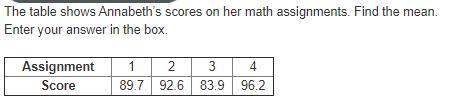
The table shows Annabeth’s scores on her math assignments. Find the mean.
Answers
Answer:
90.35
Step-by-step explanation:
its on envisions
8-2 quiz
Simplify 3(x+2) + 2x + 5
Answers
Answer:
\(5x+11\)
Step-by-step explanation:
Step 1: Distribute
\(3x+6+2x+5\)
Step 2: Add like terms
\(5x+11\) < your answer
Find the angle a of the screw shown. Round to the nearest minute.x = 10.9 mm, y = 16 mm, z = 30.4 mm

Answers
Answer: a = 31 degrees, 22'
Explanation:
From the information given,
x = 10.9
y = 16
z = 30.4
The right triangle formed is shown below
z = 2BC + x
2BC = z - x = 30.4 - 10.9 = 19.5
BC = 19.5/2
BC = 9.75
Considering the right triangle ABC with angle a as the reference angle,
opposite side = BC = 9.75
adjacent side = AB = 16
We would find a by applying the tangent trigonometric ratio which is expressed as
Tanθ = opposite side/adjacent side
tana = 9.75/16
Taking the tan inverse of 9.75/16,
a = tan^-1(9.75/16)
a = 31.36 degrees
We would convert 0.36 degrees to minute
Recall, 1 degree = 60 arcminutes
0.36 degrees = 0.36 * 60 = 21.6 arcminutes
Rounding 21.6 to the nearest minute, it becomes 22
Thus,
a = 31 degrees, 22'

Gina's electronics store purchased a television at the wholesale price of $250. Gina marked
up the price 15%. What was the amount of markup?
Answers
Answer:
$37.5
Step-by-step explanation:
Well lets see. 15% of $250 is 37.5. So AFTER the markup the TV cost 287.5.
Which of the following conditions are sufficient to show that triangle ABC sim triangle QPR
Select all that apply.
A. m angle Q = 63
B. m angle R = 81
D. m angle P = 81
C. RP = 4.5

Answers
Answer:
C. RP = 4.5
Step-by-step explanation:
You want to know what condition is sufficient to show ∆ABC ~ ∆QPR, given three sides and 2 angles in ∆ABC, and 2 sides in ∆QPR.
SimilaritySimilarity can be shown if all three sides are proportional, or if two angles are congruent.
The offered answer choices only list one angle, so none of those will work. The answer choice that makes the third side of ∆QPR be in the same proportion as the corresponding side of ∆ABC is the condition of interest.
C. RP = 4.5
__
Additional comment
The side ratios in the two triangles are ...
AB : BC : CA = 10 : 9 : 6
QP : PR : RQ = 5 : PR : 3
For these ratios to be the same, PR must be half of BC, just as the other segments in ∆QPR are half their counterparts in ∆ABC.
HELP ME PLEASE!!!!! A black bear in a zoo eats 8 kilograms of food each day. He eats 4 equal-sized meals each day. How many grams of food are in each meal?
Answers
Answer:
There are 2000 grams of in each meal.
Step-by-step explanation:
First you divide 8 by 4 because that's how many meals he eats per day then you convert the kilograms into grams.
The weight of each meal a black bear eats is 2 kilograms.
What is a unitary method?
A unitary method is a mathematical way of obtaining the value of a single unit and then deriving any no. of given units by multiplying it with the single unit.
Given, A black bear in a zoo eats 8 kilograms of food each day.
He eats 4 equal-sized meals each day.
∴ The weight of each meal is the total kilograms of food divided by the total no. of meals which is,
= (8/4) kilograms.
= 2 kilograms.
learn more about the unitary method here :
https://brainly.com/question/28276953
#SPJ2
The original cost of a sofa was $600. If it was discounted 40% and sales tax is 8%, what is the final cost of the sofa
Answers
Answer:
$312
Step-by-step explanation:
10% of $600 is $60
So $60*4=$240
$600-$240=$360
1%=$6
So $6*8=$48
$360-$48=$312
PLEASE HELP!!!!
use Euler's formula to find the missing number
faces: 25
verticies: 17
edges: ?
answer choice-
a. 43
b. 41
c. 39
d. 40
Answers
Answer:
d. 40
Step-by-step explanation:
The number of faces, edges and vertices is related by the following formula:
\(V - E + F = 2\)
In which V is the number of vertices, E is the number of edges and F is the number of faces.
In this question:
\(F = 25, V = 17\)
We want to find E. So
\(V - E + F = 2\)
\(17 - E + 25 = 2\)
\(E = 42 - 2 = 40\)
The correct answer is given by option D.
10.
A, B and C are the points (3, 4, (7,3) and (-2, 1) respectively. Obtain the
equation of the median through B of triangle ABC.
Answers
Answer:
\(y=\frac{1}{13} x+\frac{32}{13}.\)
Step-by-step explanation:
1. the midpoint of the side AC is:
\(D:(\frac{3-2}{2};\frac{4+1}{2})=(0.5;2.5).\)
2. if the coordinates of the points B and D are (7;3) and (0.5;2.5) respectively, then it is possible to make up the required equation of the median BD:
\(\frac{x-7}{7-0.5}=\frac{y-3}{3-2.5}; \ \frac{x-7}{13}=\frac{y-3}{1}\)
or
\(y=\frac{1}{13} x+\frac{32}{13}\)
Find the total in the retirement account given the following conditions:
Monthly contributions = $225
Interest rate = 4.99%
Years invested = 38
Answers
To find the total in the retirement account after 38 years of investing with monthly contributions and an interest rate of 4.99%, we can use the compound interest formula.
The formula for the future value of an investment with regular monthly contributions is given by:
FV = P * [(1 + r)^n - 1] / r
Where:
FV is the future value or the total in the retirement account.
P is the monthly contribution amount.
r is the monthly interest rate (annual interest rate divided by 12).
n is the number of monthly contributions (years invested multiplied by 12).
Let's calculate the total:
P = $225
r = 4.99% / 100 / 12 = 0.0041583 (monthly interest rate)
n = 38 * 12 = 456 (number of monthly contributions)
FV = $225 * [(1 + 0.0041583)^456 - 1] / 0.0041583
Using a financial calculator or spreadsheet, we can evaluate this expression to find the future value or total in the retirement account.
The calculated total may vary depending on the compounding frequency and rounding used.
What's 0.432 divided by 0.12and 3.616 divided by 0.8
Answers
We want to divide;
a) 0.432 divided by 0.12.
\(\frac{0.432}{0.12}=3.6\)0.432 divided by 0.12 equals to 3.6
b) 3.616 divided by 0.8.
\(\frac{3.616}{0.8}=4.52\)3.616 divided by 0.8 equals to 4.52


Since the mode is the most frequently occurring data value, it
Select one:
a. is always larger than the mean
b. can never be larger than the mean
c. must have a value of at least two
d. is always larger than the median
e. None of these answers is correct.
Any answer without justification will be rejected automatically.
Answers
The correct answer is option (e): None of these answers is correct.
The statement "the mode is the most frequently occurring data value" is true. However, none of the options provided accurately describes the relationship between the mode and the mean.
The mode and the mean are different measures of central tendency and can have different values. There is no general rule or guarantee that the mode will always be larger or smaller than the mean. The relationship between the mode and the mean depends on the specific dataset and its distribution. Therefore, none of the provided options correctly describes the relationship between the mode and the mean.
Draw an abacus and illustrate this expression 4×8⁴+2×8²+4×8⁰ on it
Answers
According to the information, this number on an abacus would look like this: tens of a thousand = 10,000, units of a thousand = 6,000, hundreds = 500, tens = 10, and units = 6.
How to illustrate this value on an abacus?To illustrate this value on an abacus we must find the number of this operation as shown below:
4 * 8⁴ + 2 * 8² + 4 * 8⁰4*4,096 + 2*64 + 4*116,384 + 128 + 416,516Now we must express it in an abacus, then we must separate each number by classifying it in the type of units to which it corresponds as shown below:
ten thousand = 10,000thousand units = 6,000hundreds = 500tens = 10units = 6Learn more about abacus in: https://brainly.com/question/13385199
#SPJ1
For the following two numbers, find two factors of the first number such that their product is the first number and their sum is the second number.
36,13
Answers
The two factors of the first number 36 which their sum is equal to 13 are 4 and 9.
What is factor of a numberFactor is a number that divides another number without a remainder. That is if multiplying two whole numbers gives us a product, then the numbers we are multiplying are factors of the product.
The first number 36 have the following factors:
1, 2, 3, 4, 6, 9, 12, 18, and 36.
the factors 4 and 9 will be the factors in question because;
4 × 9 = 36
4 + 9 = 13
Therefore, 4 and 9 are the two factors of 36 that their product is the first number 36 and their sum is the second number 13.
Know more about factors here:https://brainly.com/question/1081523
#SPJ1
How many applications will your mother actually use on her new cell phone?
Solve the equation you wrote in part b to find the unknown variable. (2 points)
Answers
Answer:
24
Step-by-step explanation:
The function f(x)=−4x4+3x3−2x2−x+5 is/has A. order 2 rotational symmetry about the origin
B. neither symmetry about the y-axis nor has order 2 rotational symmetry about the origin
C. even
D. odd
Answers
The answer choice which describes the function is; Choice B; neither symmetry about the y-axis nor has order 2 rotational symmetry about the origin.
What is rotational symmetry?Rotational symmetry, otherwise termed radial symmetry, is the characteristic of a shape when it looks the same after some rotation by a partial turn. On this note, since the function represents a quartic graph, it follows that the function has neither symmetry about the y-axis nor has order 2 rotational symmetry about the origin.
Therefore, the function f(x) = −4x⁴ + 3x³ − 2x² − x + 5 is neither symmetry about the y-axis nor has order 2 rotational symmetry about the origin.
Read more on rotational symmetry;
https://brainly.com/question/15178808
#SPJ1
Complete the table. Answer should be T or F.
P Q
T F P V Q P ^ Q P -> Q -P -Q -P V -Q -P -> Q -P -> -Q P <-> Q
F T P V Q P ^ Q P -> Q -P -Q -P V -Q -P -> Q -P -> -Q P <-> Q

Answers
P Q P V Q P ^ Q P -> Q -P -Q -P V -Q -P -> Q -P -> -Q P <-> Q
T T T T T F F F F F T T
F T T F F T T T T T F F
P F T F F T T T T T F F
-P T T F F T T T T T F F
-Q T T T T F T F F F T T
-P V -Q T T F F T T T T T F
-P -> Q T T F F T T T T T F
-P -> -Q T T F F T T T T T F
P <-> Q T T T T F T T T T F
Here is a more detailed explanation of how I filled out the table:
P | Q : This column is simply the truth value of P and Q. If P and Q are both true, then the entry in this column is T. If P is true and Q is false, then the entry in this column is F. If P is false and Q is true, then the entry in this column is F. And if P and Q are both false, then the entry in this column is T.
P V Q : This column is the truth value of P or Q. If P is true, then the entry in this column is T. If Q is true, then the entry in this column is T. And if P and Q are both false, then the entry in this column is F.
P ^ Q : This column is the truth value of P and Q. If P and Q are both true, then the entry in this column is T. And if P and Q are both false, then the entry in this column is F.
P -> Q : This column is the truth value of P implies Q. If P is true and Q is false, then the entry in this column is F. And if P is false or Q is true, then the entry in this column is T.
-P : This column is the negation of P. If P is true, then the entry in this column is F. And if P is false, then the entry in this column is T.
-Q : This column is the negation of Q. If Q is true, then the entry in this column is F. And if Q is false, then the entry in this column is T.
-P V -Q : This column is the truth value of not P or not Q. If P and Q are both true, then the entry in this column is F. If P and Q are both false, then the entry in this column is T. And if P or Q is true, then the entry in this column is T.
-P -> Q : This column is the truth value of not P implies Q. If P is true and Q is false, then the entry in this column is T. And if P is false or Q is true, then the entry in this column is F.
-P -> -Q : This column is the truth value of not P implies not Q. If P and Q are both true, then the entry in this column is T. If P is false or Q is false, then the entry in this column is T. And if P is true and Q is true, then the entry in this column is F.
P <-> Q : This column is the truth value of P if and only if Q. If P and Q are both true or P and Q are both false, then the entry in this column is T. And if P and Q have different truth values, then the entry in this column is F.
for more such questions on truth value
https://brainly.com/question/7483637
#SPJ8
Sierra buys lunch in the cafeteria everyday. Lunch costs $2.00 each day, how much did she spend after 5 days.
Answers
Answer:
$2.00 each day so $2.00 x 5 = $10
LUCILLES PENCIL POUCH WOULD HOLD 3/8
OF THE 48 PENCILS THAT SHE PURCHASED AT
THE BEGINNING OF THE NEW SCHOOL YEAR.
HOW MANY PENCILS WILL FIT IN HER POUCH. will give brainlist
Answers
Answer:
18
Step-by-step explanation:
You would divide 48 by 8 and multiply it by 3. Otherwise, you could do
3/8 = x/48
x * 8 = 3 * 48
x * 8 = 144
/8 /8
x = 18
On a piece of paper graph f(x) = 3x. Then determine which answer choice matches the graph you drew

Answers
Answer:
--
Step-by-step explanation:
Show all the options please
Not able to see all options
I’ll give you 15 points if you know the answers to this question

Answers
It would be B)no.
Hope This Helps!
Help please, Im stuck on a problem

Answers
Task:
Enter the function's domain, range, and end behavior.
f(x) = 600(0.55)^x
P.S. So it can be found on the internet.
Answer:
domain: {x | x ∈ R}
range: {y | y > 0}
As x approaches -∞, y approaches +∞
As x approaches ∞, y approaches 0
Step-by-step explanation:
Just to describe the function:
\(600(0.55)^{x}\)
600 is basically the y-intercept, 0.55 indicates that the function is decreasing
You have a horizontal asymptote on the y = 0 and the domain is (-∞, ∞)
the range is (0, ∞) because you have the horizontal asymptote at 0
About "x such that" notation, I am not sure but here it is:
domain: {x | x ∈ R}
range: {y | y > 0}
As x approaches -∞, y approaches +∞
As x approaches ∞, y approaches 0

is -4 greater or lesser than 0
Answers
Answer:
-4 is lesser than 0
Step-by-step explanation:
A triangle has interior angles
measuring
50°, 60°, and 70°.
What is the measure of the largest
exterior angle for this triangle?
Answers
Answer:
130°
Step-by-step explanation:
The exterior angle of a triangle is the sum of the interior angles.
Obviously the largest exterior angle will be the sum of the largest interior angles which are 60 and 70
So measure of largest exterior angle = 60 + 70 =130°
2 3/4 of 500grams in step by step calculator
Answers
Answer:
To calculate 2 3/4 of 500 grams, follow these steps:
1. Convert the mixed number to an improper fraction:
2 3/4 = (2 x 4 + 3)/4 = 11/4
2. Multiply the improper fraction by 500:
11/4 x 500 = (11 x 500)/4 = 2,750/4
3. Simplify the fraction by dividing the numerator and denominator by their greatest common factor, which is 2:
2,750/4 = (2 x 1,375)/(2 x 2) = 1,375/2
Therefore, 2 3/4 of 500 grams is equal to 1,375/2 grams or 687.5 grams.
Step-by-step explanation:
If you know the answer put and explanation for it please thank you

Answers
Answer:
14 students have to retake the test
Step-by-step explanation:
to calculate the mean mark as
sum of ( product of mark and frequency ) ÷ total
mean = \(\frac{14(2)+15(10)+16(2)+17(3)+18(13)}{30}\)
= \(\frac{28+150+32+51+234}{30}\)
= \(\frac{495}{30}\)
= 16.5
students who score less than 16.5 will retake the test , that is
2 scored 16 , 10 scored 15 , 2 scored 14
number who have to retake test = 2 + 10 + 2 = 14
Find the Constant of proportionality of Henderson Toll Road Cost

Answers
The constant of proportionality is equal to 3/10.
What is a proportional relationship?In Mathematics and Geometry, a proportional relationship refers to a type of relationship that produces equivalent ratios and it can be modeled or represented by the following mathematical equation:
y = kx
Where:
y represents the miles traveled.x represents the cost ($).k is the constant of proportionality.Next, we would determine the constant of proportionality (k) by using various data points as follows:
Constant of proportionality, k = y/x
Constant of proportionality, k = 3/10 = 6/20 = 9/30
Constant of proportionality, k = 3/10.
Therefore, the required linear equation is given by;
y = kx
y = 3/10(x)
Read more on proportional relationship here: brainly.com/question/28350476
#SPJ1
particle travels from(-1/3 ,1, -2) to(9,9,6) . Its motion is described by the position function r(t)=(t^3/3, t^2,2t).
a) Find the distance the particle travels along the path, its average speed, and its
displacement [the distance it could have traveled if in a straight line].
b) List a detailed snapshot of the T,N,B frame for this particle at the halfway point (by
time) including curvature and torsion.
Answers
The particle travels approximately 45.63 units along the path. The displacement is the straight-line distance between the initial and final positions of the particle is 2781.
To find the distance the particle travels along the path, we can integrate the speed over the interval of time. The speed of the particle is given by the magnitude of its velocity vector.
The velocity vector is the derivative of the position function r(t):
\(v(t) = (d/dt)(t^3/3, t^2, 2t)\)
\(= (t^2, 2t, 2)\)
The speed of the particle at any given time t is:
|v(t)| = √((t^2)^2 + (2t)^2 + 2^2)
= √(t^4 + 4t^2 + 4)
= √((t^2 + 2)^2)
To find the distance traveled along the path, we integrate the speed function over the given interval of time. The particle travels from t = -1/3 to t = 9.
distance = ∫[from -1/3 to 9] |v(t)| dt
= ∫[from -1/3 to 9] |t^2 + 2| dt
= ∫[from -1/3 to 0] -(t^2 + 2) dt + ∫[from 0 to 9] (t^2 + 2) dt
= [-1/3 * t^3 - 2t] (from -1/3 to 0) + [1/3 * t^3 + 2t] (from 0 to 9)
Evaluating the definite integrals:
distance = [-1/3 * 0^3 - 2 * 0 - (-1/3 * (-1/3)^3 - 2 * (-1/3))] + [1/3 * 9^3 + 2 * 9 - (1/3 * 0^3 + 2 * 0)]
= [0 - (1/3 * (-1/27) + 2/3)] + [1/3 * 729 + 18]
= [1/27 + 2/3] + [729/3 + 18]
= 1/27 + 2/3 + 729/3 + 18
= 1/27 + 18/27 + 729/3 + 18
= (1 + 18 + 729)/27 + 18
= 748/27 + 18
= 27.63 + 18
= 45.63 units (approximately)
Therefore, the particle travels approximately 45.63 units along the path.
To find the average speed, we divide the distance traveled by the time taken. The time taken is 9 - (-1/3) = 9 1/3 = 28/3.
average speed = distance / time
= 45.63 / (28/3)
= 45.63 * (3/28)
= 4.9179 units per unit time (approximately)
The displacement is the straight-line distance between the initial and final positions of the particle.
displacement = |r(9) - r(-1/3)|
= |(9^3/3, 9^2, 2 * 9) - ((-1/3)^3/3, (-1/3)^2, 2 * (-1/3))|
= |(27, 81, 18) - (-1/27, 1/9, -2/3)|
= |(27 + 1/27, 81
= 2781.
For more such questions on displacement , Visit:
https://brainly.com/question/1581502
#SPJ11
Find the area of the shaded triangle, if the side of each square is 1 unit long.

Answers
Answer:
10 units²
Step-by-step explanation:
The shape is a triangle.
The area can be found by multiplying the base (in units) with height (in units) divided by 2.
base = 4 units
height = 5 units
\(\frac{4 \times 5}{2}\)
\(\frac{20}{2} =10\)