Answers
Explanation
to solve an equation is to find its solutions, which are the values that fulfill the condition stated by the equation
so
Step 1
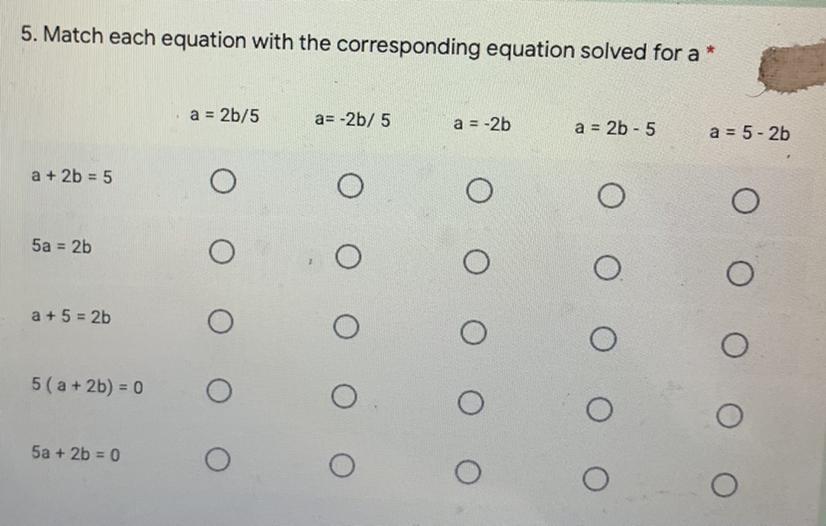
a)
\(\begin{gathered} a+2b=5 \\ \text{subtract 2b in both sides} \\ a+2b-2b=5-2b \\ a=5-2b \end{gathered}\)so
b)
\(\begin{gathered} 5a=2b \\ \text{divide both sides by 5} \\ \frac{5a}{5}=\frac{2b}{5} \\ a=\frac{2b}{5} \\ \text{hence} \\ 5a=2b\leftrightarrow a=\frac{2b}{5} \end{gathered}\)c)
\(\begin{gathered} a+5=2b \\ \text{subtract 5 in both sides} \\ a+5-5=2b-5 \\ a=2b-5 \\ so \\ a+5=2b\leftrightarrow a=2b-5 \end{gathered}\)d)
\(\begin{gathered} 5(a+2b)=0 \\ divide\text{ both sides by 5} \\ \frac{5(a+2b)}{5}=\frac{0}{5} \\ a+2b=0 \\ \text{subtract 2b in both sides} \\ a+2b-2b=0-2b \\ a=-2b \\ so \\ 5\mleft(a+2b\mright)=0\leftrightarrow a=-2b \end{gathered}\)e) finally
\(undefined\)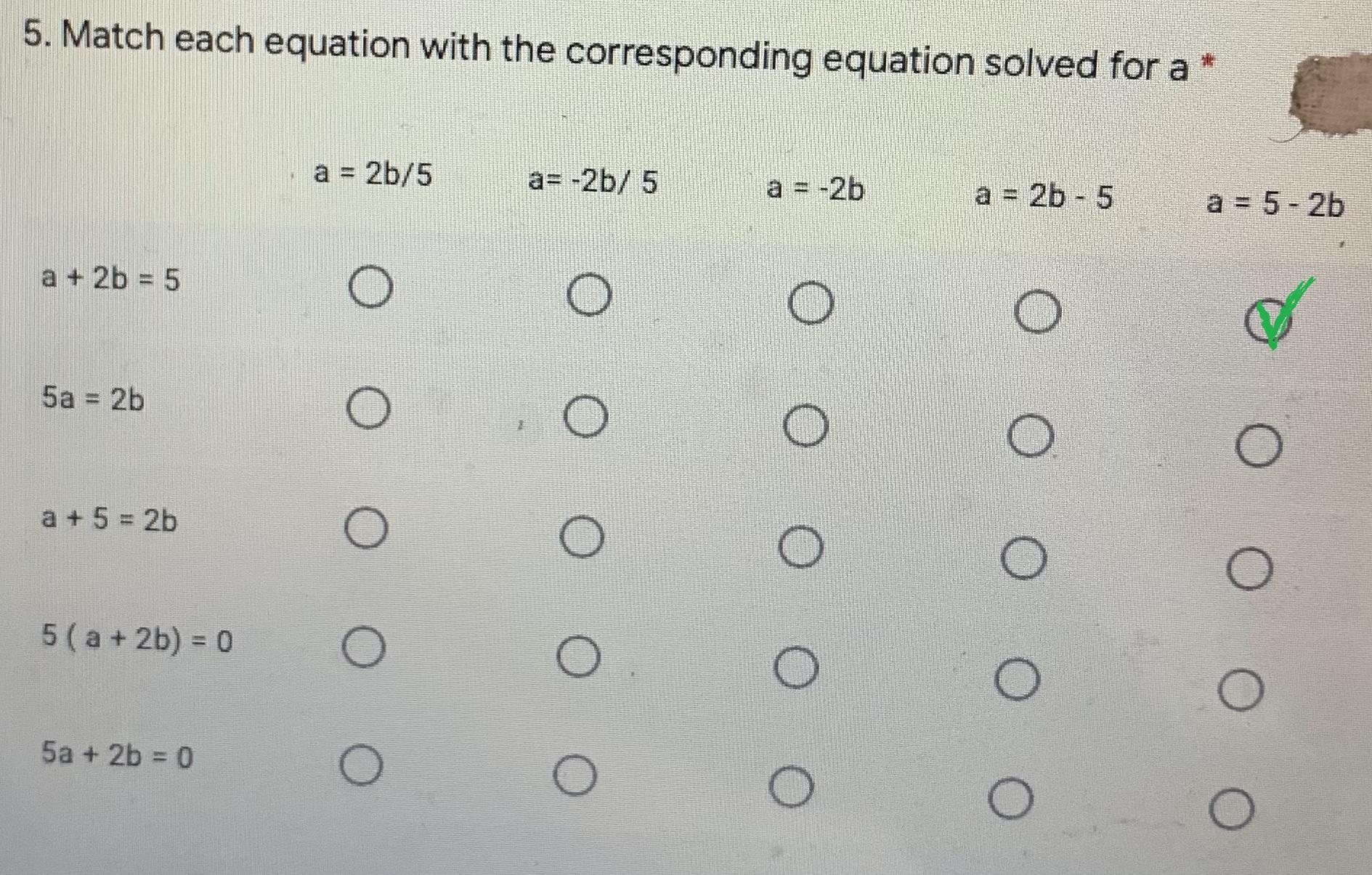
Related Questions
help please it's due tomorrow

Answers
\( \{ \: \alpha \: , \: \beta , \: a, \: b \}\)
\( \sf \longrightarrow \: No. \: of \: \: subsets = {2}^{n} \)
where, n denotes to number of elements in set .
Since, given set contains 4 elements .
Thus , 2⁴ {2 raise to power 4} .
\( \sf \longrightarrow \: No. \: of \: \: subsets = {2}^{4} \)
\( \sf \longrightarrow \: No. \: of \: \: subsets = 2 \times 2 \times 2 \times 2\)
\( \sf \longrightarrow \: No. \: of \: \: subsets = 4 \times 4\)
\( \sf \longrightarrow \: No. \: of \: \: subsets = 16\)
Therefore, Required subsets are 16.
They are , Namely;
\( \sf \longrightarrow \: subsets \: = \phi \: \{ \alpha \} \{ \beta \} \{ a\} \{ b\} \: \{ \alpha \beta \} \{ \alpha a\} \{ \alpha b\} \{ \beta a\} \{ \beta b\} \: .....\)
_____________________________
Additional Information:-If n is the number of elements in the set then,
No. of subsets possible for this subset is 2^n that's the (2 raise to the power n).
Let's take another example, {1,2}
Here, n = 2
subsets =2^2 =4
Subsets = ϕ, {1}, {2},{1,2}
Note :- every set is a subset of itself i.e. {1,2} and ϕ is a subset of every set
Can someone help me with this? I want to understand each step.
Thank you

Answers
The first 5 terms of the sequence is given by A = { -4.8 , 1.92 , -0.768 , 0.3072 , -0.12288 }
Given data ,
Let the geometric sequence be represented as A
Now , the value of A is
A = 12 ( -2/5 )ⁿ
On simplifying , we get
when n = 1
A₁ = 12 ( -2/5 ) = -4.8
A₂ = 12 ( -2/5 )²
A₂ = 12 ( 4/25 ) = 1.92
A₃ = 12 ( -2/5 )³
A₃ = -12 ( 8/125 ) = -0.768
A₄ = 12 ( -2/5 )⁴
A₄ = 12 ( 16 / 625 ) = 0.3072
A₅ = 12 ( -2/5 )⁵
A₅ = -12 ( 32 / 3,125 ) = -0.12288
Hence , the geometric sequence is solved
To learn more about geometric progression click :
https://brainly.com/question/1522572
#SPJ1
These points are linear. Find the slope.

Answers
to get the slope of any straight line, we simply need two points off of it, let's use those in the picture below.
\((\stackrel{x_1}{-4}~,~\stackrel{y_1}{0})\qquad (\stackrel{x_2}{2}~,~\stackrel{y_2}{8}) \\\\\\ \stackrel{slope}{m}\implies \cfrac{\stackrel{\textit{\large rise}} {\stackrel{y_2}{8}-\stackrel{y1}{0}}}{\underset{\textit{\large run}} {\underset{x_2}{2}-\underset{x_1}{(-4)}}} \implies \cfrac{8 }{2 +4} \implies \cfrac{ 8 }{ 6 } \implies \cfrac{4 }{ 3 }\)

I dont understand any of these functions please help on all!
Answers
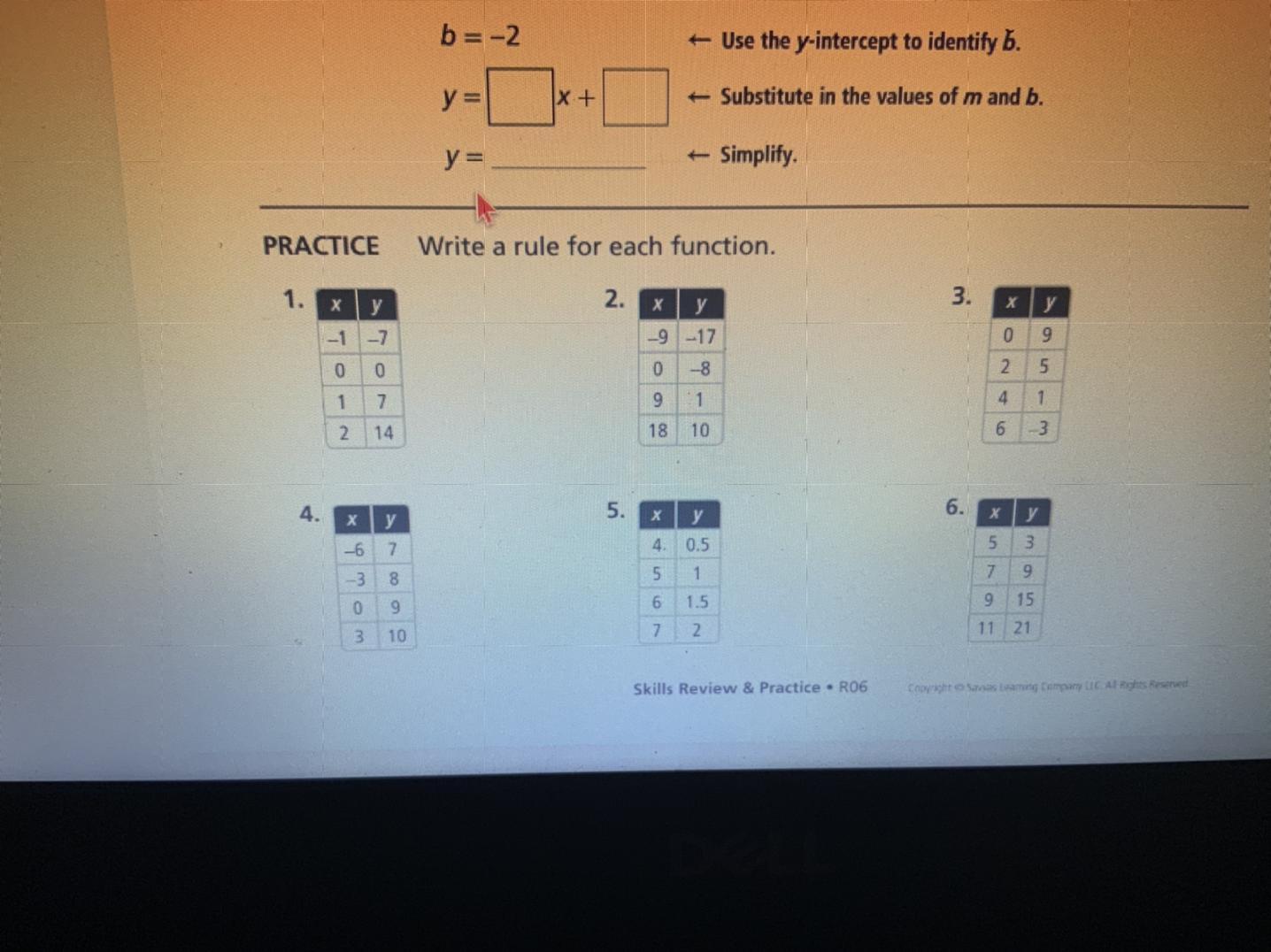
1.The slope -intercept form of the function is y = 7x
2.The slope -intercept form of the function is y = x - 8
3.The slope -intercept form of the function is y = -2x +9
4.The slope -intercept form of the function is \(y = \frac{1}{3}x+9\)
5.The slope -intercept form of the function is y = 0.5x - 1.5
6.The slope -intercept form of the function is y = 3x - 12
How is the slope -intercept form calculated?
1. The slope -intercept form of the equation of the function is y = 7x
Slope = m
\(m=\frac{y_{2}-y_{1}}{x_{2}-x_{1}}\\\\m =\frac{0+7}{0+1} \\\\m= 7\)
Substituting point (-1,-7) and m in the slope-intercept form of the equation,
y = mx+ c ----(1)
-7 = 7(-1) + c
c = 7 -7
c = 0
Substituting m and c in (1)
y = 7x
2. The slope -intercept form of the equation of the function is y = x - 8
Slope = m
\(m=\frac{y_{2}-y_{1}}{x_{2}-x_{1}}\\\\m =\frac{-8+17}{0+9} \\\\m= \frac{9}{9} =1\)
Substituting point (-9,-17) and m in the slope-intercept form of the equation,
y = mx+ c ----(1)
-17 = (-9) + c
c = -17 +9
c = -8
Substituting m and c in (1)
y = x - 8
3. The slope -intercept form of the equation of the function is y = -2x +9
Slope = m
\(m=\frac{y_{2}-y_{1}}{x_{2}-x_{1}}\\\\m =\frac{5-9}{2-0} \\\\m= \frac{-4}{2} =-2\)
Substituting point (0,9) and m in the slope-intercept form of the equation,
y = mx+ c ----(1)
9 = -2 (0) + c
c = 9
Substituting m and c in (1)
y = -2x +9
4.The slope -intercept form of the equation of the function is \(y = \frac{1}{3}x+9\)
Slope = m
\(m=\frac{y_{2}-y_{1}}{x_{2}-x_{1}}\\\\m =\frac{8-7}{-3+6} \\\\m= \frac{1}{3}\)
Substituting point (0,9) and m in the slope-intercept form of the equation,
y = mx+ c ----(1)
9 = 1/3 (0) + c
c = 9
Substituting m and c in (1)
\(y = \frac{1}{3}x+9\)
5. The slope -intercept form of the equation of the function is
y = 0.5x - 1.5
Slope = m
\(m=\frac{y_{2}-y_{1}}{x_{2}-x_{1}}\\\\m =\frac{1-0.5}{5-4} \\\\m= \frac{0.5}{1}= 0.5\)
Substituting point (5,1) and m in the slope-intercept form of the equation,
y = mx+ c ----(1)
1 =0.5 (5) + c
1 -2.5 = c
c = - 1.5
Substituting m and c in (1)
y = 0.5x - 1.5
6. The slope -intercept form of the equation of the function is y = 3x - 12
Slope = m
\(m=\frac{y_{2}-y_{1}}{x_{2}-x_{1}}\\\\m =\frac{9-3}{7-5} \\\\m= \frac{6}{2}\\\\m= 3\)
Substituting point (5,3) and m in the slope-intercept form of the equation,
y = mx+ c ----(1)
3 =3(5) + c
3 -15 = c
c = - 12
Substituting m and c in (1)
y = 3x - 12
To learn more about slope -intercept form, refer:
https://brainly.com/question/1884491
#SPJ13
i need help with "A group of friends were working on a student film. They spent all their budget on equipment and props. They spent $712 on equipment, and 11% of the total budget on props. What was the total budget for their student film?"
Answers
The total budget for their student film $800
How to finding the total money your group spent on props?11% of total budget = (11/100) * total budget
= 0.11 * total budget
Let P be the amount the group spent on props.
Now we can write the equation:
P = 0.11 * total budget
We also know that this group spent $712 on equipment. Let E be the amount they spent on equipment.
So it looks like this:
E=$712
Your total budget is the total cost of your equipment and props. This can be written as:
Total Budget = E + P
Plugging in the E and P values, we get:
Total Budget = $712 + 0.11 * Total Budget
Simplifying this equation, we get:
0.89 * total budget = $712
Dividing both sides by 0.89 gives:
Total budget = $800
So her student film had a total budget of $800.
To know more about dividing visit:-
https://brainly.com/question/15381501
#SPJ1
An accountant is concerned about the percentage of customers that have businesses which are operating at a loss . Of the last 10 years, the percentage of customers who showed a loss on their tax return is 66%. If the accountant conducts research on this concern, for what sample size n will the sampling distribution of sample proportions have a standard deviation of 0.09
Answers
Answer:
A sample size of 28.
Step-by-step explanation:
The Central Limit Theorem estabilishes that, for a normally distributed random variable X, with mean \(\mu\) and standard deviation \(\sigma\), the sampling distribution of the sample means with size n can be approximated to a normal distribution with mean \(\mu\) and standard deviation \(s = \frac{\sigma}{\sqrt{n}}\).
For a skewed variable, the Central Limit Theorem can also be applied, as long as n is at least 30.
For a proportion p in a sample of size n, the sampling distribution of the sample proportion will be approximately normal with mean \(\mu = p\) and standard deviation \(s = \sqrt{\frac{p(1-p)}{n}}\)
In this question:
We need to find n for which s = 0.09, with p = 0.66. So
\(s = \sqrt{\frac{p(1-p)}{n}}\)
\(0.09 = \sqrt{\frac{0.66*0.34}{n}}\)
\(0.09\sqrt{n} = \sqrt{0.66*0.34}\)
\(\sqrt{n} = \frac{\sqrt{0.66*0.34}}{0.09}\)
\((\sqrt{n})^{2} = (\frac{\sqrt{0.66*0.34}}{0.09})^{2}\)
\(n = 27.7\)
Rounding to the nearest whole number
A sample size of 28.
2y+1<7 answer that question
Answers
Answer:
y < 3
Step-by-step explanation:
2y + 1 < 7
~Subtract 1 to both sides
2y < 6
~Divide 2 to both sides
y < 3
Best of Luck!
A grocery store has 10 cartons of yogurt for sale, of which 4 are raspberry. What is the probability that a randomly selected carton of yogurt will be raspberry? Write your answer as a fraction or whole number.
Answers
Answer:
2/5
Step-by-step explanation:
4 raspberry / 10 total
4/10
2/5
Main Street is a straight road that runs through the center of town. Sycamore Street and Rosewood Street both intersect Main Street at the same angle. Sycamore intersects Main Street at an obtuse angle with measure (9x - 5)degrees. Rosewood Street intersects Main Street at an acute angle with measure (4x + 3)degrees, sketch the roads. What are the measures of the given angles these streets make with Main street?
Answers
Answer:
121 degrees and 59 degrees respectively.
Explanation:
The sketch of the roads is attached below:
If Sycamore Street and Rosewood Street both intersect Main Street at the same angle, it means the angle labeled a above is equal to (9x-5) degrees.
\((4x+3)+a=180^0\text{ (Linear Pairs)}\)Since a=(9x - 5) degrees.
\(\begin{gathered} (4x+3)+(9x-5)=180 \\ 13x-2=180^0 \\ 13x=180^0+2^0 \\ 13x=182^0 \\ x=\frac{182^0}{13} \\ x=14^0 \end{gathered}\)Therefore, the measure of the given angles these streets makes with Main Street are:
\(\begin{gathered} (9x-5)^0=9(14)-5=121^0 \\ (4x+3)^0=4(14)+3=59^0 \end{gathered}\)
a community center is trying to raise $1680 to purchase exercise equipment. the center is hoping to receive equal contributions from members of the community. write and algebraic expression to determine how much will be needed from each person if n people contribute. Then evaluate the expression for 10, 12, 14, or 16 people.
Answers
Lets find f(n) formula
\(\boxed{\sf f(n)=\dfrac{1680}{n}}\)
Now
\(\\ \sf\longmapsto f(10)=\dfrac{1680}{10}=168\)
\(\\ \sf\longmapsto f(12)=\dfrac{1680}{12}=140\)
\(\\ \sf\longmapsto f(16)=\dfrac{1680}{16}=105\)
\(\\ \sf\longmapsto f(14)=\dfrac{1680}{14}=120\)
The two cars travel at
Answers
Answer:
travel at what?
Step-by-step explanation:
Answer:
?
Step-by-step explanation:
Find the distance between the two points in simplest radical form.
(7,2) and (-1, -3)
Answers
Answer:
The answer is
\(\sqrt{89} \: \: \: \: units \\ \)Step-by-step explanation:
The distance between two points can be found by using the formula
\(d = \sqrt{ ({x_1 - x_2})^{2} + ({y_1 - y_2})^{2} } \\\)
where
(x1 , y1) and (x2 , y2) are the points
From the question the points are
(7,2) and (-1, -3)
The distance between them is
\(d = \sqrt{( {7 + 1})^{2} + ({2 + 3})^{2} } \\ = \sqrt{ {8}^{2} + {5}^{2} } \\ = \sqrt{64 + 25} \\ = \sqrt{89} \: \: \: \: \: \: \: \: \: \: \)
We have the final answer as
\( \sqrt{89} \: \: \: \: units \\ \)
Hope this helps you
You are interested in finding a 95% confidence interval for the mean number of visits for physical therapy patients. The data below show the number of visits for 11 randomly selected physical therapy patients. Round answers to 3 decimal places where possible.
13 5 10 11 26 20 18 18 24 23 5
a. To compute the confidence interval use a
t
Correct distribution.
b. With 95% confidence the population mean number of visits per physical therapy patient is between
and
visits.
c. If many groups of 11 randomly selected physical therapy patients are studied, then a different confidence interval would be produced from each group. About
percent of these confidence intervals will contain the true population mean number of visits per patient and about
percent will not contain the true population mean number of visits per patient.

Answers
For finding a 95% confidence interval:
a. To compute the confidence interval, use a t distribution with 10 degrees of freedom.b. With 95% confidence, the population mean number of visits per physical therapy patient is between 13.011 and 19.249 visits.c. About 95% of these confidence intervals will contain the true population mean number of visits per patient and about 5% will not contain the true population mean number of visits per patient.How to solve confidence interval?a) The sample mean is x = 16.13.
The sample standard deviation is s = 6.948.
The degrees of freedom are df = 10.
The critical value of t for a 95% confidence interval is t = 2.228.
The margin of error is ME = t × s/√n = 2.228(6.948)/√11 = 4.263.
The 95% confidence interval is x ± ME = 16.13 ± 4.263 = (11.867, 20.393).
b) The 95% confidence interval is (11.867, 20.393).
This means that we are 95% confident that the true population mean number of visits per physical therapy patient is between 11.867 and 20.393 visits.
c) This is because the confidence interval is a range of values that is likely to contain the true population mean. If many samples of the same size are taken from the same population, then about 95% of the confidence intervals from these samples will contain the true population mean.
Find out more on confidence interval here: https://brainly.com/question/15712887
#SPJ1
Barbara has 9 stuffed animals. Trish has 3 times as many stuffed animals as Barbara. How many stuffed animals does Trish have?
Answers
Answer:
27
Step-by-step explanation:
9 + 9 + 9 = 27
I hope this helps :)
Answer:
trish has 27 because 9 times 3=27 love yall
Step-by-step explanation:
Determine if triangle XYZ with coordinates x (1, 1), y (5,6) and z (6,2) is a right triangle
Answers
Answer:
No(im not totally sure though because its slanted.)
Step-by-step explanation:
desmos.

8. A boy owns 6 pairs of pants, 8 shirts, 2 ties, and 3 jackets. How many outfits can he wear to school if he must wear one of each item?

Answers
It is given that the boy owns 6 pairs of pants, 8 shirts, 2 ties, and 3 jackets.
It is also given that he must wear one of each item.
Recall the Fundamental Counting Principle:
The same is valid for any number of events following after each other.
Hence, the number of different outfits he can wear by the counting principle is:
\(6\times8\times2\times3\)Evaluate the product:
\(6\times8\times2\times3=288\)The number of different outfits he can wear is 288.
What is y=-2x-2/7 in standard form
Answers
♥️♥️♥️♥️♥️♥️♥️♥️♥️♥️♥️♥️♥️♥️
\(y = - 2x - \frac{2}{7} \\ \)
Multiply sides by 7
\(7y = - 14x - 2\)
Add sides 14x
\(14x + 7y = - 2\)
Done...
♥️♥️♥️♥️♥️♥️♥️♥️♥️♥️♥️♥️♥️♥️
3.) Find the volume of a triangular prism with a length
of 5 units, a width of 6 units, and a height of 4 units.
Answers
Answer:
Volume V = 18.735 m3
Step-by-step explanation:
hope this helps
Express the gross salary g of a person who earns per hour as a function of the number x of hours worked.
Answers
Answer:
Gross salary =G
Number of worked hours =x
Dollar per hour =$12
substitute the given data into the gross salary formula and simplify.
Gross salary = (number of worked hours)
G =(x) (12)
G =12x
Therefore, G(x) =12x
Hence the function is G(x) = 12x
THE FIRST PERSON TO ANSWER GETS THE BRAINLIEST AND FIVE STARS
the problem is in the picture below

Answers
Answer: A
Step-by-step explanation: The distance between them goes from greatest to least.
Find the sum of 1005 and 296
Answers
Answer: the sum is 1301
Answer:
1301
Step-by-step explanation:
1005 + 296 = 1301
The height of the triangle is 3 meters longer than twice its base. Find the base and height if the area is 8 square meters. Round to the nearest hundreth.
Answers
9514 1404 393
Answer:
base: 2.18 mheight: 7.35 mStep-by-step explanation:
Let b represent the base of the triangle in meters. Then the height is ...
h = 3 +2b
and the area is ...
A = 1/2bh
8 = 1/2(b)(3 +2b)
16 = 3b +2b^2 . . . . . . . multiply by 2 and eliminate parentheses
2(b^2 +3/2b + (9/16)) = 16 + 9/8 . . . . . . complete the square
2(b +3/4)^2 = 17.125
(b +3/4)^2 = 8.5625 . . . . . divide by 2
b + 0.75 = √8.5625 ≈ 2.9262
b = -0.75 +2.9262 = 2.1762
h = 3 +2b = 7.3523
The base is about 2.18 meters and the height is about 7.35 meters.
Hhhheeeellllppppp asap

Answers
Answer:
Simplify the expression.
Exact Form:
\( \frac{1}{3} \)
Decimal Form
0.3
Hope it's help.
Answer:
0.3 is the real answer
Step-by-step explanation:
i hope it's helpful
The following selected information was extracted from the records of B Solomon.
1. B Solomon, the owner of Solomon Traders, bought a new Machine for R250 000 on 1 July 2013.
2. On 1 October 2014, he purchased a second Machine for R350 000 cash.
3. On 30 June 2015, the Machine bought during 2013 was sold for R120 000 cash.
4. It is the business’ policy to depreciate Machines at 20% per annum on cost.
REQUIRED:
Prepare the following ledger accounts reflecting all applicable entries, in the books of Solomon Traders, properly balanced/closed off, for the years ended 31 March 2016:
1.1. Accumulated depreciation.
1.2. A Machines realisation.
NB: Show all calculations as marks will be awarded for calculations.
Answers
1.1. Accumulated depreciation:
The accumulated depreciation for the machine bought on 1 July 2013 would be R150,000 as of 31 March 2016.
1.2. Machine realization:
The machine bought in 2013 was sold for R120,000 on 30 June 2015, resulting in a profit/loss on the sale of R10,000.
1.1. Accumulated Depreciation:
To calculate the accumulated depreciation, we need to determine the annual depreciation expense for each machine and then accumulate it over the years.
Machine bought on 1 July 2013:
Cost: R250,000
Depreciation rate: 20% per annum on cost
Depreciation expense for the year ended 31 March 2014: 20% of R250,000 = R50,000
Depreciation expense for the year ended 31 March 2015: 20% of R250,000 = R50,000
Depreciation expense for the year ended 31 March 2016: 20% of R250,000 = R50,000
Accumulated depreciation for the machine bought on 1 July 2013:
As of 31 March 2014: R50,000
As of 31 March 2015: R100,000
As of 31 March 2016: R150,000
1.2. Machine Realisation:
To record the sale of the machine bought in 2013, we need to adjust the machine's value and the accumulated depreciation.
Machine's original cost: R250,000
Accumulated depreciation as of 30 June 2015: R100,000
Net book value as of 30 June 2015:
R250,000 - R100,000 = R150,000.
On 30 June 2015, the machine was sold for R120,000.
Realisation amount: R120,000
To record the sale:
Debit Cash: R120,000
Debit Accumulated Depreciation: R100,000
Credit Machine: R250,000
Credit Machine Realisation: R120,000
Credit Profit/Loss on Sale of Machine: R10,000 (difference between net book value and realisation amount).
These entries will reflect the appropriate balances in the ledger accounts and properly close off the accounts for the years ended 31 March 2016.
For similar question on depreciation.
https://brainly.com/question/15998639
#SPJ8
Please help
A line with a slope of 1/5 passes through the point (-4,-3). What is its equation in point slope form?
A line that includes the point (1,3) has a slope of nine. What is its equation in point slope form?
A line with a slope of -10 passes through the point (-4,-1) what is this equation in point slope form?
There is a line that includes the point (9,3) and has a slope of -1/6 what is its equation in point slope form?
A line passes through the points (1,2) and (2,10). What is its equation in point slope form?
When answering all these questions, you specific points in the equation
Answers
1. We have a point $(-4,-3)$ and a slope of $1/5$. Using point-slope form, we get:
$y - y_1 = m(x - x_1)$
$y - (-3) = \frac{1}{5}(x - (-4))$
Simplifying, we get:
$y + 3 = \frac{1}{5}(x + 4)$
This is the equation in point-slope form.
2. We have a point $(1,3)$ and a slope of $9$. Using point-slope form, we get:
$y - y_1 = m(x - x_1)$
$y - 3 = 9(x - 1)$
This is the equation in point-slope form.
3. We have a point $(-4,-1)$ and a slope of $-10$. Using point-slope form, we get:
$y - y_1 = m(x - x_1)$
$y - (-1) = -10(x - (-4))$
Simplifying, we get:
$y + 1 = -10(x + 4)$
This is the equation in point-slope form.
4. We have a point $(9,3)$ and a slope of $-\frac{1}{6}$. Using point-slope form, we get:
$y - y_1 = m(x - x_1)$
$y - 3 = -\frac{1}{6}(x - 9)$
This is the equation in point-slope form.
5. We have two points $(1,2)$ and $(2,10)$. We can find the slope using the slope formula:
$m = \frac{y_2 - y_1}{x_2 - x_1} = \frac{10 - 2}{2 - 1} = 8$
Using point-slope form with the point $(1,2)$ and the slope $8$, we get:
$y - y_1 = m(x - x_1)$
$y - 2 = 8(x - 1)$
This is the equation in point-slope form.
Jim is cutting up apples to serve. 1/3 of an apple to each of the 8 people at the meeting. How many apples Jim need to serve?
Answers
Answer:
Jim needs three apples.
Step-by-step explanation:
1/3 x 8 =
8/3 =
2 and 2/3
Round up to three apples.
\(2\frac{2}{3}\) apples Jim need to serve.
What is Expression?An expression is combination of variables, numbers and operators.
Given that Jim is cutting up apples to serve.
1/3 of an apple to each of the 8 people at the meeting.
We need to find the number of apples Jim need to serve.
1/3 of an apple to each of the 8 people.
We have to use multiplication to find this as there is a off in the sentence.
1/3×8
8/3
\(2\frac{2}{3}\)
Hence, \(2\frac{2}{3}\) apples Jim need to serve.
To learn more on Expressions click:
https://brainly.com/question/14083225
#SPJ2
Which algebraic expression represents the phrase “six less than a number”? 6x - x x - 6 6 - x x - 6x
Answers
Answer:
B. x-6
Step-by-step explanation:
The algebraic expression is x-6. Therefore, option B is the correct answer.
We need to find the algebraic expression for the phrase "six less than a number"
What are Algebraic Expressions?An algebraic expression (or) a variable expression is a combination of terms by the operations such as addition, subtraction, multiplication, division, etc.
Now, for the given statement "six less than a number".
Let the unknown number be x.
So, six less than a number is x-6.
Therefore, option B is the correct answer.
To learn more about the algebraic expression visit:
https://brainly.com/question/19245500.
#SPJ6
someone help please
in which table is y not a function of x

Answers
Answer:
B is the correct answer.
To be a function, there must be only one y value for each x value. As you can see in table B, there are multiple y values for x=0.
Let me know if this helps!
.1) Mr. Garrison and some friends are headed to the Taylor Swift concert.
The ticket office sells individual tickets for $89.95 each and offers a group
rate of $59.95 each plus a one time fee of $99.99. Write an inequality that
shows when the group rate is cheaper than the individual rate.

Answers
Answer:
(59.95n + 99.99) < 89.95n
Step-by-step explanation:
If the ticket office sells individual tickets for $89.95 each
Cost of 'n' number of tickets sold = $89.95n
If the ticket office offers a group rate of $59.95 each plus a one time fee = $99.99
Cost of tickets in a group with 'n' members = $(59.95n + 99.99)
If group rate is cheaper than the individual rate, the inequality will be,
(59.95n + 99.99) < 89.95n
Need help please badly

Answers
Answer:
CED is a right angle, CEB=AEB
hopw that helps
Answer:
1st, 2nd, 5th
Step-by-step explanation: