1. What is the value of x in this equation? 5x – 2(2x - 1) = 6 *
A.3
B.4
C.7
D.8
Answers
Answer:
Answer B. 4
Step-by-step explanation:
Equations
Solve the equation:
5x - 2( 2x - 1 ) = 6
Operate the parentheses:
5x - 4x + 2 = 6
Collect like terms:
x + 2 = 6
Subtract 2:
x = 6 - 2
x = 4
The value of x is 4
Answer B. 4
Related Questions
Last week, Jaime spent 34, 30,45,30,40,38,
and 28 minutes practicing for football. Find
the ________________
.Round to the
nearest whole number,
Answers
Answer:
35 average minutes at practice.
Step-by-step explanation:
Answer:
What do I find?
If it's the mean then the answer is 35.
Step-by-step explanation:
34, 30, 45, 30, 40, 38, 28 ==> 7 numbers
34+30+45+30+40+38+28=245
245/7=35
Hi Guys...Can Anyone Please Help With Answers and Reasons?
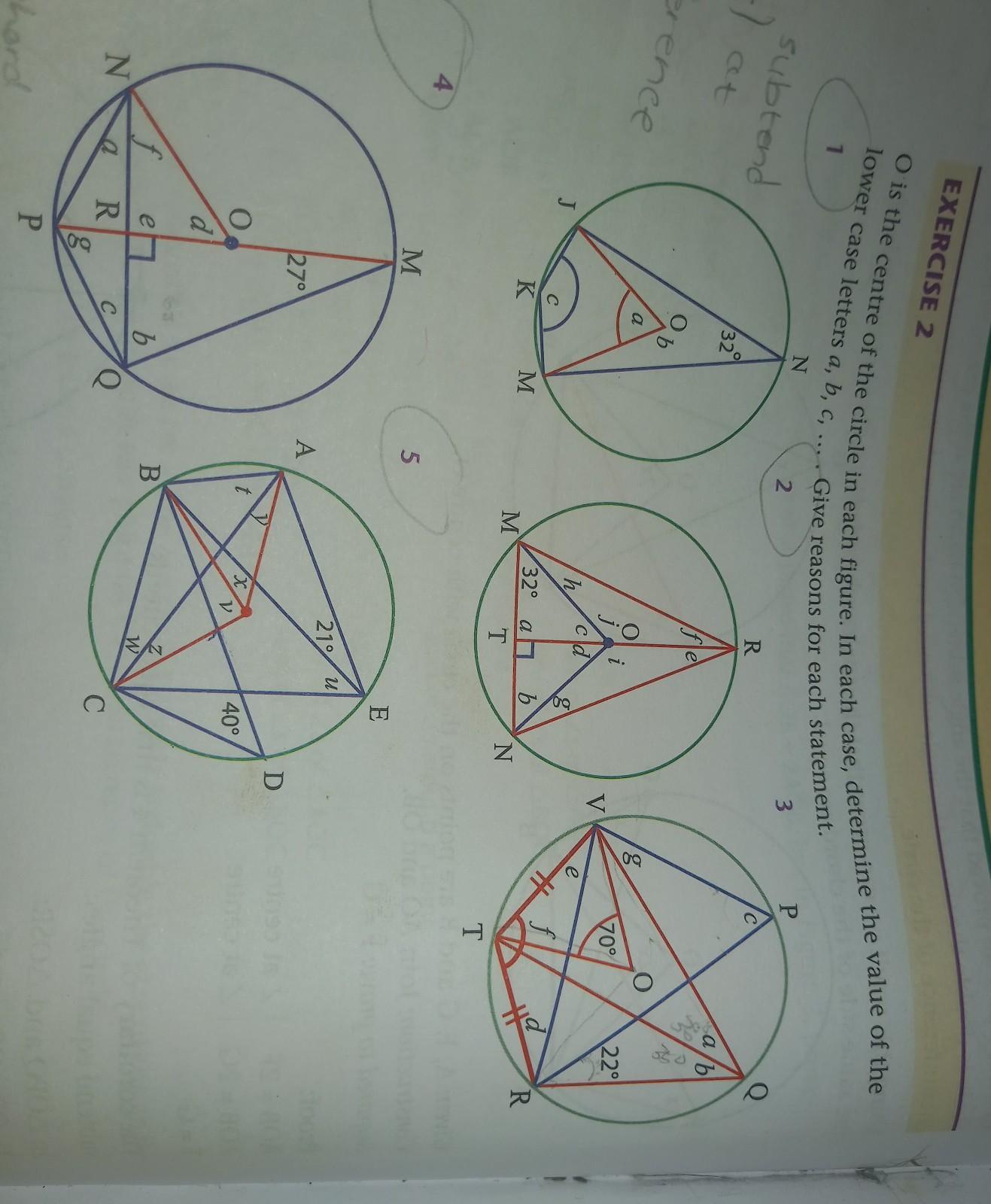
Answers
Answer:
1. a = 64°, b = 296°, c = 148°
2. a = 90°, b = 32°, c = 58°, d = 58°, e = 29°, f = 29°, g = 29°, h = 29°, i = 122°, j = 122°
3. a = 35°, b = 35°, c = 70°, d = 35°, e = 35°, f = 110°, g = 22°
4. a = 27°, b = 63°, c = 27°, d = 54°, e = 90°, f = 36°, g = 63°
5. t = 40°, u = 40°, v = 80°, w = 21°, x = 42°, y = 19°, z = 19°
Step-by-step explanation:
On the same arc angle subtended at center is twice the angle subtended at circumference
same arc, same angle on any point on the circumference
1.
a = 2 * 32° = 64°
b = 360° - a = 360° - 64° = 296°
c = b/2 = 296°/2 = 148°
a = 64°, b = 296°, c = 148°
2.
a = 180 - 90 = 90°
triangle OMT and triangle ONT are congruent
b = 32°
c = 90 - 32 = 58°
d = c = 58°
f = c /2 = 58/2 = 29°
exterior angle, c = h + f
h = c - f = 58 - 29 = 29°
j = 180 - c = 180 - 58 = 122°
similarly, e = g = 29°, i = 122°
a = 90°, b = 32°, c = 58°, d = 58°, e = 29°, f = 29°, g = 29°, h = 29°, i = 122°, j = 122°
3.
a = 70/2 = 35°
As TR = VT, b = a = 35°
arc VTR, c = a + b = 35° + 35° = 70°
arc VT, d = a = 35°
TR = VT, e = d = 35°
cyclic quadrilateral, f + a + b = 180, f = 180 - a - b = 180 - 35 - 35 = 110°
arc PQ, g = angle PRQ = 22°
a = 35°, b = 35°, c = 70°, d = 35°, e = 35°, f = 110°, g = 22°
4.
arc PQ, a = 27°
b = 90 - 27 = 63°
MP is diameter, b + c = 90°, c = 90 - b = 90 - 63 = 27°
g = 90 - c = 90 - 27 = 63°
e = 180 - 90 = 90°
angle NPR = 90 - 27 = 63°
ON + OP, a + f = angle NPR = 63°, f = 63 - a = 63 - 27 = 36°
d = 90 - f = 90 - 36 = 54°
a = 27°, b = 63°, c = 27°, d = 54°, e = 90°, f = 36°, g = 63°
5.
arc BC, t = u = 40°
arc AB, w = 21°
arc BC, v = 2u = 2 * 40 = 80°
arc AB, x = 2 * 21 = 42°
OA = OC, y = z = ( 180 - x - v )/2 = ( 160 - 42 - 80 )/2 = 19°
t = 40°, u = 40°, v = 80°, w = 21°, x = 42°, y = 19°, z = 19°
Rhea sold 6 boxes of blueberry muffins and 8 boxes of corn muffins at the bake sale. Each box contained 18 muffins. The muffins cost $0.50 each. What is the total amount raised by the sale of the muffins?
Please help me (and thanks if you are, I very much appreciate it :))
Answers
Answer:
$126.00
Step-by-step explanation:
1 you Multiply .50×18=9
so the ratio is 9 per box
you add 6+8=14 and then 14×9=126
First, you want to add together how many boxes of muffins she sold (8+6= 14)
Then, you need to multiply the amount of boxes by how many muffins are in each box (18*14 = 252)
Lastly, you multiply the amount of muffins sold by how much each muffin cost (252*0.50 = 126)
And that’s how you get $126.00.
5. Order from least to greatest
3
35%,
10
1 37
0.345,
3 100
Answers
Answer:
35%, 0.345,3,10,3100,1.37
Step-by-step explanation:
5n+ 1 = 5n -1
Solve for n
Answers
Answer:
no solution
Step-by-step explanation:
5n + 1 = 5n - 1 ( subtract 1 from both sides )
5n = 5n - 2 ( subtract 5n from both sides )
0 = - 2 ← not possible
this indicates that the equation has no solution
the production manager for the xyz manufacturing company is concerned that the customer orders are being shipped late. he asked one of his planners to check the timeliness of shipments. the planner randomly selected 1000 orders and found that 120 orders were shipped late. construct the 95% confidence interval for the proportion of orders shipped late.
Answers
The confidence interval for the proportion of orders shipped late is 2.763 and 2.523
We are to going to construct a 95% confidence interval, so here the value is x, divided by n.
That is 120 divided by 1000
120/1000= 0.12
Capital value = 1 - 0.12
= 0.88
So definitely we are going to right here for this confidence interval must be written as on.
Confidence interval must be written as a cap plus minus go alpha by 2 multiplied by under root of 0.12 multiplied by 0.88 and this must be divisible by n, which is 1000 points.
So if I write here for this, this is 0.12 plus minus
x = 0.12
n = 1000
s = 0.88 = 0.8
z = 95 = 99
Formula to calculate the confidence interval
CI = x ± zs/ √n
=0.12 ± 95 × 0.88/√1000
= 0.12 ± 2.643
= 2.763 and 2.523
Therefore the confidence interval is 2.763 and 2.523.
To know more about the confidence interval refer to the link given below:
https://brainly.com/question/17212516
#SPJ4
Please help me! I will mark Brainliest if you answer all of these portfolio questions!
+75 POINTS!
Fr0ggyLikeSMELLY avatar
I WILL MARK BRAINLIEST! PLEASE HELP ME! THIS COUNTS 50% OF MY GRADE!
Answers
Answer:
a
Step-by-step explanation:
How many 4-digit positive integers exist that satisfy the following conditions:
(A) Each of the first two digits must be 1, 4, or 5, and
(B) the last two digits cannot be the same digit, and
(C) each of the last two digits must be 5, 7, or 8?
Answers
There are 7290 4-digit positive integers that satisfy the given conditions.
We have,
To determine the number of 4-digit positive integers that satisfy the given conditions, we need to count the possibilities for each condition and then find their intersection.
Condition (A):
Each of the first two digits must be 1, 4, or 5.
Since there are 3 choices for each of the first two digits, there are
3 x 3 = 9 possibilities for condition (A).
Condition (B):
The last two digits cannot be the same digit.
There are 10 choices for the first digit, and for each of these choices, there are 9 choices for the second digit (excluding the chosen digit). Therefore, there are 10 x 9 = 90 possibilities for condition (B).
Condition (C): Each of the last two digits must be 5, 7, or 8.
There are 3 choices for each of the last two digits, resulting in 3 x 3 = 9 possibilities for condition (C).
To find the total number of 4-digit positive integers satisfying all three conditions, we multiply the possibilities for each condition together:
9 x 90 x 9 = 7290
Therefore,
There are 7290 4-digit positive integers that satisfy the given conditions.
Learn more about expressions here:
https://brainly.com/question/3118662
#SPJ4
Find the volume of the parallelepiped with adjacent edges pq, pr, and ps. p(−2, 1, 0), q(5, 3, 5), r(1, 4, −1), s(3, 6, 2)
Answers
The volume of the parallelepiped is 55 cubic units.
In the question, we are asked to find the volume of the parallelepiped with adjacent edges PQ, PR, and PS, given P(−2, 1, 0), Q(5, 3, 5), R(1, 4, −1), S(3, 6, 2).
We first find the vectors:
PQ = Q - P
= < 5 - (-2), 3 - 1, 5 - 0 >
= < 7, 2, 5 >.
PR = R - P
= < 1 - (-2), 4 - 1, -1 - 0 >
= < 3, 3, -1 >.
PS = S - P
= < 3 - (-2), 6 - 1, 2 - 0 >
= < 5 , 5, 2 >.
The volume of the parallelepiped can be found using the triple product of these vectors, PS.( PQ * PR )
\(= \begin{vmatrix}5 & 5 & 2 \\ 7 & 2 & 5 \\ 3 & 3 & -1\end{vmatrix}\)
We solve this determinant to get the value of the volume of the parallelepiped.
\(= \begin{vmatrix}5 & 5 & 2 \\ 7 & 2 & 5 \\ 3 & 3 & -1\end{vmatrix}\\= 5\begin{vmatrix}2 & 5\\ 3 & -1\end{vmatrix} - 5\begin{vmatrix}7 & 5\\ 3 & -1\end{vmatrix} + 2\begin{vmatrix}7 & 2\\ 3 & 3\end{vmatrix}\\\)
= 5(2*(-1)-5*3)-5(7*(-1)-5*3)+2(7*3-2*3)
= 5(-17) - 5(-22) + 2(15)
= -85 + 110 + 30
= 55.
Thus, the volume of the parallelepiped is 55 cubic units.
Learn more about the volume of a parallelepiped at
https://brainly.com/question/970600
#SPJ4
Detemine which equation has the same solutions as the equation below.
4X² + 32X - 28 = 0
A. (X+4)²=23
B. 4(X+4)²=36
C. (X+8)²=57
D. 4(X+8)²=28
Answers
The answer is B i hopes this helps
Angle sum theorem
y=[?]°
The answer is NOT 45°
Please help.
![Angle sum theorem y=[?]The answer is NOT 45Please help.](https://i5t5.c14.e2-1.dev/h-images-qa/contents/attachments/l5RNrC4Oy3LOFCUWZ1eGSy0gfuDmLrbw.jpeg)
Answers
Answer: 25°
Step-by-step explanation:
So we know that the right angle equals 90°.
And we know that all the angles of a triangle have to add up to 180°.
Also angle x and the exterior angle that is 115° are supplementary, so they have to add up to 180°. So we have to subtract 180 - 115 = 65.
So our equation for y is:
y + 65 + 90 = 180
y + 155 = 180
y = 25
So y = 25°
Hope this helps!!! :)
Sally's z-score on a given measure is -2.5, where the mean is 5 and the standard deviation is 1.5. What is Sally's raw score
Answers
Sally's z-score on a given measure is -2.5, where the mean is 5 and the standard deviation is 1.5: Sally's raw score on the given measure is 1.25.
To find Sally's raw score, you can use the following formula:
Raw Score = (Z-score * Standard Deviation) + Mean
Given that Sally's Z-score is -2.5, the mean is 5, and the standard deviation is 1.5, you can plug these values into the formula:
Raw Score = (-2.5 * 1.5) + 5
Now, calculate the result:
Raw Score = (-3.75) + 5
Raw Score = 1.25
So, Sally's raw score on the given measure is 1.25.
to learn more about Standard Deviation click here:
brainly.com/question/13905583
#SPJ11
Look at the simultaneous equations below.
x - 6y = 10
3y² = 4x + 7
a) Show that 3y²– 24y – 47 = 0
b) Use part a) to solve the simultaneous equations.
If any of your answers are decimals, give them to 1 d.p.
Please help I will give Brainly

Answers
A) Hence, proven that 3y²– 24y – 47 = 0
B) After solving the simultaneous equations y1 = −1.627314 or −1.6 and y2 = 9.627314 or 9.6.
What is simultaneous equations?Equations that are simultaneously solved and have two or more common variables are known as simultaneous equations (that is, simultaneously). Since the unknown variables in both equations, x and y, are the same, they can be solved simultaneously to find the values of the variables.
As an illustration, equations x + y = 5 and x - y = 6 are examples of simultaneous equations. Simultaneous equations can be resolved in a variety of ways, including graphically, by substitution, and by elimination.
a) Given that
x - 6y = 10
Lets solve for x
x = 10 + 6y
And 3y² = 4x + 7
Lets solve for x
x = (3y² - 7)/4
As x is equal lets cross multiply and we get
10 + 6y = (3y² - 7)/4
40 + 24y = 3y² - 7
47 + 24y = 3y²
0 = 3y² - 24y - 47
3y²– 24y – 47 = 0
B) To solve the simultaneous equations
Lets convert them to standard format
x - 6y = 10 already in standard format
3y² = 4x + 7
4x - 3y² = -7 in standard format
Now solve
⇒ x - 6y = 10 (x4)
4x - 3y² = -7 (x1)
⇒ 4x - 24y = 40
- 4x - 3y² = -7
0 + 3y²– 24y = 47
⇒ 3y²– 24y = 47
⇒ Putting the value in quadratic formula
⇒ y1 = −1.627314 or −1.6
⇒ y2 = 9.627314 or 9.6
A) Hence, proven that 3y²– 24y – 47 = 0
B) After solving the simultaneous equations y1 = −1.627314 or −1.6 and y2 = 9.627314 or 9.6.
Learn more about simultaneous equations
https://brainly.com/question/15165519
#SPJ9
HELP DUE IN 2 MINUTES

Answers
Answer:
6
Step-by-step explanation:
add them all together which will get you 24
then divide by the number of months
24/4=6
What would the equation of the line be that passes through the points (-2,3) and (0,2)?
Answers
find the smallest integer k so that f(n) = n^3 n^4/n^2 1 is order of nᵏ.
Answers
the function f(n) is of the order of n^5, and the smallest integer k is 5.
To find the smallest integer k so that f(n) = n^3 n^4/n^2 1 is order of nᵏ, we need to simplify the expression first. We can simplify the expression as follows:
f(n) = n^(3+4-2)
f(n) = n^5
Now we can see that f(n) is order of n^5. Therefore, the smallest integer k is 5.
Hi! To find the smallest integer k for the function f(n) = n^3 * n^4 / n^2, we first need to simplify the expression.
f(n) = (n^3 * n^4) / n^2 = n^(3+4) / n^2 = n^7 / n^2
Now, using the exponent properties, we can simplify it further:
f(n) = n^(7-2) = n^5
So, the function f(n) is of the order of n^5, and the smallest integer k is 5.
To know more about smallest integer click here:
brainly.com/question/28987158
#SPJ11
For each of the following, determine if the statement is true.
A)A trapezoid is always a parallelogram.
B)Diagonals of a parallelogram are always congruent.
C) Both pairs of opposite angles of a parallelogram are always congruent.
D)A rhombus is always a square.
E)Diagonals of a square always bisect each other.
F)A rectangle is always a
Answers
Answer:
A)
Step-by-step explanation:
There is one right angle in a parallelogram and it is not a rectangle. A square is a rectangle. Always. A trapezoid is a parallelogram.
hope that help mark me brinilylist pls
Determine how many terms of the following convergent series must be summed to be sure that the remainder is less than 10^-1 in magnitude. Σk=0 [infinity] 5(-1)^k/k!. The number of terms that must be summed is ___. (Simplify your answer. )
Answers
To ensure that the remainder of the series Σk=0 [infinity] 5(-1)^k/k! is less than 10^-1 in magnitude, we need to sum at least 4 terms.
The series Σk=0 [infinity] 5(-1)^k/k! is a convergent series, which means that the sum of the series approaches a finite value as the number of terms in the series approaches infinity. However, when we sum a finite number of terms, the sum of the series is an approximation to the true value of the sum. The difference between the true value of the sum and the sum of the finite number of terms is called the remainder.
To find the remainder of the series Σk=0 [infinity] 5(-1)^k/k!, we need to determine how many terms we need to sum to ensure that the remainder is less than 10^-1 in magnitude. One way to do this is to use the formula for the remainder of a convergent series:
|Rn| ≤ an+1/(1-r)
where Rn is the remainder after summing the first n terms of the series, an+1 is the (n+1)th term of the series, and r is the common ratio of the series.
In this case, the common ratio of the series is -1/5, and the (n+1)th term of the series is 5*(-1)^(n+1)/(n+1)! . We want to find the smallest value of n such that |Rn| ≤ 10^-1. Substituting these values into the formula for the remainder, we get:
|5*(-1)^(n+1)/(n+1)!| ≤ 10^-1/(1-(-1/5))
Simplifying this inequality, we get:
|(n+1)!| ≥ 120*(5/4)^(n+1)
Taking the logarithm of both sides of this inequality, we get:
log|(n+1)!| ≥ log[120*(5/4)^(n+1)]
Using Stirling's approximation for n!, we can simplify the left-hand side of this inequality:
(n+1)*log(n+1) - (n+1) ≥ log[120*(5/4)^(n+1)]
Simplifying the right-hand side, we get:
(n+1)*log(n+1) - (n+1) ≥ log(120) + (n+1)*log(5/4)
Dividing both sides by log(n+1), we get:
n+1 - 1/log(n+1) ≥ (log(120) + (n+1)*log(5/4))/log(n+1)
This inequality can be solved numerically to find that the smallest value of n that satisfies the inequality is n = 3.87 (rounded to two decimal places). Since n must be an integer, we need to round up to n = 4. Therefore, we need to sum at least 4 terms of the series Σk=0 [infinity] 5(-1)^k/k! to ensure that the remainder is less than 10^-1 in magnitude.
To learn more about magnitude click here: brainly.com/question/31022175
#SPJ11
Use digits and symbols to write ''the product of one and two is less than the sum of one and two'' pls help
Answers
The correct answer is: " 1 * 2 < 1 + 2 ".
____________
Step-by-step explanation:
The following text provides a detailed explanation of how one can reach the answer.
______
We are given: "{Use digits and symbols to write ''the product of one and two is less than the sum of one and two'' pls help}."
______
Okay; First, relax. Then:
Second: Note the following parts of the Actual Brainly Question:
1) "Use digits and symbols" to.. (represent this word problem/inequality).
2) Write down the following—including the "blanks" :
{The product of _____ is less than the
sum of ____ " ;
3) Then, Refer to: "{The product of 1 and 2 is less than...}" ;
Note: The "{product of 1 and 2}" ; indicates multiplying " 1" by " 2" ;
→ {e.g. to get the product; that is; to get the value when multiple numbers [i.e. "two or more numbers"] are multiplied.}.
When one multiplies " 1 " by "2", the product is "2" ;
[since: " 1 * 2 = 2 "] ; yet, for our purposes, we shall write:
→ " 1 * 2 " ;
______
Then: Note that this ^[product of 1 and 2) is "less than...{something}..." ;
Let's start by writing a "less than symbol { < }" ;
→ " 1 * 2 < ? " ;
Then, go back to the problem and note:
" {...is less than "the sum of one and two"} " ;
Take note of the phrase: "[the sum of one and two]" ;
We can write this as: " 1 + 2 " ;
⇒ " the sum [of]..." indicates addition; that is, adding values [together] .
So; we can write this inequality by using digits and symbols; as follows:
→ " 1 * 2 < 1 + 2 " ; which is our answer.
______
{ For potential interest:
One could simplify each side of the equation:
1 *2 =2 ; 1 + 2 = 3 ; 2 < 3 ; which does hold true!
However, the actual question never specifically states to simplify}.
As aforementioned:
→ " 1 * 2 < 1 + 2 " ; is our answer!
______
Hope this lengthy explanation is helpful!
Wishing you the best!
______
answer
The correct answer is: " 1 * 2 < 1 + 2 ".
____________
Step-by-step explanation:
The following text provides a detailed explanation of how one can reach the answer.
______
We are given: "{Use digits and symbols to write ''the product of one and two is less than the sum of one and two'' pls help}."
______
Okay; First, relax. Then:
Second: Note the following parts of the Actual Brainly Question:
1) "Use digits and symbols" to.. (represent this word problem/inequality).
2) Write down the following—including the "blanks" :
{The product of _____ is less than the
sum of ____ " ;
3) Then, Refer to: "{The product of 1 and 2 is less than...}" ;
Note: The "{product of 1 and 2}" ; indicates multiplying " 1" by " 2" ;
→ {e.g. to get the product; that is; to get the value when multiple numbers [i.e. "two or more numbers"] are multiplied.}.
When one multiplies " 1 " by "2", the product is "2" ;
[since: " 1 * 2 = 2 "] ; yet, for our purposes, we shall write:
→ " 1 * 2 " ;
______
Then: Note that this ^[product of 1 and 2) is "less than...{something}..." ;
Let's start by writing a "less than symbol { < }" ;
→ " 1 * 2 < ? " ;
Then, go back to the problem and note:
" {...is less than "the sum of one and two"} " ;
Take note of the phrase: "[the sum of one and two]" ;
We can write this as: " 1 + 2 " ;
⇒ " the sum [of]..." indicates addition; that is, adding values [together] .
So; we can write this inequality by using digits and symbols; as follows:
→ " 1 * 2 < 1 + 2 " ; which is our answer.
______
{ For potential interest:
One could simplify each side of the equation:
1 *2 =2 ; 1 + 2 = 3 ; 2 < 3 ; which does hold true!
However, the actual question never specifically states to simplify}.
As aforementioned:
→ " 1 * 2 < 1 + 2 " ; is our answer!
______
Hope this lengthy explanation is helpful!
Wishing you the best!
______
Factor and Solve.
x^4+7x^2+10=0

Answers
Answer:
second one
Step-by-step explanation:
Answer:
the second one
Step-by-step explanation:
x^4+7x^2+10=2
use the quadratic formula
hope this helps
brainliest?
HELP PLSSSSSSSAS THANKS NO LINK

Answers
Explain:I know
Can someone help me I’ve already done it once and can’t redo it after this try I got them all wrong. Pls help

Answers
Sin K = 10.5/17.5
Cos J = 10.5/17.5
Cos K = 14/17.5
Tan J = 14/10.5
Tan K 10.5/14
With import tax, a dealer spent 5250 for importing some cosmetics if the total of the cosmetics was 5000 what was the percentage of import tax
Answers
Answer: 5%
Step-by-step explanation:
Given
With import, Dealer spent \(Rs.\ 5250\)
If the cosmetic cost is \(Rs\ 5000\)
Import tax is \(\Rightarrow 5250-5000=Rs\ 250\)
Percentage of import tax
\(\Rightarrow \dfrac{250}{5000}\times 100=5\%\)
consider the chart to the right. what is the greatest single expense category? to the nearest degree what is the central angle of that category sector.

Answers
Given the information on the circular graph, we have that Medicare & Medicaid has the 35%, then, in angles this is:
\(\frac{360\cdot35}{100}=126\~\)For the rest, we have the following:
\(\begin{gathered} \text{Net Interest: 22\%} \\ \Rightarrow\frac{360\cdot22}{100}=79.2\~ \\ \text{Defense: 15\%} \\ \Rightarrow\frac{360\cdot15}{100}=54\~ \\ \text{Social Security: 11\%} \\ \Rightarrow\frac{360\cdot11}{100}=39.6\~ \end{gathered}\)A circle has a radius of 6 ft.
What is the area of the sector formed by a central angle measuring 5π3 radians?
Use 3.14 for pi.
Enter your answer as a decimal in the box.
Answers
Answer:
94.2 ft²
Step-by-step explanation:
I'm assuming that 5π3 is in fact 5π/3
convert radian to degrees:
5π / 3 = 5(180°) / 3 = 900° / 3 = 300°
Area of the circle = π r²
A = 3.14 * (6 ft)²
A = 3.14 * 36 ft²
A = 113.04 ft²
Area of the sector:
113.04 ft² * 300°/360° = 94.2 ft²
The area of the sector formed by a central angle measuring 5π/3 radian is 94.2 ft²
if you can please mark brainliest
keshav is making party bags for his mystery party.
he has 40 notepads, 32 plastic magnifying glasses, and 16 fingerprinting kits.
keshav wants to make as many party bags as possible.
he wants all the bags to be the same.
a) how many party bags can keshav make?.
b) how many notepads, magnifying glasses, and fingerprinting kits will be in each bag?
how do you know.
Answers
The number of party bags keshav can make is 8 party bags.
The number of notepads, magnifying glasses, and fingerprinting kits in each bag is 5, 4 and 2 respectively.How to find number of party bags keshav can make?Greatest common factor is the largest positive integer or polynomial that is a divisor of several different numbers
Number of notepads = 40Number of plastic magnifying glasses = 32Number of fingerprinting kits = 16Find the greatest common factor of 40, 32 and 16
40 = 1, 2, 4, 5, 8, 10, 20 and 4032 = 1, 2, 4, 8, 16, and 3216 = 1, 2, 4, 8 and 16The greatest common factor of 40, 32 and 16 is 8
Number of notepads in each bag = 40/8
= 5
Number of plastic magnifying glasses = 32 / 8
= 4
Number of fingerprinting kits = 16/8
= 2
Therefore, keshav can make 8 party bags each containing 5 notepads, 4 plastic magnifying glasses and 2 fingerprinting kits.
Read more on greatest common factor:
https://brainly.com/question/219464
#SPJ1
PRST is a trapezium. PQR and PTU are
straight lines. Find the values of x and y.

Answers
Answer:
x = 56 degrees
y = 62 degrees
Step-by-step explanation:
Given TS || PR
x = 56 ................. corresponding angles TS, PR parallel sides of trapezium.
VSK = x ...................... correspoinding angles given TU || SV
y = 118 - VSK .......... given VSR = 118
= 118 - 56
= 62

Laura can finish payroll in 3 hours. it takes ben 5 hours to do the same job. If they work together, how long should it take them?
Answers
Answer:
15/8 hours .................
Step-by-step explanation:
Let L be Laura, and B be Ben. Then:
3L=1
5B=1
Next:
15L=5
15B=3
15(L+B)=5+3=8
15/8 (L+B)=1
Use the Dual Simplex Method to solve the linear programming problem. Min z = 6x1 + 7x2 + 3x3 + 5x4 s. T. 5x_1 + 6x_2 3x_3 + 4x_4 2 = 12 X_2 - 5X_3 - 6X_4 > 10 2x_1 + 5x_2 + x_3 + X_4 >= 8X1, X2, X3, X4 > 0
Answers
We then initialize the problem with an initial feasible solution and construct the dual problem. We apply the Dual Simplex Method to the dual problem until an optimal solution is obtained. Finally, we use the obtained dual solution to obtain the primal solution.
The given linear programming problem is a minimization problem with inequality constraints. We start by converting these inequality constraints into equations by introducing slack variables. The resulting standard form problem is:
Minimize z = 6x1 + 7x2 + 3x3 + 5x4
Subject to: 5x1 + 6x2 + 3x3 + 4x4 + x5 = 12
x2 - 5x3 - 6x4 + x6 = 10
2x1 + 5x2 + x3 + x4 + x7 = 8
x1, x2, x3, x4, x5, x6, x7 >= 0
We initialize the problem with the initial feasible solution x1 = x2 = x3 = x4 = 0, x5 = 12, x6 = 10, x7 = 8. We then construct the dual problem by swapping the roles of the variables and constraints. The dual problem is:
Maximize z' = 12y1 + 10y2 + 8y3
Subject to: 5y1 + y2 + 2y3 <= 6
6y1 - 5y2 + 5y3 <= 7
3y1 - 6y2 + y3 <= 3
4y1 - 6y2 + y3 <= 5
y1, y2, y3 >= 0
We apply the Dual Simplex Method to the dual problem using the initial dual feasible solution y1 = y2 = y3 = 0. We select the entering variable y1 since it has the most negative reduced cost. We then apply the ratio test to determine the leaving variable, which is y3. We pivot on the (2, 1) element of the tableau to obtain a new dual feasible solution. We repeat the process until an optimal solution is obtained, which is y1 = 1.4, y2 = 0, y3 = 0.4 with optimal value z' = 26.4.
Finally, we use the obtained dual solution to obtain the primal solution. The primal solution is x1 = 0, x2 = 1.4, x3 = 0.6, x4 = 0, with optimal value z = 14.2. Therefore, the optimal solution to the given linear programming problem is x1 = 0, x2 = 1.4, x3 = 0.6, x4 = 0, with optimal value z = 14.2.
Learn more about Simplex Method:
brainly.com/question/30970325
#SPJ11
A cellphone company charges you $17 a month plus $0.25 for each text message you send. The total bill last month was $45.50. Which of the following equations could you use to figure out how many text messages you sent?
17x - 0.25 = 45.50
17x + 0.25 = 45.50
17 - 0.25x = 45.50
17 + 0.25x = 45.50
HURRRYYY PLZZZZ
Answers
Answer:
last one
Step-by-step explanation: